Environmental monitoring
data management systems
Records of monitoring shall
include
 Date and time of
sampling
 Sampling location
 Site description
 Sample type
 Sampler(s) name
 Required analysis
 date(s) analyses were
performed
 Analyst’s name
 Analytical techniques
or methods used
 Analytical results
Data Management
 Data are like letters of the alphabet:
 taken individually, they reveal very little.
 Put together with a little thought and organization, however, those
same letters can tell a complete story.
 Organised data should tell a story!
 Statistics and graphics can be tremendously helpful in perceiving
relationships among different variables contained in the data.
Data Management
Detailed plan for collection, recording, and maintenance of data.
 Specifies what data will be collected with observations
 Specifies what the data will be used for (WHY data?)
 Specifies how the data will be processed
 Specifies when it will be processed and reported,
 and who will be responsible for each task.
 Specifies how and where data will be kept
 Laboratory notebooks
 Equipment/procedure logs
 Laboratory Information Management systems (LIMS)
 Specifies Data Retention and Storage
 Frequently 3-5 years on-site; up to 10 in off-site or archived storage
Keeping a Good Lab Notebook
 Generally:
Be organized
Date (and sign) each new entry
Write everything down, no matter how trivial it may seem.
Do not erase; rather strike through and initial corrections.
Permanently affix additions to lab notebook
Have supervisor review and sign-off on data at least weekly.
 When in Doubt write it out.
Transferring Data from Lab Notebook to
Electronic Database
 Best to use LIMS with date stamping.
 Location of original data should be recorded.
 Once input, data entry should be validated (ideally
by another person; unrealistic)
 Data analysis procedures should be annotated
where possible
Data Management
 Nowadays, computerized data management systems provides a great
deal of advantages, especially if the data collection effort is
conducted at many sites and/or over a long time period
 Computer software includes a variety of spreadsheet and database
packages that allow you to organize the data and perform statistical
analyses.
 Examples of common spreadsheet software packages?
 Examples of common database software packages include dBase,
Access, SMIS at MUBAS, etc.
Choosing spreadsheet software packages
Almost every option you’ll encounter should have the
same basic functionalities, which include:
 Data input (entering data into cells)
 Cell formatting (adjusting font, color, size, and other
features of individual cells or cell groupings)
 Basic formulas (addition, subtraction, multiplication,
and division)
 Sorting (in ascending or descending order)
 Filtering (narrowing down data based on specified
criteria)
Choosing spreadsheet software packages
At a minimum, look for the following advanced features that make
it easier to sort, parse, and understand datasets:
 Pivot tables (summarizing, analyzing, and presenting data
interactively)
 Advanced formulas and functions (performing complex
calculations)
 Data visualization (converting data into charts, graphs, and
other infographics)
 Collaboration tools (real-time collaborative editing, comments,
and shared access)
Designing a Data Management
System
 Many people are capable of writing their own
programmes to manipulate and display data.
 Greater efforts are being made to develop data
storage systems that facilitate data exchange
among different users.
Designing a Data Management System
 Design the database or spreadsheet before you start collecting the
data.
 The design should be in such a way that it is readily apparent where
data should be entered.
E.g., highlighting data cells with a special color.
 It is always a good idea to make backups of any
electronic database or spreadsheet.
 Graphics (graphs, maps, photos) are nice but should not distort the
meaning of the data and should not be presented as a duplicate to
the data.
Benefits of environmental monitoring data
management systems
The benefit can best be seen from analyzing the impact of the data
management system on the whole site investigation and remediation
process.
1. During remediation you might be able, by more careful tracking and
modeling of the contamination, to decrease the amount of waste to be
removed or water to be processed.
2. You may also be able to decrease the time required to complete the project
and save many person-years of cost by making quality data available in a
standardized format and in a timely fashion.
Benefits of environmental monitoring
data management systems
 For smaller sites, automating the data management process can
provide savings by repetition.
Once the system has been set up for one site and people trained to
use it, that effort can be re-used on the next site.
 A higher quality work product, and better decision making.
EMS Vs. EMIS Vs. EDMS
 An EMS is a set of policies and procedures for managing
environmental issues for an organization or a facility.
 An EMIS is a software system implemented to support the
administration of the EMS.
 EMIS usually has a focus on record keeping and reporting, and is
implemented with the hope of improving business processes and
practices.
EMS Vs. EMIS Vs. EDMS
 A site EDMS is a software system for managing data regarding the
environmental impact of current or former operations.
 EDMS overlaps partially with EMIS systems.
 For an operating facility, the EDMS is a part of the EMIS.
 For a facility no longer in operation, there may be no formal EMS
or EMIS, but the EDMS is necessary to facilitate monitoring and
cleanup.
PURPOSE OF DATA MANAGEMENT
The purpose of data management is to support the goals of the
organization which are:
 Improve efficiency – Environmental site investigation and remediation
projects can involve an enormous amount of data.
 Well designed and implemented computerized methods can be a great
help in improving the flow of data throughout the project.

 Poorly managed methods can be a great sink of time and effort.
PURPOSE OF DATA MANAGEMENT
 Maximize quality
 Careful data storage, and annotation of data with quality information,
can be a great help in achieving data quality objectives.
 Minimize cost
 Electronic data management can help contain costs by saving time and
minimizing loss of data.
Errors in Environmental Data
 Error is the exact result of the difference between the
true/accepted value of the measure and the measured value.
 shows how accurate the measurement result is by showing the actual
distance to the true value.
 Errors of environmental data can be approximately divided into
sampling error and analytical error.
Errors in Environmental Data
In general, these errors are of two types:
 Determinate errors (systematic errors)
 can be traced to their sources, such as improper sampling and
analytical protocols, faulty instrumentation, or mistakes by operators.
 Indeterminate errors (random errors)
 random fluctuations and cannot be identified or corrected for.
 Random errors are dealt with by applying statistics to the data.
Minimisation of errors through DQP
 Two main parts of a data quality programme (DQP) are quality
control (QC) and quality assurance (QA).
 QC is generally a system of technical activities aimed at
controlling the quality of data so that it meets the need of data
users.
 QC procedures should be specified to measure the precisions and
bias of the data.
Minimisation of errors through DQP
 A QA programme is a management system that ensures the QC is
working as intended.
 QA/QC programmes are implemented not only to minimize
errors from both sampling and analysis, but many are designed
to quantify the errors in the measurement.
Quality Assurance (QA) of
chemical measurements
Quality Assurance (QA)
 Quality assurance is a definite plan for laboratory operation that
specifies standard procedures that help to produce data with
defensible quality and reported results with a high level of
confidence.
 It is a necessary part of data production, and it serves as a guide for
the operation of the laboratory for production data quality.
Quality Assurance (QA)
 Basic requirements of a quality assurance programme
 recognize possible errors,
 understand the measurement system used, and
 develop techniques and plans to minimize errors.
 It also includes evaluating what was done, and reporting
evaluated data which are technically sound and legally
defensible.
 Quality control in data processing, including expression of the
analytical results, rounding, normalization and interpretation.
 Quality assurance is the statistical control of quality.
 The elements of the quality assurance are quality control and
quality assessment.
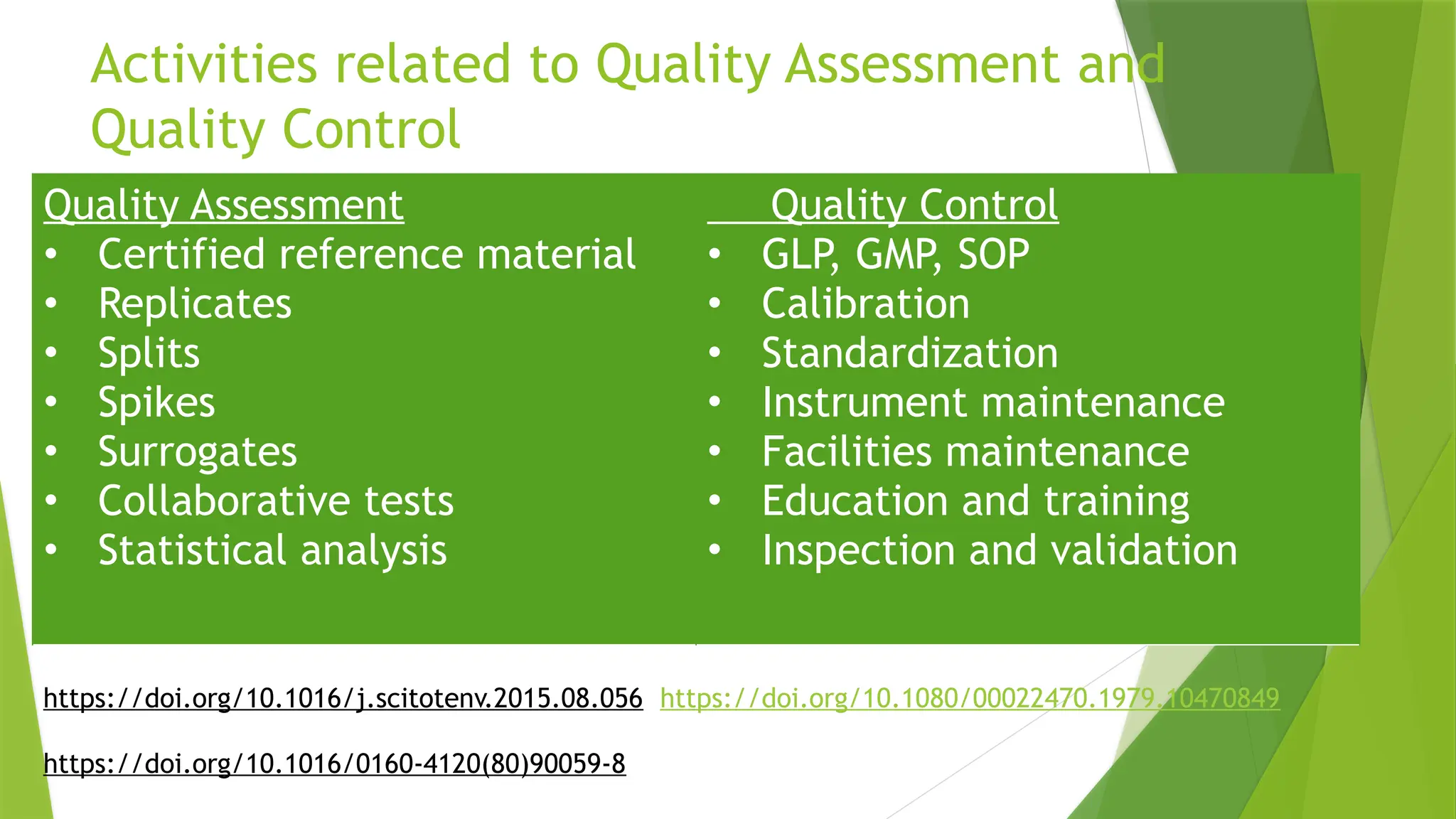
Activities related to Quality Assessment and
Quality Control
Quality Assessment
• Certified reference material
• Replicates
• Splits
• Spikes
• Surrogates
• Collaborative tests
• Statistical analysis
Quality Control
• GLP, GMP, SOP
• Calibration
• Standardization
• Instrument maintenance
• Facilities maintenance
• Education and training
• Inspection and validation
https://doi.org/10.1016/j.scitotenv.2015.08.056 https://doi.org/10.1080/00022470.1979.10470849
https://doi.org/10.1016/0160-4120(80)90059-8
Quality Control (QC)
 Quality control is a mechanism established to control errors.

 It is a set of measures within a sample analysis methodology
to assure that the process is in control.
 It helps to provide quality that is satisfactory, adequate,
dependable, and economical.
 It consists of the use of a series of procedures that must be
rigorously followed.
Quality Control (QC)
 Good quality control systems should include provisions for
inspection, both periodical and unannounced, to ascertain how well
the procedures are functioning.
 Large laboratories have a quality control officer or group,
independent of the laboratory management, that oversees the
operation of the system.
Quality Control (QC)
The elements of quality control are
 Competent personnel with adequate educational background with
specific training and experience.
 Suitable and properly maintained laboratory equipment and
facilities.
 Modern equipment increases the need for QA/QC.
 Properly selected methodology.
Quality Control (QC)
 Good laboratory practices (GLP).
 Good measurement practices (GMP).
 Standard operation procedures (SOP).
 Documentation.
 Inspection and validation.
Quality Control (QC)-Good laboratory practices (GLP)
 Is it dangerous to work in a laboratory
 No !
 If you follow Laboratory Commandments for Good
laboratory practice which are aimed at knowing the
potential dangers and taking the necessary precautions to
protect yourself and others
Quality Control (QC)-Good laboratory practices (GLP)
Laboratory safety
 Cleaning, housekeeping, temperature, humidity control,
glassware cleaning
 Storage, handling, labeling, shelf-life, and disposal of
chemicals
 Sample custody (documentation, routing, storage, preparation,
retention)
Quality Control (QC)-Good laborator
practices (GLP)
General laboratory operations
Use, maintenance, and calibration of equipment
Statistical procedures.
Data reporting, format, documentation.
Quality Control (QC)-Good laboratory practices (GLP)
 The aim of GLP is to “ Promote mutual acceptance of study
data and results across international boundaries”.
 Good Laboratory Practices:
 Ensure high quality of results
 Ensure comparability of results
 Limit the waste of resources
 Minimise risks and hazards
 Promote mutual recognition of results
Quality Control (QC)-Good laboratory practices (GLP)
 GLP aims to make the incidence of False Negatives more
obvious
E.g., Results demonstrate non-toxicity of a well known toxic
substance
 GLP aims to make the incidence of False Positives more
obvious
Results demonstrate toxicity of a well known non-toxic substance
Quality Control (QC)-Good laboratory practices (GLP)
 The main goal of GLP is to help laboratory personnel obtain data
which are:
 Repeatable
 Reliable ( quality and validity of test data)
 Auditable
 Recognized by scientists worldwide
 The purpose is not to assess the intrinsic scientific value of a study
 It is just a set of organisational requirements
Quality Assessment
 Quality assessment is the mechanism to verify that the system
is operating within acceptable limits.
 It is the overall system of activities whose purpose is to provide
assurance that the overall quality control job is being done
effectively.
 Quality assessment is a process to determine the quality of the
laboratory measurements through internal and external quality
control evaluations,
 includes performance evaluation samples, laboratory comparison
samples, and performance audits.
Quality Control checks
Equipment blanks
 Equipment blanks are used to detect any contamination from
sampling equipment.
 They are prepared in the field before sampling begins, by rinsing
the equipment with analyte-free water, filling the appropriate
sample bottle with analyte free water, and preserving with
appropriate preservative.
Quality Control checks
Field blanks
 Field blanks are collected at the end of the sampling event
by filling the appropriate sample bottle with analyte-free
water and preserving the same manner as the samples.
Quality Control checks
Trip blanks
 These are used to verify contaminations that may occur during
sample collection and transportation.
 are blanks of analyte-free water that are prepared by the
laboratory; the blank is transported to the field and remains
unopened during the sampling event and is transported back to
the laboratory with the samples.
Quality Control checks
Duplicate samples
 These samples are collected for checking the preciseness of the
sampling process.
 Duplicate samples are collected at the same time and from the same
source as the study samples.
Split samples
 These samples are taken to check analytical performance.
 The sample is taken in one container, mixed thoroughly, and split into
another container.
 Both halves are now samples that represent the same sampling point.
Chain of Custody
 Legal term for an unbroken sequence of possession
from sampling through analysis.
Sample custody
 Sample custody is the process of protecting the samples collected
and analyzed.
 If a sample decomposes or is contaminated prior to the actual
analysis, the results are unre­
liable.
 Proper sample handling is essential.
 All the paperwork involved in the sample custody process defends
and secures the quality of the reported data.
Sample custody
 It shows how samples are collected, preserved, stored,
transported to the laboratory, treated, numbered, and tracked
during the analytical process.
 All records have to be maintained so that they are easy to find
and ready at all times for immediate inspection.
 All documentation must be signed or initialed by the responsible
person and recorded with waterproof ink, without any erasures
or marking.
Documentation and Maintenance of Records
 Maintenance of all records provide documentation which may be
required in the event of legal challenges due to repercussions of
decisions based on the original analytical results.
 General guidelines followed in regulated laboratories is to maintain
records for at least five years.
 Length of time over which laboratory records should be maintained
will vary with the situation.
Sample custody
 All corrections must be made with one line marked through the
error, accompanied with a signature or initial, date, and the
corrected form.
 An important rule to remember is that “it did not happen if it is
not documented.”
 Since a large number of the work done in today's laboratories
potentially could go to litigation, all aspects of the sample
must be documented.
Sample custody
 This starts with the purchase of the bottles used to
collect the samples and ends in the laboratory with
the record of the individual who mailed the data
package.
Sample custody – Documentation must
be related to:
 Sample collection, field activities
 Sample receipt, sample distribution, and holding time
 Sample preparation prior analysis
 Analytical methods
 Reagents and standards preparation
Sample custody – Documentation must
be related to:
 Calibration procedures and frequency
 Analytical data and calculations
 Detection limits
 Quality control requirements and quality control routine
checks related to the analysis
 Data validation and reduction
 Data reporting
Reliability of data sets
 Incomplete or inaccurate data sheets are useless!
All environmental data should be scientifically reliable.
 Scientific reliability means that proper procedures for
sampling and analysis are followed so that the results
accurately reflect the content of the sample.
Causes of Scientifically Unreliable Data
 An incorrect sampling protocol (bad sampler)
 An incorrect analytical protocol (bad analyst)
 The falsification of test results.
 There are lots of “False Eurekas” in the world – some from well-
respected scientists!
 Examples of falsification:
 “Trimming”: altering one’s data
 “Cooking”: selective reporting of one’s data
“Forging”: making up the data Source: Charles Babbage (1830)
 The lack of a good laboratory practice (GLP)
The South African National Accreditation System
 In Southern Africa, South African National Accreditation System (SANAS)
certificates and their accompanying schedules are a formal recognition that an
organisation is competent to perform specific tasks.
 SANAS is responsible for the accreditation of:
 Medical Laboratories to ISO 15189:2007,
 Certification bodies to ISO/IEC 17021:2006, ISO/IEC 17024:2003 and 65:1996, and
 laboratories (testing and calibration) to ISO/IEC 17025:2005.
 Inspection Bodies are accredited to ISO/IEC 17020:1998 standards.
 Under SANAS principles, GLP facilities are inspected for compliance to OECD GLP
principles.
 But now there is also Southern African Development Community Accreditation
Services (SADCAS) based in Botswana which is responsible for accreditation.
 By definition: GLP embodies a set of principles that provides a
framework within which laboratory studies are planned performed,
monitored, reported and archived.
 GLP is an FDA/SANAS/ SADCAS regulation.
 GLP is sometimes confused with the standards of laboratory safety
like wearing safety goggles.
 The overall aim is to protect the integrity and quality of laboratory
data used.
HISTORY
 GLP is a formal regulation that was created by the FDA (United
states food and drug administration) in 1978.
 Although GLP originated in the United States , it had a world wide
impact.
 Non-US companies that wanted to do business with the United states or
register their pharmacies in the United States had to comply with the
United States GLP regulations.
They eventually started making GLP regulations in their home countries.
 In 1981 an organization named OECD (organization for economic co-
operation and development) produced GLP principles that are an
international standard.
WHY WAS GLP CREATED?
 In the early 70’s FDA became aware of cases of poor laboratory
practice all over the United States.
 FDA decided to do an in-depth investigation on 40 toxicology
labs.
 They discovered a lot fraudulent activities and a lot of poor
lab practices.
 Examples of some of these poor lab practices found were
1. Equipment not been calibrated to standard form , therefore giving
wrong measurements.
2. inaccurate accounts of the actual lab study
3. Inadequate test systems
FAMOUS EXAMPLE
 One of the labs that went under such investigation made
headline news.
 The name of the Lab was Industrial Bio Test.
 This was a big lab that ran tests for big companies
such as Procter and Gamble.
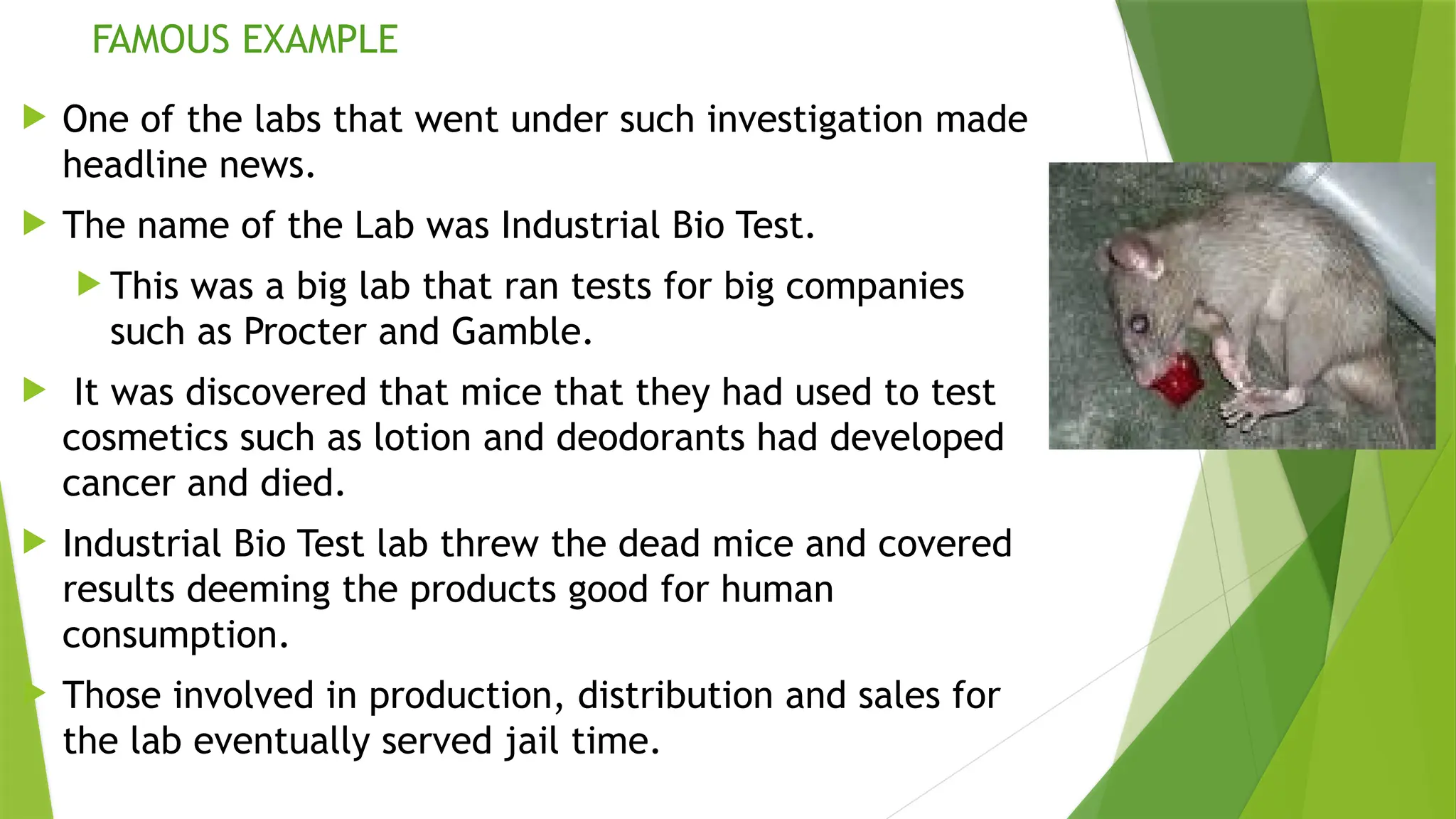
 It was discovered that mice that they had used to test
cosmetics such as lotion and deodorants had developed
cancer and died.
 Industrial Bio Test lab threw the dead mice and covered
results deeming the products good for human
consumption.
 Those involved in production, distribution and sales for
the lab eventually served jail time.
FDA investigation findings
 Poorly trained laboratory personnel
 Poorly designed protocols
 Procedures not conducted as prescribed
 Raw data badly collected – not correctly identified – without
traceability – not verified or approved by responsible persons
 Lack of standardized procedures
 Inadequate resources
 Equipment not properly calibrated
 Archives inadequate
Quality Control (QC)- Good measurement practices (GMP)
 Guidelines should be written for each measurement
technique, addressing subjects such as maintenance and
records for equipment, and specified calibration procedures.
 General instruction manuals should be available with the
requirements and precautions for each technique.
Quality Control (QC)- Standard operation
procedures (SOP)
 SOPs are written for basic operations to be done in the laboratory.
 Written procedures for a laboratories program.
 They define how to carry out protocol-specified activities.
 Most often written in a chronological listing of action
steps.
 They are written to explain how the procedures are supposed to
work.
 SOPs should include sampling, measurement, calibration, and data
processing in a standard format.
Quality Control (QC)- Standard operation procedures
(SOP)
 Routine inspection, cleaning, maintenance, testing and
calibration.
 Actions to be taken in response to equipment failure.
 Analytical methods
 Definition of raw data
 Keeping records, reporting, storage, mixing, and retrieval of data
Statistical Procedures for Data Evaluation
 Statistical procedures are not simply chosen from a text
book.
 Practitioners in a particular field may adopt certain
standards which are deemed acceptable within that field.
 Regulatory agencies often describe acceptable statistical
procedures.
Instrumentation Validation
 This is a process necessary for any analytical laboratory.
 Data produced by “faulty” instruments may give the appearance
of valid data.
 The frequency for calibration, re-validation and testing depends
on the instrument and extent of its use in the laboratory.
 Whenever an instrument’s performance is outside the “control
limits” reports must be discontinued
Instrument Validation (cont)
Equipment records should include:
 Name of the equipment and manufacturer
 Model or type for identification
 Serial number
 Date equipment was received in the laboratory
 Copy of manufacturers operating instruction (s)
Reagent/Materials Certification
 This policy is to assure that reagents used are
specified in the standard operating procedure.
 Purchasing and testing should be handled by a
quality assurance program.
Reagents and Solutions continued
Requirements:
 Reagents and solutions shall be labeled
 Deteriorated or outdated reagents and solutions
shall not be used
 Include the date when opened
 Stored under ambient temperature
 Expiration date
Analyst Certification
 Some acceptable proof of satisfactory training
and/or competence with specific laboratory
procedures must be established for each analyst.
 Qualification can come from education,
experience or additional trainings, but it should
be documented
 Sufficient people
 Requirements of certification vary
Laboratory Certification
 Normally done by an external agency
 Evaluation is concerned with issues such as
 Adequate space
 Ventilation
 Storage
 Hygiene
Specimen/Sample Tracking
 Vary among laboratories
 Must maintain the unmistakable connection
between a set of analytical data and the
specimen and/or samples from which they were
obtained.
 Original source of specimen/sample(s) must be
recorded and unmistakably connected with the
set of analytical data.
Important questions to be answered
for any analytical instrument
 What is the equipment being used for?
 Is the instrument within specification and is the
documentation to prove this available?
 If the instrument is not within specifications, how
much does it deviate by?
 If the instrument is not within specifications what
action has been taken to overcome the defect?
 Can the standards used to test and calibrate the
instrument be traced back to national standards?
 What happens if a workplace does not
comply with Good Laboratory Practice
standards?
Disqualification of a Facility
 Before a workplace can experience the
consequences of noncompliance, an explanation of
disqualification is needed
 The SANAS/SADCAS states the purpose of
disqualification as the exclusion of a testing facility
from completing laboratory studies or starting any
new studies due to not following the standards of
compliance set by principles of Good Laboratory
Practice
Possible Violations
 Falsifying information for permit, registration or
any required records.
 Falsifying information related to testing protocols,
ingredients, observations, data equipment, etc.
 Failure to prepare, retain, or submit written
records required by law.
Grounds for Disqualification
 The testing facility failed to comply with one or more
regulations implemented by the GLP manual
 The failure to comply led to adverse outcomes in the
data; in other words, it affected the validity of the study
 Warnings or rejection of previous studies have not been
adequate to improve the facility’s compliance

Environmental monitoring data management systems.pptx

  • 1.
  • 2.
    Records of monitoringshall include  Date and time of sampling  Sampling location  Site description  Sample type  Sampler(s) name  Required analysis  date(s) analyses were performed  Analyst’s name  Analytical techniques or methods used  Analytical results
  • 3.
    Data Management  Dataare like letters of the alphabet:  taken individually, they reveal very little.  Put together with a little thought and organization, however, those same letters can tell a complete story.  Organised data should tell a story!  Statistics and graphics can be tremendously helpful in perceiving relationships among different variables contained in the data.
  • 4.
    Data Management Detailed planfor collection, recording, and maintenance of data.  Specifies what data will be collected with observations  Specifies what the data will be used for (WHY data?)  Specifies how the data will be processed  Specifies when it will be processed and reported,  and who will be responsible for each task.  Specifies how and where data will be kept  Laboratory notebooks  Equipment/procedure logs  Laboratory Information Management systems (LIMS)  Specifies Data Retention and Storage  Frequently 3-5 years on-site; up to 10 in off-site or archived storage
  • 5.
    Keeping a GoodLab Notebook  Generally: Be organized Date (and sign) each new entry Write everything down, no matter how trivial it may seem. Do not erase; rather strike through and initial corrections. Permanently affix additions to lab notebook Have supervisor review and sign-off on data at least weekly.  When in Doubt write it out.
  • 6.
    Transferring Data fromLab Notebook to Electronic Database  Best to use LIMS with date stamping.  Location of original data should be recorded.  Once input, data entry should be validated (ideally by another person; unrealistic)  Data analysis procedures should be annotated where possible
  • 7.
    Data Management  Nowadays,computerized data management systems provides a great deal of advantages, especially if the data collection effort is conducted at many sites and/or over a long time period  Computer software includes a variety of spreadsheet and database packages that allow you to organize the data and perform statistical analyses.  Examples of common spreadsheet software packages?  Examples of common database software packages include dBase, Access, SMIS at MUBAS, etc.
  • 8.
    Choosing spreadsheet softwarepackages Almost every option you’ll encounter should have the same basic functionalities, which include:  Data input (entering data into cells)  Cell formatting (adjusting font, color, size, and other features of individual cells or cell groupings)  Basic formulas (addition, subtraction, multiplication, and division)  Sorting (in ascending or descending order)  Filtering (narrowing down data based on specified criteria)
  • 9.
    Choosing spreadsheet softwarepackages At a minimum, look for the following advanced features that make it easier to sort, parse, and understand datasets:  Pivot tables (summarizing, analyzing, and presenting data interactively)  Advanced formulas and functions (performing complex calculations)  Data visualization (converting data into charts, graphs, and other infographics)  Collaboration tools (real-time collaborative editing, comments, and shared access)
  • 10.
    Designing a DataManagement System  Many people are capable of writing their own programmes to manipulate and display data.  Greater efforts are being made to develop data storage systems that facilitate data exchange among different users.
  • 11.
    Designing a DataManagement System  Design the database or spreadsheet before you start collecting the data.  The design should be in such a way that it is readily apparent where data should be entered. E.g., highlighting data cells with a special color.  It is always a good idea to make backups of any electronic database or spreadsheet.  Graphics (graphs, maps, photos) are nice but should not distort the meaning of the data and should not be presented as a duplicate to the data.
  • 12.
    Benefits of environmentalmonitoring data management systems The benefit can best be seen from analyzing the impact of the data management system on the whole site investigation and remediation process. 1. During remediation you might be able, by more careful tracking and modeling of the contamination, to decrease the amount of waste to be removed or water to be processed. 2. You may also be able to decrease the time required to complete the project and save many person-years of cost by making quality data available in a standardized format and in a timely fashion.
  • 13.
    Benefits of environmentalmonitoring data management systems  For smaller sites, automating the data management process can provide savings by repetition. Once the system has been set up for one site and people trained to use it, that effort can be re-used on the next site.  A higher quality work product, and better decision making.
  • 14.
    EMS Vs. EMISVs. EDMS  An EMS is a set of policies and procedures for managing environmental issues for an organization or a facility.  An EMIS is a software system implemented to support the administration of the EMS.  EMIS usually has a focus on record keeping and reporting, and is implemented with the hope of improving business processes and practices.
  • 15.
    EMS Vs. EMISVs. EDMS  A site EDMS is a software system for managing data regarding the environmental impact of current or former operations.  EDMS overlaps partially with EMIS systems.  For an operating facility, the EDMS is a part of the EMIS.  For a facility no longer in operation, there may be no formal EMS or EMIS, but the EDMS is necessary to facilitate monitoring and cleanup.
  • 16.
    PURPOSE OF DATAMANAGEMENT The purpose of data management is to support the goals of the organization which are:  Improve efficiency – Environmental site investigation and remediation projects can involve an enormous amount of data.  Well designed and implemented computerized methods can be a great help in improving the flow of data throughout the project.   Poorly managed methods can be a great sink of time and effort.
  • 17.
    PURPOSE OF DATAMANAGEMENT  Maximize quality  Careful data storage, and annotation of data with quality information, can be a great help in achieving data quality objectives.  Minimize cost  Electronic data management can help contain costs by saving time and minimizing loss of data.
  • 18.
    Errors in EnvironmentalData  Error is the exact result of the difference between the true/accepted value of the measure and the measured value.  shows how accurate the measurement result is by showing the actual distance to the true value.  Errors of environmental data can be approximately divided into sampling error and analytical error.
  • 19.
    Errors in EnvironmentalData In general, these errors are of two types:  Determinate errors (systematic errors)  can be traced to their sources, such as improper sampling and analytical protocols, faulty instrumentation, or mistakes by operators.  Indeterminate errors (random errors)  random fluctuations and cannot be identified or corrected for.  Random errors are dealt with by applying statistics to the data.
  • 20.
    Minimisation of errorsthrough DQP  Two main parts of a data quality programme (DQP) are quality control (QC) and quality assurance (QA).  QC is generally a system of technical activities aimed at controlling the quality of data so that it meets the need of data users.  QC procedures should be specified to measure the precisions and bias of the data.
  • 21.
    Minimisation of errorsthrough DQP  A QA programme is a management system that ensures the QC is working as intended.  QA/QC programmes are implemented not only to minimize errors from both sampling and analysis, but many are designed to quantify the errors in the measurement.
  • 22.
    Quality Assurance (QA)of chemical measurements
  • 23.
    Quality Assurance (QA) Quality assurance is a definite plan for laboratory operation that specifies standard procedures that help to produce data with defensible quality and reported results with a high level of confidence.  It is a necessary part of data production, and it serves as a guide for the operation of the laboratory for production data quality.
  • 24.
    Quality Assurance (QA) Basic requirements of a quality assurance programme  recognize possible errors,  understand the measurement system used, and  develop techniques and plans to minimize errors.  It also includes evaluating what was done, and reporting evaluated data which are technically sound and legally defensible.  Quality control in data processing, including expression of the analytical results, rounding, normalization and interpretation.  Quality assurance is the statistical control of quality.  The elements of the quality assurance are quality control and quality assessment.
  • 25.
    Activities related toQuality Assessment and Quality Control Quality Assessment • Certified reference material • Replicates • Splits • Spikes • Surrogates • Collaborative tests • Statistical analysis Quality Control • GLP, GMP, SOP • Calibration • Standardization • Instrument maintenance • Facilities maintenance • Education and training • Inspection and validation https://doi.org/10.1016/j.scitotenv.2015.08.056 https://doi.org/10.1080/00022470.1979.10470849 https://doi.org/10.1016/0160-4120(80)90059-8
  • 26.
    Quality Control (QC) Quality control is a mechanism established to control errors.   It is a set of measures within a sample analysis methodology to assure that the process is in control.  It helps to provide quality that is satisfactory, adequate, dependable, and economical.  It consists of the use of a series of procedures that must be rigorously followed.
  • 27.
    Quality Control (QC) Good quality control systems should include provisions for inspection, both periodical and unannounced, to ascertain how well the procedures are functioning.  Large laboratories have a quality control officer or group, independent of the laboratory management, that oversees the operation of the system.
  • 28.
    Quality Control (QC) Theelements of quality control are  Competent personnel with adequate educational background with specific training and experience.  Suitable and properly maintained laboratory equipment and facilities.  Modern equipment increases the need for QA/QC.  Properly selected methodology.
  • 29.
    Quality Control (QC) Good laboratory practices (GLP).  Good measurement practices (GMP).  Standard operation procedures (SOP).  Documentation.  Inspection and validation.
  • 30.
    Quality Control (QC)-Goodlaboratory practices (GLP)  Is it dangerous to work in a laboratory  No !  If you follow Laboratory Commandments for Good laboratory practice which are aimed at knowing the potential dangers and taking the necessary precautions to protect yourself and others
  • 31.
    Quality Control (QC)-Goodlaboratory practices (GLP) Laboratory safety  Cleaning, housekeeping, temperature, humidity control, glassware cleaning  Storage, handling, labeling, shelf-life, and disposal of chemicals  Sample custody (documentation, routing, storage, preparation, retention)
  • 32.
    Quality Control (QC)-Goodlaborator practices (GLP) General laboratory operations Use, maintenance, and calibration of equipment Statistical procedures. Data reporting, format, documentation.
  • 33.
    Quality Control (QC)-Goodlaboratory practices (GLP)  The aim of GLP is to “ Promote mutual acceptance of study data and results across international boundaries”.  Good Laboratory Practices:  Ensure high quality of results  Ensure comparability of results  Limit the waste of resources  Minimise risks and hazards  Promote mutual recognition of results
  • 34.
    Quality Control (QC)-Goodlaboratory practices (GLP)  GLP aims to make the incidence of False Negatives more obvious E.g., Results demonstrate non-toxicity of a well known toxic substance  GLP aims to make the incidence of False Positives more obvious Results demonstrate toxicity of a well known non-toxic substance
  • 35.
    Quality Control (QC)-Goodlaboratory practices (GLP)  The main goal of GLP is to help laboratory personnel obtain data which are:  Repeatable  Reliable ( quality and validity of test data)  Auditable  Recognized by scientists worldwide  The purpose is not to assess the intrinsic scientific value of a study  It is just a set of organisational requirements
  • 36.
    Quality Assessment  Qualityassessment is the mechanism to verify that the system is operating within acceptable limits.  It is the overall system of activities whose purpose is to provide assurance that the overall quality control job is being done effectively.  Quality assessment is a process to determine the quality of the laboratory measurements through internal and external quality control evaluations,  includes performance evaluation samples, laboratory comparison samples, and performance audits.
  • 37.
    Quality Control checks Equipmentblanks  Equipment blanks are used to detect any contamination from sampling equipment.  They are prepared in the field before sampling begins, by rinsing the equipment with analyte-free water, filling the appropriate sample bottle with analyte free water, and preserving with appropriate preservative.
  • 38.
    Quality Control checks Fieldblanks  Field blanks are collected at the end of the sampling event by filling the appropriate sample bottle with analyte-free water and preserving the same manner as the samples.
  • 39.
    Quality Control checks Tripblanks  These are used to verify contaminations that may occur during sample collection and transportation.  are blanks of analyte-free water that are prepared by the laboratory; the blank is transported to the field and remains unopened during the sampling event and is transported back to the laboratory with the samples.
  • 40.
    Quality Control checks Duplicatesamples  These samples are collected for checking the preciseness of the sampling process.  Duplicate samples are collected at the same time and from the same source as the study samples. Split samples  These samples are taken to check analytical performance.  The sample is taken in one container, mixed thoroughly, and split into another container.  Both halves are now samples that represent the same sampling point.
  • 41.
    Chain of Custody Legal term for an unbroken sequence of possession from sampling through analysis.
  • 42.
    Sample custody  Samplecustody is the process of protecting the samples collected and analyzed.  If a sample decomposes or is contaminated prior to the actual analysis, the results are unre­ liable.  Proper sample handling is essential.  All the paperwork involved in the sample custody process defends and secures the quality of the reported data.
  • 43.
    Sample custody  Itshows how samples are collected, preserved, stored, transported to the laboratory, treated, numbered, and tracked during the analytical process.  All records have to be maintained so that they are easy to find and ready at all times for immediate inspection.  All documentation must be signed or initialed by the responsible person and recorded with waterproof ink, without any erasures or marking.
  • 44.
    Documentation and Maintenanceof Records  Maintenance of all records provide documentation which may be required in the event of legal challenges due to repercussions of decisions based on the original analytical results.  General guidelines followed in regulated laboratories is to maintain records for at least five years.  Length of time over which laboratory records should be maintained will vary with the situation.
  • 45.
    Sample custody  Allcorrections must be made with one line marked through the error, accompanied with a signature or initial, date, and the corrected form.  An important rule to remember is that “it did not happen if it is not documented.”  Since a large number of the work done in today's laboratories potentially could go to litigation, all aspects of the sample must be documented.
  • 46.
    Sample custody  Thisstarts with the purchase of the bottles used to collect the samples and ends in the laboratory with the record of the individual who mailed the data package.
  • 47.
    Sample custody –Documentation must be related to:  Sample collection, field activities  Sample receipt, sample distribution, and holding time  Sample preparation prior analysis  Analytical methods  Reagents and standards preparation
  • 48.
    Sample custody –Documentation must be related to:  Calibration procedures and frequency  Analytical data and calculations  Detection limits  Quality control requirements and quality control routine checks related to the analysis  Data validation and reduction  Data reporting
  • 49.
    Reliability of datasets  Incomplete or inaccurate data sheets are useless! All environmental data should be scientifically reliable.  Scientific reliability means that proper procedures for sampling and analysis are followed so that the results accurately reflect the content of the sample.
  • 50.
    Causes of ScientificallyUnreliable Data  An incorrect sampling protocol (bad sampler)  An incorrect analytical protocol (bad analyst)  The falsification of test results.  There are lots of “False Eurekas” in the world – some from well- respected scientists!  Examples of falsification:  “Trimming”: altering one’s data  “Cooking”: selective reporting of one’s data “Forging”: making up the data Source: Charles Babbage (1830)  The lack of a good laboratory practice (GLP)
  • 51.
    The South AfricanNational Accreditation System  In Southern Africa, South African National Accreditation System (SANAS) certificates and their accompanying schedules are a formal recognition that an organisation is competent to perform specific tasks.  SANAS is responsible for the accreditation of:  Medical Laboratories to ISO 15189:2007,  Certification bodies to ISO/IEC 17021:2006, ISO/IEC 17024:2003 and 65:1996, and  laboratories (testing and calibration) to ISO/IEC 17025:2005.  Inspection Bodies are accredited to ISO/IEC 17020:1998 standards.  Under SANAS principles, GLP facilities are inspected for compliance to OECD GLP principles.  But now there is also Southern African Development Community Accreditation Services (SADCAS) based in Botswana which is responsible for accreditation.
  • 52.
     By definition:GLP embodies a set of principles that provides a framework within which laboratory studies are planned performed, monitored, reported and archived.  GLP is an FDA/SANAS/ SADCAS regulation.  GLP is sometimes confused with the standards of laboratory safety like wearing safety goggles.  The overall aim is to protect the integrity and quality of laboratory data used.
  • 53.
    HISTORY  GLP isa formal regulation that was created by the FDA (United states food and drug administration) in 1978.  Although GLP originated in the United States , it had a world wide impact.  Non-US companies that wanted to do business with the United states or register their pharmacies in the United States had to comply with the United States GLP regulations. They eventually started making GLP regulations in their home countries.  In 1981 an organization named OECD (organization for economic co- operation and development) produced GLP principles that are an international standard.
  • 54.
    WHY WAS GLPCREATED?  In the early 70’s FDA became aware of cases of poor laboratory practice all over the United States.  FDA decided to do an in-depth investigation on 40 toxicology labs.  They discovered a lot fraudulent activities and a lot of poor lab practices.  Examples of some of these poor lab practices found were 1. Equipment not been calibrated to standard form , therefore giving wrong measurements. 2. inaccurate accounts of the actual lab study 3. Inadequate test systems
  • 55.
    FAMOUS EXAMPLE  Oneof the labs that went under such investigation made headline news.  The name of the Lab was Industrial Bio Test.  This was a big lab that ran tests for big companies such as Procter and Gamble.  It was discovered that mice that they had used to test cosmetics such as lotion and deodorants had developed cancer and died.  Industrial Bio Test lab threw the dead mice and covered results deeming the products good for human consumption.  Those involved in production, distribution and sales for the lab eventually served jail time.
  • 56.
    FDA investigation findings Poorly trained laboratory personnel  Poorly designed protocols  Procedures not conducted as prescribed  Raw data badly collected – not correctly identified – without traceability – not verified or approved by responsible persons  Lack of standardized procedures  Inadequate resources  Equipment not properly calibrated  Archives inadequate
  • 57.
    Quality Control (QC)-Good measurement practices (GMP)  Guidelines should be written for each measurement technique, addressing subjects such as maintenance and records for equipment, and specified calibration procedures.  General instruction manuals should be available with the requirements and precautions for each technique.
  • 58.
    Quality Control (QC)-Standard operation procedures (SOP)  SOPs are written for basic operations to be done in the laboratory.  Written procedures for a laboratories program.  They define how to carry out protocol-specified activities.  Most often written in a chronological listing of action steps.  They are written to explain how the procedures are supposed to work.  SOPs should include sampling, measurement, calibration, and data processing in a standard format.
  • 59.
    Quality Control (QC)-Standard operation procedures (SOP)  Routine inspection, cleaning, maintenance, testing and calibration.  Actions to be taken in response to equipment failure.  Analytical methods  Definition of raw data  Keeping records, reporting, storage, mixing, and retrieval of data
  • 60.
    Statistical Procedures forData Evaluation  Statistical procedures are not simply chosen from a text book.  Practitioners in a particular field may adopt certain standards which are deemed acceptable within that field.  Regulatory agencies often describe acceptable statistical procedures.
  • 61.
    Instrumentation Validation  Thisis a process necessary for any analytical laboratory.  Data produced by “faulty” instruments may give the appearance of valid data.  The frequency for calibration, re-validation and testing depends on the instrument and extent of its use in the laboratory.  Whenever an instrument’s performance is outside the “control limits” reports must be discontinued
  • 62.
    Instrument Validation (cont) Equipmentrecords should include:  Name of the equipment and manufacturer  Model or type for identification  Serial number  Date equipment was received in the laboratory  Copy of manufacturers operating instruction (s)
  • 63.
    Reagent/Materials Certification  Thispolicy is to assure that reagents used are specified in the standard operating procedure.  Purchasing and testing should be handled by a quality assurance program.
  • 64.
    Reagents and Solutionscontinued Requirements:  Reagents and solutions shall be labeled  Deteriorated or outdated reagents and solutions shall not be used  Include the date when opened  Stored under ambient temperature  Expiration date
  • 65.
    Analyst Certification  Someacceptable proof of satisfactory training and/or competence with specific laboratory procedures must be established for each analyst.  Qualification can come from education, experience or additional trainings, but it should be documented  Sufficient people  Requirements of certification vary
  • 66.
    Laboratory Certification  Normallydone by an external agency  Evaluation is concerned with issues such as  Adequate space  Ventilation  Storage  Hygiene
  • 67.
    Specimen/Sample Tracking  Varyamong laboratories  Must maintain the unmistakable connection between a set of analytical data and the specimen and/or samples from which they were obtained.  Original source of specimen/sample(s) must be recorded and unmistakably connected with the set of analytical data.
  • 68.
    Important questions tobe answered for any analytical instrument  What is the equipment being used for?  Is the instrument within specification and is the documentation to prove this available?  If the instrument is not within specifications, how much does it deviate by?  If the instrument is not within specifications what action has been taken to overcome the defect?  Can the standards used to test and calibrate the instrument be traced back to national standards?
  • 69.
     What happensif a workplace does not comply with Good Laboratory Practice standards?
  • 70.
    Disqualification of aFacility  Before a workplace can experience the consequences of noncompliance, an explanation of disqualification is needed  The SANAS/SADCAS states the purpose of disqualification as the exclusion of a testing facility from completing laboratory studies or starting any new studies due to not following the standards of compliance set by principles of Good Laboratory Practice
  • 71.
    Possible Violations  Falsifyinginformation for permit, registration or any required records.  Falsifying information related to testing protocols, ingredients, observations, data equipment, etc.  Failure to prepare, retain, or submit written records required by law.
  • 72.
    Grounds for Disqualification The testing facility failed to comply with one or more regulations implemented by the GLP manual  The failure to comply led to adverse outcomes in the data; in other words, it affected the validity of the study  Warnings or rejection of previous studies have not been adequate to improve the facility’s compliance

Editor's Notes

  • #4 Laboratory Information Management systems (LIMS)- type of software designed to improve lab productivity and efficiency
  • #5 Affix: Attach
  • #6 LIMS- Laboratory Information Management systems -type of software designed to improve lab productivity and efficiency annotate, a verb that means to add a short explanation or opinion to a text or image
  • #7 Spreadsheet software is any digital tool that lets you make, edit, analyze, and share spreadsheets. All spreadsheet software applications revolve around the core concept of organizing, analyzing, and manipulating data. But each comes with its own suite of features and formulas designed to make it easier to parse the data you input. Examples of common spreadsheet software packages? Google Sheets – (online and free). Microsoft excel
  • #8 The 10 Best Spreadsheet Software of 2024 (semrush.com)
  • #9 But the best spreadsheet software should go beyond those basic functionalities. At a minimum, look for the following advanced features that make it easier to sort, parse, and understand datasets: Parse: analyse
  • #10 The disadvantage of using a “homegrown” software programmes, however, is that if its author leaves the monitoring programme, so too does all knowledge about how the programme works.
  • #12 Person years or person months are types of measurement that take into account both the number of people in the study and the amount of time each person spends in the study.
  • #14 EMS (environmental management system) (environmental management information systems) EDMS (environmental data management systems)
  • #15 EDMS (environmental data management system)
  • #24 The major elements of the quality assurance programme should include: - sampling and analytical protocols; - uniform or equivalent instrumentation; skilled personnel (training), intralaboratory quality control including regular analysis of: a) calibration standards, b) certified reference materials, c) reference samples, and d) spiked samples; - interlaboratory quality control and performance testing with the analysis of check-samples in intercalibration exercises, - quality control in data processing, including expression of the analytical results, rounding, normalization and interpretation.
  • #25 In an environmental context, a ‘surrogate’ is a component of the system of concern that one can more easily measure or manage than others, and that is used as an indicator of the attribute/trait/characteristic/quality of that system Collaborative testing-is used to establish the within-laboratory and between-laboratory precision of test methods. For these precision estimates to be valid, the collaborative test design must ensure that all participants independently make the required number of measurements on identical samples using the same test method.
  • #31 In a laboratory, housekeeping refers to the general condition and appearance of the lab Good housekeeping is an indicator of how safely a lab functions
  • #45 Litigation: lawsuit, trial, hearing.
  • #50 An interjection/exclamation used to show that you have been successful in something you were trying to do.
  • #51 ISO/IEC: International Organization for Standardization and the International Electrotechnical Commission OECD: Organisation for Economic Co-operation and Development
  • #52 FDA: Food and Drug Administration