CHEMICAL KINETICS
The study of reaction rates and their mechanisms is called chemical
kinetics. The word kinetics means movement.Thermodynamics tell
about the feasibility of a reaction(∆G = −ve).Which product is stable(at
equilibrium)? Where as Kinetics tell about the (rate) of a chemical
process and mechanism of a reaction(any intermediate).
Thermodynamics favors the process (∆G: -ve ) .Kinetics makes this
reaction nearly impossible (Requires a very high pressure and
temperature over long time. Chemical kinetics also known as Reaction
kinetics is the study of rate of chemical processes.
Rate of a Chemical Reaction: The speed of a reaction or the rate of a reaction
can be defined as the change in concentration of a reactant or product in unit
time. Consider a reaction ,R P,If [R]1 and [p]1 are the concentration of
reactant and product at time T1 and [R]2 and [p]2 are the concentration of reactant
and product at time T2 , ∆t= T2 -T1 and Δ [R] = [R]2 - [R]1 and Δ [p] = [p]2 - [p]1
Rate of disappearance R = -Change in concentration(∆R)= +Change in
concentration(∆P)
time (∆t) time (∆t)
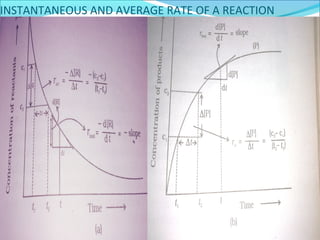
INSTANTANEOUS AND AVERAGE RATE OF A REACTION
Unit of rate of a reaction :-
unit of rate of a reaction are concentration time-1
.If concentration is
in mol L-1
S-1
. In gases reactions the unit of a rate equation will be
atm S-1
.
Rate can be expressed in three different ways;
(i) Initial rate: rate of reaction in the starting time is initial rate.
(ii) Average rate:- Average rate is the rate of a reaction which
measure at a particualr period of time interval. Average rate cannot
be used to predict the rate of a reaction at a particular instant as it
would be constant for the time interval for which it is calculated. So
to express the rate at a particular moment of time we used
instantaneous rate.
rav= -Δ[R] = Δ[P]
Δt Δt
(iii)Instantaneous rate: The rate at a particular moment of time is
instantaneous rate. As Δt →0 or rinst= -d[R] = d[P]
dt dt
Rate changes with time hence expressing the rate as an instantaneous
rate is preferable.
Instantaneous rate means rate at a particular instant (infinitesimal change
in time) i.e. Rate = ± d[concentration]
dt
For the reaction,
5Br-
(aq) +BrO3
-
(aq) +6H+
(aq) 3Br→ 2(aq) +3H2O
Rate= -1Δ[Br-
] = -1 Δ[Br O3
-
] = -1 Δ[H+
] = 1 Δ[Br2]= 1 Δ [H2O]
5 Δt Δt 6 Δt 3 Δt 3 Δt
Concentration
Time
Rate Law Expression and rate constant:
The rate of a chemical reaction at a given temperature depends on
concentration,(pressure in gases), temperature , catalyst. The representation of
rate in terms of concentration of reactants is called as rate law.
The rate of a homogeneous reaction is proportional to the
product of the concentrations of the reactants raised to some
power.
Thus for a general reaction
or -d[R] =k[A]x
[B]Y
dt
This equation is known as differential equation and k is called
rate constant or specific rate or velocity constant. It is
independent of concentrations and time.Has a specific value at
a given temperature .
or
The rate law is the expression in which reaction rate is given
in terms of molar concentration of reactants with each term
raised to some power, which may or may not be same as the
Stoichimetric coefficent of reacting species in a balance
chemical equation.
Rate law for any reaction cannot be predicted by merely
looking at the balance chemical equation.i,e,, theoretically
but must be determined experimentally.
The sum of powers of concentration of the reactants in the
rate law expression is called the order of that chemical
reaction. Order may be 0.1.2.3 and even fraction.
O order means independent of concentration of reactants.
1st
Order means rate depends on only 1 reactants.
2nd
Order means rate depends on 2 reactants.
If any reaction which take place in 1 steps are elementary
reaction while it required various steps are complex
reactions
 The sum of the powers of the concentration terms (α + β)
in the rate equation is known as the overall order of the
reaction.
 α, β are called the partial orders w. r. t the reactants A
and B respectively.
 The order of a reaction generally has a value 0 to 3
 Order can also have fractional value e.g. decomposition
of acetaldehyde: CH3CHO → CH4 + CO, rate = k
[CH3CHO]3/2
order = 3/2 or 1.5
Order is different from the stoichiometric coefficient and
needs to be determined experimentally.
Order of a Reaction
Reaction Orders and Rate
The reaction order, n, determines how the rate depends on
the concentration of the reactant.
The rate law for the
reaction can be written:
 Rate = k[A]0
= k
 Rate = k[A]1
 Rate = k[A]2
Unit of Rate of Reaction
Concentration time−1
e.g. mol L−1
sec−1
or mol dm−3
sec−1
Gaseous reactions: Pressure time−1
e.g. torr sec−1
(1)For a 0th
order reaction: Rate = k
k = rate = [conc.] time−1
= mol L−1
sec−1
(2)For a 1st
order reaction: Rate = k [conc.]
k = rate/[conc.] = [conc.] time−1
/[conc.] = time−1
= sec−1
(3)For a 2nd
order reaction: Rate = k [conc.]2
k = rate/[conc.]2
= [conc.] time−1
/[conc.]2
= [conc.]−1
time−1
= mol −1
L
sec−1
(4)For a nth
order reaction: Rate = k [conc.]n
k = rate/[conc.]n
= [conc.] time−1
/[conc.]n
= [conc.]1−n
time−1
since ,thus K=rate/[A]x
[B]y
=concentration x 1
time ( concentration )n
Molecularity of a reaction:
The number of reacting species taking part in an elementary
reaction, which must collide simultaneously in order to
bring about a chemical reaction is called molecularity of a
reaction.
Unimolecular:-only 1 reacting species.
Bimolecular: 2 reacting species which are simultaneously
collide.
Trimolecular: 3 reacting species which are simultaneously collide is very
small and hence molecularity greater than 3 is not observed.
For a complex reaction , the reaction take place more than one steps and its
steps have different order ,thus the overall rate of the reaction is controlled by
the slowest step in a reaction called the rate determining step
Order of a reaction is an experimental quantity, It can be zero and even
fraction but molecularity cannot be zero or a non integer.
Order is applicable to elementary as well as complex whereas molecularity is
applicable on elementary reaction only.
Integrated rate equation: It is different for different order reaction
(1)Zero Order reactions: For a zero order reaction R P
Rate= -d[R] /dt = K[R]0
As any quantity raised to power zero is 1
Thus rate= -d[R] /dt = Kx1.
Rearrange the equation, d[R] = - kdt
Integrating both side , [R] = - kt + I………(.1)
At t=0,R=[R]0
Substituting in equation , [R]0
= - Kx0+I, [R]0
=I
Substituting the value of I in the equation. [R] = - Kt+[R]0
………..(2)
If we plot [R] against t, we get a straight line with slope = -K and intercept
equal to [R]0
simplifying equation . we get the rate constant k= [R]0
- [R]
t
[R]
K= - Slope
Concentration R
1st
order reactions:-
For a reaction R → P
Rate=-d[R] /dt = K[R]
Or d[R] = -kdt
[R]
Integrating the equation ln[R] =-kt+I…………….(1)
When t=0,R=[R]0 where [R]0 is the initial concentration of the reactant.
Then , ln[R]0 =-kx0+I
ln[R]0 =I
Substituting “I “in equation 1, we get, ln[R] =-kt+ ln[R]0
Rearranging the equation ln [R] = -kt
[R]0
Or k= 1 ln [R]
T [R]0
At time t1, ln[R]1 =-kt1+ ln[R]0 ……………………(2)
At time t2 , ln[R]2 =-kt2+ ln[R]0 ………………………(3)
Substracting 3 from 2 we get,ln[R]1- ln[R]2=-kt1 –( -kt2)
or ln [R]1 = k(t2-t1)
[R]2
Thus K= 1 ln [R] ………………….(4)
The equation ln[R] =-kt+ ln[R]0 can be written as
ln [R] = - kt
[R]0
Taking anti log in both sides [R]= [R]0 e-kt
The equation ln[R] =-kt+ ln[R]0 is like y=mx+C .
If we plot [R] against t we get a straight line with
slope =–k and intercept =ln[R]0
Thus first order reaction can be written as
K=2.303 log [R]0
t [R]
This is the formula of rate constant for first order
reaction
(1)Plot [R] against t and( 2) ln [R] vs t for 1st
order reaction
[R]0
 ln[R]0 ln[R]0
ln [R] k=-slope [R] slope=k/2.303
↑ ↑
t→ t→
1st
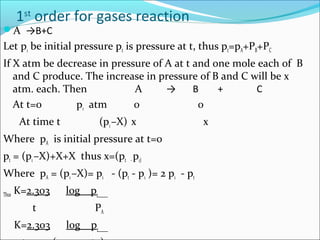
order for gases reaction
A →B+C
Let p1 be initial pressure pt is pressure at t, thus pt=pA+PB+PC
If X atm be decrease in pressure of A at t and one mole each of B
and C produce. The increase in pressure of B and C will be x
atm. each. Then A → B + C
At t=0 p1 atm 0 0
At time t (p1–X) x x
Where pA is initial pressure at t=0
pt = (p1–X)+X+X thus x=(pt -p1)
Where pA = (p1–X)= p1 - (pt - p1 )= 2 p1 - pt
Thus K=2.303 log p1
t PA
K=2.303 log p1
HALF LIFE PERIOD:It is the time in which the concentration of a
reactant is reduced to one half of its initial concentration .
For zero order reaction. K= [R]0
- [R]
t
At t=t1/2 , [R] = 1[R]0
2
The rate constant at t1/2 becomes k= [R]0
-1/2[R]0
t1/2 thus , t1/2 == [R]0
2k
For 1st order reaction.:-K=2.303 log [R]0
t [R]
At t=t1/2 , [R] = [R]0
2
Thus, K=2.303 log [R]0
t1/2 [R]/2
t1/2 =2.303 log2
k
t1/2 =2.303 x 0.301 Thus, t1/2 =0.693
k k
Pseudo 1st
order reaction:
when 2 reactant react out of which 1 is in large excess than the other
and behave as 1st
order then it is called as pseudo 1st
order reaction.
Eg ,
CH3COOC2H5 + H2O → CH3COOH + C2H5OH
T=0, 0.01mol 10 mol 0mol 0mol
At t 0 mol 9.9mol 0.01mol 0.01mol
Rate =K’[CH3COOC2H5 ] [H2O]
Where k= K’[H2O]
The reaction behave as 1st
order reaction and called as pseudo order
reactions.
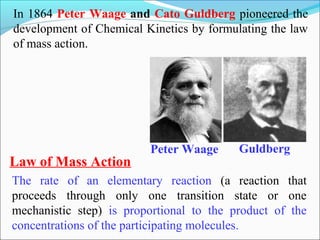
In 1864 Peter Waage and Cato Guldberg pioneered the
development of Chemical Kinetics by formulating the law
of mass action.
Peter Waage Guldberg
Law of Mass Action
The rate of an elementary reaction (a reaction that
proceeds through only one transition state or one
mechanistic step) is proportional to the product of the
concentrations of the participating molecules.
Methods for Determination of Order of a Reaction
1. Differential Method
2. Isolation Method
3. Method of Integration
4. Half-life Method
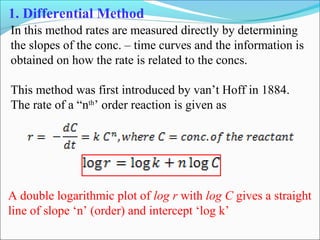
1. Differential Method
In this method rates are measured directly by determining
the slopes of the conc. – time curves and the information is
obtained on how the rate is related to the concs.
This method was first introduced by van’t Hoff in 1884.
The rate of a “nth
’ order reaction is given as
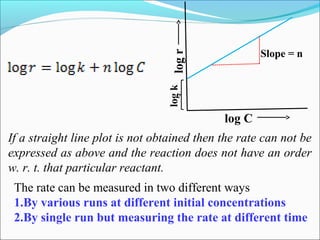
A double logarithmic plot of log r with log C gives a straight
line of slope ‘n’ (order) and intercept ‘log k’
logr
log C
logk
Slope = n
If a straight line plot is not obtained then the rate can not be
expressed as above and the reaction does not have an order
w. r. t. that particular reactant.
The rate can be measured in two different ways
1.By various runs at different initial concentrations
2.By single run but measuring the rate at different time
1. With different initial concentrations
Various runs are carried out at different initial concentrations
of the reactant and initial rates are measured by measuring the
initial slopes.
[C]
r1
t
r2
r3
r4
logr
log C
logk
Slope = nC
r1
r2
r3
r4
This procedure avoids the possible complications due to the
interference by products (e.g. inhibition or autocatalysis)
The order thus determined is called order w.r.t. conc. or true
order (nC)
2. At different time
In this procedure a single run is carried out and the slopes are
measured at different times. So this gives variation of rate
with respect to time.
logr
log C
logk
Slope = nt
r1
r2
r3
r4
Time
[C]
r1
r2
r3
r4
The order thus determined is called order w.r.t. time (nt)
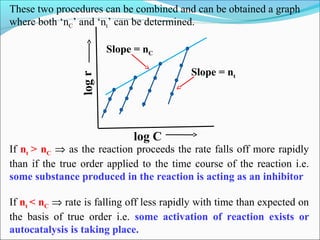
These two procedures can be combined and can be obtained a graph
where both ‘nC’ and ‘nt’ can be determined.
logr
log C
Slope = nC
Slope = nt
If nt > nC ⇒ as the reaction proceeds the rate falls off more rapidly
than if the true order applied to the time course of the reaction i.e.
some substance produced in the reaction is acting as an inhibitor
If nt < nC ⇒ rate is falling off less rapidly with time than expected on
the basis of true order i.e. some activation of reaction exists or
autocatalysis is taking place.
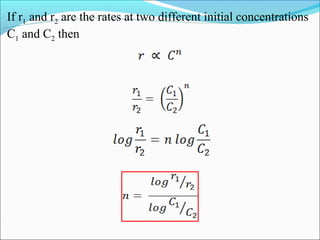
If r1 and r2 are the rates at two different initial concentrations
C1 and C2 then
2. Isolation Method
If all the reactants except one are present in excess, the
apparent order will be the order w.r.t. the one “isolated”
reactant.
If a reaction rate is expressed as: Rate = k [A]α
[B]β
[C]γ
B and C are taken in excess of A and the order w.r.t A is
determined which will be ‘α’.
The order w.r.t. B and C can also be determined by similar
procedure.
This method is often used in conjunction with other
methods.
Sometimes taking a large excess of concentration of a
particular reactant may change the mechanism of a
composite reaction.
Method of Integration
This method needs to first make a tentative guess on what
might be the order of the reaction and the corresponding
differential equation is integrated. The constant value of ‘k’
if obtained suggests the correctness of the guess.
1. First-Order Reaction
The reaction can be of any type such as
A → P, A + B→ P, A + B + C → P
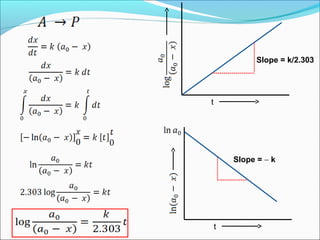
t
Slope = k/2.303
t
Slope = − k
t
a0
2. Second-Order Reaction
The reaction can be any type such as
A → P A + B→ P
Rate = k (a0 − x)2
Rate = k (a0 − x)2
if a0 = b0
Rate = k (a0 − x) (b0 − x)
t
Slope = k
Let’s consider the reaction
A → P
Rate = k (constant)
3. Zero-Order Reaction
t
Slope = − k
[A]
[A]0
Rate
[A]
4. nth
-Order Reaction
Let’s consider the reaction A → P
Method of Half-Life
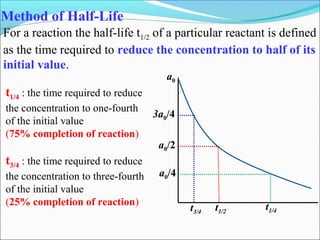
For a reaction the half-life t1/2 of a particular reactant is defined
as the time required to reduce the concentration to half of its
initial value.
a0/2
a0
a0/4
3a0/4
t1/2
t1/4t3/4
t1/4 : the time required to reduce
the concentration to one-fourth
of the initial value
(75% completion of reaction)
t3/4 : the time required to reduce
the concentration to three-fourth
of the initial value
(25% completion of reaction)
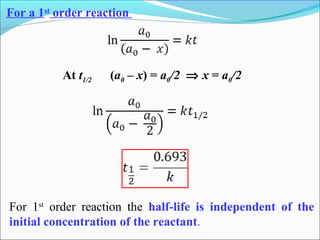
For a 1st
order reaction
At t1/2 (a0 – x) = a0/2 ⇒ x = a0/2
For 1st
order reaction the half-life is independent of the
initial concentration of the reactant.
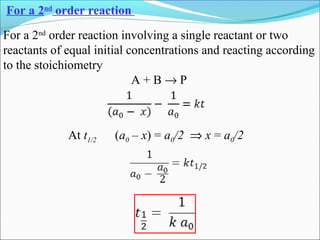
For a 2nd
order reaction
For a 2nd
order reaction involving a single reactant or two
reactants of equal initial concentrations and reacting according
to the stoichiometry
A + B → P
At t1/2 (a0 – x) = a0/2 ⇒ x = a0/2
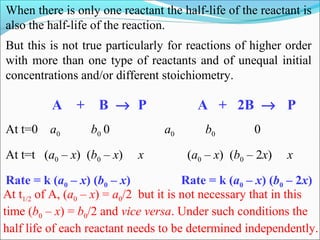
When there is only one reactant the half-life of the reactant is
also the half-life of the reaction.
But this is not true particularly for reactions of higher order
with more than one type of reactants and of unequal initial
concentrations and/or different stoichiometry.
A + B → P A + 2B → P
At t=0 a0 b0 0 a0 b0 0
At t=t (a0 – x) (b0 – x) x (a0 – x) (b0 – 2x) x
Rate = k (a0 – x) (b0 – x) Rate = k (a0 – x) (b0 – 2x)
At t1/2 of A, (a0 – x) = a0/2 but it is not necessary that in this
time (b0 – x) = b0/2 and vice versa. Under such conditions the
half life of each reactant needs to be determined independently.
For a Zero order reaction
At t = t1/2 [A] = [A]0/2
kt1/2 = [A]0 – [A]0/2
t1/2 = [A]0/2k
t1/2 ∝ [A]0
For a zero order reaction the half-life is directly
proportional to the initial concentration of the
reactant.
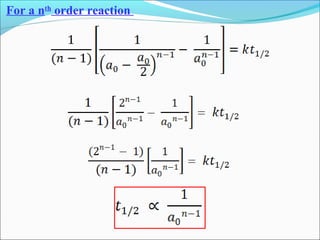
For a nth
order reaction
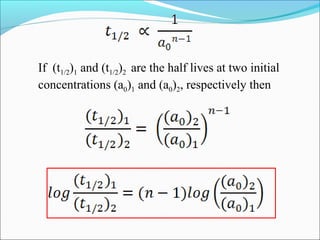
If (t1/2)1 and (t1/2)2 are the half lives at two initial
concentrations (a0)1 and (a0)2, respectively then
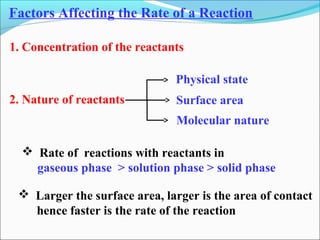
Factors Affecting the Rate of a Reaction
1. Concentration of the reactants
2. Nature of reactants
Physical state
Surface area
Molecular nature
 Rate of reactions with reactants in
gaseous phase > solution phase > solid phase
 Larger the surface area, larger is the area of contact
hence faster is the rate of the reaction
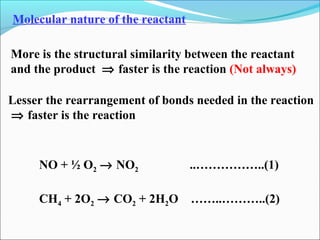
Molecular nature of the reactant
More is the structural similarity between the reactant
and the product ⇒ faster is the reaction (Not always)
NO + ½ O2 → NO2 ..……………..(1)
CH4 + 2O2 → CO2 + 2H2O ……..………..(2)
Lesser the rearrangement of bonds needed in the reaction
⇒ faster is the reaction
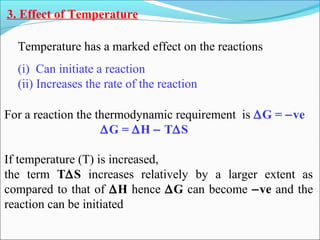
3. Effect of Temperature
Temperature has a marked effect on the reactions
(i) Can initiate a reaction
(ii) Increases the rate of the reaction
For a reaction the thermodynamic requirement is ∆G = −ve
∆G = ∆H − T∆S
If temperature (T) is increased,
the term T∆S increases relatively by a larger extent as
compared to that of ∆H hence ∆G can become −ve and the
reaction can be initiated
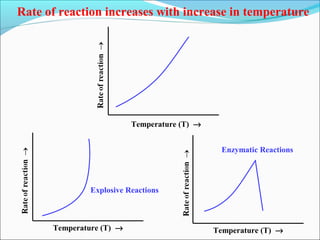
Rate of reaction increases with increase in temperature
Temperature (T) →
Temperature (T) →
Explosive Reactions
Temperature (T) →
Enzymatic Reactions
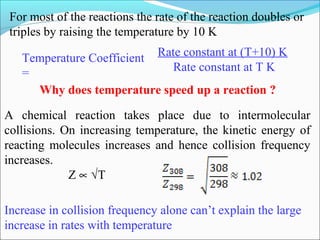
For most of the reactions the rate of the reaction doubles or
triples by raising the temperature by 10 K
Temperature Coefficient
=
Rate constant at (T+10) K
Rate constant at T K
Why does temperature speed up a reaction ?
A chemical reaction takes place due to intermolecular
collisions. On increasing temperature, the kinetic energy of
reacting molecules increases and hence collision frequency
increases.
Z ∝ √T
Increase in collision frequency alone can’t explain the large
increase in rates with temperature
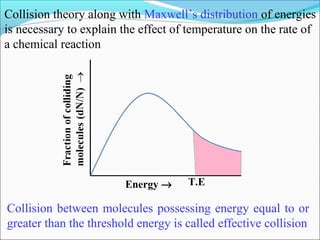
Collision theory along with Maxwell’s distribution of energies
is necessary to explain the effect of temperature on the rate of
a chemical reaction
Energy → T.E
Collision between molecules possessing energy equal to or
greater than the threshold energy is called effective collision
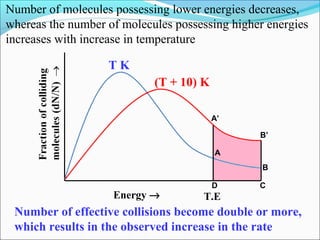
Number of molecules possessing lower energies decreases,
whereas the number of molecules possessing higher energies
increases with increase in temperature
Energy → T.E
T K
(T + 10) K
A
B
CD
A’
B’
Number of effective collisions become double or more,
which results in the observed increase in the rate
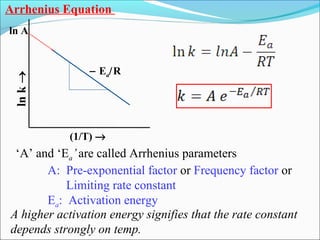
Arrhenius Equation
(1/T) →
− Ea/R
ln A
‘A’ and ‘Ea’are called Arrhenius parameters
A: Pre-exponential factor or Frequency factor or
Limiting rate constant
Ea: Activation energy
A higher activation energy signifies that the rate constant
depends strongly on temp.
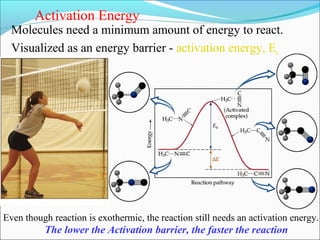
Activation Energy
Molecules need a minimum amount of energy to react.
Visualized as an energy barrier - activation energy, Ea
The lower the Activation barrier, the faster the reaction
Even though reaction is exothermic, the reaction still needs an activation energy.
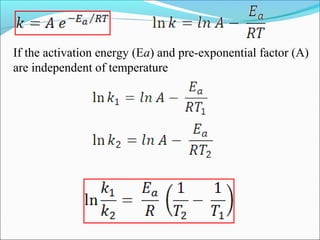
If the activation energy (Ea) and pre-exponential factor (A)
are independent of temperature
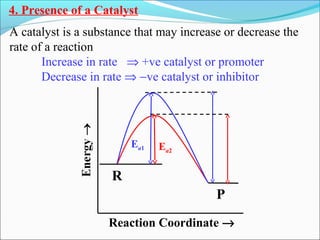
4. Presence of a Catalyst
A catalyst is a substance that may increase or decrease the
rate of a reaction
Increase in rate ⇒ +ve catalyst or promoter
Decrease in rate ⇒ −ve catalyst or inhibitor
R
P
Ea1 Ea2
Reaction Coordinate →
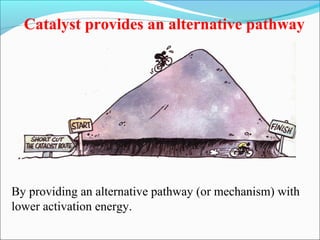
By providing an alternative pathway (or mechanism) with
lower activation energy.
Catalyst provides an alternative pathway
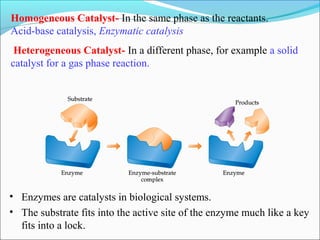
Homogeneous Catalyst- In the same phase as the reactants.
Acid-base catalysis, Enzymatic catalysis
Heterogeneous Catalyst- In a different phase, for example a solid
catalyst for a gas phase reaction.
• Enzymes are catalysts in biological systems.
• The substrate fits into the active site of the enzyme much like a key
fits into a lock.
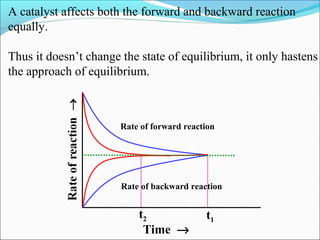
A catalyst affects both the forward and backward reaction
equally.
Thus it doesn’t change the state of equilibrium, it only hastens
the approach of equilibrium.
Time →
t2 t1
Rate of forward reaction
Rate of backward reaction
Theories of Chemical Reactions
There are various theories proposed to explain chemical
reactions.
The most important theories are
1.Collision Theory
2. Transition-State Theory or Activated Complex Theory
or Absolute Reaction Rate Theory
Collision Theory
 This is the oldest theory based on kinetic theory of
collisions.
 Originally suggested for gas phase reactions.
 This suggests that we can understand the rates of
reactions by analysing the molecular collisions.
 All assumptions of kinetic theory of gases are applicable
 The molecules/atoms are hard spheres
 The molecular motions are explained by classical
mechanics or Newtonian mechanics
 The size of the molecules is negligible as compared to the
typical distance between them
 Due to the kinetic energy of molecules, they move around
and collide with each other
 The molecular collisions are perfectly elastic i.e. energy is
Assumptions
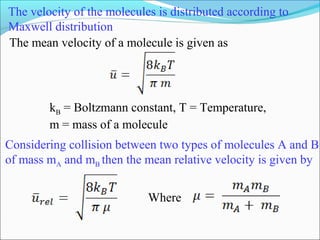
The velocity of the molecules is distributed according to
Maxwell distribution
kB = Boltzmann constant, T = Temperature,
m = mass of a molecule
Considering collision between two types of molecules A and B
of mass mA and mB then the mean relative velocity is given by
Where
The mean velocity of a molecule is given as
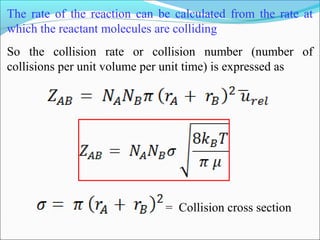
The rate of the reaction can be calculated from the rate at
which the reactant molecules are colliding
So the collision rate or collision number (number of
collisions per unit volume per unit time) is expressed as
= Collision cross section
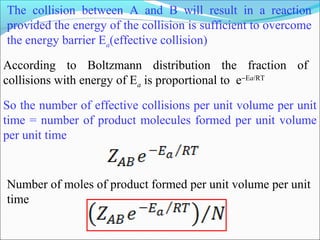
The collision between A and B will result in a reaction
provided the energy of the collision is sufficient to overcome
the energy barrier Ea(effective collision)
Number of moles of product formed per unit volume per unit
time
According to Boltzmann distribution the fraction of
collisions with energy of Ea is proportional to e−Ea/RT
So the number of effective collisions per unit volume per unit
time = number of product molecules formed per unit volume
per unit time
The rate expressed in moles/unit volume/unit time is
If the reaction is first order w.r.t. both A and B
A + B → P
r = k [A] [B]
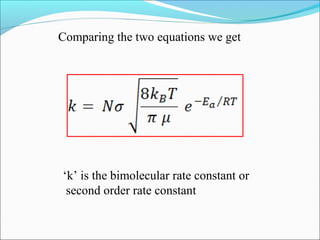
Comparing the two equations we get
‘k’ is the bimolecular rate constant or
second order rate constant
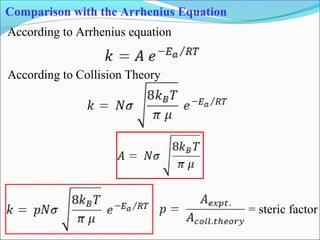
Comparison with the Arrhenius Equation
According to Arrhenius equation
According to Collision Theory
= steric factor
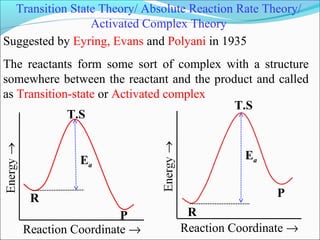
Transition State Theory/ Absolute Reaction Rate Theory/
Activated Complex Theory
Suggested by Eyring, Evans and Polyani in 1935
The reactants form some sort of complex with a structure
somewhere between the reactant and the product and called
as Transition-state or Activated complex
Reaction Coordinate →
R
P
Ea
T.S
Reaction Coordinate →
R
P
Ea
T.S
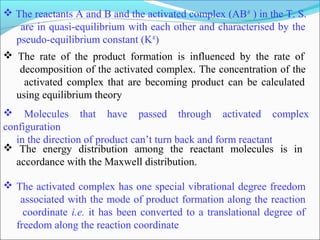
 The reactants A and B and the activated complex (AB#
) in the T. S.
are in quasi-equilibrium with each other and characterised by the
pseudo-equilibrium constant (K#
)
 The rate of the product formation is influenced by the rate of
decomposition of the activated complex. The concentration of the
activated complex that are becoming product can be calculated
using equilibrium theory
 Molecules that have passed through activated complex
configuration
in the direction of product can’t turn back and form reactant
 The energy distribution among the reactant molecules is in
accordance with the Maxwell distribution.
 The activated complex has one special vibrational degree freedom
associated with the mode of product formation along the reaction
coordinate i.e. it has been converted to a translational degree of
freedom along the reaction coordinate
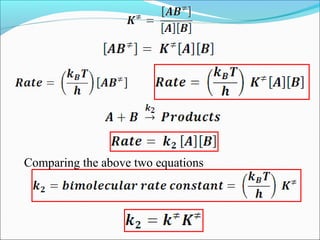
Let’s consider a simple bimolecular reaction
K#
k#
Rate of the reaction = k#
[AB#
]
The rate constant (k#
) is related to the vib. frequency (ν) as
k#
= κ ν where κ = kappa = transmission coeff. and 0 < κ ≤ 1
In AB#
one of the vib. degree of freedom = translational degree of
freedom which is responsible for the product formation
The rate at which the activated complex moves across the energy
barrier is proportional to the vibrational frequency ‘ν’
For convenience the value of κ is taken = 1 and we know kBT = hν
Comparing the above two equations
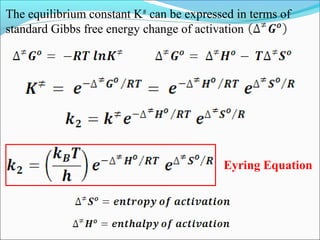
The equilibrium constant K#
can be expressed in terms of
standard Gibbs free energy change of activation
Eyring Equation
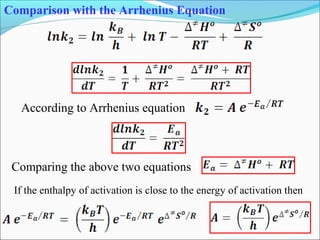
Comparison with the Arrhenius Equation
According to Arrhenius equation
Comparing the above two equations
If the enthalpy of activation is close to the energy of activation then

Lds kinetics 3

  • 1.
    CHEMICAL KINETICS The studyof reaction rates and their mechanisms is called chemical kinetics. The word kinetics means movement.Thermodynamics tell about the feasibility of a reaction(∆G = −ve).Which product is stable(at equilibrium)? Where as Kinetics tell about the (rate) of a chemical process and mechanism of a reaction(any intermediate). Thermodynamics favors the process (∆G: -ve ) .Kinetics makes this reaction nearly impossible (Requires a very high pressure and temperature over long time. Chemical kinetics also known as Reaction kinetics is the study of rate of chemical processes. Rate of a Chemical Reaction: The speed of a reaction or the rate of a reaction can be defined as the change in concentration of a reactant or product in unit time. Consider a reaction ,R P,If [R]1 and [p]1 are the concentration of reactant and product at time T1 and [R]2 and [p]2 are the concentration of reactant and product at time T2 , ∆t= T2 -T1 and Δ [R] = [R]2 - [R]1 and Δ [p] = [p]2 - [p]1 Rate of disappearance R = -Change in concentration(∆R)= +Change in concentration(∆P) time (∆t) time (∆t)
  • 2.
    INSTANTANEOUS AND AVERAGERATE OF A REACTION
  • 3.
    Unit of rateof a reaction :- unit of rate of a reaction are concentration time-1 .If concentration is in mol L-1 S-1 . In gases reactions the unit of a rate equation will be atm S-1 . Rate can be expressed in three different ways; (i) Initial rate: rate of reaction in the starting time is initial rate. (ii) Average rate:- Average rate is the rate of a reaction which measure at a particualr period of time interval. Average rate cannot be used to predict the rate of a reaction at a particular instant as it would be constant for the time interval for which it is calculated. So to express the rate at a particular moment of time we used instantaneous rate. rav= -Δ[R] = Δ[P] Δt Δt (iii)Instantaneous rate: The rate at a particular moment of time is instantaneous rate. As Δt →0 or rinst= -d[R] = d[P] dt dt
  • 4.
    Rate changes withtime hence expressing the rate as an instantaneous rate is preferable. Instantaneous rate means rate at a particular instant (infinitesimal change in time) i.e. Rate = ± d[concentration] dt For the reaction, 5Br- (aq) +BrO3 - (aq) +6H+ (aq) 3Br→ 2(aq) +3H2O Rate= -1Δ[Br- ] = -1 Δ[Br O3 - ] = -1 Δ[H+ ] = 1 Δ[Br2]= 1 Δ [H2O] 5 Δt Δt 6 Δt 3 Δt 3 Δt Concentration Time
  • 5.
    Rate Law Expressionand rate constant: The rate of a chemical reaction at a given temperature depends on concentration,(pressure in gases), temperature , catalyst. The representation of rate in terms of concentration of reactants is called as rate law. The rate of a homogeneous reaction is proportional to the product of the concentrations of the reactants raised to some power. Thus for a general reaction or -d[R] =k[A]x [B]Y dt This equation is known as differential equation and k is called rate constant or specific rate or velocity constant. It is independent of concentrations and time.Has a specific value at a given temperature . or
  • 6.
    The rate lawis the expression in which reaction rate is given in terms of molar concentration of reactants with each term raised to some power, which may or may not be same as the Stoichimetric coefficent of reacting species in a balance chemical equation. Rate law for any reaction cannot be predicted by merely looking at the balance chemical equation.i,e,, theoretically but must be determined experimentally. The sum of powers of concentration of the reactants in the rate law expression is called the order of that chemical reaction. Order may be 0.1.2.3 and even fraction. O order means independent of concentration of reactants. 1st Order means rate depends on only 1 reactants. 2nd Order means rate depends on 2 reactants. If any reaction which take place in 1 steps are elementary reaction while it required various steps are complex reactions
  • 7.
     The sumof the powers of the concentration terms (α + β) in the rate equation is known as the overall order of the reaction.  α, β are called the partial orders w. r. t the reactants A and B respectively.  The order of a reaction generally has a value 0 to 3  Order can also have fractional value e.g. decomposition of acetaldehyde: CH3CHO → CH4 + CO, rate = k [CH3CHO]3/2 order = 3/2 or 1.5 Order is different from the stoichiometric coefficient and needs to be determined experimentally. Order of a Reaction
  • 8.
    Reaction Orders andRate The reaction order, n, determines how the rate depends on the concentration of the reactant. The rate law for the reaction can be written:  Rate = k[A]0 = k  Rate = k[A]1  Rate = k[A]2
  • 9.
    Unit of Rateof Reaction Concentration time−1 e.g. mol L−1 sec−1 or mol dm−3 sec−1 Gaseous reactions: Pressure time−1 e.g. torr sec−1 (1)For a 0th order reaction: Rate = k k = rate = [conc.] time−1 = mol L−1 sec−1 (2)For a 1st order reaction: Rate = k [conc.] k = rate/[conc.] = [conc.] time−1 /[conc.] = time−1 = sec−1 (3)For a 2nd order reaction: Rate = k [conc.]2 k = rate/[conc.]2 = [conc.] time−1 /[conc.]2 = [conc.]−1 time−1 = mol −1 L sec−1 (4)For a nth order reaction: Rate = k [conc.]n k = rate/[conc.]n = [conc.] time−1 /[conc.]n = [conc.]1−n time−1 since ,thus K=rate/[A]x [B]y =concentration x 1 time ( concentration )n
  • 10.
    Molecularity of areaction: The number of reacting species taking part in an elementary reaction, which must collide simultaneously in order to bring about a chemical reaction is called molecularity of a reaction. Unimolecular:-only 1 reacting species. Bimolecular: 2 reacting species which are simultaneously collide. Trimolecular: 3 reacting species which are simultaneously collide is very small and hence molecularity greater than 3 is not observed. For a complex reaction , the reaction take place more than one steps and its steps have different order ,thus the overall rate of the reaction is controlled by the slowest step in a reaction called the rate determining step Order of a reaction is an experimental quantity, It can be zero and even fraction but molecularity cannot be zero or a non integer. Order is applicable to elementary as well as complex whereas molecularity is applicable on elementary reaction only.
  • 11.
    Integrated rate equation:It is different for different order reaction (1)Zero Order reactions: For a zero order reaction R P Rate= -d[R] /dt = K[R]0 As any quantity raised to power zero is 1 Thus rate= -d[R] /dt = Kx1. Rearrange the equation, d[R] = - kdt Integrating both side , [R] = - kt + I………(.1) At t=0,R=[R]0 Substituting in equation , [R]0 = - Kx0+I, [R]0 =I Substituting the value of I in the equation. [R] = - Kt+[R]0 ………..(2) If we plot [R] against t, we get a straight line with slope = -K and intercept equal to [R]0 simplifying equation . we get the rate constant k= [R]0 - [R] t [R] K= - Slope Concentration R
  • 12.
    1st order reactions:- For areaction R → P Rate=-d[R] /dt = K[R] Or d[R] = -kdt [R] Integrating the equation ln[R] =-kt+I…………….(1) When t=0,R=[R]0 where [R]0 is the initial concentration of the reactant. Then , ln[R]0 =-kx0+I ln[R]0 =I Substituting “I “in equation 1, we get, ln[R] =-kt+ ln[R]0 Rearranging the equation ln [R] = -kt [R]0 Or k= 1 ln [R] T [R]0 At time t1, ln[R]1 =-kt1+ ln[R]0 ……………………(2) At time t2 , ln[R]2 =-kt2+ ln[R]0 ………………………(3) Substracting 3 from 2 we get,ln[R]1- ln[R]2=-kt1 –( -kt2) or ln [R]1 = k(t2-t1) [R]2 Thus K= 1 ln [R] ………………….(4)
  • 13.
    The equation ln[R]=-kt+ ln[R]0 can be written as ln [R] = - kt [R]0 Taking anti log in both sides [R]= [R]0 e-kt The equation ln[R] =-kt+ ln[R]0 is like y=mx+C . If we plot [R] against t we get a straight line with slope =–k and intercept =ln[R]0 Thus first order reaction can be written as K=2.303 log [R]0 t [R] This is the formula of rate constant for first order reaction
  • 14.
    (1)Plot [R] againstt and( 2) ln [R] vs t for 1st order reaction [R]0  ln[R]0 ln[R]0 ln [R] k=-slope [R] slope=k/2.303 ↑ ↑ t→ t→
  • 15.
    1st order for gasesreaction A →B+C Let p1 be initial pressure pt is pressure at t, thus pt=pA+PB+PC If X atm be decrease in pressure of A at t and one mole each of B and C produce. The increase in pressure of B and C will be x atm. each. Then A → B + C At t=0 p1 atm 0 0 At time t (p1–X) x x Where pA is initial pressure at t=0 pt = (p1–X)+X+X thus x=(pt -p1) Where pA = (p1–X)= p1 - (pt - p1 )= 2 p1 - pt Thus K=2.303 log p1 t PA K=2.303 log p1
  • 16.
    HALF LIFE PERIOD:Itis the time in which the concentration of a reactant is reduced to one half of its initial concentration . For zero order reaction. K= [R]0 - [R] t At t=t1/2 , [R] = 1[R]0 2 The rate constant at t1/2 becomes k= [R]0 -1/2[R]0 t1/2 thus , t1/2 == [R]0 2k For 1st order reaction.:-K=2.303 log [R]0 t [R] At t=t1/2 , [R] = [R]0 2 Thus, K=2.303 log [R]0 t1/2 [R]/2 t1/2 =2.303 log2 k t1/2 =2.303 x 0.301 Thus, t1/2 =0.693 k k
  • 17.
    Pseudo 1st order reaction: when2 reactant react out of which 1 is in large excess than the other and behave as 1st order then it is called as pseudo 1st order reaction. Eg , CH3COOC2H5 + H2O → CH3COOH + C2H5OH T=0, 0.01mol 10 mol 0mol 0mol At t 0 mol 9.9mol 0.01mol 0.01mol Rate =K’[CH3COOC2H5 ] [H2O] Where k= K’[H2O] The reaction behave as 1st order reaction and called as pseudo order reactions.
  • 18.
    In 1864 PeterWaage and Cato Guldberg pioneered the development of Chemical Kinetics by formulating the law of mass action. Peter Waage Guldberg Law of Mass Action The rate of an elementary reaction (a reaction that proceeds through only one transition state or one mechanistic step) is proportional to the product of the concentrations of the participating molecules.
  • 19.
    Methods for Determinationof Order of a Reaction 1. Differential Method 2. Isolation Method 3. Method of Integration 4. Half-life Method
  • 20.
    1. Differential Method Inthis method rates are measured directly by determining the slopes of the conc. – time curves and the information is obtained on how the rate is related to the concs. This method was first introduced by van’t Hoff in 1884. The rate of a “nth ’ order reaction is given as A double logarithmic plot of log r with log C gives a straight line of slope ‘n’ (order) and intercept ‘log k’
  • 21.
    logr log C logk Slope =n If a straight line plot is not obtained then the rate can not be expressed as above and the reaction does not have an order w. r. t. that particular reactant. The rate can be measured in two different ways 1.By various runs at different initial concentrations 2.By single run but measuring the rate at different time
  • 22.
    1. With differentinitial concentrations Various runs are carried out at different initial concentrations of the reactant and initial rates are measured by measuring the initial slopes. [C] r1 t r2 r3 r4 logr log C logk Slope = nC r1 r2 r3 r4 This procedure avoids the possible complications due to the interference by products (e.g. inhibition or autocatalysis) The order thus determined is called order w.r.t. conc. or true order (nC)
  • 23.
    2. At differenttime In this procedure a single run is carried out and the slopes are measured at different times. So this gives variation of rate with respect to time. logr log C logk Slope = nt r1 r2 r3 r4 Time [C] r1 r2 r3 r4 The order thus determined is called order w.r.t. time (nt)
  • 24.
    These two procedurescan be combined and can be obtained a graph where both ‘nC’ and ‘nt’ can be determined. logr log C Slope = nC Slope = nt If nt > nC ⇒ as the reaction proceeds the rate falls off more rapidly than if the true order applied to the time course of the reaction i.e. some substance produced in the reaction is acting as an inhibitor If nt < nC ⇒ rate is falling off less rapidly with time than expected on the basis of true order i.e. some activation of reaction exists or autocatalysis is taking place.
  • 25.
    If r1 andr2 are the rates at two different initial concentrations C1 and C2 then
  • 26.
    2. Isolation Method Ifall the reactants except one are present in excess, the apparent order will be the order w.r.t. the one “isolated” reactant. If a reaction rate is expressed as: Rate = k [A]α [B]β [C]γ B and C are taken in excess of A and the order w.r.t A is determined which will be ‘α’. The order w.r.t. B and C can also be determined by similar procedure. This method is often used in conjunction with other methods. Sometimes taking a large excess of concentration of a particular reactant may change the mechanism of a composite reaction.
  • 27.
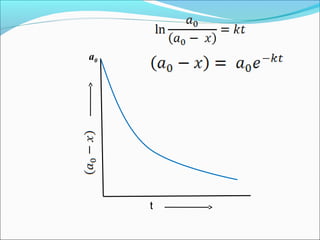
    Method of Integration Thismethod needs to first make a tentative guess on what might be the order of the reaction and the corresponding differential equation is integrated. The constant value of ‘k’ if obtained suggests the correctness of the guess. 1. First-Order Reaction The reaction can be of any type such as A → P, A + B→ P, A + B + C → P
  • 28.
  • 29.
  • 30.
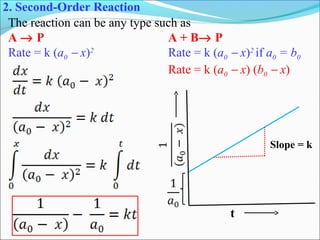
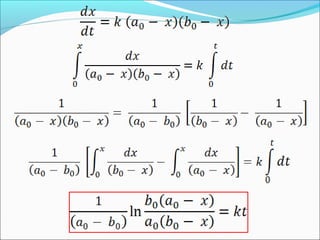
    2. Second-Order Reaction Thereaction can be any type such as A → P A + B→ P Rate = k (a0 − x)2 Rate = k (a0 − x)2 if a0 = b0 Rate = k (a0 − x) (b0 − x) t Slope = k
  • 32.
    Let’s consider thereaction A → P Rate = k (constant) 3. Zero-Order Reaction t Slope = − k [A] [A]0 Rate [A]
  • 33.
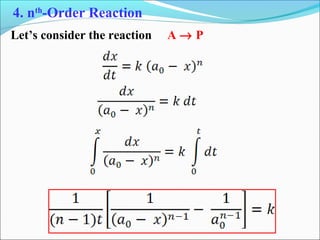
    4. nth -Order Reaction Let’sconsider the reaction A → P
  • 34.
    Method of Half-Life Fora reaction the half-life t1/2 of a particular reactant is defined as the time required to reduce the concentration to half of its initial value. a0/2 a0 a0/4 3a0/4 t1/2 t1/4t3/4 t1/4 : the time required to reduce the concentration to one-fourth of the initial value (75% completion of reaction) t3/4 : the time required to reduce the concentration to three-fourth of the initial value (25% completion of reaction)
  • 35.
    For a 1st orderreaction At t1/2 (a0 – x) = a0/2 ⇒ x = a0/2 For 1st order reaction the half-life is independent of the initial concentration of the reactant.
  • 36.
    For a 2nd orderreaction For a 2nd order reaction involving a single reactant or two reactants of equal initial concentrations and reacting according to the stoichiometry A + B → P At t1/2 (a0 – x) = a0/2 ⇒ x = a0/2
  • 37.
    When there isonly one reactant the half-life of the reactant is also the half-life of the reaction. But this is not true particularly for reactions of higher order with more than one type of reactants and of unequal initial concentrations and/or different stoichiometry. A + B → P A + 2B → P At t=0 a0 b0 0 a0 b0 0 At t=t (a0 – x) (b0 – x) x (a0 – x) (b0 – 2x) x Rate = k (a0 – x) (b0 – x) Rate = k (a0 – x) (b0 – 2x) At t1/2 of A, (a0 – x) = a0/2 but it is not necessary that in this time (b0 – x) = b0/2 and vice versa. Under such conditions the half life of each reactant needs to be determined independently.
  • 38.
    For a Zeroorder reaction At t = t1/2 [A] = [A]0/2 kt1/2 = [A]0 – [A]0/2 t1/2 = [A]0/2k t1/2 ∝ [A]0 For a zero order reaction the half-life is directly proportional to the initial concentration of the reactant.
  • 39.
  • 40.
    If (t1/2)1 and(t1/2)2 are the half lives at two initial concentrations (a0)1 and (a0)2, respectively then
  • 41.
    Factors Affecting theRate of a Reaction 1. Concentration of the reactants 2. Nature of reactants Physical state Surface area Molecular nature  Rate of reactions with reactants in gaseous phase > solution phase > solid phase  Larger the surface area, larger is the area of contact hence faster is the rate of the reaction
  • 42.
    Molecular nature ofthe reactant More is the structural similarity between the reactant and the product ⇒ faster is the reaction (Not always) NO + ½ O2 → NO2 ..……………..(1) CH4 + 2O2 → CO2 + 2H2O ……..………..(2) Lesser the rearrangement of bonds needed in the reaction ⇒ faster is the reaction
  • 43.
    3. Effect ofTemperature Temperature has a marked effect on the reactions (i) Can initiate a reaction (ii) Increases the rate of the reaction For a reaction the thermodynamic requirement is ∆G = −ve ∆G = ∆H − T∆S If temperature (T) is increased, the term T∆S increases relatively by a larger extent as compared to that of ∆H hence ∆G can become −ve and the reaction can be initiated
  • 44.
    Rate of reactionincreases with increase in temperature Temperature (T) → Temperature (T) → Explosive Reactions Temperature (T) → Enzymatic Reactions
  • 45.
    For most ofthe reactions the rate of the reaction doubles or triples by raising the temperature by 10 K Temperature Coefficient = Rate constant at (T+10) K Rate constant at T K Why does temperature speed up a reaction ? A chemical reaction takes place due to intermolecular collisions. On increasing temperature, the kinetic energy of reacting molecules increases and hence collision frequency increases. Z ∝ √T Increase in collision frequency alone can’t explain the large increase in rates with temperature
  • 46.
    Collision theory alongwith Maxwell’s distribution of energies is necessary to explain the effect of temperature on the rate of a chemical reaction Energy → T.E Collision between molecules possessing energy equal to or greater than the threshold energy is called effective collision
  • 47.
    Number of moleculespossessing lower energies decreases, whereas the number of molecules possessing higher energies increases with increase in temperature Energy → T.E T K (T + 10) K A B CD A’ B’ Number of effective collisions become double or more, which results in the observed increase in the rate
  • 48.
    Arrhenius Equation (1/T) → −Ea/R ln A ‘A’ and ‘Ea’are called Arrhenius parameters A: Pre-exponential factor or Frequency factor or Limiting rate constant Ea: Activation energy A higher activation energy signifies that the rate constant depends strongly on temp.
  • 49.
    Activation Energy Molecules needa minimum amount of energy to react. Visualized as an energy barrier - activation energy, Ea The lower the Activation barrier, the faster the reaction Even though reaction is exothermic, the reaction still needs an activation energy.
  • 50.
    If the activationenergy (Ea) and pre-exponential factor (A) are independent of temperature
  • 51.
    4. Presence ofa Catalyst A catalyst is a substance that may increase or decrease the rate of a reaction Increase in rate ⇒ +ve catalyst or promoter Decrease in rate ⇒ −ve catalyst or inhibitor R P Ea1 Ea2 Reaction Coordinate →
  • 52.
    By providing analternative pathway (or mechanism) with lower activation energy. Catalyst provides an alternative pathway
  • 53.
    Homogeneous Catalyst- Inthe same phase as the reactants. Acid-base catalysis, Enzymatic catalysis Heterogeneous Catalyst- In a different phase, for example a solid catalyst for a gas phase reaction. • Enzymes are catalysts in biological systems. • The substrate fits into the active site of the enzyme much like a key fits into a lock.
  • 54.
    A catalyst affectsboth the forward and backward reaction equally. Thus it doesn’t change the state of equilibrium, it only hastens the approach of equilibrium. Time → t2 t1 Rate of forward reaction Rate of backward reaction
  • 55.
    Theories of ChemicalReactions There are various theories proposed to explain chemical reactions. The most important theories are 1.Collision Theory 2. Transition-State Theory or Activated Complex Theory or Absolute Reaction Rate Theory
  • 56.
    Collision Theory  Thisis the oldest theory based on kinetic theory of collisions.  Originally suggested for gas phase reactions.  This suggests that we can understand the rates of reactions by analysing the molecular collisions.  All assumptions of kinetic theory of gases are applicable
  • 57.
     The molecules/atomsare hard spheres  The molecular motions are explained by classical mechanics or Newtonian mechanics  The size of the molecules is negligible as compared to the typical distance between them  Due to the kinetic energy of molecules, they move around and collide with each other  The molecular collisions are perfectly elastic i.e. energy is Assumptions
  • 58.
    The velocity ofthe molecules is distributed according to Maxwell distribution kB = Boltzmann constant, T = Temperature, m = mass of a molecule Considering collision between two types of molecules A and B of mass mA and mB then the mean relative velocity is given by Where The mean velocity of a molecule is given as
  • 59.
    The rate ofthe reaction can be calculated from the rate at which the reactant molecules are colliding So the collision rate or collision number (number of collisions per unit volume per unit time) is expressed as = Collision cross section
  • 60.
    The collision betweenA and B will result in a reaction provided the energy of the collision is sufficient to overcome the energy barrier Ea(effective collision) Number of moles of product formed per unit volume per unit time According to Boltzmann distribution the fraction of collisions with energy of Ea is proportional to e−Ea/RT So the number of effective collisions per unit volume per unit time = number of product molecules formed per unit volume per unit time
  • 61.
    The rate expressedin moles/unit volume/unit time is If the reaction is first order w.r.t. both A and B A + B → P r = k [A] [B]
  • 62.
    Comparing the twoequations we get ‘k’ is the bimolecular rate constant or second order rate constant
  • 63.
    Comparison with theArrhenius Equation According to Arrhenius equation According to Collision Theory = steric factor
  • 64.
    Transition State Theory/Absolute Reaction Rate Theory/ Activated Complex Theory Suggested by Eyring, Evans and Polyani in 1935 The reactants form some sort of complex with a structure somewhere between the reactant and the product and called as Transition-state or Activated complex Reaction Coordinate → R P Ea T.S Reaction Coordinate → R P Ea T.S
  • 65.
     The reactantsA and B and the activated complex (AB# ) in the T. S. are in quasi-equilibrium with each other and characterised by the pseudo-equilibrium constant (K# )  The rate of the product formation is influenced by the rate of decomposition of the activated complex. The concentration of the activated complex that are becoming product can be calculated using equilibrium theory  Molecules that have passed through activated complex configuration in the direction of product can’t turn back and form reactant  The energy distribution among the reactant molecules is in accordance with the Maxwell distribution.  The activated complex has one special vibrational degree freedom associated with the mode of product formation along the reaction coordinate i.e. it has been converted to a translational degree of freedom along the reaction coordinate
  • 66.
    Let’s consider asimple bimolecular reaction K# k# Rate of the reaction = k# [AB# ] The rate constant (k# ) is related to the vib. frequency (ν) as k# = κ ν where κ = kappa = transmission coeff. and 0 < κ ≤ 1 In AB# one of the vib. degree of freedom = translational degree of freedom which is responsible for the product formation The rate at which the activated complex moves across the energy barrier is proportional to the vibrational frequency ‘ν’ For convenience the value of κ is taken = 1 and we know kBT = hν
  • 67.
    Comparing the abovetwo equations
  • 68.
    The equilibrium constantK# can be expressed in terms of standard Gibbs free energy change of activation Eyring Equation
  • 69.
    Comparison with theArrhenius Equation According to Arrhenius equation Comparing the above two equations If the enthalpy of activation is close to the energy of activation then