12 Principles of Green Chemistry
(It’s Not Easy Being Green)
Dr .Vijaykumar S. Marakatti
National Post-Doctoral Fellow,
JNCASR ,Bangalore
1) History
2) 12 principles in detail
3) Important Green Process
OUTLINE
U.S. Environmental Protection Agency -1970
Protecting human health and the environment - use of DDT and other
chemical pesticides, Safe Drinking Water Act in 1974
HISTORY
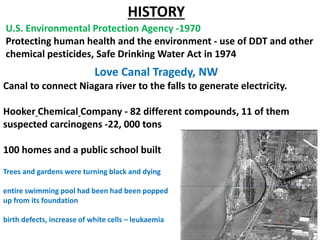
Love Canal Tragedy, NW
Canal to connect Niagara river to the falls to generate electricity.
Hooker Chemical Company - 82 different compounds, 11 of them
suspected carcinogens -22, 000 tons
100 homes and a public school built
Trees and gardens were turning black and dying
entire swimming pool had been had been popped
up from its foundation
birth defects, increase of white cells – leukaemia
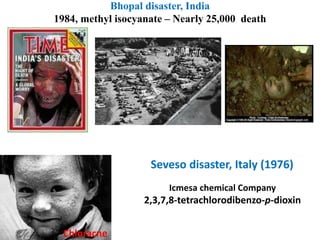
Bhopal disaster, India
1984, methyl isocyanate – Nearly 25,000 death
Seveso disaster, Italy (1976)
Icmesa chemical Company
2,3,7,8-tetrachlorodibenzo-p-dioxin
Chloracne
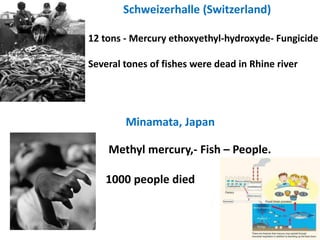
12 tons - Mercury ethoxyethyl-hydroxyde- Fungicide
Several tones of fishes were dead in Rhine river
Schweizerhalle (Switzerland)
Minamata, Japan
Methyl mercury,- Fish – People.
1000 people died
Organization for Economic Co-operation and Development (OECD)-
1980
30 industrialized countries- Environmental protection
Staff of the EPA Office of Pollution Prevention and Toxins, coined the
phrase "Green Chemistry" and showed the seeds of productive
collaboration between government, industry, and academia.
Presidential Green Chemistry Challenge Awards – Bill Clinton
1990
1997
The University of Massachusetts at Boston established the field's first
Green Chemistry Ph.D. program
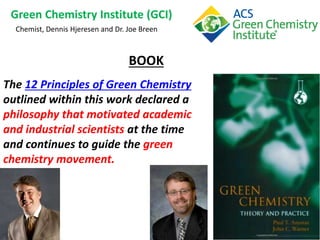
Green Chemistry Institute (GCI)
Chemist, Dennis Hjeresen and Dr. Joe Breen
The 12 Principles of Green Chemistry
outlined within this work declared a
philosophy that motivated academic
and industrial scientists at the time
and continues to guide the green
chemistry movement.
BOOK
“The design of chemical products and processes
that are more environmentally benign and reduce
negative impacts to human health and the
environment.”
Definition of Green Chemistry
Green Chemistry is the utilization of a set of principles
that reduces or eliminates the use of generation of
hazardous substances in the design, manufacture and
application of chemical product
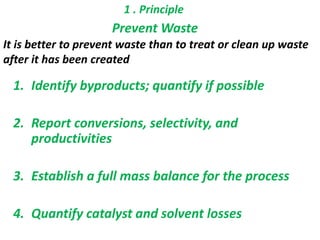
1 . Principle
Prevent Waste
It is better to prevent waste than to treat or clean up waste
after it has been created
1. Identify byproducts; quantify if possible
2. Report conversions, selectivity, and
productivities
3. Establish a full mass balance for the process
4. Quantify catalyst and solvent losses
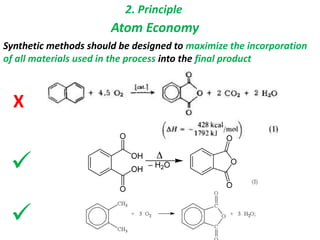
2. Principle
Atom Economy
Synthetic methods should be designed to maximize the incorporation
of all materials used in the process into the final product
X


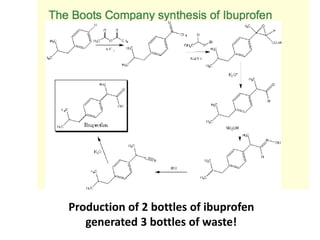
Production of 2 bottles of ibuprofen
generated 3 bottles of waste!
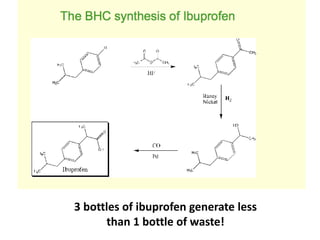
3 bottles of ibuprofen generate less
than 1 bottle of waste!
3. Principle
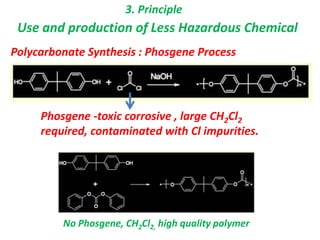
Use and production of Less Hazardous Chemical
Phosgene -toxic corrosive , large CH2Cl2
required, contaminated with Cl impurities.
Polycarbonate Synthesis : Phosgene Process
No Phosgene, CH2Cl2, high quality polymer
4. Principle
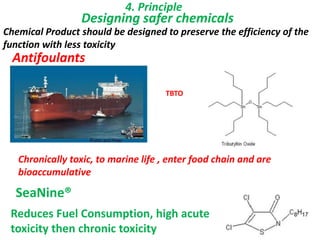
Designing safer chemicals
Antifoulants
Chronically toxic, to marine life , enter food chain and are
bioaccumulative
TBTO
SeaNine®
Reduces Fuel Consumption, high acute
toxicity then chronic toxicity
Chemical Product should be designed to preserve the efficiency of the
function with less toxicity
5. Principle
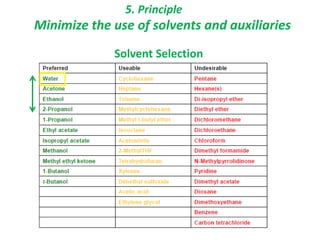
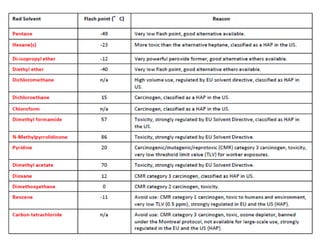
Minimize the use of solvents and auxiliaries
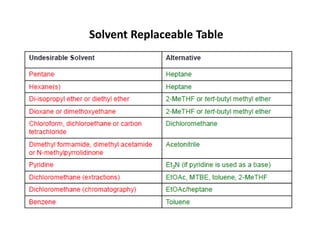
Solvent Selection
Solvent Replaceable Table
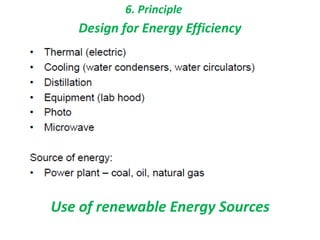
6. Principle
Design for Energy Efficiency
Use of renewable Energy Sources
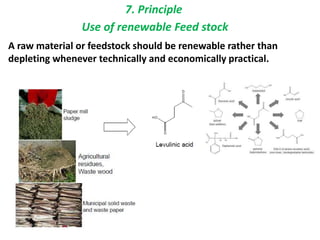
7. Principle
Use of renewable Feed stock
A raw material or feedstock should be renewable rather than
depleting whenever technically and economically practical.
8. Principle
Reduce Derivatives
Unnecessary derivatization (blocking group, protection/deprotection,
temporary modification of physical/chemical processes) should be
avoided whenever possible.
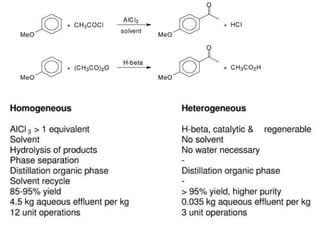
9. Principle
Catalytic reagents are superior to stoichiometric
reagents.
• Reduces energy
• Increases efficiency
• Reduces by-product formation
Design for Degradation
10. Principle
can we recycle everything?
design it so that it breaks down at the end of its useful lifetime.
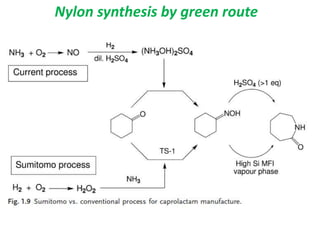
Nylon synthesis by green route
11. Principle
Real-time analysis for Pollution Prevention
Analytical methodologies need to be further developed to allow for
real-time in-process monitoring and control prior to the formation of
hazardous substances.
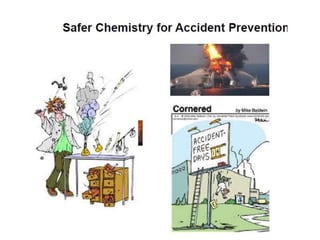
12. Principle
Substances and the form of a substance used in a chemical process
should be chosen so as to minimize the potential for chemical
accidents, including releases, explosions, and fires.
Inherently Safer Chemistry for Accident Prevention
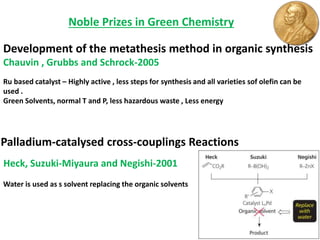
Noble Prizes in Green Chemistry
Ru based catalyst – Highly active , less steps for synthesis and all varieties sof olefin can be
used .
Green Solvents, normal T and P, less hazardous waste , Less energy
Development of the metathesis method in organic synthesis
Chauvin , Grubbs and Schrock-2005
Palladium-catalysed cross-couplings Reactions
Heck, Suzuki-Miyaura and Negishi-2001
Water is used as s solvent replacing the organic solvents
US EPA and the ACS Green Chemistry Institute
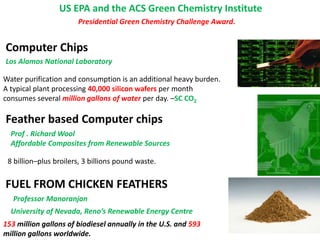
Computer Chips
Water purification and consumption is an additional heavy burden.
A typical plant processing 40,000 silicon wafers per month
consumes several million gallons of water per day. –SC CO2
Los Alamos National Laboratory
Presidential Green Chemistry Challenge Award.
8 billion–plus broilers, 3 billions pound waste.
Feather based Computer chips
Prof . Richard Wool
Affordable Composites from Renewable Sources
University of Nevada, Reno’s Renewable Energy Centre
FUEL FROM CHICKEN FEATHERS
Professor Manoranjan
153 million gallons of biodiesel annually in the U.S. and 593
million gallons worldwide.
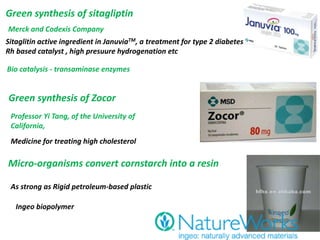
Green synthesis of sitagliptin
Merck and Codexis Company
Sitaglitin active ingredient in JanuviaTM, a treatment for type 2 diabetes
Rh based catalyst , high presuure hydrogenation etc
Bio catalysis - transaminase enzymes
Green synthesis of Zocor
Medicine for treating high cholesterol
Professor Yi Tang, of the University of
California,
Micro-organisms convert cornstarch into a resin
As strong as Rigid petroleum-based plastic
Ingeo biopolymer
Bio-degradable and Compostable Packaging solutions with
ecoflex
 Compostable polyester film that called "Ecoflex
 Biodegradable bags, "Ecovio®,"made of this film along with cassava
starch and calcium carbonate
 bags completely disintegrate into water, CO2, and biomass in industrial
composting systems
Oil-based "alkyd" paints give off large amounts of volatile organic compounds (VOCs)
Paint
Sefose® technology from P&G is prepared from natural, renewable feedstocks in a patented,
solventless process.
 Sherwin-Williams developed water-based acrylic alkyd paints with low VOCs that can be
made from recycled soda bottle plastic (PET), acrylics, and soybean oil.
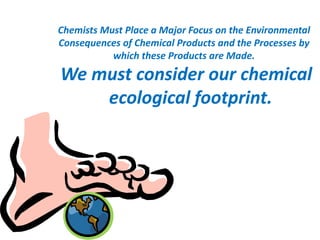
Chemists Must Place a Major Focus on the Environmental
Consequences of Chemical Products and the Processes by
which these Products are Made.
We must consider our chemical
ecological footprint.
12 principles of Green chemistry

12 principles of Green chemistry

  • 1.
    12 Principles ofGreen Chemistry (It’s Not Easy Being Green) Dr .Vijaykumar S. Marakatti National Post-Doctoral Fellow, JNCASR ,Bangalore
  • 2.
    1) History 2) 12principles in detail 3) Important Green Process OUTLINE
  • 3.
    U.S. Environmental ProtectionAgency -1970 Protecting human health and the environment - use of DDT and other chemical pesticides, Safe Drinking Water Act in 1974 HISTORY Love Canal Tragedy, NW Canal to connect Niagara river to the falls to generate electricity. Hooker Chemical Company - 82 different compounds, 11 of them suspected carcinogens -22, 000 tons 100 homes and a public school built Trees and gardens were turning black and dying entire swimming pool had been had been popped up from its foundation birth defects, increase of white cells – leukaemia
  • 4.
    Bhopal disaster, India 1984,methyl isocyanate – Nearly 25,000 death Seveso disaster, Italy (1976) Icmesa chemical Company 2,3,7,8-tetrachlorodibenzo-p-dioxin Chloracne
  • 5.
    12 tons -Mercury ethoxyethyl-hydroxyde- Fungicide Several tones of fishes were dead in Rhine river Schweizerhalle (Switzerland) Minamata, Japan Methyl mercury,- Fish – People. 1000 people died
  • 6.
    Organization for EconomicCo-operation and Development (OECD)- 1980 30 industrialized countries- Environmental protection Staff of the EPA Office of Pollution Prevention and Toxins, coined the phrase "Green Chemistry" and showed the seeds of productive collaboration between government, industry, and academia. Presidential Green Chemistry Challenge Awards – Bill Clinton 1990 1997 The University of Massachusetts at Boston established the field's first Green Chemistry Ph.D. program
  • 7.
    Green Chemistry Institute(GCI) Chemist, Dennis Hjeresen and Dr. Joe Breen The 12 Principles of Green Chemistry outlined within this work declared a philosophy that motivated academic and industrial scientists at the time and continues to guide the green chemistry movement. BOOK
  • 8.
    “The design ofchemical products and processes that are more environmentally benign and reduce negative impacts to human health and the environment.” Definition of Green Chemistry Green Chemistry is the utilization of a set of principles that reduces or eliminates the use of generation of hazardous substances in the design, manufacture and application of chemical product
  • 9.
    1 . Principle PreventWaste It is better to prevent waste than to treat or clean up waste after it has been created 1. Identify byproducts; quantify if possible 2. Report conversions, selectivity, and productivities 3. Establish a full mass balance for the process 4. Quantify catalyst and solvent losses
  • 10.
    2. Principle Atom Economy Syntheticmethods should be designed to maximize the incorporation of all materials used in the process into the final product X  
  • 11.
    Production of 2bottles of ibuprofen generated 3 bottles of waste!
  • 12.
    3 bottles ofibuprofen generate less than 1 bottle of waste!
  • 13.
    3. Principle Use andproduction of Less Hazardous Chemical Phosgene -toxic corrosive , large CH2Cl2 required, contaminated with Cl impurities. Polycarbonate Synthesis : Phosgene Process No Phosgene, CH2Cl2, high quality polymer
  • 14.
    4. Principle Designing saferchemicals Antifoulants Chronically toxic, to marine life , enter food chain and are bioaccumulative TBTO SeaNine® Reduces Fuel Consumption, high acute toxicity then chronic toxicity Chemical Product should be designed to preserve the efficiency of the function with less toxicity
  • 15.
    5. Principle Minimize theuse of solvents and auxiliaries Solvent Selection
  • 17.
  • 18.
    6. Principle Design forEnergy Efficiency Use of renewable Energy Sources
  • 19.
    7. Principle Use ofrenewable Feed stock A raw material or feedstock should be renewable rather than depleting whenever technically and economically practical.
  • 20.
    8. Principle Reduce Derivatives Unnecessaryderivatization (blocking group, protection/deprotection, temporary modification of physical/chemical processes) should be avoided whenever possible. 9. Principle Catalytic reagents are superior to stoichiometric reagents. • Reduces energy • Increases efficiency • Reduces by-product formation Design for Degradation 10. Principle can we recycle everything? design it so that it breaks down at the end of its useful lifetime.
  • 22.
    Nylon synthesis bygreen route
  • 23.
    11. Principle Real-time analysisfor Pollution Prevention Analytical methodologies need to be further developed to allow for real-time in-process monitoring and control prior to the formation of hazardous substances. 12. Principle Substances and the form of a substance used in a chemical process should be chosen so as to minimize the potential for chemical accidents, including releases, explosions, and fires. Inherently Safer Chemistry for Accident Prevention
  • 25.
    Noble Prizes inGreen Chemistry Ru based catalyst – Highly active , less steps for synthesis and all varieties sof olefin can be used . Green Solvents, normal T and P, less hazardous waste , Less energy Development of the metathesis method in organic synthesis Chauvin , Grubbs and Schrock-2005 Palladium-catalysed cross-couplings Reactions Heck, Suzuki-Miyaura and Negishi-2001 Water is used as s solvent replacing the organic solvents
  • 26.
    US EPA andthe ACS Green Chemistry Institute Computer Chips Water purification and consumption is an additional heavy burden. A typical plant processing 40,000 silicon wafers per month consumes several million gallons of water per day. –SC CO2 Los Alamos National Laboratory Presidential Green Chemistry Challenge Award. 8 billion–plus broilers, 3 billions pound waste. Feather based Computer chips Prof . Richard Wool Affordable Composites from Renewable Sources University of Nevada, Reno’s Renewable Energy Centre FUEL FROM CHICKEN FEATHERS Professor Manoranjan 153 million gallons of biodiesel annually in the U.S. and 593 million gallons worldwide.
  • 27.
    Green synthesis ofsitagliptin Merck and Codexis Company Sitaglitin active ingredient in JanuviaTM, a treatment for type 2 diabetes Rh based catalyst , high presuure hydrogenation etc Bio catalysis - transaminase enzymes Green synthesis of Zocor Medicine for treating high cholesterol Professor Yi Tang, of the University of California, Micro-organisms convert cornstarch into a resin As strong as Rigid petroleum-based plastic Ingeo biopolymer
  • 28.
    Bio-degradable and CompostablePackaging solutions with ecoflex  Compostable polyester film that called "Ecoflex  Biodegradable bags, "Ecovio®,"made of this film along with cassava starch and calcium carbonate  bags completely disintegrate into water, CO2, and biomass in industrial composting systems Oil-based "alkyd" paints give off large amounts of volatile organic compounds (VOCs) Paint Sefose® technology from P&G is prepared from natural, renewable feedstocks in a patented, solventless process.  Sherwin-Williams developed water-based acrylic alkyd paints with low VOCs that can be made from recycled soda bottle plastic (PET), acrylics, and soybean oil.
  • 29.
    Chemists Must Placea Major Focus on the Environmental Consequences of Chemical Products and the Processes by which these Products are Made. We must consider our chemical ecological footprint.