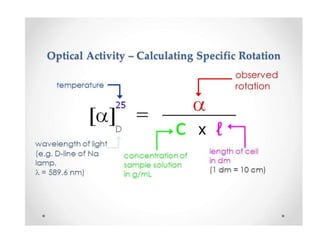
Specific Rotation
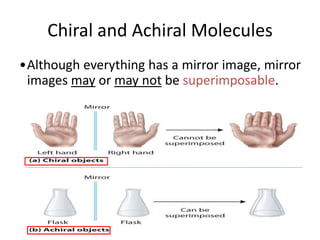
Chiral and Achiral Molecules
•Although everything has a mirror image, mirror
images may or may not be superimposable.
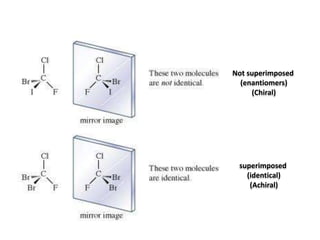
Not superimposed
(enantiomers)
(Chiral)
superimposed
(identical)
(Achiral)
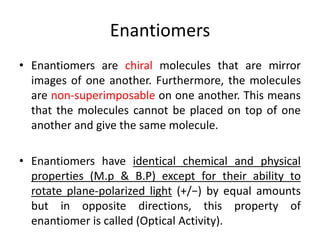
Enantiomers
• Enantiomers are chiral molecules that are mirror
images of one another. Furthermore, the molecules
are non-superimposable on one another. This means
that the molecules cannot be placed on top of one
another and give the same molecule.
• Enantiomers have identical chemical and physical
properties (M.p & B.P) except for their ability to
rotate plane-polarized light (+/−) by equal amounts
but in opposite directions, this property of
enantiomer is called (Optical Activity).
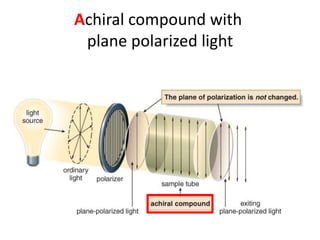
Achiral compound with
plane polarized light
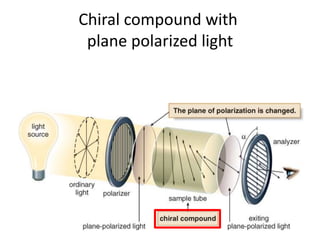
Chiral compound with
plane polarized light
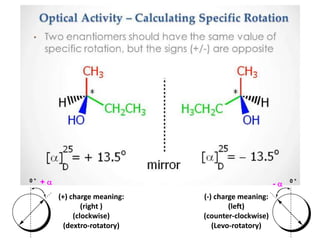
(+) charge meaning:
(right )
(clockwise)
(dextro-rotatory)
(-) charge meaning:
(left)
(counter-clockwise)
(Levo-rotatory)
0 ° +  0 °
- 
CH3 CH3
C
H
HO2C
HO
0 ° +  0 °
- 
CH3
C
H
HO
HO2C
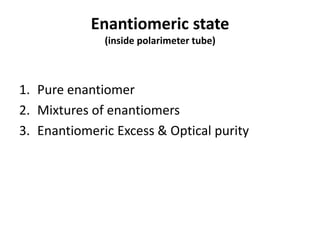
Enantiomeric state
(inside polarimeter tube)
1. Pure enantiomer
2. Mixtures of enantiomers
3. Enantiomeric Excess & Optical purity
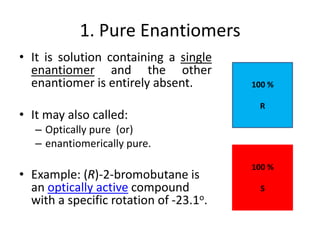
1. Pure Enantiomers
• It is solution containing a single
enantiomer and the other
enantiomer is entirely absent.
• It may also called:
– Optically pure (or)
– enantiomerically pure.
• Example: (R)-2-bromobutane is
an optically active compound
with a specific rotation of -23.1o.
100 %
R
100 %
S
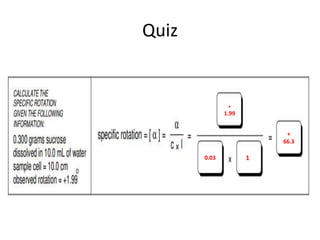
Quiz
+
1.99
0.03 1
+
66.3
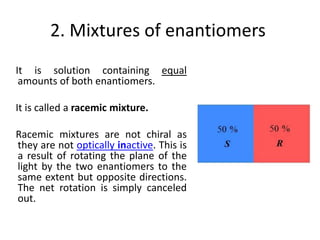
2. Mixtures of enantiomers
It is solution containing equal
amounts of both enantiomers.
It is called a racemic mixture.
Racemic mixtures are not chiral as
they are not optically inactive. This is
a result of rotating the plane of the
light by the two enantiomers to the
same extent but opposite directions.
The net rotation is simply canceled
out.
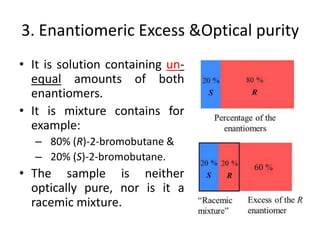
3. Enantiomeric Excess &Optical purity
• It is solution containing un-
equal amounts of both
enantiomers.
• It is mixture contains for
example:
– 80% (R)-2-bromobutane &
– 20% (S)-2-bromobutane.
• The sample is neither
optically pure, nor is it a
racemic mixture.
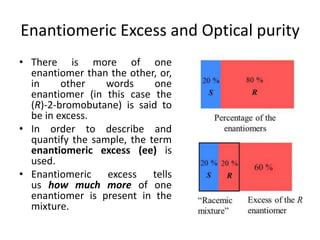
Enantiomeric Excess and Optical purity
• There is more of one
enantiomer than the other, or,
in other words one
enantiomer (in this case the
(R)-2-bromobutane) is said to
be in excess.
• In order to describe and
quantify the sample, the term
enantiomeric excess (ee) is
used.
• Enantiomeric excess tells
us how much more of one
enantiomer is present in the
mixture.
Enantiomeric Excess and Optical purity
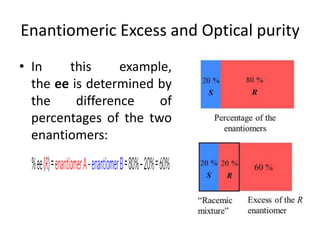
• In this example,
the ee is determined by
the difference of
percentages of the two
enantiomers:
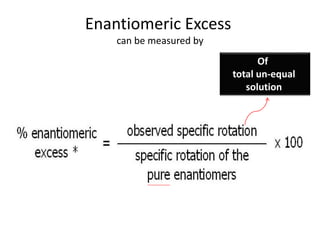
Enantiomeric Excess
can be measured by
Of
total un-equal
solution
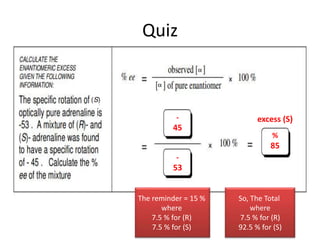
Quiz
-
45
-
53
%
85
(
excess (S
The reminder = 15 %
where
7.5 % for (R)
7.5 % for (S)
So, The Total
where
7.5 % for (R)
92.5 % for (S)

Enantiomeric excess (ee).pptx

  • 1.
  • 2.
    Chiral and AchiralMolecules •Although everything has a mirror image, mirror images may or may not be superimposable.
  • 3.
  • 4.
    Enantiomers • Enantiomers arechiral molecules that are mirror images of one another. Furthermore, the molecules are non-superimposable on one another. This means that the molecules cannot be placed on top of one another and give the same molecule. • Enantiomers have identical chemical and physical properties (M.p & B.P) except for their ability to rotate plane-polarized light (+/−) by equal amounts but in opposite directions, this property of enantiomer is called (Optical Activity).
  • 5.
  • 6.
  • 8.
    (+) charge meaning: (right) (clockwise) (dextro-rotatory) (-) charge meaning: (left) (counter-clockwise) (Levo-rotatory) 0 ° +  0 ° -  CH3 CH3 C H HO2C HO 0 ° +  0 ° -  CH3 C H HO HO2C
  • 9.
    Enantiomeric state (inside polarimetertube) 1. Pure enantiomer 2. Mixtures of enantiomers 3. Enantiomeric Excess & Optical purity
  • 10.
    1. Pure Enantiomers •It is solution containing a single enantiomer and the other enantiomer is entirely absent. • It may also called: – Optically pure (or) – enantiomerically pure. • Example: (R)-2-bromobutane is an optically active compound with a specific rotation of -23.1o. 100 % R 100 % S
  • 12.
  • 13.
    2. Mixtures ofenantiomers It is solution containing equal amounts of both enantiomers. It is called a racemic mixture. Racemic mixtures are not chiral as they are not optically inactive. This is a result of rotating the plane of the light by the two enantiomers to the same extent but opposite directions. The net rotation is simply canceled out.
  • 14.
    3. Enantiomeric Excess&Optical purity • It is solution containing un- equal amounts of both enantiomers. • It is mixture contains for example: – 80% (R)-2-bromobutane & – 20% (S)-2-bromobutane. • The sample is neither optically pure, nor is it a racemic mixture.
  • 15.
    Enantiomeric Excess andOptical purity • There is more of one enantiomer than the other, or, in other words one enantiomer (in this case the (R)-2-bromobutane) is said to be in excess. • In order to describe and quantify the sample, the term enantiomeric excess (ee) is used. • Enantiomeric excess tells us how much more of one enantiomer is present in the mixture.
  • 16.
    Enantiomeric Excess andOptical purity • In this example, the ee is determined by the difference of percentages of the two enantiomers:
  • 17.
    Enantiomeric Excess can bemeasured by Of total un-equal solution
  • 18.
    Quiz - 45 - 53 % 85 ( excess (S The reminder= 15 % where 7.5 % for (R) 7.5 % for (S) So, The Total where 7.5 % for (R) 92.5 % for (S)