Is Matter Around
Us Pure?
Classification of matter
Pure Substances
Elements
Mixture
Compounds
Solution
Concentration of a Solution
Physical Changes
Chemical Changes
Topics to be Covered
Classification of Matter
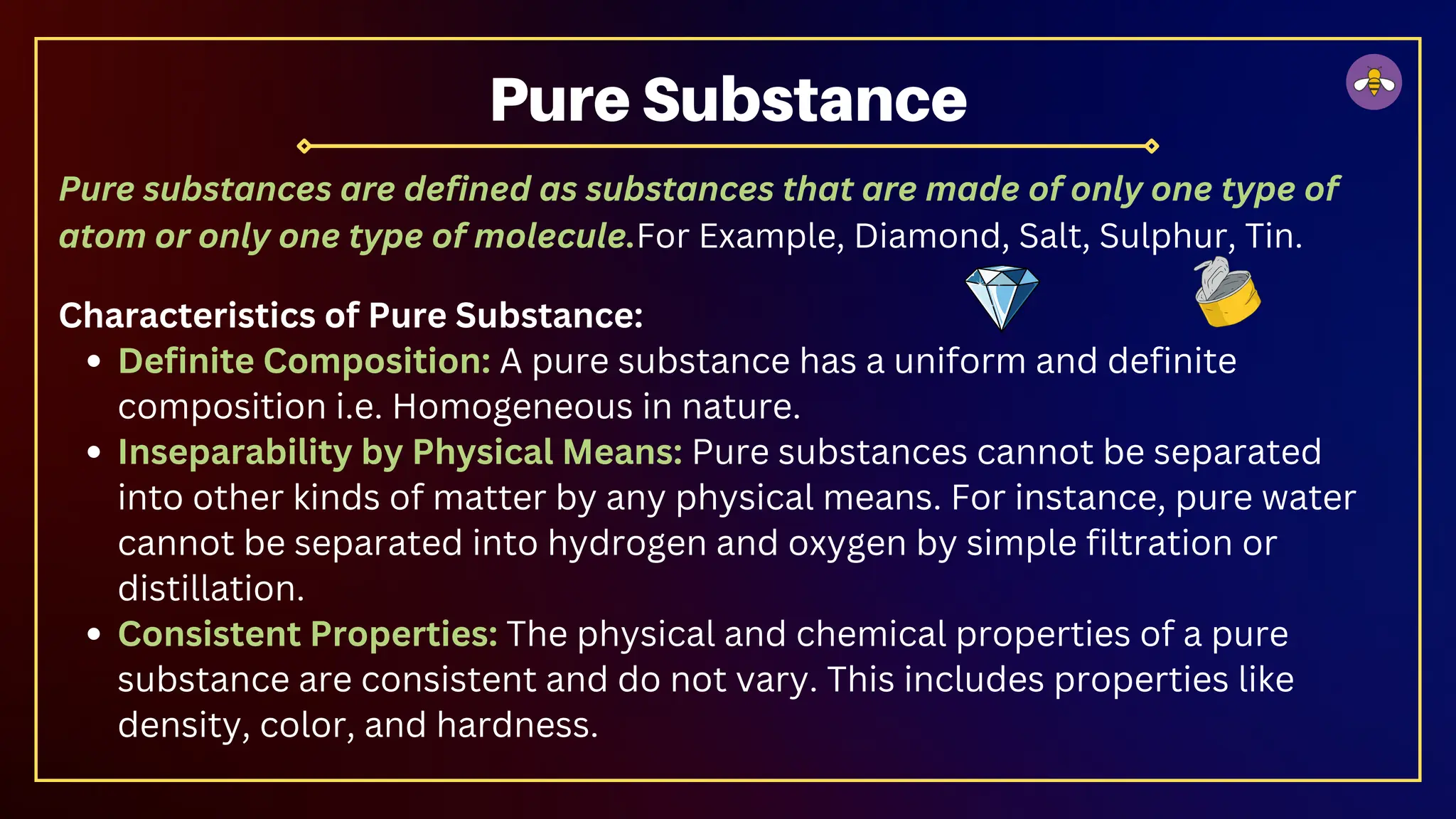
Pure substances are defined as substances that are made of only one type of
atom or only one type of molecule.For Example, Diamond, Salt, Sulphur, Tin.
Pure Substance
Characteristics of Pure Substance:
Definite Composition: A pure substance has a uniform and definite
composition i.e. Homogeneous in nature.
Inseparability by Physical Means: Pure substances cannot be separated
into other kinds of matter by any physical means. For instance, pure water
cannot be separated into hydrogen and oxygen by simple filtration or
distillation.
Consistent Properties: The physical and chemical properties of a pure
substance are consistent and do not vary. This includes properties like
density, color, and hardness.
Elements
Pure Substances
Compounds
Element is a basic form of matter
that cannot be broken down into
simpler substances by chemical
reactions.
e.g. Gold, Sodium, Iron, etc.
Compounds are chemical substances
made up of two or more elements that
are chemically bound together in a fixed
ratio.
e.g. Salt, Carbon dioxide etc.
chemical composition
Elements and Matter
Solid - Iron, copper, gold, silver
Liquid - bromine, mercury
Gas - oxygen, hydrogren
Metals Non Metals Metalloids
Elements
Periodic Table
Metals are lustrous (shiny)
Metals conduct heat and electricity
Metals have a silver-grey or gold-yellow colour
We can hammer metals and form thin sheets (Malleability)
We can convert metals into wires (Ductility)
Metals always produce a ringing sound if they are hit (Sonorous)
Properties of Metals
(i) They display a variety of colours.
(ii) They are poor conductors of heat and electricity.
(iii) They are not lustrous, sonorous or malleable.
Examples of non-metals are hydrogen, oxygen, iodine, carbon
(coal, coke), bromine, chlorine etc.
Properties of Non-Metals
Examples: Boron, silicon, germanium etc.
Properties of Metalloids
Elements having intermediate properties between those of metals
and non-metals are called metalloids.
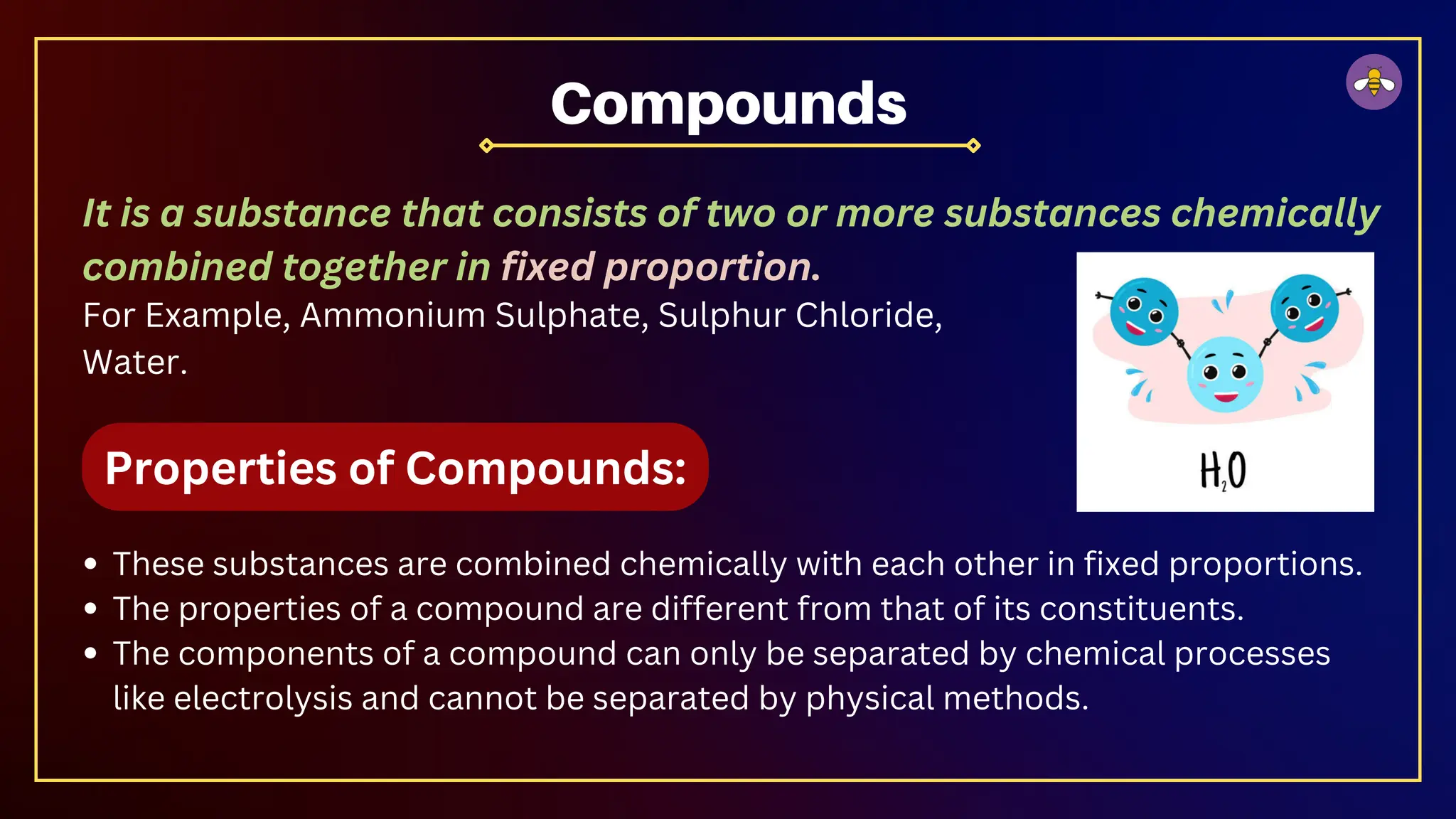
Compounds
It is a substance that consists of two or more substances chemically
combined together in fixed proportion.
For Example, Ammonium Sulphate, Sulphur Chloride,
Water.
These substances are combined chemically with each other in fixed proportions.
The properties of a compound are different from that of its constituents.
The components of a compound can only be separated by chemical processes
like electrolysis and cannot be separated by physical methods.
Properties of Compounds:
Water (H₂O) is a compound composed of two elements: hydrogen and
oxygen. In this compound, hydrogen (H) and oxygen (O) are present in a
fixed mass ratio of 1:8.
The atomic mass unit (amu) of hydrogen (H) is 1 amu.
The atomic mass unit (amu) of oxygen (O) is 16 amu.
There are 2 hydrogen atoms and 1 oxygen atom.
Therefore, the mass ratio of hydrogen to oxygen in water is
Is water an element or a compound?
2 X 1 amu 2
1 X 16 amu 16
= = 1 : 8
This fixed proportion is a characteristic property of compounds, indicating that
the elements in a compound are always combined in the same ratio by mass.
Q. Classify the following into elements, compounds and mixtures.
(a) Sodium
(b) Soil
(c) Sugar solution
(d) Silver
(e) Calcium carbonate
(f) Tin
(g) Silicon
(h) Coal
(i) Air
(j) Soap
(k) Methane
(l) Carbon dioxide
(m) Blood
Mixtures
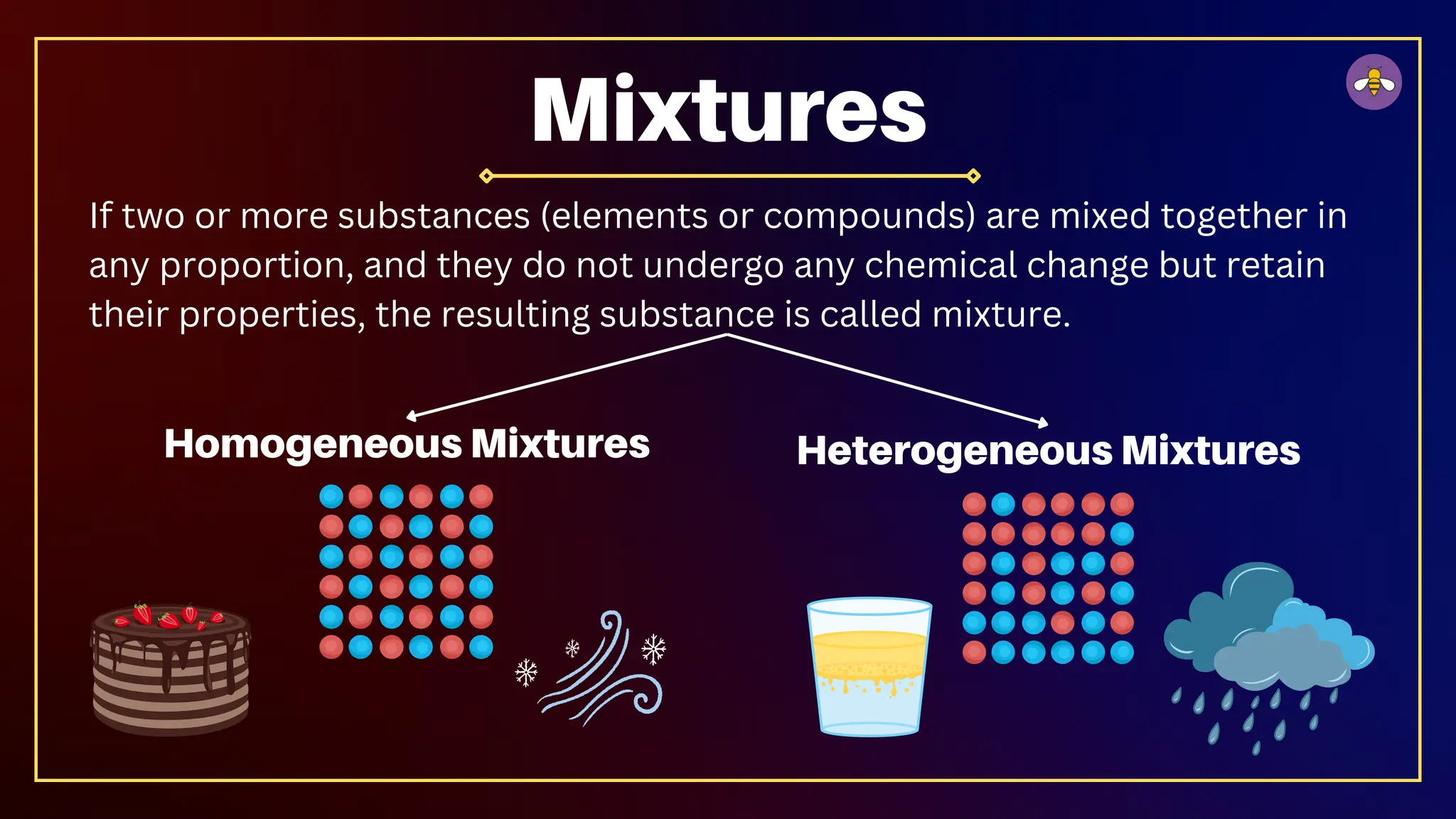
If two or more substances (elements or compounds) are mixed together in
any proportion, and they do not undergo any chemical change but retain
their properties, the resulting substance is called mixture.
Homogeneous Mixtures Heterogeneous Mixtures
Aspect Homogeneous Mixtures Heterogeneous Mixtures
Mixing of Components
Components are uniformly mixed
with no visible boundaries.
Components are not uniformly mixed
with visible boundaries.
Example Sugar in water. Oil and water.
Distribution of Components Uniformly distributed. Not uniformly distributed.
Separation of Components
Cannot be separated by physical
means.
Can be separated by physical means.
Variation in Composition
The ratio of compositions can vary,
e.g., different amounts of sugar in
lemonade.
Example: Sand in water, where sand
settles and can be separated by
filtration.
Differencebetweenhomogeneousand
heterogeneousmixture
Aspect Mixtures Compounds
Formation
Formed by physically mixing two or more
substances.
Formed by chemically combining two or
more elements.
Purity Considered impure substances. Considered pure substances.
Composition Variable composition. Fixed composition.
Nature Can be homogeneous or heterogeneous. Always homogeneous.
Separation Methods
Can be separated by physical methods (e.g.,
filtration).
Can only be separated by chemical or
electrochemical methods.
Retention of Properties Constituents retain their individual properties.
Constituents lose their individual properties;
the compound has unique properties.
Formation of New
Substances
No new substances are formed; properties
depend on the constituents.
A new substance is formed with different
properties from its constituents.
Melting and Boiling Points Do not have defined melting and boiling points. Have defined melting and boiling points.
DifferencebetweenMixture&Compounds
Are alloys mixtures or compound?
Alloys are combinations of two or more
metals or a metal and a non-metal. They
cannot be separated into their
components by physical methods. Despite
this, alloys are considered mixtures
because they retain the properties of their
constituent elements and can have
varying compositions.
For example, brass is an alloy made up of
about 30% zinc and 70% copper.
Homogeneous Mixtures
Solution (True Solution)
The particles are very small, less
than 1 nm (10^-9 m).
Transparent.
Particles cannot be separated by
filtration.
Does not scatter the beam of light.
Example: Salt-water.
Colloids (Colloidal Solution)
Particles are small, ranging from 1-
100 nm (10^-9 m to 10^-7 m).
Translucent.
Particles cannot be separated by
filtration.
Scatters a beam of light.
Example: Milk
Suspension
Particles are larger than 100 nm.
Opaque.
Particles can be separated by
filtration.
Scatters light significantly.
Example: Sand in water.
Heterogeneous Mixtures
Mixtures
Solution
Solute
The component(s) that is/are
dissolved in the solvent is/are
called solute(s).
Solvent
The component that dissolves
the other component is called
the solvent.
For example - In salt water solution, salt is
solute and water is solvent.
A solution is a
homogeneous mixture of
two or more substances.
Example - Sugar solution,
Salt water, Soft drinks,
Tea, Coffee, etc.
Q. Identify solute and solvent in 80% solution of ethyl alcohol with
water.
Concentration of a solution
A solution may have a small amount of solute dissolved in it while and
another solution may have large amount of solute dissolved in it.
The concentration of a solution is the amount of solute present in a
given amount of the solution.
Concentration of a solution
Solubility
The solubility of a solute in a solvent at a specific temperature refers
to the maximum amount of the solute that can dissolve in 100 grams
of the solvent at that temperature.
Q. To make a saturated solution, 36g of sodium chloride is
dissolved in 100g of water at 293 K. Find its concentration at this
temperature.
Q. A solution contains 60 g of sugar in 480 g of water. Calculate the
concentration of solution in terms of mass by mass percentage of
the solution.
(CBSE 2010, 2012)
Q. Pragya tested the solubility of three different substances at
different temperatures and collected the data as given below
(results are given in the following table, as grams of substance
dissolved in 100 grams of water to form a saturated solution).
(NCERT)
(a) What mass of potassium nitrate would be needed to produce a
saturated solution of potassium nitrate in 50 grams of water at 313
K?
(b) Pragya makes a saturated solution of potassium chloride in water
at 353 K and leaves the solution to cool at room temperature. What
would she observe as the solution cools? Explain.
(c) Find the solubility of each salt at 293 K. Which salt has the highest
solubility at this temperature?
(d) What is the effect of change of temperature on the solubility of a
salt?
Saturated solution
A saturated solution refers to a
solution where no additional
solute can be dissolved at a
specific temperature.
Unsaturated solution
An unsaturated solution refers to
a solution where more solute can
be dissolved at a specific
temperature.
Effect of temperature on a saturated solution
Case 1 : On increasing the temperature
Case 2 : On decreasing the temperature
In a colloid, particles of a substance are evenly spread throughout the
solution. These particles are larger than those in a solution but smaller than
those in a suspension. This makes a colloid seem uniform but it is actually a
blend of different components.
Colloidal solution
Component present in larger
proportion.
It is analogous to solvent of a
solution.
Dispersion medium
Dispersed Phase
Component present in smaller
proportion.
It is analogous to solute of a
solution.
Dispersed
Phase
Dispersing
Medium
Type Example
Liquid Gas Aerosol Fog, clouds, mist
Solid Gas Aerosol
Smoke,
automobile
exhaust
Gas Liquid Foam Shaving cream
Liquid Liquid Emulsion Milk, face cream
Dispersed
Phase
Dispersing
Medium
Type Example
Solid Liquid Sol
Milk of
magnesia, mud
Gas Solid Foam
Foam rubber,
sponge, pumice
Liquid Solid Gel
Jelly, cheese,
butter
Solid Solid Solid Sol
Coloured
gemstone,
milky glass
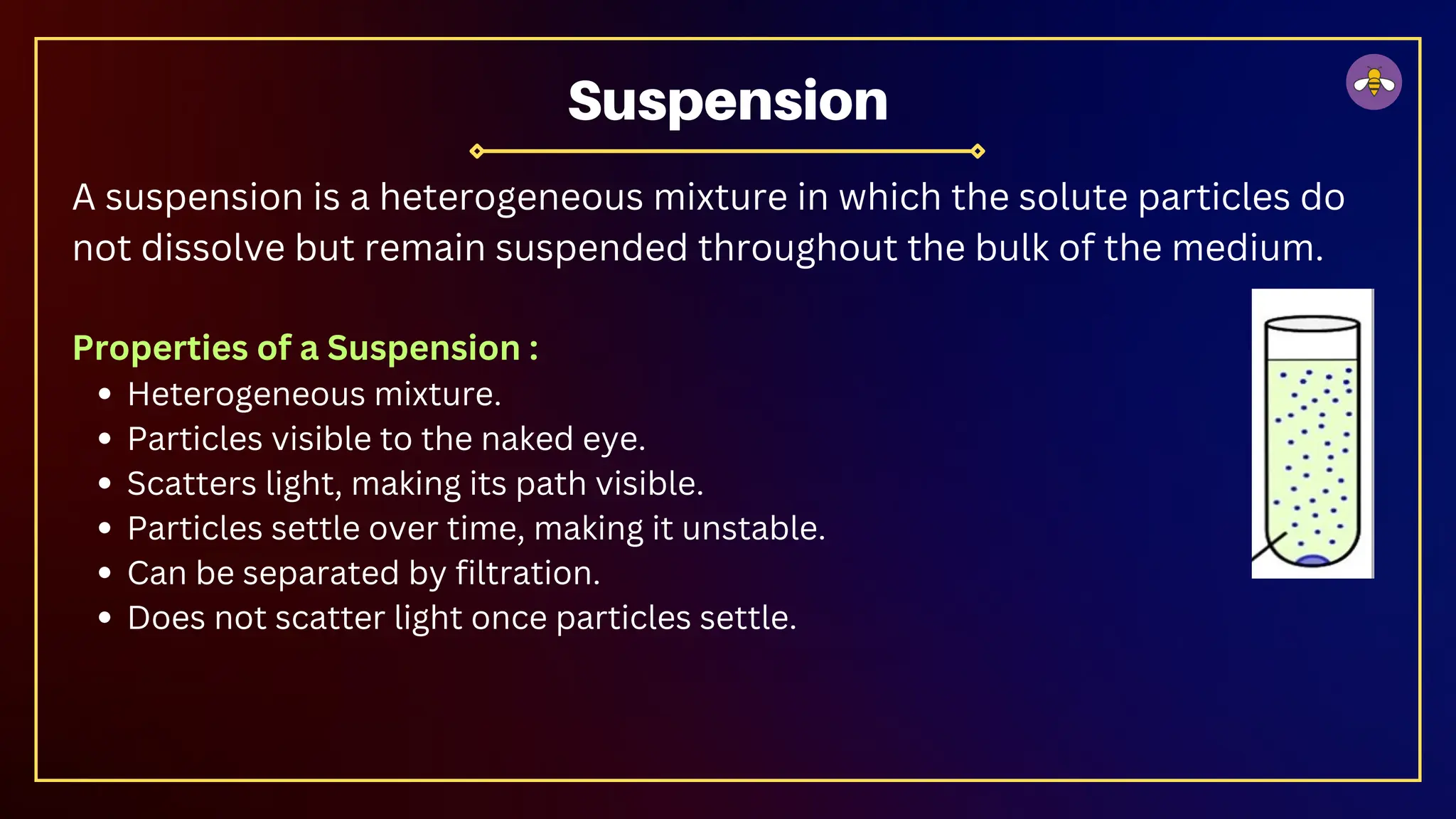
A suspension is a heterogeneous mixture in which the solute particles do
not dissolve but remain suspended throughout the bulk of the medium.
Properties of a Suspension :
Heterogeneous mixture.
Particles visible to the naked eye.
Scatters light, making its path visible.
Particles settle over time, making it unstable.
Can be separated by filtration.
Does not scatter light once particles settle.
Suspension
The phenomenon of scattering of a beam of light by colloidal particles,
when passed through a colloidal solution, is called the Tyndall effect.
Tyndall Effect
Physical Changes Chemical Changes
Changes that do not result in the formation of new
substances are referred to as physical changes.
Changes that result in the formation of new
substances are known as chemical changes.
During a physical change, the substances involved
do not alter their identity.
During a chemical change, the substances undergo
a transformation in their identity.
Physical changes can typically be reversed by
using a physical process, indicating that they are
usually reversible.
Chemical changes typically cannot revert to their
original form, indicating that they are generally
irreversible.
Changes in the physical state, size, and shape of a
substance are examples of physical changes.
Substances are converted into entirely new
substances during chemical changes.
Examples: melting of ice, chopping of vegetables,
boiling of water.
Examples: burning of magnesium, burning of paper,
rusting of iron.
Burning of a candle is a physical or chemical change?
Q. Which of the following are chemical changes?
(a) Growth of a plant
(b) Rusting of iron
(c) Mixing of iron filings and sand
(d) Cooking of food
(e) Digestion of food
(f) Freezing of water
(g) Burning of a candle.
1. Which of the following will show “Tyndall effect”?
a. Salt solution
b. Milk
c. Copper sulphate solution
d. Starch solution
TOP 5 Questions
2. Which of the following statement are true for pure substances?
(i) Pure substances contain only one kind of particles.
(ii) Pure substances may be compounds or mixtures.
(iii) Pure substances have the same composition throughout.
(iv) Pure Substances can be exemplified by all elements other than nickel.
a. (i) and (ii)
b. (i) and (iii)
c. (iii) and (iv)
d. (ii) and (iii)
TOP 5 Questions
3. Two substances, A and B, were made to react to form a third
substance, A₂B, according to the following reaction:
2A+B→ A₂B. Which of the following statements concerning this
reaction are incorrect?
a. The product, A₂B, shows the properties of substances A and B.
b. The product will always have a fixed composition.
c. The product cannot be classified as a compound.
d. The product formed is an element.
TOP 5 Questions
4. Mercury and Bromine are both
a. liquid at room temperature
b. solid at room temperature
c. gases at room
d. both (a) and (b)
TOP 5 Questions
5. Classify Brass and Diamond as element or mixture?
TOP 5 Questions
Class 9th- Is matter around us pure (Prashant Kirad).pdf

Class 9th- Is matter around us pure (Prashant Kirad).pdf

  • 1.
  • 2.
    Classification of matter PureSubstances Elements Mixture Compounds Solution Concentration of a Solution Physical Changes Chemical Changes Topics to be Covered
  • 3.
  • 4.
    Pure substances aredefined as substances that are made of only one type of atom or only one type of molecule.For Example, Diamond, Salt, Sulphur, Tin. Pure Substance Characteristics of Pure Substance: Definite Composition: A pure substance has a uniform and definite composition i.e. Homogeneous in nature. Inseparability by Physical Means: Pure substances cannot be separated into other kinds of matter by any physical means. For instance, pure water cannot be separated into hydrogen and oxygen by simple filtration or distillation. Consistent Properties: The physical and chemical properties of a pure substance are consistent and do not vary. This includes properties like density, color, and hardness.
  • 5.
    Elements Pure Substances Compounds Element isa basic form of matter that cannot be broken down into simpler substances by chemical reactions. e.g. Gold, Sodium, Iron, etc. Compounds are chemical substances made up of two or more elements that are chemically bound together in a fixed ratio. e.g. Salt, Carbon dioxide etc. chemical composition
  • 6.
    Elements and Matter Solid- Iron, copper, gold, silver Liquid - bromine, mercury Gas - oxygen, hydrogren Metals Non Metals Metalloids Elements
  • 7.
  • 8.
    Metals are lustrous(shiny) Metals conduct heat and electricity Metals have a silver-grey or gold-yellow colour We can hammer metals and form thin sheets (Malleability) We can convert metals into wires (Ductility) Metals always produce a ringing sound if they are hit (Sonorous) Properties of Metals
  • 9.
    (i) They displaya variety of colours. (ii) They are poor conductors of heat and electricity. (iii) They are not lustrous, sonorous or malleable. Examples of non-metals are hydrogen, oxygen, iodine, carbon (coal, coke), bromine, chlorine etc. Properties of Non-Metals Examples: Boron, silicon, germanium etc. Properties of Metalloids Elements having intermediate properties between those of metals and non-metals are called metalloids.
  • 10.
    Compounds It is asubstance that consists of two or more substances chemically combined together in fixed proportion. For Example, Ammonium Sulphate, Sulphur Chloride, Water. These substances are combined chemically with each other in fixed proportions. The properties of a compound are different from that of its constituents. The components of a compound can only be separated by chemical processes like electrolysis and cannot be separated by physical methods. Properties of Compounds:
  • 11.
    Water (H₂O) isa compound composed of two elements: hydrogen and oxygen. In this compound, hydrogen (H) and oxygen (O) are present in a fixed mass ratio of 1:8. The atomic mass unit (amu) of hydrogen (H) is 1 amu. The atomic mass unit (amu) of oxygen (O) is 16 amu. There are 2 hydrogen atoms and 1 oxygen atom. Therefore, the mass ratio of hydrogen to oxygen in water is Is water an element or a compound? 2 X 1 amu 2 1 X 16 amu 16 = = 1 : 8 This fixed proportion is a characteristic property of compounds, indicating that the elements in a compound are always combined in the same ratio by mass.
  • 12.
    Q. Classify thefollowing into elements, compounds and mixtures. (a) Sodium (b) Soil (c) Sugar solution (d) Silver (e) Calcium carbonate (f) Tin (g) Silicon (h) Coal (i) Air (j) Soap (k) Methane (l) Carbon dioxide (m) Blood
  • 13.
    Mixtures If two ormore substances (elements or compounds) are mixed together in any proportion, and they do not undergo any chemical change but retain their properties, the resulting substance is called mixture. Homogeneous Mixtures Heterogeneous Mixtures
  • 14.
    Aspect Homogeneous MixturesHeterogeneous Mixtures Mixing of Components Components are uniformly mixed with no visible boundaries. Components are not uniformly mixed with visible boundaries. Example Sugar in water. Oil and water. Distribution of Components Uniformly distributed. Not uniformly distributed. Separation of Components Cannot be separated by physical means. Can be separated by physical means. Variation in Composition The ratio of compositions can vary, e.g., different amounts of sugar in lemonade. Example: Sand in water, where sand settles and can be separated by filtration. Differencebetweenhomogeneousand heterogeneousmixture
  • 15.
    Aspect Mixtures Compounds Formation Formedby physically mixing two or more substances. Formed by chemically combining two or more elements. Purity Considered impure substances. Considered pure substances. Composition Variable composition. Fixed composition. Nature Can be homogeneous or heterogeneous. Always homogeneous. Separation Methods Can be separated by physical methods (e.g., filtration). Can only be separated by chemical or electrochemical methods. Retention of Properties Constituents retain their individual properties. Constituents lose their individual properties; the compound has unique properties. Formation of New Substances No new substances are formed; properties depend on the constituents. A new substance is formed with different properties from its constituents. Melting and Boiling Points Do not have defined melting and boiling points. Have defined melting and boiling points. DifferencebetweenMixture&Compounds
  • 16.
    Are alloys mixturesor compound? Alloys are combinations of two or more metals or a metal and a non-metal. They cannot be separated into their components by physical methods. Despite this, alloys are considered mixtures because they retain the properties of their constituent elements and can have varying compositions. For example, brass is an alloy made up of about 30% zinc and 70% copper.
  • 17.
    Homogeneous Mixtures Solution (TrueSolution) The particles are very small, less than 1 nm (10^-9 m). Transparent. Particles cannot be separated by filtration. Does not scatter the beam of light. Example: Salt-water. Colloids (Colloidal Solution) Particles are small, ranging from 1- 100 nm (10^-9 m to 10^-7 m). Translucent. Particles cannot be separated by filtration. Scatters a beam of light. Example: Milk Suspension Particles are larger than 100 nm. Opaque. Particles can be separated by filtration. Scatters light significantly. Example: Sand in water. Heterogeneous Mixtures Mixtures
  • 18.
    Solution Solute The component(s) thatis/are dissolved in the solvent is/are called solute(s). Solvent The component that dissolves the other component is called the solvent. For example - In salt water solution, salt is solute and water is solvent. A solution is a homogeneous mixture of two or more substances. Example - Sugar solution, Salt water, Soft drinks, Tea, Coffee, etc.
  • 19.
    Q. Identify soluteand solvent in 80% solution of ethyl alcohol with water.
  • 20.
    Concentration of asolution A solution may have a small amount of solute dissolved in it while and another solution may have large amount of solute dissolved in it. The concentration of a solution is the amount of solute present in a given amount of the solution.
  • 21.
  • 22.
    Solubility The solubility ofa solute in a solvent at a specific temperature refers to the maximum amount of the solute that can dissolve in 100 grams of the solvent at that temperature.
  • 23.
    Q. To makea saturated solution, 36g of sodium chloride is dissolved in 100g of water at 293 K. Find its concentration at this temperature.
  • 24.
    Q. A solutioncontains 60 g of sugar in 480 g of water. Calculate the concentration of solution in terms of mass by mass percentage of the solution. (CBSE 2010, 2012)
  • 25.
    Q. Pragya testedthe solubility of three different substances at different temperatures and collected the data as given below (results are given in the following table, as grams of substance dissolved in 100 grams of water to form a saturated solution). (NCERT)
  • 26.
    (a) What massof potassium nitrate would be needed to produce a saturated solution of potassium nitrate in 50 grams of water at 313 K? (b) Pragya makes a saturated solution of potassium chloride in water at 353 K and leaves the solution to cool at room temperature. What would she observe as the solution cools? Explain. (c) Find the solubility of each salt at 293 K. Which salt has the highest solubility at this temperature? (d) What is the effect of change of temperature on the solubility of a salt?
  • 27.
    Saturated solution A saturatedsolution refers to a solution where no additional solute can be dissolved at a specific temperature. Unsaturated solution An unsaturated solution refers to a solution where more solute can be dissolved at a specific temperature.
  • 28.
    Effect of temperatureon a saturated solution Case 1 : On increasing the temperature Case 2 : On decreasing the temperature
  • 29.
    In a colloid,particles of a substance are evenly spread throughout the solution. These particles are larger than those in a solution but smaller than those in a suspension. This makes a colloid seem uniform but it is actually a blend of different components. Colloidal solution Component present in larger proportion. It is analogous to solvent of a solution. Dispersion medium Dispersed Phase Component present in smaller proportion. It is analogous to solute of a solution.
  • 30.
    Dispersed Phase Dispersing Medium Type Example Liquid GasAerosol Fog, clouds, mist Solid Gas Aerosol Smoke, automobile exhaust Gas Liquid Foam Shaving cream Liquid Liquid Emulsion Milk, face cream
  • 31.
    Dispersed Phase Dispersing Medium Type Example Solid LiquidSol Milk of magnesia, mud Gas Solid Foam Foam rubber, sponge, pumice Liquid Solid Gel Jelly, cheese, butter Solid Solid Solid Sol Coloured gemstone, milky glass
  • 32.
    A suspension isa heterogeneous mixture in which the solute particles do not dissolve but remain suspended throughout the bulk of the medium. Properties of a Suspension : Heterogeneous mixture. Particles visible to the naked eye. Scatters light, making its path visible. Particles settle over time, making it unstable. Can be separated by filtration. Does not scatter light once particles settle. Suspension
  • 33.
    The phenomenon ofscattering of a beam of light by colloidal particles, when passed through a colloidal solution, is called the Tyndall effect. Tyndall Effect
  • 35.
    Physical Changes ChemicalChanges Changes that do not result in the formation of new substances are referred to as physical changes. Changes that result in the formation of new substances are known as chemical changes. During a physical change, the substances involved do not alter their identity. During a chemical change, the substances undergo a transformation in their identity. Physical changes can typically be reversed by using a physical process, indicating that they are usually reversible. Chemical changes typically cannot revert to their original form, indicating that they are generally irreversible. Changes in the physical state, size, and shape of a substance are examples of physical changes. Substances are converted into entirely new substances during chemical changes. Examples: melting of ice, chopping of vegetables, boiling of water. Examples: burning of magnesium, burning of paper, rusting of iron.
  • 36.
    Burning of acandle is a physical or chemical change?
  • 37.
    Q. Which ofthe following are chemical changes? (a) Growth of a plant (b) Rusting of iron (c) Mixing of iron filings and sand (d) Cooking of food (e) Digestion of food (f) Freezing of water (g) Burning of a candle.
  • 38.
    1. Which ofthe following will show “Tyndall effect”? a. Salt solution b. Milk c. Copper sulphate solution d. Starch solution TOP 5 Questions
  • 39.
    2. Which ofthe following statement are true for pure substances? (i) Pure substances contain only one kind of particles. (ii) Pure substances may be compounds or mixtures. (iii) Pure substances have the same composition throughout. (iv) Pure Substances can be exemplified by all elements other than nickel. a. (i) and (ii) b. (i) and (iii) c. (iii) and (iv) d. (ii) and (iii) TOP 5 Questions
  • 40.
    3. Two substances,A and B, were made to react to form a third substance, A₂B, according to the following reaction: 2A+B→ A₂B. Which of the following statements concerning this reaction are incorrect? a. The product, A₂B, shows the properties of substances A and B. b. The product will always have a fixed composition. c. The product cannot be classified as a compound. d. The product formed is an element. TOP 5 Questions
  • 41.
    4. Mercury andBromine are both a. liquid at room temperature b. solid at room temperature c. gases at room d. both (a) and (b) TOP 5 Questions
  • 42.
    5. Classify Brassand Diamond as element or mixture? TOP 5 Questions