Counting 
Functional Skills Maths
Counting 
• All mathematics is based on the very basic 
principle that one and one are equal to two. 
That two and one are equal to three. 
• Counting in itself is quite a monotonous task. 
• Many people find counting to be quite 
tedious as a result. 
• Counting is very important as it is the only 
way any other mathematics can be verified.
Counting 
• Counting doesn’t have to involve counting 
individual units – you can count in groups 
of units, fractions of units or in larger 
denominations such as tens or millions. 
• Counting does involve measuring in 
predefined fixed amounts. 
• Where a sequence is predefined but not 
fixed then this is a function.
Counting 
1 2 3 4 5 6 7 8 9 10 
2 4 6 8 10 12 14 16 18 20 
3 6 9 12 15 18 21 24 27 30 
4 8 12 16 20 24 28 32 36 40 
5 10 15 20 25 30 35 40 45 50 
6 12 18 24 30 36 42 48 54 60 
7 14 21 28 35 42 49 56 63 70 
8 16 24 32 40 48 56 64 72 80 
9 18 27 36 45 54 63 72 81 90 
10 20 30 40 50 60 70 80 90 100 
11 22 33 44 55 66 77 88 99 110 
12 24 36 48 60 72 84 96 108 120 
• All multiplication 
tables are based 
on counting. 
• Counting is a 
form of addition. 
• The number of 
times you count a 
number equal the 
amount you have 
to multiply it by 
to get that result.
Counting 
• Try counting the following number of buttons
Counting 
• Try counting the following number of buttons 
• There are 6 buttons
Counting 
• Try counting the following number of buttons
Counting 
• Try counting the following number of buttons 
• There are 10 buttons
Counting 
• Try counting the following number of buttons
Counting 
• Try counting the following number of buttons 
• There are 
68 buttons. 
• Even simply 
counting 
can be quite 
difficult.
Counting 
• Try counting the following number of buttons
Counting 
• Try counting the following number of buttons 
• I estimated that 
there were around 
800 buttons. 
• I counted two 1cm 
by 1cm squares and 
used this as the basis 
of my estimate.
Counting 
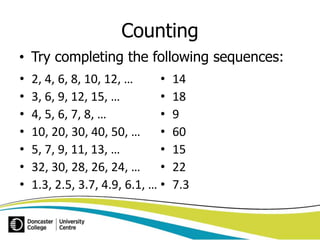
• Try completing the following sequences: 
• 2, 4, 6, 8, 10, 12, … 
• 3, 6, 9, 12, 15, … 
• 4, 5, 6, 7, 8, … 
• 10, 20, 30, 40, 50, … 
• 5, 7, 9, 11, 13, … 
• 32, 30, 28, 26, 24, … 
• 1.3, 2.5, 3.7, 4.9, 6.1, …
Counting 
• Try completing the following sequences: 
• 2, 4, 6, 8, 10, 12, … 
• 14 
• 3, 6, 9, 12, 15, … 
• 18 
• 4, 5, 6, 7, 8, … 
• 9 
• 10, 20, 30, 40, 50, … 
• 60 
• 5, 7, 9, 11, 13, … 
• 15 
• 32, 30, 28, 26, 24, … 
• 22 
• 1.3, 2.5, 3.7, 4.9, 6.1, … 
• 7.3
Counting 
• Write down all the numbers up to and 
including one hundred.
Counting 
• Write down all the numbers up to and 
including one hundred. 
• Pass the paper to the person next to you and 
ask them to highlight any mistakes you 
made. 
• Did you find the results surprising? 
• Did you use a method of laying out the 
numbers to help prevent you from making 
errors?
Counting 
• A lot of people think counting is easy but 
could you count quickly in an alternative 
number base? 
• For example computers these days often 
use a hexadecimal or binary code. 
• What are the hexadecimal and binary 
equivalents of the number 16 in the 
decimal sequence?
Sequences 
• If you run across a series of numbers that appear to 
have a natural order but that don’t change by a fixed 
amount then it is likely that there is a function 
controlling the sequence. 
• Functions are typically notated as f(x). 
• An example might be that f(x) = x2. 
x 1 2 3 4 5 6 7 8 9 
f(x) 1 4 9 16 25 36 49 64 81
Sequences 
• Given the functions see if you can 
complete the following sequences: 
x 1 2 3 4 5 6 7 8 9 
f(x) = 2x 
2 
4 
6 
8 
10 
12 
14 
16 
18 
x 1 2 3 4 5 6 7 8 9 
f(x) = 2x +1 
3 
5 
7 
9 
11 
13 
15 
17 
19 
x 1 2 3 4 5 6 7 8 9 
f(x) = 2(x + 1) 
4 
6 
8 
10 
12 
14 
16 
18 
20
Sequences 
• Given the functions see if you can 
complete the following sequences: 
x 1 2 3 4 5 6 7 8 9 
f(x) = 2x 2 4 6 8 10 12 14 16 18 
x 1 2 3 4 5 6 7 8 9 
f(x) = 2x +1 3 5 7 9 11 13 15 17 19 
x 1 2 3 4 5 6 7 8 9 
f(x) = 2(x + 1) 4 6 8 10 12 14 16 18 20
Sequences 
• You can see that the amount you count by 
each time is equal to the sum of any 
multiplications in the function. 
• Where you begin counting is equal to the 
sum of any additions in the function. 
• Two of the most common functions are: 
– f(x) = x2; also known as square numbers 
– f(x) = (x(x + 1)) ÷ 2; also known as triangular 
numbers
Counting 
• Counting is a very important part of all 
industries. 
• Most companies that deal in physical 
goods will have a number of teams which 
deal in counting goods. 
• Normally there will be a goods in 
department, a despatch team and a stock 
control department.
Counting 
• For these sorts of job role counting is so important 
that often the counts will be checked and double 
checked and then compared to data on the 
system. 
• For example, when goods go out whoever picks 
the goods counts how many they’ve picked. A 
checker will then check the goods once they’re in 
the bay. The loader will then count the goods on 
to the vehicle picking up the delivery and the 
driver will verify the count.
Counting 
• When your calculator or computer 
performs any type of action it uses 
counting to reach an outcome. 
• Like most activities the more you practice 
the better you get. Easy ways to practice 
might be to count reps when exercising or 
to count how many times you beat a 
friend in a competition.

Counting and Sequences

  • 1.
  • 2.
    Counting • Allmathematics is based on the very basic principle that one and one are equal to two. That two and one are equal to three. • Counting in itself is quite a monotonous task. • Many people find counting to be quite tedious as a result. • Counting is very important as it is the only way any other mathematics can be verified.
  • 3.
    Counting • Countingdoesn’t have to involve counting individual units – you can count in groups of units, fractions of units or in larger denominations such as tens or millions. • Counting does involve measuring in predefined fixed amounts. • Where a sequence is predefined but not fixed then this is a function.
  • 4.
    Counting 1 23 4 5 6 7 8 9 10 2 4 6 8 10 12 14 16 18 20 3 6 9 12 15 18 21 24 27 30 4 8 12 16 20 24 28 32 36 40 5 10 15 20 25 30 35 40 45 50 6 12 18 24 30 36 42 48 54 60 7 14 21 28 35 42 49 56 63 70 8 16 24 32 40 48 56 64 72 80 9 18 27 36 45 54 63 72 81 90 10 20 30 40 50 60 70 80 90 100 11 22 33 44 55 66 77 88 99 110 12 24 36 48 60 72 84 96 108 120 • All multiplication tables are based on counting. • Counting is a form of addition. • The number of times you count a number equal the amount you have to multiply it by to get that result.
  • 5.
    Counting • Trycounting the following number of buttons
  • 6.
    Counting • Trycounting the following number of buttons • There are 6 buttons
  • 7.
    Counting • Trycounting the following number of buttons
  • 8.
    Counting • Trycounting the following number of buttons • There are 10 buttons
  • 9.
    Counting • Trycounting the following number of buttons
  • 10.
    Counting • Trycounting the following number of buttons • There are 68 buttons. • Even simply counting can be quite difficult.
  • 11.
    Counting • Trycounting the following number of buttons
  • 12.
    Counting • Trycounting the following number of buttons • I estimated that there were around 800 buttons. • I counted two 1cm by 1cm squares and used this as the basis of my estimate.
  • 13.
    Counting • Trycompleting the following sequences: • 2, 4, 6, 8, 10, 12, … • 3, 6, 9, 12, 15, … • 4, 5, 6, 7, 8, … • 10, 20, 30, 40, 50, … • 5, 7, 9, 11, 13, … • 32, 30, 28, 26, 24, … • 1.3, 2.5, 3.7, 4.9, 6.1, …
  • 14.
    Counting • Trycompleting the following sequences: • 2, 4, 6, 8, 10, 12, … • 14 • 3, 6, 9, 12, 15, … • 18 • 4, 5, 6, 7, 8, … • 9 • 10, 20, 30, 40, 50, … • 60 • 5, 7, 9, 11, 13, … • 15 • 32, 30, 28, 26, 24, … • 22 • 1.3, 2.5, 3.7, 4.9, 6.1, … • 7.3
  • 15.
    Counting • Writedown all the numbers up to and including one hundred.
  • 16.
    Counting • Writedown all the numbers up to and including one hundred. • Pass the paper to the person next to you and ask them to highlight any mistakes you made. • Did you find the results surprising? • Did you use a method of laying out the numbers to help prevent you from making errors?
  • 17.
    Counting • Alot of people think counting is easy but could you count quickly in an alternative number base? • For example computers these days often use a hexadecimal or binary code. • What are the hexadecimal and binary equivalents of the number 16 in the decimal sequence?
  • 18.
    Sequences • Ifyou run across a series of numbers that appear to have a natural order but that don’t change by a fixed amount then it is likely that there is a function controlling the sequence. • Functions are typically notated as f(x). • An example might be that f(x) = x2. x 1 2 3 4 5 6 7 8 9 f(x) 1 4 9 16 25 36 49 64 81
  • 19.
    Sequences • Giventhe functions see if you can complete the following sequences: x 1 2 3 4 5 6 7 8 9 f(x) = 2x 2 4 6 8 10 12 14 16 18 x 1 2 3 4 5 6 7 8 9 f(x) = 2x +1 3 5 7 9 11 13 15 17 19 x 1 2 3 4 5 6 7 8 9 f(x) = 2(x + 1) 4 6 8 10 12 14 16 18 20
  • 20.
    Sequences • Giventhe functions see if you can complete the following sequences: x 1 2 3 4 5 6 7 8 9 f(x) = 2x 2 4 6 8 10 12 14 16 18 x 1 2 3 4 5 6 7 8 9 f(x) = 2x +1 3 5 7 9 11 13 15 17 19 x 1 2 3 4 5 6 7 8 9 f(x) = 2(x + 1) 4 6 8 10 12 14 16 18 20
  • 21.
    Sequences • Youcan see that the amount you count by each time is equal to the sum of any multiplications in the function. • Where you begin counting is equal to the sum of any additions in the function. • Two of the most common functions are: – f(x) = x2; also known as square numbers – f(x) = (x(x + 1)) ÷ 2; also known as triangular numbers
  • 22.
    Counting • Countingis a very important part of all industries. • Most companies that deal in physical goods will have a number of teams which deal in counting goods. • Normally there will be a goods in department, a despatch team and a stock control department.
  • 23.
    Counting • Forthese sorts of job role counting is so important that often the counts will be checked and double checked and then compared to data on the system. • For example, when goods go out whoever picks the goods counts how many they’ve picked. A checker will then check the goods once they’re in the bay. The loader will then count the goods on to the vehicle picking up the delivery and the driver will verify the count.
  • 24.
    Counting • Whenyour calculator or computer performs any type of action it uses counting to reach an outcome. • Like most activities the more you practice the better you get. Easy ways to practice might be to count reps when exercising or to count how many times you beat a friend in a competition.