Force
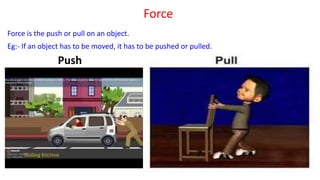
Force is the push or pull on an object.
Eg:- If an object has to be moved, it has to be pushed or pulled.
Push
Forces are due to interaction
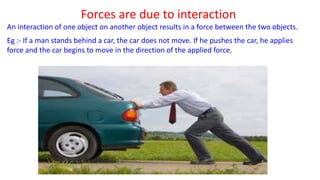
An interaction of one object on another object results in a force between the two objects.
Eg :- If a man stands behind a car, the car does not move. If he pushes the car, he applies
force and the car begins to move in the direction of the applied force.
Effects of force on an object
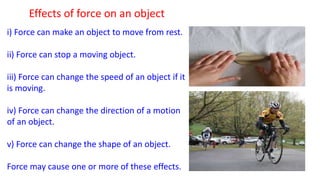
i) Force can make an object to move from rest.
ii) Force can stop a moving object.
iii) Force can change the speed of an object if it
is moving.
iv) Force can change the direction of a motion
of an object.
v) Force can change the shape of an object.
Force may cause one or more of these effects.
Types of Forces
Pressure
Pressure is the force acting on unit area of a surface.
Force
Pressure = ----------
Area
If the area is smaller the pressure is more on the
surface for the same force.
Eg :- It is easier to push a nail into a wooden plank by
its pointed end than its head because the pressure is
more.
It is easier to cut vegetables with a sharp knife than a
blunt knife because the pressure is more.
Shoulder bags have broad and not thin straps to reduce
pressure.
Applications
The decrease in the pressure, of a given force, through an increase in the
surface area over which the force acts, finds many applications in our day
to day life.
Example:
1. Rear wheels of buses and trucks are usually double.
2. High rise buildings and dams have wide base.
3. Tanks and bulldozers are fitted with caterpillar tracks rather than
wheels.
4. Railway tracks are laid on large side sized wooden/iron sleepers.
Liquid Pressure
The Pressure exerted by a stationary liquid (kept
in a container), at any point inside the liquid, is
known as hydrostatic (liquid) pressure.
• Liquids exert pressure on the walls of a
container.
• Liquids exert pressure on the bottom of a
container. It depends upon the height of the
liquid column.
• Liquids exert sideways pressure.
• Liquids exert equal pressure at the same
height.
Atmospheric Pressure
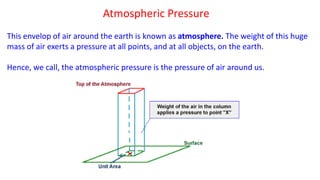
This envelop of air around the earth is known as atmosphere. The weight of this huge
mass of air exerts a pressure at all points, and at all objects, on the earth.
Hence, we call, the atmospheric pressure is the pressure of air around us.
Variation in Air Pressure
As we move upwards through the atmosphere, the height of air column, above us,
would decrease. This would result in a decrease in air pressure at higher attitudes. In
fact, when we move towards higher attitudes, breathing becomes difficult. Sometimes
bleeding from nose may also occur. Most climbers, who attempt to scale high range
mountains, (like Mount Everest), need to carry oxygen cylinders with them. For this
very reason, aircrafts “pressurized cabins.” The air pressure, in these is increased to a
(sufficient) value that safeguards the passengers and the crew.
Air pressure also varies with time, and the temperature, at a given place.
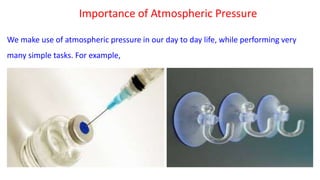
Importance of Atmospheric Pressure
We make use of atmospheric pressure in our day to day life, while performing very
many simple tasks. For example,
Force & Pressure

Force & Pressure

  • 1.
    Force Force is thepush or pull on an object. Eg:- If an object has to be moved, it has to be pushed or pulled. Push
  • 2.
    Forces are dueto interaction An interaction of one object on another object results in a force between the two objects. Eg :- If a man stands behind a car, the car does not move. If he pushes the car, he applies force and the car begins to move in the direction of the applied force.
  • 3.
    Effects of forceon an object i) Force can make an object to move from rest. ii) Force can stop a moving object. iii) Force can change the speed of an object if it is moving. iv) Force can change the direction of a motion of an object. v) Force can change the shape of an object. Force may cause one or more of these effects.
  • 5.
  • 6.
    Pressure Pressure is theforce acting on unit area of a surface. Force Pressure = ---------- Area If the area is smaller the pressure is more on the surface for the same force. Eg :- It is easier to push a nail into a wooden plank by its pointed end than its head because the pressure is more. It is easier to cut vegetables with a sharp knife than a blunt knife because the pressure is more. Shoulder bags have broad and not thin straps to reduce pressure.
  • 7.
    Applications The decrease inthe pressure, of a given force, through an increase in the surface area over which the force acts, finds many applications in our day to day life. Example: 1. Rear wheels of buses and trucks are usually double. 2. High rise buildings and dams have wide base. 3. Tanks and bulldozers are fitted with caterpillar tracks rather than wheels. 4. Railway tracks are laid on large side sized wooden/iron sleepers.
  • 8.
    Liquid Pressure The Pressureexerted by a stationary liquid (kept in a container), at any point inside the liquid, is known as hydrostatic (liquid) pressure. • Liquids exert pressure on the walls of a container. • Liquids exert pressure on the bottom of a container. It depends upon the height of the liquid column. • Liquids exert sideways pressure. • Liquids exert equal pressure at the same height.
  • 9.
    Atmospheric Pressure This envelopof air around the earth is known as atmosphere. The weight of this huge mass of air exerts a pressure at all points, and at all objects, on the earth. Hence, we call, the atmospheric pressure is the pressure of air around us.
  • 10.
    Variation in AirPressure As we move upwards through the atmosphere, the height of air column, above us, would decrease. This would result in a decrease in air pressure at higher attitudes. In fact, when we move towards higher attitudes, breathing becomes difficult. Sometimes bleeding from nose may also occur. Most climbers, who attempt to scale high range mountains, (like Mount Everest), need to carry oxygen cylinders with them. For this very reason, aircrafts “pressurized cabins.” The air pressure, in these is increased to a (sufficient) value that safeguards the passengers and the crew. Air pressure also varies with time, and the temperature, at a given place.
  • 11.
    Importance of AtmosphericPressure We make use of atmospheric pressure in our day to day life, while performing very many simple tasks. For example,