Number
What are numbers?
Numbers are basically a set of standard symbols, numerals,
that represent quantities. In addition to their use in counting
and measuring, numerals are often used for labels (as with
telephone numbers), for ordering (as with serial numbers),
and for codes (as with ISBNs).
Digits
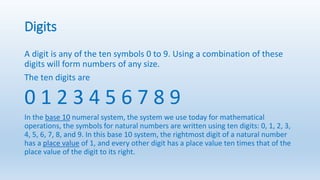
A digit is any of the ten symbols 0 to 9. Using a combination of these
digits will form numbers of any size.
The ten digits are
0 1 2 3 4 5 6 7 8 9
In the base 10 numeral system, the system we use today for mathematical
operations, the symbols for natural numbers are written using ten digits: 0, 1, 2, 3,
4, 5, 6, 7, 8, and 9. In this base 10 system, the rightmost digit of a natural number
has a place value of 1, and every other digit has a place value ten times that of the
place value of the digit to its right.
Number – Place Value
Our system of writing numbers is called the decimal system, because it
is based on ten, the number of fingers and thumbs we have.
The decimal system uses the digits 0 1 2 3 4 5 6 7 8 9
The place of the digit in a number tells you the value of that digit.
Place Value
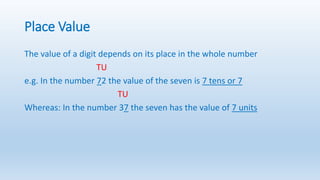
The value of a digit depends on its place in the whole number
TU
e.g. In the number 72 the value of the seven is 7 tens or 7
TU
Whereas: In the number 37 the seven has the value of 7 units
Practice – Place Value
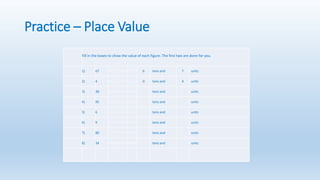
Fill in the boxes to show the value of each figure. The first two are done for you.
1) 67 6 tens and 7 units
2) 4 0 tens and 4 units
3) 28 tens and units
4) 95 tens and units
5) 6 tens and units
6) 9 tens and units
7) 80 tens and units
8) 34 tens and units
Place Value
To work out the value of large numbers we can put the figures in
columns, with the value of each column at the top.
• Examples
Six thousand, two hundred and forty five
Thousands
(Th)
Hundreds
(H)
Tens
(T)
Units
(U)
6 2 4 5
Place Value
Numbers with Zeros
The zero in a number plays a very important part in deciding its value
Four hundred is written:
H T U
4 0 0
We need to put in two zeros to show that it is four hundred and not just four, the
zero is known as the place holder and occupies that column
Place Value
Numbers with Zeros
Six hundred and seven is written:
H T U
6 0 7
We need the zero to show that there are no tens
Practice - Place Value
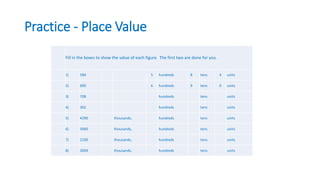
Fill in the boxes to show the value of each figure. The first two are done for you.
1) 584 5 hundreds 8 tens 4 units
2) 690 6 hundreds 9 tens 0 units
3) 708 hundreds tens units
4) 302 hundreds tens units
5) 4290 thousands, hundreds tens units
6) 5060 thousands, hundreds tens units
7) 2100 thousands, hundreds tens units
8) 3009 thousands, hundreds tens units
Larger numbers
The number 87 529 has 8 ten thousands, 7 thousands, 2 tens and 9 units
Eighty-seven thousand, five hundred and twenty-nine
Billions
Hundredmillion
Tenmillion
Millions
Hundredthousands
Tenthousands
Thousands
Hundreds
Tens
Units
B H M T M M H Th T Th Th H T U
8 7 5 2 9

Number – place value

  • 1.
  • 2.
    What are numbers? Numbersare basically a set of standard symbols, numerals, that represent quantities. In addition to their use in counting and measuring, numerals are often used for labels (as with telephone numbers), for ordering (as with serial numbers), and for codes (as with ISBNs).
  • 3.
    Digits A digit isany of the ten symbols 0 to 9. Using a combination of these digits will form numbers of any size. The ten digits are 0 1 2 3 4 5 6 7 8 9 In the base 10 numeral system, the system we use today for mathematical operations, the symbols for natural numbers are written using ten digits: 0, 1, 2, 3, 4, 5, 6, 7, 8, and 9. In this base 10 system, the rightmost digit of a natural number has a place value of 1, and every other digit has a place value ten times that of the place value of the digit to its right.
  • 4.
    Number – PlaceValue Our system of writing numbers is called the decimal system, because it is based on ten, the number of fingers and thumbs we have. The decimal system uses the digits 0 1 2 3 4 5 6 7 8 9 The place of the digit in a number tells you the value of that digit.
  • 5.
    Place Value The valueof a digit depends on its place in the whole number TU e.g. In the number 72 the value of the seven is 7 tens or 7 TU Whereas: In the number 37 the seven has the value of 7 units
  • 6.
    Practice – PlaceValue Fill in the boxes to show the value of each figure. The first two are done for you. 1) 67 6 tens and 7 units 2) 4 0 tens and 4 units 3) 28 tens and units 4) 95 tens and units 5) 6 tens and units 6) 9 tens and units 7) 80 tens and units 8) 34 tens and units
  • 7.
    Place Value To workout the value of large numbers we can put the figures in columns, with the value of each column at the top. • Examples Six thousand, two hundred and forty five Thousands (Th) Hundreds (H) Tens (T) Units (U) 6 2 4 5
  • 8.
    Place Value Numbers withZeros The zero in a number plays a very important part in deciding its value Four hundred is written: H T U 4 0 0 We need to put in two zeros to show that it is four hundred and not just four, the zero is known as the place holder and occupies that column
  • 9.
    Place Value Numbers withZeros Six hundred and seven is written: H T U 6 0 7 We need the zero to show that there are no tens
  • 10.
    Practice - PlaceValue Fill in the boxes to show the value of each figure. The first two are done for you. 1) 584 5 hundreds 8 tens 4 units 2) 690 6 hundreds 9 tens 0 units 3) 708 hundreds tens units 4) 302 hundreds tens units 5) 4290 thousands, hundreds tens units 6) 5060 thousands, hundreds tens units 7) 2100 thousands, hundreds tens units 8) 3009 thousands, hundreds tens units
  • 11.
    Larger numbers The number87 529 has 8 ten thousands, 7 thousands, 2 tens and 9 units Eighty-seven thousand, five hundred and twenty-nine Billions Hundredmillion Tenmillion Millions Hundredthousands Tenthousands Thousands Hundreds Tens Units B H M T M M H Th T Th Th H T U 8 7 5 2 9