Introduction to Chemical
Reactions
Making new substances
Main Ideas
Chemical Reactions are represented by Chemical
Equations.
Chemical Equations are balanced to show the same
number of atoms of each element on each side.
The Law of Conservation of Mass says that atoms
won’t be created or destroyed in a chemical reaction.
That is why you have to balance chemical equations!
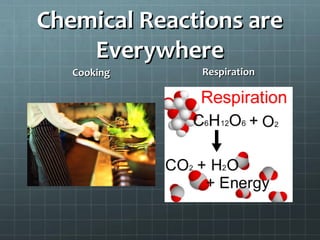
Chemical Reactions are
Everywhere
Cooking

Respiration
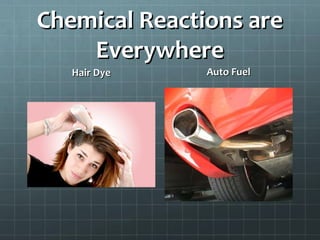
Chemical Reactions are
Everywhere
Hair Dye

Auto Fuel
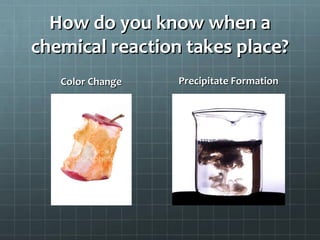
How do you know when a
chemical reaction takes place?
Color Change

Precipitate Formation
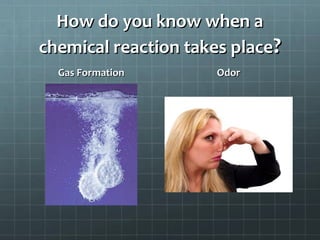
How do you know when a
chemical reaction takes place?
Gas Formation

Odor
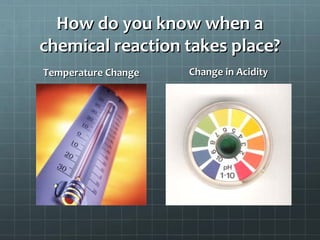
How do you know when a
chemical reaction takes place?
Temperature Change

Change in Acidity
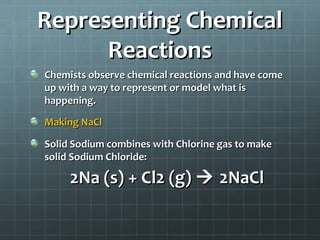
Representing Chemical
Reactions
Chemists observe chemical reactions and have come
up with a way to represent or model what is
happening.
Making NaCl
Solid Sodium combines with Chlorine gas to make
solid Sodium Chloride:

2Na (s) + Cl2 (g)  2NaCl
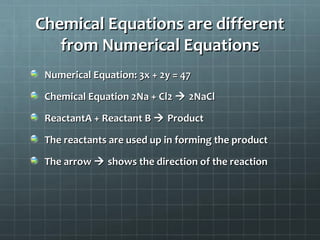
Chemical Equations are different
from Numerical Equations
Numerical Equation: 3x + 2y = 47
Chemical Equation 2Na + Cl2  2NaCl
ReactantA + Reactant B  Product
The reactants are used up in forming the product
The arrow  shows the direction of the reaction
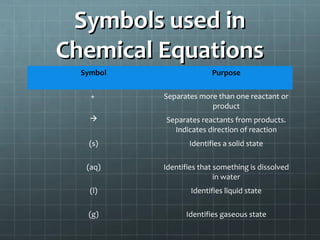
Symbols used in
Chemical Equations
Symbol

Purpose

+

Separates more than one reactant or
product



Separates reactants from products.
Indicates direction of reaction

(s)

Identifies a solid state

(aq)

Identifies that something is dissolved
in water

(l)

Identifies liquid state

(g)

Identifies gaseous state
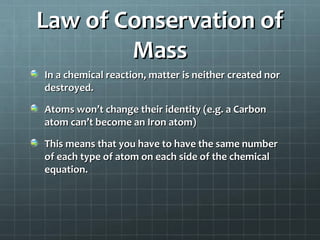
Law of Conservation of
Mass
In a chemical reaction, matter is neither created nor
destroyed.
Atoms won’t change their identity (e.g. a Carbon
atom can’t become an Iron atom)
This means that you have to have the same number
of each type of atom on each side of the chemical
equation.
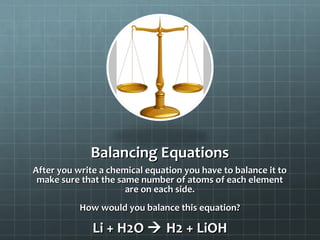
Balancing Equations
After you write a chemical equation you have to balance it to
make sure that the same number of atoms of each element
are on each side.
How would you balance this equation?

Li + H2O  H2 + LiOH
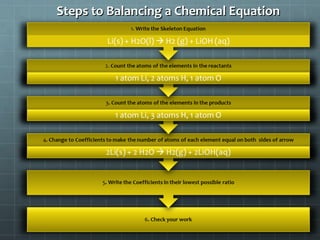
Steps to Balancing a Chemical Equation
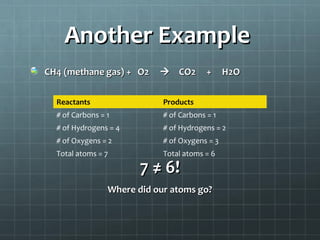
Another Example
CH4 (methane gas) + O2

 CO2

+

H2O

Reactants

Products

# of Carbons = 1

# of Carbons = 1

# of Hydrogens = 4

# of Hydrogens = 2

# of Oxygens = 2

# of Oxygens = 3

Total atoms = 7

Total atoms = 6

7 ≠ 6!

Where did our atoms go?
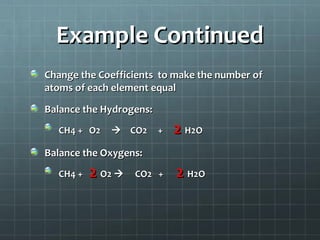
Example Continued
Change the Coefficients to make the number of
atoms of each element equal
Balance the Hydrogens:
CH4 + O2

+

2 H2O

CO2 +

2 H2O

 CO2

Balance the Oxygens:
CH4 +

2 O2 
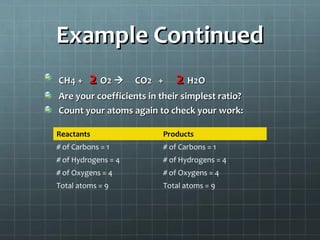
Example Continued
CH4 +

2 O2 

CO2 +

2 H2O

Are your coefficients in their simplest ratio?
Count your atoms again to check your work:
Reactants

Products

# of Carbons = 1

# of Carbons = 1

# of Hydrogens = 4

# of Hydrogens = 4

# of Oxygens = 4

# of Oxygens = 4

Total atoms = 9

Total atoms = 9
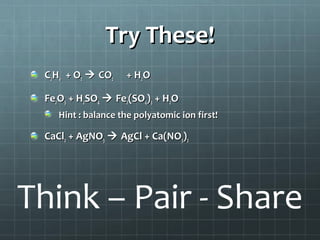
Try These!
C2H6 + O2  CO2

+ H2O

Fe2O3 + H2SO4  Fe2(SO4)3 + H2O
Hint : balance the polyatomic ion first!

CaCl2 + AgNO3  AgCl + Ca(NO3)2

Think – Pair - Share
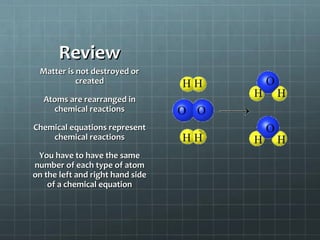
Review
Matter is not destroyed or
created
Atoms are rearranged in
chemical reactions
Chemical equations represent
chemical reactions
You have to have the same
number of each type of atom
on the left and right hand side
of a chemical equation
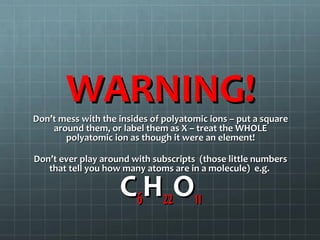
WARNING!

Don’t mess with the insides of polyatomic ions – put a square
around them, or label them as X – treat the WHOLE
polyatomic ion as though it were an element!
Don’t ever play around with subscripts (those little numbers
that tell you how many atoms are in a molecule) e.g.

C6H22O11

Intro to chemical reactions

  • 1.
  • 2.
    Main Ideas Chemical Reactionsare represented by Chemical Equations. Chemical Equations are balanced to show the same number of atoms of each element on each side. The Law of Conservation of Mass says that atoms won’t be created or destroyed in a chemical reaction. That is why you have to balance chemical equations!
  • 3.
  • 4.
  • 5.
    How do youknow when a chemical reaction takes place? Color Change Precipitate Formation
  • 6.
    How do youknow when a chemical reaction takes place? Gas Formation Odor
  • 7.
    How do youknow when a chemical reaction takes place? Temperature Change Change in Acidity
  • 8.
    Representing Chemical Reactions Chemists observechemical reactions and have come up with a way to represent or model what is happening. Making NaCl Solid Sodium combines with Chlorine gas to make solid Sodium Chloride: 2Na (s) + Cl2 (g)  2NaCl
  • 9.
    Chemical Equations aredifferent from Numerical Equations Numerical Equation: 3x + 2y = 47 Chemical Equation 2Na + Cl2  2NaCl ReactantA + Reactant B  Product The reactants are used up in forming the product The arrow  shows the direction of the reaction
  • 10.
    Symbols used in ChemicalEquations Symbol Purpose + Separates more than one reactant or product  Separates reactants from products. Indicates direction of reaction (s) Identifies a solid state (aq) Identifies that something is dissolved in water (l) Identifies liquid state (g) Identifies gaseous state
  • 11.
    Law of Conservationof Mass In a chemical reaction, matter is neither created nor destroyed. Atoms won’t change their identity (e.g. a Carbon atom can’t become an Iron atom) This means that you have to have the same number of each type of atom on each side of the chemical equation.
  • 12.
    Balancing Equations After youwrite a chemical equation you have to balance it to make sure that the same number of atoms of each element are on each side. How would you balance this equation? Li + H2O  H2 + LiOH
  • 13.
    Steps to Balancinga Chemical Equation
  • 14.
    Another Example CH4 (methanegas) + O2  CO2 + H2O Reactants Products # of Carbons = 1 # of Carbons = 1 # of Hydrogens = 4 # of Hydrogens = 2 # of Oxygens = 2 # of Oxygens = 3 Total atoms = 7 Total atoms = 6 7 ≠ 6! Where did our atoms go?
  • 15.
    Example Continued Change theCoefficients to make the number of atoms of each element equal Balance the Hydrogens: CH4 + O2 + 2 H2O CO2 + 2 H2O  CO2 Balance the Oxygens: CH4 + 2 O2 
  • 16.
    Example Continued CH4 + 2O2  CO2 + 2 H2O Are your coefficients in their simplest ratio? Count your atoms again to check your work: Reactants Products # of Carbons = 1 # of Carbons = 1 # of Hydrogens = 4 # of Hydrogens = 4 # of Oxygens = 4 # of Oxygens = 4 Total atoms = 9 Total atoms = 9
  • 17.
    Try These! C2H6 +O2  CO2 + H2O Fe2O3 + H2SO4  Fe2(SO4)3 + H2O Hint : balance the polyatomic ion first! CaCl2 + AgNO3  AgCl + Ca(NO3)2 Think – Pair - Share
  • 18.
    Review Matter is notdestroyed or created Atoms are rearranged in chemical reactions Chemical equations represent chemical reactions You have to have the same number of each type of atom on the left and right hand side of a chemical equation
  • 19.
    WARNING! Don’t mess withthe insides of polyatomic ions – put a square around them, or label them as X – treat the WHOLE polyatomic ion as though it were an element! Don’t ever play around with subscripts (those little numbers that tell you how many atoms are in a molecule) e.g. C6H22O11