www.mcqsinpharmacology.com
Adverse Drug Reactions
(ADR)
Harm associated with the use of a given
medications
OR
Unwanted or harmful reaction
experienced after the administration of a
drug or combination of drugs under normal
conditions of use
 www.mcqsinpharmacology.com
ADR= significant morbidity & mortality
Range from mild reactions
(drowsiness, nausea, itching& rash);
disappear after discontinuation of drug
OR
Severe reactions (respiratory
depression, neutorpenia, hepatocellualr
injury, hemorrhage, anaphylaxis
 www.mcqsinpharmacology.com
ADR most common in
Women
Elderly (>60 y old)
Very young (1-4 y)
Patients taking more than one drug
 www.mcqsinpharmacology.com
Classification of ADR
Rawlin & Thompson classification ABCD
Traditional classification A & B
About 80% of ADR----Type A reactions
1) Type A Reactions
a) Related to pharmacological action of drug
Extensions of the principal pharmacological action
of the drug
Cont.
 www.mcqsinpharmacology.com
b) Predictable
Relatively easily predicted by preclinical and clinical
pharmacological studies
c) Common
Type A reactions not serious---common
d) Dose-dependent
Usually dose dependent
 www.mcqsinpharmacology.com
Type A reactions
(classes)
i) Toxicity of overdose (Drug overdose)
An adverse drug reaction caused by excessive
dosing
e.g., hepatic failure with dose of paracetamol
Headache with antihypertensives
hypoglycemia with sulfonylurea;
 www.mcqsinpharmacology.com
ii) Side Effects
Nearly unavoidable secondary drug effect
produced by therapeutic doses
intensity is dose dependent
Occur immediately after initially taking drug or may
not appear until weeks after initiation of drug use
E.g., sedation with antihistamines
 www.mcqsinpharmacology.com
iii) Secondary Effects
Secondary pharmacological effect
E.g., development of diarrhea with antibiotic therapy
due to altered GIT bacterial flora
Orthostatic hypotension with a phenothiazine
 www.mcqsinpharmacology.com
iv) Drug Interactions
When two drugs taken together & they effect each
other’s response pharmacologically or kinetically
E.g., one drug slow metabolism of 2nd
drug blood
conc.= toxicity
Theophylline toxicity in presence of erythromycin
 www.mcqsinpharmacology.com
2) Type B Reactions
Unrelated to known pharmacological
actions of drug
Unpredictable
Often caused by immunological &
pharmacogenetic mechanisms
Unrelated to dosage
Comparatively rare & cause serious illness
or death cont.
 www.mcqsinpharmacology.com
Results (more likely) in withdrawal of
marketing authorization
Often not discovered until after drug is
marketed
Both environmental & genetic factors =
important in this reaction
 www.mcqsinpharmacology.com
Type B Reactions (classes)
i) Drug Intolerance
Lower threshold to normal pharmacological action of a
drug
e.g., tinnitus (single average dose of aspirin)
ii) Hypersensitivity (immunological reaction)
Immune mediated response to a drug agent in
sensitized patient
e.g., anaphylaxis with penicillin
 www.mcqsinpharmacology.com
iii) Pseudoallergic Reaction
Direct mast cell activation & degranulation by
drugs (opiates, vancomycin & radiocontrast media)
Clinically indistinguishable form Type I
hypersensitivity but not involve IgE (non
immunologic reactions)
 www.mcqsinpharmacology.com
iv) Idiosyncratic Reactions
An uncommon & abnormal response to drug
Usually due to genetic abnormality
Affect drug metabolism & receptor sensitivity
Harmful even fatal, appear in low doses
E.g., Anemia (hemolysis) by antioxidant drugs
(G6PD deficiency)
Paralysis due to succinylcholine (enzyme
deficiency)
 www.mcqsinpharmacology.com
3) Type C (chronic) Reactions
Associated with long-term drug therapy
Well known and can be anticipated
Adaptation occurs = discontinuation of
drug=abstinence syndrome
E.g. opoids, alcohol, barbiturates
 www.mcqsinpharmacology.com
4) Type D (delayed) Reactions
Carcinogenic & teratogenic effects
Delayed in onset
Very rare
Carcinogenic Effect
Medication lead to cancer; take >20 y to develop
Teratogenic Effect
Drug- induced birth defects
 www.mcqsinpharmacology.com
Sign & Symptoms of ADR
Mild, moderate, severe or lethal
Sign & symptoms manifest soon after 1st
dose or
only after chronic use
e.g., Allergic reactions occur soon after drug is taken
usually 2nd
time ( itching, rash, eruption, upper or lower
airway edema with dyspnea & hypotension)
Idiosyncratic reactions=any unpredicted symptom
 www.mcqsinpharmacology.com
Mechanisms of ADR
Type A =non immunological, reversible with
reduction of dose, non serious, extension of
pharmacological effects
Type B
Biochemical mechanism unrelated to
pharmacological
Immunologic = Hypersensitivity (Type I, II, III, IV)
OR
Non immunologic (direct)= Pseudoallergic,
idiosyncratic, intolerance www.mcqsinpharmacology.com
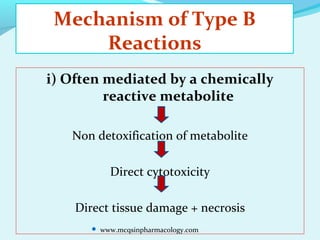
Mechanism of Type B
Reactions
i) Often mediated by a chemically
reactive metabolite
Non detoxification of metabolite
Direct cytotoxicity
Direct tissue damage + necrosis
 www.mcqsinpharmacology.com
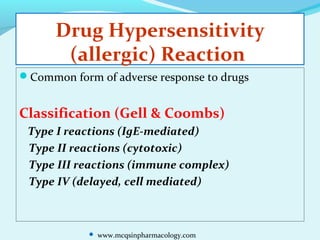
Drug Hypersensitivity
(allergic) Reaction
Common form of adverse response to drugs
Classification (Gell & Coombs)
Type I reactions (IgE-mediated)
Type II reactions (cytotoxic)
Type III reactions (immune complex)
Type IV (delayed, cell mediated)
 www.mcqsinpharmacology.com

Adverse drug reactions ppt

  • 1.
  • 2.
    Adverse Drug Reactions (ADR) Harmassociated with the use of a given medications OR Unwanted or harmful reaction experienced after the administration of a drug or combination of drugs under normal conditions of use  www.mcqsinpharmacology.com
  • 3.
    ADR= significant morbidity& mortality Range from mild reactions (drowsiness, nausea, itching& rash); disappear after discontinuation of drug OR Severe reactions (respiratory depression, neutorpenia, hepatocellualr injury, hemorrhage, anaphylaxis  www.mcqsinpharmacology.com
  • 4.
    ADR most commonin Women Elderly (>60 y old) Very young (1-4 y) Patients taking more than one drug  www.mcqsinpharmacology.com
  • 5.
    Classification of ADR Rawlin& Thompson classification ABCD Traditional classification A & B About 80% of ADR----Type A reactions 1) Type A Reactions a) Related to pharmacological action of drug Extensions of the principal pharmacological action of the drug Cont.  www.mcqsinpharmacology.com
  • 6.
    b) Predictable Relatively easilypredicted by preclinical and clinical pharmacological studies c) Common Type A reactions not serious---common d) Dose-dependent Usually dose dependent  www.mcqsinpharmacology.com
  • 7.
    Type A reactions (classes) i)Toxicity of overdose (Drug overdose) An adverse drug reaction caused by excessive dosing e.g., hepatic failure with dose of paracetamol Headache with antihypertensives hypoglycemia with sulfonylurea;  www.mcqsinpharmacology.com
  • 8.
    ii) Side Effects Nearlyunavoidable secondary drug effect produced by therapeutic doses intensity is dose dependent Occur immediately after initially taking drug or may not appear until weeks after initiation of drug use E.g., sedation with antihistamines  www.mcqsinpharmacology.com
  • 9.
    iii) Secondary Effects Secondarypharmacological effect E.g., development of diarrhea with antibiotic therapy due to altered GIT bacterial flora Orthostatic hypotension with a phenothiazine  www.mcqsinpharmacology.com
  • 10.
    iv) Drug Interactions Whentwo drugs taken together & they effect each other’s response pharmacologically or kinetically E.g., one drug slow metabolism of 2nd drug blood conc.= toxicity Theophylline toxicity in presence of erythromycin  www.mcqsinpharmacology.com
  • 11.
    2) Type BReactions Unrelated to known pharmacological actions of drug Unpredictable Often caused by immunological & pharmacogenetic mechanisms Unrelated to dosage Comparatively rare & cause serious illness or death cont.  www.mcqsinpharmacology.com
  • 12.
    Results (more likely)in withdrawal of marketing authorization Often not discovered until after drug is marketed Both environmental & genetic factors = important in this reaction  www.mcqsinpharmacology.com
  • 13.
    Type B Reactions(classes) i) Drug Intolerance Lower threshold to normal pharmacological action of a drug e.g., tinnitus (single average dose of aspirin) ii) Hypersensitivity (immunological reaction) Immune mediated response to a drug agent in sensitized patient e.g., anaphylaxis with penicillin  www.mcqsinpharmacology.com
  • 14.
    iii) Pseudoallergic Reaction Directmast cell activation & degranulation by drugs (opiates, vancomycin & radiocontrast media) Clinically indistinguishable form Type I hypersensitivity but not involve IgE (non immunologic reactions)  www.mcqsinpharmacology.com
  • 15.
    iv) Idiosyncratic Reactions Anuncommon & abnormal response to drug Usually due to genetic abnormality Affect drug metabolism & receptor sensitivity Harmful even fatal, appear in low doses E.g., Anemia (hemolysis) by antioxidant drugs (G6PD deficiency) Paralysis due to succinylcholine (enzyme deficiency)  www.mcqsinpharmacology.com
  • 16.
    3) Type C(chronic) Reactions Associated with long-term drug therapy Well known and can be anticipated Adaptation occurs = discontinuation of drug=abstinence syndrome E.g. opoids, alcohol, barbiturates  www.mcqsinpharmacology.com
  • 17.
    4) Type D(delayed) Reactions Carcinogenic & teratogenic effects Delayed in onset Very rare Carcinogenic Effect Medication lead to cancer; take >20 y to develop Teratogenic Effect Drug- induced birth defects  www.mcqsinpharmacology.com
  • 18.
    Sign & Symptomsof ADR Mild, moderate, severe or lethal Sign & symptoms manifest soon after 1st dose or only after chronic use e.g., Allergic reactions occur soon after drug is taken usually 2nd time ( itching, rash, eruption, upper or lower airway edema with dyspnea & hypotension) Idiosyncratic reactions=any unpredicted symptom  www.mcqsinpharmacology.com
  • 19.
    Mechanisms of ADR TypeA =non immunological, reversible with reduction of dose, non serious, extension of pharmacological effects Type B Biochemical mechanism unrelated to pharmacological Immunologic = Hypersensitivity (Type I, II, III, IV) OR Non immunologic (direct)= Pseudoallergic, idiosyncratic, intolerance www.mcqsinpharmacology.com
  • 20.
    Mechanism of TypeB Reactions i) Often mediated by a chemically reactive metabolite Non detoxification of metabolite Direct cytotoxicity Direct tissue damage + necrosis  www.mcqsinpharmacology.com
  • 21.
    Drug Hypersensitivity (allergic) Reaction Commonform of adverse response to drugs Classification (Gell & Coombs) Type I reactions (IgE-mediated) Type II reactions (cytotoxic) Type III reactions (immune complex) Type IV (delayed, cell mediated)  www.mcqsinpharmacology.com