16
Physico-chemical properties in relation to
biological action
¾ Drug action results from the interaction of drug molecules with
either normal or abnormal physiological processes.
¾ Drugs normally interact with targets/receptors (which they are proteins,
enzymes, cell lipids, or pieces of DNA or RNA).
¾ The ability of a chemical compound to show a pharmacologic /therapeutic
effect is related to the influence of its various physical and chemical
(physicochemical) properties
17
¾ Physical-chemical properties refer to both physical and chemical
properties of the drug molecule that may have an effect on its
biological activity
partition coefficient
degree of ionization
surface activity
isosterism
intermolecular forces
oxidation-reduction potentials
interatomic distances between functional groups
stereochemistry
¾ Drug molecules should have the required physicochemical properties
to be accessible to active sites
to have favorable drug receptor interaction
Physical-chemical Properties
18
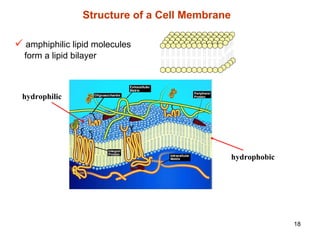
9 amphiphilic lipid molecules
form a lipid bilayer
Structure of a Cell Membrane
hydrophilic
hydrophobic
Solubility and Chemical Bonding
¾ If an organic drug molecule dissolves fully or partially in a
nonaqueous or lipid solvent, the molecule is said to be lipophilic or to
have lipophilic character.
¾ The term lipophilic or lipid loving is synonymous with hydrophobic
or water hating, and these terms may be used interchangeably.
Hydrophilic ……………water loving
Lipophobic ………………lipid hating
Lipophilic ………………..lipid loving
Hydrophobic …………..water hating
In order to predict whether a drug will dissolve in water or in lipid
solvent, it must be determined whether the molecule and its functional
groups can be bond to water or the lipid solvent molecules.
THIS IS THE KEY TO SOLUBILITY.
Lipophilicity (‘fat-liking’) is the most important physical property of a
drug in relation to its absorption, distribution, potency, and elimination.
20
The hydrophobic effect
¾ If a compound is too lipophilic, it may
ƒ be insoluble in aqueous media (e.g. gastrointestinal fluid or blood)
ƒ bind too strongly to plasma proteins and therefore the free blood
concentration will be too low to produce the desired effect
ƒ distribute into lipid bilayers and be unable to reach the inside of the cell
(can go to the other lipophilic sites in the body)
¾ Conversely, if the compound is too polar, it may not be absorbed through
the gut wall due to lack of membrane solubility.
So it is important that the lipophilicity of a potential drug molecule is correct
- optimized-.
21
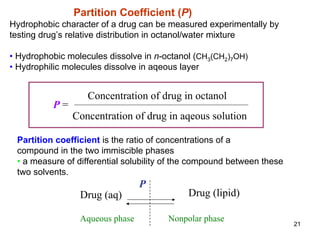
Partition Coefficient (P)
Hydrophobic character of a drug can be measured experimentally by
testing drug’s relative distribution in octanol/water mixture
• Hydrophobic molecules dissolve in n-octanol (CH3(CH2)7OH)
• Hydrophilic molecules dissolve in aqeous layer
Concentration of drug in octanol
Concentration of drug in aqeous solution
P =
Partition coefficient is the ratio of concentrations of a
compound in the two immiscible phases
• a measure of differential solubility of the compound between these
two solvents.
Drug (aq) Drug (lipid)
P
Aqueous phase Nonpolar phase
22
¾ useful in estimating distribution of drugs within the body
¾ hydrophobic drugs with high partition coefficients are preferentially
distributed to hydrophobic compartments such as lipid bilayers of cells
¾ while hydrophilic drugs (low partition coefficients) preferentially are found
in hydrophilic compartments such as blood serum
* Hydrophobic compounds will high P value
* Hydrophilic compounds will have low P value
Partition Coefficient (P)
¾ π is a measure of hydrophobicity of a substituent relative to hydrogen
23
Calculation steps of Log P for Drugs
(i) The molecule is divided into its various groups, functionalities and
substituents
(ii) Appropriate hydrophilic/lipophilic fragment constants are assigned and
summed
(iii) Compounds with log Pcalc values greater than +0.5 are considered
water insoluble (lipophilic) and those with log Pcalc values less than
+0.5 are considered water soluble (hydrophilic).
COOH
OH
COOH
OH
Salicylic acid
p-Hydroxybenzoic acid
Calculated log P Values for salicylic acid and p-Hydroxybenzoic acid:
p-Hydroxybenzoic acid
Salicylic acid
π Value
Fragment
π Value
Fragment
+2.0
Phenyl
+2.0
Phenyl
-1.0
OH
-1.0
OH
-0.7
COOH
-0.7
COOH
-
-
+0.65
IMHB*
+0.3
+0.95
Sum
Water soluble
Prediction
Water insoluble
Prediction
*IMHB: inter molecular hydrogen bonding
24
Example
Calculate log P value for m-chlorobenzamide.
πCl = 2.84-2.13 = 0.71
πCONH2 = 0.64-2.13 = -1.49
log P(chlorobenzamide) = log P (benzene) + πCl + π CONH2
= 2.13 + 0.71+ -1.49 = 1.35
πX = log PX – log PH
25
6.5
7
7.5
8
8.5
9
2 3 4 5 6
logP
pIC50
Blood clot preventing activity
of salicylic acids
O OH
OH
R2
R1
O OH
O
O
Aspirin
26
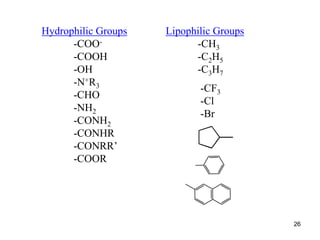
Hydrophilic Groups
-COO-
-COOH
-OH
-N+R3
-CHO
-NH2
-CONH2
-CONHR
-CONRR’
-COOR
Lipophilic Groups
-CH3
-C2H5
-C3H7
-CF3
-Cl
-Br
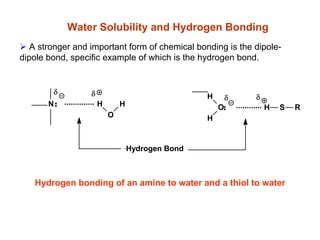
Water Solubility and Hydrogen Bonding
¾ A stronger and important form of chemical bonding is the dipole-
dipole bond, specific example of which is the hydrogen bond.
Hydrogen bonding of an amine to water and a thiol to water
N H
O
H
H
O
H
H S R
.............. ............
δ δ
δ δ
Hydrogen Bond
Predicting Water Solubility
An excellent example of the importance of intramolecular bonding:
Tyrosine:
• Three functional group present:
• a phenol
• an amine
• and a carboxylic acid group.
CH2 CH
HO
NH2
COOH
Solubility in H2O 0.45g/1000ml @ 25o C
29
Solubility Prediction
Example:
Examination of the structure of chloramphenicol (indicates the presence
of both lipophilic (nonpolar) and hydrophilic (polar) groups and
substituents.
CH
O2N
OH
CH
CH2OH
NH C
O
CHCl2
Lipophilic
Lipophilic
Hydrophilic
Hydrophilic
Hydrophilic
Chloramphenicol
The presence of oxygen and nitrogen containing functional groups usually
increases water solubility.
While lipid solubility is enhanced by nonionizable hydrocarbon chains and
ring systems.
30
Acidity and Basicity
Acidic and/or basic properties of drugs are important in both:
1- Pharmaceutical phase (dosage formulation, etc.) and
2- Pharmacological phases (disposition, structure at target site, etc.).
The three aspects of acid-base chemistry:
(1) Definitions
(2) Recognition of acidic or basic organic functional groups and
(3) An estimation of the relative acid/base strength of these groups.
Definitions:
Acid: An organic compound containing a functional group that can donate a
proton (H+)
Base: An organic compound that contains a functional group that can
accept a proton (H+)
31
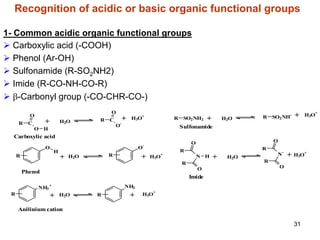
Recognition of acidic or basic organic functional groups
1- Common acidic organic functional groups
¾ Carboxylic acid (-COOH)
¾ Phenol (Ar-OH)
¾ Sulfonamide (R-SO2NH2)
¾ Imide (R-CO-NH-CO-R)
¾ β-Carbonyl group (-CO-CHR-CO-)
R C
O
O H
+ H2O R C
O
O-
+ H3O
+
O
H
R + H2O
O-
R
Carboxylic acid
Phenol
H3O+
R
NH3
+
H2O
+
NH2
R
+
H3O
+
+
Anilinium cation
R SO2NH2
H3O
+
+
H2O
+ R SO2NH-
Sulfonamide
R
O
N
O
R
H + H2O +
R
O
N
-
O
R
H3O+
Imide
32
Recognition of acidic or basic organic functional groups
(cont)
2- Common basic organic functional groups
¾ Aliphatic 1º (R-NH2), 2º (R2NH) and 3º (R3N)-amines
¾ Heterocyclic amines
¾ Aromatic amines (Ar-NH2)
R N
R
R
+ H3O+
H2O
+
R N+
R
R
H
+ H2O
H3O+
+
N N+
R
Aliphatic amines
Heteroaromatic amines
NH3
+
NH2
+ H3O+ H2O
+
Aromatic amines
N N
H
N NH
Pyridine
Piperidine
Imidazole
33
Ionization
ƒ Ionization = protonation or deprotonation resulting in charged
molecules
ƒ About 85% of marketed drugs contain functional groups that are
ionized to some extent at physiological pH (pH 1.5 – 8).
The acidity or basicity of a compound plays a major role in controlling:
ƒ Absorption and transport to site of action
• Solubility, bioavailability, absorption and cell penetration, plasma
binding, volume of distribution
ƒ Binding of a compound at its site of action
• un-ionised form involved in hydrogen bonding
• ionised form influences strength of salt bridges or H-bonds
ƒ Elimination of compound
• Biliary and renal excretion
• CYP P450 metabolism
34
The same compound will be ionised
to different extents in different parts
of the body.
This means that, for example, basic
compounds will not be so well
absorbed in the stomach than acidic
compounds since it is generally the
unionised form of the drug which
diffuses into the blood stream.
How does pH vary in the body?
Fluid pH
Aqueous humour 7.2
Blood 7.4
Colon 5-8
Duodenum (fasting) 4.4-6.6
Duodenum (fed) 5.2-6.2
Saliva 6.4
Small intestine 6.5
Stomach (fasting) 1.4-2.1
Stomach (fed) 3-7
Sweat 5.4
Urine 5.5-7.0
35
Handerson Hasselbalch Equation
pH = pKa + log
[A-]
[HA]
pH = pKa + log
[B]
[BH+]
*Weak acid
*Weak base
¾ For calculating the percentage of drug existing in ionized or
unionized form at a given pH
Weak acids: pH > pKa ; [A-] > [HA] , (ionized > unionized)
Weak bases: pH > pKa ; [HA] > [A-] , (unionized > ionized)
¾ pH = pKa ; [HA] = [A-] , (unionized = ionized)
HA H
+
+ A
Ka
H
+
+ B
BH+ Ka
CH3COOH CH3COO + H+
NH4 + H2O NH3 + H3O+
36
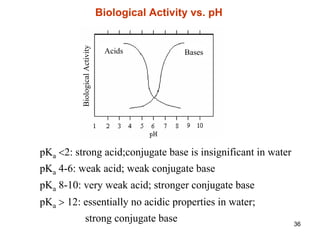
pKa <2: strong acid;conjugate base is insignificant in water
pKa 4-6: weak acid; weak conjugate base
pKa 8-10: very weak acid; stronger conjugate base
pKa > 12: essentially no acidic properties in water;
strong conjugate base
Biological
Activity
Acids Bases
Biological Activity vs. pH
37
pH = pKa + log
[A-]
[HA]
B = A-
A = HA
38
0
10
20
30
40
50
60
70
80
90
100
3 4 5 6 7 8 9 10 11
pH
pe
rce
nt
% neutral
% anion
OH
NO2
NO2
-H+
O
NO2
NO2
pKa = 4.1
Ionisation of an acid – 2,4-dinitrophenol
Neutral: unionized
Anion: ionized
39
0
10
20
30
40
50
60
70
80
90
100
3 4 5 6 7 8 9 10 11
pH
percent
% neutral
% cation
N
+
NH2
H
N
NH2
-H+
pKa = 9.1
Ionisation of an base – 4-aminopyridine
40
Steric Factors
¾ Bulk, size and the shape of a drug have an influence on its interaction
with an enzyme or a receptor
¾ Bulky (large) substituent may shield and hinder the ideal interaction
between drug and receptor
¾ or alternatively may help to orientate a drug for maximum receptor
binding, increasing activity
¾ Difficult to quantify steric properties
Taft’s steric factor (ES)
Molar refractivity (MR)
Verloop steric parameter
41
Structural features of drugs and their pharmacological
activity
Stereochemistry: Space arrangement of the atoms or three-dimensional
structure of the molecule.
Stereochemistry plays a major role in the pharmacological properties
because:
(1) Any change in stereospecificity of the drug will affect its
pharmacological activity
(2) The isomeric pairs have different physical properties (partition
coefficient, pka, etc.) and thus differ in pharmacological activity.
The following steric factors influence pharmacological activity:
● Optical and geometric isomerism
● Conformational isomerism
● Isosterism and bioisosterism
42
Enantiomers (optical isomers) can have large differences in potency,
receptor fit, biological activity, transport and metabolism.
For example, levo-phenol has narcotic, analgesic, and antitussive
properties, whereas its mirror image, dextro-phenol, has only antitussive
activity.
CH3
OH
H
H3C
CH3
H CH3
OH
2-Hydroxybutane enantiomers (mirror images can not superimposed)
Optical and geometric isomerism and
pharmacological activity
43
Bioisosterism and pharmacological activity
Bioisosteres are compounds or groups that have near-equal molecular
shapes and volumes, approximately the same distribution of electrons, and
show similar chemical and physical properties producing broadly similar
biological effects.
Parameters affected with bioisosteric replacements
Size, conformation, inductive and mesomeric effects, polarizability, H-bond
formation capacity, pKa, solubility,hydrophobicity, reactivity, stability
Bioisosteric replacements: Why?
• Greater selectivity
• Less side effects
• Decreased toxicity
• Improved pharmacokinetics (solubility-hydrophobicity)
• Increased stability
• Simplified synthesis
44
9 Halogen to CN or CF3 replacements
9 COCH2-R (ketone), -COOR (ester)
9 CONHR (amide) for the carbonyl containing compounds
Classical Bioisosteres
45
. Bioisosterism - Carboxylic acid replacements
46
Bioisosterism and pharmacological activity
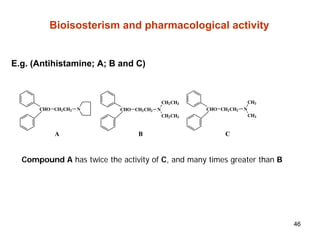
E.g. (Antihistamine; A; B and C)
CHO CH2CH2 N CHO CH2CH2 N
CH2CH3
CH2CH3
CHO CH2CH2 N
CH3
CH3
A B C
Compound A has twice the activity of C, and many times greater than B
47
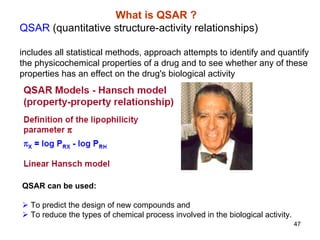
What is QSAR ?
QSAR (quantitative structure-activity relationships)
includes all statistical methods, approach attempts to identify and quantify
the physicochemical properties of a drug and to see whether any of these
properties has an effect on the drug's biological activity
QSAR can be used:
¾ To predict the design of new compounds and
¾ To reduce the types of chemical process involved in the biological activity.
48
Molecular Properties and Their Parameters

20.-physicochemical-properties-determination-1.pdf

  • 1.
    16 Physico-chemical properties inrelation to biological action ¾ Drug action results from the interaction of drug molecules with either normal or abnormal physiological processes. ¾ Drugs normally interact with targets/receptors (which they are proteins, enzymes, cell lipids, or pieces of DNA or RNA). ¾ The ability of a chemical compound to show a pharmacologic /therapeutic effect is related to the influence of its various physical and chemical (physicochemical) properties
  • 2.
    17 ¾ Physical-chemical propertiesrefer to both physical and chemical properties of the drug molecule that may have an effect on its biological activity partition coefficient degree of ionization surface activity isosterism intermolecular forces oxidation-reduction potentials interatomic distances between functional groups stereochemistry ¾ Drug molecules should have the required physicochemical properties to be accessible to active sites to have favorable drug receptor interaction Physical-chemical Properties
  • 3.
    18 9 amphiphilic lipidmolecules form a lipid bilayer Structure of a Cell Membrane hydrophilic hydrophobic
  • 4.
    Solubility and ChemicalBonding ¾ If an organic drug molecule dissolves fully or partially in a nonaqueous or lipid solvent, the molecule is said to be lipophilic or to have lipophilic character. ¾ The term lipophilic or lipid loving is synonymous with hydrophobic or water hating, and these terms may be used interchangeably. Hydrophilic ……………water loving Lipophobic ………………lipid hating Lipophilic ………………..lipid loving Hydrophobic …………..water hating In order to predict whether a drug will dissolve in water or in lipid solvent, it must be determined whether the molecule and its functional groups can be bond to water or the lipid solvent molecules. THIS IS THE KEY TO SOLUBILITY. Lipophilicity (‘fat-liking’) is the most important physical property of a drug in relation to its absorption, distribution, potency, and elimination.
  • 5.
    20 The hydrophobic effect ¾If a compound is too lipophilic, it may ƒ be insoluble in aqueous media (e.g. gastrointestinal fluid or blood) ƒ bind too strongly to plasma proteins and therefore the free blood concentration will be too low to produce the desired effect ƒ distribute into lipid bilayers and be unable to reach the inside of the cell (can go to the other lipophilic sites in the body) ¾ Conversely, if the compound is too polar, it may not be absorbed through the gut wall due to lack of membrane solubility. So it is important that the lipophilicity of a potential drug molecule is correct - optimized-.
  • 6.
    21 Partition Coefficient (P) Hydrophobiccharacter of a drug can be measured experimentally by testing drug’s relative distribution in octanol/water mixture • Hydrophobic molecules dissolve in n-octanol (CH3(CH2)7OH) • Hydrophilic molecules dissolve in aqeous layer Concentration of drug in octanol Concentration of drug in aqeous solution P = Partition coefficient is the ratio of concentrations of a compound in the two immiscible phases • a measure of differential solubility of the compound between these two solvents. Drug (aq) Drug (lipid) P Aqueous phase Nonpolar phase
  • 7.
    22 ¾ useful inestimating distribution of drugs within the body ¾ hydrophobic drugs with high partition coefficients are preferentially distributed to hydrophobic compartments such as lipid bilayers of cells ¾ while hydrophilic drugs (low partition coefficients) preferentially are found in hydrophilic compartments such as blood serum * Hydrophobic compounds will high P value * Hydrophilic compounds will have low P value Partition Coefficient (P) ¾ π is a measure of hydrophobicity of a substituent relative to hydrogen
  • 8.
    23 Calculation steps ofLog P for Drugs (i) The molecule is divided into its various groups, functionalities and substituents (ii) Appropriate hydrophilic/lipophilic fragment constants are assigned and summed (iii) Compounds with log Pcalc values greater than +0.5 are considered water insoluble (lipophilic) and those with log Pcalc values less than +0.5 are considered water soluble (hydrophilic). COOH OH COOH OH Salicylic acid p-Hydroxybenzoic acid Calculated log P Values for salicylic acid and p-Hydroxybenzoic acid: p-Hydroxybenzoic acid Salicylic acid π Value Fragment π Value Fragment +2.0 Phenyl +2.0 Phenyl -1.0 OH -1.0 OH -0.7 COOH -0.7 COOH - - +0.65 IMHB* +0.3 +0.95 Sum Water soluble Prediction Water insoluble Prediction *IMHB: inter molecular hydrogen bonding
  • 9.
    24 Example Calculate log Pvalue for m-chlorobenzamide. πCl = 2.84-2.13 = 0.71 πCONH2 = 0.64-2.13 = -1.49 log P(chlorobenzamide) = log P (benzene) + πCl + π CONH2 = 2.13 + 0.71+ -1.49 = 1.35 πX = log PX – log PH
  • 10.
    25 6.5 7 7.5 8 8.5 9 2 3 45 6 logP pIC50 Blood clot preventing activity of salicylic acids O OH OH R2 R1 O OH O O Aspirin
  • 11.
  • 12.
    Water Solubility andHydrogen Bonding ¾ A stronger and important form of chemical bonding is the dipole- dipole bond, specific example of which is the hydrogen bond. Hydrogen bonding of an amine to water and a thiol to water N H O H H O H H S R .............. ............ δ δ δ δ Hydrogen Bond
  • 13.
    Predicting Water Solubility Anexcellent example of the importance of intramolecular bonding: Tyrosine: • Three functional group present: • a phenol • an amine • and a carboxylic acid group. CH2 CH HO NH2 COOH Solubility in H2O 0.45g/1000ml @ 25o C
  • 14.
    29 Solubility Prediction Example: Examination ofthe structure of chloramphenicol (indicates the presence of both lipophilic (nonpolar) and hydrophilic (polar) groups and substituents. CH O2N OH CH CH2OH NH C O CHCl2 Lipophilic Lipophilic Hydrophilic Hydrophilic Hydrophilic Chloramphenicol The presence of oxygen and nitrogen containing functional groups usually increases water solubility. While lipid solubility is enhanced by nonionizable hydrocarbon chains and ring systems.
  • 15.
    30 Acidity and Basicity Acidicand/or basic properties of drugs are important in both: 1- Pharmaceutical phase (dosage formulation, etc.) and 2- Pharmacological phases (disposition, structure at target site, etc.). The three aspects of acid-base chemistry: (1) Definitions (2) Recognition of acidic or basic organic functional groups and (3) An estimation of the relative acid/base strength of these groups. Definitions: Acid: An organic compound containing a functional group that can donate a proton (H+) Base: An organic compound that contains a functional group that can accept a proton (H+)
  • 16.
    31 Recognition of acidicor basic organic functional groups 1- Common acidic organic functional groups ¾ Carboxylic acid (-COOH) ¾ Phenol (Ar-OH) ¾ Sulfonamide (R-SO2NH2) ¾ Imide (R-CO-NH-CO-R) ¾ β-Carbonyl group (-CO-CHR-CO-) R C O O H + H2O R C O O- + H3O + O H R + H2O O- R Carboxylic acid Phenol H3O+ R NH3 + H2O + NH2 R + H3O + + Anilinium cation R SO2NH2 H3O + + H2O + R SO2NH- Sulfonamide R O N O R H + H2O + R O N - O R H3O+ Imide
  • 17.
    32 Recognition of acidicor basic organic functional groups (cont) 2- Common basic organic functional groups ¾ Aliphatic 1º (R-NH2), 2º (R2NH) and 3º (R3N)-amines ¾ Heterocyclic amines ¾ Aromatic amines (Ar-NH2) R N R R + H3O+ H2O + R N+ R R H + H2O H3O+ + N N+ R Aliphatic amines Heteroaromatic amines NH3 + NH2 + H3O+ H2O + Aromatic amines N N H N NH Pyridine Piperidine Imidazole
  • 18.
    33 Ionization ƒ Ionization =protonation or deprotonation resulting in charged molecules ƒ About 85% of marketed drugs contain functional groups that are ionized to some extent at physiological pH (pH 1.5 – 8). The acidity or basicity of a compound plays a major role in controlling: ƒ Absorption and transport to site of action • Solubility, bioavailability, absorption and cell penetration, plasma binding, volume of distribution ƒ Binding of a compound at its site of action • un-ionised form involved in hydrogen bonding • ionised form influences strength of salt bridges or H-bonds ƒ Elimination of compound • Biliary and renal excretion • CYP P450 metabolism
  • 19.
    34 The same compoundwill be ionised to different extents in different parts of the body. This means that, for example, basic compounds will not be so well absorbed in the stomach than acidic compounds since it is generally the unionised form of the drug which diffuses into the blood stream. How does pH vary in the body? Fluid pH Aqueous humour 7.2 Blood 7.4 Colon 5-8 Duodenum (fasting) 4.4-6.6 Duodenum (fed) 5.2-6.2 Saliva 6.4 Small intestine 6.5 Stomach (fasting) 1.4-2.1 Stomach (fed) 3-7 Sweat 5.4 Urine 5.5-7.0
  • 20.
    35 Handerson Hasselbalch Equation pH= pKa + log [A-] [HA] pH = pKa + log [B] [BH+] *Weak acid *Weak base ¾ For calculating the percentage of drug existing in ionized or unionized form at a given pH Weak acids: pH > pKa ; [A-] > [HA] , (ionized > unionized) Weak bases: pH > pKa ; [HA] > [A-] , (unionized > ionized) ¾ pH = pKa ; [HA] = [A-] , (unionized = ionized) HA H + + A Ka H + + B BH+ Ka CH3COOH CH3COO + H+ NH4 + H2O NH3 + H3O+
  • 21.
    36 pKa <2: strongacid;conjugate base is insignificant in water pKa 4-6: weak acid; weak conjugate base pKa 8-10: very weak acid; stronger conjugate base pKa > 12: essentially no acidic properties in water; strong conjugate base Biological Activity Acids Bases Biological Activity vs. pH
  • 22.
    37 pH = pKa+ log [A-] [HA] B = A- A = HA
  • 23.
    38 0 10 20 30 40 50 60 70 80 90 100 3 4 56 7 8 9 10 11 pH pe rce nt % neutral % anion OH NO2 NO2 -H+ O NO2 NO2 pKa = 4.1 Ionisation of an acid – 2,4-dinitrophenol Neutral: unionized Anion: ionized
  • 24.
    39 0 10 20 30 40 50 60 70 80 90 100 3 4 56 7 8 9 10 11 pH percent % neutral % cation N + NH2 H N NH2 -H+ pKa = 9.1 Ionisation of an base – 4-aminopyridine
  • 25.
    40 Steric Factors ¾ Bulk,size and the shape of a drug have an influence on its interaction with an enzyme or a receptor ¾ Bulky (large) substituent may shield and hinder the ideal interaction between drug and receptor ¾ or alternatively may help to orientate a drug for maximum receptor binding, increasing activity ¾ Difficult to quantify steric properties Taft’s steric factor (ES) Molar refractivity (MR) Verloop steric parameter
  • 26.
    41 Structural features ofdrugs and their pharmacological activity Stereochemistry: Space arrangement of the atoms or three-dimensional structure of the molecule. Stereochemistry plays a major role in the pharmacological properties because: (1) Any change in stereospecificity of the drug will affect its pharmacological activity (2) The isomeric pairs have different physical properties (partition coefficient, pka, etc.) and thus differ in pharmacological activity. The following steric factors influence pharmacological activity: ● Optical and geometric isomerism ● Conformational isomerism ● Isosterism and bioisosterism
  • 27.
    42 Enantiomers (optical isomers)can have large differences in potency, receptor fit, biological activity, transport and metabolism. For example, levo-phenol has narcotic, analgesic, and antitussive properties, whereas its mirror image, dextro-phenol, has only antitussive activity. CH3 OH H H3C CH3 H CH3 OH 2-Hydroxybutane enantiomers (mirror images can not superimposed) Optical and geometric isomerism and pharmacological activity
  • 28.
    43 Bioisosterism and pharmacologicalactivity Bioisosteres are compounds or groups that have near-equal molecular shapes and volumes, approximately the same distribution of electrons, and show similar chemical and physical properties producing broadly similar biological effects. Parameters affected with bioisosteric replacements Size, conformation, inductive and mesomeric effects, polarizability, H-bond formation capacity, pKa, solubility,hydrophobicity, reactivity, stability Bioisosteric replacements: Why? • Greater selectivity • Less side effects • Decreased toxicity • Improved pharmacokinetics (solubility-hydrophobicity) • Increased stability • Simplified synthesis
  • 29.
    44 9 Halogen toCN or CF3 replacements 9 COCH2-R (ketone), -COOR (ester) 9 CONHR (amide) for the carbonyl containing compounds Classical Bioisosteres
  • 30.
    45 . Bioisosterism -Carboxylic acid replacements
  • 31.
    46 Bioisosterism and pharmacologicalactivity E.g. (Antihistamine; A; B and C) CHO CH2CH2 N CHO CH2CH2 N CH2CH3 CH2CH3 CHO CH2CH2 N CH3 CH3 A B C Compound A has twice the activity of C, and many times greater than B
  • 32.
    47 What is QSAR? QSAR (quantitative structure-activity relationships) includes all statistical methods, approach attempts to identify and quantify the physicochemical properties of a drug and to see whether any of these properties has an effect on the drug's biological activity QSAR can be used: ¾ To predict the design of new compounds and ¾ To reduce the types of chemical process involved in the biological activity.
  • 33.