NOTES: 10.3 –
Empirical and Molecular
Formulas
What Could It Be?
Empirical Formulas
• Indicate the lowest whole number ratio of
the atoms in a compound:
1) Determine moles of each element present
in the compound
2) Divide molar amounts by the smallest
number of moles present
3) Obtain whole numbers by multiplying by
integers if necessary
Calculating the Empirical
Formula
Example: A compound is found to contain the
following…
2.199 g Copper
0.277 g Oxygen
Calculate it’s empirical formula.
Calculating the Empirical
Formula
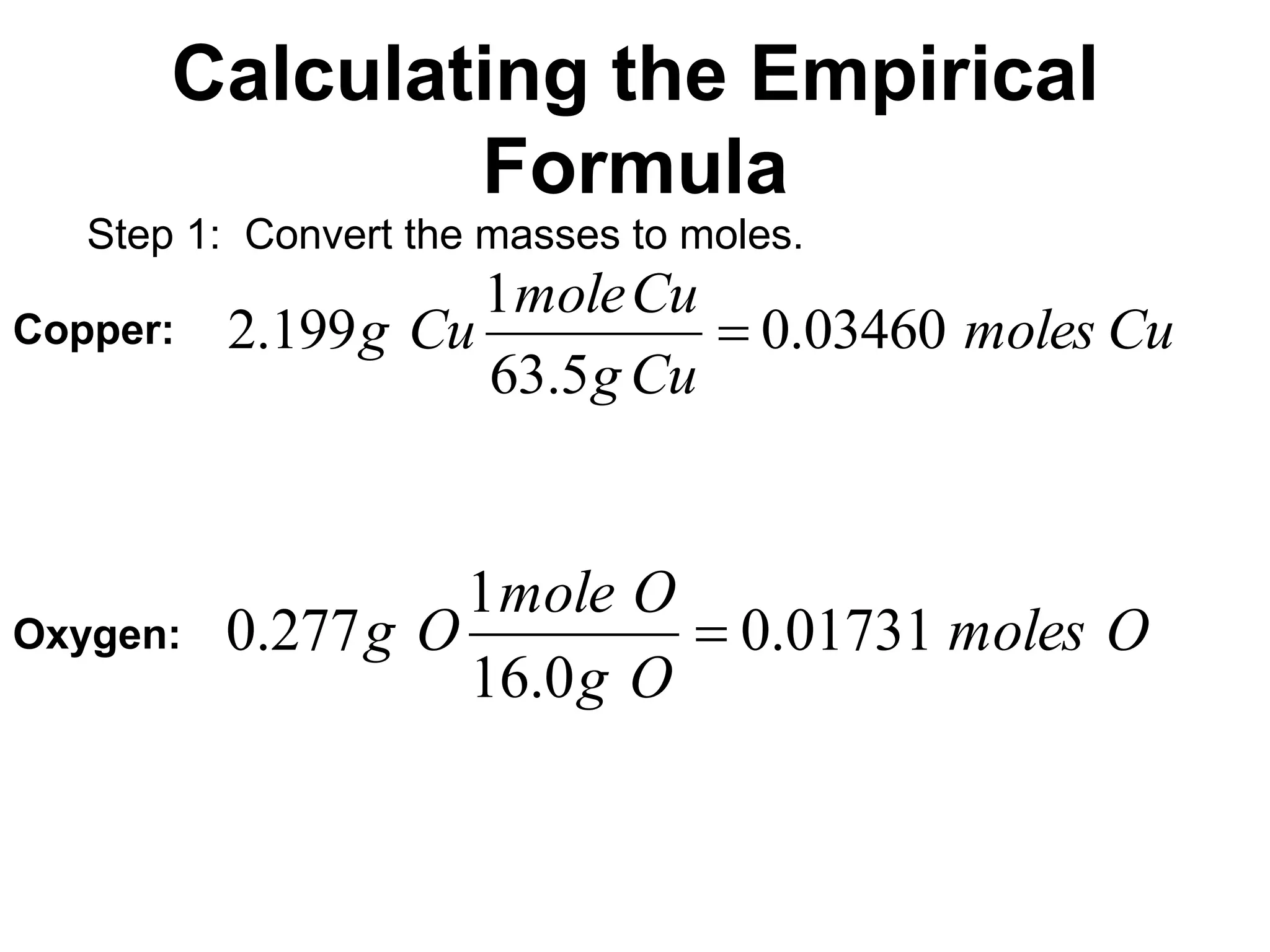
Step 1: Convert the masses to moles.
Cu
moles
Cu
g
Cu
mole
Cu
g 03460
.
0
5
.
63
1
199
.
2 
Copper:
Oxygen: O
moles
O
g
O
mole
O
g 01731
.
0
0
.
16
1
277
.
0 
Calculating the Empirical
Formula
Step 2: Divide all the moles by the smallest value.
This gives the “mole ratio”
O
O
m
u
000
.
1
mol
0173
.
0
ol
0173
.
0
C
1.999
mol
0.0173
Cu
mol
0.03460


Calculating the Empirical
Formula
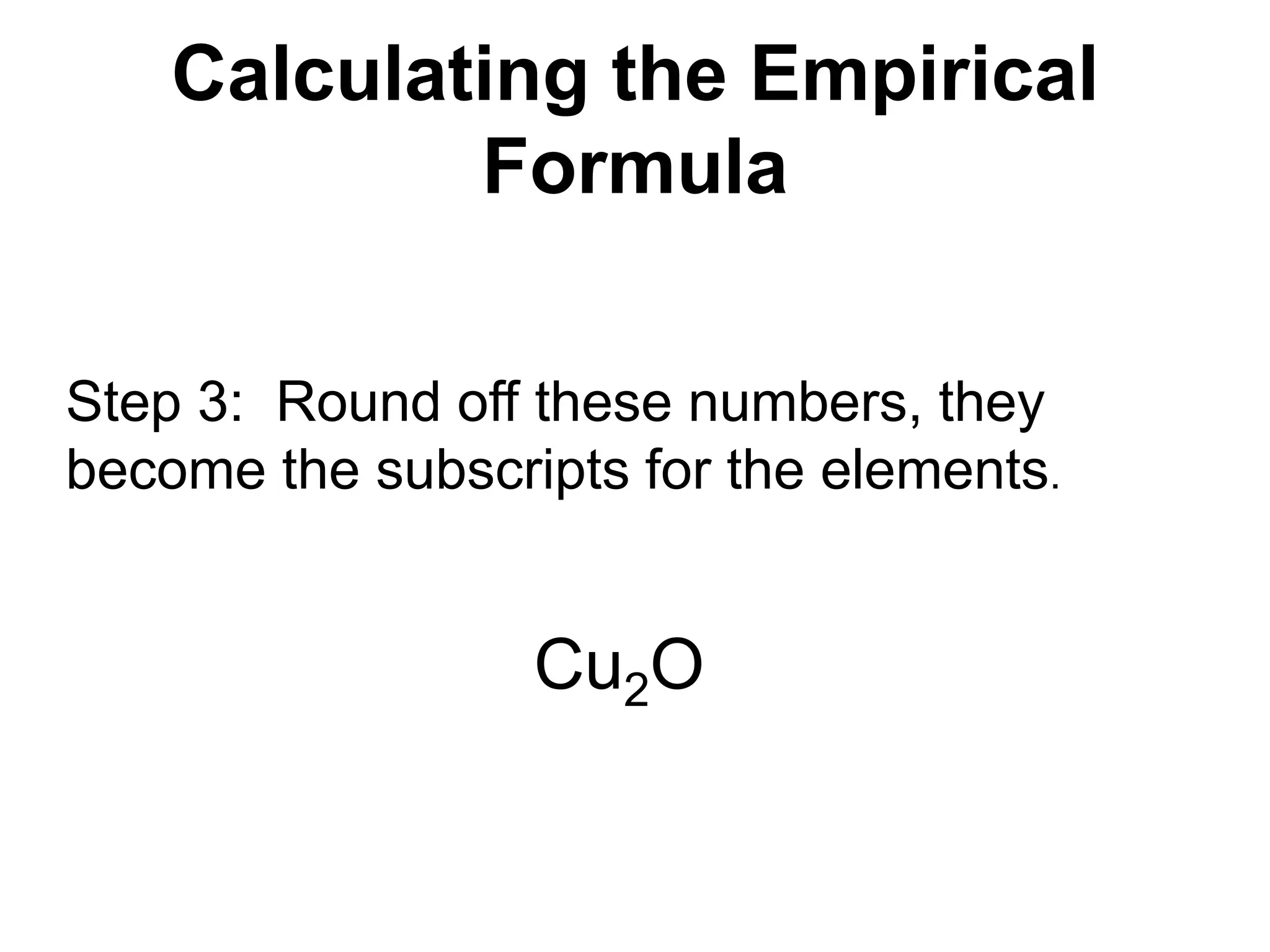
Step 3: Round off these numbers, they
become the subscripts for the elements.
Cu2O
Empirical Formula Example
Problems:
1) A compound is analyzed and found to
contain 79.8 g C and 20.2 g H.
Determine the empirical formula.
2) What is the empirical formula of a
compound that is 25.9 g nitrogen and
74.1 g oxygen?
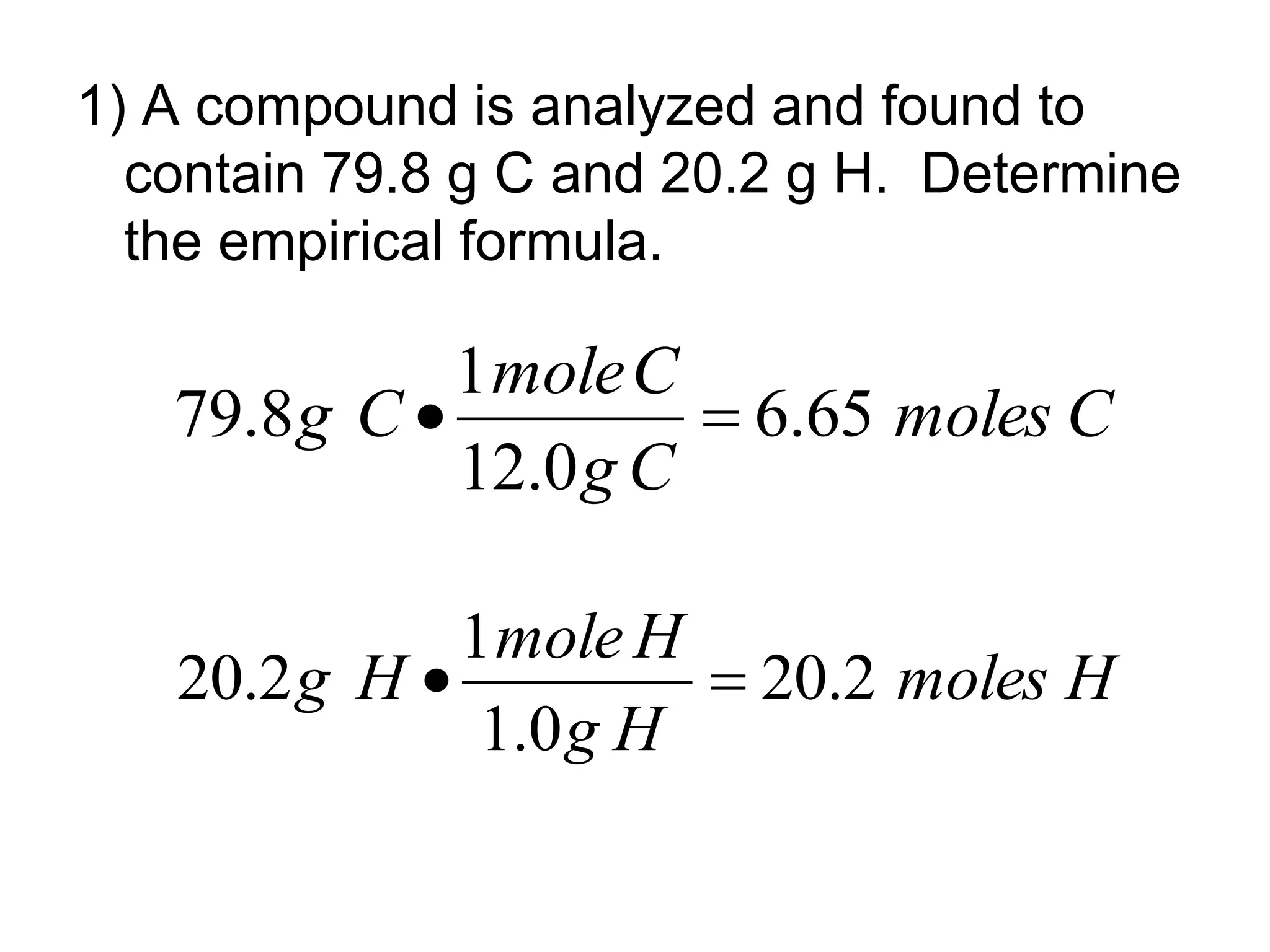
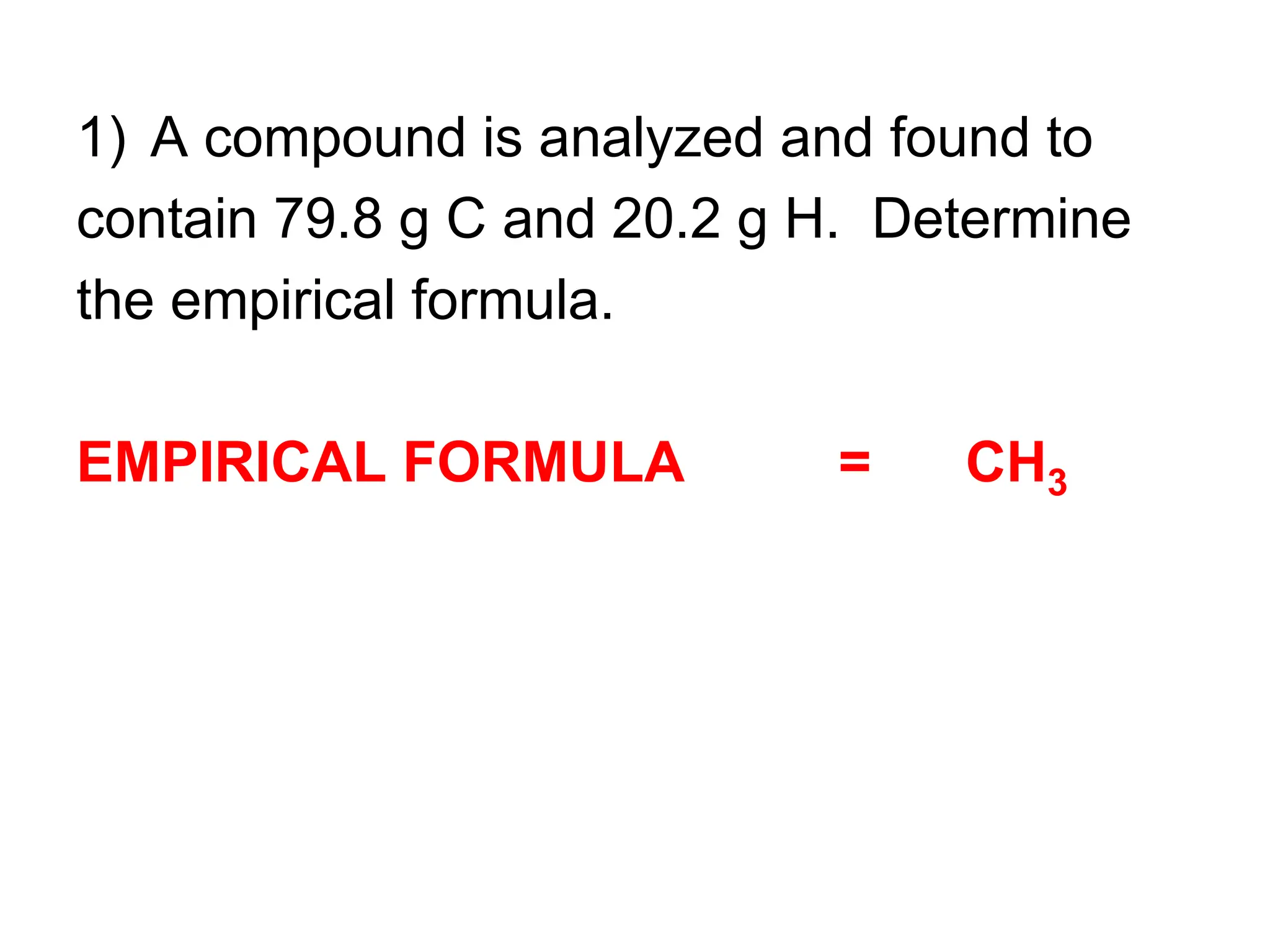
1) A compound is analyzed and found to
contain 79.8 g C and 20.2 g H. Determine
the empirical formula.
C
moles
C
g
C
mole
C
g 65
.
6
0
.
12
1
8
.
79 

H
moles
H
g
H
mole
H
g 2
.
20
0
.
1
1
2
.
20 

1) A compound is analyzed and found to
contain 79.8 g C and 20.2 g H. Determine
the empirical formula.
H
H
m
0
.
3
mol
65
.
6
ol
2
.
20
C
1.0
mol
6.65
C
mol
6.65


1) A compound is analyzed and found to
contain 79.8 g C and 20.2 g H. Determine
the empirical formula.
EMPIRICAL FORMULA = CH3
2) What is the empirical formula of a compound
that is 25.9 g nitrogen and 74.1 g oxygen?
N
moles
N
g
N
mole
N
g 85
.
1
0
.
14
1
9
.
25 

O
moles
O
g
O
mole
O
g 63
.
4
0
.
16
1
1
.
74 

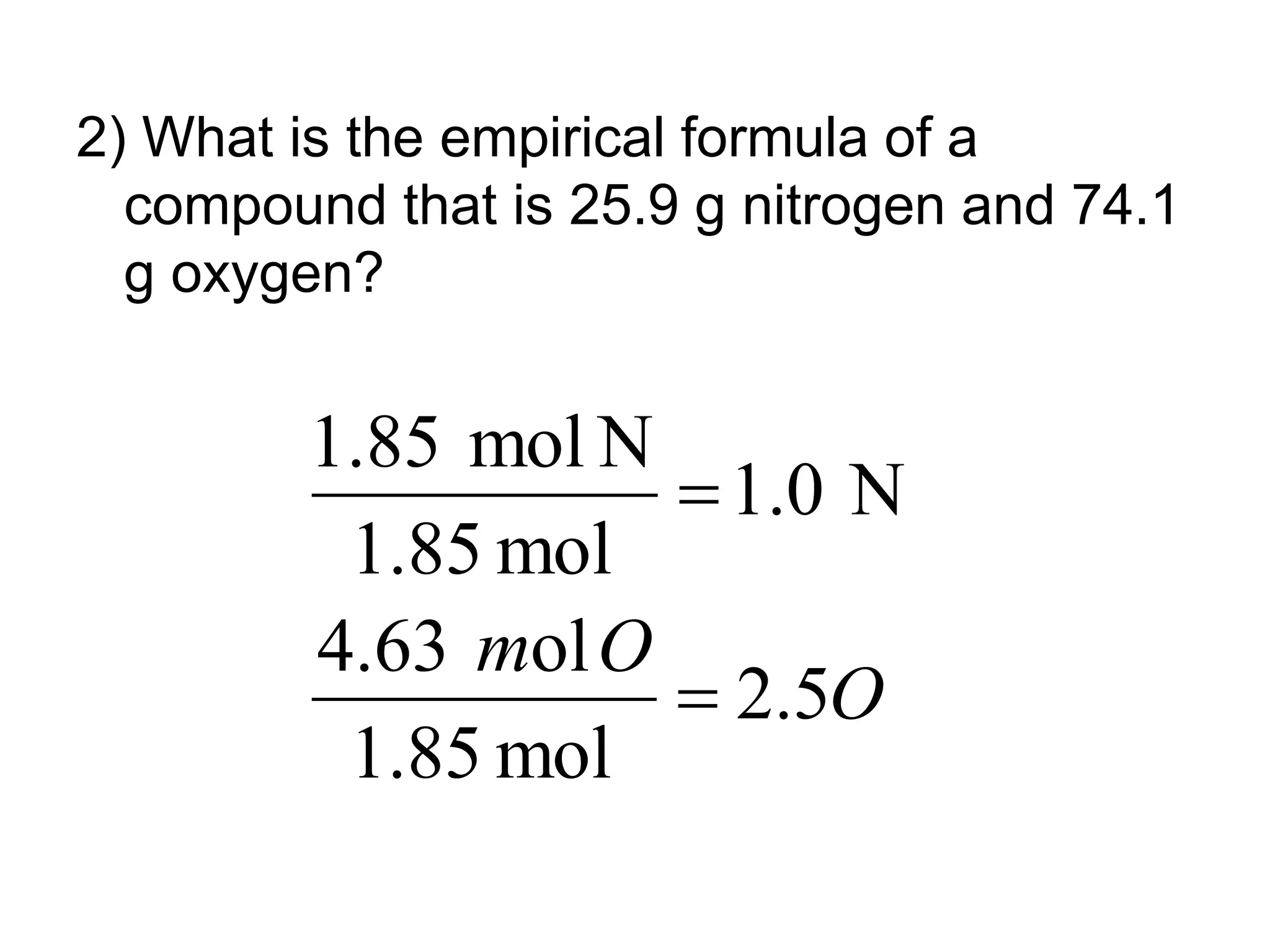
2) What is the empirical formula of a
compound that is 25.9 g nitrogen and 74.1
g oxygen?
O
O
m
5
.
2
mol
85
.
1
ol
63
.
4
N
1.0
mol
1.85
N
mol
1.85


2) What is the empirical formula of a
compound that is 25.9 g nitrogen and
74.1 g oxygen?
EMPIRICAL FORMULA = NO2.5
Is this formula acceptable?
2) What is the empirical formula of a
compound that is 25.9 g nitrogen and
74.1 g oxygen?
EMPIRICAL FORMULA = NO2.5
Is this formula acceptable? NO!
(must be WHOLE NUMBERS)
So, multiply by 2.
2) What is the empirical formula of a
compound that is 25.9 g nitrogen and
74.1 g oxygen?
EMPIRICAL FORMULA:
2 x (NO2.5) = N2O5
Molecular Formulas
• Indicates the actual formula for a
compound; the true formula
• Will be a multiple of the empirical formula
• EXAMPLE: glucose
-empirical: CH2O
-molecular: C6H12O6
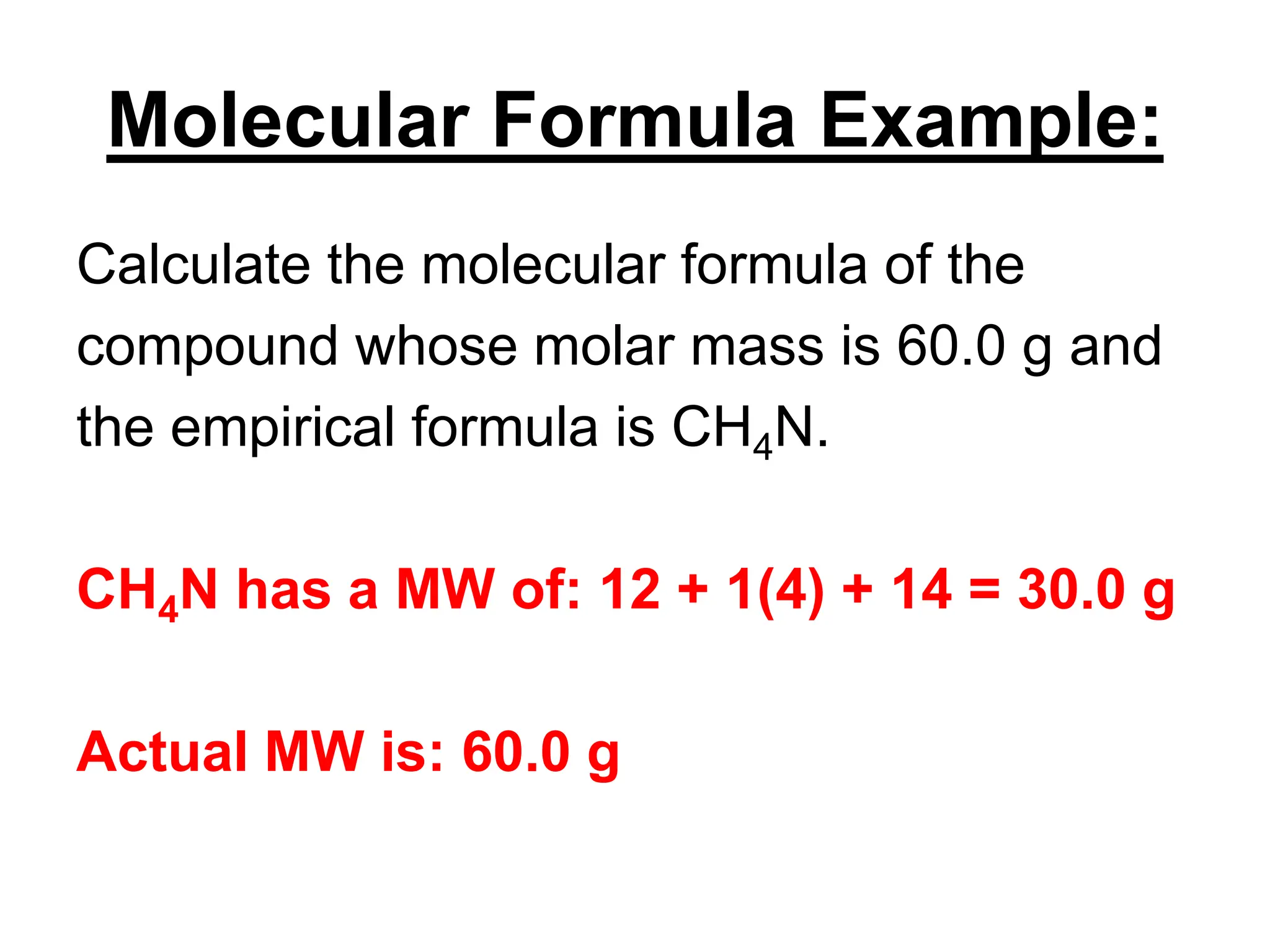
Molecular Formula Example:
Calculate the molecular formula of the
compound whose molar mass is 60.0 g and
the empirical formula is CH4N.
Molecular Formula Example:
Calculate the molecular formula of the
compound whose molar mass is 60.0 g and
the empirical formula is CH4N.
CH4N has a MW of: 12 + 1(4) + 14 = 30.0 g
Actual MW is: 60.0 g
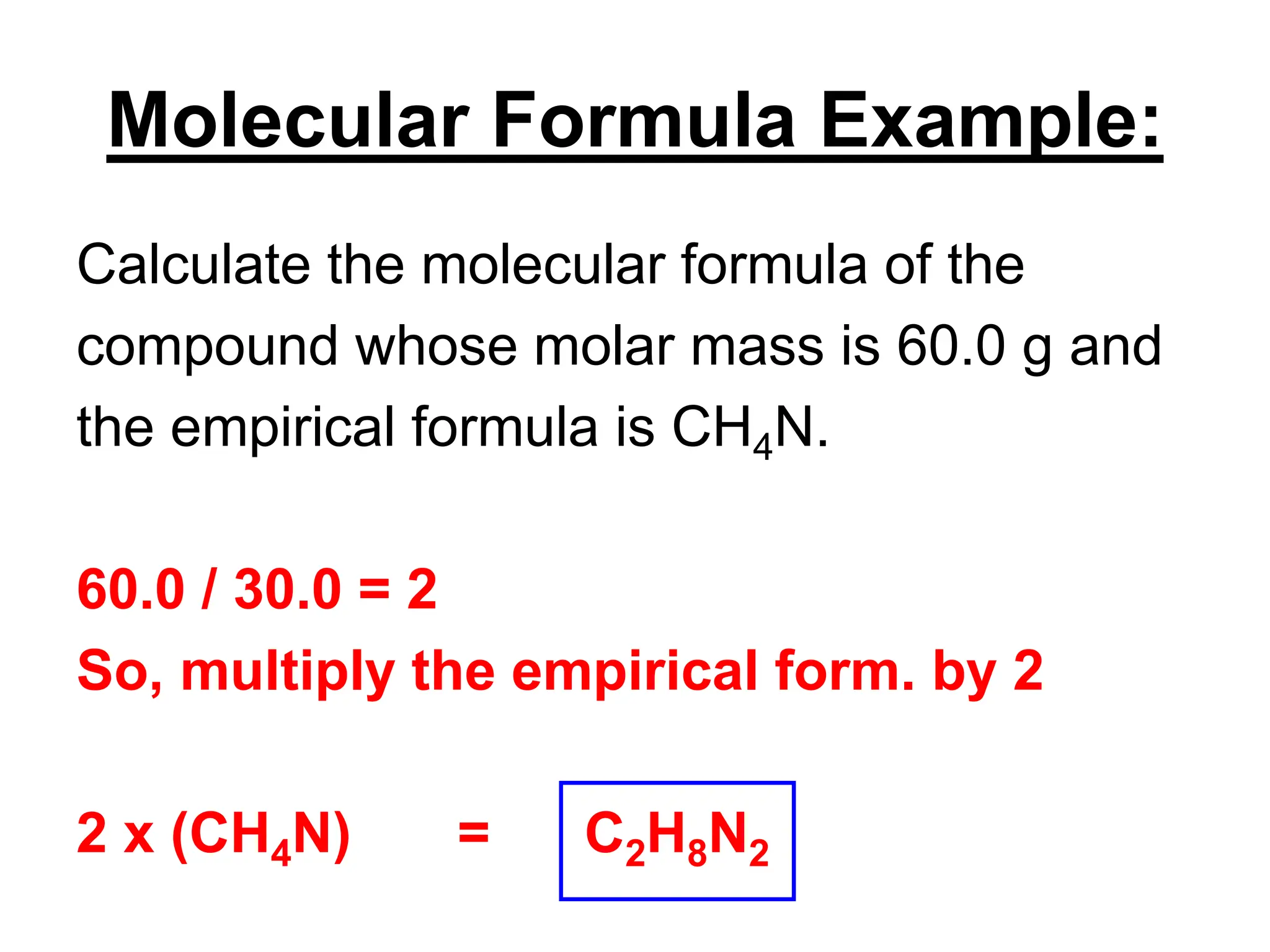
Molecular Formula Example:
Calculate the molecular formula of the
compound whose molar mass is 60.0 g and
the empirical formula is CH4N.
60.0 / 30.0 = 2
So, multiply the empirical form. by 2
2 x (CH4N) = C2H8N2
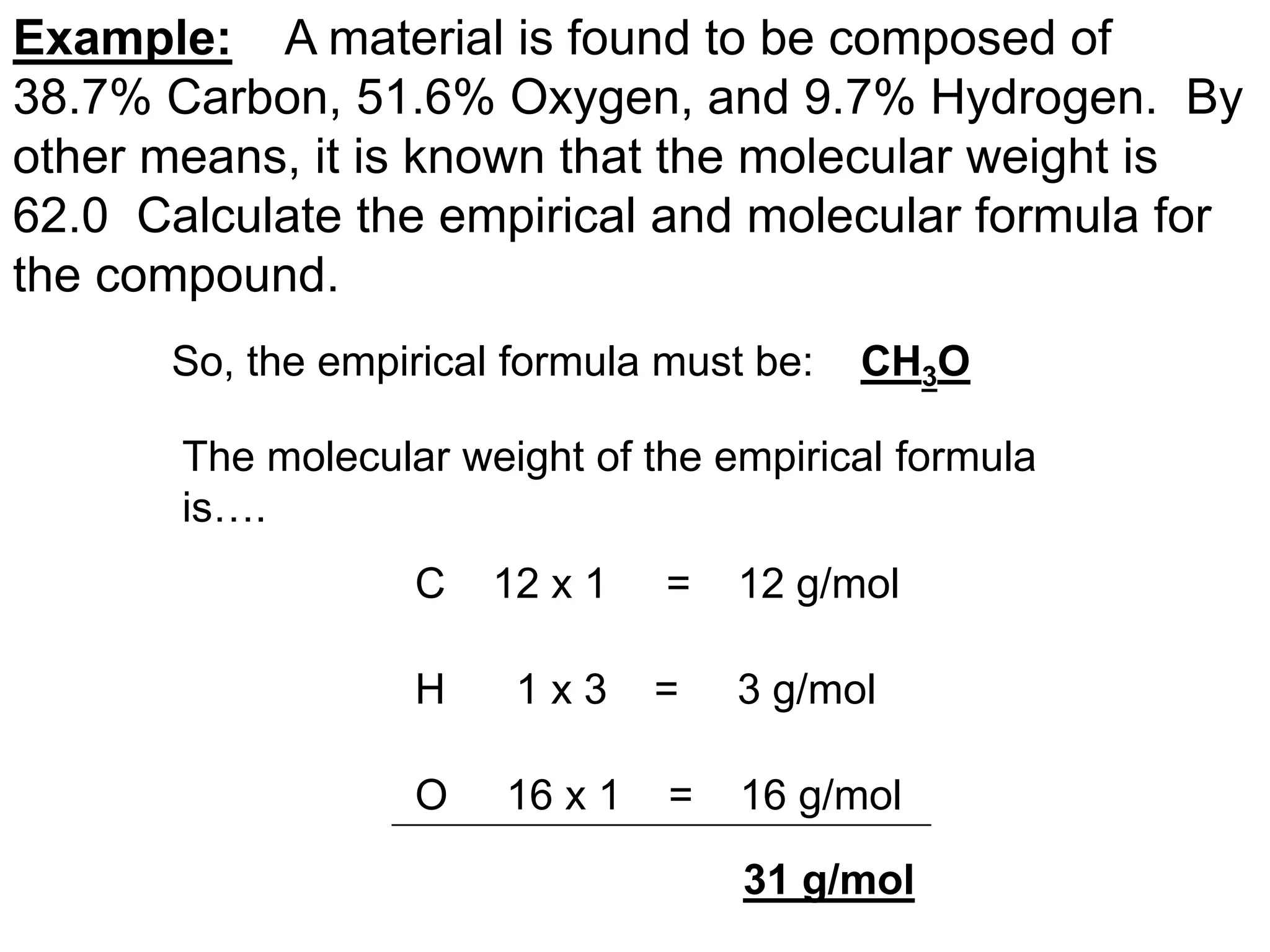
Example: A material is found to be composed of
38.7% Carbon, 51.6% Oxygen, and 9.7% Hydrogen. By
other means, it is known that the molecular weight is
62.0 g/mol Calculate the empirical and molecular
formula for the compound.
If you assume a sample weight
of 100 grams, then the percents
are really grams.
Example: A material is found to be composed of
38.7% Carbon, 51.6% Oxygen, and 9.7% Hydrogen. By
other means, it is known that the molecular weight is
62.0 Calculate the empirical and molecular formula for
the compound.
Carbon: mol
grams
mole
grams 23
.
3
0
.
12
1
7
.
38 

Oxygen: mol
grams
mole
grams 23
.
3
0
.
16
1
6
.
51 

Hydrogen: mol
grams
mole
grams 7
.
9
0
.
1
1
7
.
9 

Carbon: mol
grams
mole
grams 23
.
3
0
.
12
1
7
.
38 

Oxygen: mol
grams
mole
grams 23
.
3
0
.
16
1
6
.
51 

Hydrogen: mol
grams
mole
grams 7
.
9
0
.
1
1
7
.
9 

Now, divide all the moles
by the smallest one, 3.23
00
.
1
23
.
3

00
.
1
23
.
3

00
.
3
23
.
3

Example: A material is found to be composed of
38.7% Carbon, 51.6% Oxygen, and 9.7% Hydrogen. By
other means, it is known that the molecular weight is
62.0 Calculate the empirical and molecular formula for
the compound.
So, the empirical formula must be: CH3O
The molecular weight of the empirical formula
is….
C 12 x 1 = 12 g/mol
H 1 x 3 = 3 g/mol
O 16 x 1 = 16 g/mol
31 g/mol
Remember, the
empirical formula is not
necessarily the molecular
formula!
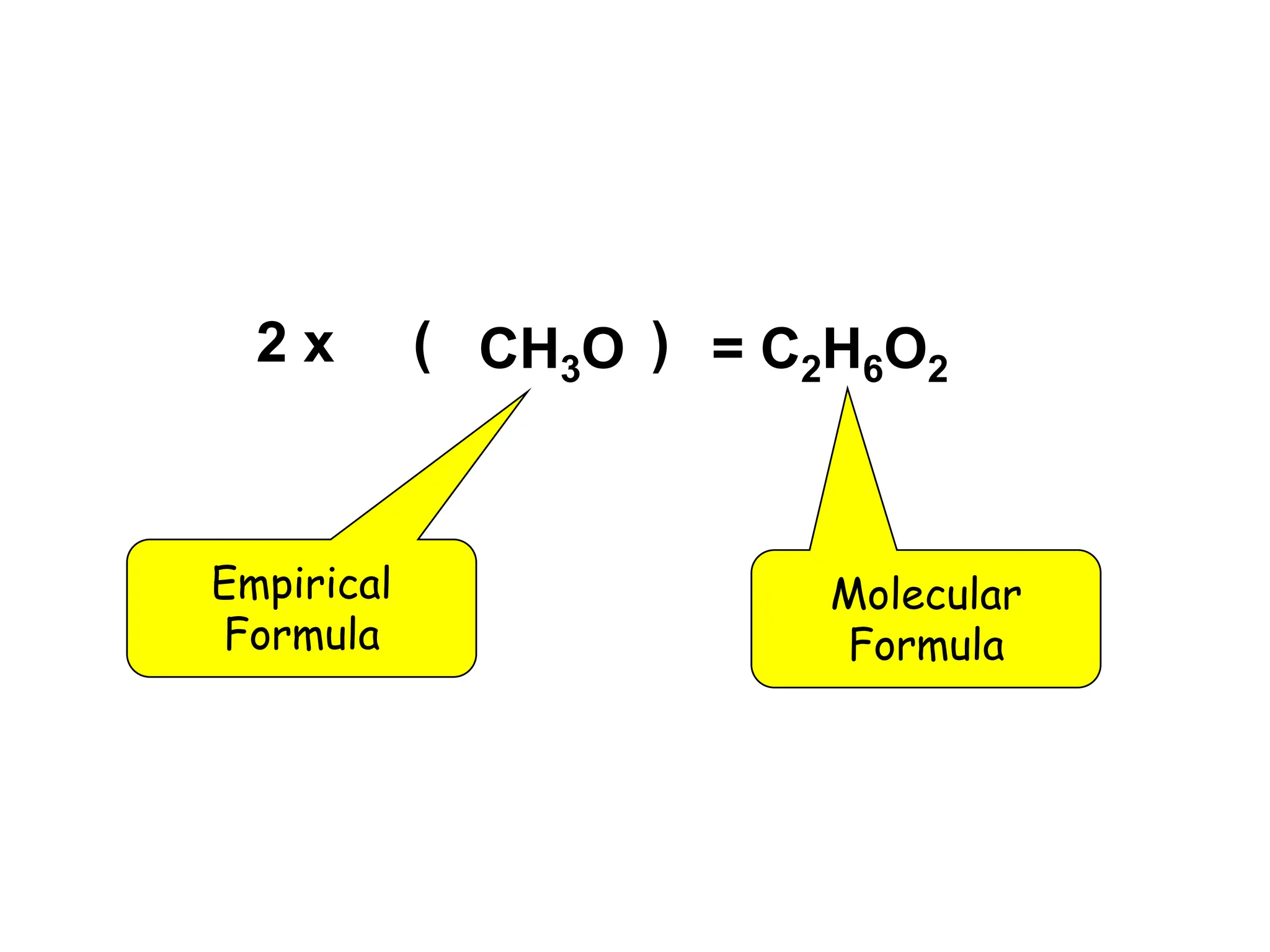
MW of the empirical formula = 31
MW of the molecular formula = 62
Empirical
Molecular
Factor
g
Multiplyin 
2
31
62


CH3O
2 x ( ) = C2H6O2
Empirical
Formula
Molecular
Formula
Remember, the molecular
formula represents the
actual formula.
What if the mole ratios
don’t come out even?
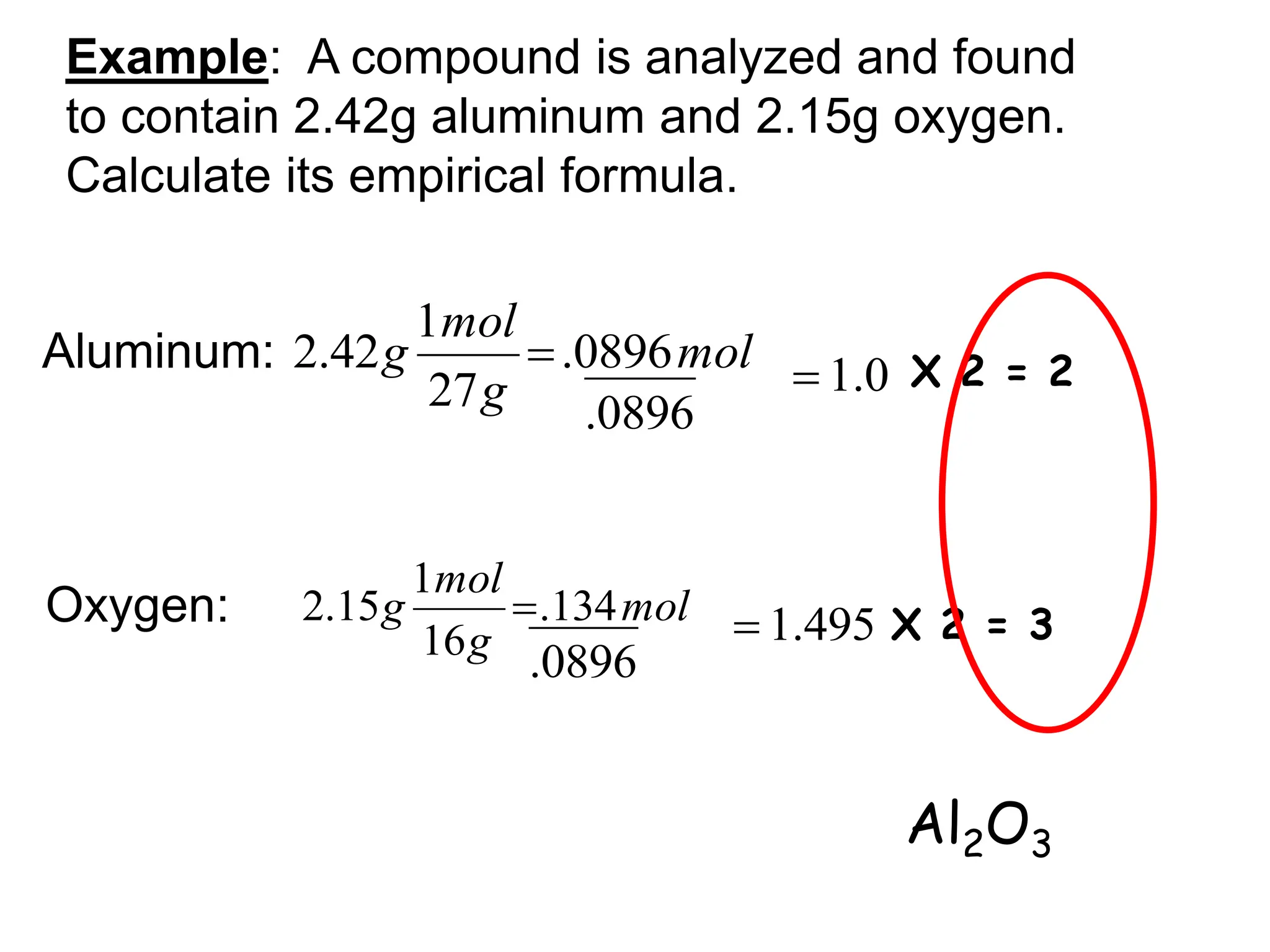
Example: A compound is analyzed and found
to contain 2.42g aluminum and 2.15g oxygen.
Calculate its empirical formula.
Aluminum: mol
g
mol
g 0896
.
27
1
42
.
2 
Oxygen: mol
g
mol
g 134
.
16
1
15
.
2 
0
.
1
0896
.

495
.
1
0896
.

X 2 = 2
X 2 = 3
Al2O3

تحضر4.pdfااااااتتتتهههخخخممممككككننتتتاااا

  • 1.
    NOTES: 10.3 – Empiricaland Molecular Formulas
  • 2.
  • 3.
    Empirical Formulas • Indicatethe lowest whole number ratio of the atoms in a compound: 1) Determine moles of each element present in the compound 2) Divide molar amounts by the smallest number of moles present 3) Obtain whole numbers by multiplying by integers if necessary
  • 4.
    Calculating the Empirical Formula Example:A compound is found to contain the following… 2.199 g Copper 0.277 g Oxygen Calculate it’s empirical formula.
  • 5.
    Calculating the Empirical Formula Step1: Convert the masses to moles. Cu moles Cu g Cu mole Cu g 03460 . 0 5 . 63 1 199 . 2  Copper: Oxygen: O moles O g O mole O g 01731 . 0 0 . 16 1 277 . 0 
  • 6.
    Calculating the Empirical Formula Step2: Divide all the moles by the smallest value. This gives the “mole ratio” O O m u 000 . 1 mol 0173 . 0 ol 0173 . 0 C 1.999 mol 0.0173 Cu mol 0.03460  
  • 7.
    Calculating the Empirical Formula Step3: Round off these numbers, they become the subscripts for the elements. Cu2O
  • 8.
    Empirical Formula Example Problems: 1)A compound is analyzed and found to contain 79.8 g C and 20.2 g H. Determine the empirical formula. 2) What is the empirical formula of a compound that is 25.9 g nitrogen and 74.1 g oxygen?
  • 9.
    1) A compoundis analyzed and found to contain 79.8 g C and 20.2 g H. Determine the empirical formula. C moles C g C mole C g 65 . 6 0 . 12 1 8 . 79   H moles H g H mole H g 2 . 20 0 . 1 1 2 . 20  
  • 10.
    1) A compoundis analyzed and found to contain 79.8 g C and 20.2 g H. Determine the empirical formula. H H m 0 . 3 mol 65 . 6 ol 2 . 20 C 1.0 mol 6.65 C mol 6.65  
  • 11.
    1) A compoundis analyzed and found to contain 79.8 g C and 20.2 g H. Determine the empirical formula. EMPIRICAL FORMULA = CH3
  • 12.
    2) What isthe empirical formula of a compound that is 25.9 g nitrogen and 74.1 g oxygen? N moles N g N mole N g 85 . 1 0 . 14 1 9 . 25   O moles O g O mole O g 63 . 4 0 . 16 1 1 . 74  
  • 13.
    2) What isthe empirical formula of a compound that is 25.9 g nitrogen and 74.1 g oxygen? O O m 5 . 2 mol 85 . 1 ol 63 . 4 N 1.0 mol 1.85 N mol 1.85  
  • 14.
    2) What isthe empirical formula of a compound that is 25.9 g nitrogen and 74.1 g oxygen? EMPIRICAL FORMULA = NO2.5 Is this formula acceptable?
  • 15.
    2) What isthe empirical formula of a compound that is 25.9 g nitrogen and 74.1 g oxygen? EMPIRICAL FORMULA = NO2.5 Is this formula acceptable? NO! (must be WHOLE NUMBERS) So, multiply by 2.
  • 16.
    2) What isthe empirical formula of a compound that is 25.9 g nitrogen and 74.1 g oxygen? EMPIRICAL FORMULA: 2 x (NO2.5) = N2O5
  • 17.
    Molecular Formulas • Indicatesthe actual formula for a compound; the true formula • Will be a multiple of the empirical formula • EXAMPLE: glucose -empirical: CH2O -molecular: C6H12O6
  • 18.
    Molecular Formula Example: Calculatethe molecular formula of the compound whose molar mass is 60.0 g and the empirical formula is CH4N.
  • 19.
    Molecular Formula Example: Calculatethe molecular formula of the compound whose molar mass is 60.0 g and the empirical formula is CH4N. CH4N has a MW of: 12 + 1(4) + 14 = 30.0 g Actual MW is: 60.0 g
  • 20.
    Molecular Formula Example: Calculatethe molecular formula of the compound whose molar mass is 60.0 g and the empirical formula is CH4N. 60.0 / 30.0 = 2 So, multiply the empirical form. by 2 2 x (CH4N) = C2H8N2
  • 21.
    Example: A materialis found to be composed of 38.7% Carbon, 51.6% Oxygen, and 9.7% Hydrogen. By other means, it is known that the molecular weight is 62.0 g/mol Calculate the empirical and molecular formula for the compound. If you assume a sample weight of 100 grams, then the percents are really grams.
  • 22.
    Example: A materialis found to be composed of 38.7% Carbon, 51.6% Oxygen, and 9.7% Hydrogen. By other means, it is known that the molecular weight is 62.0 Calculate the empirical and molecular formula for the compound. Carbon: mol grams mole grams 23 . 3 0 . 12 1 7 . 38   Oxygen: mol grams mole grams 23 . 3 0 . 16 1 6 . 51   Hydrogen: mol grams mole grams 7 . 9 0 . 1 1 7 . 9  
  • 23.
    Carbon: mol grams mole grams 23 . 3 0 . 12 1 7 . 38  Oxygen: mol grams mole grams 23 . 3 0 . 16 1 6 . 51   Hydrogen: mol grams mole grams 7 . 9 0 . 1 1 7 . 9   Now, divide all the moles by the smallest one, 3.23 00 . 1 23 . 3  00 . 1 23 . 3  00 . 3 23 . 3 
  • 24.
    Example: A materialis found to be composed of 38.7% Carbon, 51.6% Oxygen, and 9.7% Hydrogen. By other means, it is known that the molecular weight is 62.0 Calculate the empirical and molecular formula for the compound. So, the empirical formula must be: CH3O The molecular weight of the empirical formula is…. C 12 x 1 = 12 g/mol H 1 x 3 = 3 g/mol O 16 x 1 = 16 g/mol 31 g/mol
  • 25.
    Remember, the empirical formulais not necessarily the molecular formula! MW of the empirical formula = 31 MW of the molecular formula = 62 Empirical Molecular Factor g Multiplyin  2 31 62  
  • 26.
    CH3O 2 x () = C2H6O2 Empirical Formula Molecular Formula
  • 27.
    Remember, the molecular formularepresents the actual formula.
  • 28.
    What if themole ratios don’t come out even?
  • 29.
    Example: A compoundis analyzed and found to contain 2.42g aluminum and 2.15g oxygen. Calculate its empirical formula. Aluminum: mol g mol g 0896 . 27 1 42 . 2  Oxygen: mol g mol g 134 . 16 1 15 . 2  0 . 1 0896 .  495 . 1 0896 .  X 2 = 2 X 2 = 3 Al2O3