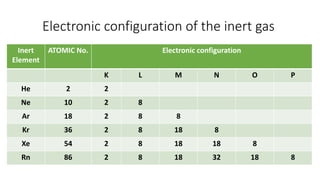
Electronic configuration of the inert gas
Inert
Element
ATOMIC No. Electronic configuration
K L M N O P
He 2 2
Ne 10 2 8
Ar 18 2 8 8
Kr 36 2 8 18 8
Xe 54 2 8 18 18 8
Rn 86 2 8 18 32 18 8
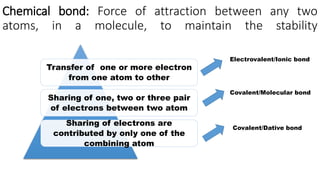
Chemical bond: Force of attraction between any two
atoms, in a molecule, to maintain the stability
Transfer of one or more electron
from one atom to other
Sharing of one, two or three pair
of electrons between two atom
Sharing of electrons are
contributed by only one of the
combining atom
Electrovalent/Ionic bond
Covalent/Molecular bond
Covalent/Dative bond
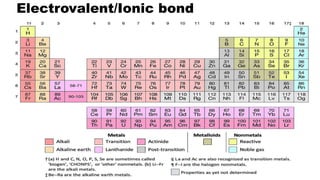
Electrovalent/Ionic bond
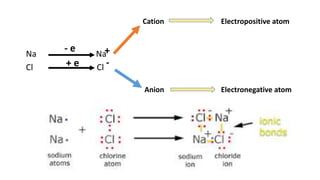
Na Na
Cl Cl
- e
Cation
+ e
+
-
Anion
Electropositive atom
Electronegative atom
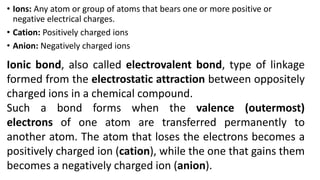
• Ions: Any atom or group of atoms that bears one or more positive or
negative electrical charges.
• Cation: Positively charged ions
• Anion: Negatively charged ions
Ionic bond, also called electrovalent bond, type of linkage
formed from the electrostatic attraction between oppositely
charged ions in a chemical compound.
Such a bond forms when the valence (outermost)
electrons of one atom are transferred permanently to
another atom. The atom that loses the electrons becomes a
positively charged ion (cation), while the one that gains them
becomes a negatively charged ion (anion).
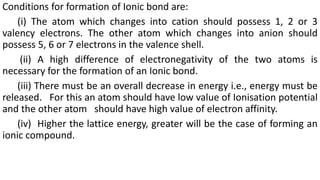
Conditions for formation of Ionic bond are:
(i) The atom which changes into cation should possess 1, 2 or 3
valency electrons. The other atom which changes into anion should
possess 5, 6 or 7 electrons in the valence shell.
(ii) A high difference of electronegativity of the two atoms is
necessary for the formation of an Ionic bond.
(iii) There must be an overall decrease in energy i.e., energy must be
released. For this an atom should have low value of Ionisation potential
and the other atom should have high value of electron affinity.
(iv) Higher the lattice energy, greater will be the case of forming an
ionic compound.
Chemical bonding (Ionic bonding)

Chemical bonding (Ionic bonding)

  • 2.
    Electronic configuration ofthe inert gas Inert Element ATOMIC No. Electronic configuration K L M N O P He 2 2 Ne 10 2 8 Ar 18 2 8 8 Kr 36 2 8 18 8 Xe 54 2 8 18 18 8 Rn 86 2 8 18 32 18 8
  • 3.
    Chemical bond: Forceof attraction between any two atoms, in a molecule, to maintain the stability Transfer of one or more electron from one atom to other Sharing of one, two or three pair of electrons between two atom Sharing of electrons are contributed by only one of the combining atom Electrovalent/Ionic bond Covalent/Molecular bond Covalent/Dative bond
  • 4.
  • 5.
    Na Na Cl Cl -e Cation + e + - Anion Electropositive atom Electronegative atom
  • 6.
    • Ions: Anyatom or group of atoms that bears one or more positive or negative electrical charges. • Cation: Positively charged ions • Anion: Negatively charged ions Ionic bond, also called electrovalent bond, type of linkage formed from the electrostatic attraction between oppositely charged ions in a chemical compound. Such a bond forms when the valence (outermost) electrons of one atom are transferred permanently to another atom. The atom that loses the electrons becomes a positively charged ion (cation), while the one that gains them becomes a negatively charged ion (anion).
  • 7.
    Conditions for formationof Ionic bond are: (i) The atom which changes into cation should possess 1, 2 or 3 valency electrons. The other atom which changes into anion should possess 5, 6 or 7 electrons in the valence shell. (ii) A high difference of electronegativity of the two atoms is necessary for the formation of an Ionic bond. (iii) There must be an overall decrease in energy i.e., energy must be released. For this an atom should have low value of Ionisation potential and the other atom should have high value of electron affinity. (iv) Higher the lattice energy, greater will be the case of forming an ionic compound.