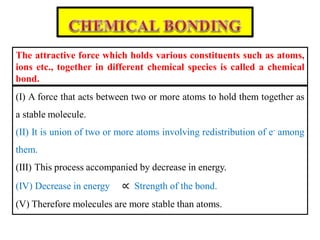
(I) A force that acts between two or more atoms to hold them together as
a stable molecule.
(II) It is union of two or more atoms involving redistribution of e- among
them.
(III) This process accompanied by decrease in energy.
(IV) Decrease in energy ∝ Strength of the bond.
(V) Therefore molecules are more stable than atoms.
The attractive force which holds various constituents such as atoms,
ions etc., together in different chemical species is called a chemical
bond.
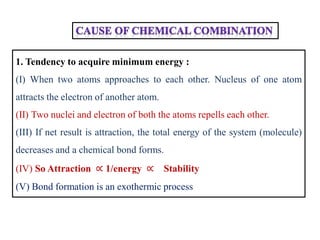
1. Tendency to acquire minimum energy :
(I) When two atoms approaches to each other. Nucleus of one atom
attracts the electron of another atom.
(II) Two nuclei and electron of both the atoms repells each other.
(III) If net result is attraction, the total energy of the system (molecule)
decreases and a chemical bond forms.
(IV) So Attraction ∝ 1/energy ∝ Stability
(V) Bond formation is an exothermic process
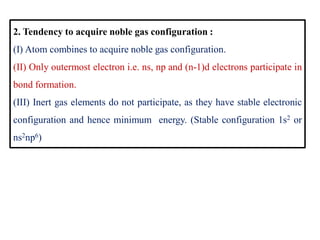
2. Tendency to acquire noble gas configuration :
(I) Atom combines to acquire noble gas configuration.
(II) Only outermost electron i.e. ns, np and (n-1)d electrons participate in
bond formation.
(III) Inert gas elements do not participate, as they have stable electronic
configuration and hence minimum energy. (Stable configuration 1s2 or
ns2np6)
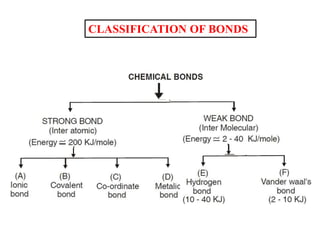
CLASSIFICATION OF BONDS
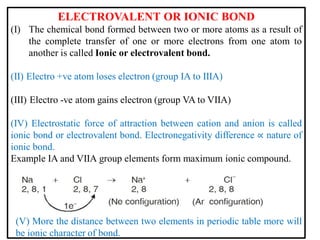
ELECTROVALENT OR IONIC BOND
(I) The chemical bond formed between two or more atoms as a result of
the complete transfer of one or more electrons from one atom to
another is called Ionic or electrovalent bond.
(II) Electro +ve atom loses electron (group IA to IIIA)
(III) Electro -ve atom gains electron (group VA to VIIA)
(IV) Electrostatic force of attraction between cation and anion is called
ionic bond or electrovalent bond. Electronegativity difference ∝ nature of
ionic bond.
Example IA and VIIA group elements form maximum ionic compound.
(V) More the distance between two elements in periodic table more will
be ionic character of bond.
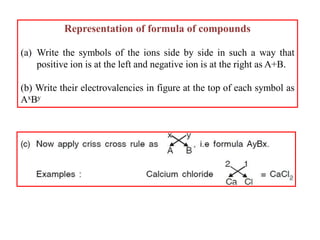
Representation of formula of compounds
(a) Write the symbols of the ions side by side in such a way that
positive ion is at the left and negative ion is at the right as A+B.
(b) Write their electrovalencies in figure at the top of each symbol as
AxBy
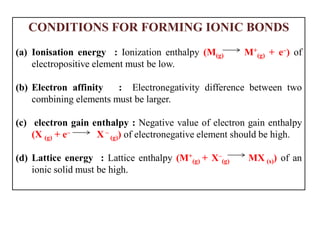
CONDITIONS FOR FORMING IONIC BONDS
(a) Ionisation energy : Ionization enthalpy (M(g) M+
(g) + e–) of
electropositive element must be low.
(b) Electron affinity : Electronegativity difference between two
combining elements must be larger.
(c) electron gain enthalpy : Negative value of electron gain enthalpy
(X (g) + e– X –
(g)) of electronegative element should be high.
(d) Lattice energy : Lattice enthalpy (M+
(g) + X–
(g) MX (s)) of an
ionic solid must be high.
PROPERTIES OF IONIC COMPOUNDS
(a) Physical state : Ionic compounds are hard, crystalline and brittle
due to strong force of attraction.
(b) Isomorphism : Simple ionic compounds do not show isomerism
but isomorphism is their important.
(c) Boiling point and melting point:
Ionic compounds have high boiling point and melting point due to
strong electrostatics force of attraction among oppositely charged ions.
(d) Conductivity:
It depends on ionic mobility. In solid state - No free ions - Bad
conductor of electricity. In fused state or aqueous solution Due to free
ions - Good conductor of eletricity.
conductivity order : Solid state > Fused state < Aqueous solution
(e) Solubility :
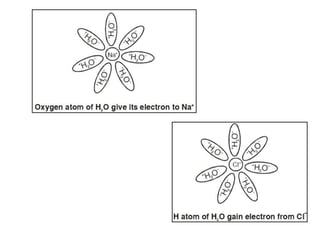
Highly soluble in water (Polar solvents). Example : NaCl in water
(I) The Na+ ions get associates with -vely charged ‘O’ of water
(II) And Cl - ions associates with +vely charged ‘H’ of water.
(III) Thus charge on Na+ and Cl- decreases and electrostatics force of
attraction also decreases which leads to free ion.
(IV) The energy released due to interaction between solvent and solute is
called solvation energy. If water is used as solvent it is called hydration
energy.
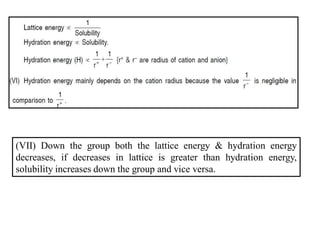
(V) For an ionic compound to be soluble in water - Hydration energy >
Lattice energy
(VII) Down the group both the lattice energy & hydration energy
decreases, if decreases in lattice is greater than hydration energy,
solubility increases down the group and vice versa.
14

Chemicak bonding

  • 2.
    (I) A forcethat acts between two or more atoms to hold them together as a stable molecule. (II) It is union of two or more atoms involving redistribution of e- among them. (III) This process accompanied by decrease in energy. (IV) Decrease in energy ∝ Strength of the bond. (V) Therefore molecules are more stable than atoms. The attractive force which holds various constituents such as atoms, ions etc., together in different chemical species is called a chemical bond.
  • 3.
    1. Tendency toacquire minimum energy : (I) When two atoms approaches to each other. Nucleus of one atom attracts the electron of another atom. (II) Two nuclei and electron of both the atoms repells each other. (III) If net result is attraction, the total energy of the system (molecule) decreases and a chemical bond forms. (IV) So Attraction ∝ 1/energy ∝ Stability (V) Bond formation is an exothermic process
  • 4.
    2. Tendency toacquire noble gas configuration : (I) Atom combines to acquire noble gas configuration. (II) Only outermost electron i.e. ns, np and (n-1)d electrons participate in bond formation. (III) Inert gas elements do not participate, as they have stable electronic configuration and hence minimum energy. (Stable configuration 1s2 or ns2np6)
  • 5.
  • 6.
    ELECTROVALENT OR IONICBOND (I) The chemical bond formed between two or more atoms as a result of the complete transfer of one or more electrons from one atom to another is called Ionic or electrovalent bond. (II) Electro +ve atom loses electron (group IA to IIIA) (III) Electro -ve atom gains electron (group VA to VIIA) (IV) Electrostatic force of attraction between cation and anion is called ionic bond or electrovalent bond. Electronegativity difference ∝ nature of ionic bond. Example IA and VIIA group elements form maximum ionic compound. (V) More the distance between two elements in periodic table more will be ionic character of bond.
  • 7.
    Representation of formulaof compounds (a) Write the symbols of the ions side by side in such a way that positive ion is at the left and negative ion is at the right as A+B. (b) Write their electrovalencies in figure at the top of each symbol as AxBy
  • 8.
    CONDITIONS FOR FORMINGIONIC BONDS (a) Ionisation energy : Ionization enthalpy (M(g) M+ (g) + e–) of electropositive element must be low. (b) Electron affinity : Electronegativity difference between two combining elements must be larger. (c) electron gain enthalpy : Negative value of electron gain enthalpy (X (g) + e– X – (g)) of electronegative element should be high. (d) Lattice energy : Lattice enthalpy (M+ (g) + X– (g) MX (s)) of an ionic solid must be high.
  • 9.
    PROPERTIES OF IONICCOMPOUNDS (a) Physical state : Ionic compounds are hard, crystalline and brittle due to strong force of attraction. (b) Isomorphism : Simple ionic compounds do not show isomerism but isomorphism is their important. (c) Boiling point and melting point: Ionic compounds have high boiling point and melting point due to strong electrostatics force of attraction among oppositely charged ions.
  • 10.
    (d) Conductivity: It dependson ionic mobility. In solid state - No free ions - Bad conductor of electricity. In fused state or aqueous solution Due to free ions - Good conductor of eletricity. conductivity order : Solid state > Fused state < Aqueous solution (e) Solubility : Highly soluble in water (Polar solvents). Example : NaCl in water (I) The Na+ ions get associates with -vely charged ‘O’ of water (II) And Cl - ions associates with +vely charged ‘H’ of water.
  • 12.
    (III) Thus chargeon Na+ and Cl- decreases and electrostatics force of attraction also decreases which leads to free ion. (IV) The energy released due to interaction between solvent and solute is called solvation energy. If water is used as solvent it is called hydration energy. (V) For an ionic compound to be soluble in water - Hydration energy > Lattice energy
  • 13.
    (VII) Down thegroup both the lattice energy & hydration energy decreases, if decreases in lattice is greater than hydration energy, solubility increases down the group and vice versa.
  • 14.