SAMPLING
Prepared by
James N Mwangi
Ntti Trainer; Analytical chemistry
DEFINITION OF SAMPLING
• Sampling is the process of taking a small
amount of a substance from the bulk which is
a true representation of the whole amount.
• The end product of sampling step is a small
quantity of homogenous material weighing a
few grams or a few hundred grams that may
constitute about one part in 10^7 or 10^8 of
bulk material.
Types of samples
• Representative sample
A representative sample is a sample that is a true
representative of the bulk.
• Grab sample
A grab sample is a sample taken at a specific
place and time. Usually used for a quick test
• Composite sample
A composite sample is a sample made from
mixing many grab samples together. It is more
representative of the population.
Importance of sampling
• To get results that are:
Accurate
Of required precision
Applicable to the bulk material
Reliable
Reproducible.
Sampling plan
• To get good results, the analyst requires a
sampling plan.
• A sampling plan must support the goals of an
analysis - qualitative – identify components
- quantitative- amount of each
component
• A good sampling plan helps to eliminate sampling
errors - determinate errors
- indeterminate errors
- gross errors
Sampling steps
• Three sampling steps
– Identification of the bulk material from which to
obtain sample
– Collection of a gross sample that is truly
representative of the bulk material
– Reduction of the gross sample to a laboratory
sample suitable for analysis
Sampling uncertainties
• Introduce errors in the process of chemical
analysis.
• Goal of analysis is to keep these errors to a
minimum and to estimate their size with
acceptable accuracy
• Types of errors;
– Indeterminate errors
– Determinate errors
– Gross errors
Sampling errors
• Indeterminate (or random) errors
– Affect the precision of measurement. Can be
eliminated by exercising care, by calibration and
proper use of standards, blanks & reference materials
• Determinate (or systematic) errors
– Affect the precision of data i.e. accuracy of results.
Can be minimized by close control of the variables
that influence measurements
• Gross errors
– Affect only a single result in a set of replicate data
causing it to differ significantly from the rest. Leads to
outliers.
Implementing a sampling plan
• Implementing a sampling plan normally involves
three steps:
 physically removing the sample from its target
population,
preserving the sample, and
 preparing the sample for analysis.
• usually we analyze a sample after removing it
from its target population.
• To prevent contamination, the sampling device
must be inert and clean.
Quantitative analysis necessitates a careful sampling plan:
• Among the issues to consider are these five questions.
• From where within the target population should we
collect samples?
• What type of samples should we collect?
• What is the minimum amount of sample for each
analysis?
• How many samples should we analyze?
• How can we minimize the overall variance for the
analysis?
Separating samples from interferences
• Why separation?
most analytical methods are not selective enough for a
single species(analyte).
The goal of an analytical separation is to remove either
the analyte or the interferent from the sample’s matrix.
To achieve this separation there must be at least one
significant difference between the analyte’s and the
interferent’s chemical or physical properties.
Care should be taken to prevent loss of significant
amount of analyte or to retain significant amount of
interferent.
Sampling techniques
• Random sampling; samples are collected from
random sites from the bulk
• Systematic sampling; In systematic sampling
we sample the target population at regular
intervals in space or time.
• Judgmental sampling; we use prior
information about the target population to
help guide our selection of samples.
Sampling techniques
• Stratified sampling; a combination of the three primary
approaches to sampling. Also called judgmental–
random.
We divide the target population into strata and collect
random samples from within each stratum.
• Systematic-judgmental sampling; we use prior
knowledge about a system to guide a systematic
sampling plan.
• Convenient sampling; we select sample sites using
criteria other than minimizing sampling error and
sampling variance.
What type of sample to collect?
There are three common methods for obtaining
samples:
• grab sampling,
• composite sampling, and
• in situ sampling.
Grab sample
Grab sample, in which we collect a portion of the
target population at a specific time and/or location,
providing a “snapshot” of the target population.
• If our target population is homogeneous, a series
of random grab samples allows us to establish its
properties.
• For a heterogeneous target population, systematic
grab sampling allows us to characterize how its
properties change over time and/or space.
composite sample
• A composite sample is a set of grab samples that we
combine into a single sample before analysis.
• Because information is lost when we combine individual
samples, we normally analyze grab sample separately. In
some situations, however, there are advantages to working
with a composite sample.
• One situation where composite sampling is appropriate is
when our interest is in the target population’s average
composition over time or space. For example,
wastewater treatment plants must monitor and report
the average daily composition of the treated water they
release to the environment.
In situ sampling
• In situ sampling, in which we insert an
analytical sensor into the target population,
allows us to continuously monitor the target
population without removing individual grab
samples.
• For example, we can monitor the pH of a
solution moving through an industrial
production line by immersing a pH electrode
in the solution’s flow.
How Much Sample to Collect
• To minimize sampling errors, samples must be
of an appropriate size. If a sample is too small,
its composition may differ substantially from
that of the target population, introducing a
sampling error. Samples that are too large,
however, require more time and money to collect
and analyze, without providing a significant
improvement in the sampling error.
How Many Samples to Collect
• Another important consideration is the
number of samples to collect.
• Number of samples collected should be
enough for bulk material in consideration
Sampling Solutions
• Typical examples of solution samples include those drawn from containers of
commercial solvents; beverages, such as milk or fruit juice; natural waters,
including lakes, streams, seawater and rain; bodily fluids, such as blood and urine;
and, suspensions; such as those found in many oral medications.
Sample Collection
• The chemical composition of a surface water—such as a stream, river, lake, estuary,
or ocean—is influenced by flow rate and depth.
• Rapidly flowing shallow streams and rivers, and shallow (<5 m) lakes are usually
well mixed, and show little stratification with depth.
• To collect a grab sample we submerge a capped bottle below the surface, remove
the cap and allow the bottle to fill completely, and replace the cap.
• Collecting a sample this way avoids the air–water interface, which may be enriched
with heavy metals or contaminated with oil.10
Sampling Solutions
• Slowly moving streams
and rivers, lakes deeper
than five meters,
estuaries, and oceans may
show substantial
stratification. Grab
samples from near the
surface are collected as
described earlier, and
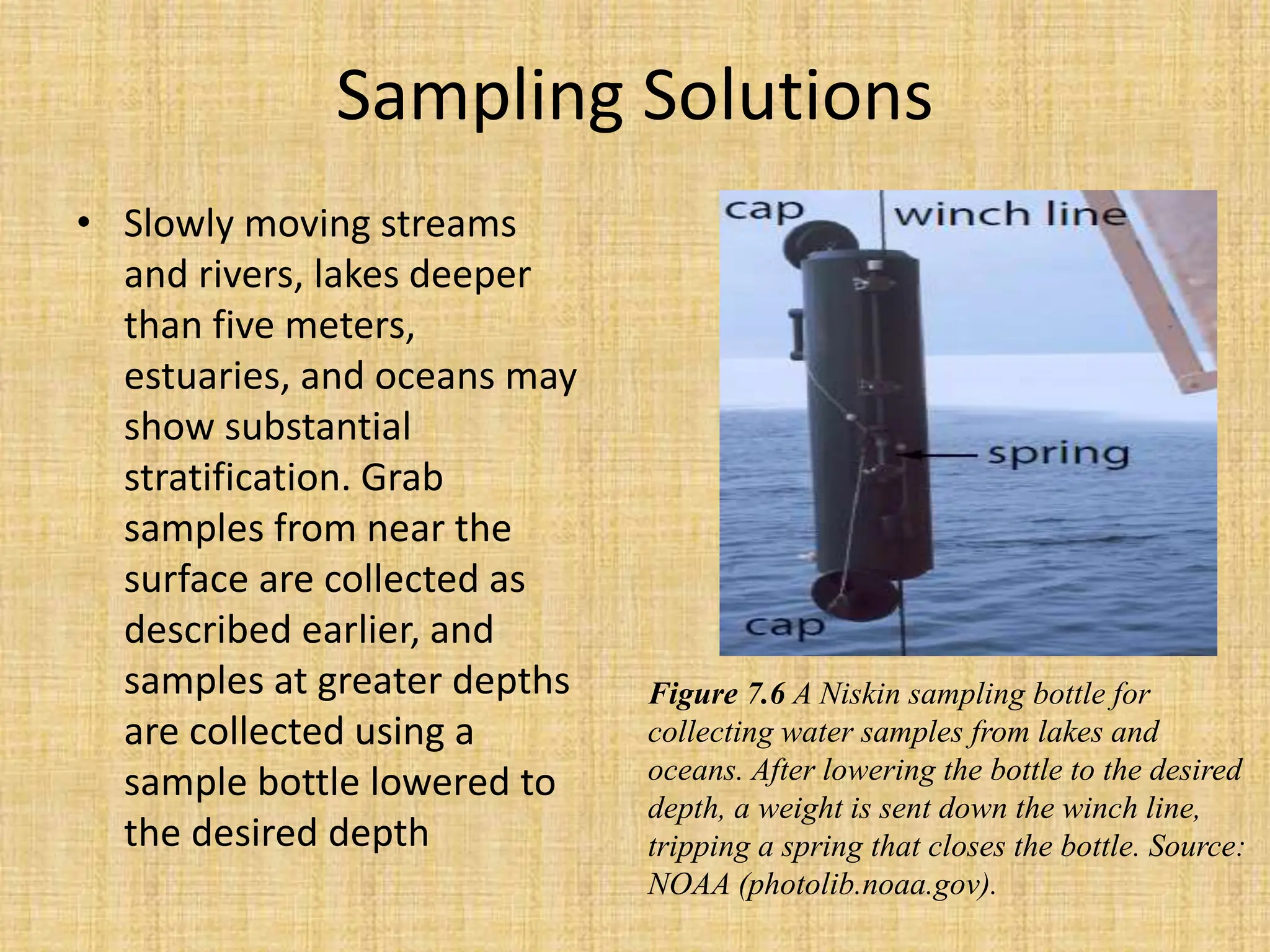
samples at greater depths
are collected using a
sample bottle lowered to
the desired depth
Figure 7.6 A Niskin sampling bottle for
collecting water samples from lakes and
oceans. After lowering the bottle to the desired
depth, a weight is sent down the winch line,
tripping a spring that closes the bottle. Source:
NOAA (photolib.noaa.gov).
Sampling solutions
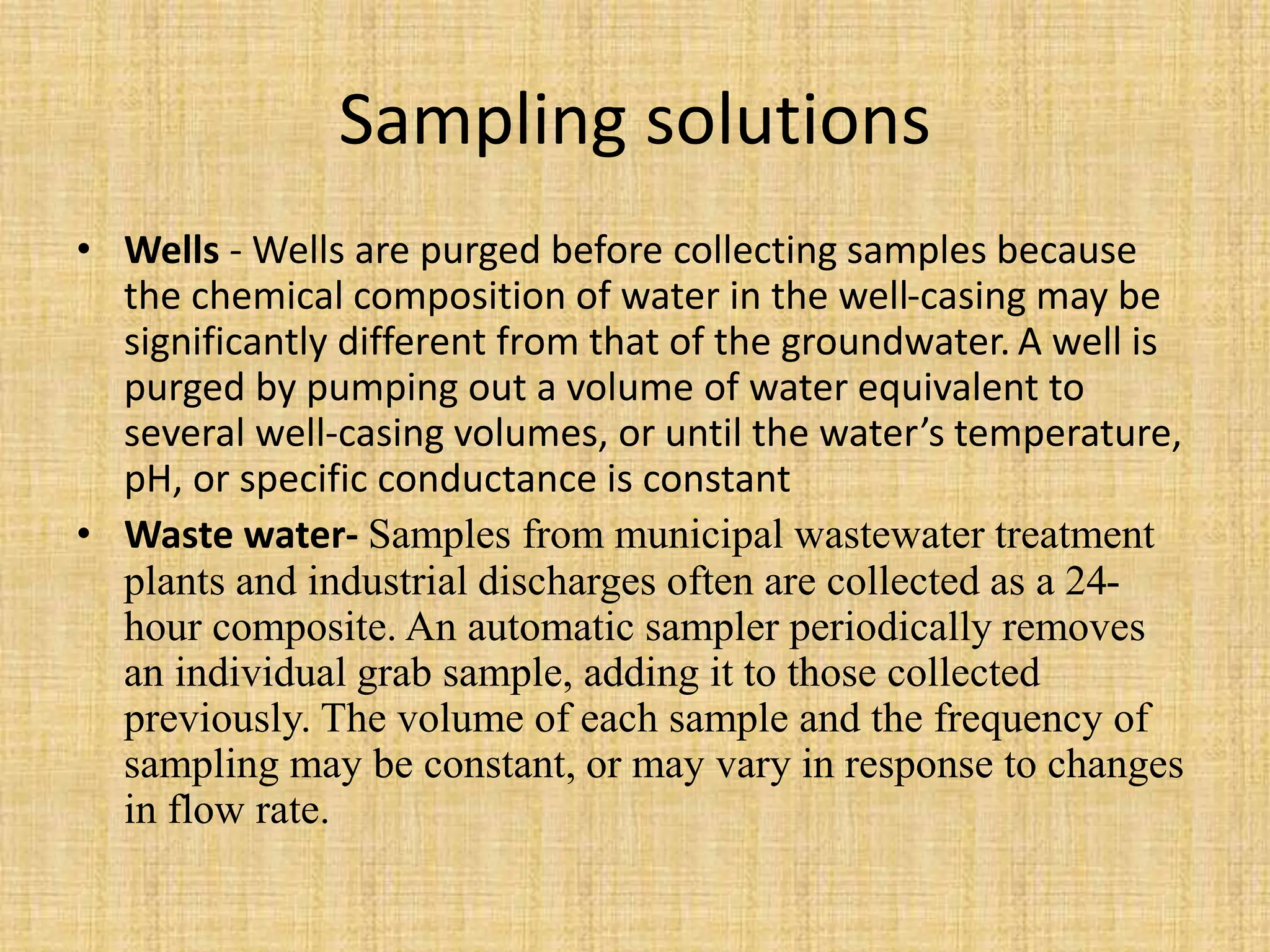
• Wells - Wells are purged before collecting samples because
the chemical composition of water in the well-casing may be
significantly different from that of the groundwater. A well is
purged by pumping out a volume of water equivalent to
several well-casing volumes, or until the water’s temperature,
pH, or specific conductance is constant
• Waste water- Samples from municipal wastewater treatment
plants and industrial discharges often are collected as a 24-
hour composite. An automatic sampler periodically removes
an individual grab sample, adding it to those collected
previously. The volume of each sample and the frequency of
sampling may be constant, or may vary in response to changes
in flow rate.
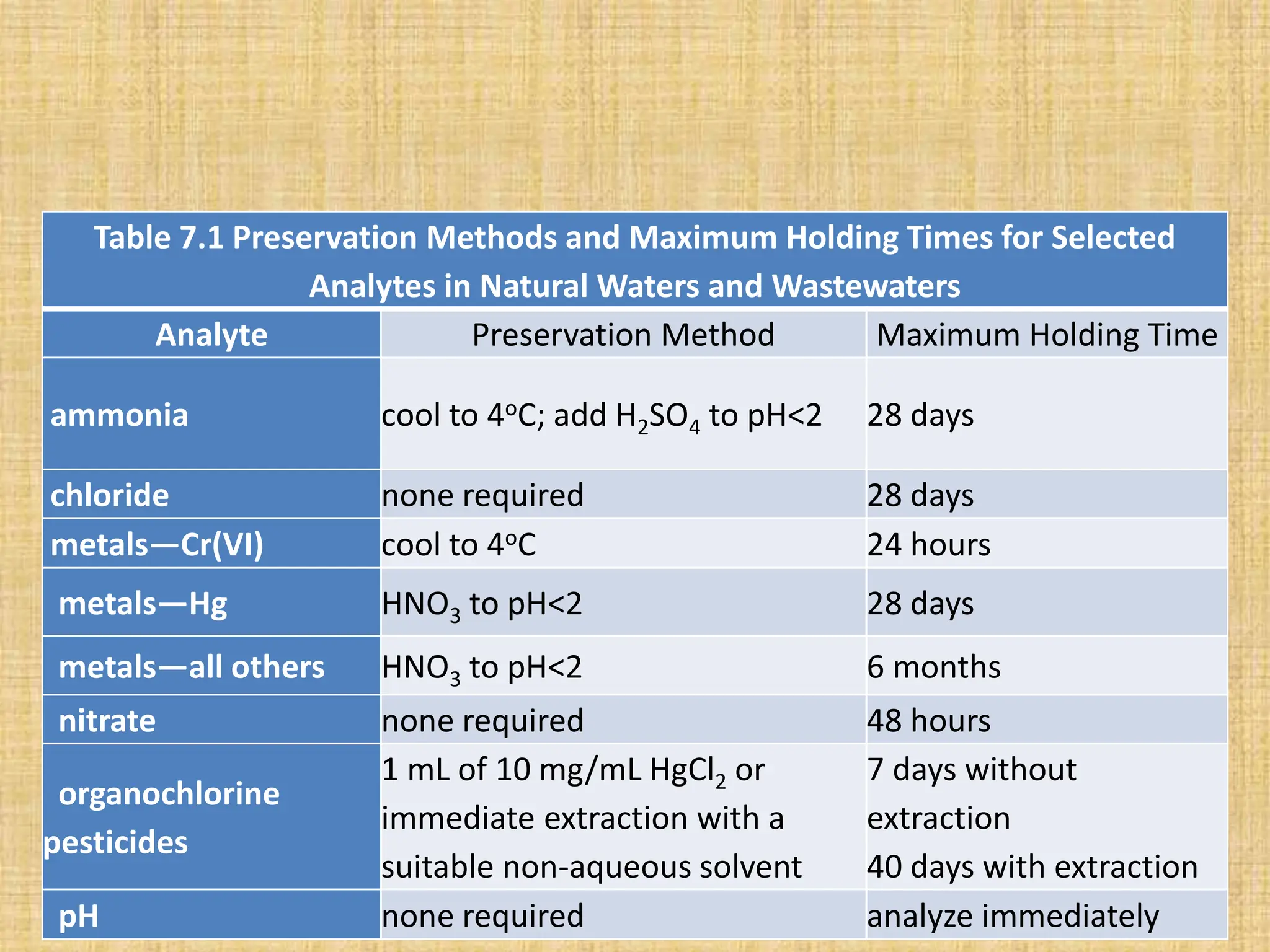
Table 7.1 Preservation Methods and Maximum Holding Times for Selected
Analytes in Natural Waters and Wastewaters
Analyte Preservation Method Maximum Holding Time
ammonia cool to 4oC; add H2SO4 to pH<2 28 days
chloride none required 28 days
metals—Cr(VI) cool to 4oC 24 hours
metals—Hg HNO3 to pH<2 28 days
metals—all others HNO3 to pH<2 6 months
nitrate none required 48 hours
organochlorine
pesticides
1 mL of 10 mg/mL HgCl2 or
immediate extraction with a
suitable non-aqueous solvent
7 days without
extraction
40 days with extraction
pH none required analyze immediately
Sample Preservation and
Preparation
After removing a sample from its target population, its chemical
composition may change as a result of chemical, biological, or
physical processes.
To prevent a change in composition, samples are preserved by
controlling the solution’s pH and temperature, by limiting its
exposure to light or to the atmosphere, or by adding a chemical
preservative.
After preserving a sample, it may be safely stored for later
analysis.
The maximum holding time between preservation and analysis
depends on the analyte’s stability and the effectiveness of sample
preservation.
Sampling containers
• Sample containers for collecting natural waters and
wastewaters are made from glass or plastic.
Glass containers
• Kimax and Pyrex brand borosilicate glass have the advantage
of being easy to sterilize, easy to clean, and inert to all
solutions except those that are strongly alkaline.
• The disadvantages of glass containers are cost, weight, and the
ease of breakage.
• Glass containers are always used when collecting samples for
the analysis of pesticides, oil and grease, and organics because
these species often interact with plastic surfaces.
Plastic containers.
• Are made from a variety of polymers, including polyethylene,
polypropylene, polycarbonate, polyvinyl chloride, and Teflon.
• Plastic containers are lightweight, durable, and, except for
those manufactured from Teflon, inexpensive.
• In most cases glass or plastic bottles may be used
interchangeably, although polyethylene bottles are generally
preferred because of their lower cost.
• Because glass surfaces easily adsorb metal ions, plastic bottles
are preferred when collecting samples for the analysis of trace
metals
Sampling gases
Typical examples of gaseous samples include:
• automobile exhaust
• emissions from industrial smokestacks
•atmospheric gases and
• compressed gases.
Also included in this category are aerosol particulates
—the fine solid particles and liquid droplets that
form smoke and smog
Sampling gases
• Most urban air samples are collected using a trap containing
a solid sorbent or by filtering.
• Solid sorbents are used for volatile gases and semi-volatile
gases .
• Filtration is used to collect aerosol particulates.
• Trapping and filtering allows for sampling larger volumes
of gas and stabilizes the sample between its collection and
its analysis.
• Typically 2–100 L of air are sampled when collecting volatile
compounds, and 2–500 m3 when collecting semi-volatile
gases.
• A variety of inorganic, organic polymer, and carbon
sorbents have been used.
Sampling gases
• Inorganic sorbents:
• silica gel, alumina, magnesium aluminum silicate,
and molecular sieves,
• are efficient collectors for polar compounds.
• Organic polymeric sorbents include:
– polymeric resins of 2,4-diphenyl-p-phenylene oxide
or styrene-divinylbenzene for volatile compounds,
and
– polyurethane foam for semi-volatile compounds.
Sampling gases
• Sample Preservation and Preparation
• After collecting a gross sample of urban air,
there is generally little need for sample
preservation or preparation.
• The chemical composition of a gas sample is
usually stable when it is collected using a solid
sorbent, a filter, or by cryogenic cooling.
Sampling solids
• Typical examples of solid samples include:
– large particulates- such as those found in ores;
– smaller particulates- such as soils and sediments;
– tablets, pellets, and capsules- used for dispensing
pharmaceutical products and animal feeds;
– sheet materials- such as polymers and rolled metals;
and
– tissue samples - from biological specimens.
Solids are usually heterogeneous and samples must be
collected carefully if they are to be representative of
the target population.
Sampling solids
• Sediments from the bottom of streams, rivers,
lakes, estuaries, and oceans are collected with
a bottom grab sampler, or with a corer.
• A bottom grab sampler is equipped with a
pair of jaws that close when they contact the
sediment, scooping up sediment in the
process.
Sampling solids
• Collecting soil samples at depths of up to 30 cm is
easily accomplished with a
– scoop or shovel.
– soil punch - which is a thin-walled steel tube that retains a
core sample after it is pushed into the soil and removed.
• Soil samples from depths greater than 30 cm are
collected by
- digging a trench and collecting lateral samples with a
soil punch or
- by drilling a hole with an auger to the desired depth
and the sample collected with a soil punch
Sampling solids
• For particulate materials, particle size often
determines the sampling method:
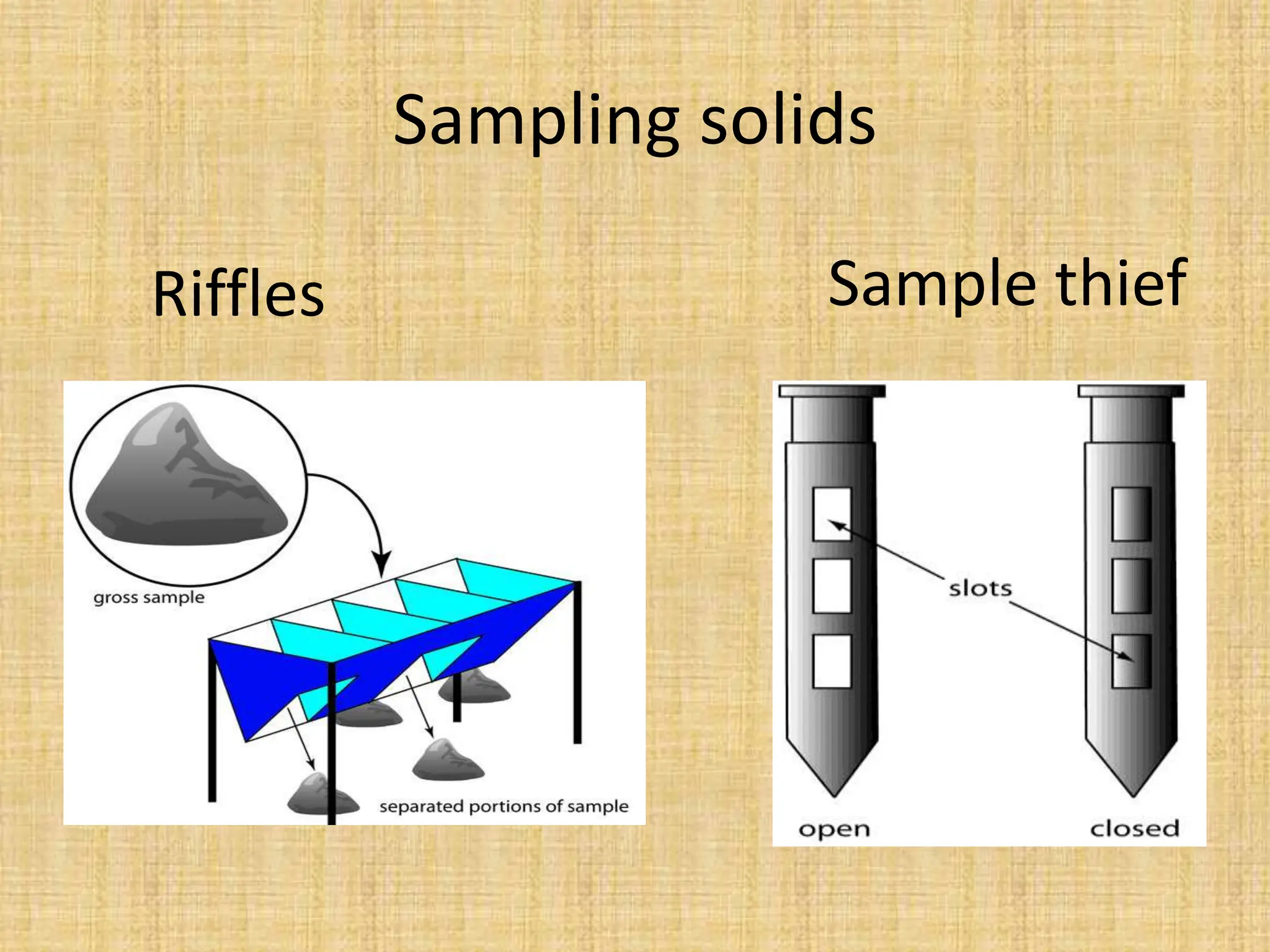
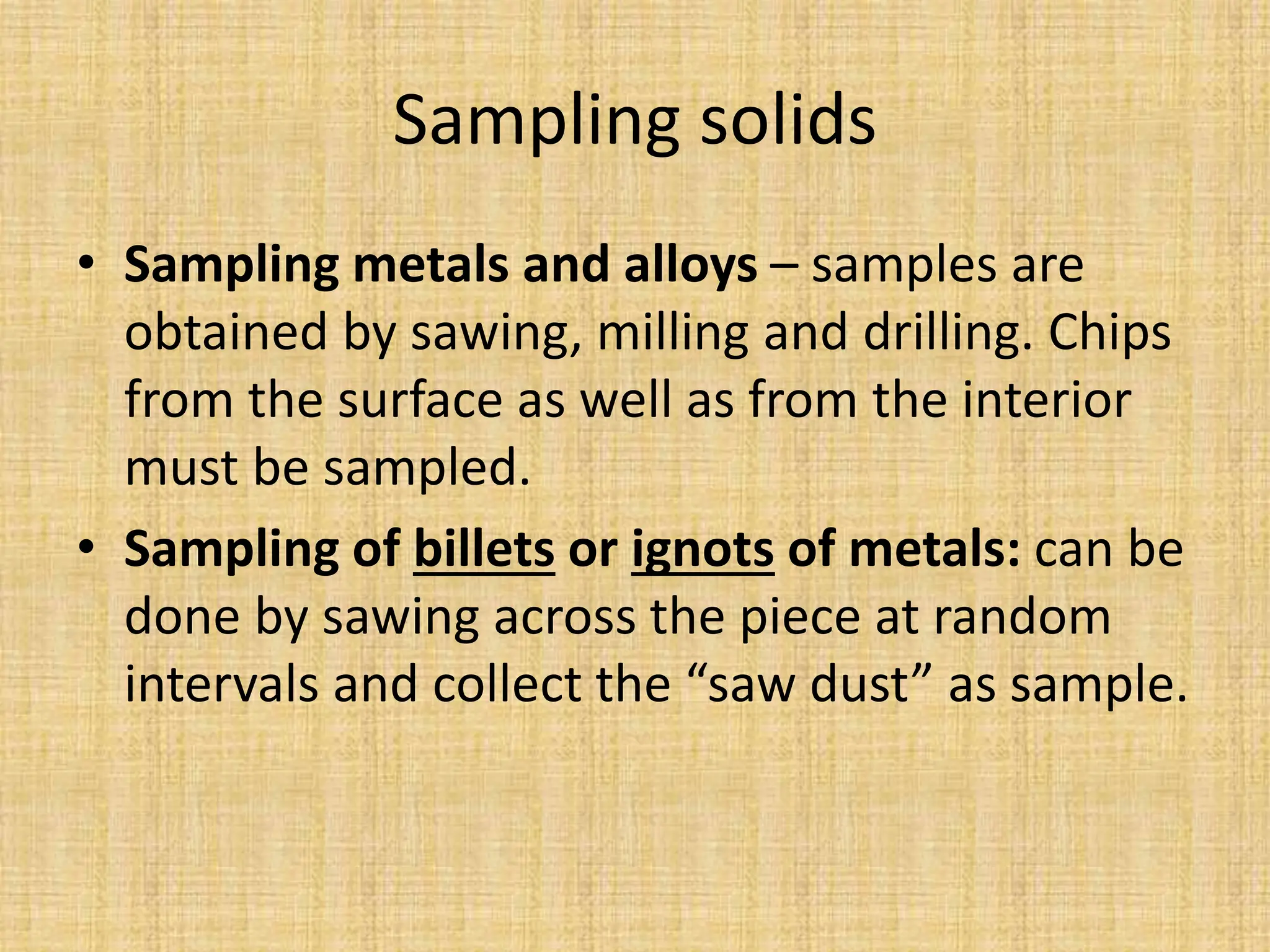
• Larger particulate solids, such as ores, are sampled using a
riffle - a trough containing an even number of compartments.
Because adjoining compartments empty onto opposite sides of
the riffle, dumping a gross sample into the riffle divides it in
half.
• By repeatedly passing half of the separated material back
through the riffle, a sample of any desired size may be
collected.
Sampling solids
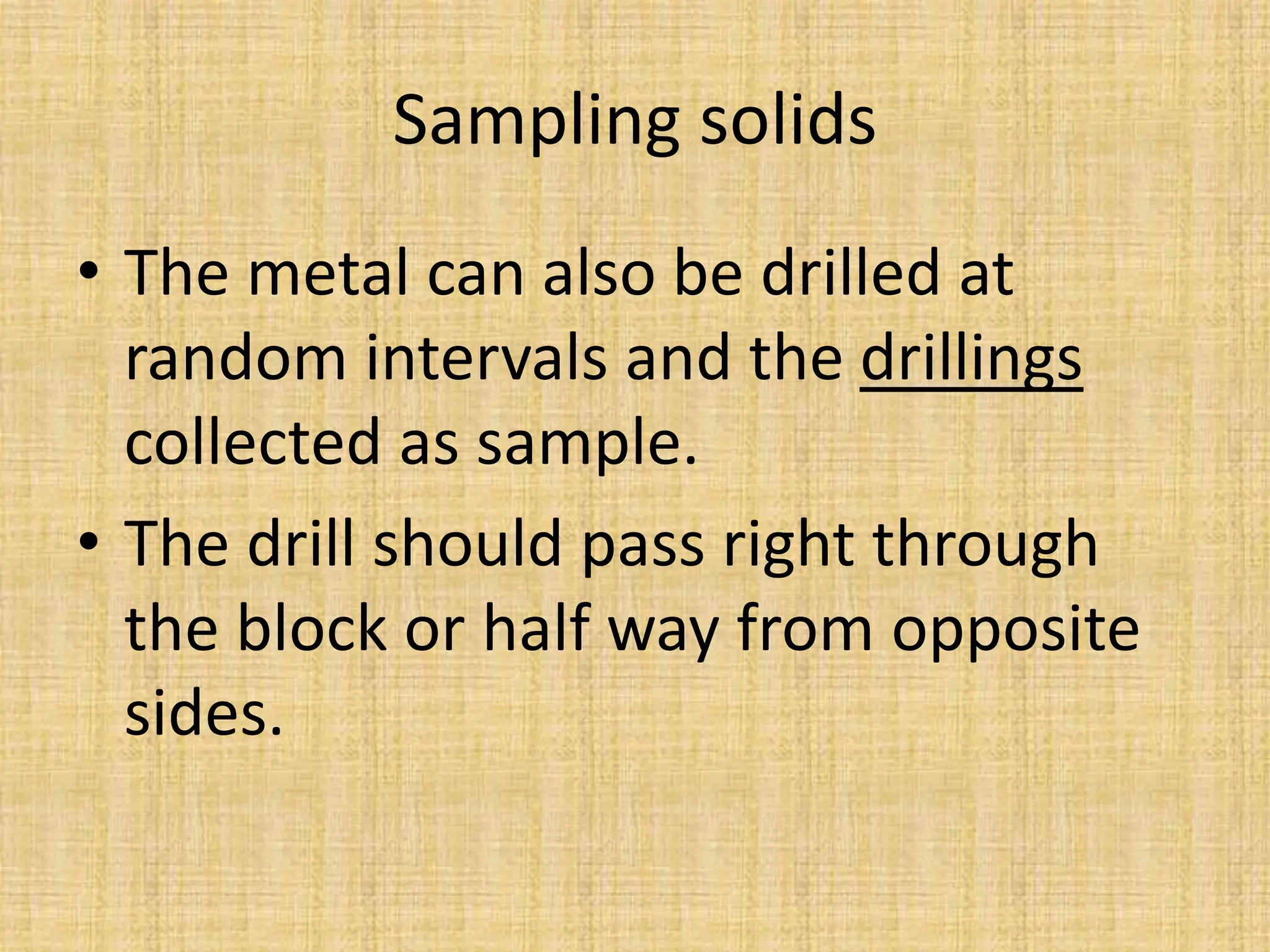
• A sample thief is used for sampling smaller
particulate materials, such as powders.
• A typical sample thief consists of two tubes that are
nestled together. Each tube has one or more slots
aligned down the sample thief’s length.
• Before inserting the sample thief into the material being
sampled, the slots are closed by rotating the inner
tube.
• When the sample thief is in place, rotating the inner
tube opens the slots, which fill with individual samples.
• The inner tube is then rotated to the closed position and
the sample thief withdrawn.
Sampling solids
Riffles Sample thief
Sampling solids
• Sampling metals and alloys – samples are
obtained by sawing, milling and drilling. Chips
from the surface as well as from the interior
must be sampled.
• Sampling of billets or ignots of metals: can be
done by sawing across the piece at random
intervals and collect the “saw dust” as sample.
Sampling solids
• The metal can also be drilled at
random intervals and the drillings
collected as sample.
• The drill should pass right through
the block or half way from opposite
sides.
Methods of storing samples
• Open air storage – for samples that are not
affected by air, moisture or light
• Air-tight storage – for sample that are oxidized
by air
• Cold storage – for samples that are affected
by heat or are highly perishable
• Dark storage – for samples affected by light
• Dry storage – samples that absorb moisture
from air
Sample preparation
• a solid sample usually needs some processing
or treatment before analysis.
• There are two reasons for this.
–First, the standard deviation for sampling,
ssamp, is a function of the number of
particles in the sample, not the combined
mass of the particles
–Second, many analytical techniques require
that the analyte be in solution.
Sample preparation
• Sample preparation activities include:
– Reducing Particle Size
– Mixing
– Reducing sample size
– Drying the sample
– Storing sample
– Decomposing & dissolving the sample
Sample preparation/treatment
Reducing Particle Size
• A reduction in particle size is accomplished by a
combination of crushing and grinding the gross
sample. The resulting particulates are then thoroughly
mixed and divided into subsamples of smaller mass.
• This process seldom occurs in a single step. Instead,
subsamples are cycled through the process several
times until a final laboratory sample is obtained.
• Crushing and grinding uses mechanical force to
break larger particles into smaller particles.
• A variety of tools are used depending on the
particle’s size and hardness.
Crushing and grinding
• Purpose ; to decrease particle size of solid samples
for homogeneity and ready attack by reagents.
• Effects of crushing and grinding on sample
composition
– Loss of volatile components due heat generated
– Increased susceptibility to reaction with atmosphere
– Substantial change in water content of sample
– Loss of softer components as powder dust during grinding
and flying fragments tend to contain a higher fraction of
the harder components
– Mechanical abrasion of surfaces of the grinding device can
contaminate the sample
Crushing and grinding tools
• Jaw crushers and disc pulverizers; for large
sample containing large lumps
• Ball mills; for medium size samples and
particles
• Mortar and pestle; small amount of material
• Plattner diamond; crushing hard brittle
materials.
Mixing solid laboratory samples
• Mixing – done to achieve random distribution
of components in the analytical samples.
• Methods of mixing;
– Rolling the sample on a sheet of glazed paper.
– Rotating sample in ball mill or a twin-shell V-
blender
– Shoveling and coning
Reducing sample size
• The gross sample is reduced to a uniform particle size by
intermittently passing it through a sieve. Those particles
not passing through the sieve receive additional
processing until the entire sample is of uniform size.
• The resulting material is mixed thoroughly to ensure
homogeneity and a subsample obtained with a riffle, or
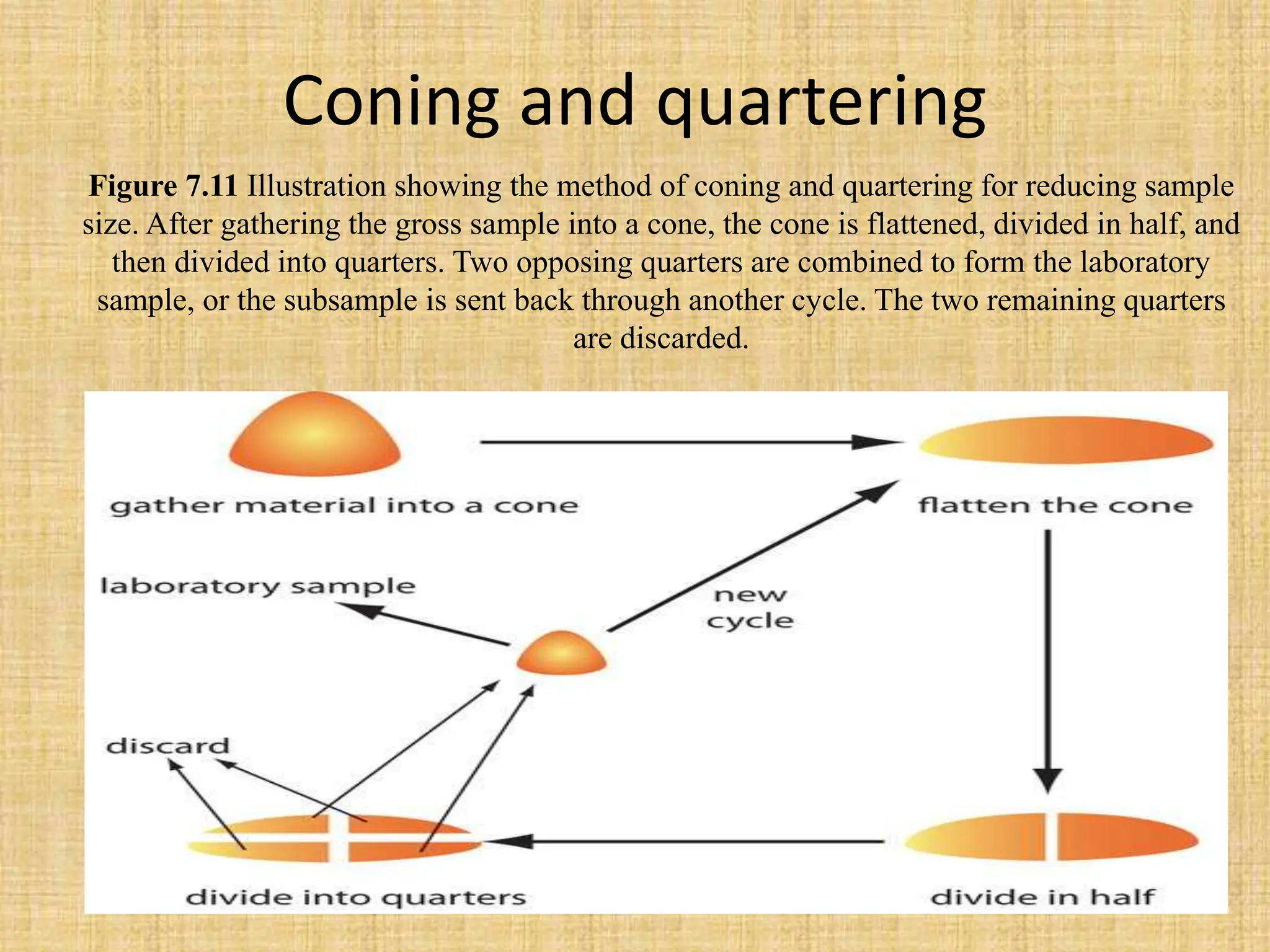
by coning and quartering. As shown in Figure 7.11, the
gross sample is piled into a cone, flattened, and divided
into four quarters. After discarding two diagonally
opposed quarters, the remaining material is cycled
through the process of coning and quartering until a
suitable laboratory sample remains.
Coning and quartering
Figure 7.11 Illustration showing the method of coning and quartering for reducing sample
size. After gathering the gross sample into a cone, the cone is flattened, divided in half, and
then divided into quarters. Two opposing quarters are combined to form the laboratory
sample, or the subsample is sent back through another cycle. The two remaining quarters
are discarded.
Moisture in samples
• Solid samples contain water that is in equilibrium
with the atmosphere and varies with relative
humidity and ambient temperature
• Variability in composition due to moisture can be
handled by;
– Removal of water from sample before weighing
– Reducing water to some reproducible levels
– Determination of water content at time of weighing
the sample
Forms of water in samples
• Essential water – form an integral part of the molecular or
crystalline structure of the solid e.g. water of crystallization
as in CaC2O4.2H2O & BaCl2.2H2O
• Water of constitution- water yielded by compound on
heating or decomposition e.g. calcium hydroxide ------
calcium oxide + water
• Non-essential water – water retained by solids as a result of
physical forces
– Sorbed water- water held in condensed phase in interstices or
capillaries of colloidal solids
– Adsorbed water – water retained on surface of solids
• Occluded water – liquid water trapped in microscopic
pockets in solid crystals
Drying analytical samples
• Methods of dealing with moisture in solid
samples depend on information required;
– As received basis – no drying required
– Air-dry basis – dried to constant mass in air
– Oven-drying basis – dried in oven to constant
mass
– Solar drying basis- samples not decomposed or
volatized by solar radiation
Decomposing & dissolving the sample
• Most analytical measurements are performed
in solutions of the analyte.
• A proper choice should be made in regard to;
– Reagent to use
– Technique to adopt
General considerations
• Reagent should dissolve sample completely
• Reagent should not introduce interferences to
sample
• Possible volatilization of analyte during dissolution
hence lost as; SO2,CO2,H2S,Cl2 etc
• Formation of volatile products with sample/ analyte
eg hot HCl forms volatile chlorides with tin(IV),
germanium(iii), antimony(iii) etc
• Presence of impurities in decomposing reagent that
can cause loss of analyte eg Cl- in hot H2SO4 cause
volatilization loses of Bi, Mn, Mo, Th, V & Cr.
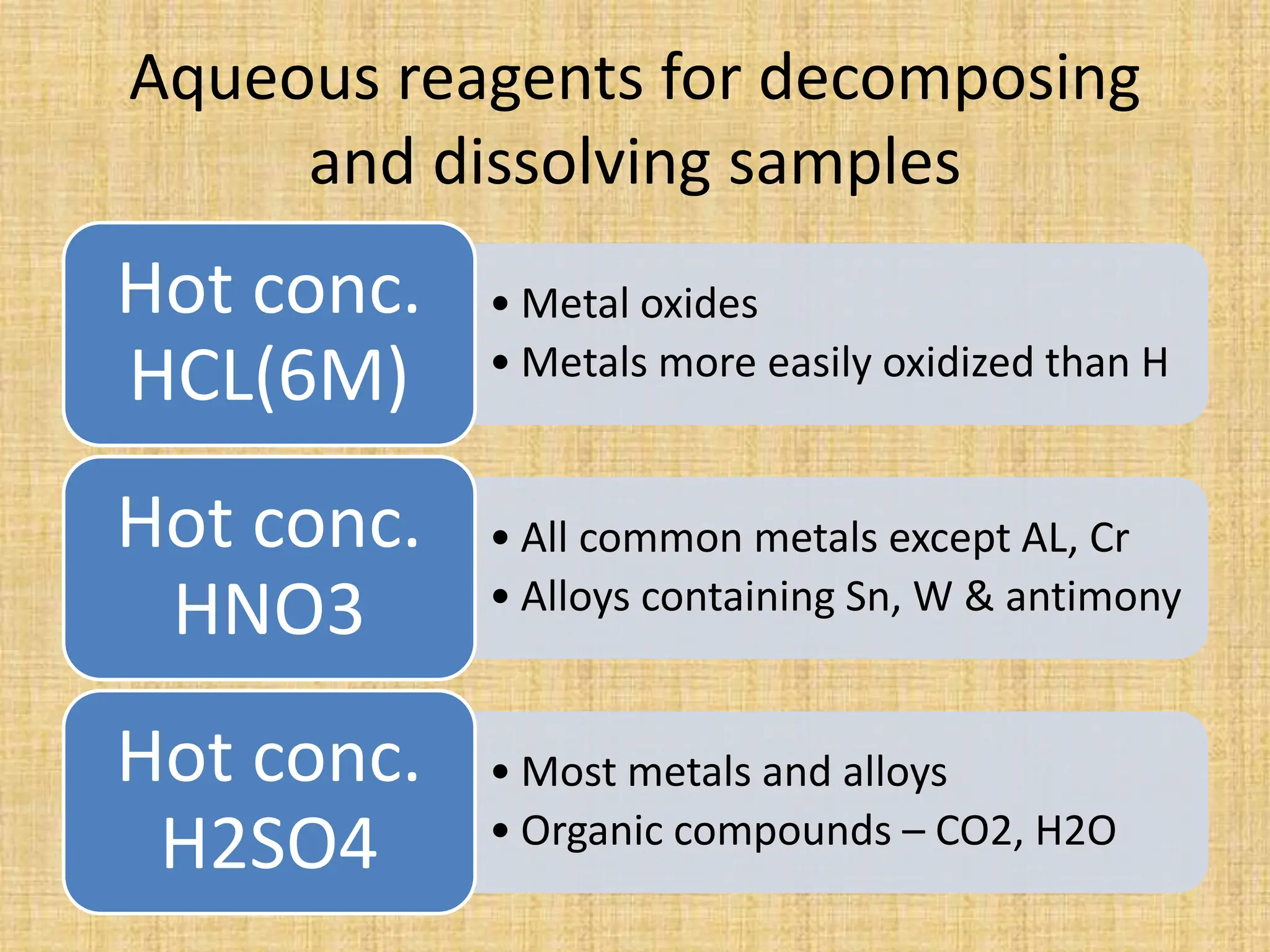
Aqueous reagents for decomposing
and dissolving samples
• Metal oxides
• Metals more easily oxidized than H
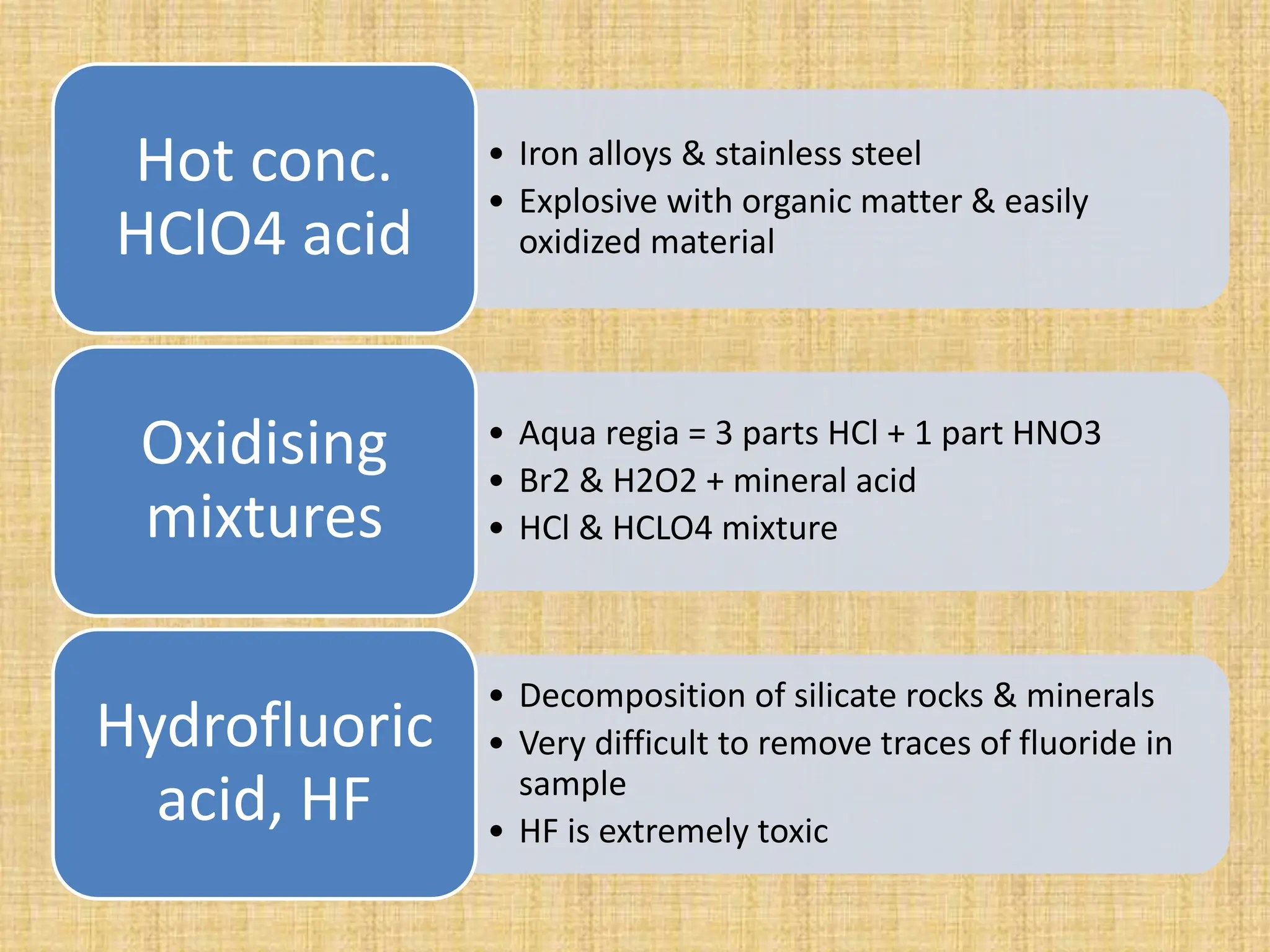
Hot conc.
HCL(6M)
• All common metals except AL, Cr
• Alloys containing Sn, W & antimony
Hot conc.
HNO3
• Most metals and alloys
• Organic compounds – CO2, H2O
Hot conc.
H2SO4
• Iron alloys & stainless steel
• Explosive with organic matter & easily
oxidized material
Hot conc.
HClO4 acid
• Aqua regia = 3 parts HCl + 1 part HNO3
• Br2 & H2O2 + mineral acid
• HCl & HCLO4 mixture
Oxidising
mixtures
• Decomposition of silicate rocks & minerals
• Very difficult to remove traces of fluoride in
sample
• HF is extremely toxic
Hydrofluoric
acid, HF
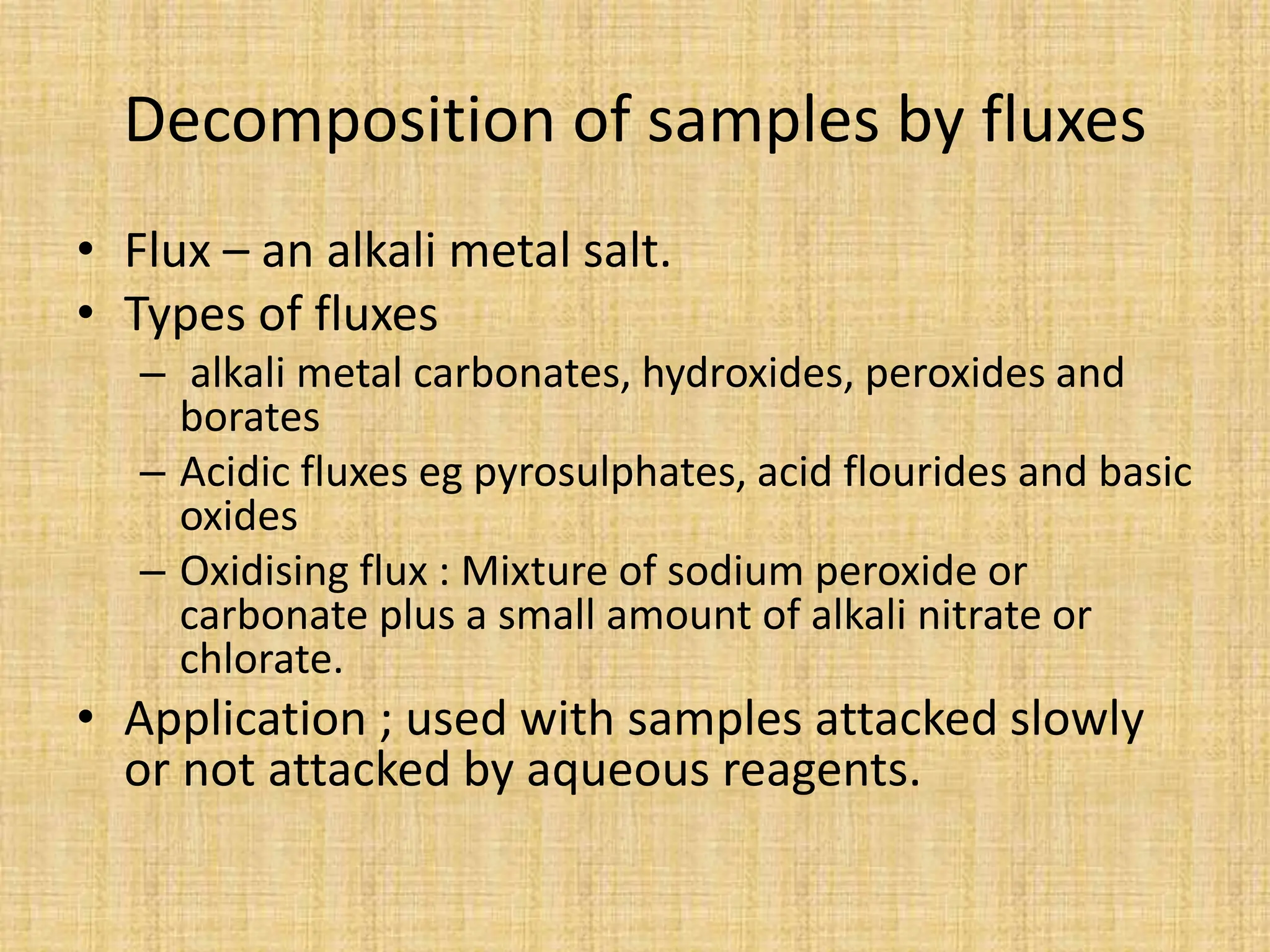
Decomposition of samples by fluxes
• Flux – an alkali metal salt.
• Types of fluxes
– alkali metal carbonates, hydroxides, peroxides and
borates
– Acidic fluxes eg pyrosulphates, acid flourides and basic
oxides
– Oxidising flux : Mixture of sodium peroxide or
carbonate plus a small amount of alkali nitrate or
chlorate.
• Application ; used with samples attacked slowly
or not attacked by aqueous reagents.
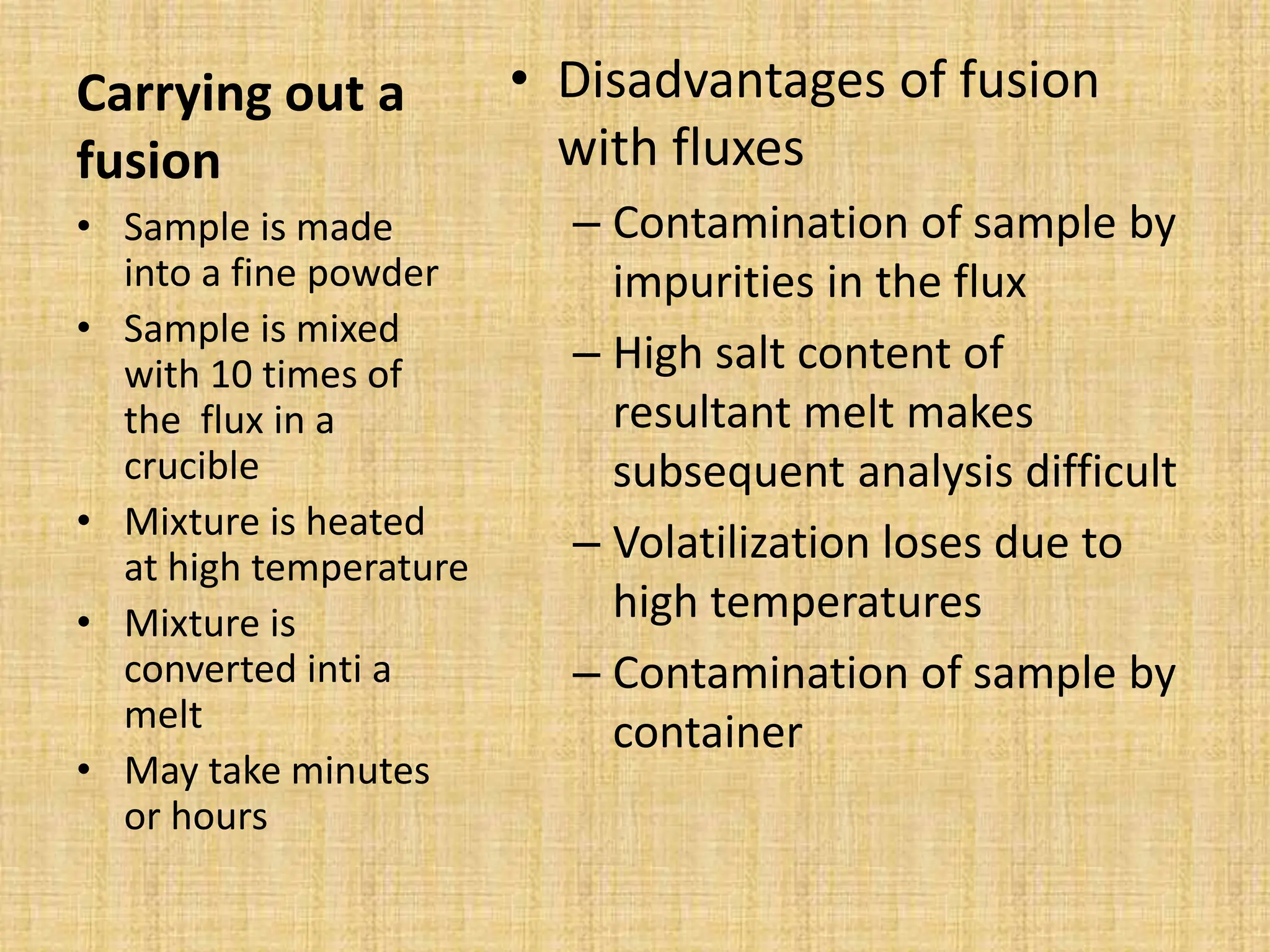
Carrying out a
fusion
• Disadvantages of fusion
with fluxes
– Contamination of sample by
impurities in the flux
– High salt content of
resultant melt makes
subsequent analysis difficult
– Volatilization loses due to
high temperatures
– Contamination of sample by
container
• Sample is made
into a fine powder
• Sample is mixed
with 10 times of
the flux in a
crucible
• Mixture is heated
at high temperature
• Mixture is
converted inti a
melt
• May take minutes
or hours
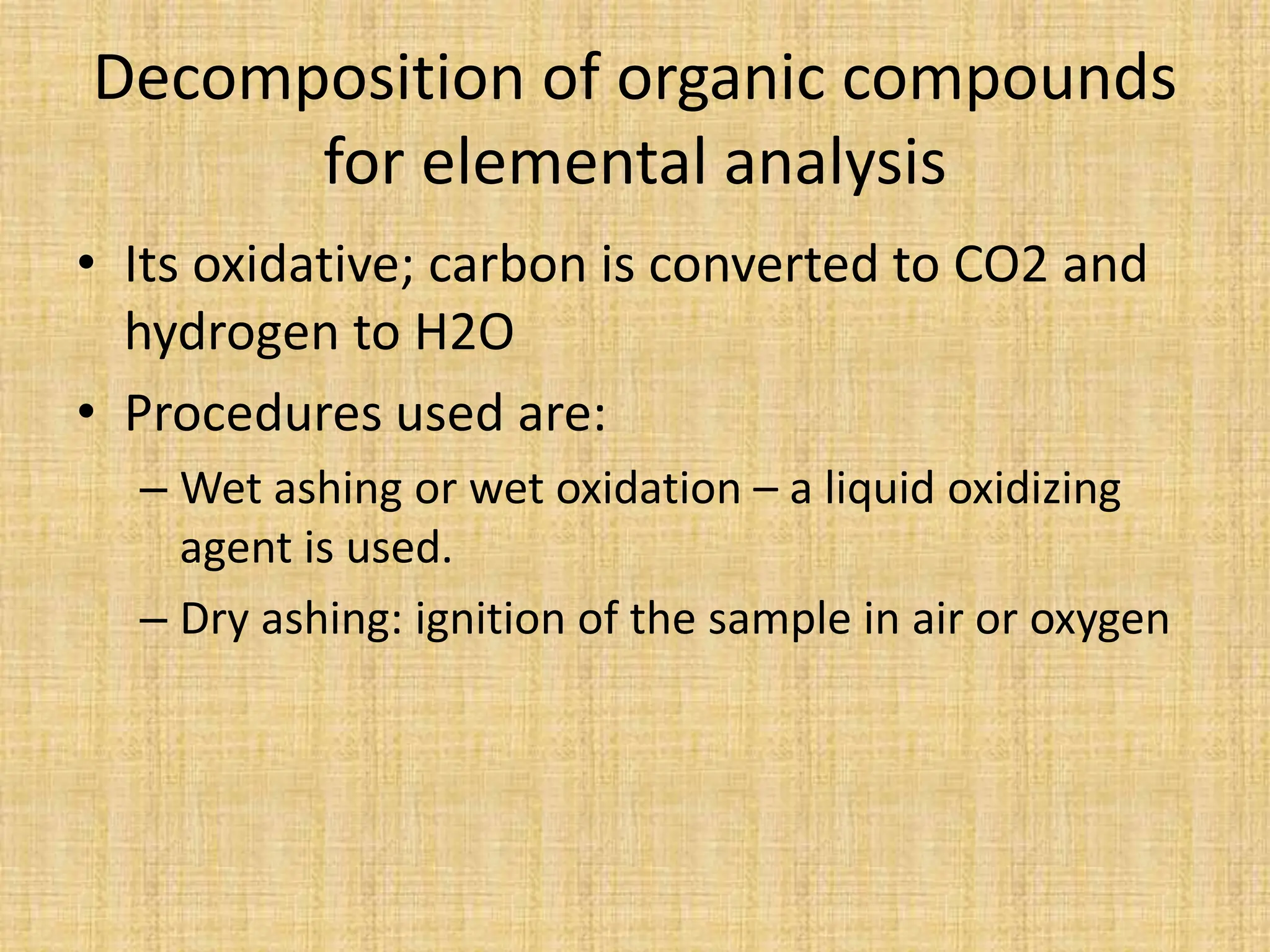
Decomposition of organic compounds
for elemental analysis
• Its oxidative; carbon is converted to CO2 and
hydrogen to H2O
• Procedures used are:
– Wet ashing or wet oxidation – a liquid oxidizing
agent is used.
– Dry ashing: ignition of the sample in air or oxygen
• Wet ashing – involves
boiling sample with conc.
Strong oxidizing agent.
• Reagents used:
– Hot conc H2SO4 as in
Kjeldahl analysis
– Mixture of perchloric acid
and nitric acid
• Other wet ashing
techniques;
– High-pressure wet-ashing
– Micro-wave wet ashing
• Dry ashing – involves
heating the sample in an
open crucible to red heat
to ensure complete
combustion of sample to
CO2.
• Method is simple but not
reliable due to;
– Losses due volatilization
– Uncertain recovery of non-
volatile elements.
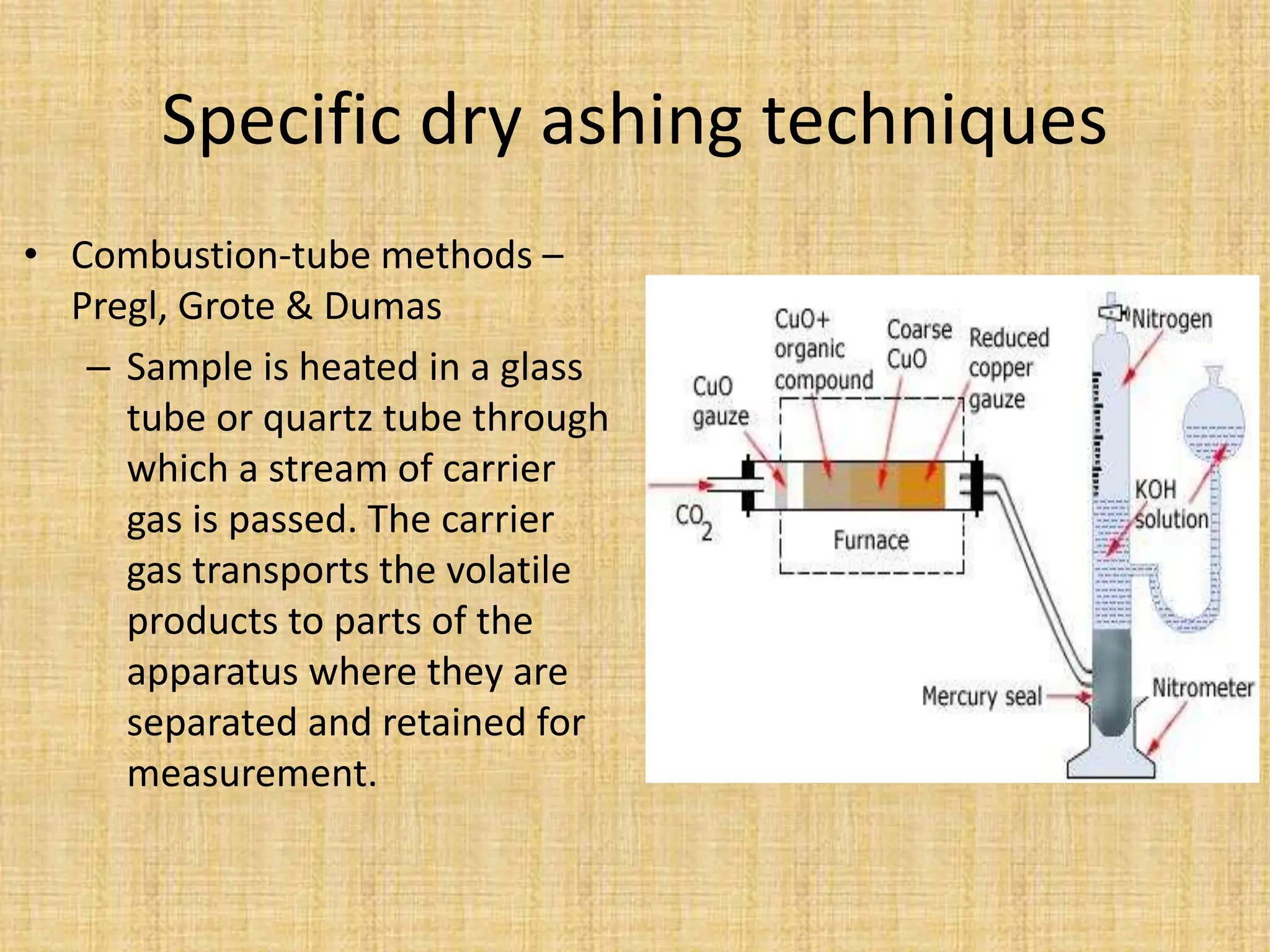
Specific dry ashing techniques
• Combustion-tube methods –
Pregl, Grote & Dumas
– Sample is heated in a glass
tube or quartz tube through
which a stream of carrier
gas is passed. The carrier
gas transports the volatile
products to parts of the
apparatus where they are
separated and retained for
measurement.
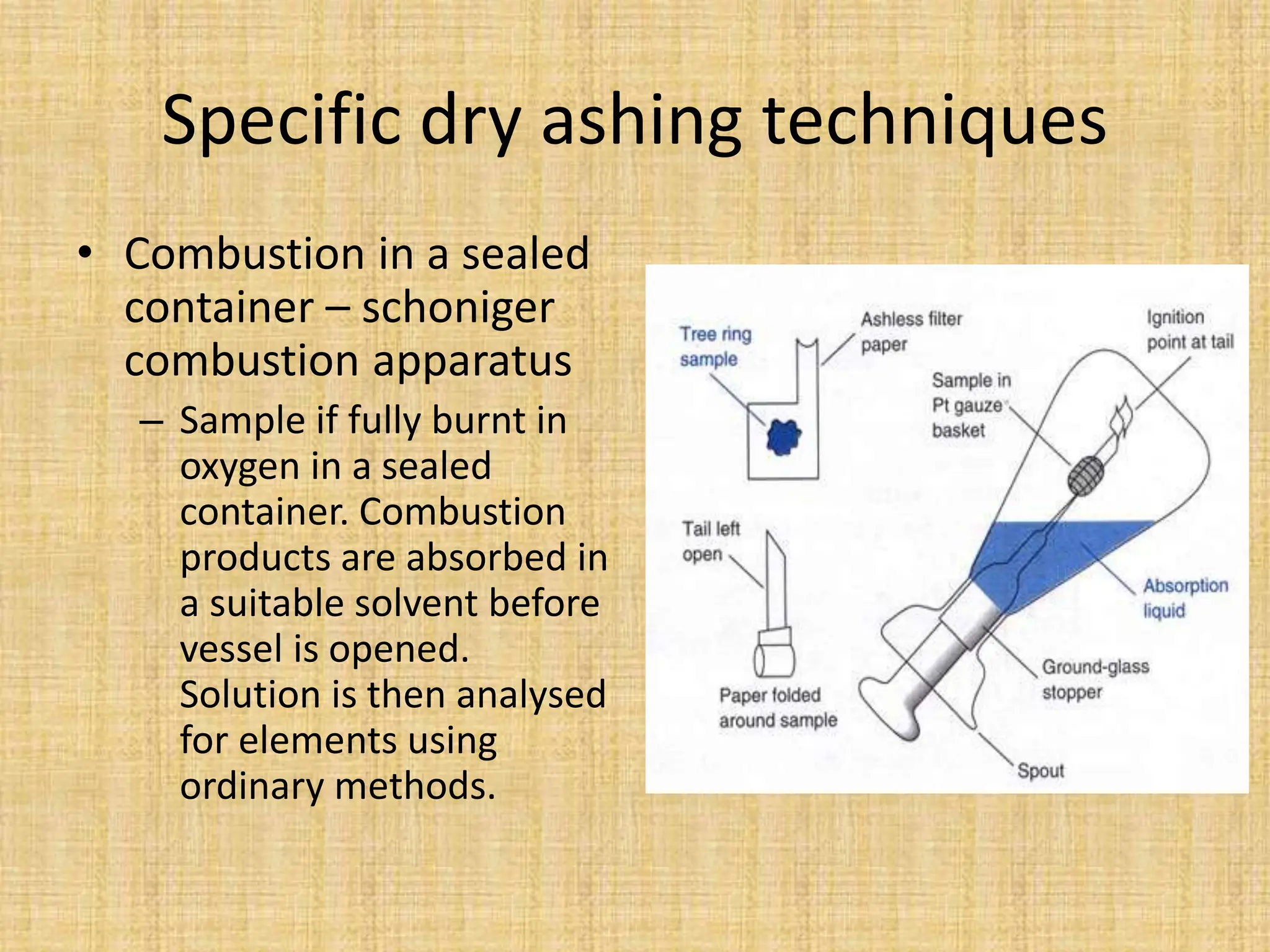
Specific dry ashing techniques
• Combustion in a sealed
container – schoniger
combustion apparatus
– Sample if fully burnt in
oxygen in a sealed
container. Combustion
products are absorbed in
a suitable solvent before
vessel is opened.
Solution is then analysed
for elements using
ordinary methods.
SAMPLING.pptx for analystical chemistry sample techniques

SAMPLING.pptx for analystical chemistry sample techniques

  • 1.
    SAMPLING Prepared by James NMwangi Ntti Trainer; Analytical chemistry
  • 2.
    DEFINITION OF SAMPLING •Sampling is the process of taking a small amount of a substance from the bulk which is a true representation of the whole amount. • The end product of sampling step is a small quantity of homogenous material weighing a few grams or a few hundred grams that may constitute about one part in 10^7 or 10^8 of bulk material.
  • 3.
    Types of samples •Representative sample A representative sample is a sample that is a true representative of the bulk. • Grab sample A grab sample is a sample taken at a specific place and time. Usually used for a quick test • Composite sample A composite sample is a sample made from mixing many grab samples together. It is more representative of the population.
  • 4.
    Importance of sampling •To get results that are: Accurate Of required precision Applicable to the bulk material Reliable Reproducible.
  • 5.
    Sampling plan • Toget good results, the analyst requires a sampling plan. • A sampling plan must support the goals of an analysis - qualitative – identify components - quantitative- amount of each component • A good sampling plan helps to eliminate sampling errors - determinate errors - indeterminate errors - gross errors
  • 6.
    Sampling steps • Threesampling steps – Identification of the bulk material from which to obtain sample – Collection of a gross sample that is truly representative of the bulk material – Reduction of the gross sample to a laboratory sample suitable for analysis
  • 7.
    Sampling uncertainties • Introduceerrors in the process of chemical analysis. • Goal of analysis is to keep these errors to a minimum and to estimate their size with acceptable accuracy • Types of errors; – Indeterminate errors – Determinate errors – Gross errors
  • 8.
    Sampling errors • Indeterminate(or random) errors – Affect the precision of measurement. Can be eliminated by exercising care, by calibration and proper use of standards, blanks & reference materials • Determinate (or systematic) errors – Affect the precision of data i.e. accuracy of results. Can be minimized by close control of the variables that influence measurements • Gross errors – Affect only a single result in a set of replicate data causing it to differ significantly from the rest. Leads to outliers.
  • 9.
    Implementing a samplingplan • Implementing a sampling plan normally involves three steps:  physically removing the sample from its target population, preserving the sample, and  preparing the sample for analysis. • usually we analyze a sample after removing it from its target population. • To prevent contamination, the sampling device must be inert and clean.
  • 10.
    Quantitative analysis necessitatesa careful sampling plan: • Among the issues to consider are these five questions. • From where within the target population should we collect samples? • What type of samples should we collect? • What is the minimum amount of sample for each analysis? • How many samples should we analyze? • How can we minimize the overall variance for the analysis?
  • 11.
    Separating samples frominterferences • Why separation? most analytical methods are not selective enough for a single species(analyte). The goal of an analytical separation is to remove either the analyte or the interferent from the sample’s matrix. To achieve this separation there must be at least one significant difference between the analyte’s and the interferent’s chemical or physical properties. Care should be taken to prevent loss of significant amount of analyte or to retain significant amount of interferent.
  • 12.
    Sampling techniques • Randomsampling; samples are collected from random sites from the bulk • Systematic sampling; In systematic sampling we sample the target population at regular intervals in space or time. • Judgmental sampling; we use prior information about the target population to help guide our selection of samples.
  • 13.
    Sampling techniques • Stratifiedsampling; a combination of the three primary approaches to sampling. Also called judgmental– random. We divide the target population into strata and collect random samples from within each stratum. • Systematic-judgmental sampling; we use prior knowledge about a system to guide a systematic sampling plan. • Convenient sampling; we select sample sites using criteria other than minimizing sampling error and sampling variance.
  • 14.
    What type ofsample to collect? There are three common methods for obtaining samples: • grab sampling, • composite sampling, and • in situ sampling.
  • 15.
    Grab sample Grab sample,in which we collect a portion of the target population at a specific time and/or location, providing a “snapshot” of the target population. • If our target population is homogeneous, a series of random grab samples allows us to establish its properties. • For a heterogeneous target population, systematic grab sampling allows us to characterize how its properties change over time and/or space.
  • 16.
    composite sample • Acomposite sample is a set of grab samples that we combine into a single sample before analysis. • Because information is lost when we combine individual samples, we normally analyze grab sample separately. In some situations, however, there are advantages to working with a composite sample. • One situation where composite sampling is appropriate is when our interest is in the target population’s average composition over time or space. For example, wastewater treatment plants must monitor and report the average daily composition of the treated water they release to the environment.
  • 17.
    In situ sampling •In situ sampling, in which we insert an analytical sensor into the target population, allows us to continuously monitor the target population without removing individual grab samples. • For example, we can monitor the pH of a solution moving through an industrial production line by immersing a pH electrode in the solution’s flow.
  • 18.
    How Much Sampleto Collect • To minimize sampling errors, samples must be of an appropriate size. If a sample is too small, its composition may differ substantially from that of the target population, introducing a sampling error. Samples that are too large, however, require more time and money to collect and analyze, without providing a significant improvement in the sampling error.
  • 19.
    How Many Samplesto Collect • Another important consideration is the number of samples to collect. • Number of samples collected should be enough for bulk material in consideration
  • 20.
    Sampling Solutions • Typicalexamples of solution samples include those drawn from containers of commercial solvents; beverages, such as milk or fruit juice; natural waters, including lakes, streams, seawater and rain; bodily fluids, such as blood and urine; and, suspensions; such as those found in many oral medications. Sample Collection • The chemical composition of a surface water—such as a stream, river, lake, estuary, or ocean—is influenced by flow rate and depth. • Rapidly flowing shallow streams and rivers, and shallow (<5 m) lakes are usually well mixed, and show little stratification with depth. • To collect a grab sample we submerge a capped bottle below the surface, remove the cap and allow the bottle to fill completely, and replace the cap. • Collecting a sample this way avoids the air–water interface, which may be enriched with heavy metals or contaminated with oil.10
  • 21.
    Sampling Solutions • Slowlymoving streams and rivers, lakes deeper than five meters, estuaries, and oceans may show substantial stratification. Grab samples from near the surface are collected as described earlier, and samples at greater depths are collected using a sample bottle lowered to the desired depth Figure 7.6 A Niskin sampling bottle for collecting water samples from lakes and oceans. After lowering the bottle to the desired depth, a weight is sent down the winch line, tripping a spring that closes the bottle. Source: NOAA (photolib.noaa.gov).
  • 22.
    Sampling solutions • Wells- Wells are purged before collecting samples because the chemical composition of water in the well-casing may be significantly different from that of the groundwater. A well is purged by pumping out a volume of water equivalent to several well-casing volumes, or until the water’s temperature, pH, or specific conductance is constant • Waste water- Samples from municipal wastewater treatment plants and industrial discharges often are collected as a 24- hour composite. An automatic sampler periodically removes an individual grab sample, adding it to those collected previously. The volume of each sample and the frequency of sampling may be constant, or may vary in response to changes in flow rate.
  • 23.
    Table 7.1 PreservationMethods and Maximum Holding Times for Selected Analytes in Natural Waters and Wastewaters Analyte Preservation Method Maximum Holding Time ammonia cool to 4oC; add H2SO4 to pH<2 28 days chloride none required 28 days metals—Cr(VI) cool to 4oC 24 hours metals—Hg HNO3 to pH<2 28 days metals—all others HNO3 to pH<2 6 months nitrate none required 48 hours organochlorine pesticides 1 mL of 10 mg/mL HgCl2 or immediate extraction with a suitable non-aqueous solvent 7 days without extraction 40 days with extraction pH none required analyze immediately
  • 24.
    Sample Preservation and Preparation Afterremoving a sample from its target population, its chemical composition may change as a result of chemical, biological, or physical processes. To prevent a change in composition, samples are preserved by controlling the solution’s pH and temperature, by limiting its exposure to light or to the atmosphere, or by adding a chemical preservative. After preserving a sample, it may be safely stored for later analysis. The maximum holding time between preservation and analysis depends on the analyte’s stability and the effectiveness of sample preservation.
  • 25.
    Sampling containers • Samplecontainers for collecting natural waters and wastewaters are made from glass or plastic. Glass containers • Kimax and Pyrex brand borosilicate glass have the advantage of being easy to sterilize, easy to clean, and inert to all solutions except those that are strongly alkaline. • The disadvantages of glass containers are cost, weight, and the ease of breakage. • Glass containers are always used when collecting samples for the analysis of pesticides, oil and grease, and organics because these species often interact with plastic surfaces.
  • 26.
    Plastic containers. • Aremade from a variety of polymers, including polyethylene, polypropylene, polycarbonate, polyvinyl chloride, and Teflon. • Plastic containers are lightweight, durable, and, except for those manufactured from Teflon, inexpensive. • In most cases glass or plastic bottles may be used interchangeably, although polyethylene bottles are generally preferred because of their lower cost. • Because glass surfaces easily adsorb metal ions, plastic bottles are preferred when collecting samples for the analysis of trace metals
  • 27.
    Sampling gases Typical examplesof gaseous samples include: • automobile exhaust • emissions from industrial smokestacks •atmospheric gases and • compressed gases. Also included in this category are aerosol particulates —the fine solid particles and liquid droplets that form smoke and smog
  • 28.
    Sampling gases • Mosturban air samples are collected using a trap containing a solid sorbent or by filtering. • Solid sorbents are used for volatile gases and semi-volatile gases . • Filtration is used to collect aerosol particulates. • Trapping and filtering allows for sampling larger volumes of gas and stabilizes the sample between its collection and its analysis. • Typically 2–100 L of air are sampled when collecting volatile compounds, and 2–500 m3 when collecting semi-volatile gases. • A variety of inorganic, organic polymer, and carbon sorbents have been used.
  • 29.
    Sampling gases • Inorganicsorbents: • silica gel, alumina, magnesium aluminum silicate, and molecular sieves, • are efficient collectors for polar compounds. • Organic polymeric sorbents include: – polymeric resins of 2,4-diphenyl-p-phenylene oxide or styrene-divinylbenzene for volatile compounds, and – polyurethane foam for semi-volatile compounds.
  • 30.
    Sampling gases • SamplePreservation and Preparation • After collecting a gross sample of urban air, there is generally little need for sample preservation or preparation. • The chemical composition of a gas sample is usually stable when it is collected using a solid sorbent, a filter, or by cryogenic cooling.
  • 31.
    Sampling solids • Typicalexamples of solid samples include: – large particulates- such as those found in ores; – smaller particulates- such as soils and sediments; – tablets, pellets, and capsules- used for dispensing pharmaceutical products and animal feeds; – sheet materials- such as polymers and rolled metals; and – tissue samples - from biological specimens. Solids are usually heterogeneous and samples must be collected carefully if they are to be representative of the target population.
  • 32.
    Sampling solids • Sedimentsfrom the bottom of streams, rivers, lakes, estuaries, and oceans are collected with a bottom grab sampler, or with a corer. • A bottom grab sampler is equipped with a pair of jaws that close when they contact the sediment, scooping up sediment in the process.
  • 33.
    Sampling solids • Collectingsoil samples at depths of up to 30 cm is easily accomplished with a – scoop or shovel. – soil punch - which is a thin-walled steel tube that retains a core sample after it is pushed into the soil and removed. • Soil samples from depths greater than 30 cm are collected by - digging a trench and collecting lateral samples with a soil punch or - by drilling a hole with an auger to the desired depth and the sample collected with a soil punch
  • 34.
    Sampling solids • Forparticulate materials, particle size often determines the sampling method: • Larger particulate solids, such as ores, are sampled using a riffle - a trough containing an even number of compartments. Because adjoining compartments empty onto opposite sides of the riffle, dumping a gross sample into the riffle divides it in half. • By repeatedly passing half of the separated material back through the riffle, a sample of any desired size may be collected.
  • 35.
    Sampling solids • Asample thief is used for sampling smaller particulate materials, such as powders. • A typical sample thief consists of two tubes that are nestled together. Each tube has one or more slots aligned down the sample thief’s length. • Before inserting the sample thief into the material being sampled, the slots are closed by rotating the inner tube. • When the sample thief is in place, rotating the inner tube opens the slots, which fill with individual samples. • The inner tube is then rotated to the closed position and the sample thief withdrawn.
  • 36.
  • 37.
    Sampling solids • Samplingmetals and alloys – samples are obtained by sawing, milling and drilling. Chips from the surface as well as from the interior must be sampled. • Sampling of billets or ignots of metals: can be done by sawing across the piece at random intervals and collect the “saw dust” as sample.
  • 38.
    Sampling solids • Themetal can also be drilled at random intervals and the drillings collected as sample. • The drill should pass right through the block or half way from opposite sides.
  • 39.
    Methods of storingsamples • Open air storage – for samples that are not affected by air, moisture or light • Air-tight storage – for sample that are oxidized by air • Cold storage – for samples that are affected by heat or are highly perishable • Dark storage – for samples affected by light • Dry storage – samples that absorb moisture from air
  • 40.
    Sample preparation • asolid sample usually needs some processing or treatment before analysis. • There are two reasons for this. –First, the standard deviation for sampling, ssamp, is a function of the number of particles in the sample, not the combined mass of the particles –Second, many analytical techniques require that the analyte be in solution.
  • 41.
    Sample preparation • Samplepreparation activities include: – Reducing Particle Size – Mixing – Reducing sample size – Drying the sample – Storing sample – Decomposing & dissolving the sample
  • 42.
    Sample preparation/treatment Reducing ParticleSize • A reduction in particle size is accomplished by a combination of crushing and grinding the gross sample. The resulting particulates are then thoroughly mixed and divided into subsamples of smaller mass. • This process seldom occurs in a single step. Instead, subsamples are cycled through the process several times until a final laboratory sample is obtained. • Crushing and grinding uses mechanical force to break larger particles into smaller particles. • A variety of tools are used depending on the particle’s size and hardness.
  • 43.
    Crushing and grinding •Purpose ; to decrease particle size of solid samples for homogeneity and ready attack by reagents. • Effects of crushing and grinding on sample composition – Loss of volatile components due heat generated – Increased susceptibility to reaction with atmosphere – Substantial change in water content of sample – Loss of softer components as powder dust during grinding and flying fragments tend to contain a higher fraction of the harder components – Mechanical abrasion of surfaces of the grinding device can contaminate the sample
  • 44.
    Crushing and grindingtools • Jaw crushers and disc pulverizers; for large sample containing large lumps • Ball mills; for medium size samples and particles • Mortar and pestle; small amount of material • Plattner diamond; crushing hard brittle materials.
  • 45.
    Mixing solid laboratorysamples • Mixing – done to achieve random distribution of components in the analytical samples. • Methods of mixing; – Rolling the sample on a sheet of glazed paper. – Rotating sample in ball mill or a twin-shell V- blender – Shoveling and coning
  • 46.
    Reducing sample size •The gross sample is reduced to a uniform particle size by intermittently passing it through a sieve. Those particles not passing through the sieve receive additional processing until the entire sample is of uniform size. • The resulting material is mixed thoroughly to ensure homogeneity and a subsample obtained with a riffle, or by coning and quartering. As shown in Figure 7.11, the gross sample is piled into a cone, flattened, and divided into four quarters. After discarding two diagonally opposed quarters, the remaining material is cycled through the process of coning and quartering until a suitable laboratory sample remains.
  • 47.
    Coning and quartering Figure7.11 Illustration showing the method of coning and quartering for reducing sample size. After gathering the gross sample into a cone, the cone is flattened, divided in half, and then divided into quarters. Two opposing quarters are combined to form the laboratory sample, or the subsample is sent back through another cycle. The two remaining quarters are discarded.
  • 48.
    Moisture in samples •Solid samples contain water that is in equilibrium with the atmosphere and varies with relative humidity and ambient temperature • Variability in composition due to moisture can be handled by; – Removal of water from sample before weighing – Reducing water to some reproducible levels – Determination of water content at time of weighing the sample
  • 49.
    Forms of waterin samples • Essential water – form an integral part of the molecular or crystalline structure of the solid e.g. water of crystallization as in CaC2O4.2H2O & BaCl2.2H2O • Water of constitution- water yielded by compound on heating or decomposition e.g. calcium hydroxide ------ calcium oxide + water • Non-essential water – water retained by solids as a result of physical forces – Sorbed water- water held in condensed phase in interstices or capillaries of colloidal solids – Adsorbed water – water retained on surface of solids • Occluded water – liquid water trapped in microscopic pockets in solid crystals
  • 50.
    Drying analytical samples •Methods of dealing with moisture in solid samples depend on information required; – As received basis – no drying required – Air-dry basis – dried to constant mass in air – Oven-drying basis – dried in oven to constant mass – Solar drying basis- samples not decomposed or volatized by solar radiation
  • 51.
    Decomposing & dissolvingthe sample • Most analytical measurements are performed in solutions of the analyte. • A proper choice should be made in regard to; – Reagent to use – Technique to adopt
  • 52.
    General considerations • Reagentshould dissolve sample completely • Reagent should not introduce interferences to sample • Possible volatilization of analyte during dissolution hence lost as; SO2,CO2,H2S,Cl2 etc • Formation of volatile products with sample/ analyte eg hot HCl forms volatile chlorides with tin(IV), germanium(iii), antimony(iii) etc • Presence of impurities in decomposing reagent that can cause loss of analyte eg Cl- in hot H2SO4 cause volatilization loses of Bi, Mn, Mo, Th, V & Cr.
  • 53.
    Aqueous reagents fordecomposing and dissolving samples • Metal oxides • Metals more easily oxidized than H Hot conc. HCL(6M) • All common metals except AL, Cr • Alloys containing Sn, W & antimony Hot conc. HNO3 • Most metals and alloys • Organic compounds – CO2, H2O Hot conc. H2SO4
  • 54.
    • Iron alloys& stainless steel • Explosive with organic matter & easily oxidized material Hot conc. HClO4 acid • Aqua regia = 3 parts HCl + 1 part HNO3 • Br2 & H2O2 + mineral acid • HCl & HCLO4 mixture Oxidising mixtures • Decomposition of silicate rocks & minerals • Very difficult to remove traces of fluoride in sample • HF is extremely toxic Hydrofluoric acid, HF
  • 55.
    Decomposition of samplesby fluxes • Flux – an alkali metal salt. • Types of fluxes – alkali metal carbonates, hydroxides, peroxides and borates – Acidic fluxes eg pyrosulphates, acid flourides and basic oxides – Oxidising flux : Mixture of sodium peroxide or carbonate plus a small amount of alkali nitrate or chlorate. • Application ; used with samples attacked slowly or not attacked by aqueous reagents.
  • 56.
    Carrying out a fusion •Disadvantages of fusion with fluxes – Contamination of sample by impurities in the flux – High salt content of resultant melt makes subsequent analysis difficult – Volatilization loses due to high temperatures – Contamination of sample by container • Sample is made into a fine powder • Sample is mixed with 10 times of the flux in a crucible • Mixture is heated at high temperature • Mixture is converted inti a melt • May take minutes or hours
  • 57.
    Decomposition of organiccompounds for elemental analysis • Its oxidative; carbon is converted to CO2 and hydrogen to H2O • Procedures used are: – Wet ashing or wet oxidation – a liquid oxidizing agent is used. – Dry ashing: ignition of the sample in air or oxygen
  • 58.
    • Wet ashing– involves boiling sample with conc. Strong oxidizing agent. • Reagents used: – Hot conc H2SO4 as in Kjeldahl analysis – Mixture of perchloric acid and nitric acid • Other wet ashing techniques; – High-pressure wet-ashing – Micro-wave wet ashing • Dry ashing – involves heating the sample in an open crucible to red heat to ensure complete combustion of sample to CO2. • Method is simple but not reliable due to; – Losses due volatilization – Uncertain recovery of non- volatile elements.
  • 59.
    Specific dry ashingtechniques • Combustion-tube methods – Pregl, Grote & Dumas – Sample is heated in a glass tube or quartz tube through which a stream of carrier gas is passed. The carrier gas transports the volatile products to parts of the apparatus where they are separated and retained for measurement.
  • 60.
    Specific dry ashingtechniques • Combustion in a sealed container – schoniger combustion apparatus – Sample if fully burnt in oxygen in a sealed container. Combustion products are absorbed in a suitable solvent before vessel is opened. Solution is then analysed for elements using ordinary methods.

Editor's Notes

  • #2 Sampling is the process of taking a small amount of a substance from the bulk which is a true representation of the whole amount. The small amount taken should resemble the whole in all aspects so that when the small amount is analysed the results can be generalised for the whole.
  • #4 A representative sample is that is a true representative of the bulk. A grab sample is a sample taken at a specific place and time. Usually used for a quick test. A composite sample is a sample made from mixing many grab samples together. It is more representative of the population.
  • #6 Qualitative analysis – analysis aimed at identifying composition of material or presence of an analyte. - does not require sample to identical to the bulk. Quantitative analysis – analysis to determine quantity of one or more of the components of the sample. - requires that the sample trully resemble the bulk as closely as possible.
  • #12 When an analytical method is selective for the analyte, analyzing samples is a relatively simple task. For example, a quantitative analysis for glucose in honey is relatively easy to accomplish if the method is selective for glucose, even in the presence of other reducing sugars, such as fructose. Unfortunately, few analytical methods are selective toward a single species. To achieve this separation there must be at least one significant difference between the analyte’s and the interferent’s chemical or physical properties.
  • #28 Sampling gases Typical examples of gaseous samples include automobile exhaust, emissions from industrial smokestacks, atmospheric gases, and compressed gases. Also included in this category are aerosol particulates—the fine solid particles and liquid droplets that form smoke and smog Most urban air samples are collected using a trap containing a solid sorbent or by filtering. Solid sorbents are used for volatile gases (vapor pressures more than 10–6 atm) and semi-volatile gases (vapor pressures between 10–6 atm and 10–12 atm). Filtration is used to collect aerosol particulates. Trapping and filtering allows for sampling larger volumes of gas—an important concern for an analyte with a small concentration—and stabilizes the sample between its collection and its analysis. Typically 2–100 L of air are sampled when collecting volatile compounds, and 2–500 m3 when collecting semi-volatile gases. A variety of inorganic, organic polymer, and carbon sorbents have been used
  • #30  Inorganic sorbents, such as silica gel, alumina, magnesium aluminum silicate, and molecular sieves, are efficient collectors for polar compounds. Their efficiency for collecting water, however, limits their sorption capacity for many organic compounds. Organic polymeric sorbents include polymeric resins of 2,4-diphenyl-p-phenylene oxide or styrene-divinylbenzene for volatile compounds, and polyurethane foam for semi-volatile compounds.
  • #31 Sample Preservation and Preparation After collecting a gross sample of urban air, there is generally little need for sample preservation or preparation. The chemical composition of a gas sample is usually stable when it is collected using a solid sorbent, a filter, or by cryogenic cooling.
  • #32 Typical examples of solid samples include large particulates, such as those found in ores; smaller particulates, such as soils and sediments; tablets, pellets, and capsules used for dispensing pharmaceutical products and animal feeds; sheet materials, such as polymers and rolled metals; and tissue samples from biological specimens. Solids are usually heterogeneous and samples must be collected carefully if they are to be representative of the target population. Sediments from the bottom of streams, rivers, lakes, estuaries, and oceans are collected with a bottom grab sampler, or with a corer. A bottom grab sampler (Figure 7.7) is equipped with a pair of jaws that close when they contact the sediment, scooping up sediment in the process.
  • #34 Collecting soil samples at depths of up to 30 cm is easily accomplished with a scoop or shovel, although the sampling variance is generally high. A better tool for collecting soil samples near the surface is a soil punch, which is a thin-walled steel tube that retains a core sample after it is pushed into the soil and removed. Soil samples from depths greater than 30 cm are collected by digging a trench and collecting lateral samples with a soil punch. Alternatively, an auger may be used to drill a hole to the desired depth and the sample collected with a soil punch