Ionic Bonding

By: Collin Chance & Luis Marquez
Introduction to bonding
• An attraction between atoms that allows the
  formation of chemical substances that contain
  two or more atoms.
• Atoms form chemical bonds to become stable.
Ionic bonding

• Ionic bonds are formed between cation
  and ion. Ionic bonds is a type of chemical
  bond formed through an electrostatic
  attraction between two oppositely
  charged ions.
• Greater charge = Greater electrostatic
  attraction; stronger bond = Higher
  melting point
Ionic Bonding Continued

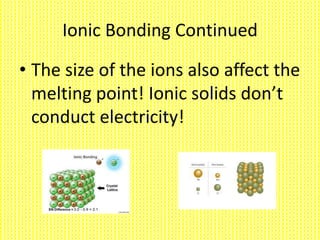
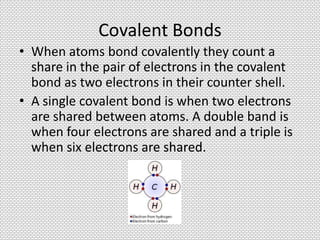
• The size of the ions also affect the
  melting point! Ionic solids don’t
  conduct electricity!
Covalent Bonds
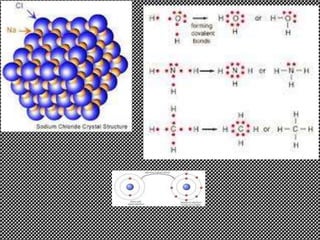
• When atoms bond covalently they count a
  share in the pair of electrons in the covalent
  bond as two electrons in their counter shell.
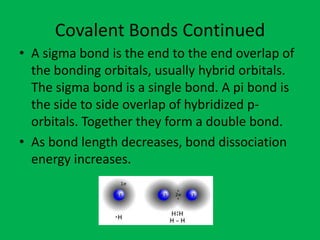
• A single covalent bond is when two electrons
  are shared between atoms. A double band is
  when four electrons are shared and a triple is
  when six electrons are shared.
Covalent Bonds Continued
• A sigma bond is the end to the end overlap of
  the bonding orbitals, usually hybrid orbitals.
  The sigma bond is a single bond. A pi bond is
  the side to side overlap of hybridized p-
  orbitals. Together they form a double bond.
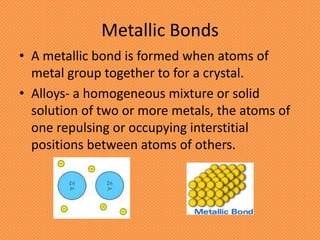
• As bond length decreases, bond dissociation
  energy increases.
Metallic Bonds
• A metallic bond is formed when atoms of
  metal group together to for a crystal.
• Alloys- a homogeneous mixture or solid
  solution of two or more metals, the atoms of
  one repulsing or occupying interstitial
  positions between atoms of others.

Ionic bonding

  • 1.
    Ionic Bonding By: CollinChance & Luis Marquez
  • 3.
    Introduction to bonding •An attraction between atoms that allows the formation of chemical substances that contain two or more atoms. • Atoms form chemical bonds to become stable.
  • 4.
    Ionic bonding • Ionicbonds are formed between cation and ion. Ionic bonds is a type of chemical bond formed through an electrostatic attraction between two oppositely charged ions. • Greater charge = Greater electrostatic attraction; stronger bond = Higher melting point
  • 5.
    Ionic Bonding Continued •The size of the ions also affect the melting point! Ionic solids don’t conduct electricity!
  • 6.
    Covalent Bonds • Whenatoms bond covalently they count a share in the pair of electrons in the covalent bond as two electrons in their counter shell. • A single covalent bond is when two electrons are shared between atoms. A double band is when four electrons are shared and a triple is when six electrons are shared.
  • 7.
    Covalent Bonds Continued •A sigma bond is the end to the end overlap of the bonding orbitals, usually hybrid orbitals. The sigma bond is a single bond. A pi bond is the side to side overlap of hybridized p- orbitals. Together they form a double bond. • As bond length decreases, bond dissociation energy increases.
  • 8.
    Metallic Bonds • Ametallic bond is formed when atoms of metal group together to for a crystal. • Alloys- a homogeneous mixture or solid solution of two or more metals, the atoms of one repulsing or occupying interstitial positions between atoms of others.