
metallic bondingDone by: Zhu Zehao 2A234
ContentsIntroductionDefinitionStructureDelocalized   ElectronsElectrostatic AttractionPhysical PropertiesChemical PropertiesCommercial usageDaily usage
IntroductionMetals do not form covalent bonds with each other as they do not have enough valence electrons to achieve a stable octet state.Therefore, there is a special way for metals to bond with each other which is metallic bonding.
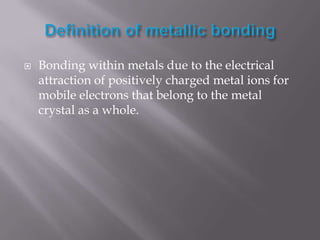
Definition of metallic bondingBonding within metals due to the electrical attraction of positively charged metal ions for mobile electrons that belong to the metal crystal as a whole.
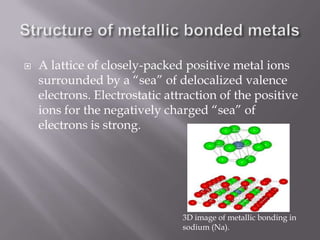
Structure of metallic bonded metalsA lattice of closely-packed positive metal ions surrounded by a “sea” of delocalized valence electrons. Electrostatic attraction of the positive ions for the negatively charged “sea” of electrons is strong.3D image of metallic bonding in sodium (Na).
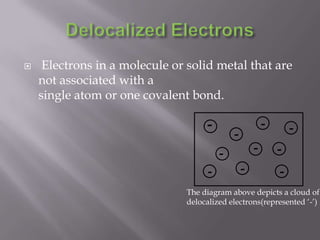
Delocalized Electrons Electrons in a molecule or solid metal that are not associated with a single atom or one covalent bond.----------The diagram above depicts a cloud of delocalized electrons(represented ‘-’)
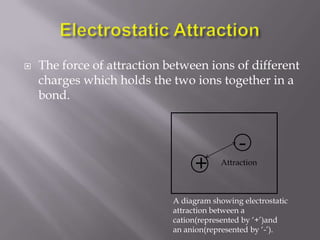
Electrostatic AttractionThe force of attraction between ions of different charges which holds the two ions together in a bond.-+AttractionA diagram showing electrostatic attraction between a cation(represented by ‘+’)and an anion(represented by ‘-’).
Physical Properties of metallic-bonded metals(in general)Malleability (ability to be flattened without breaking)Ductility (ability to be drawn into wires)OpaquenessMetal luster (shiny)
Chemical Properties of metallic-bonded metals(in general)Good heat conductorsElectrical conductorsPosses high melting points Posses freezing points Posses high boiling points
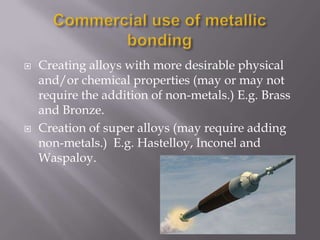
Commercial use of metallic bondingCreating alloys with more desirable physical and/or chemical properties (may or may not require the addition of non-metals.) E.g. Brass and Bronze.Creation of super alloys (may require adding non-metals.)  E.g. Hastelloy, Inconel and Waspaloy.
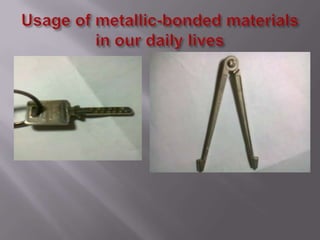
Usage of metallic-bonded materials in our daily lives
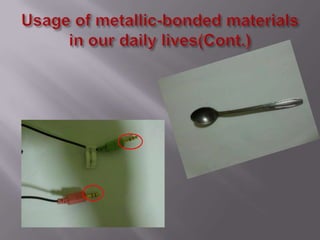
Usage of metallic-bonded materials in our daily lives(Cont.)
Referenceshttp://dl.clackamas.cc.or.us/ch104-08/metallic.htmhttp://sixthsense.osfc.ac.uk/chemistry/bonding/metallic.aspIGCSE CHEMISTRY DEFINITIONShttp://www.youtube.com/watch?v=vTJ4WUIFyV0http://www.chemistry.wustl.edu/~courses/genchem/Tutorials/LED/weakcovalent.htmhttp://www.buzzle.com/articles/metallic-bonding.html
Picture Sourceshttp://www.chemistry.wustl.edu/~courses/genchem/Tutorials/LED/weakcovalent.htmhttp://www.google.com.sg/imglanding?q=rockets&hl=en&gbv=2&tbm=isch&tbnid=xuGy1HJEKx8sbM:&imgrefurl=http://blog.al.com/space-news/2009/05/space_shuttle_replacement_ares.html&imgurl=http://blog.al.com/space-news/2009/05/156335main_Orion_launch.jpg&w=2840&h=1615&ei=IxHNTen6LIW-sAPjjemvCw&zoom=1&iact=hc&page=7&tbnh=156&tbnw=231&start=124&ndsp=19&ved=1t:429,r:4,s:124&biw=1366&bih=659
Thank You!!

Science ace metallic bonding