Chapter 9Covalent Bonding
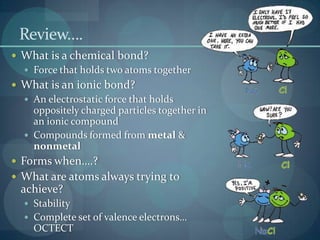
Review….What is a chemical bond?Force that holds two atoms togetherWhat is an ionic bond?An electrostatic force that holds oppositely charged particles together in an ionic compoundCompounds formed from metal & nonmetalForms when….?What are atoms always trying to achieve?StabilityComplete set of valence electrons… OCTECT
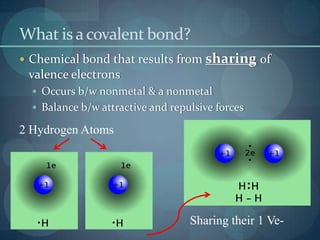
What is a covalent bond?Chemical bond that results from sharingof valence electronsOccurs b/w nonmetal & a nonmetalBalance b/w attractive and repulsive forces2 Hydrogen AtomsSharing their 1 Ve-
MoleculesCompound made when 2 or more atoms are bonded covalentlyDiatomic moleculesIn nature, sometimes two atoms of the same element are more stable when they are covalently bonded than the individual atom alone…BrINClHOF (pronounced “Brinkle Hoff”)Br2 I2 N2 Cl2 H2 O2 F2
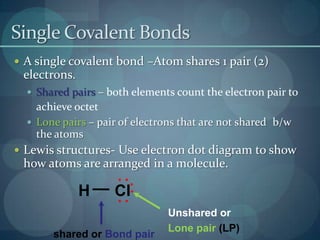
HClUnshared orLone pair (LP)shared or Bond pairSingle Covalent BondsA single covalent bond –Atom shares 1 pair (2) electrons.Shared pairs – both elements count the electron pair to achieve octetLonepairs– pair of electrons that are not shared	 b/w the atomsLewis structures- Use electron dot diagram to show how atoms are arranged in a molecule.. .. .. .
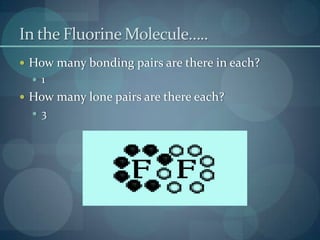
In the Fluorine Molecule…..How many bonding pairs are there in each?1How many lone pairs are there each?3
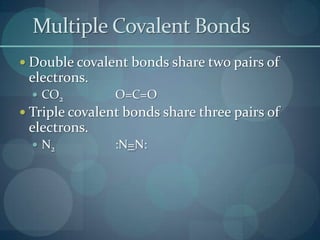
Multiple Covalent BondsDouble covalent bonds share two pairs of electrons.       CO2		O=C=OTriple covalent bonds share three pairs of electrons.N2	  	:N=N:
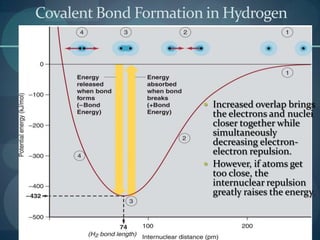
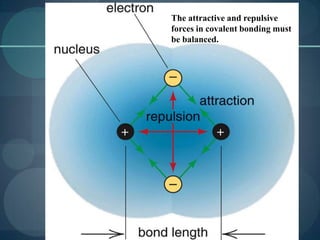
Covalent Bond Formation in HydrogenIncreased overlap brings the electrons and nuclei closer together while simultaneously decreasing electron-electron repulsion.
However, if atoms get too close, the internuclear repulsion greatly raises the energy.The attractive and repulsive forces in covalent bonding must be balanced.
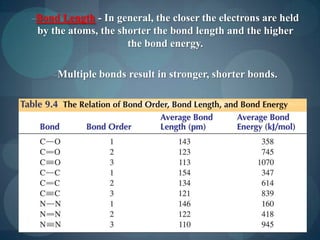
Bond Length - In general, the closer the electrons are held by the atoms, the shorter the bond length and the higher the bond energy.Multiple bonds result in stronger, shorter bonds.
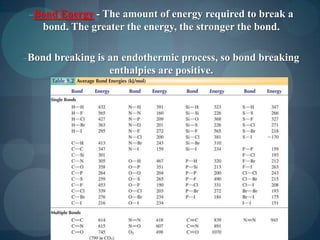
Bond Energy - The amount of energy required to break a bond. The greater the energy, the stronger the bond.Bond breaking is an endothermic process, so bond breaking enthalpies are positive.
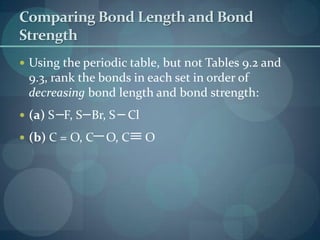
Comparing Bond Length and Bond StrengthUsing the periodic table, but not Tables 9.2 and 9.3, rank the bonds in each set in order of decreasing bond length and bond strength:(a) S   F, S   Br, S    Cl(b) C = O, C    O, C     O
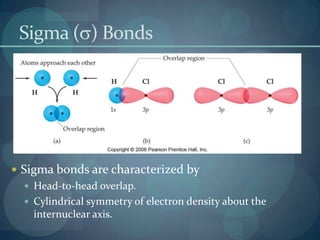
Sigma () BondsSigma bonds are characterized byHead-to-head overlap.Cylindrical symmetry of electron density about the internuclear axis.
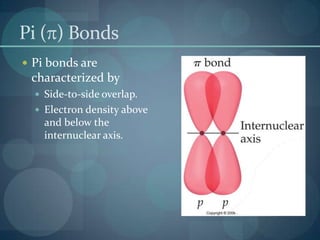
Pi () BondsPi bonds are characterized bySide-to-side overlap.Electron density above and below the internuclear axis.
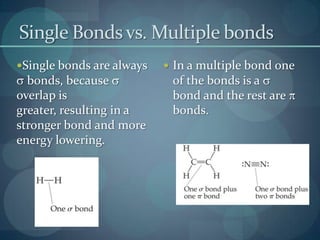
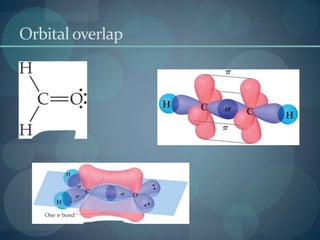
Single Bonds vs. Multiple bondsSingle bonds are always  bonds, because  overlap is greater, resulting in a stronger bond and more energy lowering.In a multiple bond one of the bonds is a  bond and the rest are  bonds.
Orbital overlap
Lewis Dot StructuresDetermine the number of Valence e- for all atoms in the moleculeDivide the Ve- by 2 to get pairs (2 dots or 1 line)Decide on central atom (least electronegative or furthest to the left).Hydrogen & halogens are terminal atomsConnect all atoms to the central atom by a bonding pair (single line)Place remaining pairs around all atoms before moving on to central atom.Check for octet (not H)If atom does not have an octet, move lone pairs from a terminal atom to create a double or a triple bond (except grp 7).

Ch 9-section-1

  • 1.
  • 2.
    Review….What is achemical bond?Force that holds two atoms togetherWhat is an ionic bond?An electrostatic force that holds oppositely charged particles together in an ionic compoundCompounds formed from metal & nonmetalForms when….?What are atoms always trying to achieve?StabilityComplete set of valence electrons… OCTECT
  • 3.
    What is acovalent bond?Chemical bond that results from sharingof valence electronsOccurs b/w nonmetal & a nonmetalBalance b/w attractive and repulsive forces2 Hydrogen AtomsSharing their 1 Ve-
  • 4.
    MoleculesCompound made when2 or more atoms are bonded covalentlyDiatomic moleculesIn nature, sometimes two atoms of the same element are more stable when they are covalently bonded than the individual atom alone…BrINClHOF (pronounced “Brinkle Hoff”)Br2 I2 N2 Cl2 H2 O2 F2
  • 5.
    HClUnshared orLone pair(LP)shared or Bond pairSingle Covalent BondsA single covalent bond –Atom shares 1 pair (2) electrons.Shared pairs – both elements count the electron pair to achieve octetLonepairs– pair of electrons that are not shared b/w the atomsLewis structures- Use electron dot diagram to show how atoms are arranged in a molecule.. .. .. .
  • 6.
    In the FluorineMolecule…..How many bonding pairs are there in each?1How many lone pairs are there each?3
  • 7.
    Multiple Covalent BondsDoublecovalent bonds share two pairs of electrons. CO2 O=C=OTriple covalent bonds share three pairs of electrons.N2 :N=N:
  • 8.
    Covalent Bond Formationin HydrogenIncreased overlap brings the electrons and nuclei closer together while simultaneously decreasing electron-electron repulsion.
  • 9.
    However, if atomsget too close, the internuclear repulsion greatly raises the energy.The attractive and repulsive forces in covalent bonding must be balanced.
  • 10.
    Bond Length -In general, the closer the electrons are held by the atoms, the shorter the bond length and the higher the bond energy.Multiple bonds result in stronger, shorter bonds.
  • 11.
    Bond Energy -The amount of energy required to break a bond. The greater the energy, the stronger the bond.Bond breaking is an endothermic process, so bond breaking enthalpies are positive.
  • 12.
    Comparing Bond Lengthand Bond StrengthUsing the periodic table, but not Tables 9.2 and 9.3, rank the bonds in each set in order of decreasing bond length and bond strength:(a) S F, S Br, S Cl(b) C = O, C O, C O
  • 13.
    Sigma () BondsSigmabonds are characterized byHead-to-head overlap.Cylindrical symmetry of electron density about the internuclear axis.
  • 14.
    Pi () BondsPibonds are characterized bySide-to-side overlap.Electron density above and below the internuclear axis.
  • 15.
    Single Bonds vs.Multiple bondsSingle bonds are always  bonds, because  overlap is greater, resulting in a stronger bond and more energy lowering.In a multiple bond one of the bonds is a  bond and the rest are  bonds.
  • 16.
  • 17.
    Lewis Dot StructuresDeterminethe number of Valence e- for all atoms in the moleculeDivide the Ve- by 2 to get pairs (2 dots or 1 line)Decide on central atom (least electronegative or furthest to the left).Hydrogen & halogens are terminal atomsConnect all atoms to the central atom by a bonding pair (single line)Place remaining pairs around all atoms before moving on to central atom.Check for octet (not H)If atom does not have an octet, move lone pairs from a terminal atom to create a double or a triple bond (except grp 7).

Editor's Notes

  • #18 Exs:SiF4NCl3AsH3SO2CO2CO