Charles’ LawCharles’ Law
The Temperature-Volume
Relationship
Charles’ LawCharles’ Law
• French chemist Jacques CharlesJacques Charles
discovered that the volume of a gas
at constant pressure changes with
temperature.
• As the temperature of the gas
increases, so does its volume, and as
its temperature decreases, so does
its volume.
C h a r l e s ’ L a wC h a r l e s ’ L a w
The law says that at constant pressure,
the volume of a fixed number of
particles of gas is directly proportional
to the absolute (Kelvin) temperature,
mathematically expressed as:
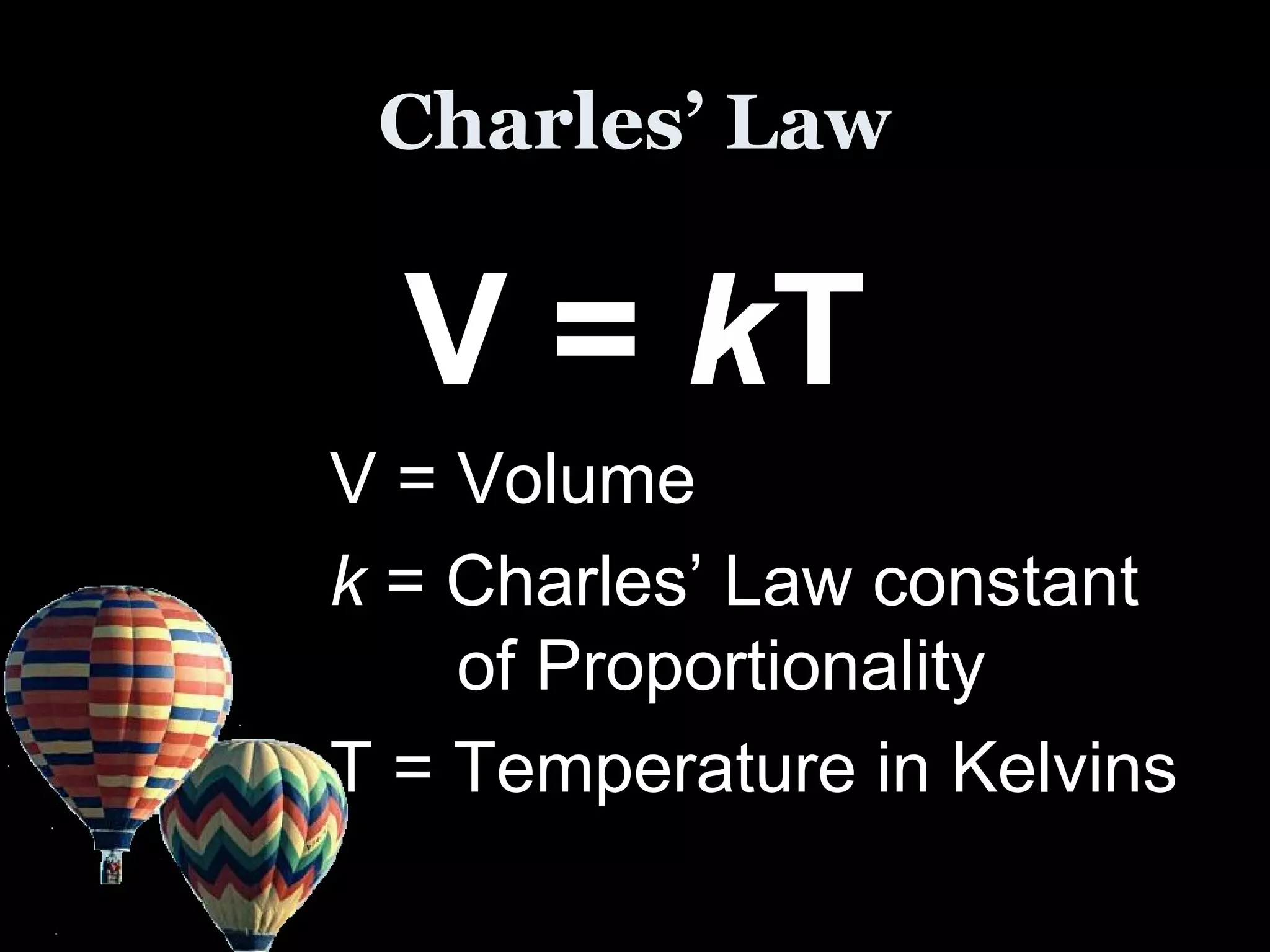
V =V = kkTT
Charles’ LawCharles’ Law
V =V = kkTT
V = Volume
k = Charles’ Law constant
of Proportionality
T = Temperature in Kelvins
ExplanationExplanation
• Raising the temperature of a gas
causes the gas to fill a greater volume
as long as pressure remains
constant.
• Gases expand at a constant rate as
temperature increases, and the rate
of expansion is similar for all gases.
ExampleExample
• If the temperature of a given amount
of gas is doubled, for example, its
volume will also double (as long as
pressure remains unchanged).
2V = 22V = 2kkTT
Charles’ LawCharles’ Law
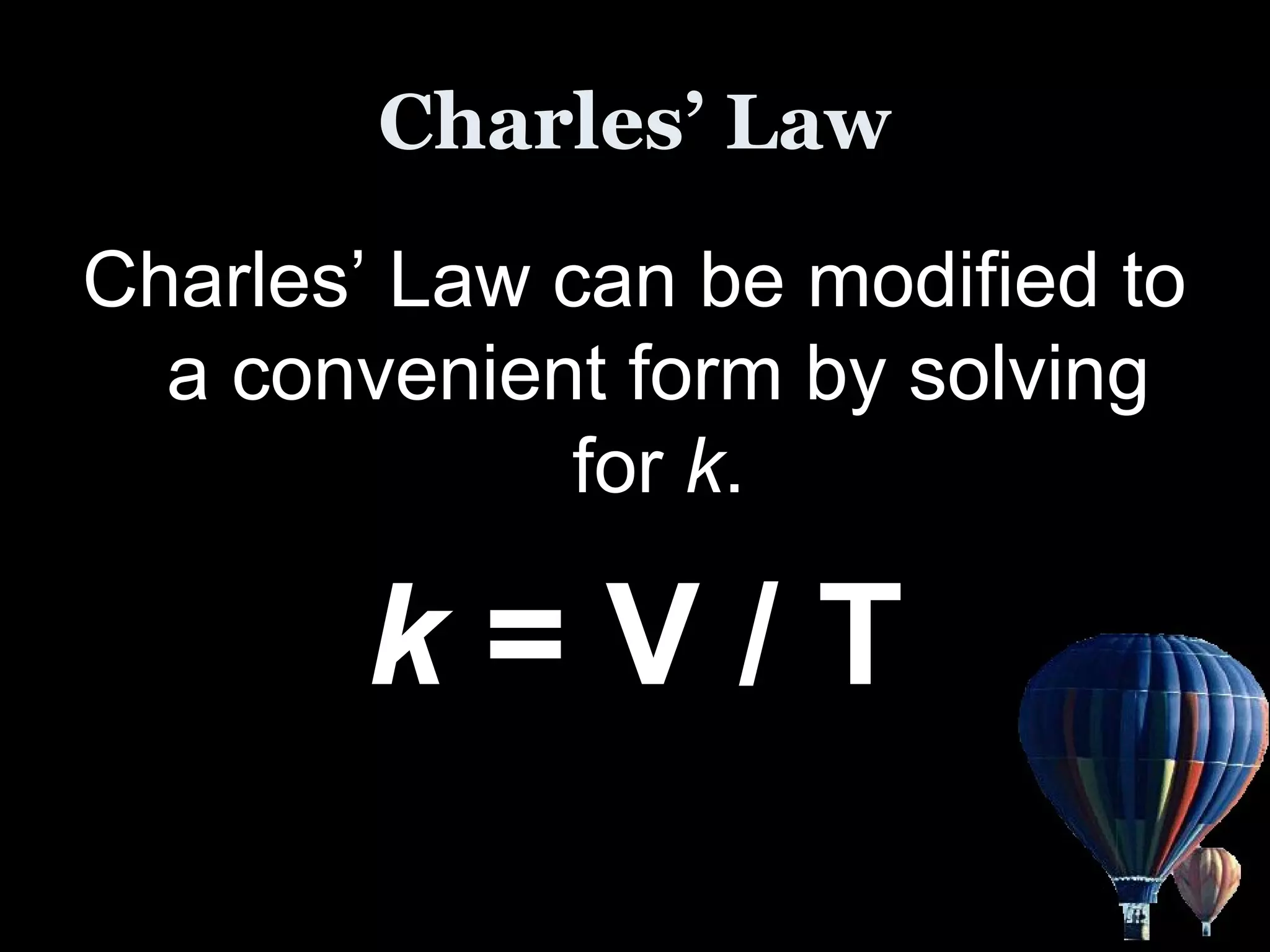
Charles’ Law can be modified to
a convenient form by solving
for k.
kk = V / T= V / T
Charles’ LawCharles’ Law
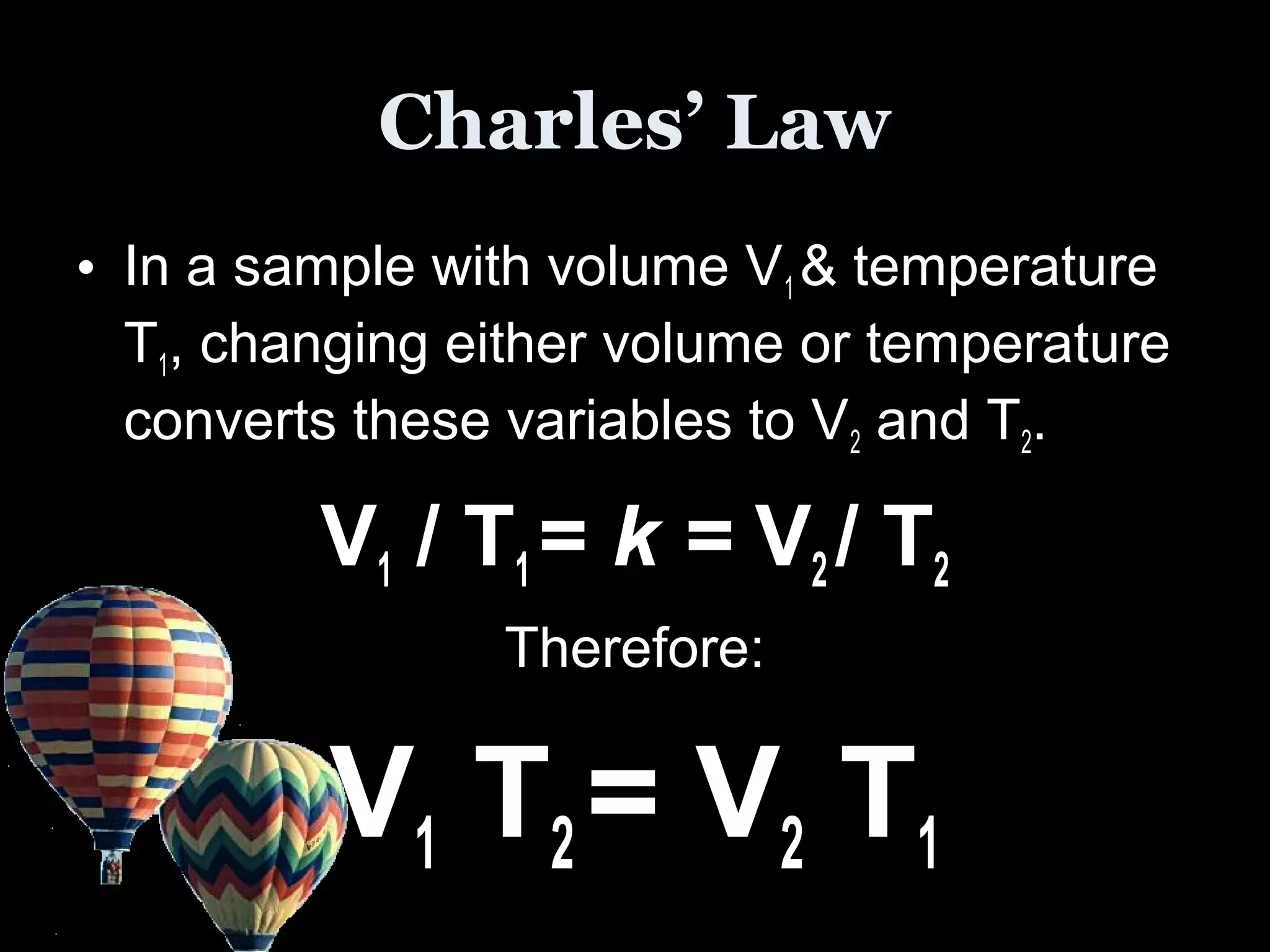
• In a sample with volume V1 & temperature
T1, changing either volume or temperature
converts these variables to V2 and T2.
VV11 / T/ T11 == k =k = VV22 / T/ T22
Therefore:
VV11 TT22 = V= V22 TT11
DemonstrationDemonstration
ofof
Charles’ LawCharles’ Law
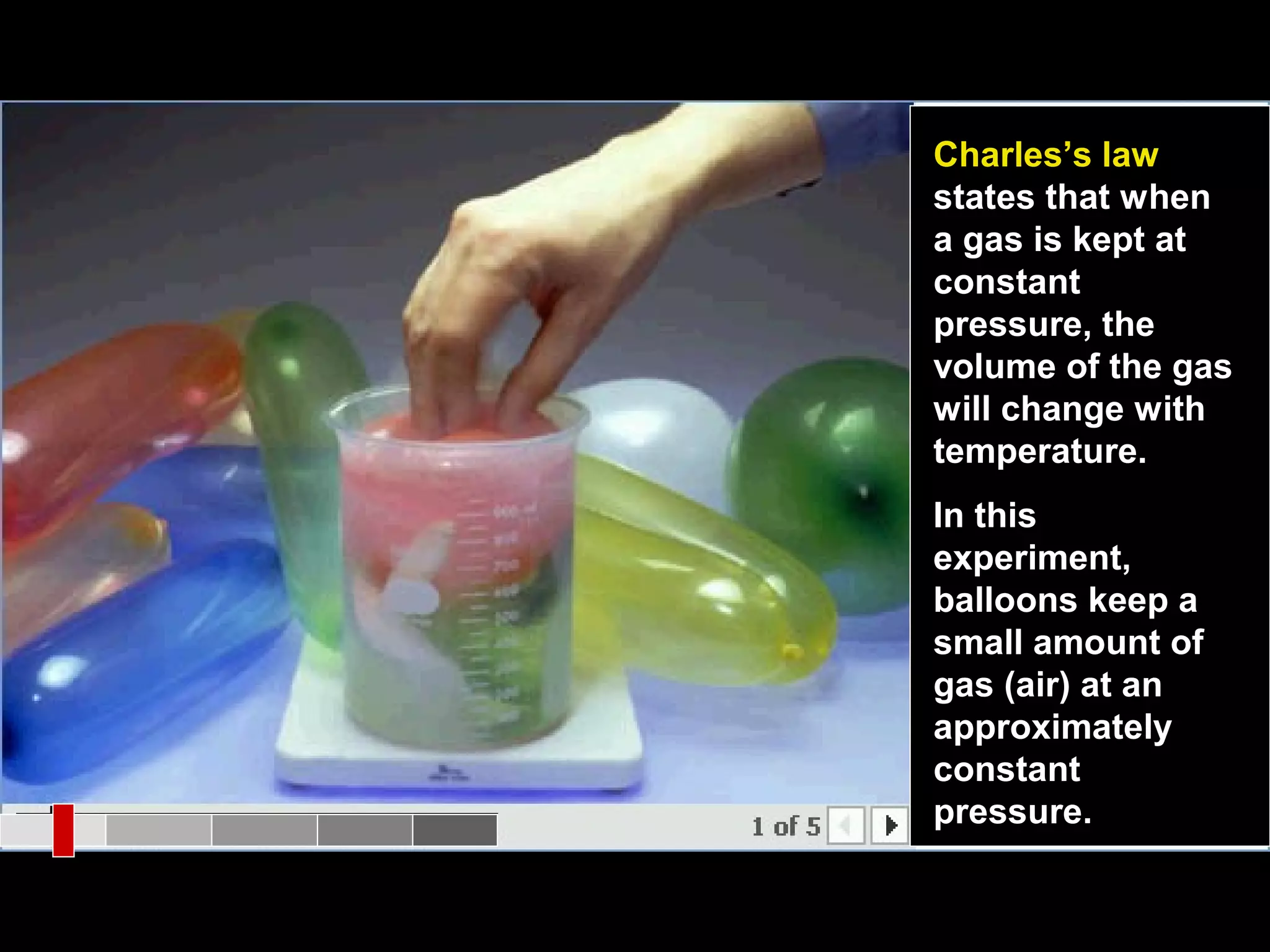
Charles’s law
states that when
a gas is kept at
constant
pressure, the
volume of the gas
will change with
temperature.
In this
experiment,
balloons keep a
small amount of
gas (air) at an
approximately
constant
pressure.
As the balloons
are dipped into a
beaker of liquid
nitrogen (-196°C;
-320°F), the air
inside them
quickly cools.
The volume of
the air inside the
balloons
decreases as the
temperature of
the balloons
decreases.
As the balloons
are dipped into a
beaker of liquid
nitrogen (-196°C;
-320°F), the air
inside them
quickly cools.
The volume of
the air inside the
balloons
decreases as the
temperature of
the balloons
decreases.
As the balloons
are dipped into a
beaker of liquid
nitrogen (-196°C;
-320°F), the air
inside them
quickly cools.
The volume of
the air inside the
balloons
decreases as the
temperature of
the balloons
decreases.
As the balloons
are dipped into a
beaker of liquid
nitrogen (-196°C;
-320°F), the air
inside them
quickly cools.
The volume of
the air inside the
balloons
decreases as the
temperature of
the balloons
decreases.
Relationship ofRelationship of
Boyle’s Law andBoyle’s Law and
Charles’ LawCharles’ Law
Temperature in kelvins
Pressuree in kilograms per square centimeter
PracticalPractical
ApplicationsApplications
Hot AIR BalloonHot AIR Balloon
The hot air that gives the hot-air balloon
its name is commonly created by a
propane gas burner that sends powerful
jets of flame into the colorful rip-stop
nylon envelope. Once the balloon is
aloft, its height is maintained by opening
and closing the blast valve, which
controls the flow of the gas to the
burner.

BIO-VISION'S MULTIMEDIA CLASS - Charles law

  • 1.
    Charles’ LawCharles’ Law TheTemperature-Volume Relationship
  • 2.
    Charles’ LawCharles’ Law •French chemist Jacques CharlesJacques Charles discovered that the volume of a gas at constant pressure changes with temperature. • As the temperature of the gas increases, so does its volume, and as its temperature decreases, so does its volume.
  • 3.
    C h ar l e s ’ L a wC h a r l e s ’ L a w The law says that at constant pressure, the volume of a fixed number of particles of gas is directly proportional to the absolute (Kelvin) temperature, mathematically expressed as: V =V = kkTT
  • 4.
    Charles’ LawCharles’ Law V=V = kkTT V = Volume k = Charles’ Law constant of Proportionality T = Temperature in Kelvins
  • 5.
    ExplanationExplanation • Raising thetemperature of a gas causes the gas to fill a greater volume as long as pressure remains constant. • Gases expand at a constant rate as temperature increases, and the rate of expansion is similar for all gases.
  • 6.
    ExampleExample • If thetemperature of a given amount of gas is doubled, for example, its volume will also double (as long as pressure remains unchanged). 2V = 22V = 2kkTT
  • 7.
    Charles’ LawCharles’ Law Charles’Law can be modified to a convenient form by solving for k. kk = V / T= V / T
  • 8.
    Charles’ LawCharles’ Law •In a sample with volume V1 & temperature T1, changing either volume or temperature converts these variables to V2 and T2. VV11 / T/ T11 == k =k = VV22 / T/ T22 Therefore: VV11 TT22 = V= V22 TT11
  • 9.
  • 10.
    Charles’s law states thatwhen a gas is kept at constant pressure, the volume of the gas will change with temperature. In this experiment, balloons keep a small amount of gas (air) at an approximately constant pressure.
  • 11.
    As the balloons aredipped into a beaker of liquid nitrogen (-196°C; -320°F), the air inside them quickly cools. The volume of the air inside the balloons decreases as the temperature of the balloons decreases.
  • 12.
    As the balloons aredipped into a beaker of liquid nitrogen (-196°C; -320°F), the air inside them quickly cools. The volume of the air inside the balloons decreases as the temperature of the balloons decreases.
  • 13.
    As the balloons aredipped into a beaker of liquid nitrogen (-196°C; -320°F), the air inside them quickly cools. The volume of the air inside the balloons decreases as the temperature of the balloons decreases.
  • 14.
    As the balloons aredipped into a beaker of liquid nitrogen (-196°C; -320°F), the air inside them quickly cools. The volume of the air inside the balloons decreases as the temperature of the balloons decreases.
  • 15.
    Relationship ofRelationship of Boyle’sLaw andBoyle’s Law and Charles’ LawCharles’ Law
  • 16.
    Temperature in kelvins Pressureein kilograms per square centimeter
  • 17.
  • 18.
    Hot AIR BalloonHotAIR Balloon The hot air that gives the hot-air balloon its name is commonly created by a propane gas burner that sends powerful jets of flame into the colorful rip-stop nylon envelope. Once the balloon is aloft, its height is maintained by opening and closing the blast valve, which controls the flow of the gas to the burner.