Introduction to Basic Chemistry
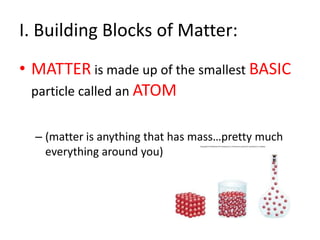
I. Building Blocks of Matter:MATTER is made up of the smallest BASIC particle called an ATOM(matter is anything that has mass…pretty much everything around you)
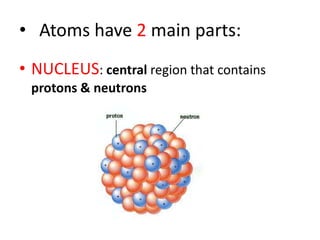
Atoms have 2 main parts:NUCLEUS: central region that contains protons & neutrons
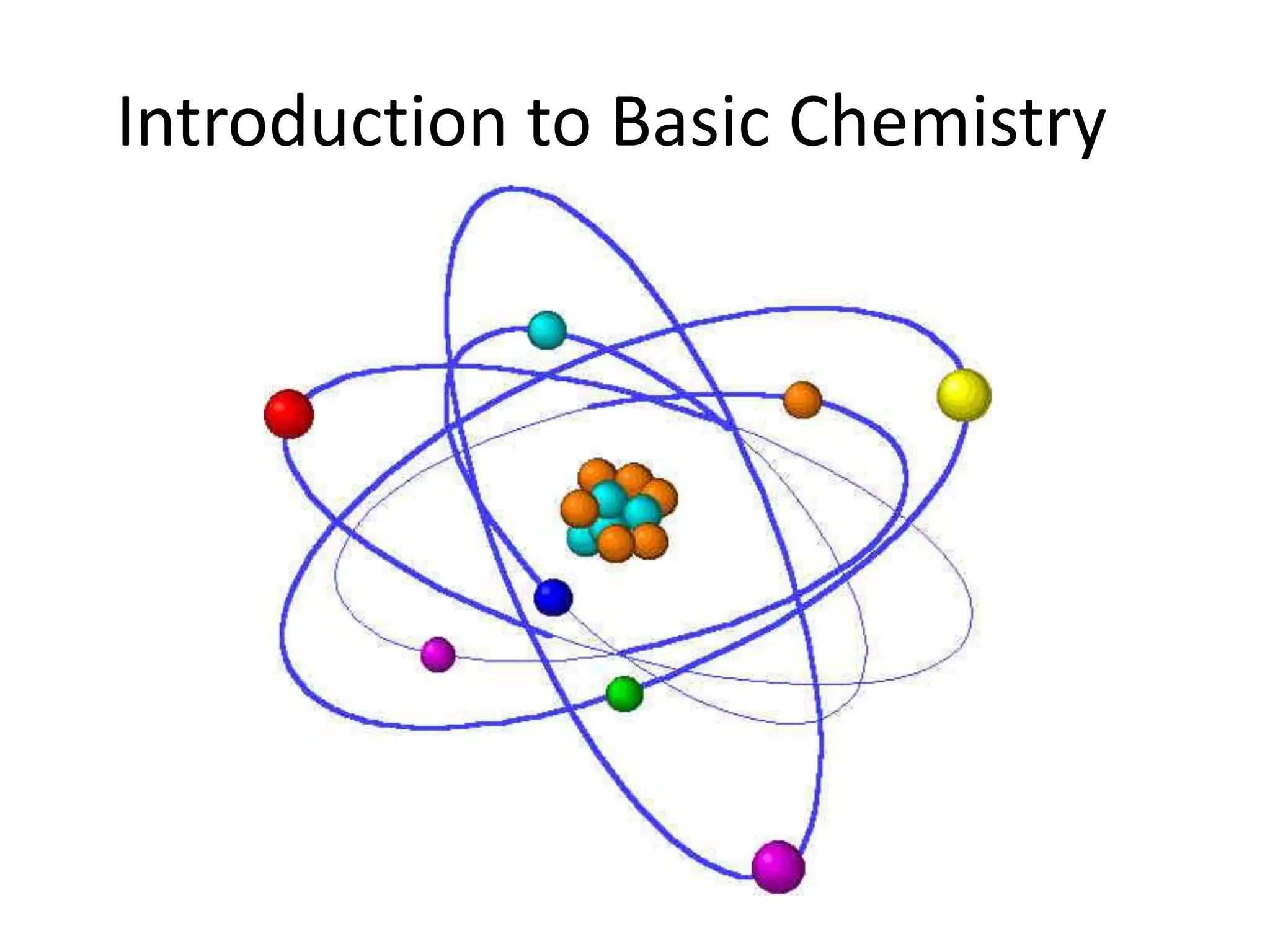
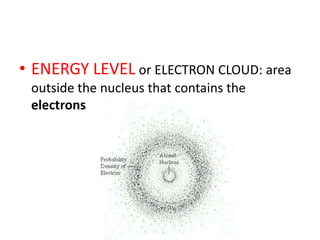
ENERGY LEVEL or ELECTRON CLOUD: area outside the nucleus that contains the electrons
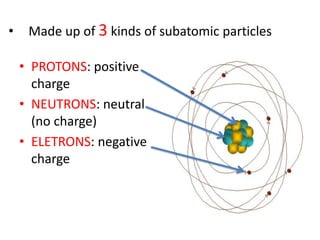
Made up of 3 kinds of subatomic particlesPROTONS: positive chargeNEUTRONS: neutral (no charge)ELETRONS: negative charge
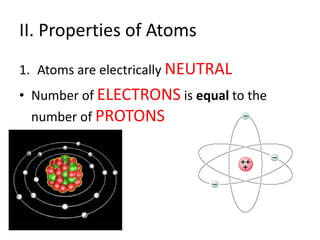
II. Properties of AtomsAtoms are electrically NEUTRALNumber of ELECTRONS is equal to the number of PROTONS
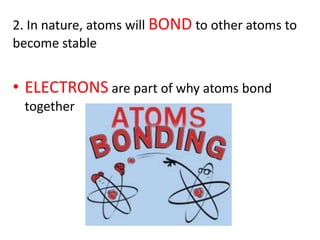
2. In nature, atoms will BOND to other atoms to become stableELECTRONS are part of why atoms bond together
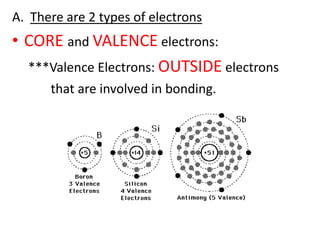
There are 2 types of electronsCORE and VALENCE electrons:    ***Valence Electrons: OUTSIDE electrons            that are involved in bonding.
3. BONDING: an attraction within atoms to form a chemical compoundAll atoms are electrically neutral but are UNSTABLE until they form an attraction with another atomThe outermost energy level may SHARE, LOSE, or GAIN electrons to form a BOND and become stable
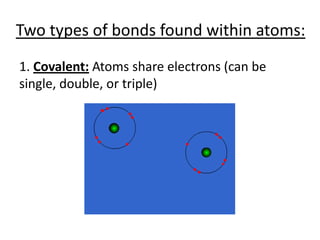
Two types of bonds found within atoms:1. Covalent: Atoms share electrons (can be single, double, or triple)
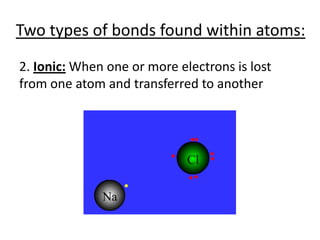
Two types of bonds found within atoms:2. Ionic: When one or more electrons is lost from one atom and transferred to another

Intro to chem

  • 1.
  • 2.
    I. Building Blocksof Matter:MATTER is made up of the smallest BASIC particle called an ATOM(matter is anything that has mass…pretty much everything around you)
  • 3.
    Atoms have 2main parts:NUCLEUS: central region that contains protons & neutrons
  • 4.
    ENERGY LEVEL orELECTRON CLOUD: area outside the nucleus that contains the electrons
  • 5.
    Made up of3 kinds of subatomic particlesPROTONS: positive chargeNEUTRONS: neutral (no charge)ELETRONS: negative charge
  • 6.
    II. Properties ofAtomsAtoms are electrically NEUTRALNumber of ELECTRONS is equal to the number of PROTONS
  • 7.
    2. In nature,atoms will BOND to other atoms to become stableELECTRONS are part of why atoms bond together
  • 8.
    There are 2types of electronsCORE and VALENCE electrons: ***Valence Electrons: OUTSIDE electrons that are involved in bonding.
  • 9.
    3. BONDING: anattraction within atoms to form a chemical compoundAll atoms are electrically neutral but are UNSTABLE until they form an attraction with another atomThe outermost energy level may SHARE, LOSE, or GAIN electrons to form a BOND and become stable
  • 10.
    Two types ofbonds found within atoms:1. Covalent: Atoms share electrons (can be single, double, or triple)
  • 11.
    Two types ofbonds found within atoms:2. Ionic: When one or more electrons is lost from one atom and transferred to another