Charcot Foot and Ankle
Selene G. Parekh, MD, MBA
Associate Professor of Surgery
Partner, North Carolina Orthopaedic Clinic
Department of Orthopaedic Surgery
Adjunct Faculty Fuqua Business School
Duke University
Durham, NC
919.471.9622
http://seleneparekhmd.com
Twitter: @seleneparekhmd
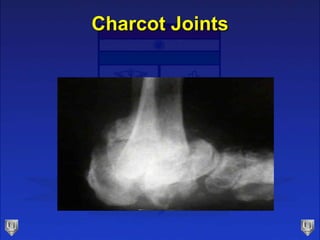
Charcot Joints
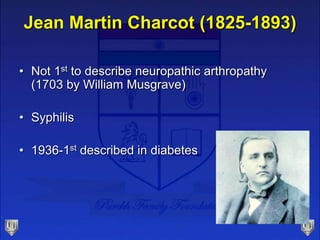
Jean Martin Charcot (1825-1893)
• Not 1st to describe neuropathic arthropathy
(1703 by William Musgrave)
• Syphilis
• 1936-1st described in diabetes
Charcot Joints
• What is it?
Progressive, noninfectious, destructive
disease of the bones and
joints in persons with sensory neuropathy
Charcot Joints
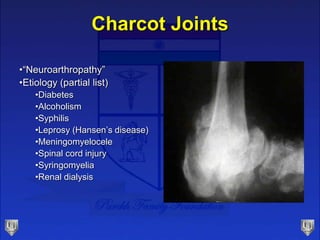
•“Neuroarthropathy”
•Etiology (partial list)
•Diabetes
•Alcoholism
•Syphilis
•Leprosy (Hansen’s disease)
•Meningomyelocele
•Spinal cord injury
•Syringomyelia
•Renal dialysis
Charcot Joints
• Epidemiology
• Foot and ankle most commonly
• Incidence: 0.1% - 0.12% of diabetics
• Radiographic incidence: 1.4%
Charcot Joints
• Two theories
• Neurotraumatic
• Cumulative mechanical trauma
• Insensate joint
• Neurovascular (autonomic neuropathy)
• Neurally stimulated vascular reflex
• Bone resorption, ligament weakening
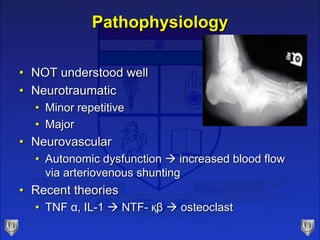
Pathophysiology
• NOT understood well
• Neurotraumatic
• Minor repetitive
• Major
• Neurovascular
• Autonomic dysfunction  increased blood flow
via arteriovenous shunting
• Recent theories
• TNF α, IL-1  NTF- қβ  osteoclast
Clinical Presentation
• Assoc w/ advance sequelae of diabetes
• Nephropathy
• Retinopathy
• Obesity
• Assoc w/ recipients of solid organ
transplantation
• Type 1 Db
• 5th decade of life (20-40yrs)
• Type 2 Db
• 6th decade of life (6-9yrs)
Clinical Presentation
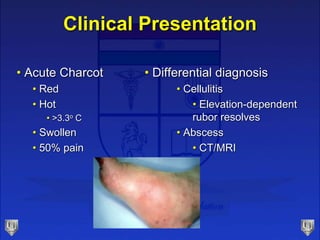
• Differential diagnosis
• Cellulitis
• Elevation-dependent
rubor resolves
• Abscess
• CT/MRI
• Acute Charcot
• Red
• Hot
• >3.3o C
• Swollen
• 50% pain
Clinical Presentation
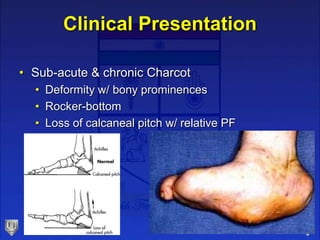
• Sub-acute & chronic Charcot
• Deformity w/ bony prominences
• Rocker-bottom
• Loss of calcaneal pitch w/ relative PF
Clinical Presentation
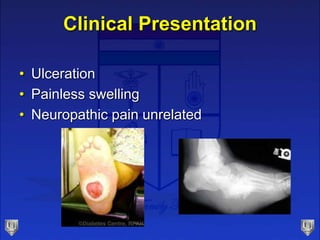
• Ulceration
• Painless swelling
• Neuropathic pain unrelated
Imaging
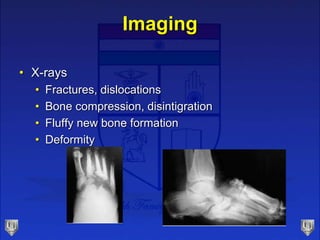
• X-rays
• Fractures, dislocations
• Bone compression, disintigration
• Fluffy new bone formation
• Deformity
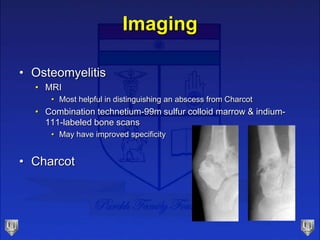
• Osteomyelitis
• MRI
• Most helpful in distinguishing an abscess from Charcot
• Combination technetium-99m sulfur colloid marrow & indium-
111-labeled bone scans
• May have improved specificity
• Charcot
Imaging
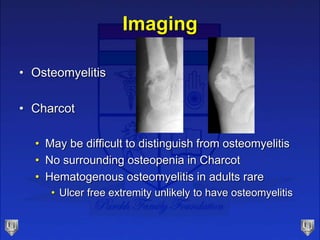
• Osteomyelitis
• Charcot
• May be difficult to distinguish from osteomyelitis
• No surrounding osteopenia in Charcot
• Hematogenous osteomyelitis in adults rare
• Ulcer free extremity unlikely to have osteomyelitis
Imaging
Eichenholtz Stages
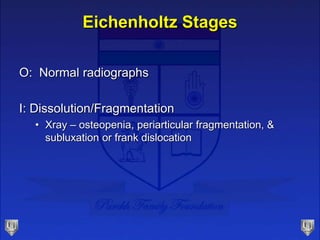
O: Normal radiographs
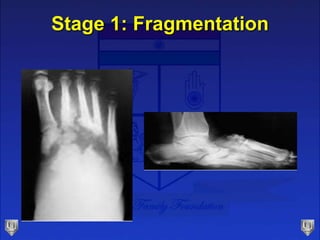
I: Dissolution/Fragmentation
• Xray – osteopenia, periarticular fragmentation, &
subluxation or frank dislocation
Eichenholtz Stages
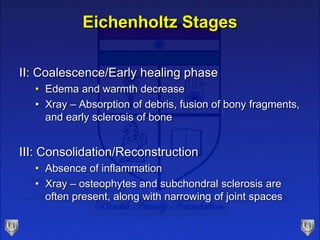
II: Coalescence/Early healing phase
• Edema and warmth decrease
• Xray – Absorption of debris, fusion of bony fragments,
and early sclerosis of bone
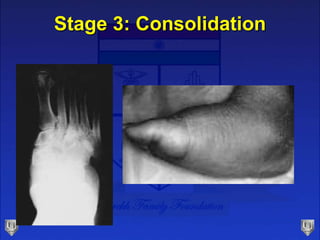
III: Consolidation/Reconstruction
• Absence of inflammation
• Xray – osteophytes and subchondral sclerosis are
often present, along with narrowing of joint spaces
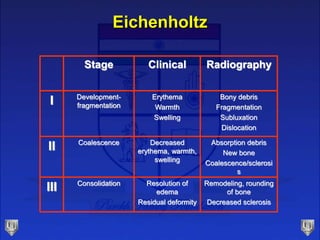
Eichenholtz
Stage Clinical Radiography
I Development-
fragmentation
Erythema
Warmth
Swelling
Bony debris
Fragmentation
Subluxation
Dislocation
II Coalescence Decreased
erythema, warmth,
swelling
Absorption debris
New bone
Coalescence/sclerosi
s
III Consolidation Resolution of
edema
Residual deformity
Remodeling, rounding
of bone
Decreased sclerosis
Stage 1: Fragmentation
Stage 3: Consolidation
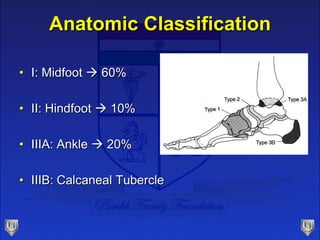
Anatomic Classification
• I: Midfoot  60%
• II: Hindfoot  10%
• IIIA: Ankle  20%
• IIIB: Calcaneal Tubercle
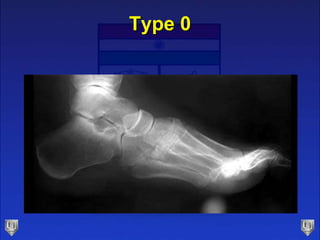
Type 0
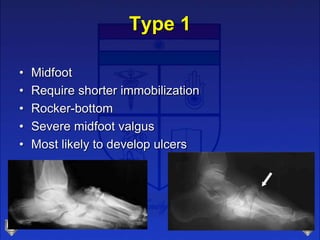
Type 1
• Midfoot
• Require shorter immobilization
• Rocker-bottom
• Severe midfoot valgus
• Most likely to develop ulcers
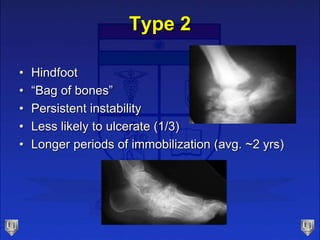
Type 2
• Hindfoot
• “Bag of bones”
• Persistent instability
• Less likely to ulcerate (1/3)
• Longer periods of immobilization (avg. ~2 yrs)
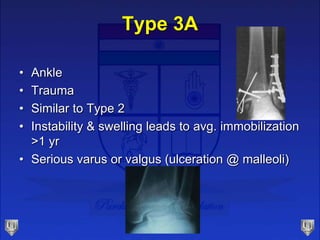
Type 3A
• Ankle
• Trauma
• Similar to Type 2
• Instability & swelling leads to avg. immobilization
>1 yr
• Serious varus or valgus (ulceration @ malleoli)
Type 3B
• Os calcis
• Pathologic fracture of tubercle
• Leads to 2° collapse of foot
Conservative Treatment
• Recommendations
• Based on level IV evidence
• Goals
• Achieve 3rd stage of bony healing
• Avoid & treat ulcers
• Keep patient as ambulatory as possible during
treatment
Conservative Treatment
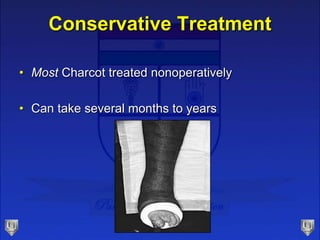
• Most Charcot treated nonoperatively
• Can take several months to years
Conservative Treatment
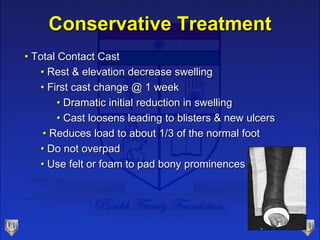
• Total Contact Cast
• Rest & elevation decrease swelling
• First cast change @ 1 week
• Dramatic initial reduction in swelling
• Cast loosens leading to blisters & new ulcers
• Reduces load to about 1/3 of the normal foot
• Do not overpad
• Use felt or foam to pad bony prominences
Conservative Treatment
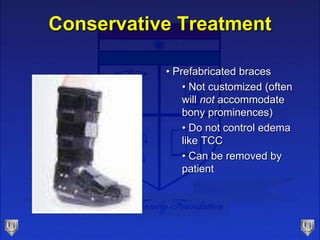
• Prefabricated braces
• Not customized (often
will not accommodate
bony prominences)
• Do not control edema
like TCC
• Can be removed by
patient
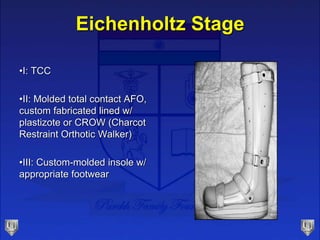
Eichenholtz Stage
•I: TCC
•II: Molded total contact AFO,
custom fabricated lined w/
plastizote or CROW (Charcot
Restraint Orthotic Walker)
•III: Custom-molded insole w/
appropriate footwear
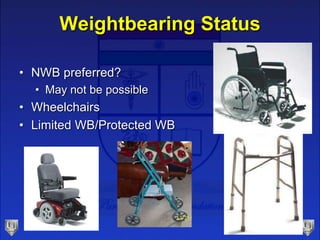
Weightbearing Status
• NWB preferred?
• May not be possible
• Wheelchairs
• Limited WB/Protected WB
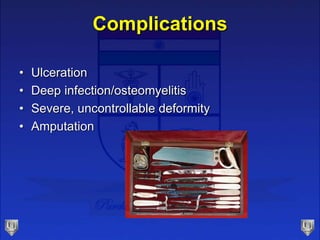
Complications
• Ulceration
• Deep infection/osteomyelitis
• Severe, uncontrollable deformity
• Amputation
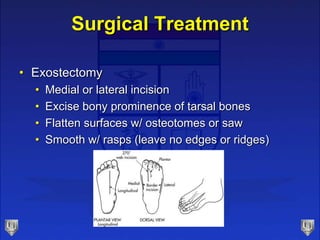
Surgical Treatment
• Exostectomy
• Medial or lateral incision
• Excise bony prominence of tarsal bones
• Flatten surfaces w/ osteotomes or saw
• Smooth w/ rasps (leave no edges or ridges)

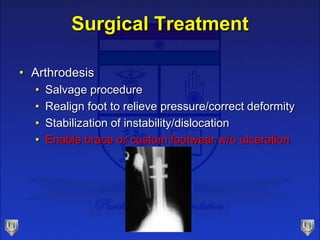
Surgical Treatment
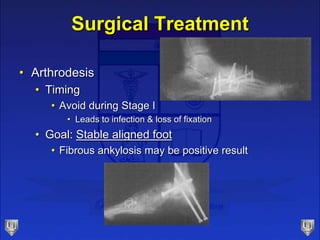
• Arthrodesis
• Salvage procedure
• Realign foot to relieve pressure/correct deformity
• Stabilization of instability/dislocation
• Enable brace or custom footwear w/o ulceration
Surgical Treatment
• Arthrodesis
• Timing
• Avoid during Stage I
• Leads to infection & loss of fixation
• Goal: Stable aligned foot
• Fibrous ankylosis may be positive result
Fixation Methods
• Dorsal plating - compression
Fixation Methods
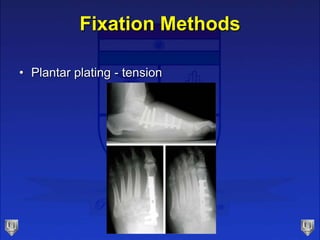
• Plantar plating - tension
Fixation Methods
• Medial plating
Fixation Methods
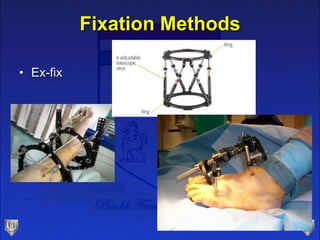
• Ex-fix
Fixation Methods
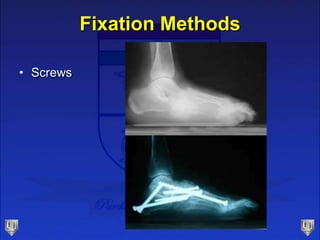
• Screws
Fixation Methods
• Combination
Fixation Methods
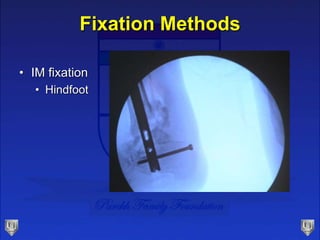
• IM fixation
• Hindfoot
Fixation Methods
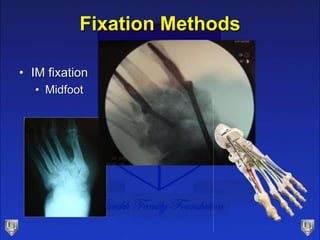
• IM fixation
• Midfoot
Fixation Methods
• Time to fusion w/ internal fixation
• 11-22 weeks
• High complication rate up to 69%
• Infection, both superficial and deep
• Post-op amputation rate 0-10%
• Hardware malposition requiring removal
• Recurrent ulceration
• Fracture
Fixation Methods
• External Fixation
• Indications
• Ulcers with underlying osteomyelitis
• Poor soft-tissue envelope
• Poor bone quality
• Morbid obesity
• Advantages
• Singlestage treatment in the presence of osteomyelitis
or ulceration
• Easy monitoring of soft-tissue healing
• Protect somewhat against noncompliance with
postoperative non–weight-bearing instruction
• Can adjust in office
Fixation Methods
• External Fixation
• Limb salvage rates were >90%
• New or recurrent ulceration rare
• Pin-tract infection - most common complication
Amputation
• Indications
• Failed surgeries
• Osteomyelitis
• Unstable arthrodesis
Pharmacologic
• Bisphosphonates
• Promising short-term results in preventing bone
resorption
• Mechanism based on the promotion of osteoclast
apoptosis and the inhibition of osteoclast activity
Pharmacologic
• Bisphosphonates
• Jude et al
• 6 wks: significant reduction in bone turnover
markers (bone specific alkaline phosphate,
deoxypyridinoline
• > 3 months differences not significant
• ? Interval doses may be necessary
• Pitocco et al
• Improvement in bone turnover markers, BMD, and
pain
Pharmacologic
• Calcitonin
• Jude et al
• Daily dose of 200 IU intranasal calcitonin
• 3 months of treatment
• Decreased bone turnover markers
• 6 months
• No difference
Thank You
RE
ECT
the ankle
the foot

Lecture 30 parekh charcot

  • 1.
    Charcot Foot andAnkle Selene G. Parekh, MD, MBA Associate Professor of Surgery Partner, North Carolina Orthopaedic Clinic Department of Orthopaedic Surgery Adjunct Faculty Fuqua Business School Duke University Durham, NC 919.471.9622 http://seleneparekhmd.com Twitter: @seleneparekhmd
  • 2.
  • 3.
    Jean Martin Charcot(1825-1893) • Not 1st to describe neuropathic arthropathy (1703 by William Musgrave) • Syphilis • 1936-1st described in diabetes
  • 4.
    Charcot Joints • Whatis it? Progressive, noninfectious, destructive disease of the bones and joints in persons with sensory neuropathy
  • 5.
    Charcot Joints •“Neuroarthropathy” •Etiology (partiallist) •Diabetes •Alcoholism •Syphilis •Leprosy (Hansen’s disease) •Meningomyelocele •Spinal cord injury •Syringomyelia •Renal dialysis
  • 6.
    Charcot Joints • Epidemiology •Foot and ankle most commonly • Incidence: 0.1% - 0.12% of diabetics • Radiographic incidence: 1.4%
  • 7.
    Charcot Joints • Twotheories • Neurotraumatic • Cumulative mechanical trauma • Insensate joint • Neurovascular (autonomic neuropathy) • Neurally stimulated vascular reflex • Bone resorption, ligament weakening
  • 8.
    Pathophysiology • NOT understoodwell • Neurotraumatic • Minor repetitive • Major • Neurovascular • Autonomic dysfunction  increased blood flow via arteriovenous shunting • Recent theories • TNF α, IL-1  NTF- қβ  osteoclast
  • 9.
    Clinical Presentation • Assocw/ advance sequelae of diabetes • Nephropathy • Retinopathy • Obesity • Assoc w/ recipients of solid organ transplantation • Type 1 Db • 5th decade of life (20-40yrs) • Type 2 Db • 6th decade of life (6-9yrs)
  • 10.
    Clinical Presentation • Differentialdiagnosis • Cellulitis • Elevation-dependent rubor resolves • Abscess • CT/MRI • Acute Charcot • Red • Hot • >3.3o C • Swollen • 50% pain
  • 11.
    Clinical Presentation • Sub-acute& chronic Charcot • Deformity w/ bony prominences • Rocker-bottom • Loss of calcaneal pitch w/ relative PF
  • 12.
    Clinical Presentation • Ulceration •Painless swelling • Neuropathic pain unrelated
  • 13.
    Imaging • X-rays • Fractures,dislocations • Bone compression, disintigration • Fluffy new bone formation • Deformity
  • 14.
    • Osteomyelitis • MRI •Most helpful in distinguishing an abscess from Charcot • Combination technetium-99m sulfur colloid marrow & indium- 111-labeled bone scans • May have improved specificity • Charcot Imaging
  • 15.
    • Osteomyelitis • Charcot •May be difficult to distinguish from osteomyelitis • No surrounding osteopenia in Charcot • Hematogenous osteomyelitis in adults rare • Ulcer free extremity unlikely to have osteomyelitis Imaging
  • 16.
    Eichenholtz Stages O: Normalradiographs I: Dissolution/Fragmentation • Xray – osteopenia, periarticular fragmentation, & subluxation or frank dislocation
  • 17.
    Eichenholtz Stages II: Coalescence/Earlyhealing phase • Edema and warmth decrease • Xray – Absorption of debris, fusion of bony fragments, and early sclerosis of bone III: Consolidation/Reconstruction • Absence of inflammation • Xray – osteophytes and subchondral sclerosis are often present, along with narrowing of joint spaces
  • 18.
    Eichenholtz Stage Clinical Radiography IDevelopment- fragmentation Erythema Warmth Swelling Bony debris Fragmentation Subluxation Dislocation II Coalescence Decreased erythema, warmth, swelling Absorption debris New bone Coalescence/sclerosi s III Consolidation Resolution of edema Residual deformity Remodeling, rounding of bone Decreased sclerosis
  • 19.
  • 20.
  • 21.
    Anatomic Classification • I:Midfoot  60% • II: Hindfoot  10% • IIIA: Ankle  20% • IIIB: Calcaneal Tubercle
  • 22.
  • 23.
    Type 1 • Midfoot •Require shorter immobilization • Rocker-bottom • Severe midfoot valgus • Most likely to develop ulcers
  • 24.
    Type 2 • Hindfoot •“Bag of bones” • Persistent instability • Less likely to ulcerate (1/3) • Longer periods of immobilization (avg. ~2 yrs)
  • 25.
    Type 3A • Ankle •Trauma • Similar to Type 2 • Instability & swelling leads to avg. immobilization >1 yr • Serious varus or valgus (ulceration @ malleoli)
  • 26.
    Type 3B • Oscalcis • Pathologic fracture of tubercle • Leads to 2° collapse of foot
  • 27.
    Conservative Treatment • Recommendations •Based on level IV evidence • Goals • Achieve 3rd stage of bony healing • Avoid & treat ulcers • Keep patient as ambulatory as possible during treatment
  • 28.
    Conservative Treatment • MostCharcot treated nonoperatively • Can take several months to years
  • 29.
    Conservative Treatment • TotalContact Cast • Rest & elevation decrease swelling • First cast change @ 1 week • Dramatic initial reduction in swelling • Cast loosens leading to blisters & new ulcers • Reduces load to about 1/3 of the normal foot • Do not overpad • Use felt or foam to pad bony prominences
  • 30.
    Conservative Treatment • Prefabricatedbraces • Not customized (often will not accommodate bony prominences) • Do not control edema like TCC • Can be removed by patient
  • 31.
    Eichenholtz Stage •I: TCC •II:Molded total contact AFO, custom fabricated lined w/ plastizote or CROW (Charcot Restraint Orthotic Walker) •III: Custom-molded insole w/ appropriate footwear
  • 32.
    Weightbearing Status • NWBpreferred? • May not be possible • Wheelchairs • Limited WB/Protected WB
  • 33.
    Complications • Ulceration • Deepinfection/osteomyelitis • Severe, uncontrollable deformity • Amputation
  • 34.
    Surgical Treatment • Exostectomy •Medial or lateral incision • Excise bony prominence of tarsal bones • Flatten surfaces w/ osteotomes or saw • Smooth w/ rasps (leave no edges or ridges)
  • 35.
    Surgical Treatment • Arthrodesis •Salvage procedure • Realign foot to relieve pressure/correct deformity • Stabilization of instability/dislocation • Enable brace or custom footwear w/o ulceration
  • 36.
    Surgical Treatment • Arthrodesis •Timing • Avoid during Stage I • Leads to infection & loss of fixation • Goal: Stable aligned foot • Fibrous ankylosis may be positive result
  • 37.
    Fixation Methods • Dorsalplating - compression
  • 38.
  • 39.
  • 40.
  • 41.
  • 42.
  • 43.
    Fixation Methods • IMfixation • Hindfoot
  • 44.
    Fixation Methods • IMfixation • Midfoot
  • 45.
    Fixation Methods • Timeto fusion w/ internal fixation • 11-22 weeks • High complication rate up to 69% • Infection, both superficial and deep • Post-op amputation rate 0-10% • Hardware malposition requiring removal • Recurrent ulceration • Fracture
  • 46.
    Fixation Methods • ExternalFixation • Indications • Ulcers with underlying osteomyelitis • Poor soft-tissue envelope • Poor bone quality • Morbid obesity • Advantages • Singlestage treatment in the presence of osteomyelitis or ulceration • Easy monitoring of soft-tissue healing • Protect somewhat against noncompliance with postoperative non–weight-bearing instruction • Can adjust in office
  • 47.
    Fixation Methods • ExternalFixation • Limb salvage rates were >90% • New or recurrent ulceration rare • Pin-tract infection - most common complication
  • 48.
    Amputation • Indications • Failedsurgeries • Osteomyelitis • Unstable arthrodesis
  • 49.
    Pharmacologic • Bisphosphonates • Promisingshort-term results in preventing bone resorption • Mechanism based on the promotion of osteoclast apoptosis and the inhibition of osteoclast activity
  • 50.
    Pharmacologic • Bisphosphonates • Judeet al • 6 wks: significant reduction in bone turnover markers (bone specific alkaline phosphate, deoxypyridinoline • > 3 months differences not significant • ? Interval doses may be necessary • Pitocco et al • Improvement in bone turnover markers, BMD, and pain
  • 51.
    Pharmacologic • Calcitonin • Judeet al • Daily dose of 200 IU intranasal calcitonin • 3 months of treatment • Decreased bone turnover markers • 6 months • No difference
  • 52.
  • 53.