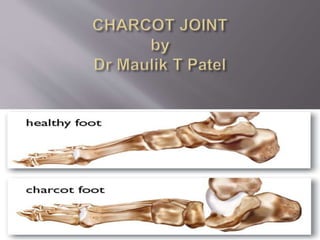
 In 1868, Jean-Martin Charcot gave the first detailed
description of the neuropathic aspect of this disease;
hence, the condition is named after him.
 Progressive destructive disease of joint.
 Painless arthropathy with dislocation, fracture,
debilited deformities.
 Frequently misdiagnosed.
 Most commonly involve joints of lower limb.
 Any condition that causes sensory or autonomic
neuropathy can lead to a Charcot joint
 Diabetes is considered to be the most common cause
of Charcot arthropathy.
 Prevalence is 0.5%.
 Bilateral disease in < 10%
NEUROTRAUMATIC THEORY;
An unperceived trauma or injury to an insensate
joint.
NEUROVASCULAR THEORY:
autonomic neuropathy increase vascularity
mismatch in destruction & synthesis
 Genetics molecular biology
 RANK/RANKL/OPG triad pathway is thought to be
involved
 Associated conditions shoulder
 syringomyelia
 most common etiology of neuropathic arthropathy of the
upper extremity
 25% of these patients develop a neuropathic joint
 Mono articular (shoulder > elbow)
 Hansen's disease (leprosy)
 second most common cause of upper extremity neuropathic
arthropathy
 syphilis
 usually affects the knee
 can be poly articular
 diabetes
 most common cause of foot and ankle neuropathic joints
 Arnold- Chiari malformation
 cervical spondylosis
 adhesive arachnoiditis and TB arachnoiditis
 posttraumatic syringomyelia
 alcoholism
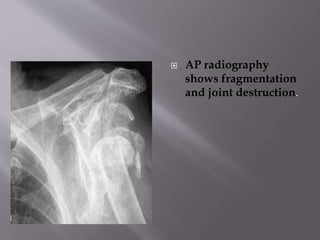
 AP radiography
shows fragmentation
and joint destruction.
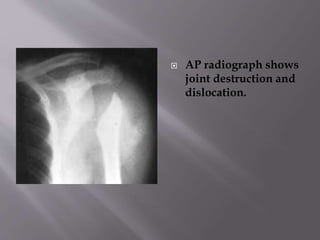
 AP radiograph shows
joint destruction and
dislocation.
Elbow
 syringomyelia
 syphilis
 congenital insensitivity to pain
 diabetes
 Charcot-Marie-Tooth
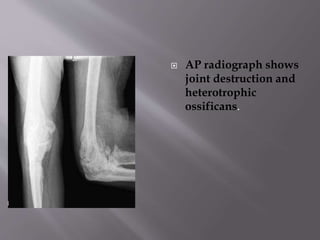
 AP radiograph shows
joint destruction and
heterotrophic
ossificans.
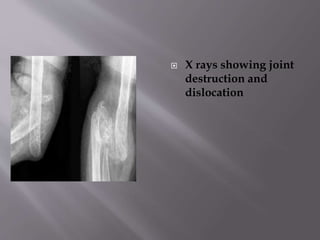
 X rays showing joint
destruction and
dislocation
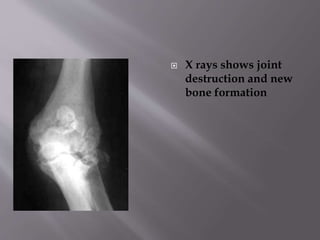
 X rays shows joint
destruction and new
bone formation
 Classification Eichenholtz Classification
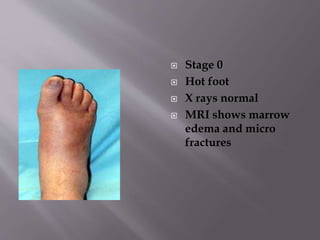
 Stage 0 • Joint edema
• Radiographs are negative
• Bone scan may be positive in all stages
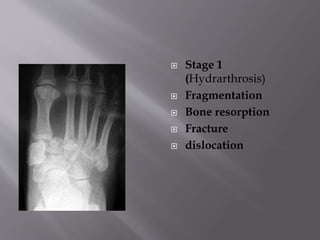
Stage 1 • Joint edema
• Radiographs show osseous fragmentation with joint
dislocation
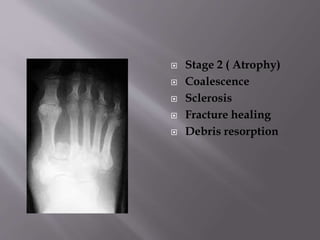
Stage 2 • Decreased local edema
• Radiographs show coalescence of fragments and
absorption of fine bone debris
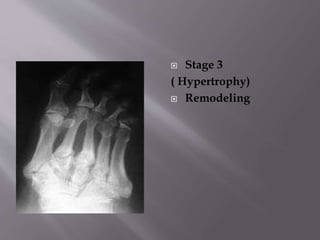
Stage 3 • No local edema
• Radiographs show consolidation and remodeling of
fracture fragments
 Stage 0
 Hot foot
 X rays normal
 MRI shows marrow
edema and micro
fractures
 Stage 1
(Hydrarthrosis)
 Fragmentation
 Bone resorption
 Fracture
 dislocation
 Stage 2 ( Atrophy)
 Coalescence
 Sclerosis
 Fracture healing
 Debris resorption
 Stage 3
( Hypertrophy)
 Remodeling
 Presentation Symptoms
 swollen shoulder or elbow
 50% have pain, 50% are painless
 loss of function
 Physical exam
 inspection
 swollen, warm, erythematous joint
 mimics infection
 motion
 joint may be mechanically unstable
 loss of active motion, but passive motion is maintained
 neurovascular
 a neurologic evaluation is essential
 Imaging Radiographs
 recommended views
 standard views of affected joint
 AP and scapula Y of the shoulder
 AP and lateral of the elbow
 AP and lateral of foot and ankle
 findings
 early changes
 degenerative changes may mimic osteoarthritis
 late changes
 obliteration of joint space
 fragmentation of both articular surfaces of a joint leading
to subluxation or dislocation
 scattered "chunks" of bone in fibrous tissue
 joint distention by fluid
 surrounding soft tissue edema
 heterotopic ossification
 fracture
 MRI
 indications
 MRI of cervical spine to rule out syrinx when neuropathic
shoulder arthropathy is present
 Bone scan
 technetium bone scan
 findings
 may be positive (hot) for neuropathic joints and osteomyelitis
 indium WBC scan
 findings
 will be negative (cold) for neuropathic joints and positive (hot) for
osteomyelitis
 useful to differentiate from osteomyelitis
 Studies Labs
 ESR and WBC can be elevated making it difficult to
differentiate from osteomyelitis
 Histology
 synovial hypertrophy
 detritic synovitis (cartilage and bone distributed in
synovium)
 Differential diagnosis :
 Osteomyelitis/septic joint
 difficult to distinguish from osteomyelitis based on
radiographs and physical exam
 common findings in both conditions
 swelling, warmth
 elevated WBC and ESR
 technetium bone scan is "hot"
 unique to Charcot joint disease
 indium leukocyte scan will be "cold" (negative)
 will be "hot" (positive) for osteomyelitis
 Treatment
 Non operative
 rest, elevation, protected immobilization with a sling, and
restriction of activity
 indications
 neuropathic shoulder joint
 functional bracing
 indications
 neuropathic elbow joint
 technique
 should allow flexion-extension, but neutralizes varus-valgus
stresses
 Operative
 Arthrodesis
 do not attempt during acute inflammatory stage (Eichenholtz
0-2) because of continued bone erosion
 only perform during quiescent stage (Eichenholtz 3)
 requires long periods of immobilization
 Total joint replacement
 indications
 Charcot joint is a contraindication to total joint replacement
 due to poor bone stock, prosthetic loosening, instability, and soft-
tissue compromise
An ounce of prevention is worth a pound of
cure.”
– Benjamin Franklin
Charcot joint / Neuropathic Joint

Charcot joint / Neuropathic Joint

  • 2.
     In 1868,Jean-Martin Charcot gave the first detailed description of the neuropathic aspect of this disease; hence, the condition is named after him.  Progressive destructive disease of joint.  Painless arthropathy with dislocation, fracture, debilited deformities.  Frequently misdiagnosed.
  • 3.
     Most commonlyinvolve joints of lower limb.  Any condition that causes sensory or autonomic neuropathy can lead to a Charcot joint  Diabetes is considered to be the most common cause of Charcot arthropathy.  Prevalence is 0.5%.  Bilateral disease in < 10%
  • 4.
    NEUROTRAUMATIC THEORY; An unperceivedtrauma or injury to an insensate joint. NEUROVASCULAR THEORY: autonomic neuropathy increase vascularity mismatch in destruction & synthesis
  • 5.
     Genetics molecularbiology  RANK/RANKL/OPG triad pathway is thought to be involved
  • 6.
     Associated conditionsshoulder  syringomyelia  most common etiology of neuropathic arthropathy of the upper extremity  25% of these patients develop a neuropathic joint  Mono articular (shoulder > elbow)  Hansen's disease (leprosy)  second most common cause of upper extremity neuropathic arthropathy
  • 7.
     syphilis  usuallyaffects the knee  can be poly articular  diabetes  most common cause of foot and ankle neuropathic joints  Arnold- Chiari malformation  cervical spondylosis  adhesive arachnoiditis and TB arachnoiditis  posttraumatic syringomyelia  alcoholism
  • 8.
     AP radiography showsfragmentation and joint destruction.
  • 9.
     AP radiographshows joint destruction and dislocation.
  • 10.
    Elbow  syringomyelia  syphilis congenital insensitivity to pain  diabetes  Charcot-Marie-Tooth
  • 11.
     AP radiographshows joint destruction and heterotrophic ossificans.
  • 12.
     X raysshowing joint destruction and dislocation
  • 13.
     X raysshows joint destruction and new bone formation
  • 14.
     Classification EichenholtzClassification  Stage 0 • Joint edema • Radiographs are negative • Bone scan may be positive in all stages Stage 1 • Joint edema • Radiographs show osseous fragmentation with joint dislocation Stage 2 • Decreased local edema • Radiographs show coalescence of fragments and absorption of fine bone debris Stage 3 • No local edema • Radiographs show consolidation and remodeling of fracture fragments
  • 15.
     Stage 0 Hot foot  X rays normal  MRI shows marrow edema and micro fractures
  • 16.
     Stage 1 (Hydrarthrosis) Fragmentation  Bone resorption  Fracture  dislocation
  • 17.
     Stage 2( Atrophy)  Coalescence  Sclerosis  Fracture healing  Debris resorption
  • 18.
     Stage 3 (Hypertrophy)  Remodeling
  • 19.
     Presentation Symptoms swollen shoulder or elbow  50% have pain, 50% are painless  loss of function  Physical exam  inspection  swollen, warm, erythematous joint  mimics infection  motion  joint may be mechanically unstable  loss of active motion, but passive motion is maintained  neurovascular  a neurologic evaluation is essential
  • 20.
     Imaging Radiographs recommended views  standard views of affected joint  AP and scapula Y of the shoulder  AP and lateral of the elbow  AP and lateral of foot and ankle  findings  early changes  degenerative changes may mimic osteoarthritis  late changes  obliteration of joint space  fragmentation of both articular surfaces of a joint leading to subluxation or dislocation  scattered "chunks" of bone in fibrous tissue  joint distention by fluid  surrounding soft tissue edema  heterotopic ossification  fracture
  • 21.
     MRI  indications MRI of cervical spine to rule out syrinx when neuropathic shoulder arthropathy is present  Bone scan  technetium bone scan  findings  may be positive (hot) for neuropathic joints and osteomyelitis  indium WBC scan  findings  will be negative (cold) for neuropathic joints and positive (hot) for osteomyelitis  useful to differentiate from osteomyelitis
  • 22.
     Studies Labs ESR and WBC can be elevated making it difficult to differentiate from osteomyelitis  Histology  synovial hypertrophy  detritic synovitis (cartilage and bone distributed in synovium)
  • 23.
     Differential diagnosis:  Osteomyelitis/septic joint  difficult to distinguish from osteomyelitis based on radiographs and physical exam  common findings in both conditions  swelling, warmth  elevated WBC and ESR  technetium bone scan is "hot"  unique to Charcot joint disease  indium leukocyte scan will be "cold" (negative)  will be "hot" (positive) for osteomyelitis
  • 24.
     Treatment  Nonoperative  rest, elevation, protected immobilization with a sling, and restriction of activity  indications  neuropathic shoulder joint  functional bracing  indications  neuropathic elbow joint  technique  should allow flexion-extension, but neutralizes varus-valgus stresses
  • 25.
     Operative  Arthrodesis do not attempt during acute inflammatory stage (Eichenholtz 0-2) because of continued bone erosion  only perform during quiescent stage (Eichenholtz 3)  requires long periods of immobilization  Total joint replacement  indications  Charcot joint is a contraindication to total joint replacement  due to poor bone stock, prosthetic loosening, instability, and soft- tissue compromise
  • 26.
    An ounce ofprevention is worth a pound of cure.” – Benjamin Franklin