Characteristics of a challenging
learning environment affecting
students’ learning processes
and achievements

Suzanne Vrancken & Sanne Tromp
Junior College Utrecht
Utrecht University
s.e.a.vrancken@uu.nl
s.tromp@uu.nl
Contents

            • Introduction
            • Research aim
            • Theoretical framework
            • Method
            • Results
            • Conclusion & recommendations


4-10-2012                                    2
Introduction                                                                                                      (1)

            • Talented students
                   Can do more than is offered in regular curriculum
                   Need to be challenged
                   Education needs to be adapted to students’ needs and
                   capacities
            • Dutch government policy
                   Education is insufficiently challenging for talented
                   students
                   Motivating and challenging learning environments need
                   to be created
            • Excellence programs
                   Existing programs can serve as sources of knowledge and
                   inspiration

4-10-2012             Introduction - Research aim - Theoretical framework – Method – Results – Conclusion & recommendations    3
Introduction                                                                                                         (2)

            Junior College Utrecht (JCU)
               • Science program for 100 students in grade 11th and
                   12th of pre-university education
               •   Two years, two days a week
               •   Students are selected
               •   Accelerated and enriched curriculum
               •   Research activities

               • Excellent student achievements
               • Example of an excellence program: Junior College
                   learning environment affects students’ learning
                   processes and achievements

4-10-2012                Introduction - Research aim - Theoretical framework – Method – Results – Conclusion & recommendations    4
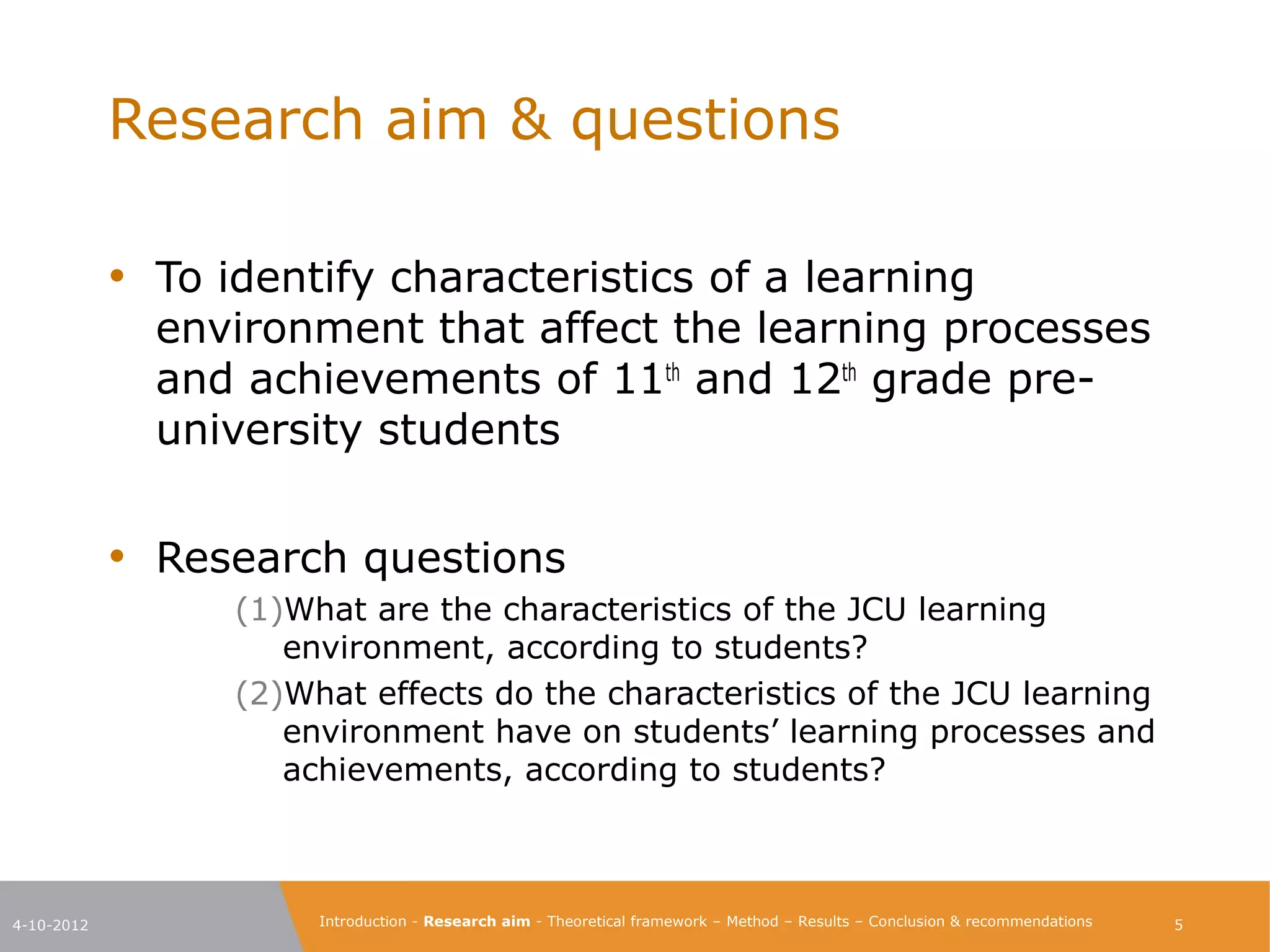
Research aim & questions

            • To identify characteristics of a learning
              environment that affect the learning processes
              and achievements of 11th and 12th grade pre-
              university students

            • Research questions
                  (1)What are the characteristics of the JCU learning
                     environment, according to students?
                  (2)What effects do the characteristics of the JCU learning
                     environment have on students’ learning processes and
                     achievements, according to students?


4-10-2012              Introduction - Research aim - Theoretical framework – Method – Results – Conclusion & recommendations   5
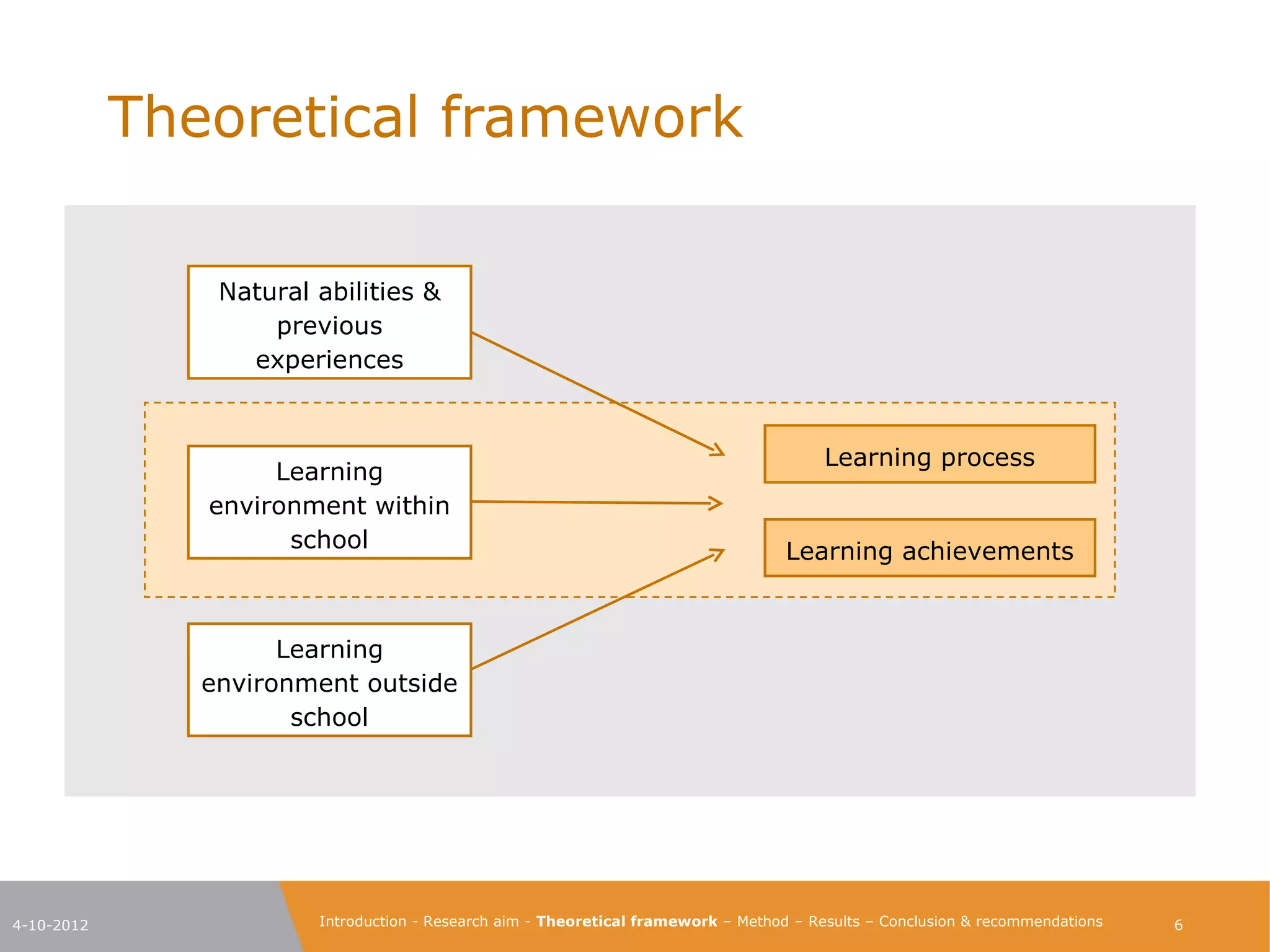
Theoretical framework

                Natural abilities &
                    previous
                  experiences


                                                                                         Learning process
                    Learning
               environment within
                     school                                                         Learning achievements


                     Learning
               environment outside
                      school


4-10-2012               Introduction - Research aim - Theoretical framework – Method – Results – Conclusion & recommendations   6
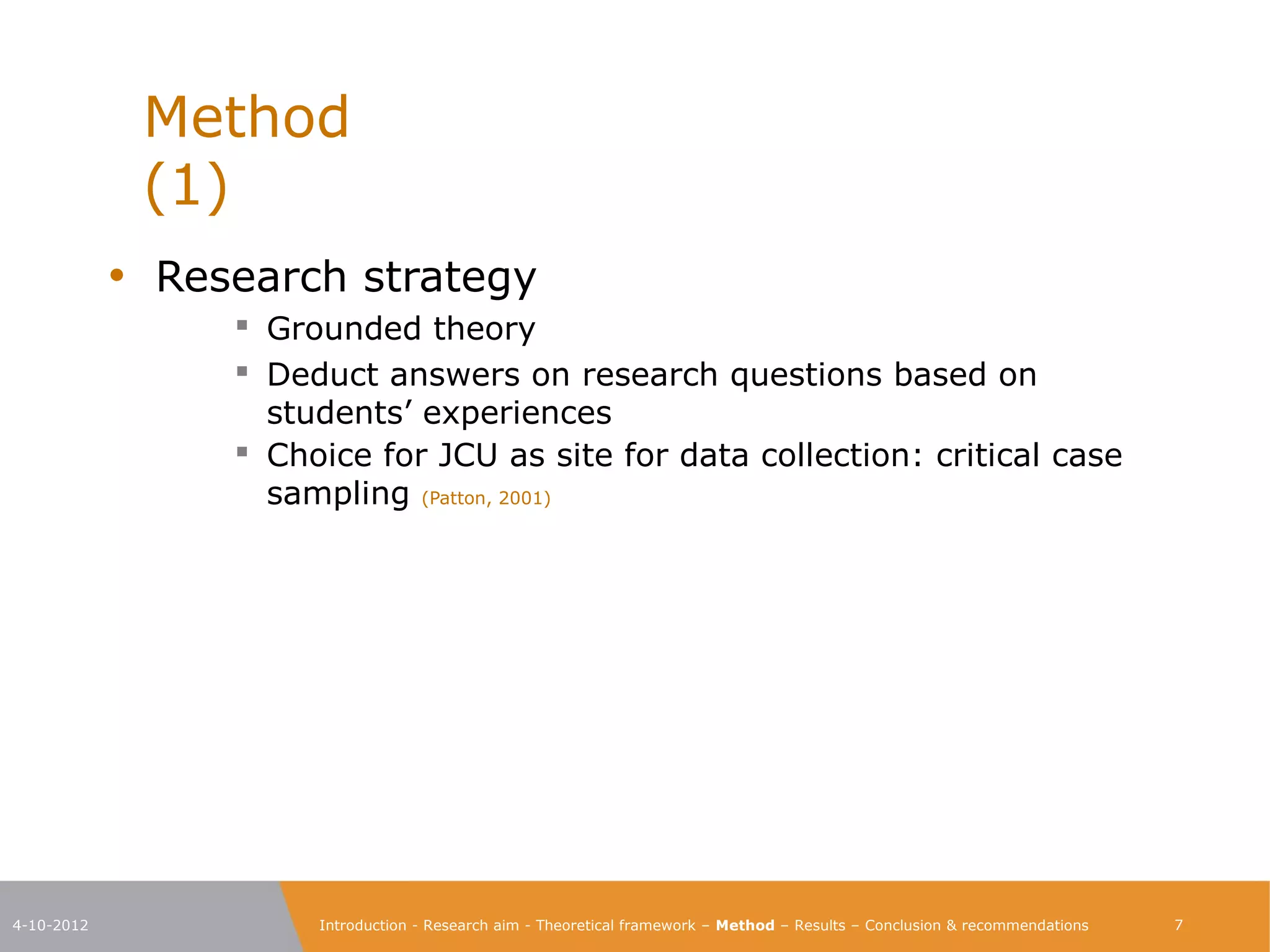
Method                                                                                                           (1)

            • Research strategy
                  Grounded theory
                  Deduct answers on research questions based on
                  students’ experiences
                  Choice for JCU as site for data collection: critical case
                  sampling (Patton, 2001)


4-10-2012            Introduction - Research aim - Theoretical framework – Method – Results – Conclusion & recommendations    7
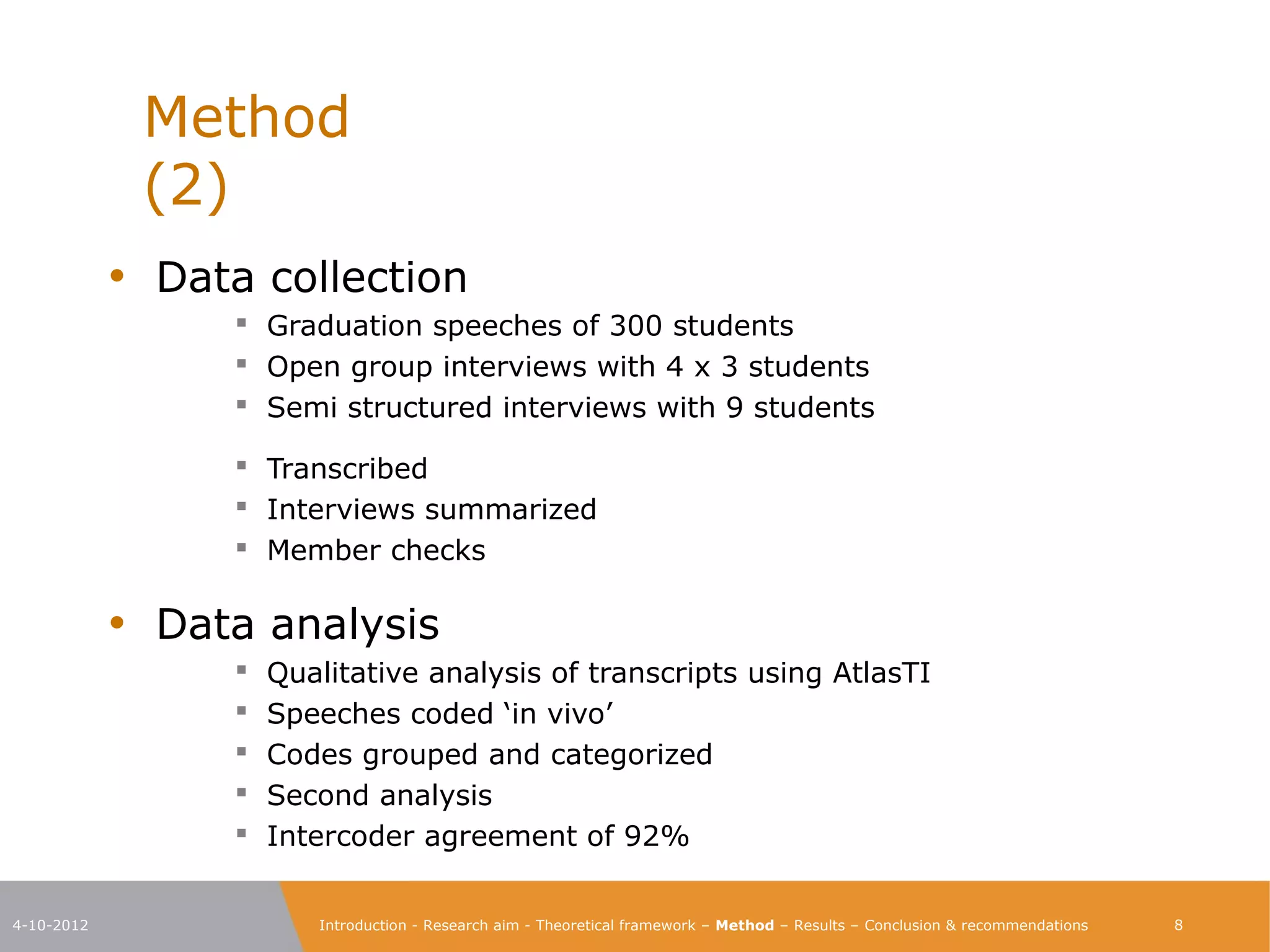
Method                                                                                                            (2)

            • Data collection
                   Graduation speeches of 300 students
                   Open group interviews with 4 x 3 students
                   Semi structured interviews with 9 students

                   Transcribed
                   Interviews summarized
                   Member checks

            • Data analysis
                   Qualitative analysis of transcripts using AtlasTI
                   Speeches coded ‘in vivo’
                   Codes grouped and categorized
                   Second analysis
                   Intercoder agreement of 92%


4-10-2012             Introduction - Research aim - Theoretical framework – Method – Results – Conclusion & recommendations    8
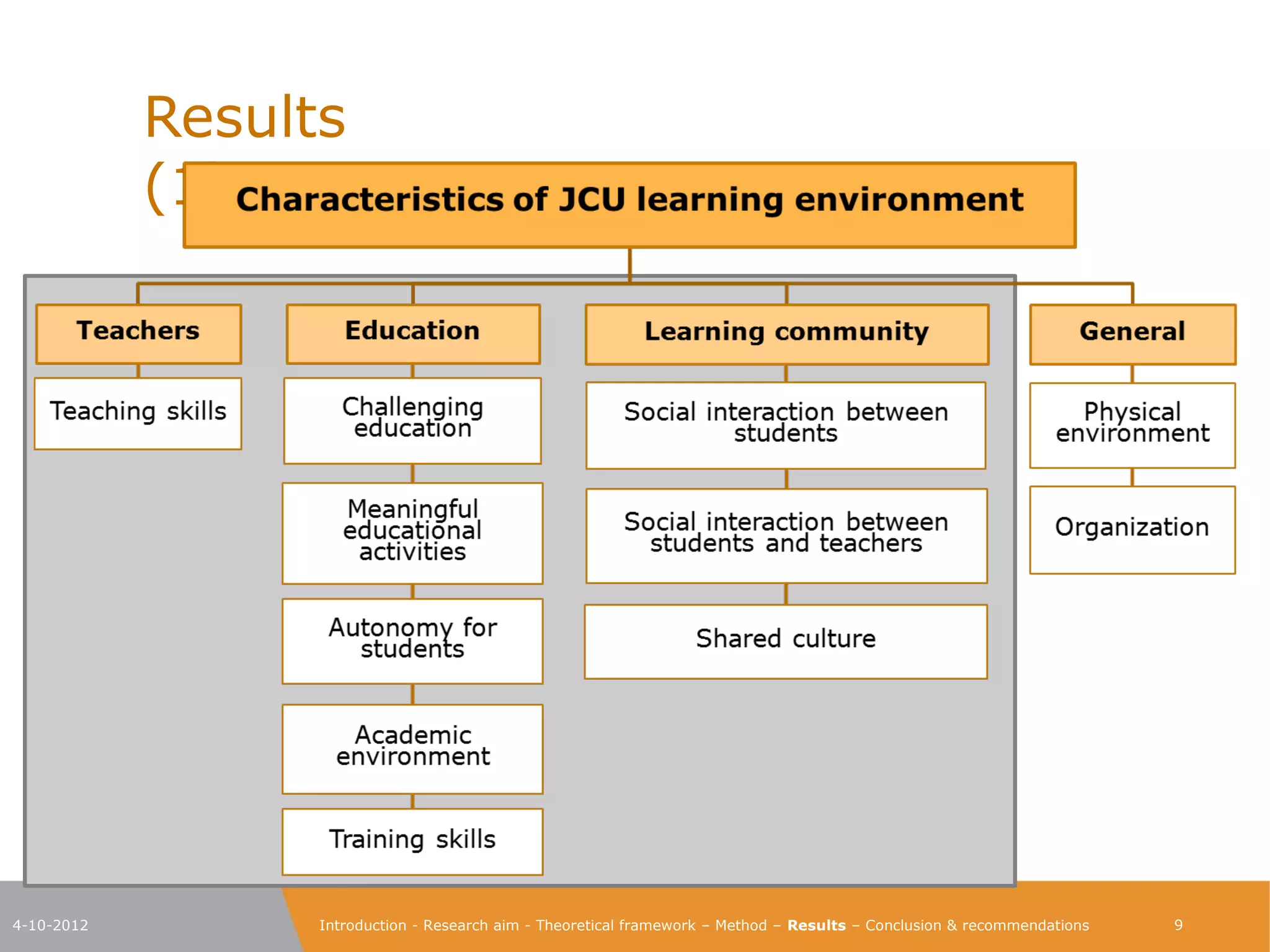
Results                                                                                                               (1)
                      Characteristics of JCU learning environment


       Teachers              Education                              Learning community                                       General


    Teaching skills         Challenging                          Social interaction between                                 Physical
                             education                                     students                                       environment


                            Meaningful
                            educational                          Social interaction between                               Organization
                             activities                            students and teachers


                           Autonomy for                                    Shared culture
                             students


                            Academic
                           environment


                           Training skills


4-10-2012                 Introduction - Research aim - Theoretical framework – Method – Results – Conclusion & recommendations    9
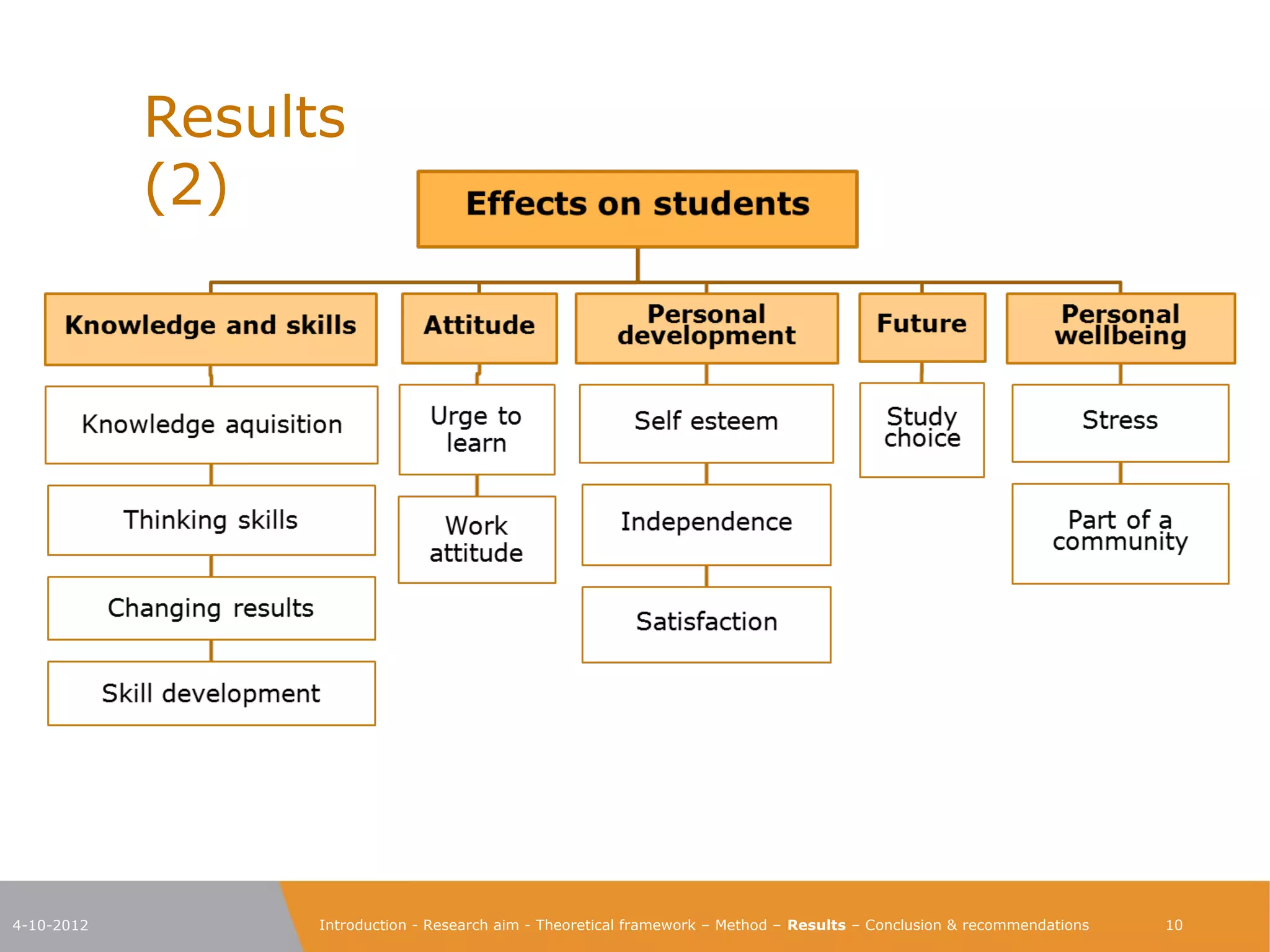
Results                                                                                                                    (2)
                                                  Effects on students


      Knowledge and skills                  Attitude                    Personal                        Future                 Personal
                                                                      development                                              wellbeing


       Knowledge aquisition                  Urge to                    Self esteem                      Study                     Stress
                                              learn                                                      choice


             Thinking skills                  Work                    Independence                                              Part of a
                                             attitude                                                                          community

            Changing results
                                                                        Satisfaction

            Skill development


4-10-2012                      Introduction - Research aim - Theoretical framework – Method – Results – Conclusion & recommendations        10
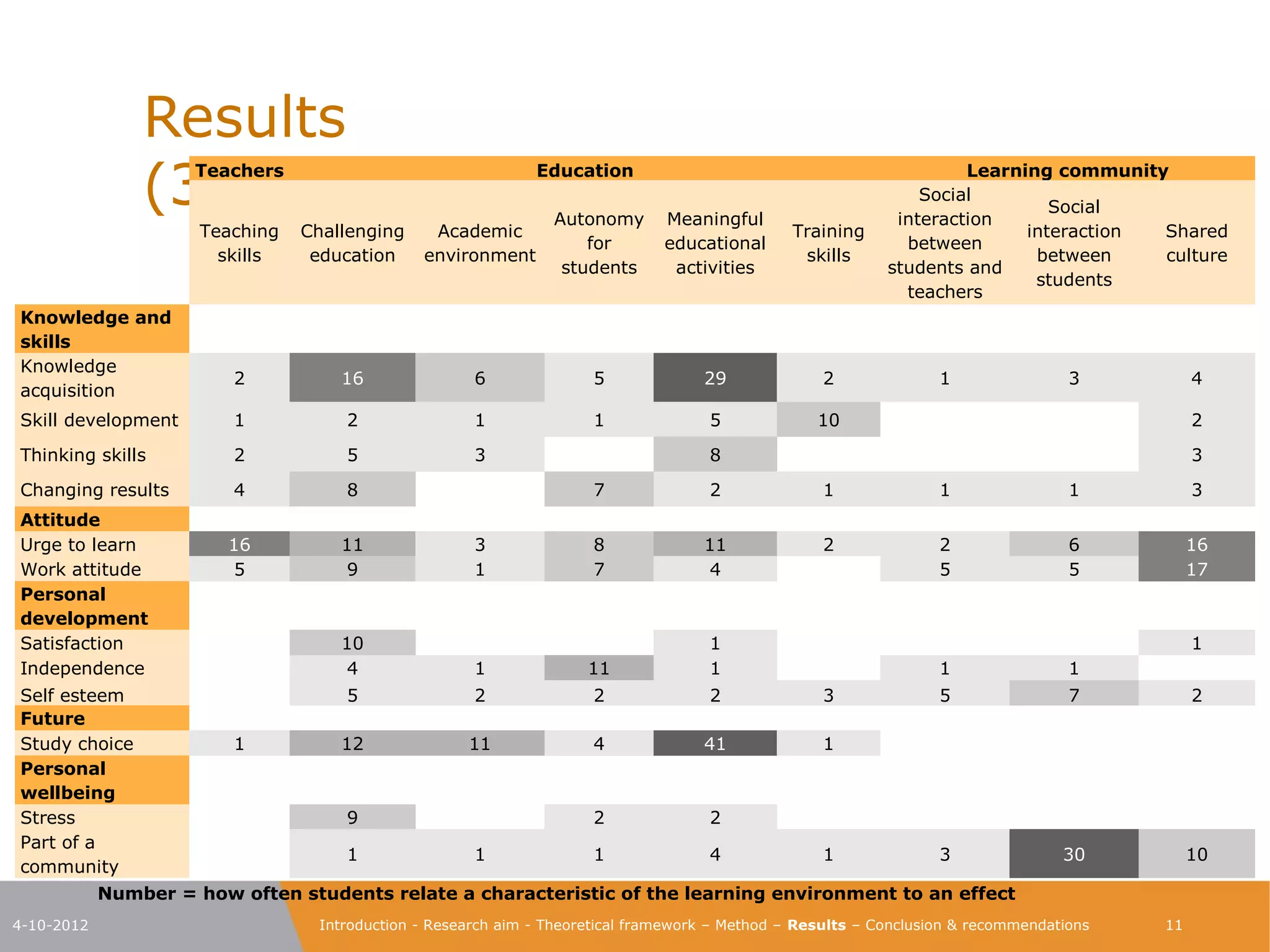
Results                                                                                                                       (3)
                     Teachers                                  Education                                              Learning community
                                                                                                                 Social
                                                                                                                               Social
                                                                 Autonomy       Meaningful                    interaction
                      Teaching   Challenging     Academic                                        Training                   interaction Shared
                                                                     for        educational                    between
                        skills    education     environment                                       skills                     between    culture
                                                                  students       activities                  students and
                                                                                                                             students
                                                                                                               teachers
Knowledge and
skills
Knowledge
                         2           16                6               5             29              2              1                3           4
acquisition
Skill development        1            2                1               1              5             10                                           2
Thinking skills          2            5                3                              8                                                          3
Changing results         4            8                                7              2              1              1                1           3
Attitude
Urge to learn            16          11                3               8             11              2              2                6           16
Work attitude             5          9                 1               7              4                             5                5           17
Personal
development
Satisfaction                         10                                               1                                                          1
Independence                         4                 1              11              1                             1                1
Self esteem                          5                 2               2              2              3              5                7           2
Future
Study choice             1           12               11               4             41              1
Personal
wellbeing
Stress                                9                                2              2
Part of a
                                      1                1               1              4              1              3               30           10
community
            Number = how often students relate a characteristic of the learning environment to an effect
4-10-2012                          Introduction - Research aim - Theoretical framework – Method – Results – Conclusion & recommendations    11
Results                                                                                                                     (4)
                   Teachers                                 Education                                              Learning community
                                                                                                              Social
                                                                                                                            Social
                                                              Autonomy       Meaningful                    interaction
                   Teaching   Challenging     Academic                                        Training                   interaction Shared
                                                                  for        educational                    between
                     skills    education     environment                                       skills                     between    culture
Knowledge and                                                  students       activities                  students and
                                                                                                                          students
skills                                                                                                      teachers
Knowledge
                      2           16                                              29
acquisition


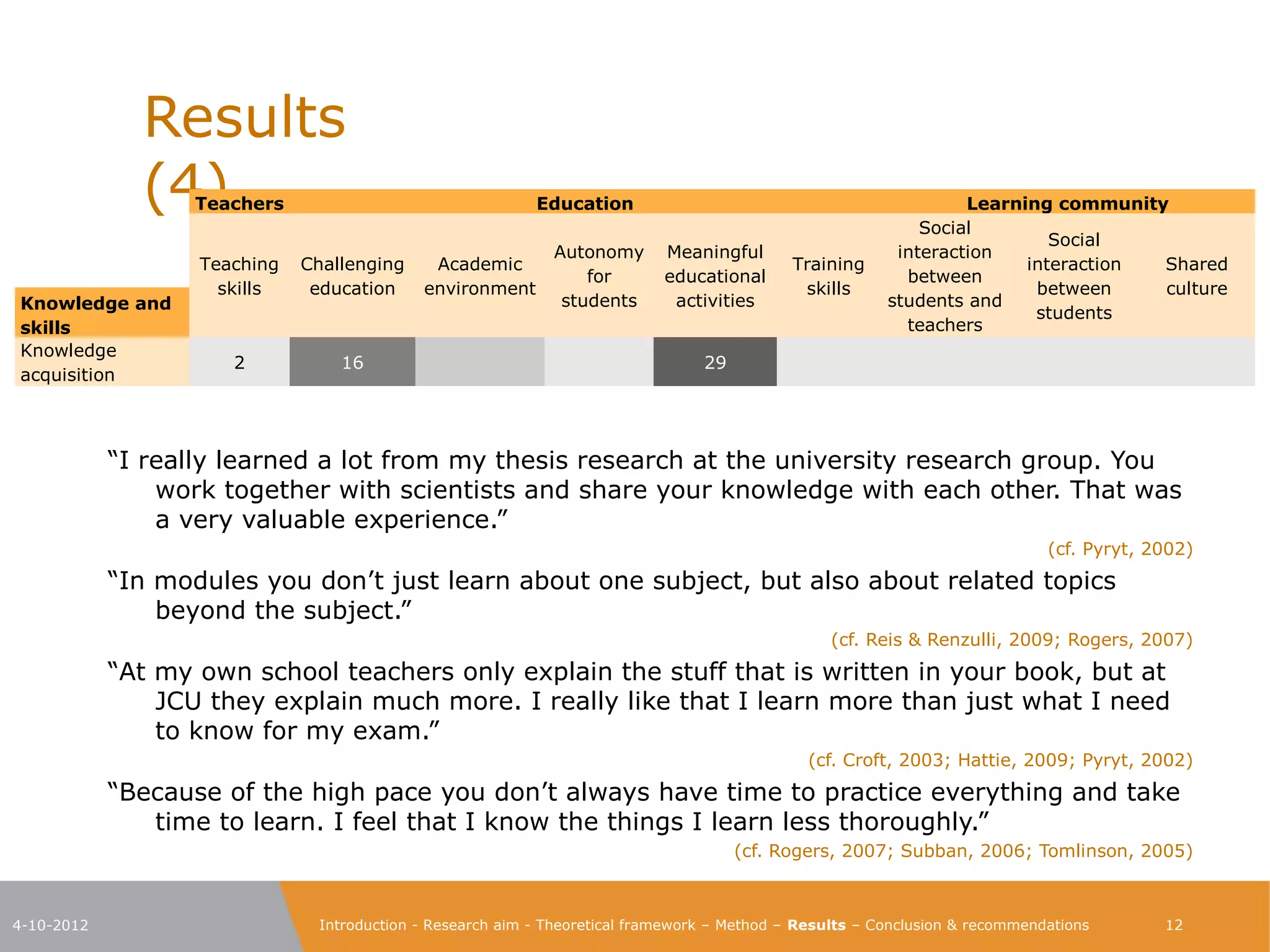
            “I really learned a lot from my thesis research at the university research group. You
            work together with scientists and share your knowledge with each other. That was a
            very valuable experience.”
                                                                                                                               (cf. Pyryt, 2002)
            “In modules you don’t just learn about one subject, but also about related topics
            beyond the subject.”
                                                                                                  (cf. Reis & Renzulli, 2009; Rogers, 2007)
            “At my own school teachers only explain the stuff that is written in your book, but at
            JCU they explain much more. I really like that I learn more than just what I need to
            know for my exam.”
                                                                                               (cf. Croft, 2003; Hattie, 2009; Pyryt, 2002)
            “Because of the high pace you don’t always have time to practice everything and take
            time to learn. I feel that I know the things I learn less thoroughly.”
                                                                                       (cf. Rogers, 2007; Subban, 2006; Tomlinson, 2005)


4-10-2012                       Introduction - Research aim - Theoretical framework – Method – Results – Conclusion & recommendations       12
Results                                                                                                                     (5)
                   Teachers                                 Education                                              Learning community
                                                                                                              Social
                                                                                                                            Social
                                                              Autonomy       Meaningful                    interaction
                   Teaching   Challenging     Academic                                        Training                   interaction Shared
                                                                  for        educational                    between
                     skills    education     environment                                       skills                     between    culture
                                                               students       activities                  students and
                                                                                                                          students
Attitude                                                                                                    teachers
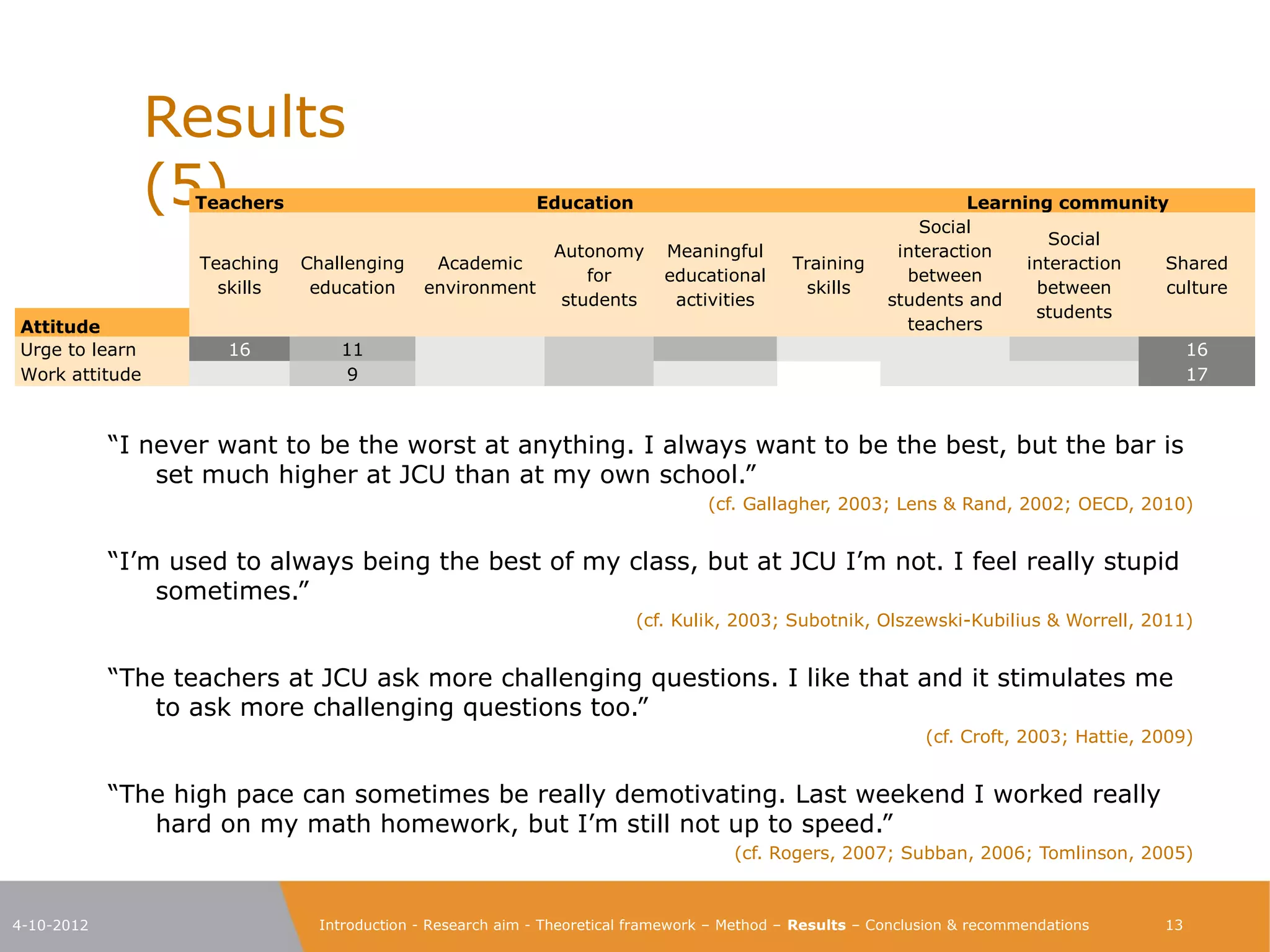
Urge to learn        16           11                                                                                                   16
Work attitude                     9                                                                                                    17


            “I never want to be the worst at anything. I always want to be the best, but the bar is
            set much higher at JCU than at my own school.”
                                                                                  (cf. Gallagher, 2003; Lens & Rand, 2002; OECD, 2010)


            “I’m used to always being the best of my class, but at JCU I’m not. I feel really stupid
            sometimes.”
                                                                         (cf. Kulik, 2003; Subotnik, Olszewski-Kubilius & Worrell, 2011)


            “The teachers at JCU ask more challenging questions. I like that and it stimulates me
            to ask more challenging questions too.”
                                                                                                               (cf. Croft, 2003; Hattie, 2009)


            “The high pace can sometimes be really demotivating. Last weekend I worked really
            hard on my math homework, but I’m still not up to speed.”
                                                                                     (cf. Rogers, 2007; Subban, 2006; Tomlinson, 2005)


4-10-2012                       Introduction - Research aim - Theoretical framework – Method – Results – Conclusion & recommendations     13
Results                                                                                                                     (6)
                   Teachers                                 Education                                              Learning community
                                                                                                              Social
                                                                                                                            Social
                                                              Autonomy       Meaningful                    interaction
                   Teaching   Challenging     Academic                                        Training                   interaction Shared
                                                                  for        educational                    between
                     skills    education     environment                                       skills                     between    culture
Personal                                                       students       activities                  students and
                                                                                                                          students
development                                                                                                 teachers
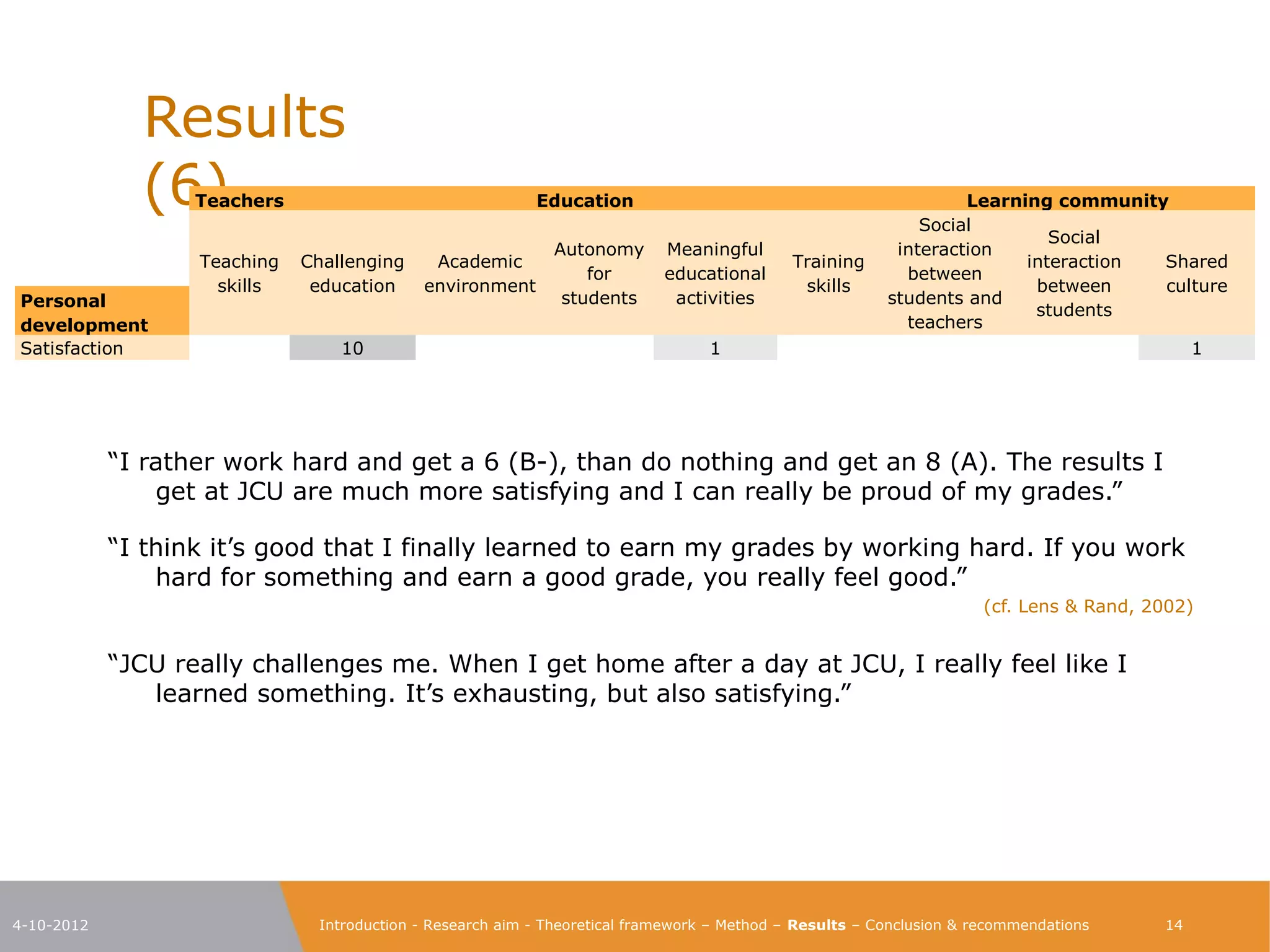
Satisfaction                      10                                               1                                                    1


            “I rather work hard and get a 6 (B-), than do nothing and get an 8 (A). The results I
            get at JCU are much more satisfying and I can really be proud of my grades.”

            “I think it’s good that I finally learned to earn my grades by working hard. If you work
            hard for something and earn a good grade, you really feel good.”
                                                                                                                      (cf. Lens & Rand, 2002)


            “JCU really challenges me. When I get home after a day at JCU, I really feel like I
            learned something. It’s exhausting, but also satisfying.”


4-10-2012                       Introduction - Research aim - Theoretical framework – Method – Results – Conclusion & recommendations    14
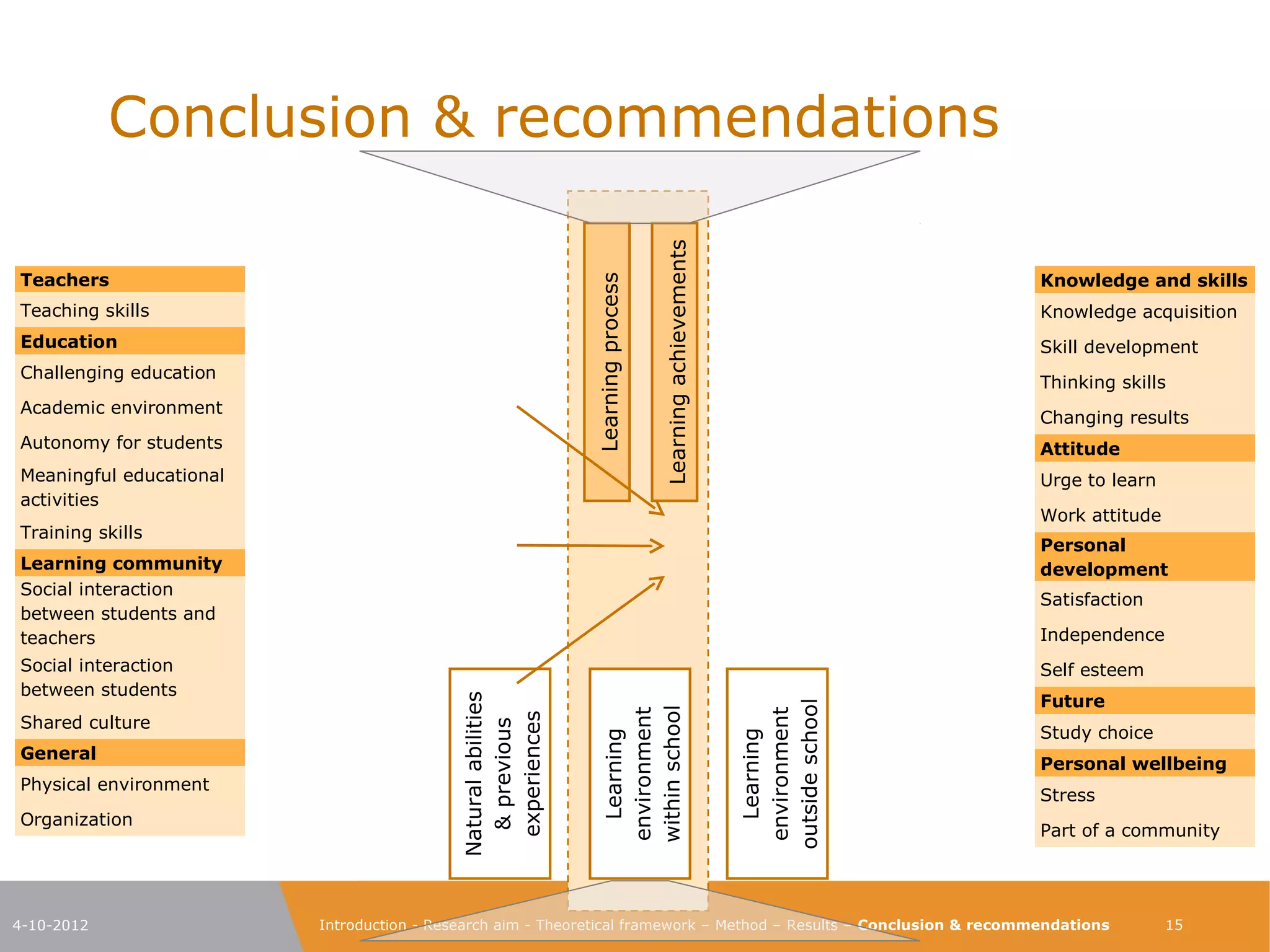
Conclusion & recommendations

Teachers                                                                                                             Knowledge and skills
Teaching skills                                                                                                      Knowledge acquisition
Education                                                                                                            Skill development
Challenging education     Natural abilities                                                                          Thinking skills
Academic environment        & previous                                                                               Changing results
Autonomy for students      experiences
                                                                                                                     Attitude
Meaningful educational                                                                                               Urge to learn
activities
                             Learning                                         Learning process                       Work attitude
Training skills
                           environment                                                                               Personal
Learning community                                                                                                   development
                           within school                                 Learning achievements
Social interaction
                                                                                                                     Satisfaction
between students and
teachers                                                                                                             Independence
Social interaction
                              Learning
                                                                                                                     Self esteem
between students            environment
                                                                                                                     Future
Shared culture             outside school
                                                                                                                     Study choice
General
                                                                                                                     Personal wellbeing
Physical environment
                                                                                                                     Stress
Organization
                                                                                                                     Part of a community


4-10-2012                Introduction - Research aim - Theoretical framework – Method – Results – Conclusion & recommendations       15
References
            Croft, L. J. (2003). Teachers of the gifted: gifted teachers. In N. Colangelo, & G.A. Davis (red.), Handbook of gifted education (3rd ed.)
            (pp.558-571). Boston, Verenigde Staten: Allyn and Bacon.

            Gallagher, J.J. (2003). Issues and challenges in the education of gifted students. In N. Colangelo, & G.A. Davis (red.), Handbook of
            gifted education (3rd ed.) (pp.11-23). Boston, Verenigde Staten: Allyn and Bacon.

            Hattie, J. (2009). Visible learning: a synthesis of over 800 meta-analyses relating to achievement. London, Verenigd Koninkrijk:
            Routledge.

            Kulik, J.A. (2003). Grouping and tracking. In N. Colangelo, & G.A. Davis (red.), Handbook of gifted education (3rd ed.) (pp.268-281).
            Boston, Verenigde Staten: Allyn and Bacon.

            Lens, W., & Rand, P. (2002). Motivation and cognotion: their role in the development of giftedness. In K. Heller, F. Mönks, R.
            Sternberg, & R. Subotnik (red.), International Handbook of giftedness and talent (2nd ed.) (pp.193-202). Oxford, Verenigd Koninkrijk:
            Pergamon.

            OECD. (2010). PISA 2009 results: what makes a school successful? (volume IV). Paris: OECD.

            Pyryt, M.C. (2002). Talent development in science and technology. In: Heller, K., Mönks, F., Sternberg, R. & Subotnik, R. (Eds.),
            International Handbook of giftedness and talent (2nd ed.). (pp.427-438). Oxford, Verenigd Koninkrijk: Pergamon.

            Reis, S.M., & Renzulli, J.S. (2010). Is there still a need for gifted education? An examination of current research. Learning and
            individual differences, 20, 308-317.

            Rogers, K.B. (2007). Lessons learned about educating the gifted and talented: a synthesis of the research on educational practice.
            Gifted child quarterly, 51, 382-396.

            Subban, P. (2006). Differentiated instruction: a research basis. International education journal, 7(7), 935-947.

            Subotnik, R.F., Olszewski-Kubilius, P., & Worrell, F.C. (2011). Rethinking giftedness and gifted education: a proposed direction forward
            based on psychological science. Psychological science in the public interest, 12(1), 3-54.

            Trost, G. (2002). Prediction of excellence in school, higher education and work. In K. Heller, F. Mönks, R. Sternberg, & R. Subotnik
            (red.), International Handbook of giftedness and talent (2nd ed.) (pp.317-330). Oxford, Verenigd Koninkrijk: Pergamon.

            Tomlinson, C.A. (2005). Quality curriculum and instruction for highly able students. Theory into practice, 44(2), 160-166.


4-10-2012                              PPT FIsme                                                                                                   16

Characteristics of a challenging learning environment affecting students’ learning processes and achievements

  • 1.
    Characteristics of achallenging learning environment affecting students’ learning processes and achievements Suzanne Vrancken & Sanne Tromp Junior College Utrecht Utrecht University s.e.a.vrancken@uu.nl s.tromp@uu.nl
  • 2.
    Contents • Introduction • Research aim • Theoretical framework • Method • Results • Conclusion & recommendations 4-10-2012 2
  • 3.
    Introduction (1) • Talented students Can do more than is offered in regular curriculum Need to be challenged Education needs to be adapted to students’ needs and capacities • Dutch government policy Education is insufficiently challenging for talented students Motivating and challenging learning environments need to be created • Excellence programs Existing programs can serve as sources of knowledge and inspiration 4-10-2012 Introduction - Research aim - Theoretical framework – Method – Results – Conclusion & recommendations 3
  • 4.
    Introduction (2) Junior College Utrecht (JCU) • Science program for 100 students in grade 11th and 12th of pre-university education • Two years, two days a week • Students are selected • Accelerated and enriched curriculum • Research activities • Excellent student achievements • Example of an excellence program: Junior College learning environment affects students’ learning processes and achievements 4-10-2012 Introduction - Research aim - Theoretical framework – Method – Results – Conclusion & recommendations 4
  • 5.
    Research aim &questions • To identify characteristics of a learning environment that affect the learning processes and achievements of 11th and 12th grade pre- university students • Research questions (1)What are the characteristics of the JCU learning environment, according to students? (2)What effects do the characteristics of the JCU learning environment have on students’ learning processes and achievements, according to students? 4-10-2012 Introduction - Research aim - Theoretical framework – Method – Results – Conclusion & recommendations 5
  • 6.
    Theoretical framework Natural abilities & previous experiences Learning process Learning environment within school Learning achievements Learning environment outside school 4-10-2012 Introduction - Research aim - Theoretical framework – Method – Results – Conclusion & recommendations 6
  • 7.
    Method (1) • Research strategy Grounded theory Deduct answers on research questions based on students’ experiences Choice for JCU as site for data collection: critical case sampling (Patton, 2001) 4-10-2012 Introduction - Research aim - Theoretical framework – Method – Results – Conclusion & recommendations 7
  • 8.
    Method (2) • Data collection Graduation speeches of 300 students Open group interviews with 4 x 3 students Semi structured interviews with 9 students Transcribed Interviews summarized Member checks • Data analysis Qualitative analysis of transcripts using AtlasTI Speeches coded ‘in vivo’ Codes grouped and categorized Second analysis Intercoder agreement of 92% 4-10-2012 Introduction - Research aim - Theoretical framework – Method – Results – Conclusion & recommendations 8
  • 9.
    Results (1) Characteristics of JCU learning environment Teachers Education Learning community General Teaching skills Challenging Social interaction between Physical education students environment Meaningful educational Social interaction between Organization activities students and teachers Autonomy for Shared culture students Academic environment Training skills 4-10-2012 Introduction - Research aim - Theoretical framework – Method – Results – Conclusion & recommendations 9
  • 10.
    Results (2) Effects on students Knowledge and skills Attitude Personal Future Personal development wellbeing Knowledge aquisition Urge to Self esteem Study Stress learn choice Thinking skills Work Independence Part of a attitude community Changing results Satisfaction Skill development 4-10-2012 Introduction - Research aim - Theoretical framework – Method – Results – Conclusion & recommendations 10
  • 11.
    Results (3) Teachers Education Learning community Social Social Autonomy Meaningful interaction Teaching Challenging Academic Training interaction Shared for educational between skills education environment skills between culture students activities students and students teachers Knowledge and skills Knowledge 2 16 6 5 29 2 1 3 4 acquisition Skill development 1 2 1 1 5 10 2 Thinking skills 2 5 3 8 3 Changing results 4 8 7 2 1 1 1 3 Attitude Urge to learn 16 11 3 8 11 2 2 6 16 Work attitude 5 9 1 7 4 5 5 17 Personal development Satisfaction 10 1 1 Independence 4 1 11 1 1 1 Self esteem 5 2 2 2 3 5 7 2 Future Study choice 1 12 11 4 41 1 Personal wellbeing Stress 9 2 2 Part of a 1 1 1 4 1 3 30 10 community Number = how often students relate a characteristic of the learning environment to an effect 4-10-2012 Introduction - Research aim - Theoretical framework – Method – Results – Conclusion & recommendations 11
  • 12.
    Results (4) Teachers Education Learning community Social Social Autonomy Meaningful interaction Teaching Challenging Academic Training interaction Shared for educational between skills education environment skills between culture Knowledge and students activities students and students skills teachers Knowledge 2 16 29 acquisition “I really learned a lot from my thesis research at the university research group. You work together with scientists and share your knowledge with each other. That was a very valuable experience.” (cf. Pyryt, 2002) “In modules you don’t just learn about one subject, but also about related topics beyond the subject.” (cf. Reis & Renzulli, 2009; Rogers, 2007) “At my own school teachers only explain the stuff that is written in your book, but at JCU they explain much more. I really like that I learn more than just what I need to know for my exam.” (cf. Croft, 2003; Hattie, 2009; Pyryt, 2002) “Because of the high pace you don’t always have time to practice everything and take time to learn. I feel that I know the things I learn less thoroughly.” (cf. Rogers, 2007; Subban, 2006; Tomlinson, 2005) 4-10-2012 Introduction - Research aim - Theoretical framework – Method – Results – Conclusion & recommendations 12
  • 13.
    Results (5) Teachers Education Learning community Social Social Autonomy Meaningful interaction Teaching Challenging Academic Training interaction Shared for educational between skills education environment skills between culture students activities students and students Attitude teachers Urge to learn 16 11 16 Work attitude 9 17 “I never want to be the worst at anything. I always want to be the best, but the bar is set much higher at JCU than at my own school.” (cf. Gallagher, 2003; Lens & Rand, 2002; OECD, 2010) “I’m used to always being the best of my class, but at JCU I’m not. I feel really stupid sometimes.” (cf. Kulik, 2003; Subotnik, Olszewski-Kubilius & Worrell, 2011) “The teachers at JCU ask more challenging questions. I like that and it stimulates me to ask more challenging questions too.” (cf. Croft, 2003; Hattie, 2009) “The high pace can sometimes be really demotivating. Last weekend I worked really hard on my math homework, but I’m still not up to speed.” (cf. Rogers, 2007; Subban, 2006; Tomlinson, 2005) 4-10-2012 Introduction - Research aim - Theoretical framework – Method – Results – Conclusion & recommendations 13
  • 14.
    Results (6) Teachers Education Learning community Social Social Autonomy Meaningful interaction Teaching Challenging Academic Training interaction Shared for educational between skills education environment skills between culture Personal students activities students and students development teachers Satisfaction 10 1 1 “I rather work hard and get a 6 (B-), than do nothing and get an 8 (A). The results I get at JCU are much more satisfying and I can really be proud of my grades.” “I think it’s good that I finally learned to earn my grades by working hard. If you work hard for something and earn a good grade, you really feel good.” (cf. Lens & Rand, 2002) “JCU really challenges me. When I get home after a day at JCU, I really feel like I learned something. It’s exhausting, but also satisfying.” 4-10-2012 Introduction - Research aim - Theoretical framework – Method – Results – Conclusion & recommendations 14
  • 15.
    Conclusion & recommendations Teachers Knowledge and skills Teaching skills Knowledge acquisition Education Skill development Challenging education Natural abilities Thinking skills Academic environment & previous Changing results Autonomy for students experiences Attitude Meaningful educational Urge to learn activities Learning Learning process Work attitude Training skills environment Personal Learning community development within school Learning achievements Social interaction Satisfaction between students and teachers Independence Social interaction Learning Self esteem between students environment Future Shared culture outside school Study choice General Personal wellbeing Physical environment Stress Organization Part of a community 4-10-2012 Introduction - Research aim - Theoretical framework – Method – Results – Conclusion & recommendations 15
  • 16.
    References Croft, L. J. (2003). Teachers of the gifted: gifted teachers. In N. Colangelo, & G.A. Davis (red.), Handbook of gifted education (3rd ed.) (pp.558-571). Boston, Verenigde Staten: Allyn and Bacon. Gallagher, J.J. (2003). Issues and challenges in the education of gifted students. In N. Colangelo, & G.A. Davis (red.), Handbook of gifted education (3rd ed.) (pp.11-23). Boston, Verenigde Staten: Allyn and Bacon. Hattie, J. (2009). Visible learning: a synthesis of over 800 meta-analyses relating to achievement. London, Verenigd Koninkrijk: Routledge. Kulik, J.A. (2003). Grouping and tracking. In N. Colangelo, & G.A. Davis (red.), Handbook of gifted education (3rd ed.) (pp.268-281). Boston, Verenigde Staten: Allyn and Bacon. Lens, W., & Rand, P. (2002). Motivation and cognotion: their role in the development of giftedness. In K. Heller, F. Mönks, R. Sternberg, & R. Subotnik (red.), International Handbook of giftedness and talent (2nd ed.) (pp.193-202). Oxford, Verenigd Koninkrijk: Pergamon. OECD. (2010). PISA 2009 results: what makes a school successful? (volume IV). Paris: OECD. Pyryt, M.C. (2002). Talent development in science and technology. In: Heller, K., Mönks, F., Sternberg, R. & Subotnik, R. (Eds.), International Handbook of giftedness and talent (2nd ed.). (pp.427-438). Oxford, Verenigd Koninkrijk: Pergamon. Reis, S.M., & Renzulli, J.S. (2010). Is there still a need for gifted education? An examination of current research. Learning and individual differences, 20, 308-317. Rogers, K.B. (2007). Lessons learned about educating the gifted and talented: a synthesis of the research on educational practice. Gifted child quarterly, 51, 382-396. Subban, P. (2006). Differentiated instruction: a research basis. International education journal, 7(7), 935-947. Subotnik, R.F., Olszewski-Kubilius, P., & Worrell, F.C. (2011). Rethinking giftedness and gifted education: a proposed direction forward based on psychological science. Psychological science in the public interest, 12(1), 3-54. Trost, G. (2002). Prediction of excellence in school, higher education and work. In K. Heller, F. Mönks, R. Sternberg, & R. Subotnik (red.), International Handbook of giftedness and talent (2nd ed.) (pp.317-330). Oxford, Verenigd Koninkrijk: Pergamon. Tomlinson, C.A. (2005). Quality curriculum and instruction for highly able students. Theory into practice, 44(2), 160-166. 4-10-2012 PPT FIsme 16