Building the Bigger
Picture ofTeaching-
Research Nexus on
Learning Experiences
Crisanto A. Daing, Ph.D
Associate Dean, College of Arts and Sciences
Graduate School Professor
Our Lady of Fatima University, Philippines
✓Acknowledge the impact of the teaching-research nexus
on student learning and teaching practice
Intended Learning Outcomes (ILO’s)
✓Differentiate teacher research from action research and
classroom research
✓Appreciate the significance of research in improving
teaching and learning practices
How can I encourage more parental support?
How can I make my students enjoy learning?
How can I make my classroom more
interesting to my students?
How can I adapt an already demanding
curriculum to better meet the specific needs of
my students in the class?
How can content, strategies, and learning
activities be varied to help students?
What kind of method works best with certain
types of students?
How can teachers encourage students to
think about important issues?
How can subject matter e better presented to
promote understanding?
RESEARCH!
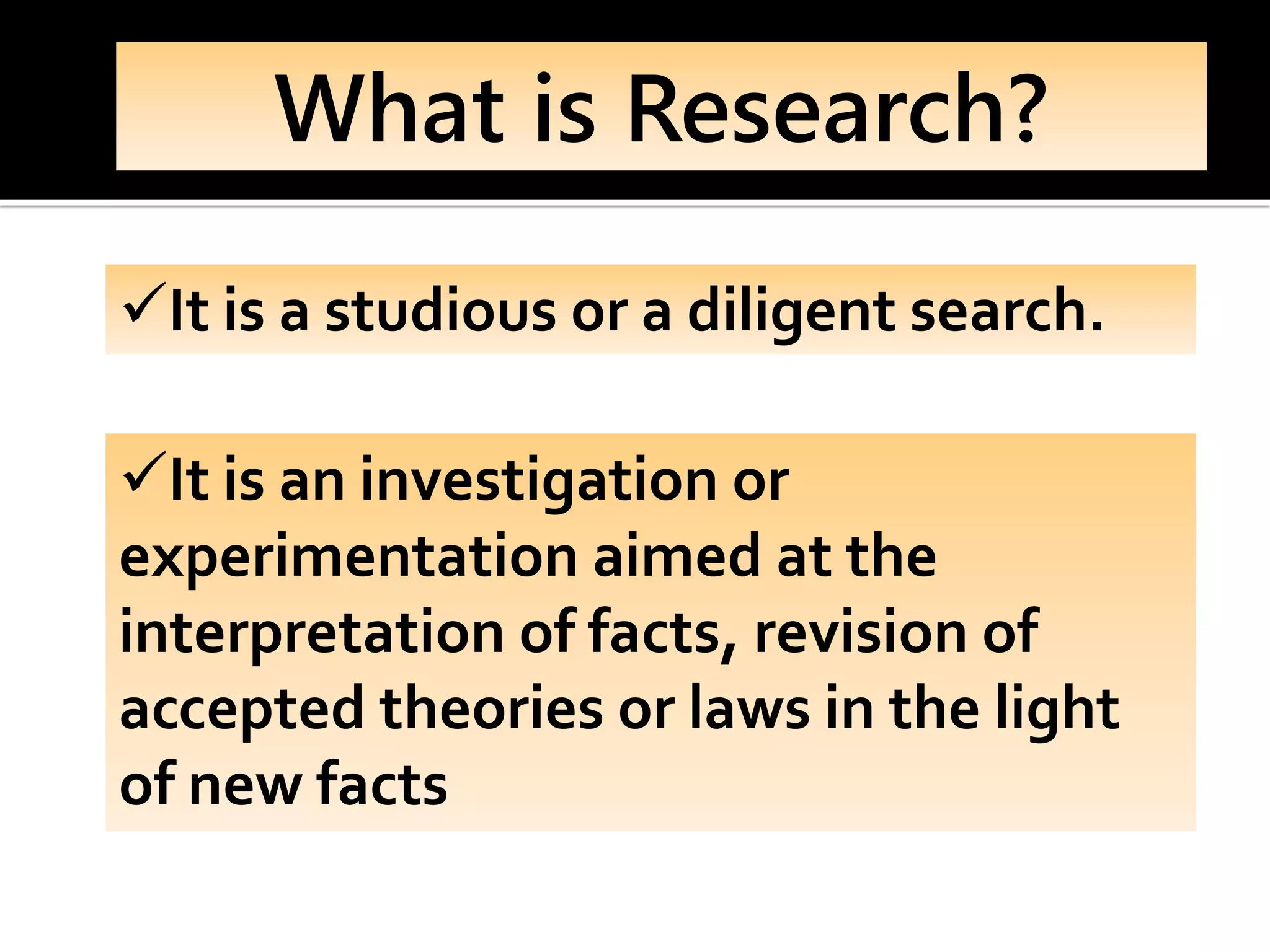
What is Research?
✓It is a studious or a diligent search.
✓It is an investigation or
experimentation aimed at the
interpretation of facts, revision of
accepted theories or laws in the light
of new facts
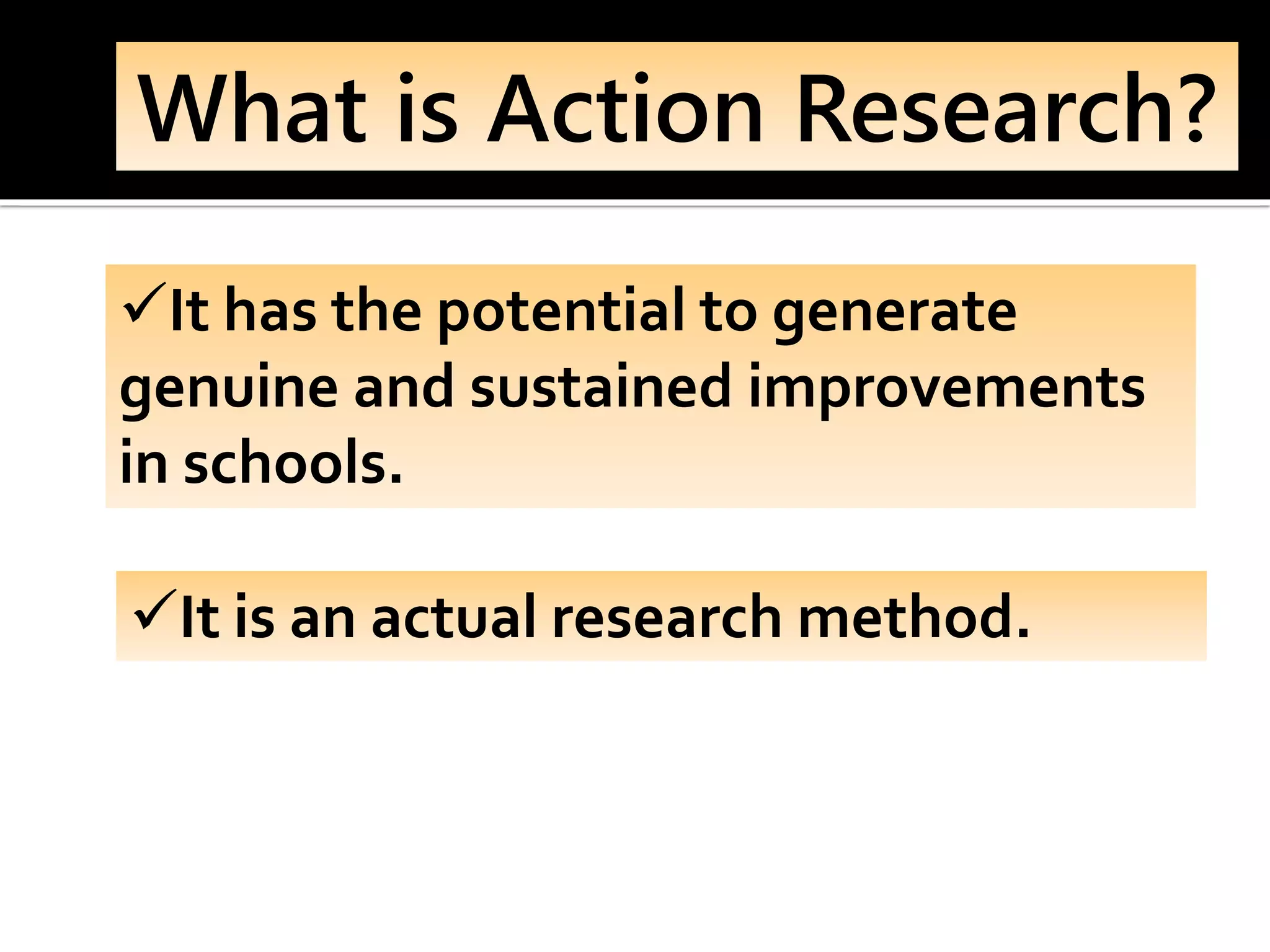
What is Action Research?
✓A family of research methodologies
which pursue an action (or CHANGE)
and research (UNDERSTANDING) at
the same time
✓It is an inquiry or research in the
context of focused efforts to improve
the quality of a PRACTICE.
What is Action Research?
✓It has the potential to generate
genuine and sustained improvements
in schools.
✓It is an actual research method.
WHY Action Research?
✓ gives educators more opportunities
to reflect on and assess their
teaching
✓ to explore and test new ideas,
methods and materials
✓ assess how effective the new
approaches are
WHY Action Research?
✓ to share feedback with fellow team
members
✓ to make decisions about which new
approaches to include in the practice
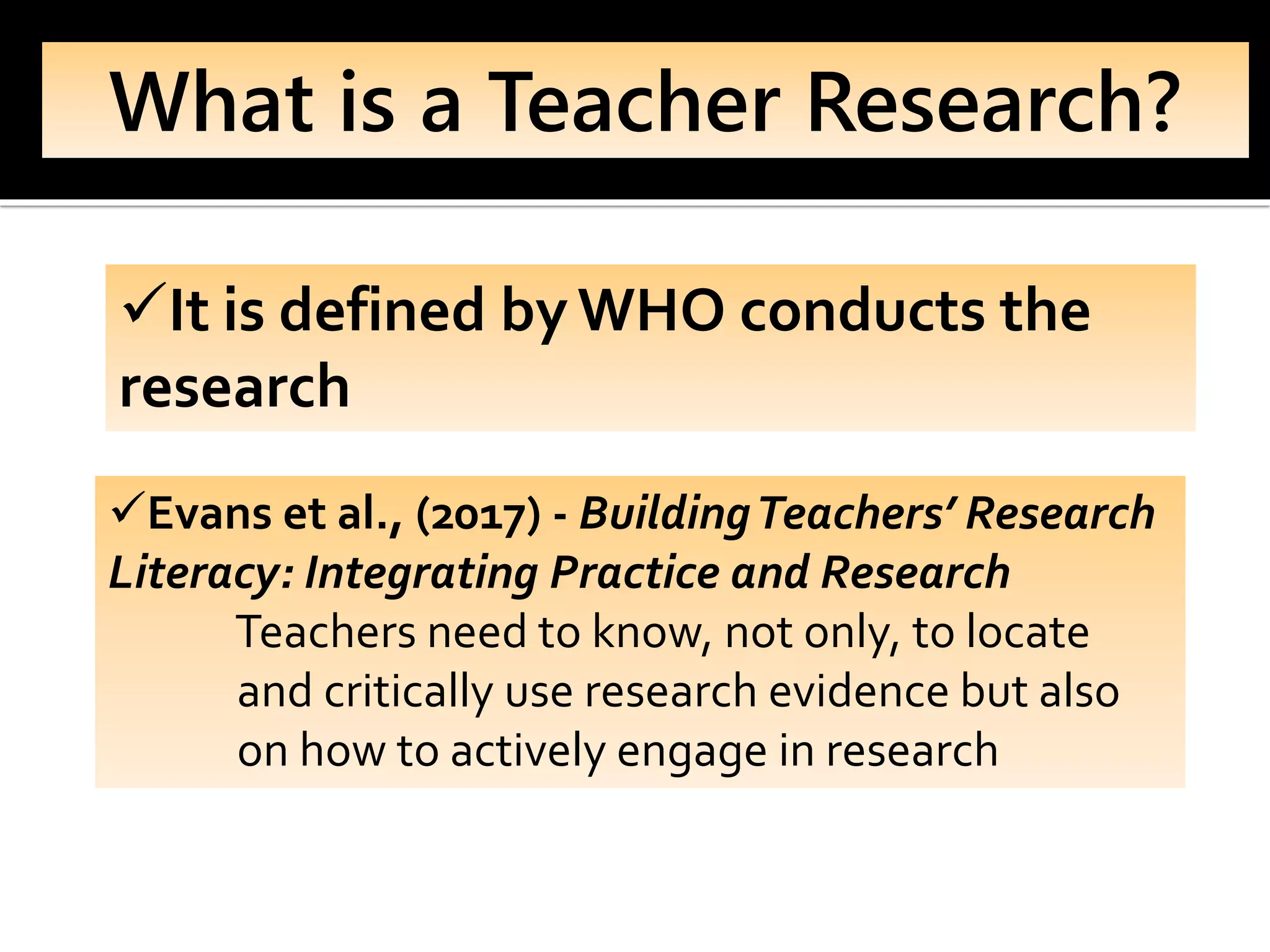
What is a Teacher Research?
✓It is defined byWHO conducts the
research
✓Evans et al., (2017) - BuildingTeachers’ Research
Literacy: Integrating Practice and Research
Teachers need to know, not only, to locate
and critically use research evidence but also
on how to actively engage in research
What is a Teacher Research?
✓Evans et al., (2017) - BuildingTeachers’ Research
Literacy: Integrating Practice and Research
Engage in research with your pupils as an
integral part of their practice
Research should not be seen as a separate
entity but an integral part of being a teacher
professional
What is a Teacher Research?
✓According to Brindley, it is often connected with
teacher development and empowerment
By investigating the teaching and learning
processes in the classroom, we learn more
about the craft and the science of teaching so
that me may improve our work as teachers.
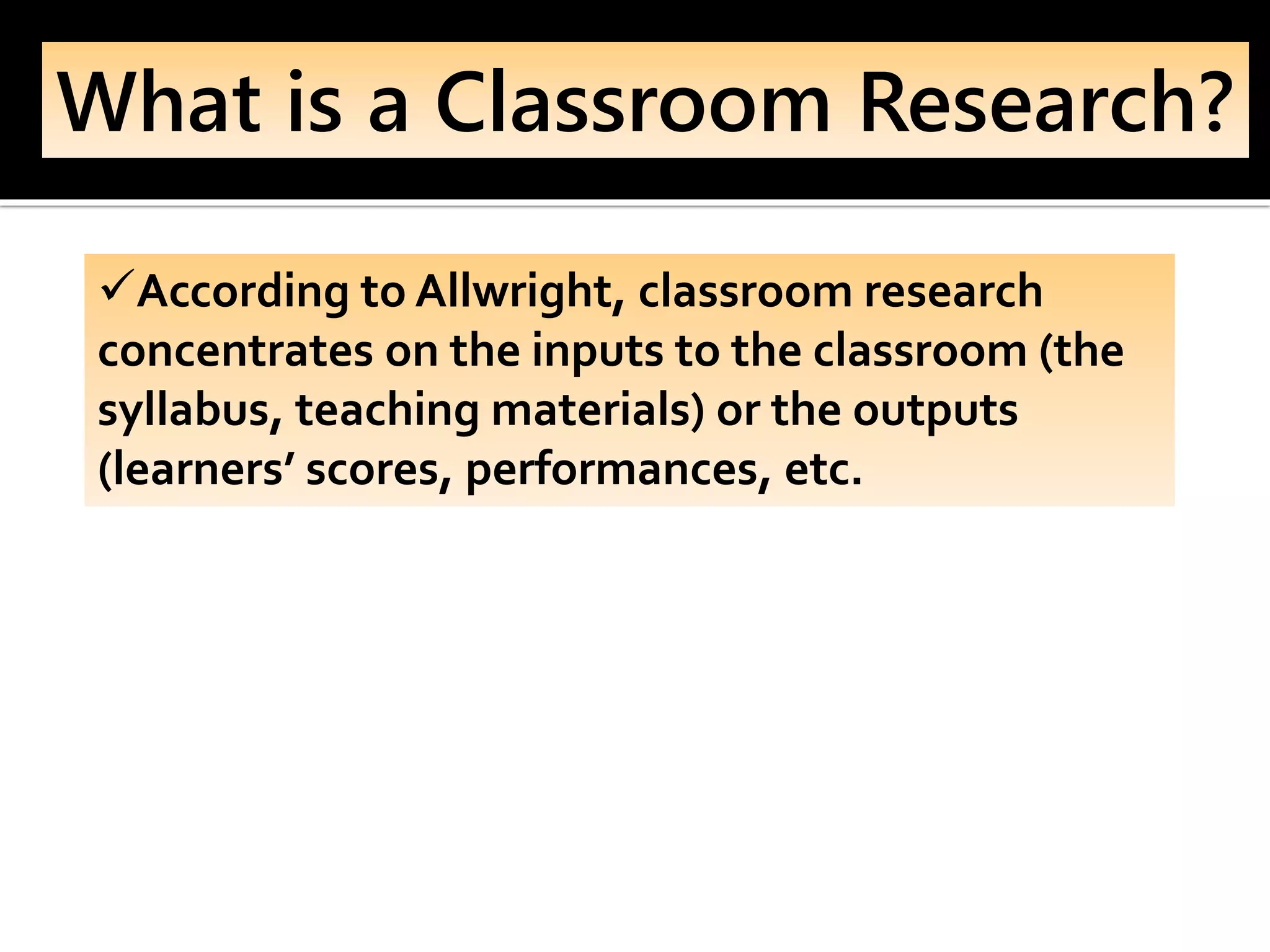
What is a Classroom Research?
✓It is defined by the setting or place in which the
data are collected.
Bridget Long defined classroom research as all or
part of whose data are derived from the
observation or measurement of the classroom
performance of teachers and students.
What is a Classroom Research?
✓According to Allwright, classroom research
concentrates on the inputs to the classroom (the
syllabus, teaching materials) or the outputs
(learners’ scores, performances, etc.
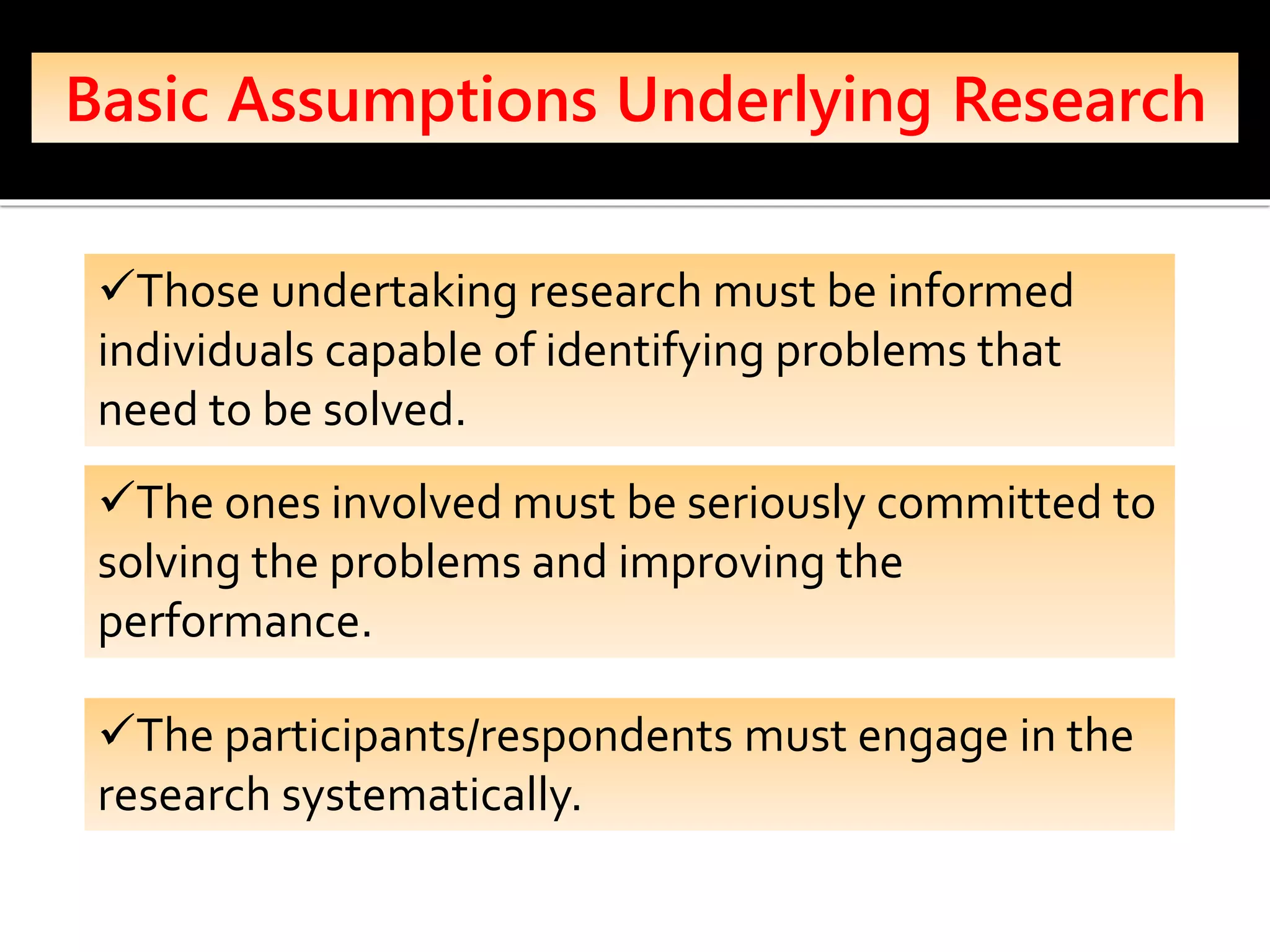
Basic Assumptions Underlying Research
✓Those undertaking research must be informed
individuals capable of identifying problems that
need to be solved.
✓The ones involved must be seriously committed to
solving the problems and improving the
performance.
✓The participants/respondents must engage in the
research systematically.
Six Positive Influences of Teacher-Research
Builds a knowledge
base
Learns about
research
Improves classroom
instruction
Source: Journal of Curriculum and
Instruction, January 2009
Six Positive Influences of Teacher-Research
Connects with other
teachers and colleagues
Brings about change
Gains new understanding
of students
Source: Journal of Curriculum and
Instruction, January 2009
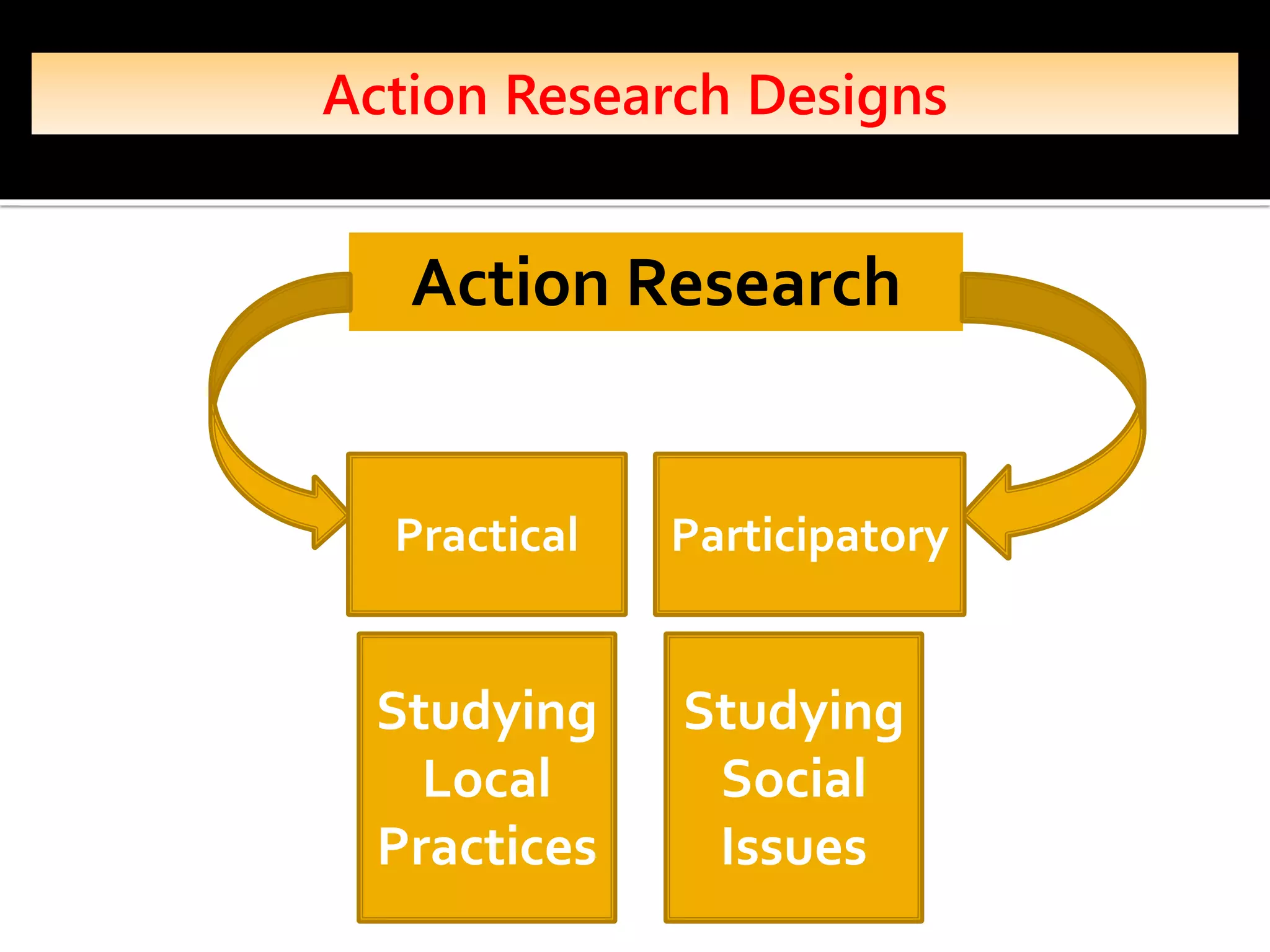
Action Research Designs
Action Research
Practical Participatory
Studying
Local
Practices
Studying
Social
Issues
Action Research Designs
Practical AR
Involving Individual orTeam based inquiry
Focusing onTeacher Development and
Student Learning
Implementing a Plan of Action
Leading to the teacher as researcher
The Research Spiral
-Mills, 2000
Analyze and
Interpret
Data
Collect
Data
Identify an
area of
focus
Develop an
Action Plan
Action Research Designs
Participatory AR
Emphasizing equal collaboration
Focusing on “life enhancing changes”
Resulting in the emancipated researcher
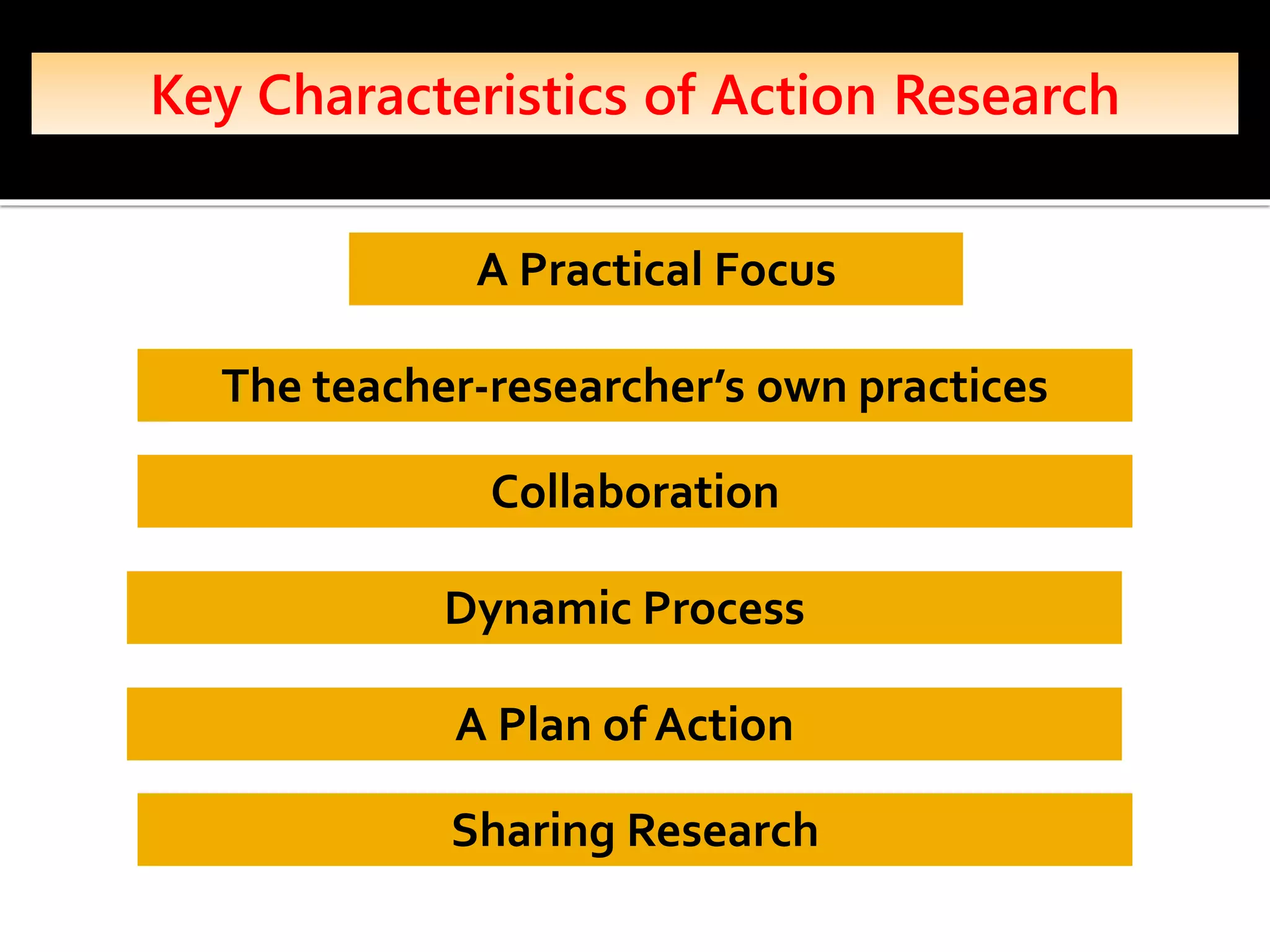
Key Characteristics of Action Research
A Practical Focus
The teacher-researcher’s own practices
Collaboration
Dynamic Process
A Plan of Action
Sharing Research
Practical Focus
A problem that will have
immediate benefits for:
A single teacher
Schools
Communities
Study of the teacher-researcher’s own
practices
Self-
Reflective
Collaboration
Collaborative
Team
STUDENTS
PARENTS
STAFF
TEACHERS
ADMINISTRATORS
COMMUNITY
STAKEHOLDERS
A Dynamic Process
Spiraling back and
forth among
Reflection, Data
Collection, and Action
A Plan of Action
Involves a few individuals
or the whole community
Presenting data to
stakeholders, establishing
a pilot program, exploring
new practices
Sharing Research
✓Group of stakeholders
✓Local Schools,
Educational personnel
✓Individuals or groups
who can promote change
Can classroom
research, teacher
research and action
research fit together?
The Oral Communication Teacher (teacher-
researcher) is interested to know why the
students in the classroom (classroom
research) have difficulties in the correct
pronunciation of words in English. Hence,
he asks the students, one by one, to read a
passage and records common errors in
pronunciation (action research).
Teachers
need
necessity
for
change
Teachers
need to
be...
SUPPORTED
Teachers
need to
evidence
that things
work
Teachers need time out from the
classroom
Teachers need encouragement and interest
from management
Benefits are:
Improved teaching and
better student outcomes
Improved teacher confidence
due to evidence-based
teaching
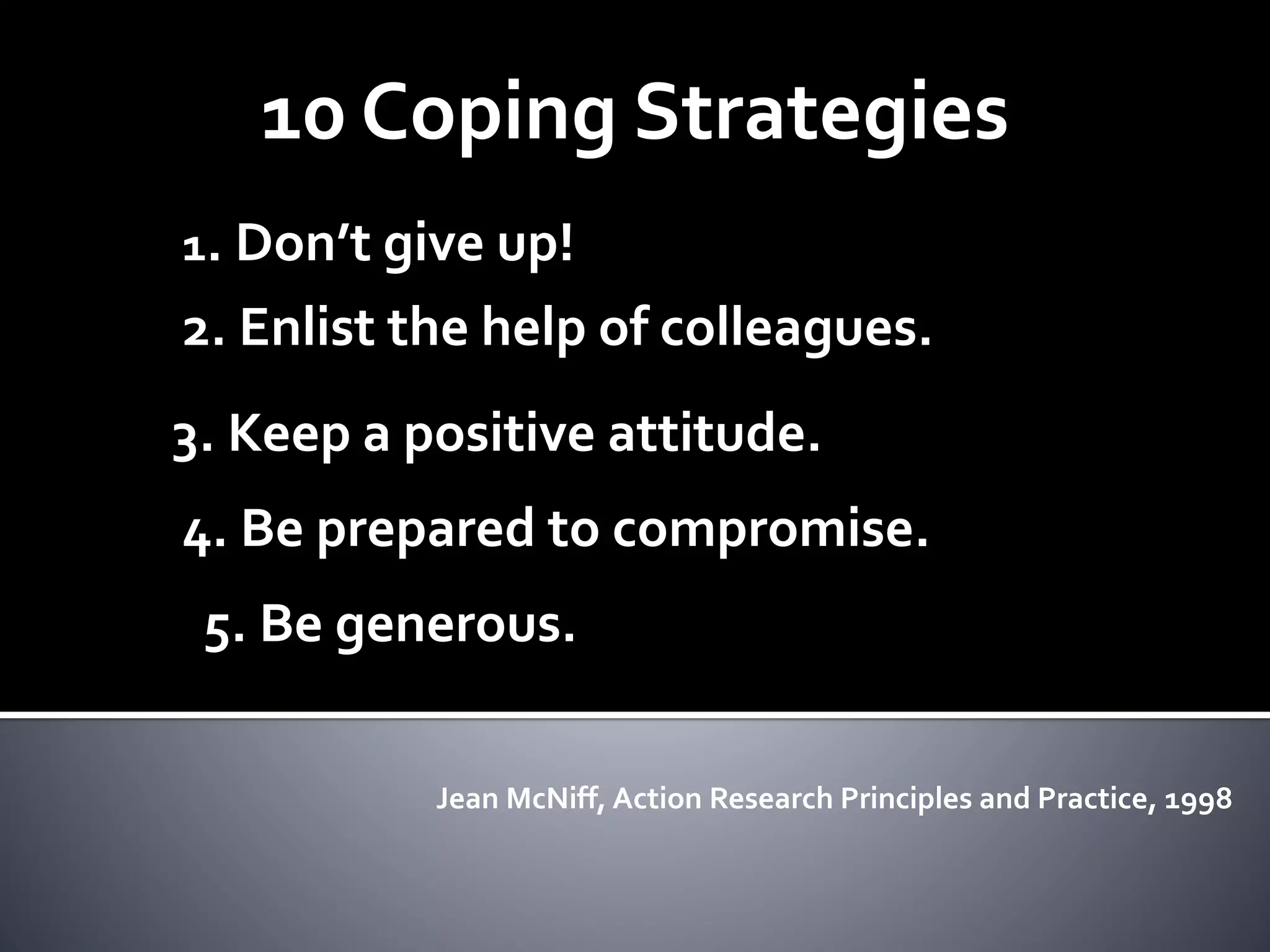
10 Coping Strategies
1. Don’t give up!
2. Enlist the help of colleagues.
3. Keep a positive attitude.
4. Be prepared to compromise.
5. Be generous.
Jean McNiff, Action Research Principles and Practice, 1998
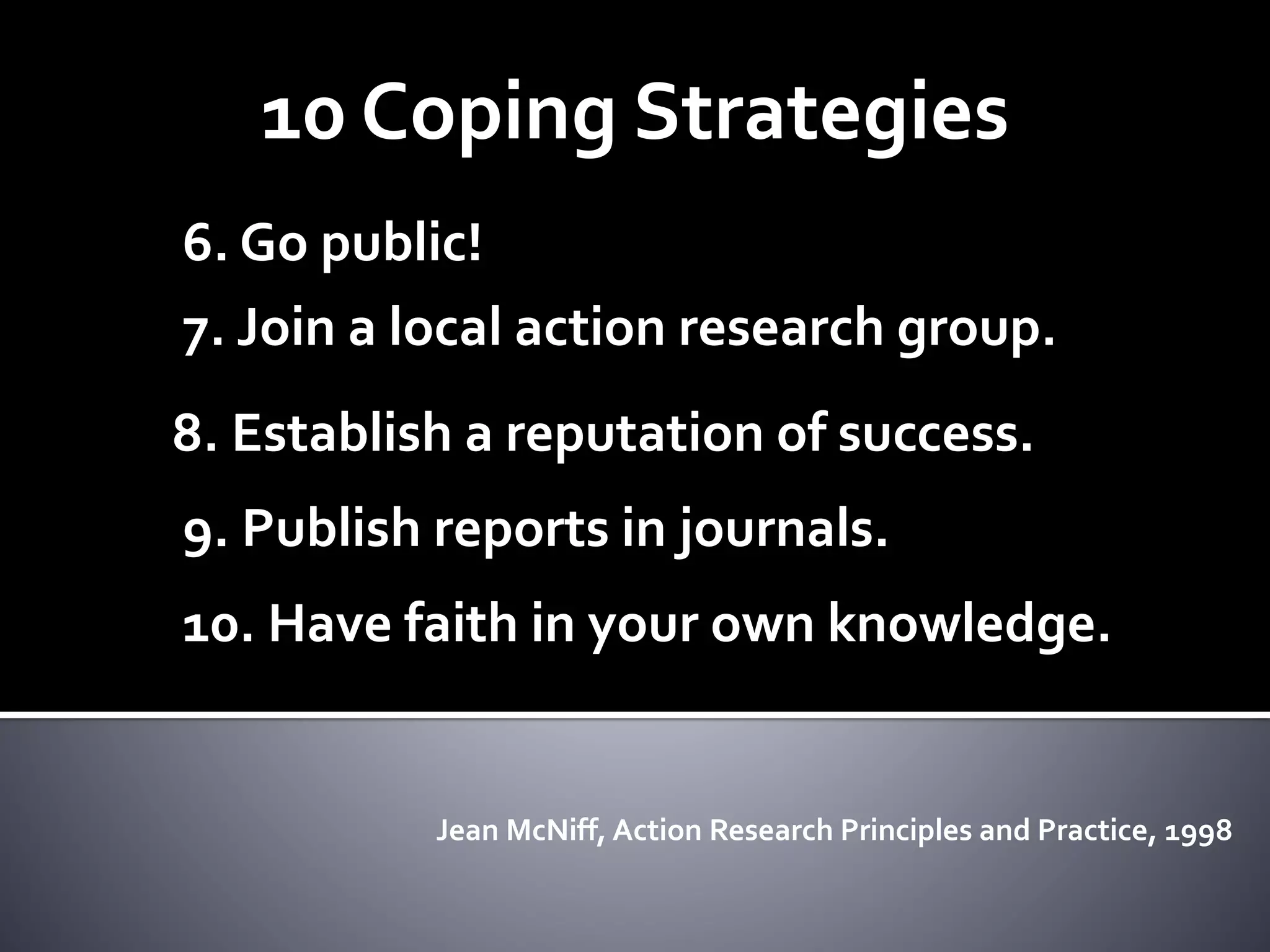
10 Coping Strategies
6. Go public!
7. Join a local action research group.
8. Establish a reputation of success.
9. Publish reports in journals.
10. Have faith in your own knowledge.
Jean McNiff, Action Research Principles and Practice, 1998
Crisanto A. Daing 09285545644 crisdaing@yahoo.com
Crisanto A. Daing Crisanto A. Daing

Building research pdf

  • 1.
    Building the Bigger PictureofTeaching- Research Nexus on Learning Experiences Crisanto A. Daing, Ph.D Associate Dean, College of Arts and Sciences Graduate School Professor Our Lady of Fatima University, Philippines
  • 2.
    ✓Acknowledge the impactof the teaching-research nexus on student learning and teaching practice Intended Learning Outcomes (ILO’s) ✓Differentiate teacher research from action research and classroom research ✓Appreciate the significance of research in improving teaching and learning practices
  • 3.
    How can Iencourage more parental support? How can I make my students enjoy learning? How can I make my classroom more interesting to my students? How can I adapt an already demanding curriculum to better meet the specific needs of my students in the class?
  • 4.
    How can content,strategies, and learning activities be varied to help students? What kind of method works best with certain types of students? How can teachers encourage students to think about important issues? How can subject matter e better presented to promote understanding?
  • 5.
  • 6.
    What is Research? ✓Itis a studious or a diligent search. ✓It is an investigation or experimentation aimed at the interpretation of facts, revision of accepted theories or laws in the light of new facts
  • 7.
    What is ActionResearch? ✓A family of research methodologies which pursue an action (or CHANGE) and research (UNDERSTANDING) at the same time ✓It is an inquiry or research in the context of focused efforts to improve the quality of a PRACTICE.
  • 8.
    What is ActionResearch? ✓It has the potential to generate genuine and sustained improvements in schools. ✓It is an actual research method.
  • 9.
    WHY Action Research? ✓gives educators more opportunities to reflect on and assess their teaching ✓ to explore and test new ideas, methods and materials ✓ assess how effective the new approaches are
  • 10.
    WHY Action Research? ✓to share feedback with fellow team members ✓ to make decisions about which new approaches to include in the practice
  • 11.
    What is aTeacher Research? ✓It is defined byWHO conducts the research ✓Evans et al., (2017) - BuildingTeachers’ Research Literacy: Integrating Practice and Research Teachers need to know, not only, to locate and critically use research evidence but also on how to actively engage in research
  • 12.
    What is aTeacher Research? ✓Evans et al., (2017) - BuildingTeachers’ Research Literacy: Integrating Practice and Research Engage in research with your pupils as an integral part of their practice Research should not be seen as a separate entity but an integral part of being a teacher professional
  • 13.
    What is aTeacher Research? ✓According to Brindley, it is often connected with teacher development and empowerment By investigating the teaching and learning processes in the classroom, we learn more about the craft and the science of teaching so that me may improve our work as teachers.
  • 14.
    What is aClassroom Research? ✓It is defined by the setting or place in which the data are collected. Bridget Long defined classroom research as all or part of whose data are derived from the observation or measurement of the classroom performance of teachers and students.
  • 15.
    What is aClassroom Research? ✓According to Allwright, classroom research concentrates on the inputs to the classroom (the syllabus, teaching materials) or the outputs (learners’ scores, performances, etc.
  • 16.
    Basic Assumptions UnderlyingResearch ✓Those undertaking research must be informed individuals capable of identifying problems that need to be solved. ✓The ones involved must be seriously committed to solving the problems and improving the performance. ✓The participants/respondents must engage in the research systematically.
  • 17.
    Six Positive Influencesof Teacher-Research Builds a knowledge base Learns about research Improves classroom instruction Source: Journal of Curriculum and Instruction, January 2009
  • 18.
    Six Positive Influencesof Teacher-Research Connects with other teachers and colleagues Brings about change Gains new understanding of students Source: Journal of Curriculum and Instruction, January 2009
  • 19.
    Action Research Designs ActionResearch Practical Participatory Studying Local Practices Studying Social Issues
  • 20.
    Action Research Designs PracticalAR Involving Individual orTeam based inquiry Focusing onTeacher Development and Student Learning Implementing a Plan of Action Leading to the teacher as researcher
  • 21.
    The Research Spiral -Mills,2000 Analyze and Interpret Data Collect Data Identify an area of focus Develop an Action Plan
  • 22.
    Action Research Designs ParticipatoryAR Emphasizing equal collaboration Focusing on “life enhancing changes” Resulting in the emancipated researcher
  • 23.
    Key Characteristics ofAction Research A Practical Focus The teacher-researcher’s own practices Collaboration Dynamic Process A Plan of Action Sharing Research
  • 24.
    Practical Focus A problemthat will have immediate benefits for: A single teacher Schools Communities
  • 25.
    Study of theteacher-researcher’s own practices Self- Reflective
  • 26.
  • 27.
    A Dynamic Process Spiralingback and forth among Reflection, Data Collection, and Action
  • 28.
    A Plan ofAction Involves a few individuals or the whole community Presenting data to stakeholders, establishing a pilot program, exploring new practices
  • 29.
    Sharing Research ✓Group ofstakeholders ✓Local Schools, Educational personnel ✓Individuals or groups who can promote change
  • 30.
    Can classroom research, teacher researchand action research fit together?
  • 31.
    The Oral CommunicationTeacher (teacher- researcher) is interested to know why the students in the classroom (classroom research) have difficulties in the correct pronunciation of words in English. Hence, he asks the students, one by one, to read a passage and records common errors in pronunciation (action research).
  • 32.
  • 33.
  • 34.
  • 35.
    Teachers need timeout from the classroom
  • 36.
    Teachers need encouragementand interest from management
  • 37.
    Benefits are: Improved teachingand better student outcomes Improved teacher confidence due to evidence-based teaching
  • 38.
    10 Coping Strategies 1.Don’t give up! 2. Enlist the help of colleagues. 3. Keep a positive attitude. 4. Be prepared to compromise. 5. Be generous. Jean McNiff, Action Research Principles and Practice, 1998
  • 39.
    10 Coping Strategies 6.Go public! 7. Join a local action research group. 8. Establish a reputation of success. 9. Publish reports in journals. 10. Have faith in your own knowledge. Jean McNiff, Action Research Principles and Practice, 1998
  • 40.
    Crisanto A. Daing09285545644 crisdaing@yahoo.com Crisanto A. Daing Crisanto A. Daing