Give examples of how you think
lessons could be criticised for
lacking pace and challenge.
http://www.learningspy.co.uk/english-gcse/b
Pace and Challenge
• To know what is meant by pace and
challenge.
• To understand how to develop challenge
in the lesson.
Objectives
Pace.
• What is pace?
“The pace is just right, no time is wasted and
students move quickly from one learning activity
to another. However there is no sense of rushing
and everybody has enough time to think.”
Grade 1 lesson
Pace
MAINTAINING COGNITIVE PACE
• Slick start to the lesson.
• Brisk well ordered transitions.
• Appropriately timed activities.
• Engaging, concise exposition delivered
with enthusiasm.
Challenge
• Are students extending their existing levels of
knowledge, understanding skills?
• Are they working to capacity?
• Are they thinking for themselves and solving
problems or are they being spoon-fed by the
teacher.
Challenge
“The best conditions for learning exist when
children have a challenge that extends their
cognitive range.”
Challenge
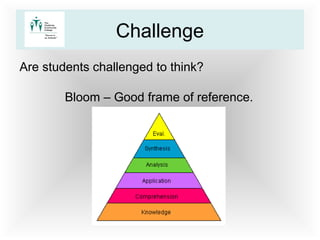
Are students challenged to think?
Bloom – Good frame of reference.
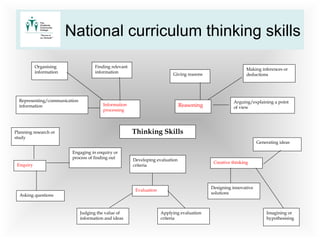
National curriculum thinking skills
Information
processing
Reasoning
Thinking Skills
Enquiry
Creative thinking
Evaluation
Finding relevant
information
Organising
information
Representing/communication
information
Giving reasons
Making inferences or
deductions
Arguing/explaining a point
of view
Planning research or
study
Asking questions
Engaging in enquiry or
process of finding out
Judging the value of
information and ideas
Applying evaluation
criteria
Developing evaluation
criteria
Designing innovative
solutions
Generating ideas
Imagining or
hypothesising
Thinking skills
(National Curriculum)
Cognitive goals
(Bloom)
Key questions
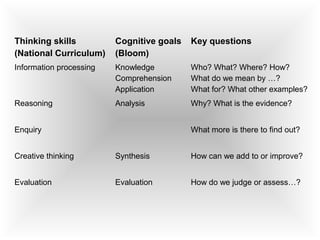
Information processing Knowledge
Comprehension
Application
Who? What? Where? How?
What do we mean by …?
What for? What other examples?
Reasoning Analysis Why? What is the evidence?
Enquiry What more is there to find out?
Creative thinking Synthesis How can we add to or improve?
Evaluation Evaluation How do we judge or assess…?
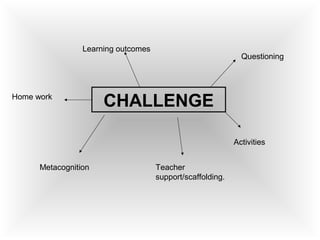
CHALLENGE
Learning outcomes
Questioning
Teacher
support/scaffolding.
Metacognition
Activities
Home work
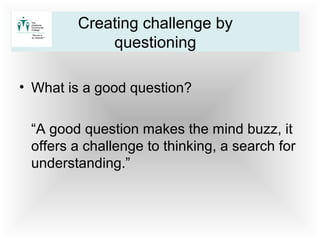
• What is a good question?
“A good question makes the mind buzz, it
offers a challenge to thinking, a search for
understanding.”
Creating challenge by
questioning
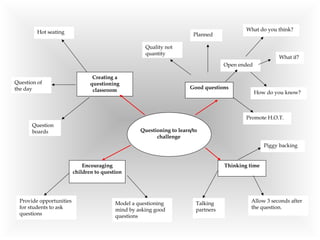
Questioning to learn/to
challenge
Thinking time
Piggy backing
Allow 3 seconds after
the question.
Talking
partners
Good questions
Quality not
quantity
Planned
Open ended
What do you think?
How do you know?
What if?
Promote H.O.T.
Creating a
questioning
classroom
Hot seating
Question of
the day
Question
boards
Encouraging
children to question
Provide opportunities
for students to ask
questions
Model a questioning
mind by asking good
questions
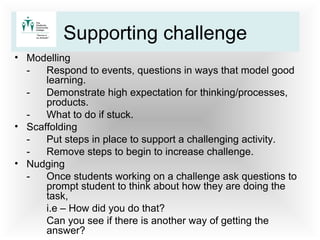
• Modelling
- Respond to events, questions in ways that model good
learning.
- Demonstrate high expectation for thinking/processes,
products.
- What to do if stuck.
• Scaffolding
- Put steps in place to support a challenging activity.
- Remove steps to begin to increase challenge.
• Nudging
- Once students working on a challenge ask questions to
prompt student to think about how they are doing the
task,
i.e – How did you do that?
Can you see if there is another way of getting the
answer?
Supporting challenge
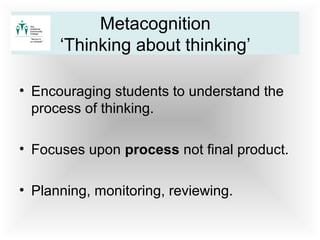
• Encouraging students to understand the
process of thinking.
• Focuses upon process not final product.
• Planning, monitoring, reviewing.
Metacognition
‘Thinking about thinking’
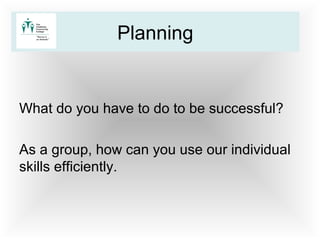
What do you have to do to be successful?
As a group, how can you use our individual
skills efficiently.
Planning
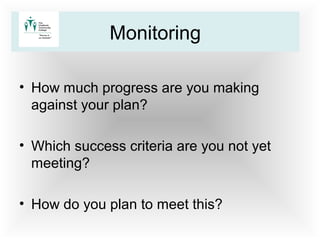
• How much progress are you making
against your plan?
• Which success criteria are you not yet
meeting?
• How do you plan to meet this?
Monitoring
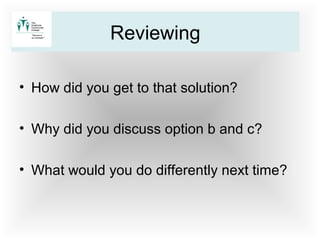
• How did you get to that solution?
• Why did you discuss option b and c?
• What would you do differently next time?
Reviewing
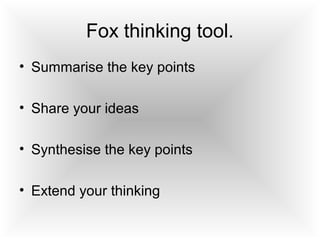
Fox thinking tool.
• Summarise the key points
• Share your ideas
• Synthesise the key points
• Extend your thinking
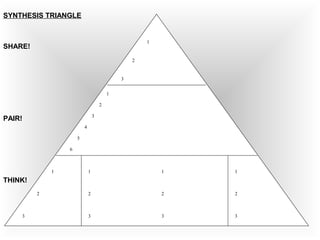
SYNTHESIS TRIANGLE
SHARE!
PAIR!
THINK!
1
2
3
1
2
3
4
5
6
1
2
3
1
2
3
1
2
3
1
2
3
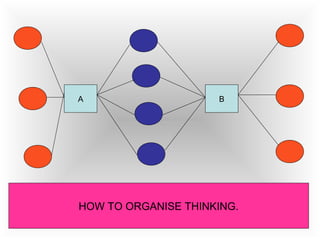
HOW TO ORGANISE THINKING.
A B
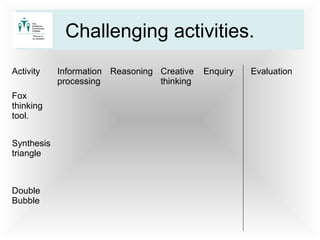
Challenging activities.
Activity Information
processing
Reasoning Creative
thinking
Enquiry Evaluation
Fox
thinking
tool.
Synthesis
triangle
Double
Bubble
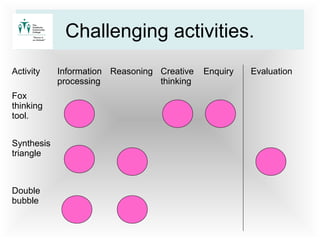
Challenging activities.
Activity Information
processing
Reasoning Creative
thinking
Enquiry Evaluation
Fox
thinking
tool.
Synthesis
triangle
Double
bubble

Pace and challenge

  • 1.
    Give examples ofhow you think lessons could be criticised for lacking pace and challenge. http://www.learningspy.co.uk/english-gcse/b Pace and Challenge
  • 2.
    • To knowwhat is meant by pace and challenge. • To understand how to develop challenge in the lesson. Objectives
  • 3.
    Pace. • What ispace? “The pace is just right, no time is wasted and students move quickly from one learning activity to another. However there is no sense of rushing and everybody has enough time to think.” Grade 1 lesson Pace
  • 4.
    MAINTAINING COGNITIVE PACE •Slick start to the lesson. • Brisk well ordered transitions. • Appropriately timed activities. • Engaging, concise exposition delivered with enthusiasm.
  • 5.
    Challenge • Are studentsextending their existing levels of knowledge, understanding skills? • Are they working to capacity? • Are they thinking for themselves and solving problems or are they being spoon-fed by the teacher. Challenge “The best conditions for learning exist when children have a challenge that extends their cognitive range.”
  • 6.
    Challenge Are students challengedto think? Bloom – Good frame of reference.
  • 7.
    National curriculum thinkingskills Information processing Reasoning Thinking Skills Enquiry Creative thinking Evaluation Finding relevant information Organising information Representing/communication information Giving reasons Making inferences or deductions Arguing/explaining a point of view Planning research or study Asking questions Engaging in enquiry or process of finding out Judging the value of information and ideas Applying evaluation criteria Developing evaluation criteria Designing innovative solutions Generating ideas Imagining or hypothesising
  • 8.
    Thinking skills (National Curriculum) Cognitivegoals (Bloom) Key questions Information processing Knowledge Comprehension Application Who? What? Where? How? What do we mean by …? What for? What other examples? Reasoning Analysis Why? What is the evidence? Enquiry What more is there to find out? Creative thinking Synthesis How can we add to or improve? Evaluation Evaluation How do we judge or assess…?
  • 9.
  • 10.
    • What isa good question? “A good question makes the mind buzz, it offers a challenge to thinking, a search for understanding.” Creating challenge by questioning
  • 11.
    Questioning to learn/to challenge Thinkingtime Piggy backing Allow 3 seconds after the question. Talking partners Good questions Quality not quantity Planned Open ended What do you think? How do you know? What if? Promote H.O.T. Creating a questioning classroom Hot seating Question of the day Question boards Encouraging children to question Provide opportunities for students to ask questions Model a questioning mind by asking good questions
  • 12.
    • Modelling - Respondto events, questions in ways that model good learning. - Demonstrate high expectation for thinking/processes, products. - What to do if stuck. • Scaffolding - Put steps in place to support a challenging activity. - Remove steps to begin to increase challenge. • Nudging - Once students working on a challenge ask questions to prompt student to think about how they are doing the task, i.e – How did you do that? Can you see if there is another way of getting the answer? Supporting challenge
  • 13.
    • Encouraging studentsto understand the process of thinking. • Focuses upon process not final product. • Planning, monitoring, reviewing. Metacognition ‘Thinking about thinking’
  • 14.
    What do youhave to do to be successful? As a group, how can you use our individual skills efficiently. Planning
  • 15.
    • How muchprogress are you making against your plan? • Which success criteria are you not yet meeting? • How do you plan to meet this? Monitoring
  • 16.
    • How didyou get to that solution? • Why did you discuss option b and c? • What would you do differently next time? Reviewing
  • 17.
    Fox thinking tool. •Summarise the key points • Share your ideas • Synthesise the key points • Extend your thinking
  • 18.
  • 19.
    HOW TO ORGANISETHINKING. A B
  • 20.
    Challenging activities. Activity Information processing ReasoningCreative thinking Enquiry Evaluation Fox thinking tool. Synthesis triangle Double Bubble
  • 21.
    Challenging activities. Activity Information processing ReasoningCreative thinking Enquiry Evaluation Fox thinking tool. Synthesis triangle Double bubble

Editor's Notes

  • #4 Link to the next slide. Pace is inherent within a challenging lesson, yet challenge is not inherent within a lesson with lots of pace!
  • #10 Holistic approach. – Need high challenge low threat. Not just simply ample enough to produce challenging activity – also need to create a whole ethos for challenging students – the above illustrates this point. Talk around the model and stress the idea of challenging outcomes – higher order thinking. Then discuss the idea of challenging tasks. Not simple enough to write a challenge – it actually could be very low level thinking. Yet conversely not always right to set a highly challenging activity with no teacher support/ scaffolding as students may simply take the attitude they can not do it so give up – very de motivating. Yet are they simply displaying poor learner behaviours? We need to teach students how to think!!!! And cope with problems/ challenges. – Zone of proximal learning happens just outside of the comfort zone! Now pose the question – How do we challenge students without negative stress? (5 Minutes) Use traffic light cards whilst doing the activity. Talking partners and piggy backing technique to help with debrief.
  • #21 Talk about the above activities. – Demonstrate the fox thinking tool. Then ask staff to map out which level of thinking the task demonstrates.
  • #22 Talk about the above activities. – Demonstrate the fox thinking tool. Then ask staff to map out which level of thinking the task demonstrates.