The view from their desk…

   You have three
    minutes to read
    the section and
    answer the
    questions that
    follow.

   GO!
Activity Experiences

               First
             Thoughts?
             Reactions
                 ?
             Purpose?
Today’s Objectives:
I will be able to:            Agenda:
 Explain the purpose
                               The What, How, &
   and benefits of
   differentiating by           Why of DI by
   readiness.                   readiness
 Identify the literacy
                               Strategies &
   levels of my students.
 Create readiness
                                Application
   groups using student        Your turn! Time to
   literacy levels.             plan a
 Identify and create
                                lesson/assessment
   instructional activities
   that are appropriate for     that uses literacy
   each of your readiness       levels to DI by
   group.
What is Readiness?

               “Current knowledge,
                understanding, and skill level a
                student has related to a particular
                sequence of learning” (Tomlinson &
                Strickland 6).

               Readiness is influenced by a
                student’s prior learning and life
                experiences, attitudes about
                school, and habits of mind
                (Tomlinson 3).

               Readiness, NOT ability!
 For more information and examples, see pages 1-8 in your
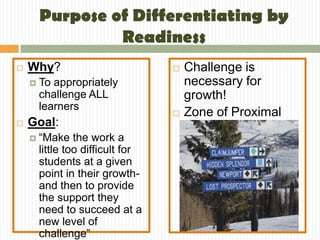
Purpose of Differentiating by
                 Readiness
   Why?                              Challenge is
       To appropriately               necessary for
        challenge ALL                  growth!
        learners
                                      Zone of Proximal
   Goal:                              Development
       “Make the work a
        little too difficult for
        students at a given
        point in their growth-
        and then to provide
        the support they
        need to succeed at a
        new level of
        challenge”
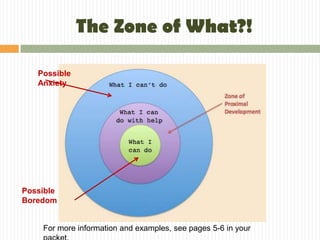
The Zone of What?!

   Possible
   Anxiety


Possible
Boredom


    For more information and examples, see pages 5-6 in your
When we differentiate by readiness,
                     we should consider
           The students’:
           Knowledge, understanding, and skill with
            the topic
           “Attitude (toward school & topic)
           Experience with the topic (outside of school or
            previous courses)
           Preconceptions about the topic
           Overgeneralizations about the topic
           General communication, thinking, & reasoning
            skills”
http://www.foridahoteachers.org/differentiation_framework.htm
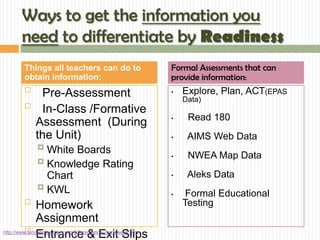
Ways to get the information you
       need to differentiate by Readiness
         Things all teachers can do to                          Formal Assessments that can
         obtain information:                                    provide information:
                                                                   Explore, Plan, ACT(EPAS
              Pre-Assessment                                    •
                                                                    Data)
         
              In-Class /Formative
                                                                •    Read 180
             Assessment (During
             the Unit)                                          •    AIMS Web Data
               White Boards                                    •    NWEA Map Data
               Knowledge Rating
                Chart                                           •    Aleks Data
               KWL
                                                                •    Formal Educational
                                                                   Testing
                Homework
                Assignment
          
                Entrance & Exit Slips
http://www.foridahoteachers.org/differentiation_framework.htm
LT gives those tests…but how do I
              access the scores?
 Infinite Campus (individual students)
 Decision Ed (whole class)

   Same as above, but can access
    spreadsheets of entire classes (we
    know-amazing!)             Wish
          I wish they’d      Granted.
         tell us how to
             find that
           information!
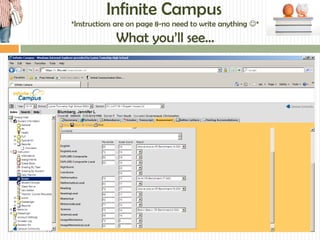
Infinite Campus
*Instructions are on page 8-no need to write anything *
             What you’ll see…
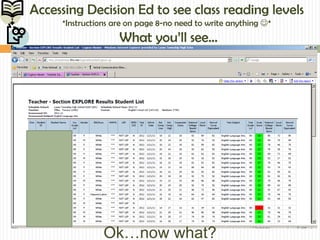
Accessing Decision Ed to see class reading levels
     *Instructions are on page 8-no need to write anything *
                    What you’ll see…


                Ok…now what?
Tiering: A Method of Differentiating
           by Readiness
“Tiering is a                                  To Tier an Assignment:
                                         1) Determine the KUD statement
process of                               2) Identify the readiness ranges
adjusting the                               relative to the KUD goals
                                         3) Create an activity that is
degree of difficulty                        engaging & rigorous
of a question,                           4) Replicate the activity to address
                                            differences in readiness
task, or product to                          • Use similar knowledge &
match a student’s                                skills
                                             • Yields the same
current readiness                                understanding
level.”                                  5) Use assessment data to match
                                            the task to the student
        For more information and examples, see pages 9-32for Readiness Differentiation
                                        Strickland, A Strategy in your
Strickland, A Strategy for Readiness
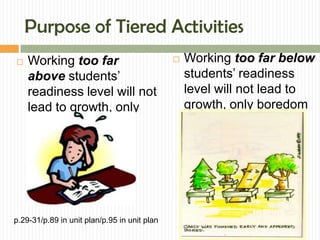
Purpose of Tiered Activities
   Working too far                              Working too far below
    above students’                               students’ readiness
    readiness level will not                      level will not lead to
    lead to growth, only                          growth, only boredom
    frustration


p.29-31/p.89 in unit plan/p.95 in unit plan
Tiering in a Nutshell
The Game
   Everyone wants to play the
   game.
   In order for me to play it,
   the game has to start
   where I am.
   In order to continue playing
   it, the game has to grow as
   fast as I do.
   If that doesn’t happen,
   I won’t play the game.
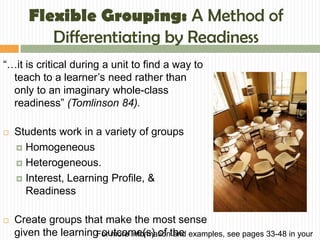
Flexible Grouping: A Method of
          Differentiating by Readiness
“…it is critical during a unit to find a way to
  teach to a learner’s need rather than
  only to an imaginary whole-class
  readiness” (Tomlinson 84).

   Students work in a variety of groups
     Homogeneous

     Heterogeneous.

     Interest, Learning Profile, &
      Readiness

   Create groups that make the most sense
    given the learningFor more informationthe examples, see pages 33-48 in your
                       outcome(s) of and
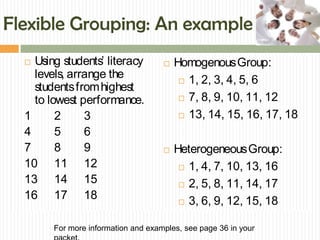
Flexible Grouping: An example
    Flexible Grouping: An Example
   Using students’ literacy                Homogenous Group:
    levels, arrange the                        1, 2, 3, 4, 5, 6
    students from highest
    to lowest performance.                     7, 8, 9, 10, 11, 12

  1      2     3                               13, 14, 15, 16, 17, 18

  4      5     6
  7      8     9                            Heterogeneous Group:
  10 11 12                                     1, 4, 7, 10, 13, 16
  13 14 15                                     2, 5, 8, 11, 14, 17
  16 17 18                                     3, 6, 9, 12, 15, 18
      Example in Handout
            For more information and examples, see page 36 in your
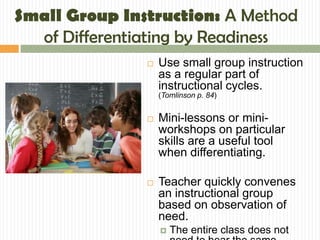
Small Group Instruction: A Method
  of Differentiating by Readiness
                  Use small group instruction
                   as a regular part of
                   instructional cycles.
                   (Tomlinson p. 84)


                  Mini-lessons or mini-
                   workshops on particular
                   skills are a useful tool
                   when differentiating.

                  Teacher quickly convenes
                   an instructional group
                   based on observation of
                   need.
                      The entire class does not
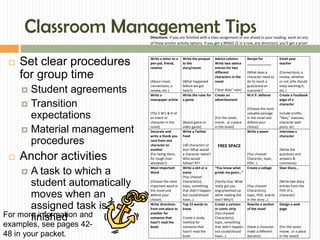
Anchor Activities for literature


     Classroom Management Tips
                               Bingo


                               Directions: If you are finished with a class assignment or are ahead in your reading, work on any
                               of these anchor activity options. If you get a BINGO (5 in a row, any direction), you’ll get a prize!


    Set clear procedures      Write a letter to a
                               pen-pal, friend,
                               relative
                                                     Write the prequel
                                                     to the
                                                     story/novel.
                                                                           Advice column:
                                                                           Write two advice
                                                                           entries for two
                                                                                                 Recipe for
                                                                                                 _____________
                                                                                                                      Email your
                                                                                                                      teacher


     for group time            (About novel,         (What happened
                                                                           different
                                                                           characters in the
                                                                           novel.
                                                                                                 (What does a
                                                                                                 character need to
                                                                                                 do to reach a
                                                                                                                      (Connections, a
                                                                                                                      review, whether
                                                                                                                      or not s/he should
                               connections, a        before we got                               goal/avoid an        keep teaching it,
      Student agreements      review, etc.)
                               Write a
                                                     here?)
                                                     Write the rules for
                                                                           (“Dear Abby” style)
                                                                           Create an
                                                                                                 outcome?
                                                                                                 M.V.P. defense
                                                                                                                      etc.)
                                                                                                                      Create a Facebook
                               newspaper article     a game                advertisement                              page of a
      Transition                                                                                (Choose the most
                                                                                                                      character


       expectations            (The 5 W’s & H of
                               an event or
                               character in the      (Board game or
                                                                           (For the novel,
                                                                           movie, or a place
                                                                                                 valuable passage
                                                                                                 in the novel and
                                                                                                 defend your
                                                                                                                      Include profile,
                                                                                                                      “likes,” statuses,
                                                                                                                      character wall

      Material management
                               novel)                video game)           in the novel)         choice).             posts, etc.
                               Decorate and          Write a Twitter                             Write a poem         Interview a
                               write a thank you     Feed                                                             character
       procedures              card from one
                               character to          140 characters or       FREE SPACE
                               another               less! What would                                                 (Write the

    Anchor activities         (For being there,
                               for tough love-
                               whatever!)
                                                     a character tweet?
                                                     Who would
                                                     follow? RT?
                                                                                                 (You choose!
                                                                                                 Character, topic,
                                                                                                 POV…)
                                                                                                                      questions and
                                                                                                                      answers &
                                                                                                                      comments)
                               Most Important        Write a skit or a     “You know what        Create a collage     Dear Diary…
      A task to which a       Word                  scene
                                                     (You choose!
                                                                           grinds my gears…”


       student automatically   (Choose the most
                               important word in
                                                     Character(s),
                                                     topic, something
                                                                           (Family Guy: What
                                                                           really got you        (You choose!
                                                                                                                      (Write two diary
                                                                                                                      entries from the
                               the novel and         that didn’t happen    angry/worked up       Character(s),        POV of a
       moves when an           defend your
                               choice).
                                                     but could/should
                                                     have…)
                                                                           while reading the
                                                                           text? Why?)
                                                                                                 topic, POV, events
                                                                                                 in the story…)
                                                                                                                      character)


       assigned task is        Write directions
                               from one place to
                                                     Top 15 words to
                                                     know
                                                                           Create a cartoon
                                                                           or comic strip
                                                                                                 Rewrite a section
                                                                                                 of the novel
                                                                                                                      Design a web
                                                                                                                      page
For more information and
       finished
                               another for
                               someone that          Create a study
                                                                           (You choose!
                                                                           Character(s),
                               hasn’t read the       method for            topic, something
examples, see pages 42-        book.                 someone that          that didn’t happen    (Have a character    (For the novel,
                                                     hasn’t read the       but could/should      make a different     movie, or a place
48 in your packet.                                   book                  have…)                decision)            in the novel)
But how can I give (& assess)
             different assignments?
 Focus on the KUD no matter what
  level the activity is designed at!
 Teacher observations, checklists,

  rubrics can all be based on a scale
  from 1-4
 To what extent do the students
  demonstrate that they…
    For more information and examples, see pages 59-62 in your
    packet.
It’s your turn!
Imagine that you’ve placed your “students” into three
           groups based on literacy levels.
1. Create a KUD for a unit/lesson/activity that your
  team teaches
      OR
  Use the KUD that you created with your team
  earlier today!
2. Use the graphic organizer to plan a lesson based
  on your KUD. WHAT WILL EACH GROUP DO?!
3. Insider note: TYPICALLY, the KUD has to be the
  same…
    BUT with readiness, the U stays the same,
Today’s Objectives:

       I will be able to:
        Explain the purpose and benefits of
         differentiating by readiness.
        Identify the literacy levels of my

         students.
        Create readiness groups using
         student literacy levels.
        Identify and create instructional
         activities that are appropriate for
         each of your readiness group.
I get it! I’m excited! (Now what?)

  Realistic goals
  Ask reading specialists in the building
   for help!
      (There   is a list in your packet on page
      49).
   Use resources for leveled readings
    (lexile.com)
  Try something out!
For more information and examples, see pages 49-62 & the
         full unit plan at the end of your packet.
References:
Ford, M.P. (2005). Differentation Through Flexible Grouping: Successfully Reaching All Readers. Learning
  Point Associates: Naperville, Illinois.
Strickland, C.A. (2011). Differentiation of instruction at the high school level. ASCD: Alexandria,
  Virginia.

Tomlinson, C.A. & Strickland, C. A. (2005). Differentiation in practice: A resource guide for differentiating
  curriculum – Grades 9-12. ASCD: Alexandria, Virginia.

(2007). Tools for high quality: Differentiated instruction. ASCD, 12.
(2012). LTHS professional learning communities glossary. LTHS: LaGrange, IL.
http://www.act.org/standard/planact/reading/index.html
http://www.derry.k12.nh.us/dvs/staff/cmccallum/differentiation/tiered.pdf
http://www.foridahoteachers.org/differentiation_framework.htm
http://www.lexile.com/analyzer
                                                           Thank you for

Using literacy levels to differentiate by readiness final edit

  • 2.
    The view fromtheir desk…  You have three minutes to read the section and answer the questions that follow.  GO!
  • 3.
    Activity Experiences First Thoughts? Reactions ? Purpose?
  • 4.
    Today’s Objectives: I willbe able to: Agenda:  Explain the purpose  The What, How, & and benefits of differentiating by Why of DI by readiness. readiness  Identify the literacy  Strategies & levels of my students.  Create readiness Application groups using student  Your turn! Time to literacy levels. plan a  Identify and create lesson/assessment instructional activities that are appropriate for that uses literacy each of your readiness levels to DI by group.
  • 5.
    What is Readiness?  “Current knowledge, understanding, and skill level a student has related to a particular sequence of learning” (Tomlinson & Strickland 6).  Readiness is influenced by a student’s prior learning and life experiences, attitudes about school, and habits of mind (Tomlinson 3).  Readiness, NOT ability! For more information and examples, see pages 1-8 in your
  • 6.
    Purpose of Differentiatingby Readiness  Why?  Challenge is  To appropriately necessary for challenge ALL growth! learners  Zone of Proximal  Goal: Development  “Make the work a little too difficult for students at a given point in their growth- and then to provide the support they need to succeed at a new level of challenge”
  • 7.
    The Zone ofWhat?! Possible Anxiety Possible Boredom For more information and examples, see pages 5-6 in your
  • 8.
    When we differentiateby readiness, we should consider The students’: Knowledge, understanding, and skill with the topic “Attitude (toward school & topic) Experience with the topic (outside of school or previous courses) Preconceptions about the topic Overgeneralizations about the topic General communication, thinking, & reasoning skills” http://www.foridahoteachers.org/differentiation_framework.htm
  • 9.
    Ways to getthe information you need to differentiate by Readiness Things all teachers can do to Formal Assessments that can obtain information: provide information:  Explore, Plan, ACT(EPAS Pre-Assessment • Data)  In-Class /Formative • Read 180 Assessment (During the Unit) • AIMS Web Data  White Boards • NWEA Map Data  Knowledge Rating Chart • Aleks Data  KWL • Formal Educational  Testing Homework Assignment  Entrance & Exit Slips http://www.foridahoteachers.org/differentiation_framework.htm
  • 10.
    LT gives thosetests…but how do I access the scores?  Infinite Campus (individual students)  Decision Ed (whole class)  Same as above, but can access spreadsheets of entire classes (we know-amazing!) Wish I wish they’d Granted. tell us how to find that information!
  • 11.
    Infinite Campus *Instructions areon page 8-no need to write anything * What you’ll see…
  • 12.
    Accessing Decision Edto see class reading levels *Instructions are on page 8-no need to write anything * What you’ll see… Ok…now what?
  • 13.
    Tiering: A Methodof Differentiating by Readiness “Tiering is a To Tier an Assignment: 1) Determine the KUD statement process of 2) Identify the readiness ranges adjusting the relative to the KUD goals 3) Create an activity that is degree of difficulty engaging & rigorous of a question, 4) Replicate the activity to address differences in readiness task, or product to • Use similar knowledge & match a student’s skills • Yields the same current readiness understanding level.” 5) Use assessment data to match the task to the student For more information and examples, see pages 9-32for Readiness Differentiation Strickland, A Strategy in your Strickland, A Strategy for Readiness
  • 14.
    Purpose of TieredActivities  Working too far  Working too far below above students’ students’ readiness readiness level will not level will not lead to lead to growth, only growth, only boredom frustration p.29-31/p.89 in unit plan/p.95 in unit plan
  • 15.
    Tiering in aNutshell The Game Everyone wants to play the game. In order for me to play it, the game has to start where I am. In order to continue playing it, the game has to grow as fast as I do. If that doesn’t happen, I won’t play the game.
  • 16.
    Flexible Grouping: AMethod of Differentiating by Readiness “…it is critical during a unit to find a way to teach to a learner’s need rather than only to an imaginary whole-class readiness” (Tomlinson 84).  Students work in a variety of groups  Homogeneous  Heterogeneous.  Interest, Learning Profile, & Readiness  Create groups that make the most sense given the learningFor more informationthe examples, see pages 33-48 in your outcome(s) of and
  • 17.
    Flexible Grouping: Anexample Flexible Grouping: An Example  Using students’ literacy  Homogenous Group: levels, arrange the  1, 2, 3, 4, 5, 6 students from highest to lowest performance.  7, 8, 9, 10, 11, 12 1 2 3  13, 14, 15, 16, 17, 18 4 5 6 7 8 9  Heterogeneous Group: 10 11 12  1, 4, 7, 10, 13, 16 13 14 15  2, 5, 8, 11, 14, 17 16 17 18  3, 6, 9, 12, 15, 18 Example in Handout For more information and examples, see page 36 in your
  • 18.
    Small Group Instruction:A Method of Differentiating by Readiness  Use small group instruction as a regular part of instructional cycles. (Tomlinson p. 84)  Mini-lessons or mini- workshops on particular skills are a useful tool when differentiating.  Teacher quickly convenes an instructional group based on observation of need.  The entire class does not
  • 19.
    Anchor Activities forliterature Classroom Management Tips Bingo Directions: If you are finished with a class assignment or are ahead in your reading, work on any of these anchor activity options. If you get a BINGO (5 in a row, any direction), you’ll get a prize!  Set clear procedures Write a letter to a pen-pal, friend, relative Write the prequel to the story/novel. Advice column: Write two advice entries for two Recipe for _____________ Email your teacher for group time (About novel, (What happened different characters in the novel. (What does a character need to do to reach a (Connections, a review, whether or not s/he should connections, a before we got goal/avoid an keep teaching it,  Student agreements review, etc.) Write a here?) Write the rules for (“Dear Abby” style) Create an outcome? M.V.P. defense etc.) Create a Facebook newspaper article a game advertisement page of a  Transition (Choose the most character expectations (The 5 W’s & H of an event or character in the (Board game or (For the novel, movie, or a place valuable passage in the novel and defend your Include profile, “likes,” statuses, character wall  Material management novel) video game) in the novel) choice). posts, etc. Decorate and Write a Twitter Write a poem Interview a write a thank you Feed character procedures card from one character to 140 characters or FREE SPACE another less! What would (Write the  Anchor activities (For being there, for tough love- whatever!) a character tweet? Who would follow? RT? (You choose! Character, topic, POV…) questions and answers & comments) Most Important Write a skit or a “You know what Create a collage Dear Diary…  A task to which a Word scene (You choose! grinds my gears…” student automatically (Choose the most important word in Character(s), topic, something (Family Guy: What really got you (You choose! (Write two diary entries from the the novel and that didn’t happen angry/worked up Character(s), POV of a moves when an defend your choice). but could/should have…) while reading the text? Why?) topic, POV, events in the story…) character) assigned task is Write directions from one place to Top 15 words to know Create a cartoon or comic strip Rewrite a section of the novel Design a web page For more information and finished another for someone that Create a study (You choose! Character(s), hasn’t read the method for topic, something examples, see pages 42- book. someone that that didn’t happen (Have a character (For the novel, hasn’t read the but could/should make a different movie, or a place 48 in your packet. book have…) decision) in the novel)
  • 20.
    But how canI give (& assess) different assignments?  Focus on the KUD no matter what level the activity is designed at!  Teacher observations, checklists, rubrics can all be based on a scale from 1-4  To what extent do the students demonstrate that they… For more information and examples, see pages 59-62 in your packet.
  • 21.
    It’s your turn! Imaginethat you’ve placed your “students” into three groups based on literacy levels. 1. Create a KUD for a unit/lesson/activity that your team teaches  OR Use the KUD that you created with your team earlier today! 2. Use the graphic organizer to plan a lesson based on your KUD. WHAT WILL EACH GROUP DO?! 3. Insider note: TYPICALLY, the KUD has to be the same…  BUT with readiness, the U stays the same,
  • 22.
    Today’s Objectives: I will be able to:  Explain the purpose and benefits of differentiating by readiness.  Identify the literacy levels of my students.  Create readiness groups using student literacy levels.  Identify and create instructional activities that are appropriate for each of your readiness group.
  • 23.
    I get it!I’m excited! (Now what?)  Realistic goals  Ask reading specialists in the building for help!  (There is a list in your packet on page 49).  Use resources for leveled readings (lexile.com)  Try something out! For more information and examples, see pages 49-62 & the full unit plan at the end of your packet.
  • 24.
    References: Ford, M.P. (2005).Differentation Through Flexible Grouping: Successfully Reaching All Readers. Learning Point Associates: Naperville, Illinois. Strickland, C.A. (2011). Differentiation of instruction at the high school level. ASCD: Alexandria, Virginia. Tomlinson, C.A. & Strickland, C. A. (2005). Differentiation in practice: A resource guide for differentiating curriculum – Grades 9-12. ASCD: Alexandria, Virginia. (2007). Tools for high quality: Differentiated instruction. ASCD, 12. (2012). LTHS professional learning communities glossary. LTHS: LaGrange, IL. http://www.act.org/standard/planact/reading/index.html http://www.derry.k12.nh.us/dvs/staff/cmccallum/differentiation/tiered.pdf http://www.foridahoteachers.org/differentiation_framework.htm http://www.lexile.com/analyzer Thank you for

Editor's Notes

  • #3 A list of procedures and steps, or a lecture slide with media.
  • #6 Introductory notes.