




Research Methodology Research Writing WTUC Dec. 2006 Research Methodology Research Writing WTUC Dec. 2006
Purpose The method section answers these two main questions: 1. How was the data collected or generated? 2. How was it analyzed? In other words, it shows your reader how you obtained your results. But why do you need to explain how you obtained your results? http://www.clet.ait.ac.th/el21meth.htm
Point 1 We need to know how the data was obtained because the method affects the results.  For instance, if you are investigating users' perceptions of the efficiency of public transport in Bangkok, you will obtain different results if you use a multiple choice questionnaire than if you conduct interviews.  Knowing how the data was collected helps the reader evaluate the validity and reliability of your results, and the conclusions you draw from them. http://www.clet.ait.ac.th/el21meth.htm
Point 2 Often there are different methods that we can use to investigate a research problem. Your methodology should make clear the reasons why you chose a particular method or procedure.
Point 3 The reader wants to know that the data was collected or generated in a way that is consistent with accepted practice in the field of study.  For example, if you are using a questionnaire, readers need to know that it offered your respondents a reasonable range of answers to choose from (asking if the efficiency of public transport in Bangkok is "a. excellent, b. very good or c. good" would obviously not be acceptable as it does not allow respondents to give negative answers).
Point 4 The research methods must be appropriate to the objectives of the study. If you perform a case study of one commuter in order to investigate users' perceptions of the efficiency of public transport in Bangkok, your method is obviously unsuited to your objectives.
Point 5 The methodology should also discuss the problems that were anticipated and explain the steps taken to prevent them from occurring, and the problems that did occur and the ways their impact was minimized.
Point 6 In some cases, it is useful for other researchers to adapt or replicate your methodology, so often sufficient information is given to allow others to use the work. This is particularly the case when a new method had been developed, or an innovative adaptation used.
Common Problems irrelevant detail   unnecessary explanation of basic procedures problem blindness http://www.clet.ait.ac.th/el21meth.htm#problems
Irrelevant detail and unnecessary info Remember that you are not writing a how-to guide for beginners. Your readers will be people who have a level of expertise in your field and you can assume that they are familiar with basic assessments etc, so do not explain these in detail.
Problem Blindness Most of us encounter some problems when collecting or generating our data. Do not ignore significant problems or pretend they did not occur. Often, recording how you overcame obstacles can form an interesting part of the methodology, and means you can also give a rationale for certain decisions, plus a realistic view of using the methods you chose.
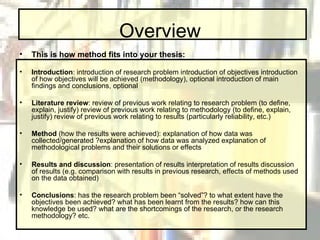
Overview This is how method fits into your thesis: Introduction : introduction of research problem introduction of objectives introduction of how objectives will be achieved (methodology), optional introduction of main findings and conclusions, optional  Literature review : review of previous work relating to research problem (to define, explain, justify) review of previous work relating to methodology (to define, explain, justify) review of previous work relating to results (particularly reliability, etc.)  Method  (how the results were achieved): explanation of how data was collected/generated ?explanation of how data was analyzed explanation of methodological problems and their solutions or effects  Results and discussion : presentation of results interpretation of results discussion of results (e.g. comparison with results in previous research, effects of methods used on the data obtained) Conclusions : has the research problem been “solved”? to what extent have the objectives been achieved? what has been learnt from the results? how can this knowledge be used? what are the shortcomings of the research, or the research methodology? etc.
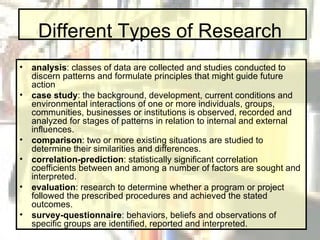
Different Types of Research analysis : classes of data are collected and studies conducted to discern patterns and formulate principles that might guide future action  case study : the background, development, current conditions and environmental interactions of one or more individuals, groups, communities, businesses or institutions is observed, recorded and analyzed for stages of patterns in relation to internal and external influences.  comparison : two or more existing situations are studied to determine their similarities and differences.  correlation-prediction : statistically significant correlation coefficients between and among a number of factors are sought and interpreted.  evaluation : research to determine whether a program or project followed the prescribed procedures and achieved the stated outcomes.  survey-questionnaire : behaviors, beliefs and observations of specific groups are identified, reported and interpreted.
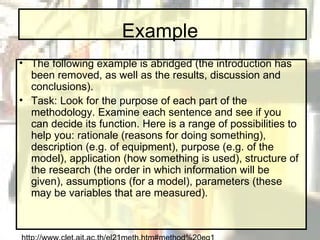
Example The following example is abridged (the introduction has been removed, as well as the results, discussion and conclusions). Task: Look for the purpose of each part of the methodology. Examine each sentence and see if you can decide its function. Here is a range of possibilities to help you: rationale (reasons for doing something), description (e.g. of equipment), purpose (e.g. of the model), application (how something is used), structure of the research (the order in which information will be given), assumptions (for a model), parameters (these may be variables that are measured). http://www.clet.ait.ac.th/el21meth.htm#method%20eg1
Sample 1: Description of Context The Current Study The study was conducted to further investigate PRC EFL learners’ metacognitive knowledge of reading strategy use at two universities in a northwestern city of about 2.5 million people in the PRC,where the majority of the EFL learners were studying in an input-poor environment in order to satisfy the Foreign Language Requirements for graduation (Cortazzi & Jin, 1996). English was a compulsory subject for the first two years in their four year programme in the universities with an average of four hours of classroom exposure per week. At the end of the first year, the freshmen had to sit the CET (College English Test) Band II to qualify for the next year. The test was a graded proficiency test of university students’ achievement as well as their proficiency in EFL. Failure would result in their access to higher levels being denied. The test comprised listening comprehension, reading comprehension, grammar and vocabulary, cloze, and guided writing. Its format is very similar to that of the TOEFL. Because of testing effects, the standard curriculum was set within this parameter: inten- http://www.multilingual-matters.net/la/010/0268/la0100268.pdf
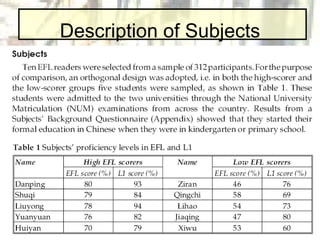
Description of Subjects
Description of Subjects and Context
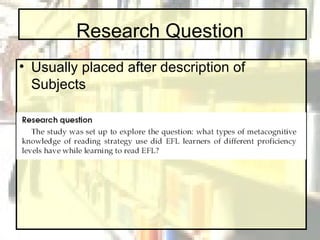
Research Question Usually placed after description of Subjects
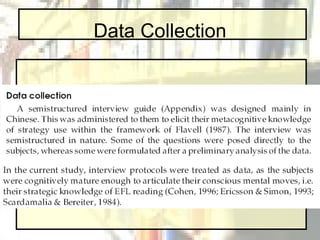
Data Collection
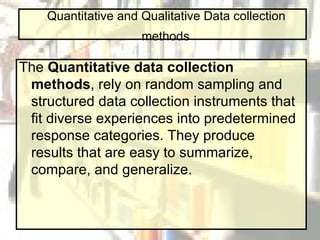
Quantitative and Qualitative Data collection  methods   The  Quantitative data collection methods , rely on random sampling and structured data collection instruments that fit diverse experiences into predetermined response categories. They produce results that are easy to summarize, compare, and generalize. 
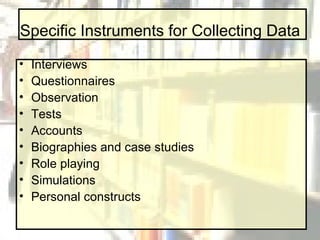
Specific Instruments for Collecting Data Interviews Questionnaires Observation Tests Accounts Biographies and case studies Role playing Simulations Personal constructs
Kinds of research to undertake The data to be collected and the instruments to be used depend on which kind of research to undertake: A survey An experiment An in-depth ethnography Action research Case study research Testing and assessment
Quantitative Research Quantitative research  is the systematic  scientific  investigation of  quantitative  properties and phenomena and their relationships.  The objective of quantitative research is to develop and employ mathematical models, theories and hypotheses pertaining to natural phenomena.  The process of  measurement  is central to quantitative research because it provides the fundamental connection between empirical observation and mathematical expression of quantitative relationships. http://en.wikipedia.org/wiki/Quantitative_research
Qualitative Research Qualitative research  is one of the two major approaches to research methodology in social sciences. Qualitative research involves an indepth understanding of human behaviour and the reasons that govern human behaviour. Unlike  quantitative research , qualitative research relies on reasons behind various aspects of behaviour. Simply put, it investigates the  why  and  how  of decision making, as compared to  what ,  where , and  when  of quantitative research. Hence, the need is for smaller but focused samples rather than large and random samples. http://en.wikipedia.org/wiki/Qualitative_research
Qualitative research studies rely on three basic data gathering techniques:  participant observation ,  interview , and  social artifact  (usually, documents)  content analysis . [3]  Each of these techniques represents a continuum of from less to more structured. [4]  Various studies or particular techniques may rely more heavily on one data gathering technique or another.
Qualitative data collection methods  play an important role in impact evaluation by providing information useful to understand the processes behind observed results and assess changes in people’s perceptions of their well-being. Furthermore qualitative methods can be used to improve the quality of survey-based quantitative evaluations by helping generate evaluation hypothesis; strengthening the design of survey questionnaires and expanding or clarifying quantitative evaluation findings.  http://www.uwec.edu/piercech/ResearchMethods/Data%20collection%20methods/DATA%20COLLECTION%20METHODS.htm
These methods are characterized by the following attributes: they tend to be open-ended and have less structured protocols (i.e., researchers may change the data collection strategy by adding, refining, or dropping techniques or informants)  they rely more heavily on interactive interviews; respondents may be interviewed several times to follow up on a particular issue, clarify concepts or check the reliability of data  they use triangulation to increase the credibility of their findings (i.e., researchers rely on multiple data collection methods to check the authenticity of their results)  generally their findings are not generalizable to any specific population, rather each case study produces a single piece of evidence that can be used to seek general patterns among different studies of the same issue
Regardless of the kinds of data involved, data collection in a qualitative study takes a great deal of time. The researcher needs to record any potentially useful data thoroughly, accurately, and systematically, using field notes, sketches, audiotapes, photographs and other suitable means. The data collection methods must observe the ethical principles of research.  The qualitative methods most commonly used in evaluation can be classified in three broad categories:   in-depth interview  observation methods  document review
end

Research Writing Methodology

  • 1.
    Research Methodology ResearchWriting WTUC Dec. 2006 Research Methodology Research Writing WTUC Dec. 2006
  • 2.
    Purpose The methodsection answers these two main questions: 1. How was the data collected or generated? 2. How was it analyzed? In other words, it shows your reader how you obtained your results. But why do you need to explain how you obtained your results? http://www.clet.ait.ac.th/el21meth.htm
  • 3.
    Point 1 Weneed to know how the data was obtained because the method affects the results. For instance, if you are investigating users' perceptions of the efficiency of public transport in Bangkok, you will obtain different results if you use a multiple choice questionnaire than if you conduct interviews. Knowing how the data was collected helps the reader evaluate the validity and reliability of your results, and the conclusions you draw from them. http://www.clet.ait.ac.th/el21meth.htm
  • 4.
    Point 2 Oftenthere are different methods that we can use to investigate a research problem. Your methodology should make clear the reasons why you chose a particular method or procedure.
  • 5.
    Point 3 Thereader wants to know that the data was collected or generated in a way that is consistent with accepted practice in the field of study. For example, if you are using a questionnaire, readers need to know that it offered your respondents a reasonable range of answers to choose from (asking if the efficiency of public transport in Bangkok is "a. excellent, b. very good or c. good" would obviously not be acceptable as it does not allow respondents to give negative answers).
  • 6.
    Point 4 Theresearch methods must be appropriate to the objectives of the study. If you perform a case study of one commuter in order to investigate users' perceptions of the efficiency of public transport in Bangkok, your method is obviously unsuited to your objectives.
  • 7.
    Point 5 Themethodology should also discuss the problems that were anticipated and explain the steps taken to prevent them from occurring, and the problems that did occur and the ways their impact was minimized.
  • 8.
    Point 6 Insome cases, it is useful for other researchers to adapt or replicate your methodology, so often sufficient information is given to allow others to use the work. This is particularly the case when a new method had been developed, or an innovative adaptation used.
  • 9.
    Common Problems irrelevantdetail unnecessary explanation of basic procedures problem blindness http://www.clet.ait.ac.th/el21meth.htm#problems
  • 10.
    Irrelevant detail andunnecessary info Remember that you are not writing a how-to guide for beginners. Your readers will be people who have a level of expertise in your field and you can assume that they are familiar with basic assessments etc, so do not explain these in detail.
  • 11.
    Problem Blindness Mostof us encounter some problems when collecting or generating our data. Do not ignore significant problems or pretend they did not occur. Often, recording how you overcame obstacles can form an interesting part of the methodology, and means you can also give a rationale for certain decisions, plus a realistic view of using the methods you chose.
  • 12.
    Overview This ishow method fits into your thesis: Introduction : introduction of research problem introduction of objectives introduction of how objectives will be achieved (methodology), optional introduction of main findings and conclusions, optional Literature review : review of previous work relating to research problem (to define, explain, justify) review of previous work relating to methodology (to define, explain, justify) review of previous work relating to results (particularly reliability, etc.) Method (how the results were achieved): explanation of how data was collected/generated ?explanation of how data was analyzed explanation of methodological problems and their solutions or effects Results and discussion : presentation of results interpretation of results discussion of results (e.g. comparison with results in previous research, effects of methods used on the data obtained) Conclusions : has the research problem been “solved”? to what extent have the objectives been achieved? what has been learnt from the results? how can this knowledge be used? what are the shortcomings of the research, or the research methodology? etc.
  • 13.
    Different Types ofResearch analysis : classes of data are collected and studies conducted to discern patterns and formulate principles that might guide future action case study : the background, development, current conditions and environmental interactions of one or more individuals, groups, communities, businesses or institutions is observed, recorded and analyzed for stages of patterns in relation to internal and external influences. comparison : two or more existing situations are studied to determine their similarities and differences. correlation-prediction : statistically significant correlation coefficients between and among a number of factors are sought and interpreted. evaluation : research to determine whether a program or project followed the prescribed procedures and achieved the stated outcomes. survey-questionnaire : behaviors, beliefs and observations of specific groups are identified, reported and interpreted.
  • 14.
    Example The followingexample is abridged (the introduction has been removed, as well as the results, discussion and conclusions). Task: Look for the purpose of each part of the methodology. Examine each sentence and see if you can decide its function. Here is a range of possibilities to help you: rationale (reasons for doing something), description (e.g. of equipment), purpose (e.g. of the model), application (how something is used), structure of the research (the order in which information will be given), assumptions (for a model), parameters (these may be variables that are measured). http://www.clet.ait.ac.th/el21meth.htm#method%20eg1
  • 15.
    Sample 1: Descriptionof Context The Current Study The study was conducted to further investigate PRC EFL learners’ metacognitive knowledge of reading strategy use at two universities in a northwestern city of about 2.5 million people in the PRC,where the majority of the EFL learners were studying in an input-poor environment in order to satisfy the Foreign Language Requirements for graduation (Cortazzi & Jin, 1996). English was a compulsory subject for the first two years in their four year programme in the universities with an average of four hours of classroom exposure per week. At the end of the first year, the freshmen had to sit the CET (College English Test) Band II to qualify for the next year. The test was a graded proficiency test of university students’ achievement as well as their proficiency in EFL. Failure would result in their access to higher levels being denied. The test comprised listening comprehension, reading comprehension, grammar and vocabulary, cloze, and guided writing. Its format is very similar to that of the TOEFL. Because of testing effects, the standard curriculum was set within this parameter: inten- http://www.multilingual-matters.net/la/010/0268/la0100268.pdf
  • 16.
  • 17.
  • 18.
    Research Question Usuallyplaced after description of Subjects
  • 19.
  • 20.
    Quantitative and QualitativeData collection methods The Quantitative data collection methods , rely on random sampling and structured data collection instruments that fit diverse experiences into predetermined response categories. They produce results that are easy to summarize, compare, and generalize. 
  • 21.
    Specific Instruments forCollecting Data Interviews Questionnaires Observation Tests Accounts Biographies and case studies Role playing Simulations Personal constructs
  • 22.
    Kinds of researchto undertake The data to be collected and the instruments to be used depend on which kind of research to undertake: A survey An experiment An in-depth ethnography Action research Case study research Testing and assessment
  • 23.
    Quantitative Research Quantitativeresearch is the systematic scientific investigation of quantitative properties and phenomena and their relationships. The objective of quantitative research is to develop and employ mathematical models, theories and hypotheses pertaining to natural phenomena. The process of measurement is central to quantitative research because it provides the fundamental connection between empirical observation and mathematical expression of quantitative relationships. http://en.wikipedia.org/wiki/Quantitative_research
  • 24.
    Qualitative Research Qualitativeresearch is one of the two major approaches to research methodology in social sciences. Qualitative research involves an indepth understanding of human behaviour and the reasons that govern human behaviour. Unlike quantitative research , qualitative research relies on reasons behind various aspects of behaviour. Simply put, it investigates the why and how of decision making, as compared to what , where , and when of quantitative research. Hence, the need is for smaller but focused samples rather than large and random samples. http://en.wikipedia.org/wiki/Qualitative_research
  • 25.
    Qualitative research studiesrely on three basic data gathering techniques: participant observation , interview , and social artifact (usually, documents) content analysis . [3] Each of these techniques represents a continuum of from less to more structured. [4] Various studies or particular techniques may rely more heavily on one data gathering technique or another.
  • 26.
    Qualitative data collectionmethods play an important role in impact evaluation by providing information useful to understand the processes behind observed results and assess changes in people’s perceptions of their well-being. Furthermore qualitative methods can be used to improve the quality of survey-based quantitative evaluations by helping generate evaluation hypothesis; strengthening the design of survey questionnaires and expanding or clarifying quantitative evaluation findings. http://www.uwec.edu/piercech/ResearchMethods/Data%20collection%20methods/DATA%20COLLECTION%20METHODS.htm
  • 27.
    These methods arecharacterized by the following attributes: they tend to be open-ended and have less structured protocols (i.e., researchers may change the data collection strategy by adding, refining, or dropping techniques or informants) they rely more heavily on interactive interviews; respondents may be interviewed several times to follow up on a particular issue, clarify concepts or check the reliability of data they use triangulation to increase the credibility of their findings (i.e., researchers rely on multiple data collection methods to check the authenticity of their results) generally their findings are not generalizable to any specific population, rather each case study produces a single piece of evidence that can be used to seek general patterns among different studies of the same issue
  • 28.
    Regardless of thekinds of data involved, data collection in a qualitative study takes a great deal of time. The researcher needs to record any potentially useful data thoroughly, accurately, and systematically, using field notes, sketches, audiotapes, photographs and other suitable means. The data collection methods must observe the ethical principles of research. The qualitative methods most commonly used in evaluation can be classified in three broad categories:  in-depth interview observation methods document review
  • 29.