Six Core Principles for Creating Memorable Presentations and Courses


                              Ilene Alexander, Jane O’Brien, Christina Petersen
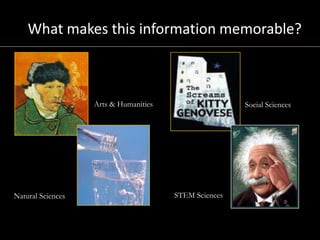
What makes this information memorable?


                   Arts & Humanities                   Social Sciences


Natural Sciences                       STEM Sciences
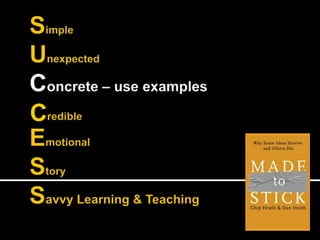
C
C
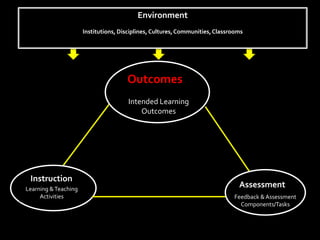
Environment
                                  Situational Context
                                      Environmental Factors:
                      Institutions, Disciplines, Cultures, Communities, Classrooms


                                      Outcomes
                                       Intended Learning
                                        Intended Learning
                                       Intended Learning
                                            Outcomes
                                            Outcomes


  Instruction
Learning & Teaching
Learning & Teaching
                                                                                Assessment
     Activities                                                               Feedback & Assessment
                                                                                Components/Tasks
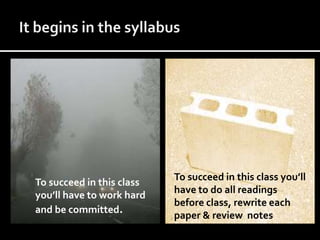
To succeed in this class you’ll
To succeed in this class
                           have to do all readings
you’ll have to work hard
                           before class, rewrite each
and be committed.
                           paper & review notes
                           weekly
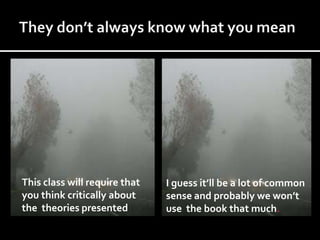
This class will require that   I guess it’ll be a lot of common
you think critically about     sense and probably we won’t
the theories presented         use the book that much.
You can:
• Explain why there is no one right answer to this issue
• Identify and correct for your personal biases
• Explore evidence from several perspectives
• Set criteria and make a recommendation
• Plan to monitor and adjust for changing conditions
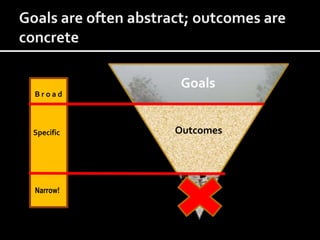
Goals
Broad


Specific   Outcomes


Narrow!
V
    L.Dee Fink (2003)
   Select one broad course or unit goal
     Student A will…..
   Define it in concrete terms
     Refer to HANDOUT – pages 2 & 3
   Record on white board & discuss
     Is this outcome concrete enough?
     Would greater specificity help or hinder?
   Learning goal:
       Appreciate differences

   Learning outcomes:
     Describe an experience where multiple viewpoints
        resulted in a better outcome
Credible   - make it real
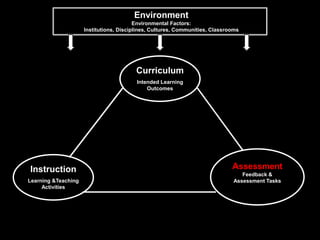
Environment
                                         Environmental Factors:
                     Institutions, Disciplines, Cultures, Communities, Classrooms


                                         Curriculum
                                         Intended Learning
                                             Outcomes


Instruction                                                                   Assessment
                                                                                 Feedback &
Learning &Teaching                                                            Assessment Tasks
     Activities
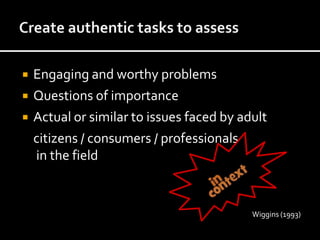
   Engaging and worthy problems
   Questions of importance
   Actual or similar to issues faced by adult
    citizens / consumers / professionals
    in the field


                                           Wiggins (1993)
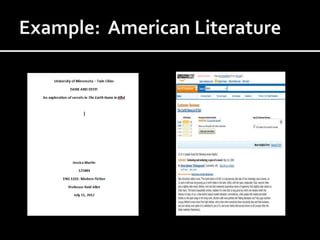
Jessica martin
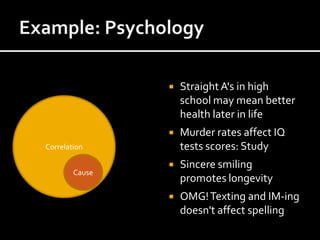
   Straight A's in high
                    school may mean better
                    health later in life
                   Murder rates affect IQ
Correlation         tests scores: Study
                   Sincere smiling
        Cause
                    promotes longevity
                   OMG! Texting and IM-ing
                    doesn't affect spelling
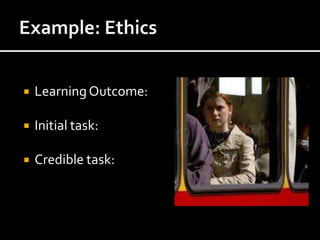
   Learning Outcome:

   Initial task:

   Credible task:
   Return to your learning outcome
   Design an authentic task in which students
    can demonstrate mastery of that outcome
   Record on white board and discuss


                                                 2
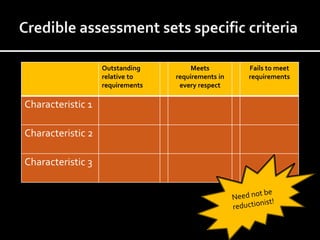
Outstanding         Meets        Fails to meet
 November 2008 | By Natasha Haugnes &
                   relative to    requirements in   requirements
                   requirements    every respect
  Jennifer Russell | Office of Faculty
Characteristic 1
  Development | Academy of Art University,
  San Francisco, CA
Characteristic 2
 The Academy
Characteristic 3
The Truth
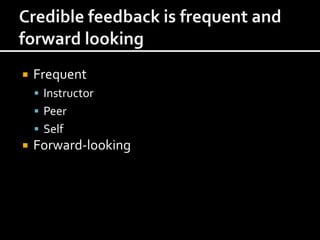
   Frequent
     Instructor
     Peer
     Self
   Forward-looking
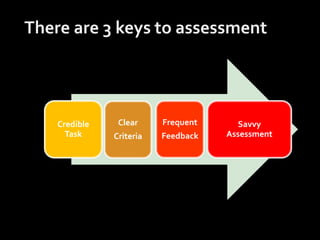
Credible    Clear     Frequent     Savvy
  Task     Criteria   Feedback   Assessment
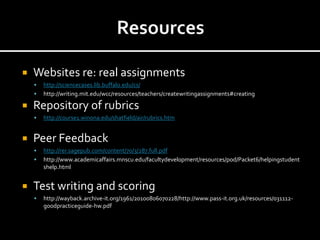
   Websites re: real assignments
       http://sciencecases.lib.buffalo.edu/cs/
       http://writing.mit.edu/wcc/resources/teachers/createwritingassignments#creating

   Repository of rubrics
       http://course1.winona.edu/shatfield/air/rubrics.htm


   Peer Feedback
       http://rer.sagepub.com/content/70/3/287.full.pdf
       http://www.academicaffairs.mnscu.edu/facultydevelopment/resources/pod/Packet6/helpingstudent
        shelp.html


   Test writing and scoring
       http://wayback.archive-it.org/1961/20100806070228/http://www.pass-it.org.uk/resources/031112-
        goodpracticeguide-hw.pdf

Teaching that sicks Jane O'Brien slides

  • 1.
    Six Core Principlesfor Creating Memorable Presentations and Courses Ilene Alexander, Jane O’Brien, Christina Petersen
  • 2.
    What makes thisinformation memorable? Arts & Humanities Social Sciences Natural Sciences STEM Sciences
  • 3.
  • 4.
  • 5.
    Environment Situational Context Environmental Factors: Institutions, Disciplines, Cultures, Communities, Classrooms Outcomes Intended Learning Intended Learning Intended Learning Outcomes Outcomes Instruction Learning & Teaching Learning & Teaching Assessment Activities Feedback & Assessment Components/Tasks
  • 7.
    To succeed inthis class you’ll To succeed in this class have to do all readings you’ll have to work hard before class, rewrite each and be committed. paper & review notes weekly
  • 8.
    This class willrequire that I guess it’ll be a lot of common you think critically about sense and probably we won’t the theories presented use the book that much.
  • 9.
    You can: • Explainwhy there is no one right answer to this issue • Identify and correct for your personal biases • Explore evidence from several perspectives • Set criteria and make a recommendation • Plan to monitor and adjust for changing conditions
  • 10.
    Goals Broad Specific Outcomes Narrow!
  • 12.
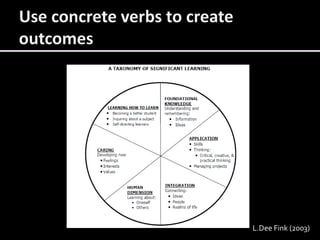
    V L.Dee Fink (2003)
  • 13.
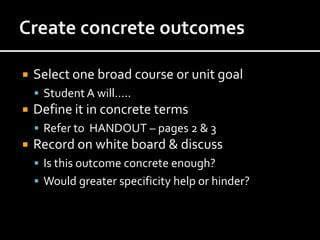
    Select one broad course or unit goal  Student A will…..  Define it in concrete terms  Refer to HANDOUT – pages 2 & 3  Record on white board & discuss  Is this outcome concrete enough?  Would greater specificity help or hinder?
  • 14.
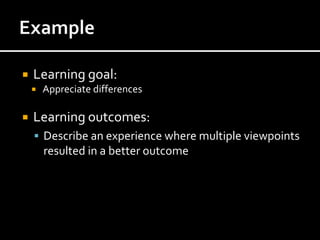
    Learning goal:  Appreciate differences  Learning outcomes:  Describe an experience where multiple viewpoints resulted in a better outcome
  • 15.
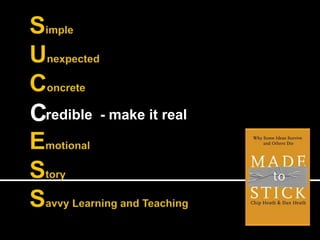
    Credible - make it real
  • 16.
    Environment Environmental Factors: Institutions, Disciplines, Cultures, Communities, Classrooms Curriculum Intended Learning Outcomes Instruction Assessment Feedback & Learning &Teaching Assessment Tasks Activities
  • 17.
    Engaging and worthy problems  Questions of importance  Actual or similar to issues faced by adult citizens / consumers / professionals in the field Wiggins (1993)
  • 18.
  • 20.
    Straight A's in high school may mean better health later in life  Murder rates affect IQ Correlation tests scores: Study  Sincere smiling Cause promotes longevity  OMG! Texting and IM-ing doesn't affect spelling
  • 21.
    Learning Outcome:  Initial task:  Credible task:
  • 22.
    Return to your learning outcome  Design an authentic task in which students can demonstrate mastery of that outcome  Record on white board and discuss 2
  • 23.
    Outstanding Meets Fails to meet  November 2008 | By Natasha Haugnes & relative to requirements in requirements requirements every respect Jennifer Russell | Office of Faculty Characteristic 1 Development | Academy of Art University, San Francisco, CA Characteristic 2  The Academy Characteristic 3
  • 24.
  • 25.
    Frequent  Instructor  Peer  Self  Forward-looking
  • 26.
    Credible Clear Frequent Savvy Task Criteria Feedback Assessment
  • 27.
    Websites re: real assignments  http://sciencecases.lib.buffalo.edu/cs/  http://writing.mit.edu/wcc/resources/teachers/createwritingassignments#creating  Repository of rubrics  http://course1.winona.edu/shatfield/air/rubrics.htm  Peer Feedback  http://rer.sagepub.com/content/70/3/287.full.pdf  http://www.academicaffairs.mnscu.edu/facultydevelopment/resources/pod/Packet6/helpingstudent shelp.html  Test writing and scoring  http://wayback.archive-it.org/1961/20100806070228/http://www.pass-it.org.uk/resources/031112- goodpracticeguide-hw.pdf

Editor's Notes

  • #4 See handouts from session for activities for this portion of the workshop.
  • #5 See handouts from session for activities for this portion of the workshop.
  • #13 Dee Fink divides learning into these six components and posits that they are interrelated rather than sequential. The three on the right are similar to Bloom’s taxonomy. By human dimension Fink means skills like teamwork and communication. Caring has to do with motivation and valuing the subject matter. Learning to learn includes reflecting on learning and how to improve.
  • #24 November 2008 | By Natasha Haugnes & Jennifer Russell | Office of Faculty Development | Academy of Art University, San Francisco, CAThe Academyhttp://pareonline.net/getvn.asp?v=9&n=2