Flipped classrooms and more
HOW CAN WE IMPROVE OUR TEACHING METHODS TO ENHANCE STUDENT LEARNING?
Wednesday 4 November 2015
Before we get started
2
TELL US ABOUT YOUR STUDENTS AND YOUR UNITS
• On a web-enabled device, visit:
m.socrative.com
Room code: 7528
• Or, scan this QR code:
First year biology
REDESIGN FOR LEARNING
Smorgasbord
4OFFICE I FACULTY I DEPARTMENT
A BUFFET OF IDEAS
• Disclaimers:
• Not everything will work in
your context
• Springboard for other ideas
• No one ‘right way’
First year biology
5
CHALLENGES AND OPPORTUNITIES
The University of Sydney Page 6
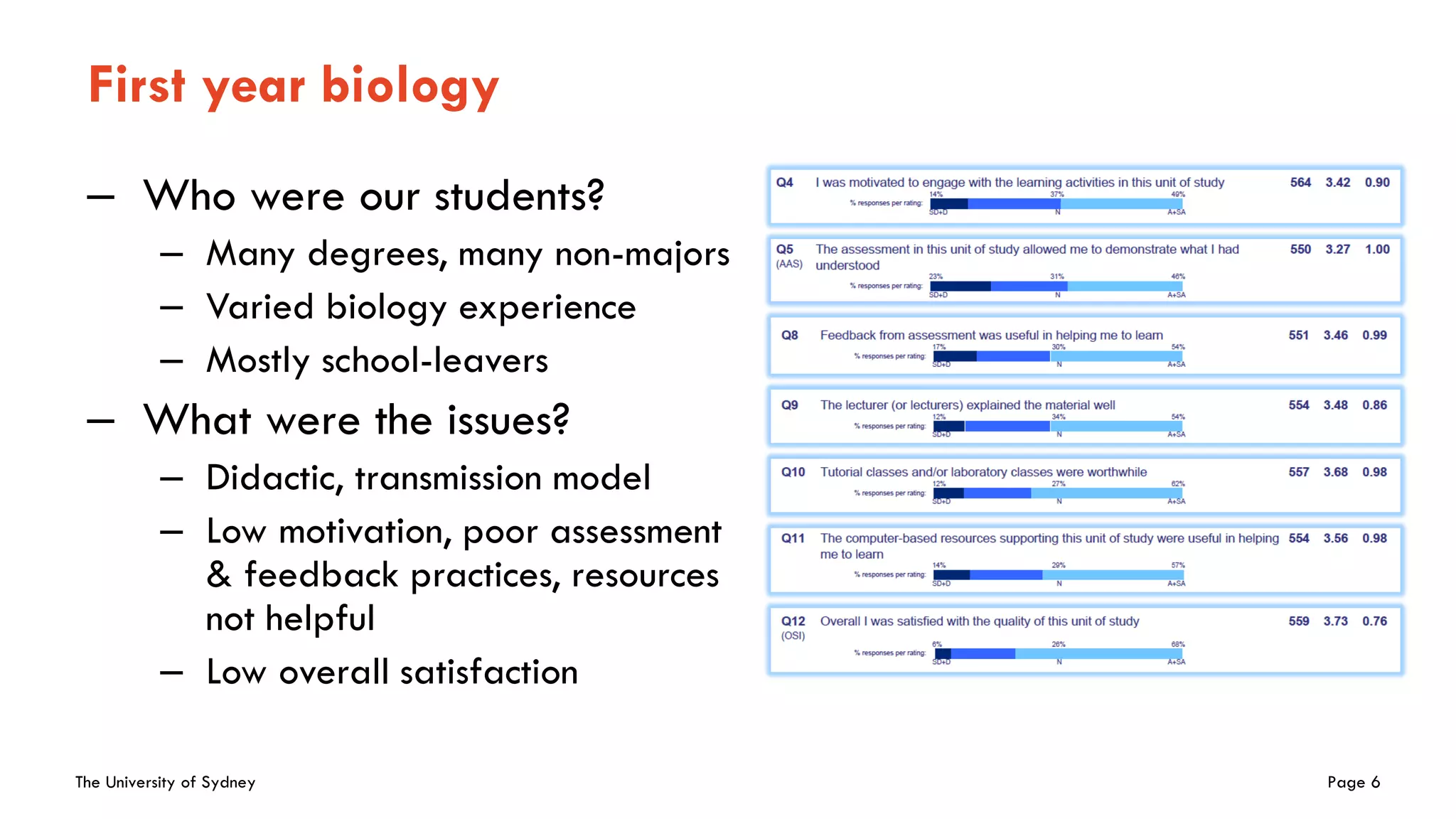
First year biology
– Who were our students?
– Many degrees, many non-majors
– Varied biology experience
– Mostly school-leavers
– What were the issues?
– Didactic, transmission model
– Low motivation, poor assessment
& feedback practices, resources
not helpful
– Low overall satisfaction
The University of Sydney Page 7
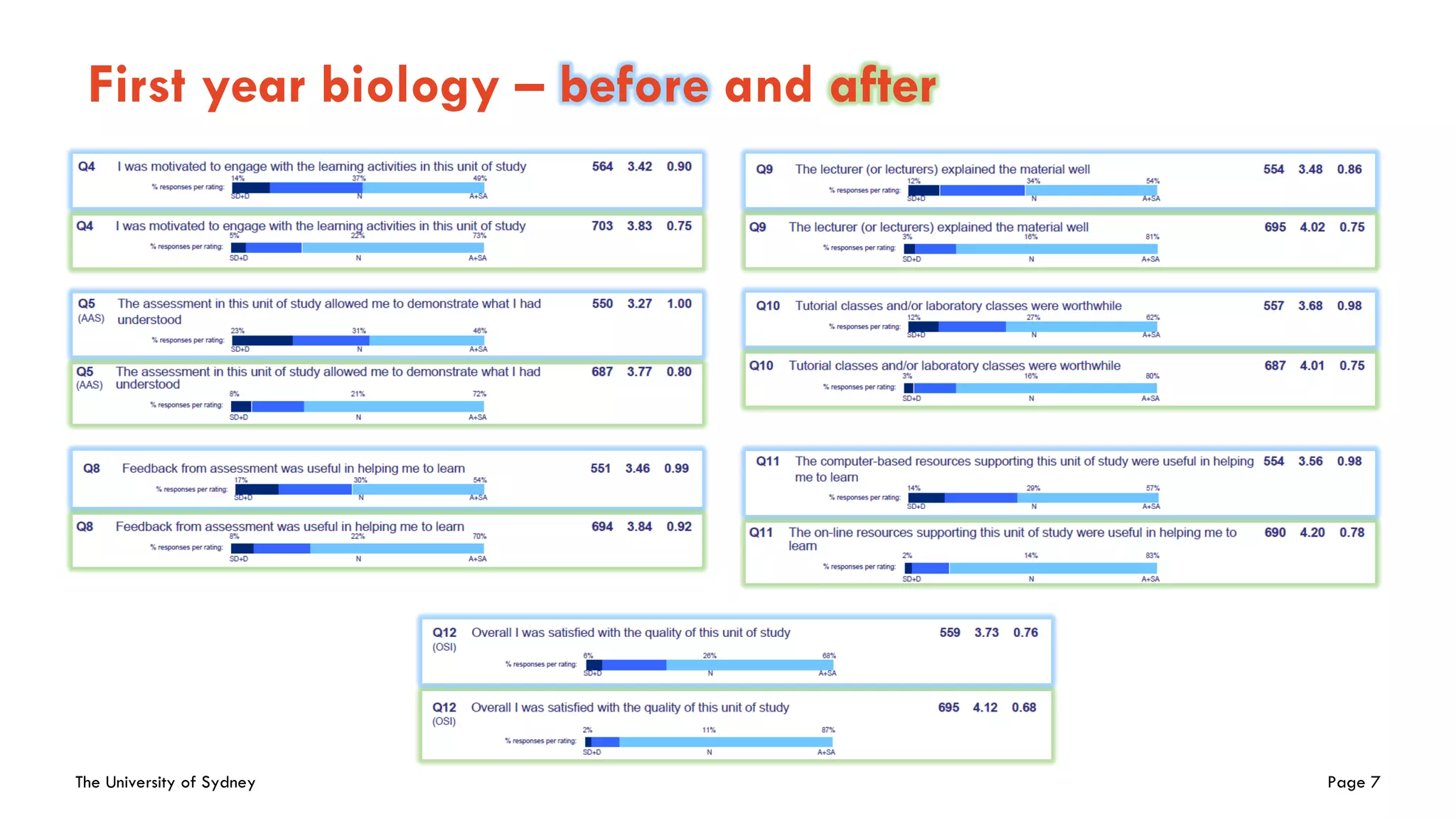
First year biology – before and after
The University of Sydney Page 8
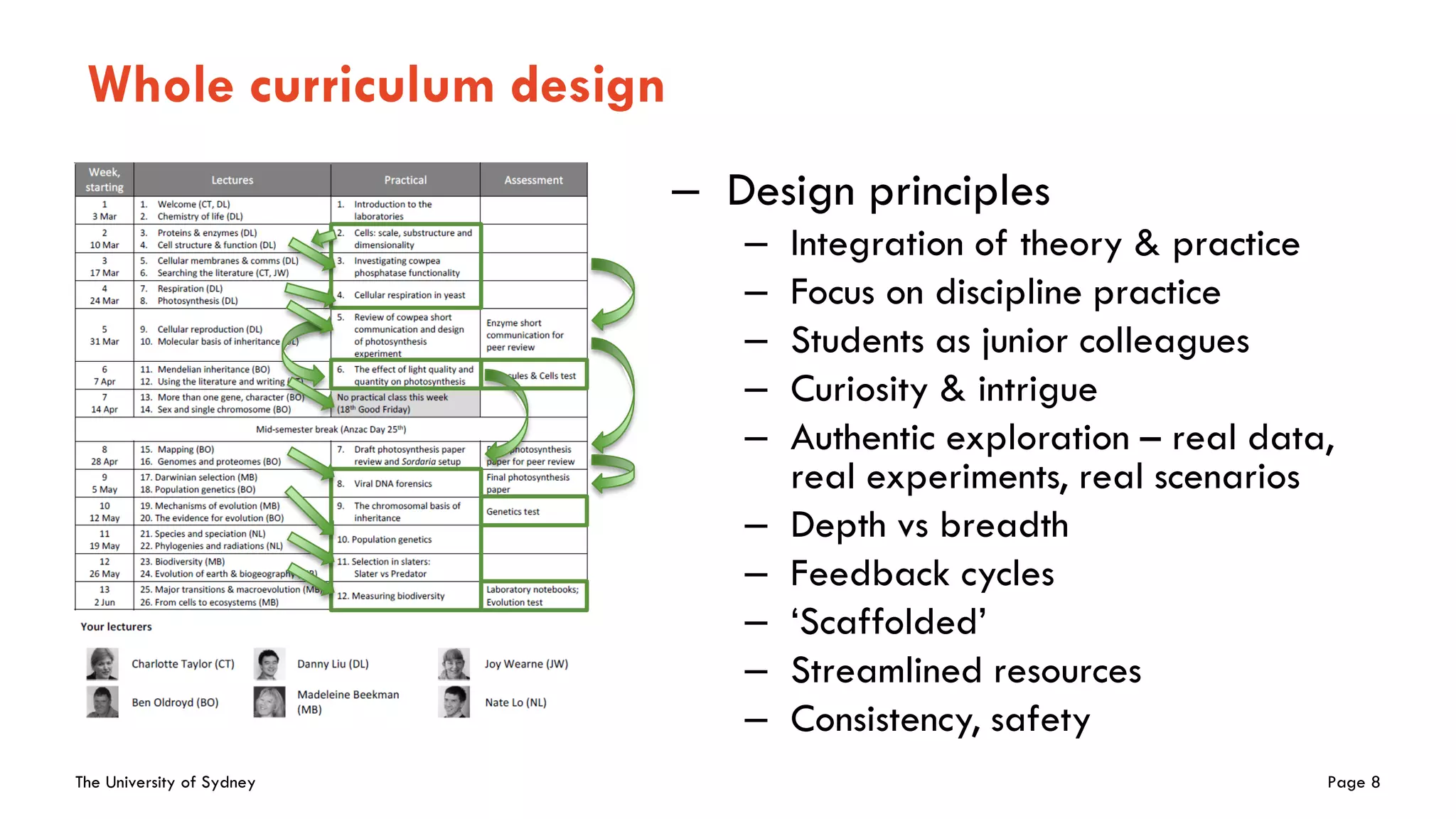
Whole curriculum design
– Design principles
– Integration of theory & practice
– Focus on discipline practice
– Students as junior colleagues
– Curiosity & intrigue
– Authentic exploration – real data,
real experiments, real scenarios
– Depth vs breadth
– Feedback cycles
– ‘Scaffolded’
– Streamlined resources
– Consistency, safety
The University of Sydney Page 9
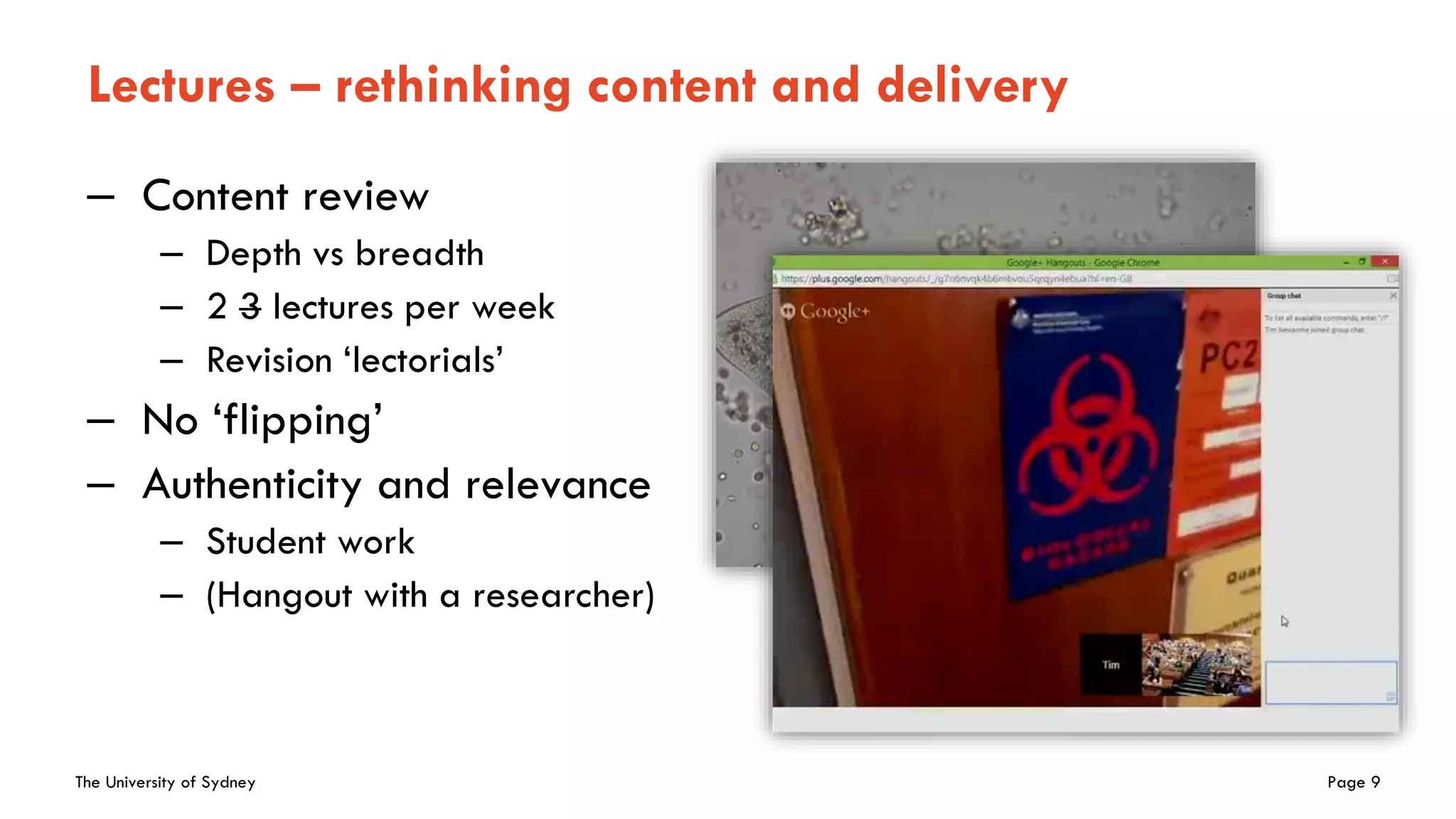
Lectures – rethinking content and delivery
– Content review
– Depth vs breadth
– 2 3 lectures per week
– Revision ‘lectorials’
– No ‘flipping’
– Authenticity and relevance
– Student work
– (Hangout with a researcher)
The University of Sydney Page 10
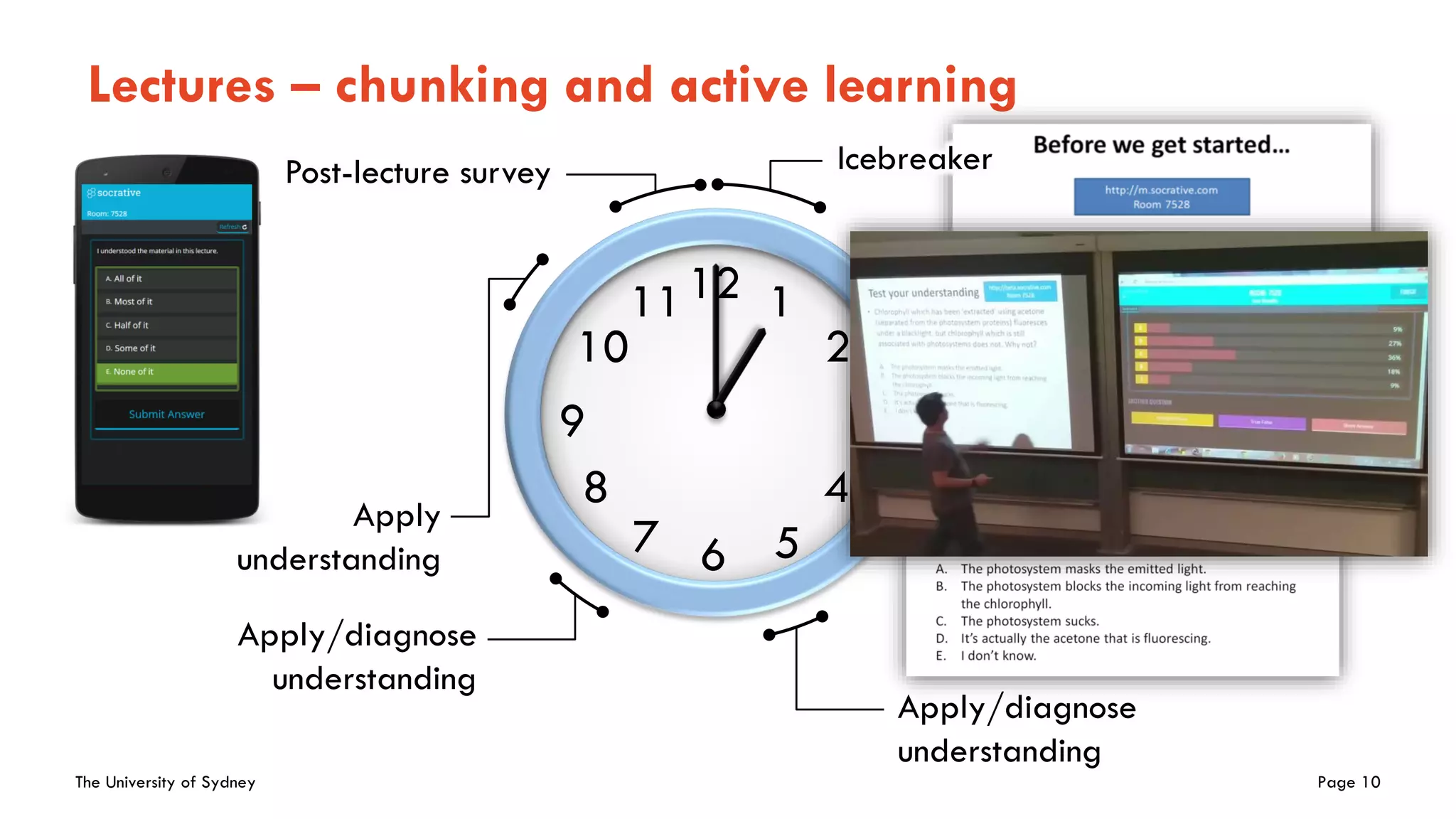
Lectures – chunking and active learning
12 1
2
3
4
567
8
9
10
11
Icebreaker
Apply/diagnose
understanding
Apply/diagnose
understanding
Apply
understanding
Post-lecture survey
The University of Sydney Page 11
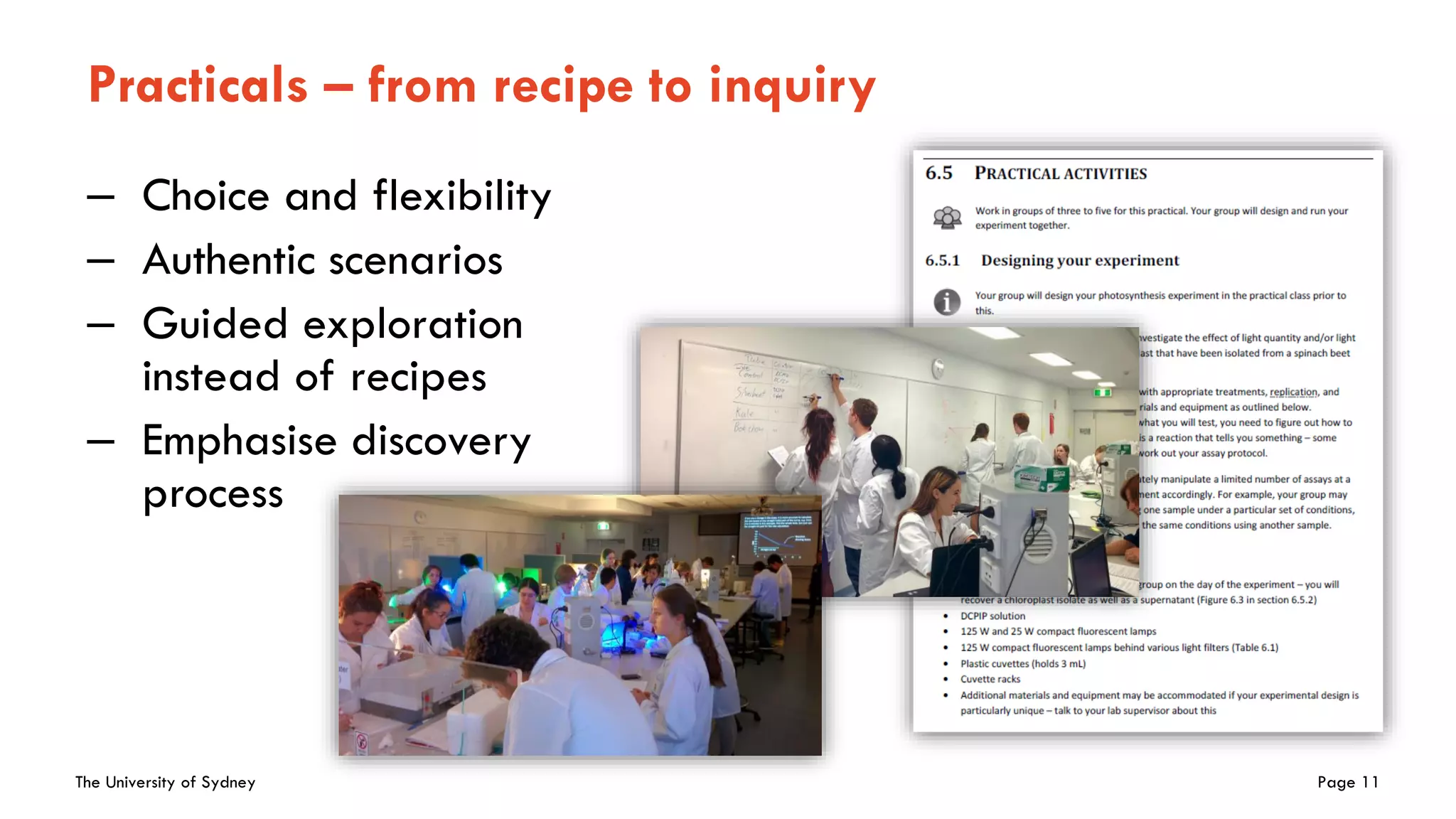
Practicals – from recipe to inquiry
– Choice and flexibility
– Authentic scenarios
– Guided exploration
instead of recipes
– Emphasise discovery
process
The University of Sydney Page 12
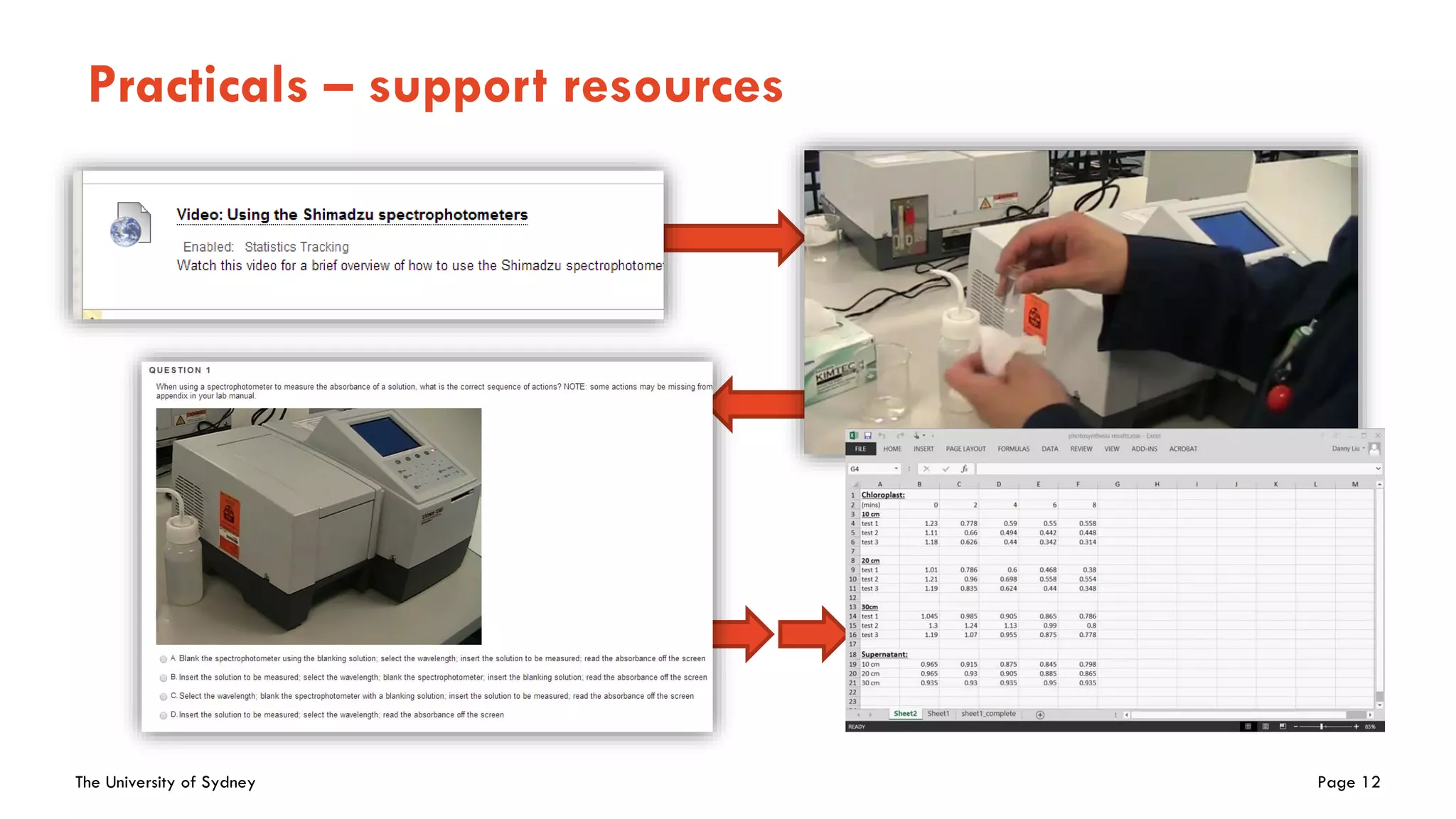
Practicals – support resources
The University of Sydney Page 13
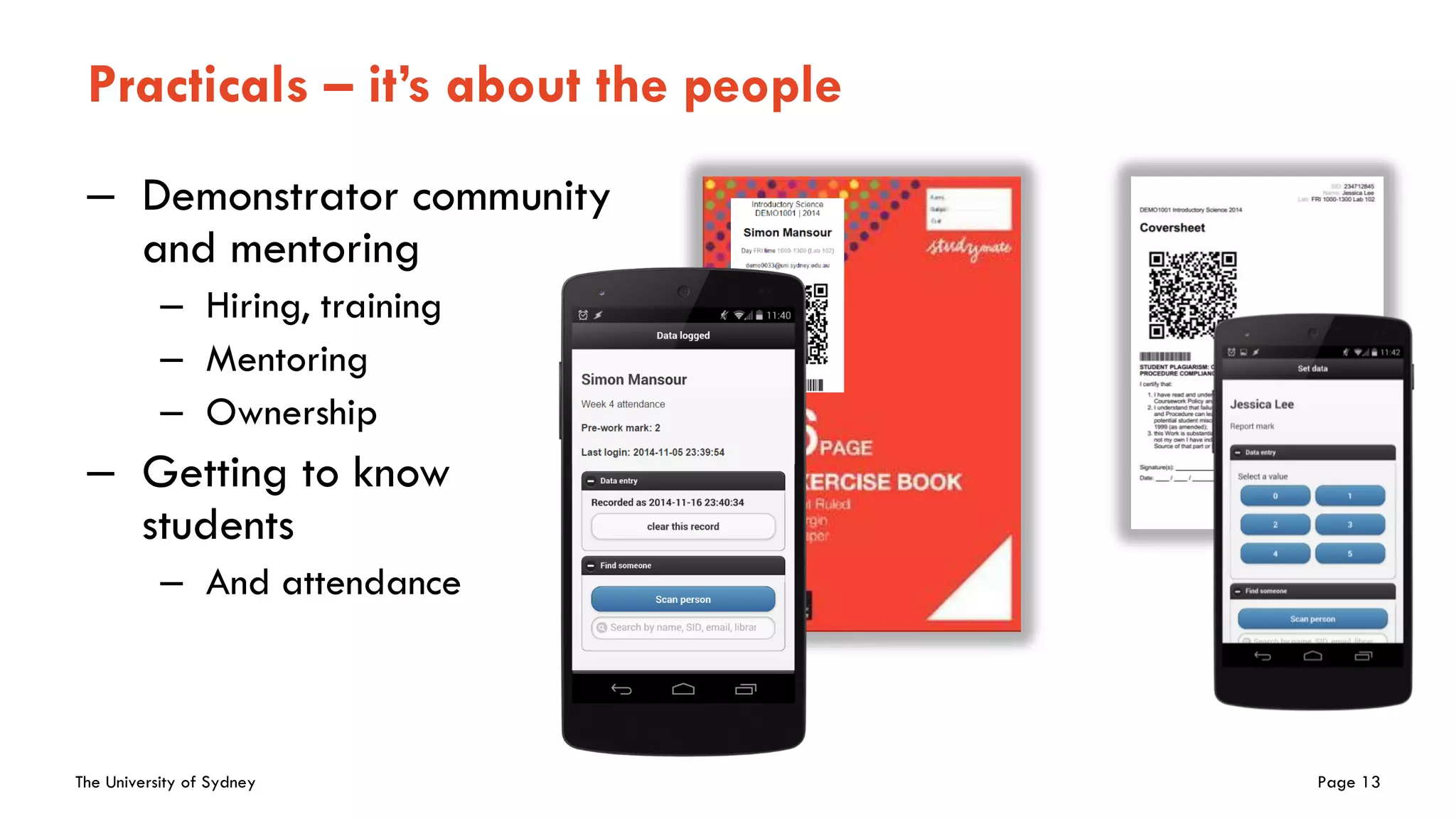
Practicals – it’s about the people
– Demonstrator community
and mentoring
– Hiring, training
– Mentoring
– Ownership
– Getting to know
students
– And attendance
The University of Sydney Page 14
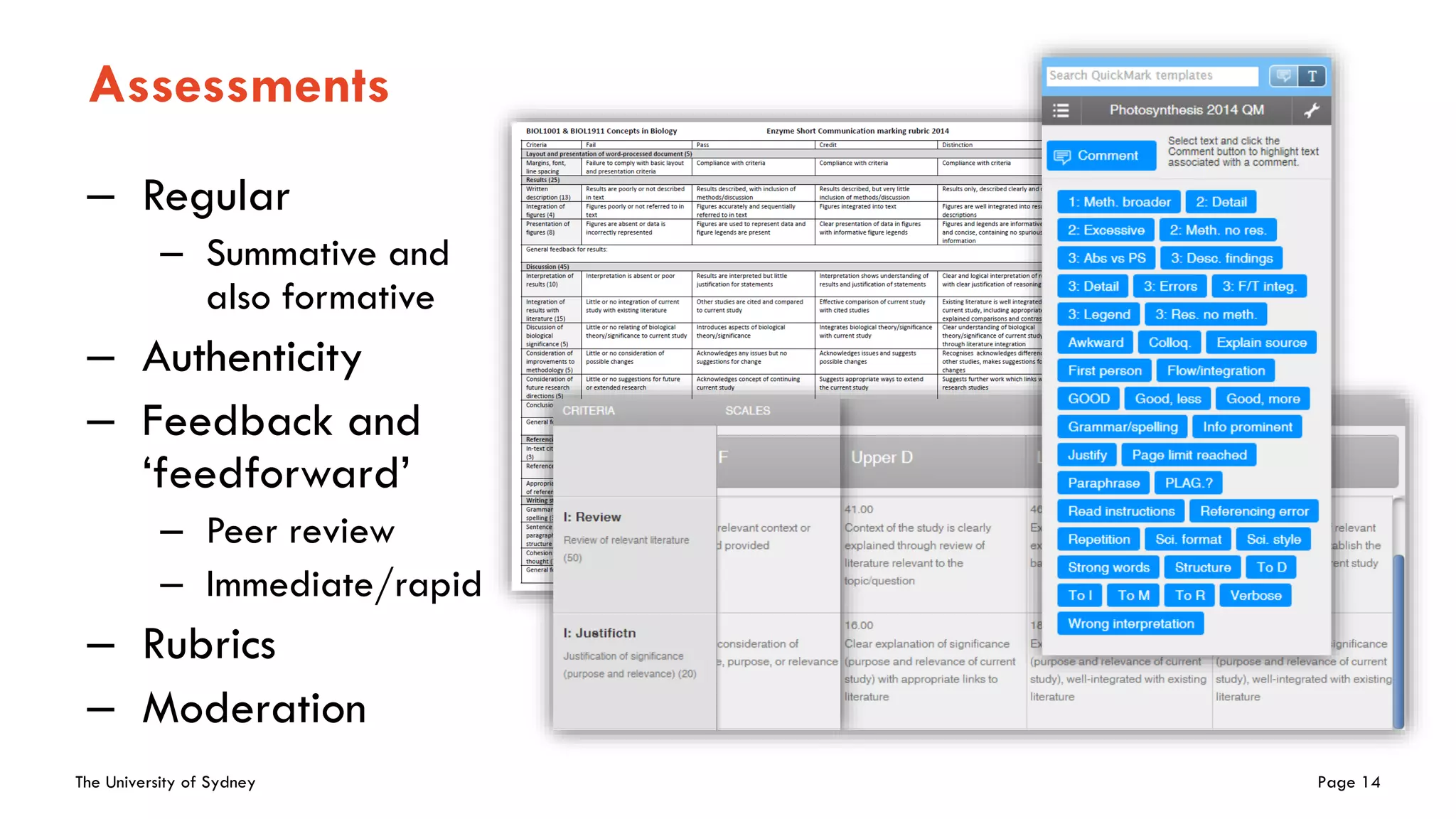
Assessments
– Regular
– Summative and
also formative
– Authenticity
– Feedback and
‘feedforward’
– Peer review
– Immediate/rapid
– Rubrics
– Moderation
The University of Sydney Page 15
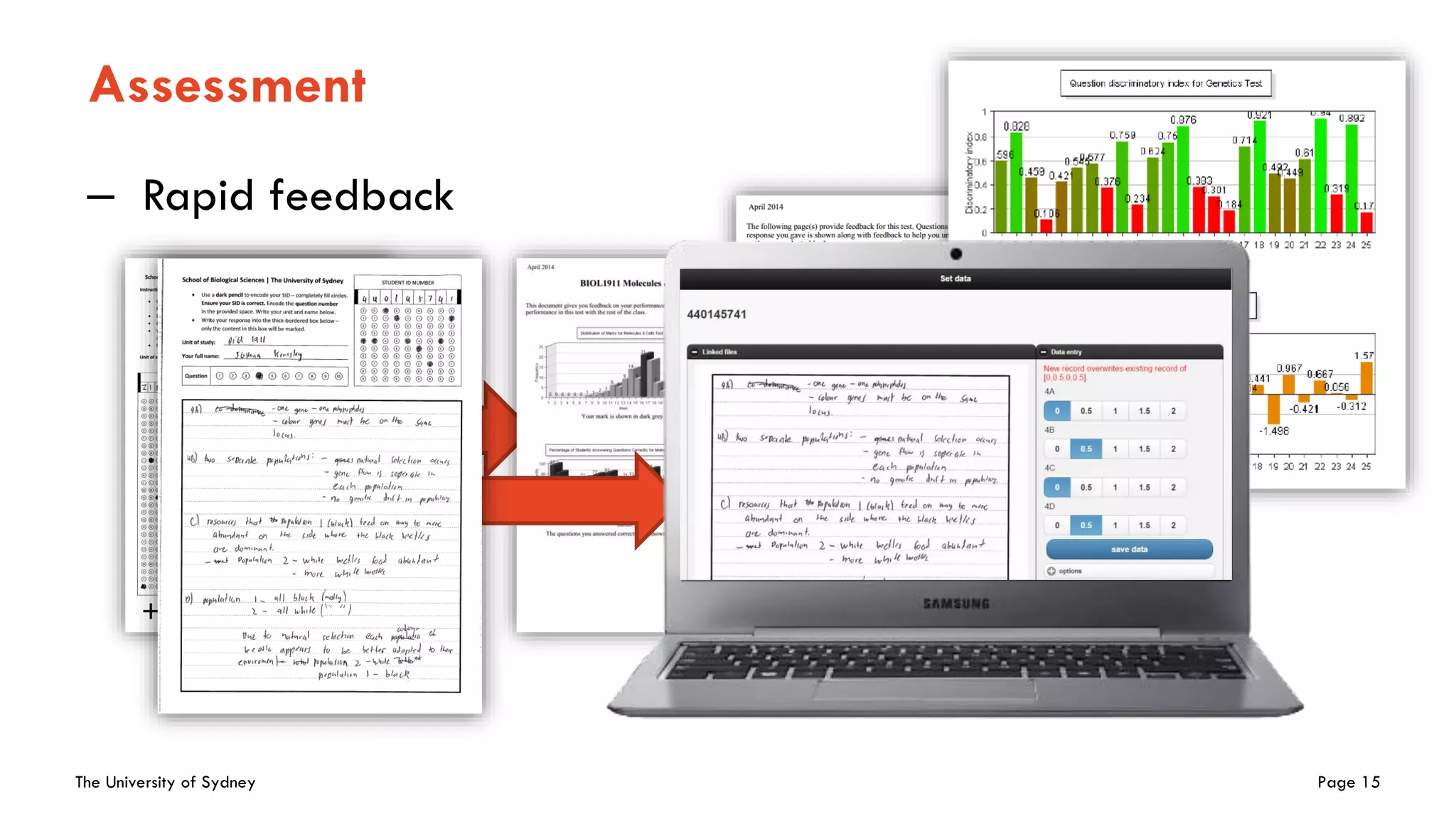
Assessment
– Rapid feedback
The University of Sydney Page 16
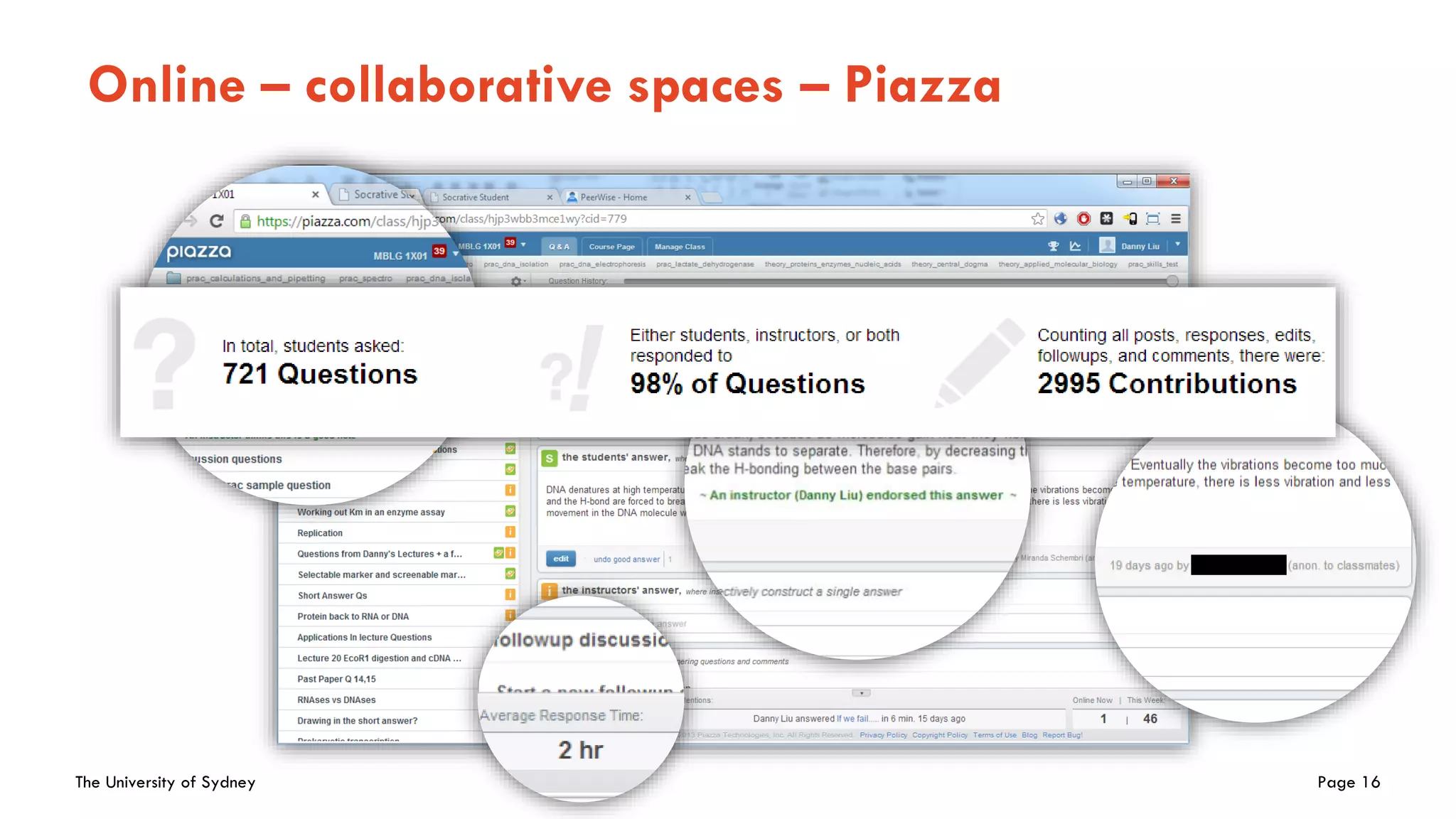
Online – collaborative spaces – Piazza
The University of Sydney Page 17
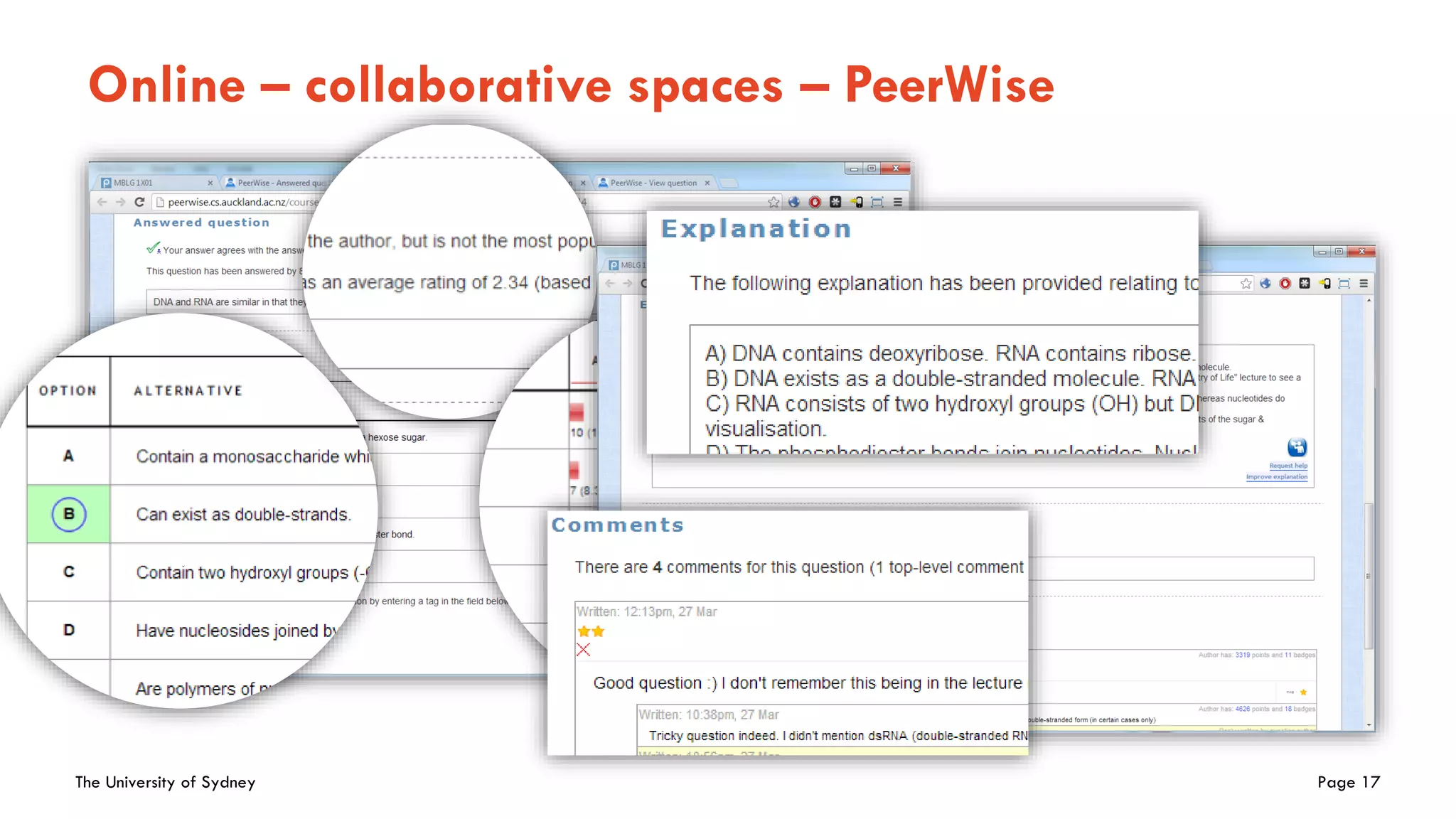
Online – collaborative spaces – PeerWise
The University of Sydney Page 18
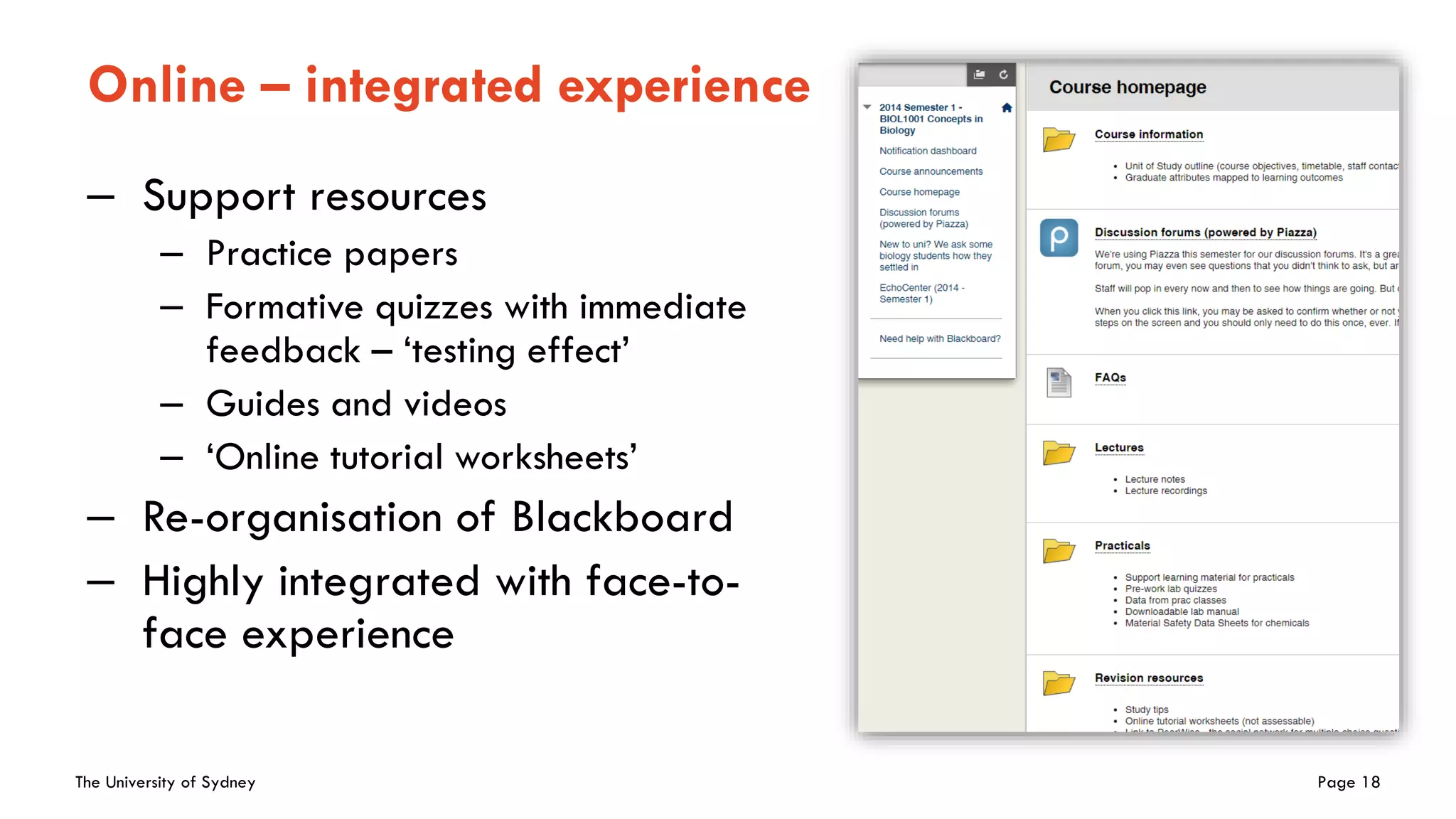
Online – integrated experience
– Support resources
– Practice papers
– Formative quizzes with immediate
feedback – ‘testing effect’
– Guides and videos
– ‘Online tutorial worksheets’
– Re-organisation of Blackboard
– Highly integrated with face-to-
face experience
The University of Sydney Page 19
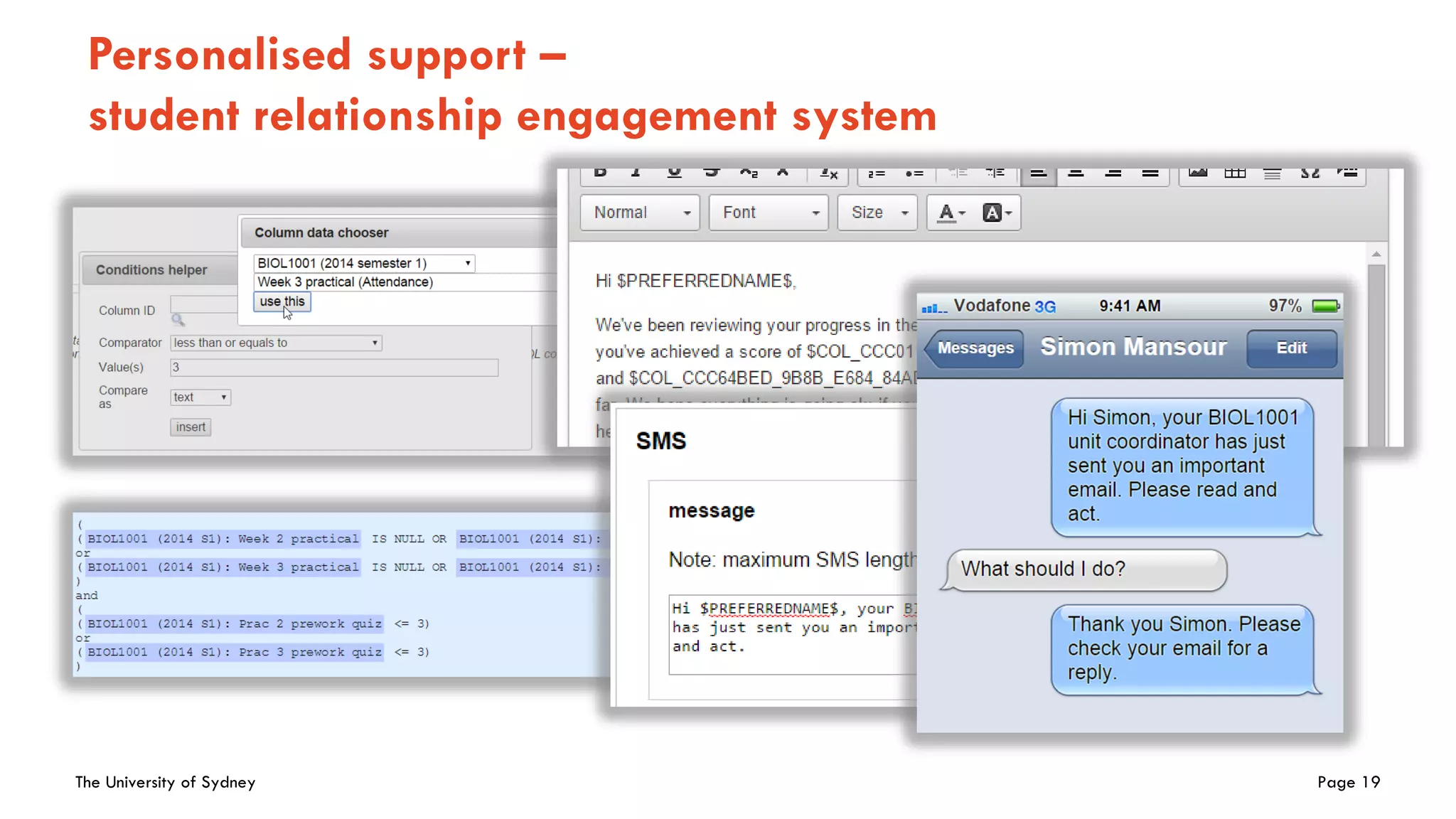
Personalised support –
student relationship engagement system
The University of Sydney Page 20
Translating to
Pharmacy
REDESIGNING FOR LEARNING
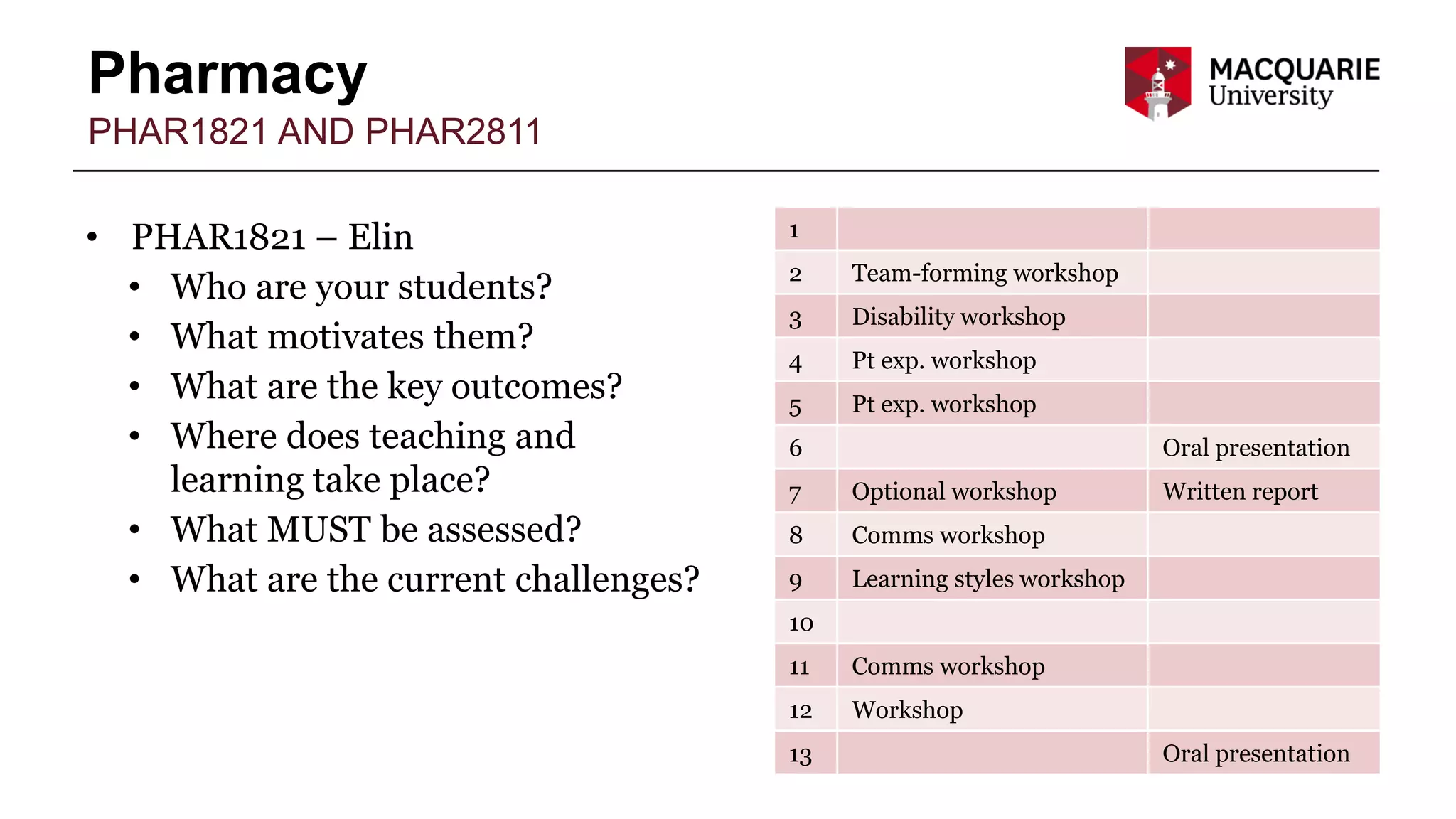
Pharmacy
PHAR1821 AND PHAR2811
• PHAR1821 – Elin
• Who are your students?
• What motivates them?
• What are the key outcomes?
• Where does teaching and
learning take place?
• What MUST be assessed?
• What are the current challenges?
1
2 Team-forming workshop
3 Disability workshop
4 Pt exp. workshop
5 Pt exp. workshop
6 Oral presentation
7 Optional workshop Written report
8 Comms workshop
9 Learning styles workshop
10
11 Comms workshop
12 Workshop
13 Oral presentation
Pharmacy
PHAR1821 AND PHAR2811
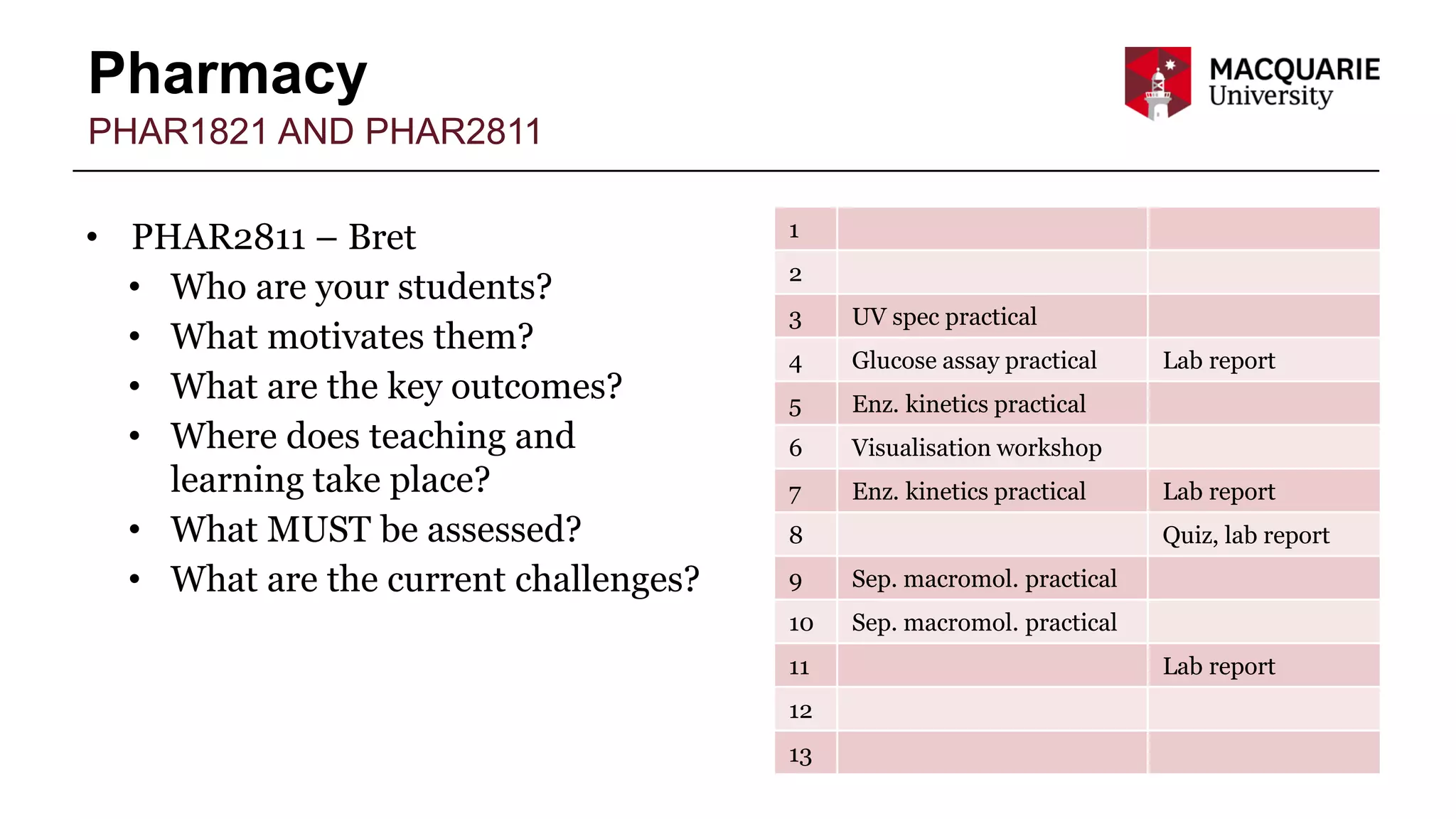
• PHAR2811 – Bret
• Who are your students?
• What motivates them?
• What are the key outcomes?
• Where does teaching and
learning take place?
• What MUST be assessed?
• What are the current challenges?
1
2
3 UV spec practical
4 Glucose assay practical Lab report
5 Enz. kinetics practical
6 Visualisation workshop
7 Enz. kinetics practical Lab report
8 Quiz, lab report
9 Sep. macromol. practical
10 Sep. macromol. practical
11 Lab report
12
13
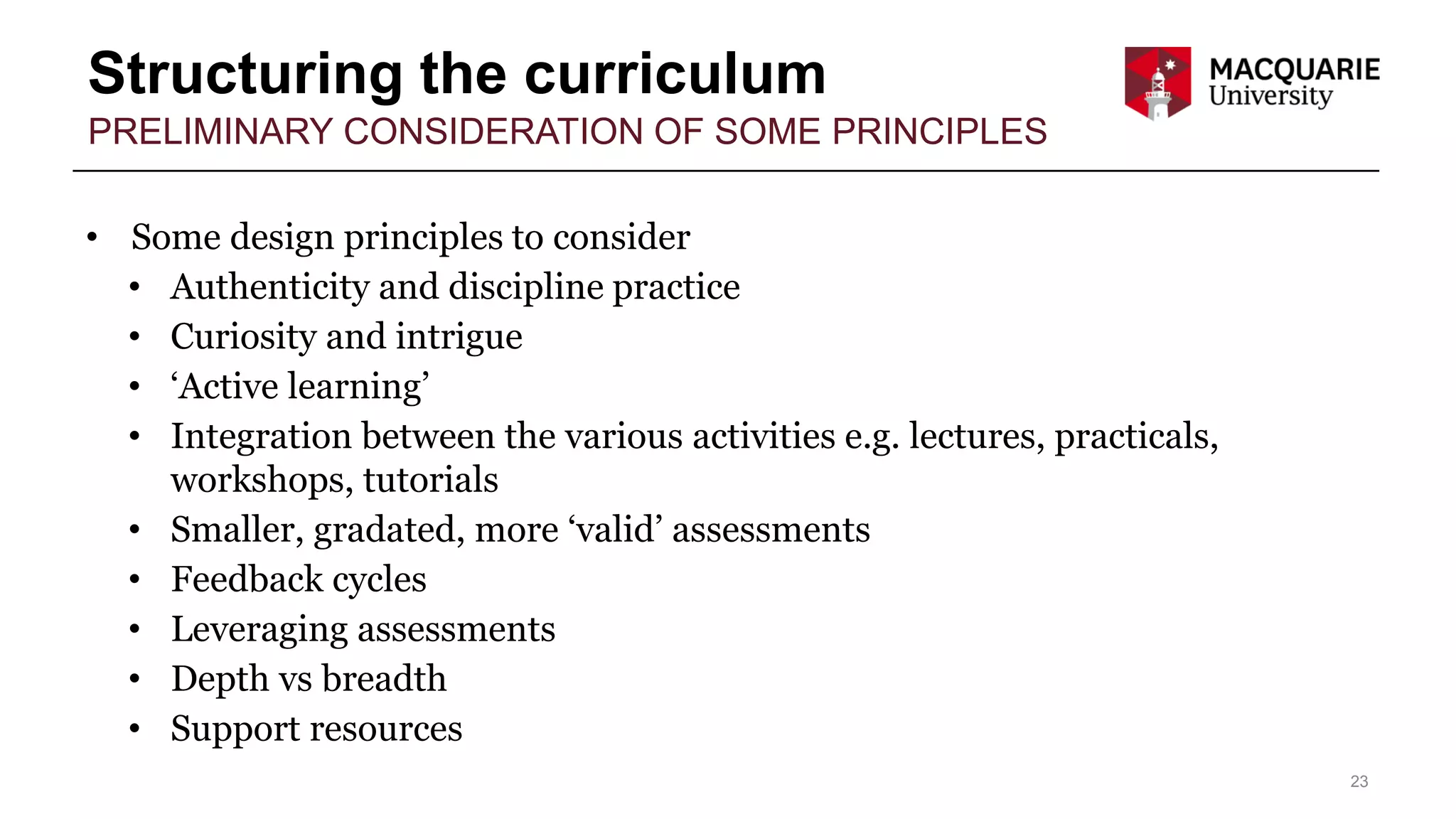
Structuring the curriculum
23
PRELIMINARY CONSIDERATION OF SOME PRINCIPLES
• Some design principles to consider
• Authenticity and discipline practice
• Curiosity and intrigue
• ‘Active learning’
• Integration between the various activities e.g. lectures, practicals,
workshops, tutorials
• Smaller, gradated, more ‘valid’ assessments
• Feedback cycles
• Leveraging assessments
• Depth vs breadth
• Support resources
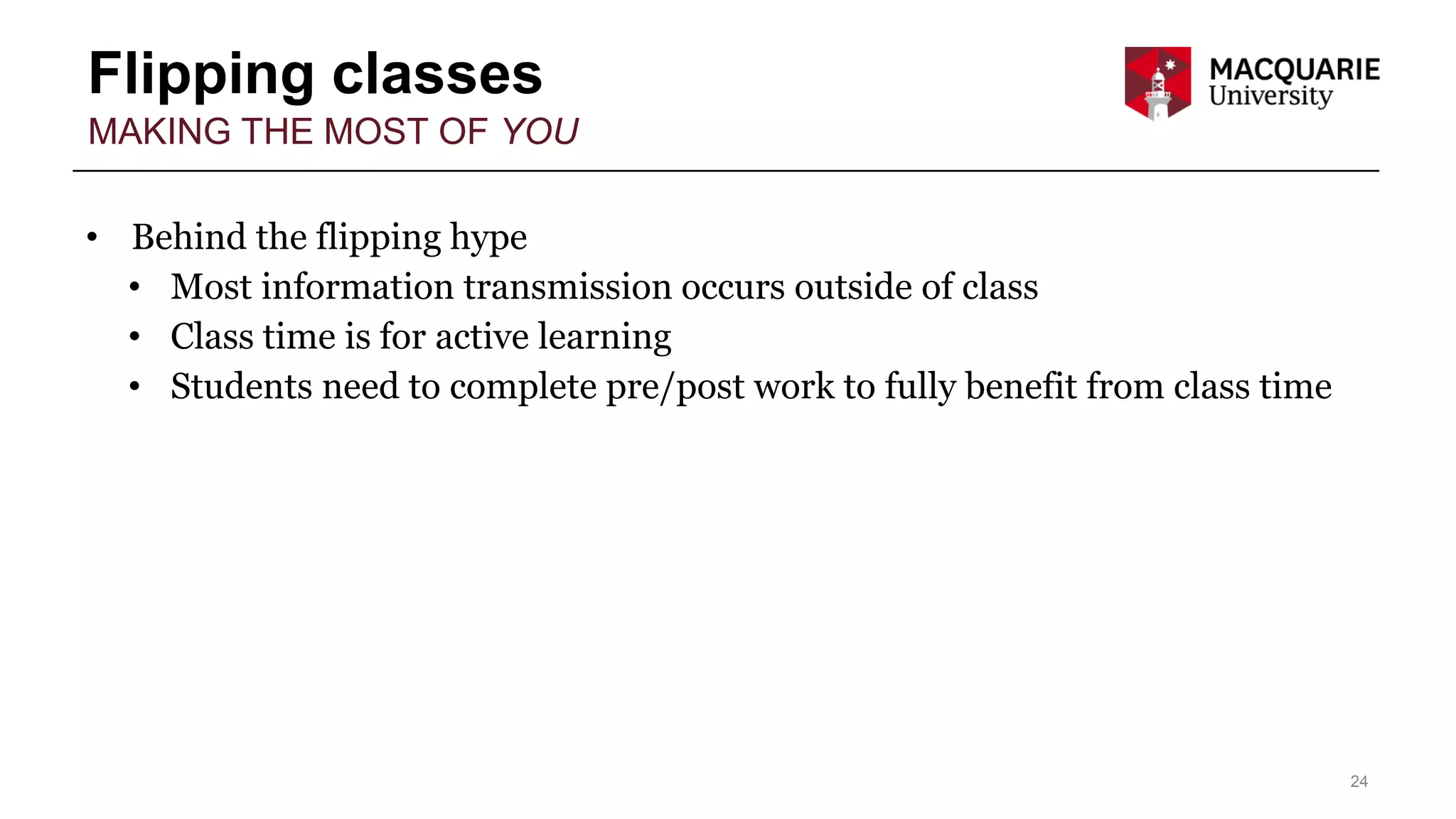
Flipping classes
24
MAKING THE MOST OF YOU
• Behind the flipping hype
• Most information transmission occurs outside of class
• Class time is for active learning
• Students need to complete pre/post work to fully benefit from class time
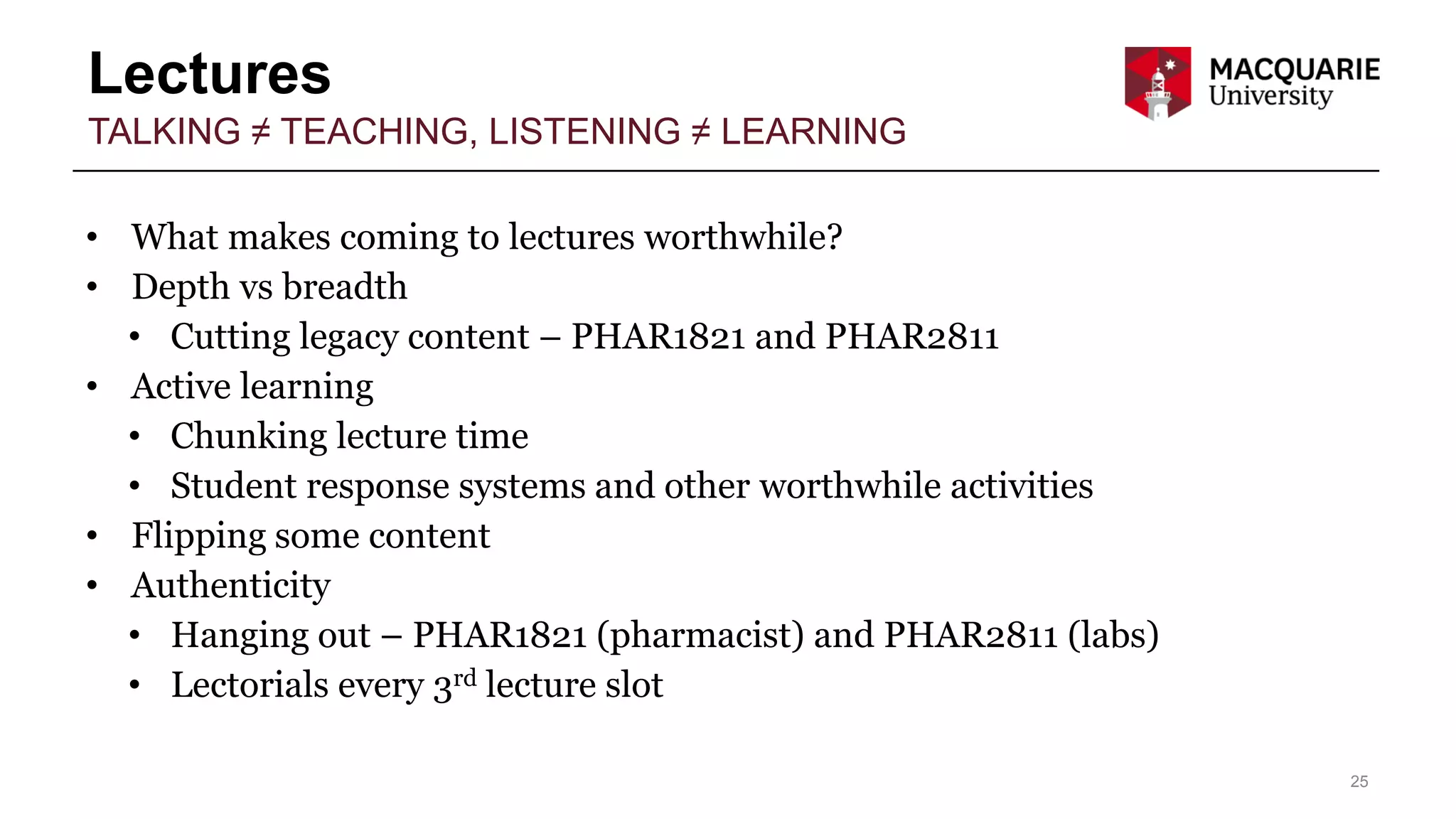
Lectures
25
TALKING ≠ TEACHING, LISTENING ≠ LEARNING
• What makes coming to lectures worthwhile?
• Depth vs breadth
• Cutting legacy content – PHAR1821 and PHAR2811
• Active learning
• Chunking lecture time
• Student response systems and other worthwhile activities
• Flipping some content
• Authenticity
• Hanging out – PHAR1821 (pharmacist) and PHAR2811 (labs)
• Lectorials every 3rd lecture slot
Practicals, workshops, tutorials
26
MAKING THE MOST OF SMALL CLASSES
• Authenticity, curiosity, intrigue
• Providing real experiences – PHAR1821 role plays, PHAR2811
• Asking real questions
• Integration with other aspects of the unit
• Support resources
• Pre-work, post-work
• Assessment
• What are the necessary outcomes? PHAR2811 labs
• Staff community
Assessment
27
ASSESSMENT DRIVES LEARNING, (UN?)FORTUNATELY
• Feedback cycles
• Early review – PHAR1821 report draft, rubric review
• Peer review – PHAR1821 oral presentations and report
• Personalised feedback – PHAR2811 mid-semester quiz
• Support materials – PHAR2811 online quizzes
• Marks ≠ feedback
• Increasing feedback efficiency – technology, rubrics, group feedback, peer
feedback
Assessment
28
ASSESSMENT DRIVES LEARNING, (UN?)FORTUNATELY
• Smaller, gradated assessments
• Reconsider final exam weighting
• Nominal summative assessments – e.g. pre-work
• Build ‘self-efficacy’
• Authenticity
• Student autonomy
• Choice, openness, variety (not just lab reports)
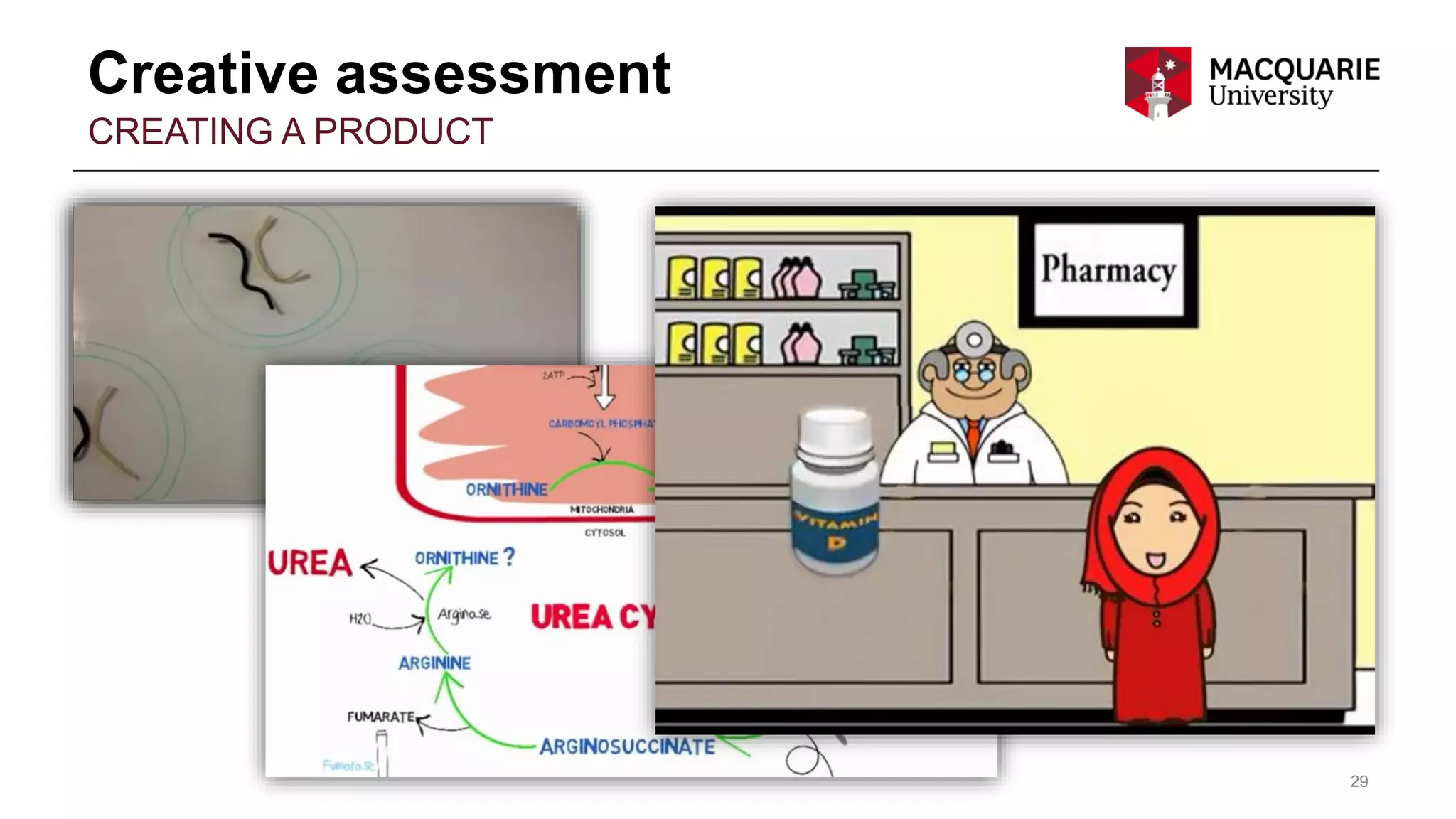
Creative assessment
29
CREATING A PRODUCT
Online
30
ANYTIME SUPPORTING RESOURCES
• Integration
• Reorganising Blackboard sites – truly ‘blended’ experience
• Adding authenticity – e.g. voices, perspectives, student-generated resources
• Collaborative spaces
• Personalised support
• Support resources
• Supporting assessment preparation - e.g. exemplars, guides, videos,
forums
• Webinars – e.g. revision
• Pre and/or post work (quizzes, videos, lessons)
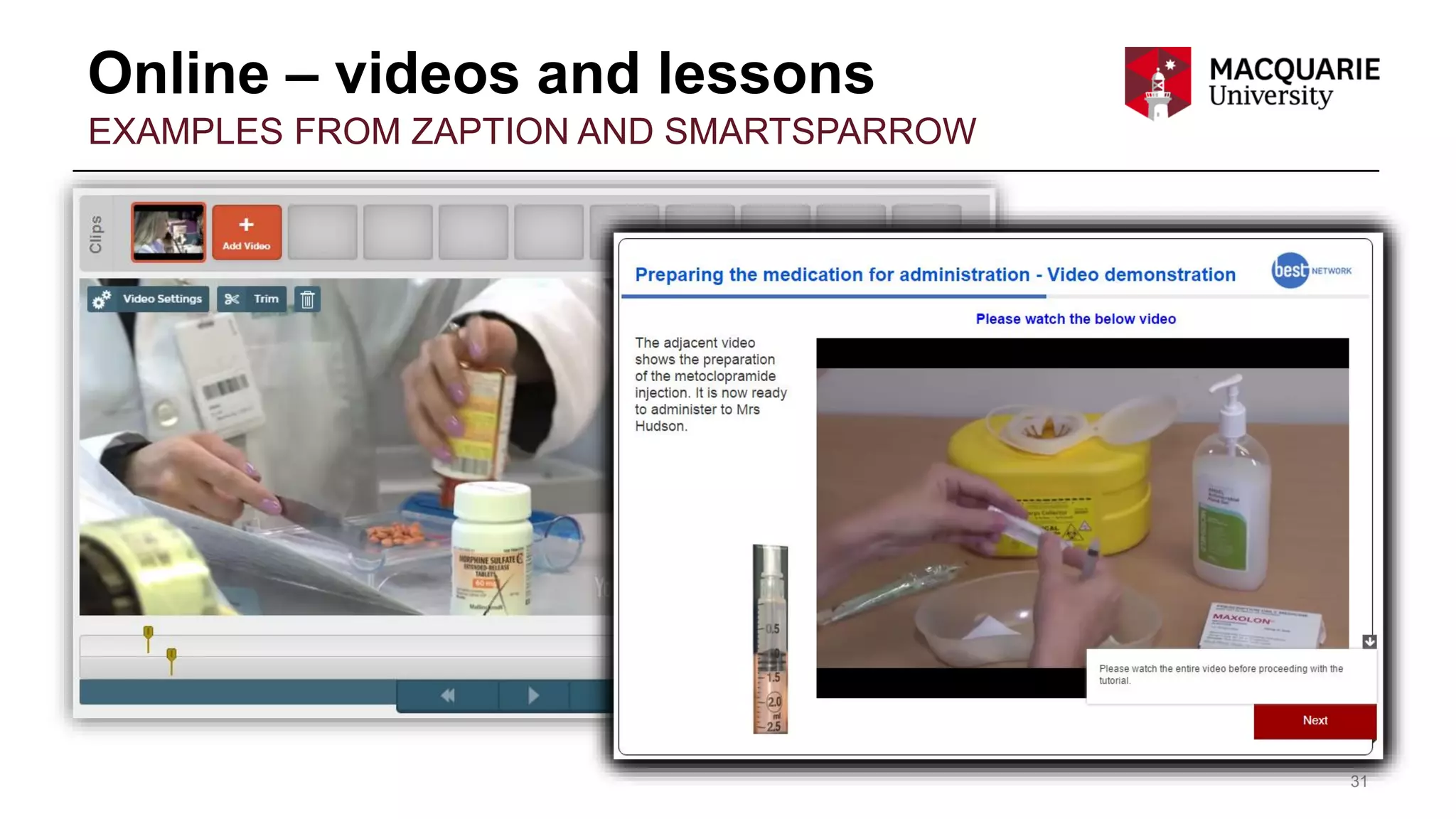
Online – videos and lessons
31
EXAMPLES FROM ZAPTION AND SMARTSPARROW
Workshop
ENHANCING STUDENT LEARNING
IN YOUR UNIT
Pick a unit of study
33
FOR DIRECTED BRAINSTORMING
• In your groups, nominate a unit of study that you wish to work on
• Students
• Who are your students?
• What motivates them?
• Outcomes
• What are the key concepts and
competencies of the unit?
• What activities must the
students complete to achieve
these?
• Environment
• Where will teaching and
learning take place?
• Assessment
• What MUST be assessed?
• What feedback strategies could
be used?
• What are the current challenges?
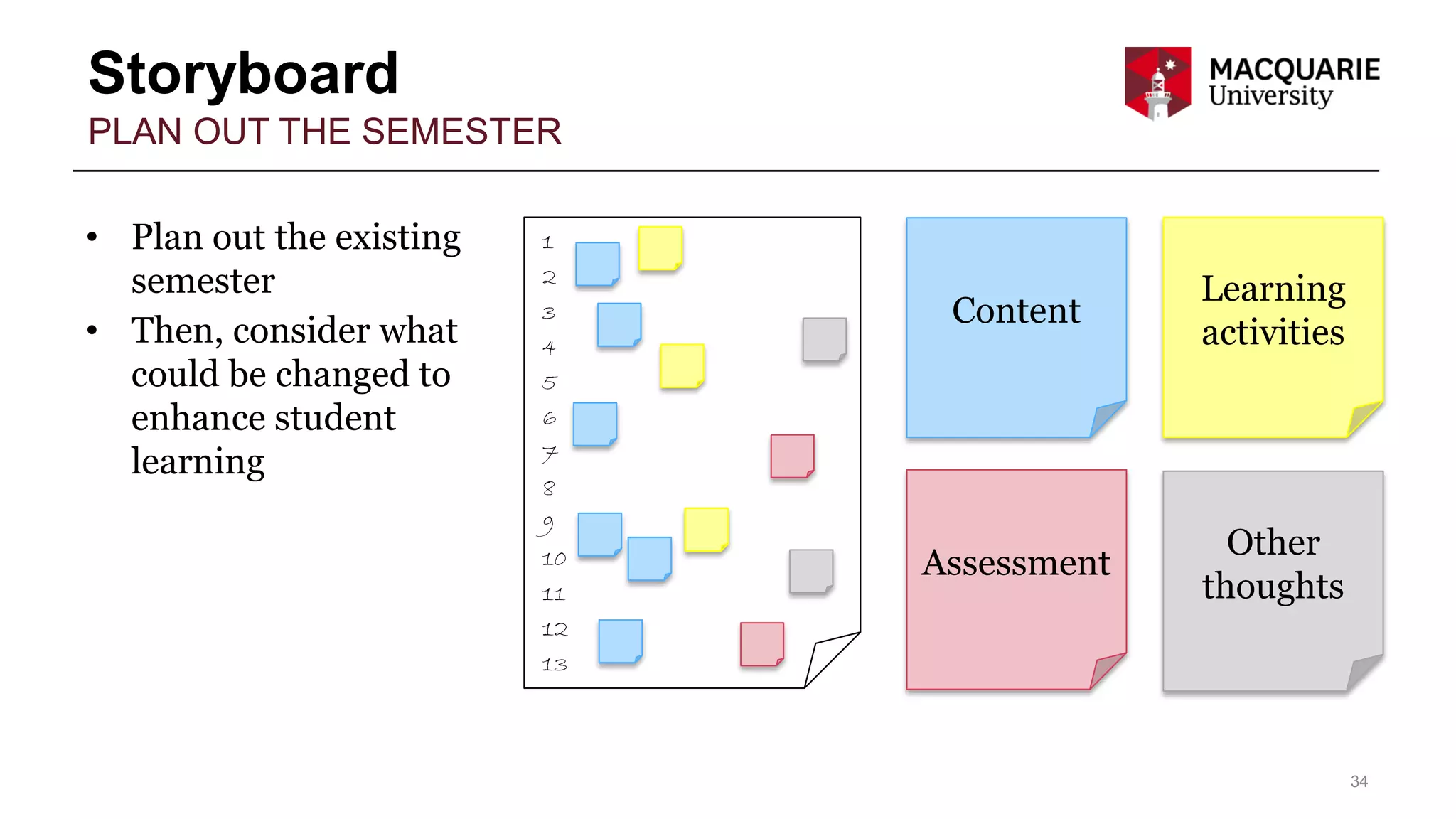
Storyboard
34
PLAN OUT THE SEMESTER
• Plan out the existing
semester
• Then, consider what
could be changed to
enhance student
learning
Other
thoughts
Assessment
Content
Learning
activities
1
2
3
4
5
6
7
8
9
10
11
12
13
Share your storyboard
35
REVIEWING DESIGNS
• Share your storyboard with the rest of the group
Next steps
WHAT NEXT FROM HERE?
Next steps
37
WHAT CAN I DO NOW?
• We can provide some resources…
• But really you need to experiment, try new things, work with a guide
Resources
38
FURTHER INSPIRATION
• Pharmacy at Monash
• PharmAcademy
• Pharmacy L&T journals – e.g. Currents in Pharmacy T&L
• Deans for impact
danny.liu@mq.edu.au

Flipped classrooms and more: How can we improve our teaching methods to enhance student learning?

  • 1.
    Flipped classrooms andmore HOW CAN WE IMPROVE OUR TEACHING METHODS TO ENHANCE STUDENT LEARNING? Wednesday 4 November 2015
  • 2.
    Before we getstarted 2 TELL US ABOUT YOUR STUDENTS AND YOUR UNITS • On a web-enabled device, visit: m.socrative.com Room code: 7528 • Or, scan this QR code:
  • 3.
  • 4.
    Smorgasbord 4OFFICE I FACULTYI DEPARTMENT A BUFFET OF IDEAS • Disclaimers: • Not everything will work in your context • Springboard for other ideas • No one ‘right way’
  • 5.
  • 6.
    The University ofSydney Page 6 First year biology – Who were our students? – Many degrees, many non-majors – Varied biology experience – Mostly school-leavers – What were the issues? – Didactic, transmission model – Low motivation, poor assessment & feedback practices, resources not helpful – Low overall satisfaction
  • 7.
    The University ofSydney Page 7 First year biology – before and after
  • 8.
    The University ofSydney Page 8 Whole curriculum design – Design principles – Integration of theory & practice – Focus on discipline practice – Students as junior colleagues – Curiosity & intrigue – Authentic exploration – real data, real experiments, real scenarios – Depth vs breadth – Feedback cycles – ‘Scaffolded’ – Streamlined resources – Consistency, safety
  • 9.
    The University ofSydney Page 9 Lectures – rethinking content and delivery – Content review – Depth vs breadth – 2 3 lectures per week – Revision ‘lectorials’ – No ‘flipping’ – Authenticity and relevance – Student work – (Hangout with a researcher)
  • 10.
    The University ofSydney Page 10 Lectures – chunking and active learning 12 1 2 3 4 567 8 9 10 11 Icebreaker Apply/diagnose understanding Apply/diagnose understanding Apply understanding Post-lecture survey
  • 11.
    The University ofSydney Page 11 Practicals – from recipe to inquiry – Choice and flexibility – Authentic scenarios – Guided exploration instead of recipes – Emphasise discovery process
  • 12.
    The University ofSydney Page 12 Practicals – support resources
  • 13.
    The University ofSydney Page 13 Practicals – it’s about the people – Demonstrator community and mentoring – Hiring, training – Mentoring – Ownership – Getting to know students – And attendance
  • 14.
    The University ofSydney Page 14 Assessments – Regular – Summative and also formative – Authenticity – Feedback and ‘feedforward’ – Peer review – Immediate/rapid – Rubrics – Moderation
  • 15.
    The University ofSydney Page 15 Assessment – Rapid feedback
  • 16.
    The University ofSydney Page 16 Online – collaborative spaces – Piazza
  • 17.
    The University ofSydney Page 17 Online – collaborative spaces – PeerWise
  • 18.
    The University ofSydney Page 18 Online – integrated experience – Support resources – Practice papers – Formative quizzes with immediate feedback – ‘testing effect’ – Guides and videos – ‘Online tutorial worksheets’ – Re-organisation of Blackboard – Highly integrated with face-to- face experience
  • 19.
    The University ofSydney Page 19 Personalised support – student relationship engagement system
  • 20.
    The University ofSydney Page 20 Translating to Pharmacy REDESIGNING FOR LEARNING
  • 21.
    Pharmacy PHAR1821 AND PHAR2811 •PHAR1821 – Elin • Who are your students? • What motivates them? • What are the key outcomes? • Where does teaching and learning take place? • What MUST be assessed? • What are the current challenges? 1 2 Team-forming workshop 3 Disability workshop 4 Pt exp. workshop 5 Pt exp. workshop 6 Oral presentation 7 Optional workshop Written report 8 Comms workshop 9 Learning styles workshop 10 11 Comms workshop 12 Workshop 13 Oral presentation
  • 22.
    Pharmacy PHAR1821 AND PHAR2811 •PHAR2811 – Bret • Who are your students? • What motivates them? • What are the key outcomes? • Where does teaching and learning take place? • What MUST be assessed? • What are the current challenges? 1 2 3 UV spec practical 4 Glucose assay practical Lab report 5 Enz. kinetics practical 6 Visualisation workshop 7 Enz. kinetics practical Lab report 8 Quiz, lab report 9 Sep. macromol. practical 10 Sep. macromol. practical 11 Lab report 12 13
  • 23.
    Structuring the curriculum 23 PRELIMINARYCONSIDERATION OF SOME PRINCIPLES • Some design principles to consider • Authenticity and discipline practice • Curiosity and intrigue • ‘Active learning’ • Integration between the various activities e.g. lectures, practicals, workshops, tutorials • Smaller, gradated, more ‘valid’ assessments • Feedback cycles • Leveraging assessments • Depth vs breadth • Support resources
  • 24.
    Flipping classes 24 MAKING THEMOST OF YOU • Behind the flipping hype • Most information transmission occurs outside of class • Class time is for active learning • Students need to complete pre/post work to fully benefit from class time
  • 25.
    Lectures 25 TALKING ≠ TEACHING,LISTENING ≠ LEARNING • What makes coming to lectures worthwhile? • Depth vs breadth • Cutting legacy content – PHAR1821 and PHAR2811 • Active learning • Chunking lecture time • Student response systems and other worthwhile activities • Flipping some content • Authenticity • Hanging out – PHAR1821 (pharmacist) and PHAR2811 (labs) • Lectorials every 3rd lecture slot
  • 26.
    Practicals, workshops, tutorials 26 MAKINGTHE MOST OF SMALL CLASSES • Authenticity, curiosity, intrigue • Providing real experiences – PHAR1821 role plays, PHAR2811 • Asking real questions • Integration with other aspects of the unit • Support resources • Pre-work, post-work • Assessment • What are the necessary outcomes? PHAR2811 labs • Staff community
  • 27.
    Assessment 27 ASSESSMENT DRIVES LEARNING,(UN?)FORTUNATELY • Feedback cycles • Early review – PHAR1821 report draft, rubric review • Peer review – PHAR1821 oral presentations and report • Personalised feedback – PHAR2811 mid-semester quiz • Support materials – PHAR2811 online quizzes • Marks ≠ feedback • Increasing feedback efficiency – technology, rubrics, group feedback, peer feedback
  • 28.
    Assessment 28 ASSESSMENT DRIVES LEARNING,(UN?)FORTUNATELY • Smaller, gradated assessments • Reconsider final exam weighting • Nominal summative assessments – e.g. pre-work • Build ‘self-efficacy’ • Authenticity • Student autonomy • Choice, openness, variety (not just lab reports)
  • 29.
  • 30.
    Online 30 ANYTIME SUPPORTING RESOURCES •Integration • Reorganising Blackboard sites – truly ‘blended’ experience • Adding authenticity – e.g. voices, perspectives, student-generated resources • Collaborative spaces • Personalised support • Support resources • Supporting assessment preparation - e.g. exemplars, guides, videos, forums • Webinars – e.g. revision • Pre and/or post work (quizzes, videos, lessons)
  • 31.
    Online – videosand lessons 31 EXAMPLES FROM ZAPTION AND SMARTSPARROW
  • 32.
  • 33.
    Pick a unitof study 33 FOR DIRECTED BRAINSTORMING • In your groups, nominate a unit of study that you wish to work on • Students • Who are your students? • What motivates them? • Outcomes • What are the key concepts and competencies of the unit? • What activities must the students complete to achieve these? • Environment • Where will teaching and learning take place? • Assessment • What MUST be assessed? • What feedback strategies could be used? • What are the current challenges?
  • 34.
    Storyboard 34 PLAN OUT THESEMESTER • Plan out the existing semester • Then, consider what could be changed to enhance student learning Other thoughts Assessment Content Learning activities 1 2 3 4 5 6 7 8 9 10 11 12 13
  • 35.
    Share your storyboard 35 REVIEWINGDESIGNS • Share your storyboard with the rest of the group
  • 36.
  • 37.
    Next steps 37 WHAT CANI DO NOW? • We can provide some resources… • But really you need to experiment, try new things, work with a guide
  • 38.
    Resources 38 FURTHER INSPIRATION • Pharmacyat Monash • PharmAcademy • Pharmacy L&T journals – e.g. Currents in Pharmacy T&L • Deans for impact
  • 39.