How to make Education more
relevant (and fun)
Fred Verboon
Director
Our students are changing
• The “21st century learner”:
– Prefers internet for research
– Learns from images, sound, colours
– Communicates via social media
– Searches Twitter for the lastest news
* Purcell, K. , Rainie, L., Heaps, A., Buchanan, J., Friedrich, L., Jacklin, A., Chen, C., Zickuhr, K., (2012),
PEW Research Center (2012): How Teens Do Research in the Digital World
Our economy is changing
• Unified Europe:
– New markets, different cultures, new languages
• Internet changes economies:
– Consumers can and will compare online
– Online markets change distribution channels (retail)
– Changes communications: postal services, telephony
• Internet changes value perceptions:
– If information is always available, you need to differentiate.
– Creativity, branding, image becomes valuable
– Production is not a differentiating factor and out sourced to low
income countries
The role of teachers is changing
• Children have all the information they want, anytime,
anywhere
• Teachers no longer are the experts or primary source for
information
• Teachers do know…….
– where to find relevant information
– that information is sometimes biased
– how to combine and reflect on information
– how to learn and set personalized learning goals
• Teachers will become learning coaches, aimed at realizing
personal potental of each student
The 21st century learner
Today, we..
•educate by lecturing, while the majority of
lectures is available online,
•still build schools with class rooms, so we can
continue lecturing,
•ask children to be quiet and listen….
The school heads perspective:
How can we make people
feel that they belong at school,
work towards clear goals and feel
appreciated
Education changes:
Pisa 2018: focus on 21st century skills.
Government change education policies
Can school heads change their schools?
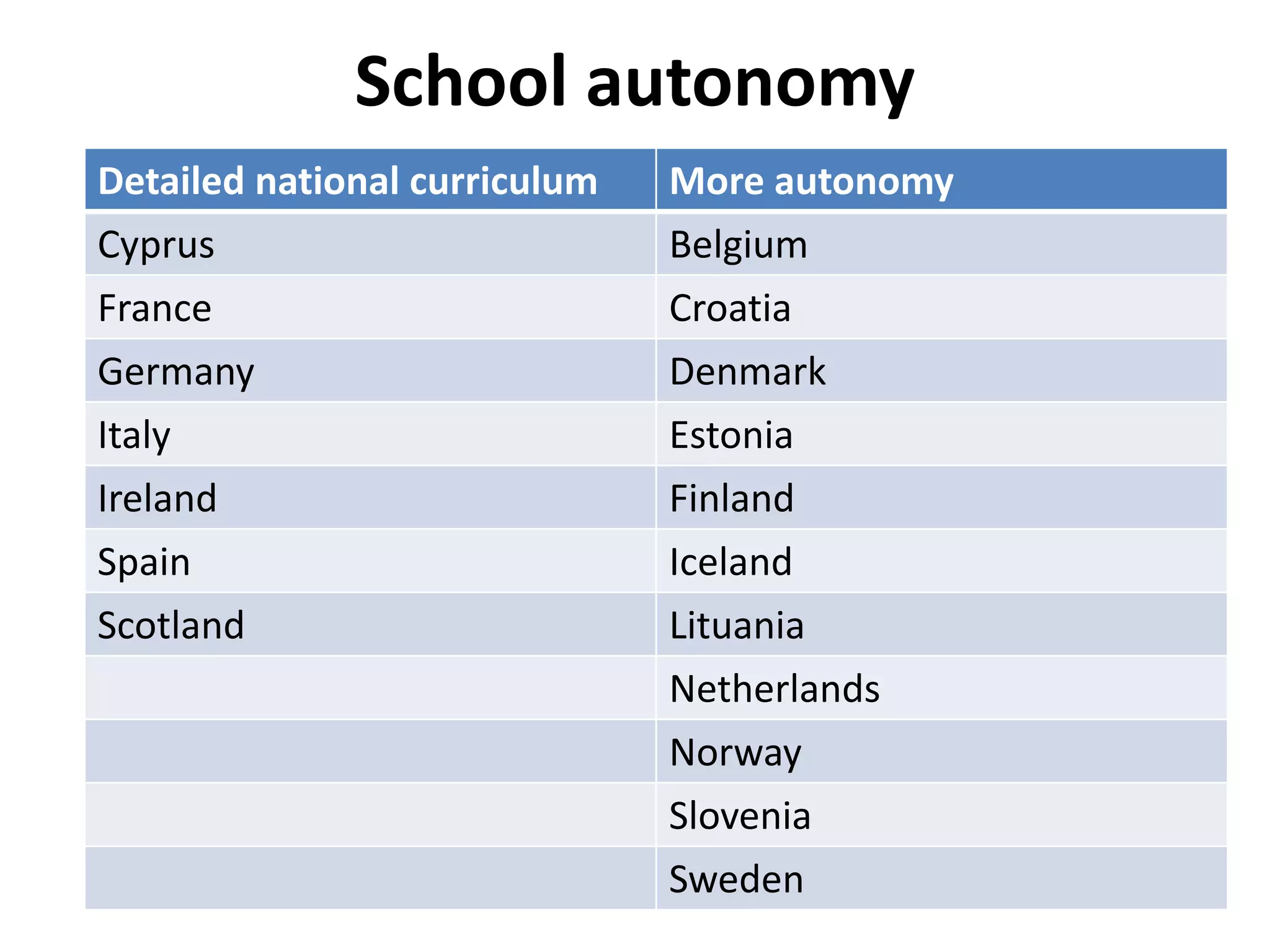
School autonomy
Detailed national curriculum More autonomy
Cyprus Belgium
France Croatia
Germany Denmark
Italy Estonia
Ireland Finland
Spain Iceland
Scotland Lituania
Netherlands
Norway
Slovenia
Sweden
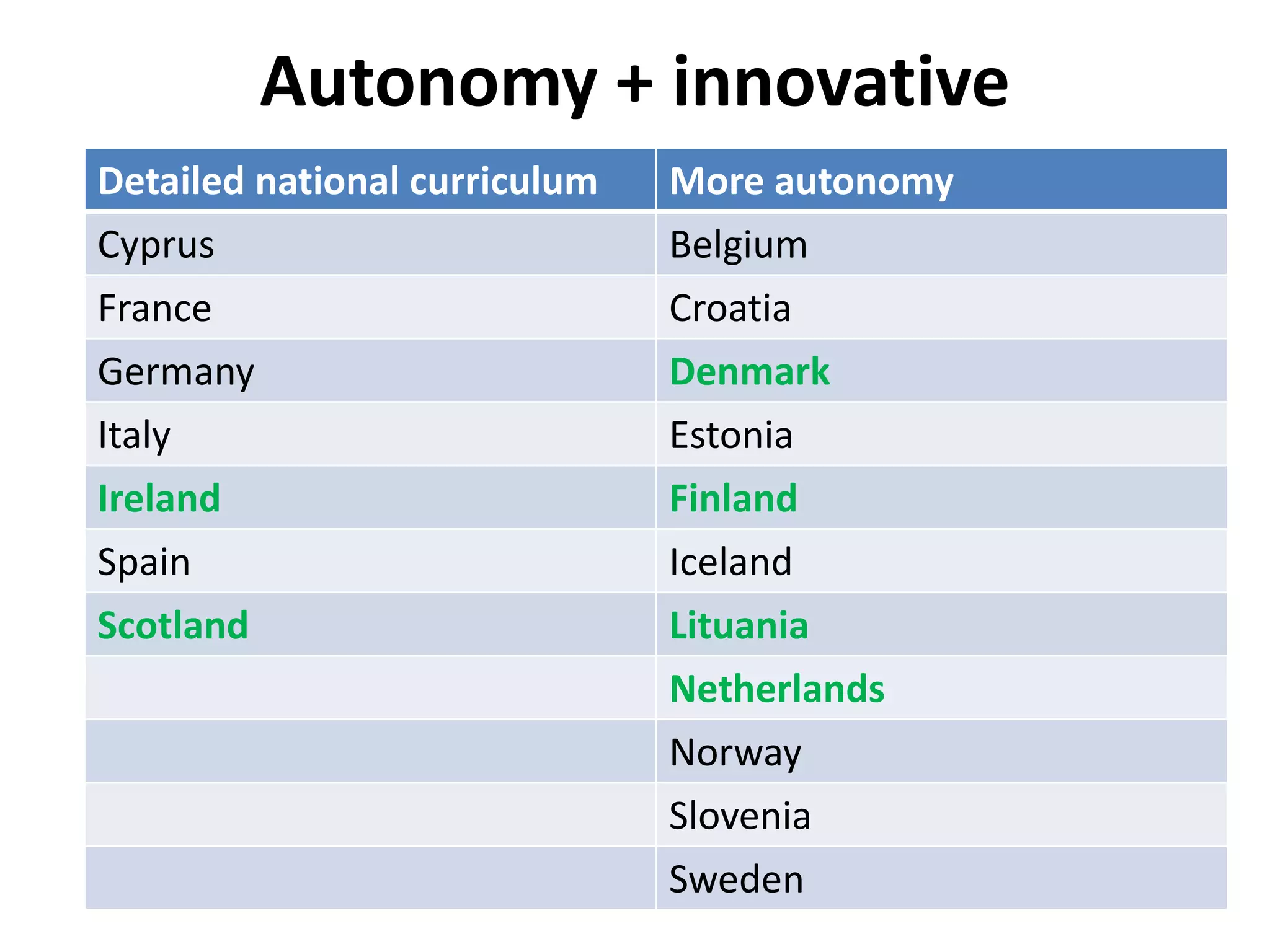
Autonomy + innovative
Detailed national curriculum More autonomy
Cyprus Belgium
France Croatia
Germany Denmark
Italy Estonia
Ireland Finland
Spain Iceland
Scotland Lituania
Netherlands
Norway
Slovenia
Sweden
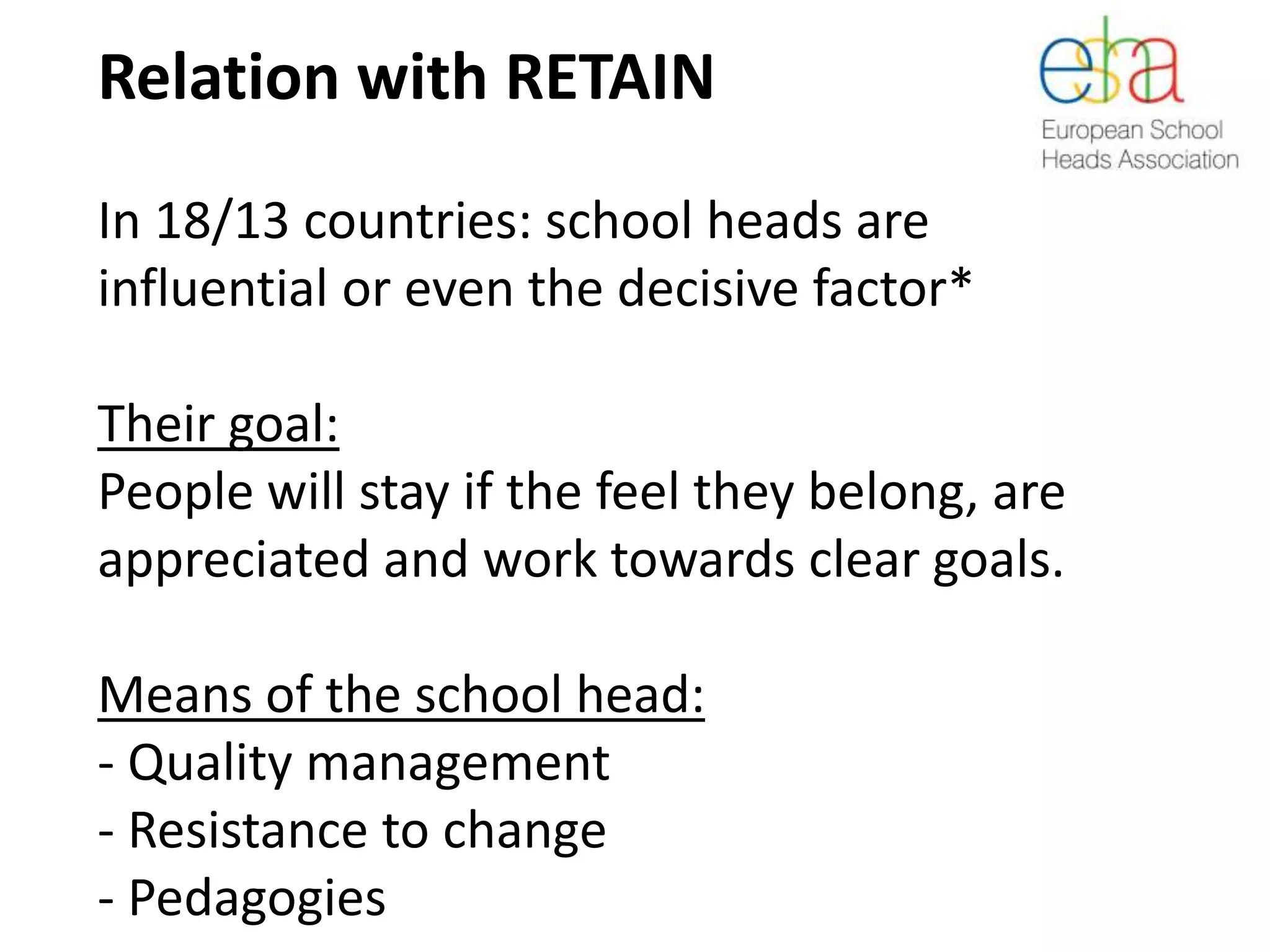
Relation with RETAIN
In 18/13 countries: school heads are
influential or even the decisive factor*
Their goal:
People will stay if the feel they belong, are
appreciated and work towards clear goals.
Means of the school head:
- Quality management
- Resistance to change
- Pedagogies
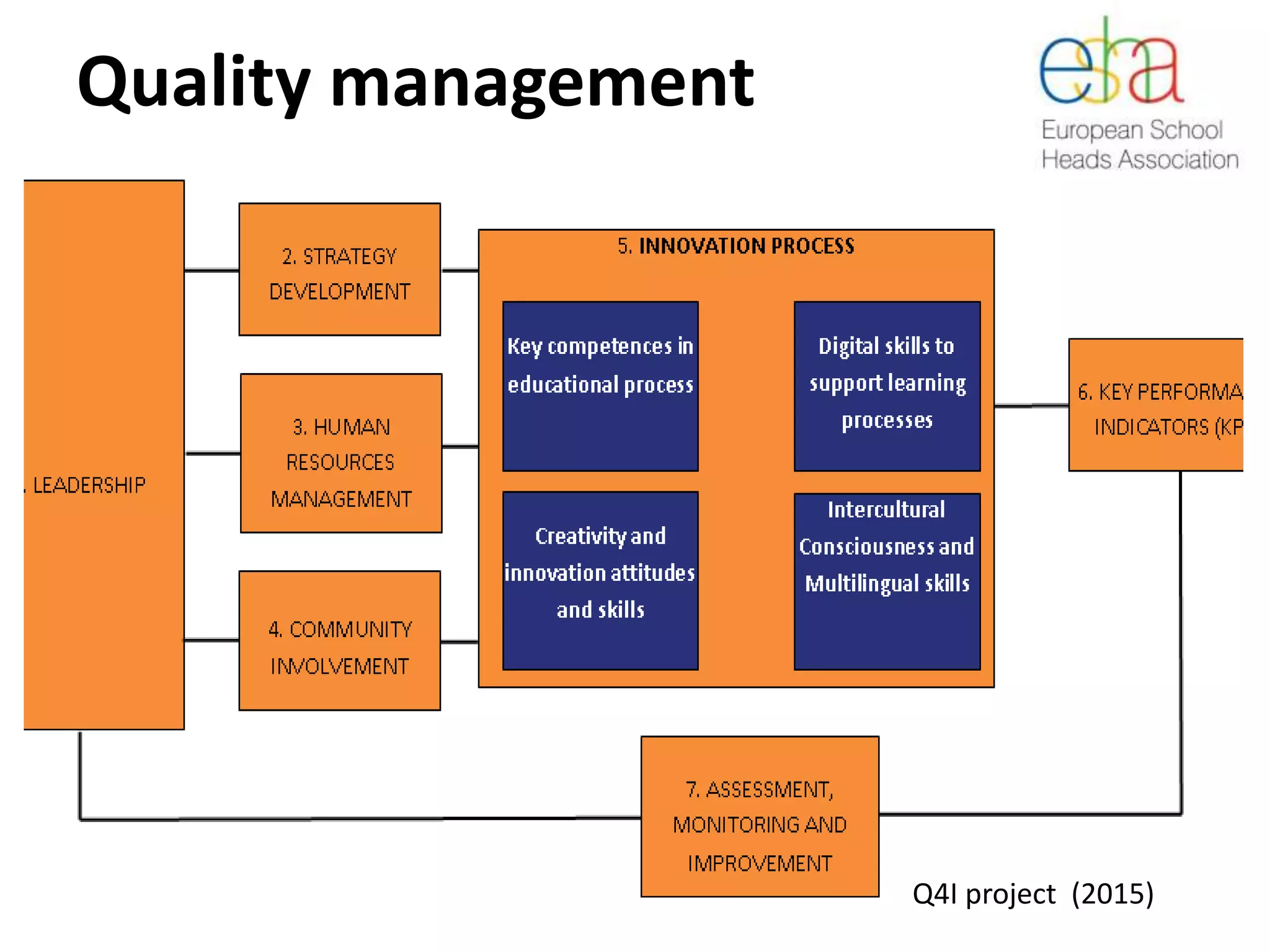
Quality management
Q4I project (2015)
Quality management
- Identity: sense of belonging
- Goals: sense of achievement
- Personal Growth Plans:
can a teacher stop learning?
Resistance to change
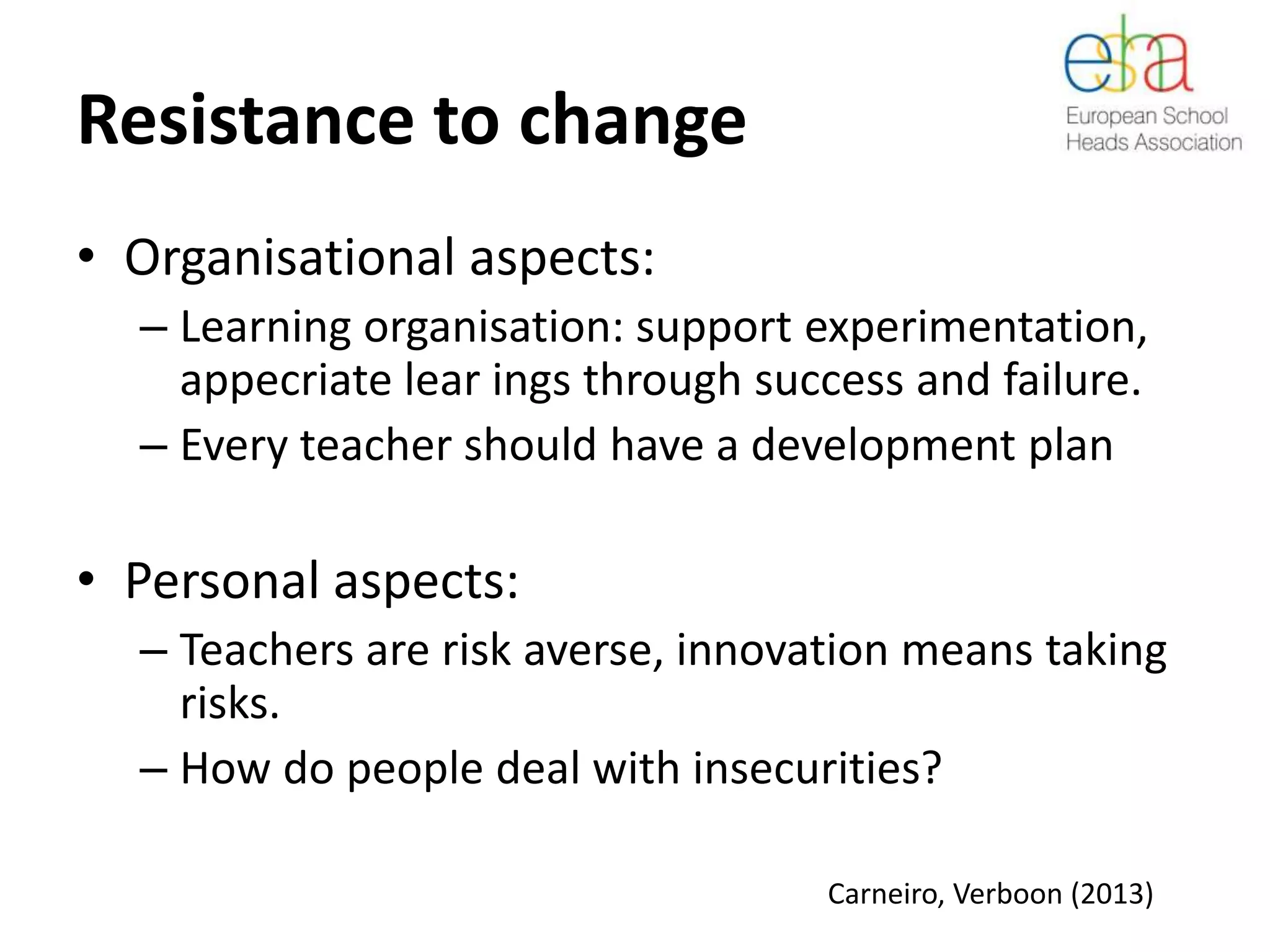
• Organisational aspects:
– Learning organisation: support experimentation,
appecriate lear ings through success and failure.
– Every teacher should have a development plan
• Personal aspects:
– Teachers are risk averse, innovation means taking
risks.
– How do people deal with insecurities?
Carneiro, Verboon (2013)
Resistance to change
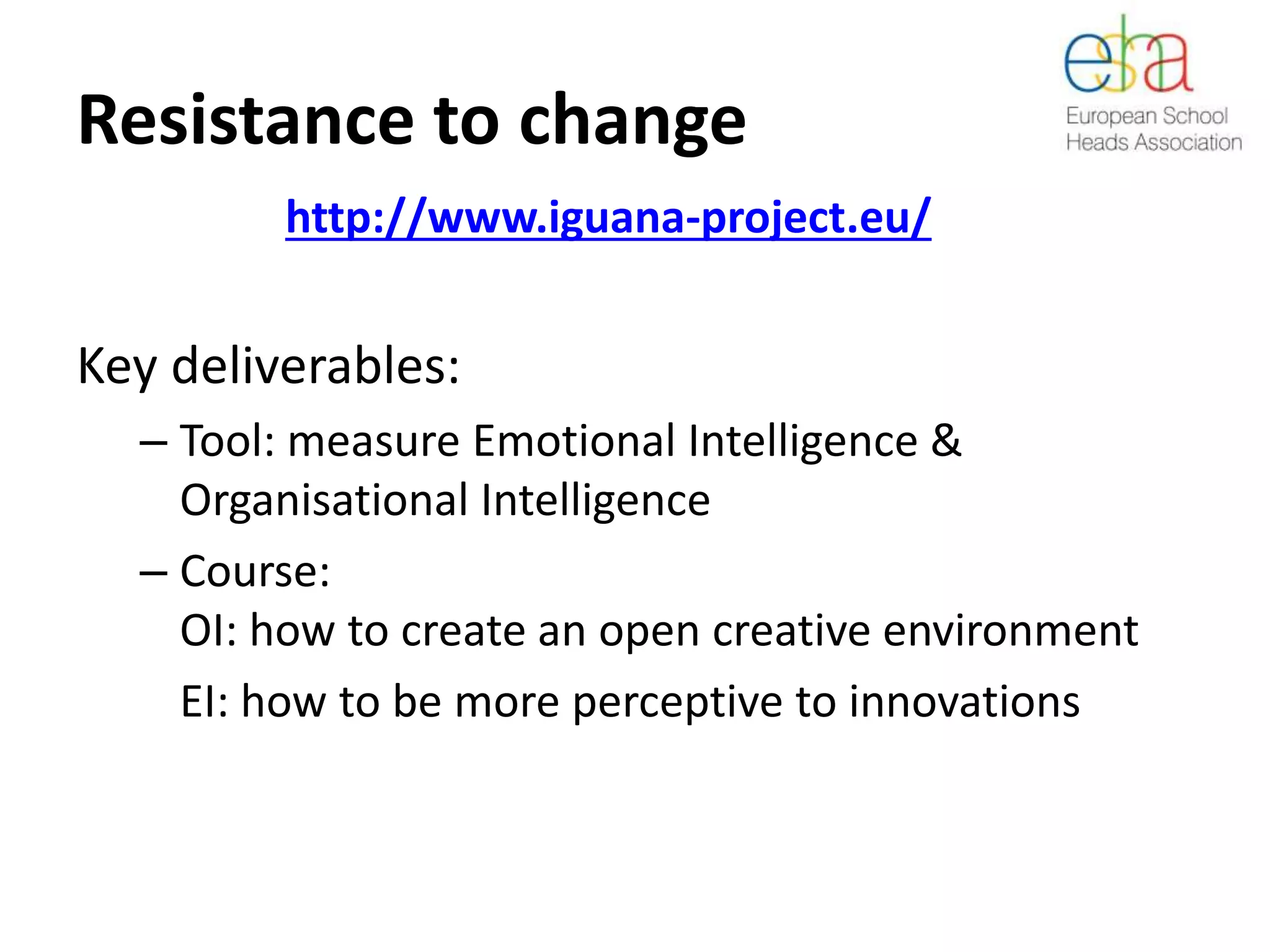
Key deliverables:
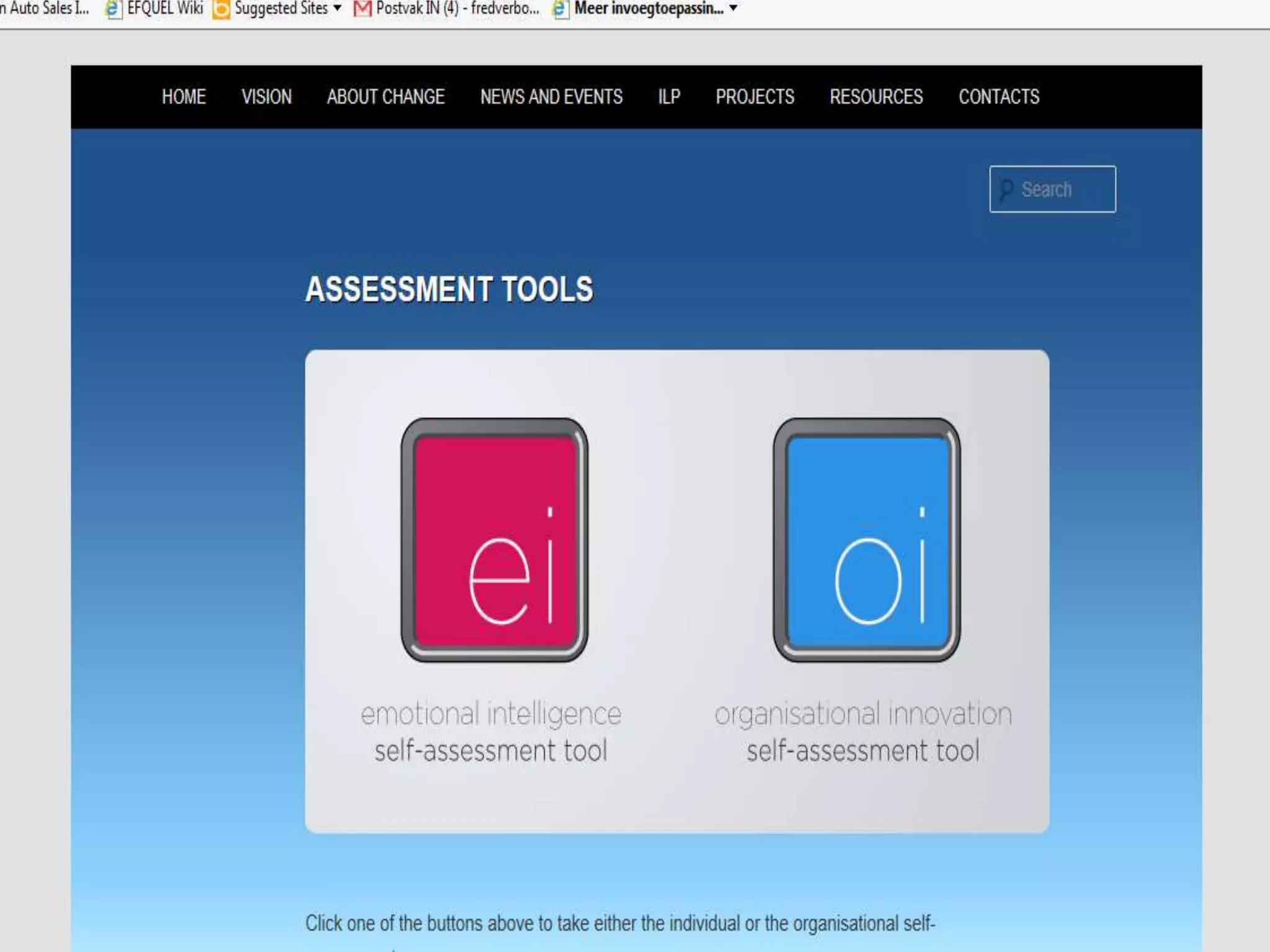
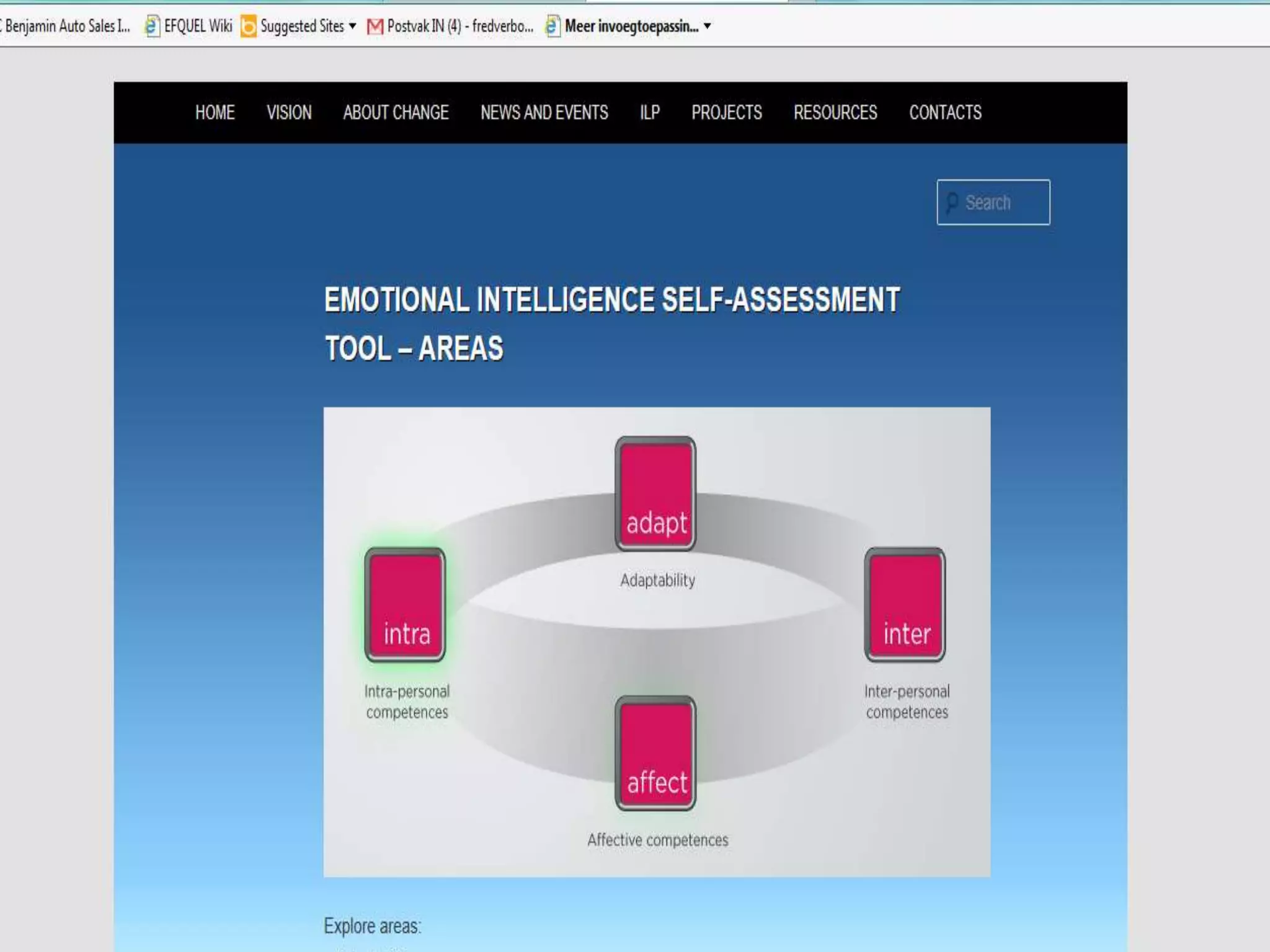
– Tool: measure Emotional Intelligence &
Organisational Intelligence
– Course:
OI: how to create an open creative environment
EI: how to be more perceptive to innovations
http://www.iguana-project.eu/
Pedagogies for 21st century schools
• Focus on learn to learn
• Learning is fun and challenging
• 21st Century skills (Information Literacy, Problem-solving, Creativity and
experimentation)
• Attitudes and values
– Curiosity
– Differences and change are celebrated (Individual learning goals)
– Not necessarily to find a ‘correct’ answer (Focus on rewarding students, no
public grading)
– Every student feels important
– Active classroom learning
• Teachers as Model Lifelong Learners
• Education is organized both horizontally and vertically
Are 21st century schools successful?
• Research: 20 high performing colleges and
universities
– engage students individually: Staff know their
students: who they are, where they came from,
what motivates and inspires the students and
where they hope to go.
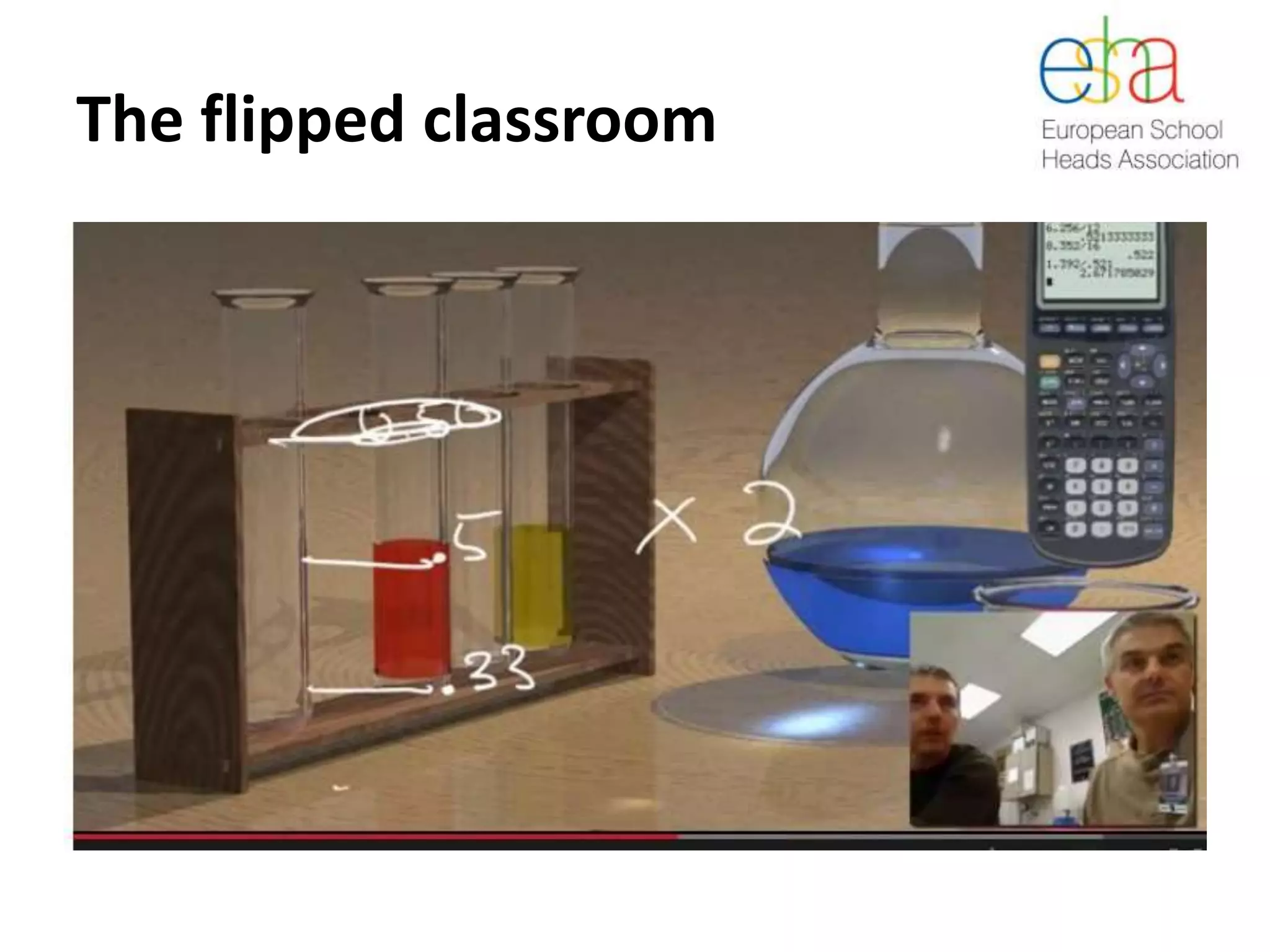
– faculty focus on active classroom learning
(Flipping Classrooms project, Entrepreneurial
learning)
Iowa State University research
The flipped classroom
Entrepreneurial learning process
• Students go through an actual entrepreneurial
learning process in which they influence and
own their individual learning path*.
• Students actively participate in and even lead
their learning efforts.
• Entrepreneurial learning is the opposite of
traditional classroom learning.
* Kyrö, 2005
EE relevance
• Entrepreneurial education leads to an increase
in perceived relevancy, engagement and
motivation
• For both students and teachers
(Surlemont, 2007)

How to make Education more relevant (and fun)

  • 1.
    How to makeEducation more relevant (and fun) Fred Verboon Director
  • 2.
    Our students arechanging • The “21st century learner”: – Prefers internet for research – Learns from images, sound, colours – Communicates via social media – Searches Twitter for the lastest news * Purcell, K. , Rainie, L., Heaps, A., Buchanan, J., Friedrich, L., Jacklin, A., Chen, C., Zickuhr, K., (2012), PEW Research Center (2012): How Teens Do Research in the Digital World
  • 3.
    Our economy ischanging • Unified Europe: – New markets, different cultures, new languages • Internet changes economies: – Consumers can and will compare online – Online markets change distribution channels (retail) – Changes communications: postal services, telephony • Internet changes value perceptions: – If information is always available, you need to differentiate. – Creativity, branding, image becomes valuable – Production is not a differentiating factor and out sourced to low income countries
  • 4.
    The role ofteachers is changing • Children have all the information they want, anytime, anywhere • Teachers no longer are the experts or primary source for information • Teachers do know……. – where to find relevant information – that information is sometimes biased – how to combine and reflect on information – how to learn and set personalized learning goals • Teachers will become learning coaches, aimed at realizing personal potental of each student
  • 5.
  • 6.
    Today, we.. •educate bylecturing, while the majority of lectures is available online, •still build schools with class rooms, so we can continue lecturing, •ask children to be quiet and listen….
  • 7.
    The school headsperspective: How can we make people feel that they belong at school, work towards clear goals and feel appreciated
  • 8.
    Education changes: Pisa 2018:focus on 21st century skills. Government change education policies Can school heads change their schools?
  • 9.
    School autonomy Detailed nationalcurriculum More autonomy Cyprus Belgium France Croatia Germany Denmark Italy Estonia Ireland Finland Spain Iceland Scotland Lituania Netherlands Norway Slovenia Sweden
  • 10.
    Autonomy + innovative Detailednational curriculum More autonomy Cyprus Belgium France Croatia Germany Denmark Italy Estonia Ireland Finland Spain Iceland Scotland Lituania Netherlands Norway Slovenia Sweden
  • 11.
    Relation with RETAIN In18/13 countries: school heads are influential or even the decisive factor* Their goal: People will stay if the feel they belong, are appreciated and work towards clear goals. Means of the school head: - Quality management - Resistance to change - Pedagogies
  • 12.
  • 13.
    Quality management - Identity:sense of belonging - Goals: sense of achievement - Personal Growth Plans: can a teacher stop learning?
  • 14.
    Resistance to change •Organisational aspects: – Learning organisation: support experimentation, appecriate lear ings through success and failure. – Every teacher should have a development plan • Personal aspects: – Teachers are risk averse, innovation means taking risks. – How do people deal with insecurities? Carneiro, Verboon (2013)
  • 15.
    Resistance to change Keydeliverables: – Tool: measure Emotional Intelligence & Organisational Intelligence – Course: OI: how to create an open creative environment EI: how to be more perceptive to innovations http://www.iguana-project.eu/
  • 18.
    Pedagogies for 21stcentury schools • Focus on learn to learn • Learning is fun and challenging • 21st Century skills (Information Literacy, Problem-solving, Creativity and experimentation) • Attitudes and values – Curiosity – Differences and change are celebrated (Individual learning goals) – Not necessarily to find a ‘correct’ answer (Focus on rewarding students, no public grading) – Every student feels important – Active classroom learning • Teachers as Model Lifelong Learners • Education is organized both horizontally and vertically
  • 19.
    Are 21st centuryschools successful? • Research: 20 high performing colleges and universities – engage students individually: Staff know their students: who they are, where they came from, what motivates and inspires the students and where they hope to go. – faculty focus on active classroom learning (Flipping Classrooms project, Entrepreneurial learning) Iowa State University research
  • 20.
  • 21.
    Entrepreneurial learning process •Students go through an actual entrepreneurial learning process in which they influence and own their individual learning path*. • Students actively participate in and even lead their learning efforts. • Entrepreneurial learning is the opposite of traditional classroom learning. * Kyrö, 2005
  • 22.
    EE relevance • Entrepreneurialeducation leads to an increase in perceived relevancy, engagement and motivation • For both students and teachers (Surlemont, 2007)

Editor's Notes

  • #3 A part of learning how to learn and becoming an independent learner involves learning how to handle information from multiple sources of information and make links between these sources and different subject areas.   In many schools students are fluent users of the Internet, but the term ‘information literacy’ encapsulates a great deal more than information technology. It includes recognition of the need for information. It involves collecting, analysing and organising information from multiple sources and the ability to pose appropriate questions and integrate the information.  
  • #4 A part of learning how to learn and becoming an independent learner involves learning how to handle information from multiple sources of information and make links between these sources and different subject areas.   In many schools students are fluent users of the Internet, but the term ‘information literacy’ encapsulates a great deal more than information technology. It includes recognition of the need for information. It involves collecting, analysing and organising information from multiple sources and the ability to pose appropriate questions and integrate the information.  
  • #5 A part of learning how to learn and becoming an independent learner involves learning how to handle information from multiple sources of information and make links between these sources and different subject areas.   In many schools students are fluent users of the Internet, but the term ‘information literacy’ encapsulates a great deal more than information technology. It includes recognition of the need for information. It involves collecting, analysing and organising information from multiple sources and the ability to pose appropriate questions and integrate the information.