6. Alkenes: Structure
and Reactivity
Based on McMurry’s Organic Chemistry, 7th edition
2
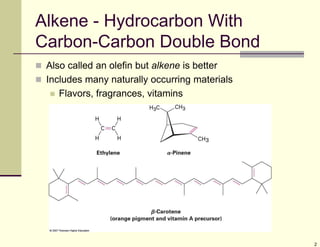
Alkene - Hydrocarbon With
Carbon-Carbon Double Bond
 Also called an olefin but alkene is better
 Includes many naturally occurring materials
 Flavors, fragrances, vitamins
3
Why this Chapter?
 C-C double bonds are present in most
organic and biological molecules
 To examine consequences of alkene
stereoisomerism
 To focus on general alkene reaction:
electrophilic addition
4
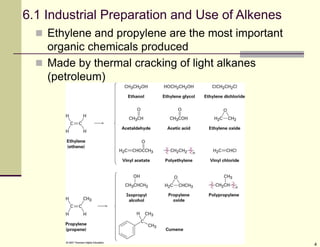
6.1 Industrial Preparation and Use of Alkenes
 Ethylene and propylene are the most important
organic chemicals produced
 Made by thermal cracking of light alkanes
(petroleum)
5
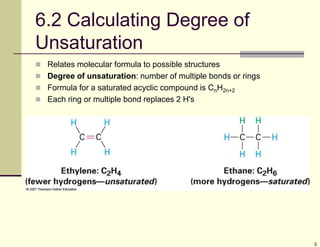
6.2 Calculating Degree of
Unsaturation
 Relates molecular formula to possible structures
 Degree of unsaturation: number of multiple bonds or rings
 Formula for a saturated acyclic compound is CnH2n+2
 Each ring or multiple bond replaces 2 H's
6
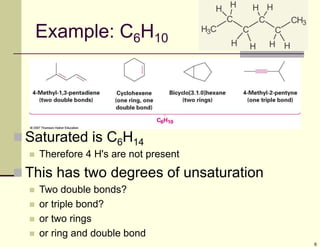
Example: C6H10
 Saturated is C6H14
 Therefore 4 H's are not present
 This has two degrees of unsaturation
 Two double bonds?
 or triple bond?
 or two rings
 or ring and double bond
7
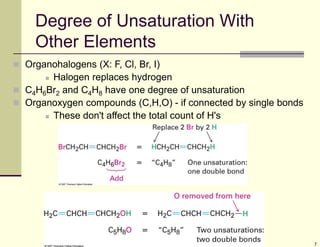
Degree of Unsaturation With
Other Elements
 Organohalogens (X: F, Cl, Br, I)
 Halogen replaces hydrogen
 C4H6Br2 and C4H8 have one degree of unsaturation
 Organoxygen compounds (C,H,O) - if connected by single bonds
 These don't affect the total count of H's
8
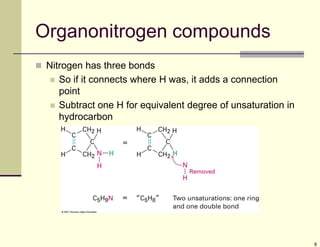
Organonitrogen compounds
 Nitrogen has three bonds
 So if it connects where H was, it adds a connection
point
 Subtract one H for equivalent degree of unsaturation in
hydrocarbon
9
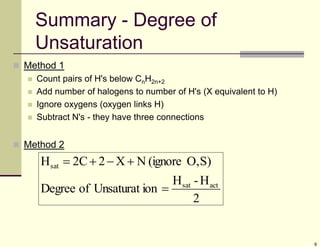
 Method 1
 Count pairs of H's below CnH2n+2
 Add number of halogens to number of H's (X equivalent to H)
 Ignore oxygens (oxygen links H)
 Subtract N's - they have three connections
 Method 2
Summary - Degree of
Unsaturation
2
H
-
H
ion
Unsaturat
of
Degree
S)
O,
(ignore
N
X
2
2C
H
act
sat
sat





10
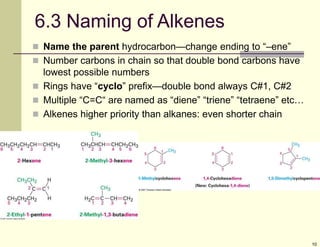
6.3 Naming of Alkenes
 Name the parent hydrocarbon—change ending to “–ene”
 Number carbons in chain so that double bond carbons have
lowest possible numbers
 Rings have “cyclo” prefix—double bond always C#1, C#2
 Multiple “C=C“ are named as “diene” “triene” “tetraene” etc…
 Alkenes higher priority than alkanes: even shorter chain
11
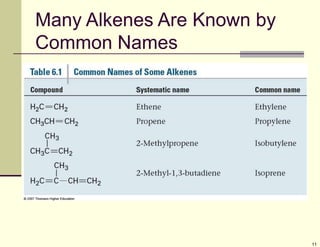
Many Alkenes Are Known by
Common Names
12
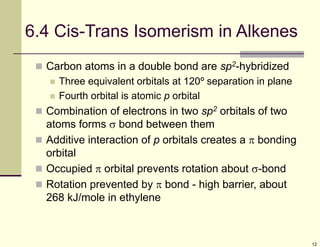
6.4 Cis-Trans Isomerism in Alkenes
 Carbon atoms in a double bond are sp2-hybridized
 Three equivalent orbitals at 120º separation in plane
 Fourth orbital is atomic p orbital
 Combination of electrons in two sp2 orbitals of two
atoms forms  bond between them
 Additive interaction of p orbitals creates a  bonding
orbital
 Occupied  orbital prevents rotation about -bond
 Rotation prevented by  bond - high barrier, about
268 kJ/mole in ethylene
13
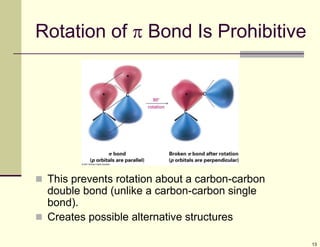
Rotation of  Bond Is Prohibitive
 This prevents rotation about a carbon-carbon
double bond (unlike a carbon-carbon single
bond).
 Creates possible alternative structures
14
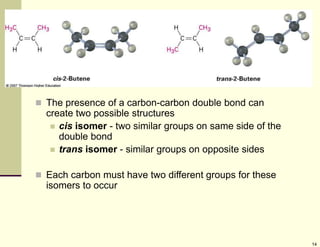
 The presence of a carbon-carbon double bond can
create two possible structures
 cis isomer - two similar groups on same side of the
double bond
 trans isomer - similar groups on opposite sides
 Each carbon must have two different groups for these
isomers to occur
15
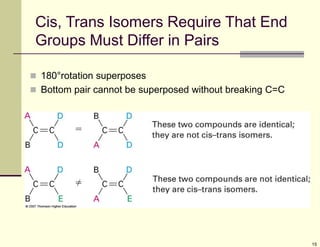
Cis, Trans Isomers Require That End
Groups Must Differ in Pairs
 180°rotation superposes
 Bottom pair cannot be superposed without breaking C=C
16
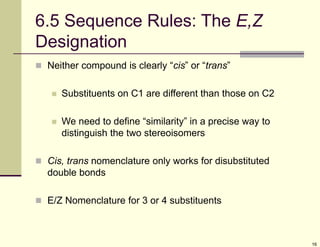
6.5 Sequence Rules: The E,Z
Designation
 Neither compound is clearly “cis” or “trans”
 Substituents on C1 are different than those on C2
 We need to define “similarity” in a precise way to
distinguish the two stereoisomers
 Cis, trans nomenclature only works for disubstituted
double bonds
 E/Z Nomenclature for 3 or 4 substituents
17
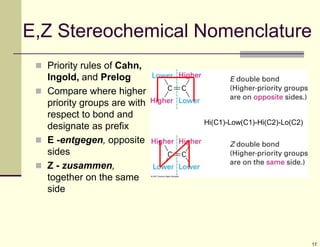
E,Z Stereochemical Nomenclature
 Priority rules of Cahn,
Ingold, and Prelog
 Compare where higher
priority groups are with
respect to bond and
designate as prefix
 E -entgegen, opposite
sides
 Z - zusammen,
together on the same
side
Hi(C1)-Low(C1)-Hi(C2)-Lo(C2)
18
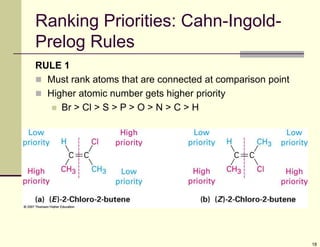
Ranking Priorities: Cahn-Ingold-
Prelog Rules
RULE 1
 Must rank atoms that are connected at comparison point
 Higher atomic number gets higher priority
 Br > Cl > S > P > O > N > C > H
19
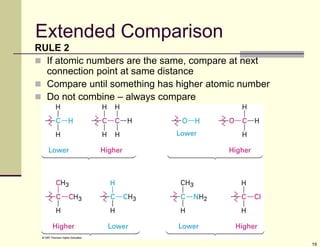
RULE 2
 If atomic numbers are the same, compare at next
connection point at same distance
 Compare until something has higher atomic number
 Do not combine – always compare
Extended Comparison
20
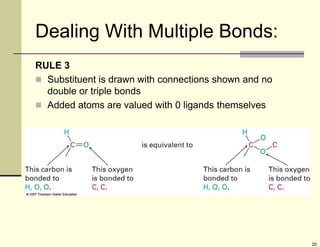
RULE 3
 Substituent is drawn with connections shown and no
double or triple bonds
 Added atoms are valued with 0 ligands themselves
Dealing With Multiple Bonds:
21
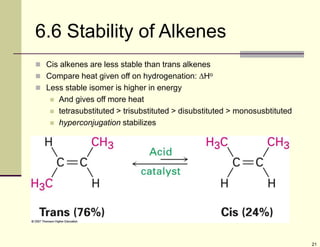
6.6 Stability of Alkenes
 Cis alkenes are less stable than trans alkenes
 Compare heat given off on hydrogenation: Ho
 Less stable isomer is higher in energy
 And gives off more heat
 tetrasubstituted > trisubstituted > disubstituted > monosusbtituted
 hyperconjugation stabilizes
22
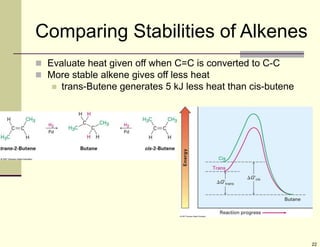
Comparing Stabilities of Alkenes
 Evaluate heat given off when C=C is converted to C-C
 More stable alkene gives off less heat
 trans-Butene generates 5 kJ less heat than cis-butene
23
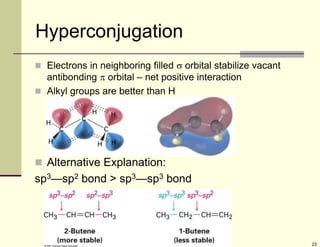
Hyperconjugation
 Electrons in neighboring filled  orbital stabilize vacant
antibonding  orbital – net positive interaction
 Alkyl groups are better than H
 Alternative Explanation:
sp3—sp2 bond > sp3—sp3 bond
24
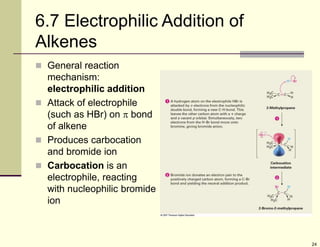
6.7 Electrophilic Addition of
Alkenes
 General reaction
mechanism:
electrophilic addition
 Attack of electrophile
(such as HBr) on  bond
of alkene
 Produces carbocation
and bromide ion
 Carbocation is an
electrophile, reacting
with nucleophilic bromide
ion
25
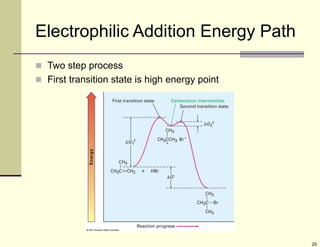
 Two step process
 First transition state is high energy point
Electrophilic Addition Energy Path
26
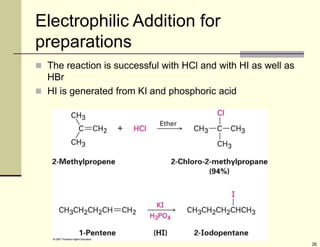
Electrophilic Addition for
preparations
 The reaction is successful with HCl and with HI as well as
HBr
 HI is generated from KI and phosphoric acid
27
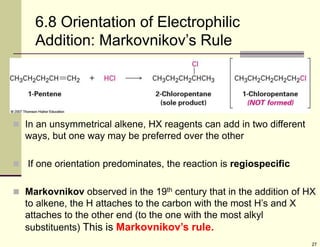
6.8 Orientation of Electrophilic
Addition: Markovnikov’s Rule
 In an unsymmetrical alkene, HX reagents can add in two different
ways, but one way may be preferred over the other
 If one orientation predominates, the reaction is regiospecific
 Markovnikov observed in the 19th century that in the addition of HX
to alkene, the H attaches to the carbon with the most H’s and X
attaches to the other end (to the one with the most alkyl
substituents) This is Markovnikov’s rule.
28
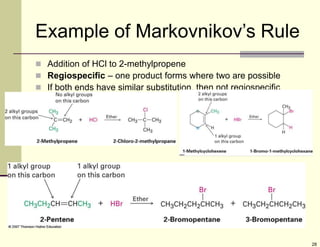
 Addition of HCl to 2-methylpropene
 Regiospecific – one product forms where two are possible
 If both ends have similar substitution, then not regiospecific
Example of Markovnikov’s Rule
29
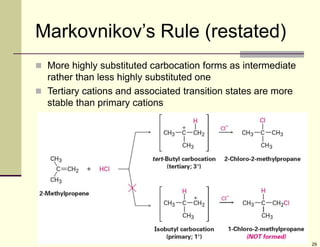
Markovnikov’s Rule (restated)
 More highly substituted carbocation forms as intermediate
rather than less highly substituted one
 Tertiary cations and associated transition states are more
stable than primary cations
30
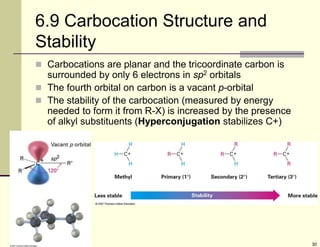
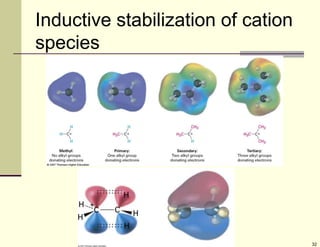
6.9 Carbocation Structure and
Stability
 Carbocations are planar and the tricoordinate carbon is
surrounded by only 6 electrons in sp2 orbitals
 The fourth orbital on carbon is a vacant p-orbital
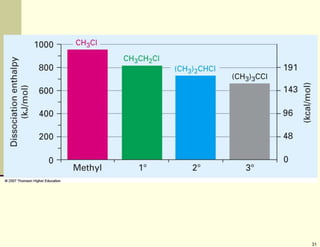
 The stability of the carbocation (measured by energy
needed to form it from R-X) is increased by the presence
of alkyl substituents (Hyperconjugation stabilizes C+)
31
32
Inductive stabilization of cation
species
33
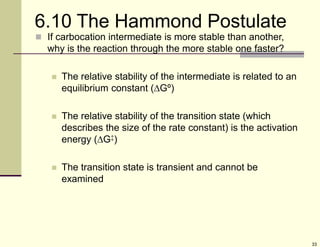
6.10 The Hammond Postulate
 If carbocation intermediate is more stable than another,
why is the reaction through the more stable one faster?
 The relative stability of the intermediate is related to an
equilibrium constant (Gº)
 The relative stability of the transition state (which
describes the size of the rate constant) is the activation
energy (G‡)
 The transition state is transient and cannot be
examined
34
Transition State Structures
 A transition state is the highest energy species in a
reaction step
 By definition, its structure is not stable enough to exist for
one vibration
 But the structure controls the rate of reaction
 So we need to be able to guess about its properties in an
informed way
 We classify them in general ways and look for trends in
reactivity – the conclusions are in the Hammond Postulate
 “The structure of the transition state resembles the
structure of the nearest stable species. T.S. for
Endergonic steps resemble products. T.S. for Exergonic
steps resemble reactants.”
35
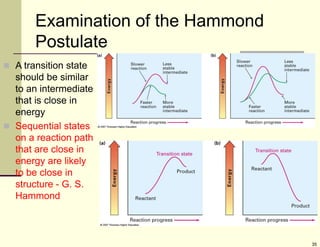
Examination of the Hammond
Postulate
 A transition state
should be similar
to an intermediate
that is close in
energy
 Sequential states
on a reaction path
that are close in
energy are likely
to be close in
structure - G. S.
Hammond
36
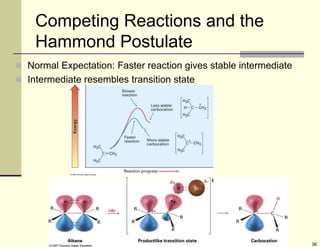
Competing Reactions and the
Hammond Postulate
 Normal Expectation: Faster reaction gives stable intermediate
 Intermediate resembles transition state
37
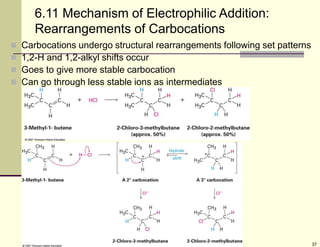
6.11 Mechanism of Electrophilic Addition:
Rearrangements of Carbocations
 Carbocations undergo structural rearrangements following set patterns
 1,2-H and 1,2-alkyl shifts occur
 Goes to give more stable carbocation
 Can go through less stable ions as intermediates
38
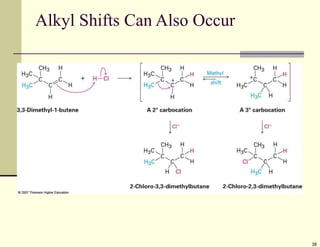
Alkyl Shifts Can Also Occur

chapter-alkene.ppt

  • 1.
    6. Alkenes: Structure andReactivity Based on McMurry’s Organic Chemistry, 7th edition
  • 2.
    2 Alkene - HydrocarbonWith Carbon-Carbon Double Bond  Also called an olefin but alkene is better  Includes many naturally occurring materials  Flavors, fragrances, vitamins
  • 3.
    3 Why this Chapter? C-C double bonds are present in most organic and biological molecules  To examine consequences of alkene stereoisomerism  To focus on general alkene reaction: electrophilic addition
  • 4.
    4 6.1 Industrial Preparationand Use of Alkenes  Ethylene and propylene are the most important organic chemicals produced  Made by thermal cracking of light alkanes (petroleum)
  • 5.
    5 6.2 Calculating Degreeof Unsaturation  Relates molecular formula to possible structures  Degree of unsaturation: number of multiple bonds or rings  Formula for a saturated acyclic compound is CnH2n+2  Each ring or multiple bond replaces 2 H's
  • 6.
    6 Example: C6H10  Saturatedis C6H14  Therefore 4 H's are not present  This has two degrees of unsaturation  Two double bonds?  or triple bond?  or two rings  or ring and double bond
  • 7.
    7 Degree of UnsaturationWith Other Elements  Organohalogens (X: F, Cl, Br, I)  Halogen replaces hydrogen  C4H6Br2 and C4H8 have one degree of unsaturation  Organoxygen compounds (C,H,O) - if connected by single bonds  These don't affect the total count of H's
  • 8.
    8 Organonitrogen compounds  Nitrogenhas three bonds  So if it connects where H was, it adds a connection point  Subtract one H for equivalent degree of unsaturation in hydrocarbon
  • 9.
    9  Method 1 Count pairs of H's below CnH2n+2  Add number of halogens to number of H's (X equivalent to H)  Ignore oxygens (oxygen links H)  Subtract N's - they have three connections  Method 2 Summary - Degree of Unsaturation 2 H - H ion Unsaturat of Degree S) O, (ignore N X 2 2C H act sat sat     
  • 10.
    10 6.3 Naming ofAlkenes  Name the parent hydrocarbon—change ending to “–ene”  Number carbons in chain so that double bond carbons have lowest possible numbers  Rings have “cyclo” prefix—double bond always C#1, C#2  Multiple “C=C“ are named as “diene” “triene” “tetraene” etc…  Alkenes higher priority than alkanes: even shorter chain
  • 11.
    11 Many Alkenes AreKnown by Common Names
  • 12.
    12 6.4 Cis-Trans Isomerismin Alkenes  Carbon atoms in a double bond are sp2-hybridized  Three equivalent orbitals at 120º separation in plane  Fourth orbital is atomic p orbital  Combination of electrons in two sp2 orbitals of two atoms forms  bond between them  Additive interaction of p orbitals creates a  bonding orbital  Occupied  orbital prevents rotation about -bond  Rotation prevented by  bond - high barrier, about 268 kJ/mole in ethylene
  • 13.
    13 Rotation of Bond Is Prohibitive  This prevents rotation about a carbon-carbon double bond (unlike a carbon-carbon single bond).  Creates possible alternative structures
  • 14.
    14  The presenceof a carbon-carbon double bond can create two possible structures  cis isomer - two similar groups on same side of the double bond  trans isomer - similar groups on opposite sides  Each carbon must have two different groups for these isomers to occur
  • 15.
    15 Cis, Trans IsomersRequire That End Groups Must Differ in Pairs  180°rotation superposes  Bottom pair cannot be superposed without breaking C=C
  • 16.
    16 6.5 Sequence Rules:The E,Z Designation  Neither compound is clearly “cis” or “trans”  Substituents on C1 are different than those on C2  We need to define “similarity” in a precise way to distinguish the two stereoisomers  Cis, trans nomenclature only works for disubstituted double bonds  E/Z Nomenclature for 3 or 4 substituents
  • 17.
    17 E,Z Stereochemical Nomenclature Priority rules of Cahn, Ingold, and Prelog  Compare where higher priority groups are with respect to bond and designate as prefix  E -entgegen, opposite sides  Z - zusammen, together on the same side Hi(C1)-Low(C1)-Hi(C2)-Lo(C2)
  • 18.
    18 Ranking Priorities: Cahn-Ingold- PrelogRules RULE 1  Must rank atoms that are connected at comparison point  Higher atomic number gets higher priority  Br > Cl > S > P > O > N > C > H
  • 19.
    19 RULE 2  Ifatomic numbers are the same, compare at next connection point at same distance  Compare until something has higher atomic number  Do not combine – always compare Extended Comparison
  • 20.
    20 RULE 3  Substituentis drawn with connections shown and no double or triple bonds  Added atoms are valued with 0 ligands themselves Dealing With Multiple Bonds:
  • 21.
    21 6.6 Stability ofAlkenes  Cis alkenes are less stable than trans alkenes  Compare heat given off on hydrogenation: Ho  Less stable isomer is higher in energy  And gives off more heat  tetrasubstituted > trisubstituted > disubstituted > monosusbtituted  hyperconjugation stabilizes
  • 22.
    22 Comparing Stabilities ofAlkenes  Evaluate heat given off when C=C is converted to C-C  More stable alkene gives off less heat  trans-Butene generates 5 kJ less heat than cis-butene
  • 23.
    23 Hyperconjugation  Electrons inneighboring filled  orbital stabilize vacant antibonding  orbital – net positive interaction  Alkyl groups are better than H  Alternative Explanation: sp3—sp2 bond > sp3—sp3 bond
  • 24.
    24 6.7 Electrophilic Additionof Alkenes  General reaction mechanism: electrophilic addition  Attack of electrophile (such as HBr) on  bond of alkene  Produces carbocation and bromide ion  Carbocation is an electrophile, reacting with nucleophilic bromide ion
  • 25.
    25  Two stepprocess  First transition state is high energy point Electrophilic Addition Energy Path
  • 26.
    26 Electrophilic Addition for preparations The reaction is successful with HCl and with HI as well as HBr  HI is generated from KI and phosphoric acid
  • 27.
    27 6.8 Orientation ofElectrophilic Addition: Markovnikov’s Rule  In an unsymmetrical alkene, HX reagents can add in two different ways, but one way may be preferred over the other  If one orientation predominates, the reaction is regiospecific  Markovnikov observed in the 19th century that in the addition of HX to alkene, the H attaches to the carbon with the most H’s and X attaches to the other end (to the one with the most alkyl substituents) This is Markovnikov’s rule.
  • 28.
    28  Addition ofHCl to 2-methylpropene  Regiospecific – one product forms where two are possible  If both ends have similar substitution, then not regiospecific Example of Markovnikov’s Rule
  • 29.
    29 Markovnikov’s Rule (restated) More highly substituted carbocation forms as intermediate rather than less highly substituted one  Tertiary cations and associated transition states are more stable than primary cations
  • 30.
    30 6.9 Carbocation Structureand Stability  Carbocations are planar and the tricoordinate carbon is surrounded by only 6 electrons in sp2 orbitals  The fourth orbital on carbon is a vacant p-orbital  The stability of the carbocation (measured by energy needed to form it from R-X) is increased by the presence of alkyl substituents (Hyperconjugation stabilizes C+)
  • 31.
  • 32.
  • 33.
    33 6.10 The HammondPostulate  If carbocation intermediate is more stable than another, why is the reaction through the more stable one faster?  The relative stability of the intermediate is related to an equilibrium constant (Gº)  The relative stability of the transition state (which describes the size of the rate constant) is the activation energy (G‡)  The transition state is transient and cannot be examined
  • 34.
    34 Transition State Structures A transition state is the highest energy species in a reaction step  By definition, its structure is not stable enough to exist for one vibration  But the structure controls the rate of reaction  So we need to be able to guess about its properties in an informed way  We classify them in general ways and look for trends in reactivity – the conclusions are in the Hammond Postulate  “The structure of the transition state resembles the structure of the nearest stable species. T.S. for Endergonic steps resemble products. T.S. for Exergonic steps resemble reactants.”
  • 35.
    35 Examination of theHammond Postulate  A transition state should be similar to an intermediate that is close in energy  Sequential states on a reaction path that are close in energy are likely to be close in structure - G. S. Hammond
  • 36.
    36 Competing Reactions andthe Hammond Postulate  Normal Expectation: Faster reaction gives stable intermediate  Intermediate resembles transition state
  • 37.
    37 6.11 Mechanism ofElectrophilic Addition: Rearrangements of Carbocations  Carbocations undergo structural rearrangements following set patterns  1,2-H and 1,2-alkyl shifts occur  Goes to give more stable carbocation  Can go through less stable ions as intermediates
  • 38.