1
Chapter 12
The Analysis of Categorical Data
and
Goodness-of-Fit Tests
2
Univariate Categorical Data
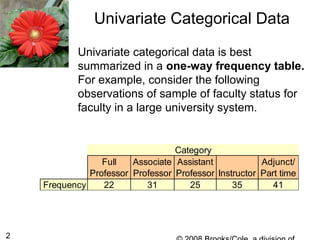
Univariate categorical data is best
summarized in a one-way frequency table.
For example, consider the following
observations of sample of faculty status for
faculty in a large university system.
Full
Professor
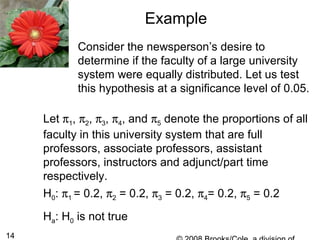
Associate
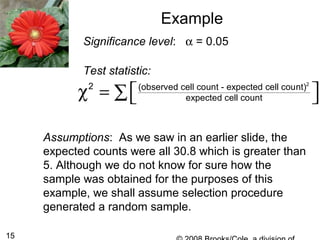
Professor
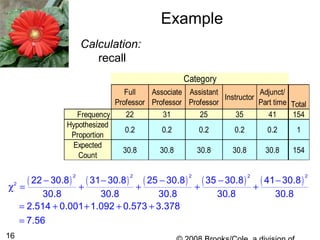
Assistant
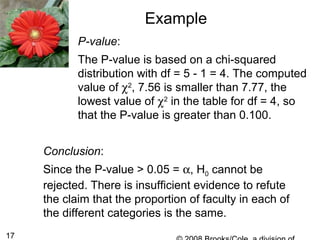
Professor Instructor
Adjunct/
Part time
Frequency 22 31 25 35 41
Category
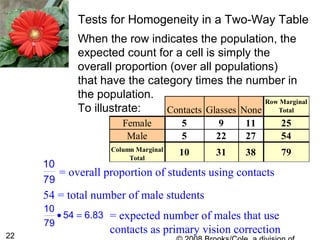
3
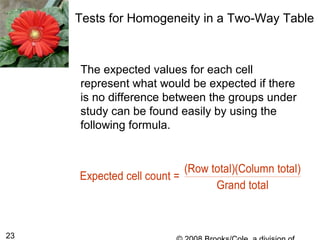
Univariate Categorical Data
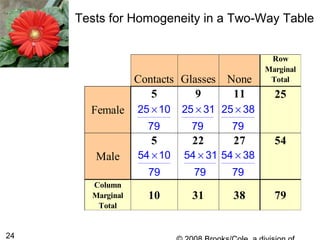
A local newsperson might be interested in
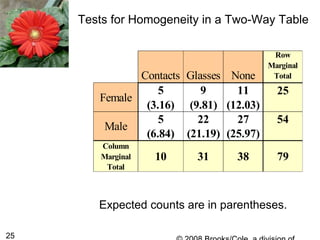
testing hypotheses about the proportion of
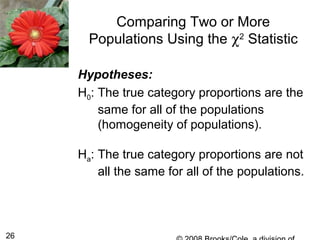
the population that fall in each of the
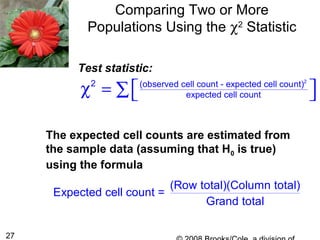
categories.
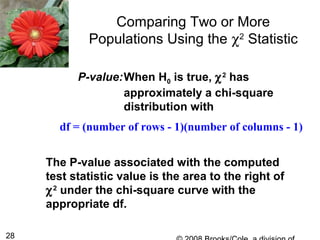
For example, the newsperson might want to
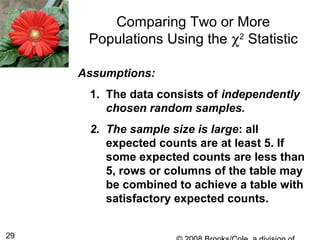
test to see if the five categories occur with
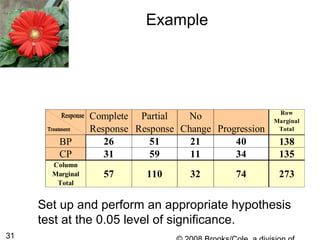
equal frequency throughout the whole
university system.
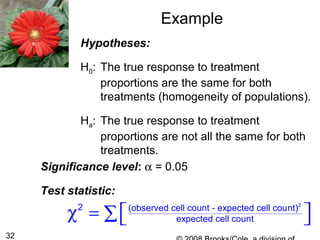
To deal with this type of question we need
to establish some notation.
4
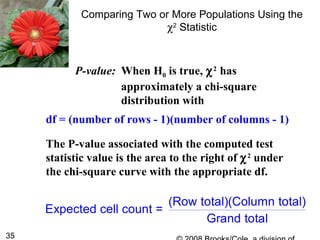
Notation
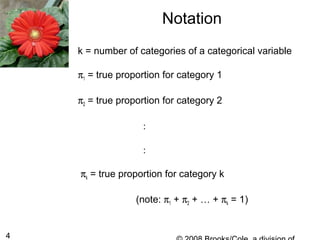
k = number of categories of a categorical variable
π1 = true proportion for category 1
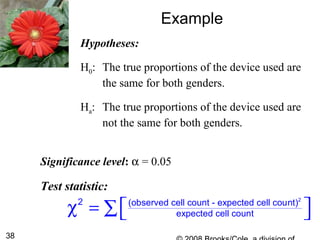
π2 = true proportion for category 2
:
:
πk = true proportion for category k
(note: π1 + π2 + … + πk = 1)
5
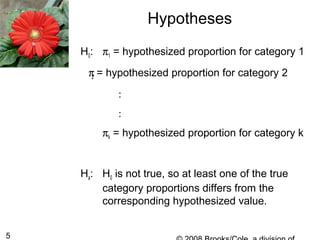
Hypotheses
H0: π1 = hypothesized proportion for category 1
π2 = hypothesized proportion for category 2
:
:
πk = hypothesized proportion for category k
Ha: H0 is not true, so at least one of the true
category proportions differs from the
corresponding hypothesized value.
6
Expected Counts
For each category, the expected count for
that category is the product of the total
number of observations with the
hypothesized proportion for that category.
7
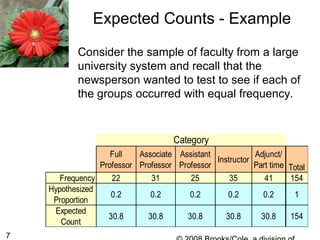
Expected Counts - Example
Consider the sample of faculty from a large
university system and recall that the
newsperson wanted to test to see if each of
the groups occurred with equal frequency.
Full
Professor
Associate
Professor
Assistant
Professor
Instructor
Adjunct/
Part time Total
Frequency 22 31 25 35 41 154
Hypothesized
Proportion
0.2 0.2 0.2 0.2 0.2 1
Expected
Count
30.8 30.8 30.8 30.8 30.8 154
Category
8
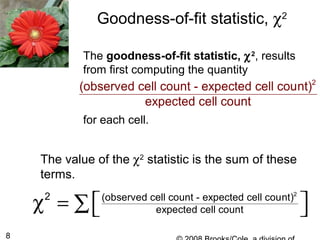
Goodness-of-fit statistic, χ2
The value of the χ2
statistic is the sum of these
terms.
The goodness-of-fit statistic, χ2
, results
from first computing the quantity
for each cell.
2
(observed cell count - expected cell count)
expected cell count
2
2 (observed cell count - expected cell count)
expected cell countχ =   ∑
9
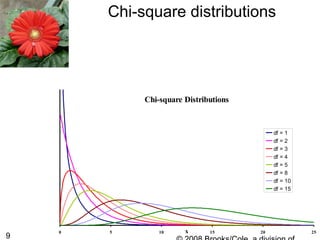
Chi-square distributions
Chi-square Distributions
0 5 10 15 20 25x
df = 1
df = 2
df = 3
df = 4
df = 5
df = 8
df = 10
df = 15
10
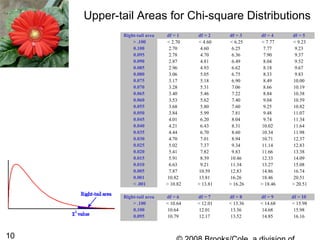
Upper-tail Areas for Chi-square Distributions
Right-tail area df = 1 df = 2 df = 3 df = 4 df = 5
> .100 < 2.70 < 4.60 < 6.25 < 7.77 < 9.23
0.100 2.70 4.60 6.25 7.77 9.23
0.095 2.78 4.70 6.36 7.90 9.37
0.090 2.87 4.81 6.49 8.04 9.52
0.085 2.96 4.93 6.62 8.18 9.67
0.080 3.06 5.05 6.75 8.33 9.83
0.075 3.17 5.18 6.90 8.49 10.00
0.070 3.28 5.31 7.06 8.66 10.19
0.065 3.40 5.46 7.22 8.84 10.38
0.060 3.53 5.62 7.40 9.04 10.59
0.055 3.68 5.80 7.60 9.25 10.82
0.050 3.84 5.99 7.81 9.48 11.07
0.045 4.01 6.20 8.04 9.74 11.34
0.040 4.21 6.43 8.31 10.02 11.64
0.035 4.44 6.70 8.60 10.34 11.98
0.030 4.70 7.01 8.94 10.71 12.37
0.025 5.02 7.37 9.34 11.14 12.83
0.020 5.41 7.82 9.83 11.66 13.38
0.015 5.91 8.39 10.46 12.33 14.09
0.010 6.63 9.21 11.34 13.27 15.08
0.005 7.87 10.59 12.83 14.86 16.74
0.001 10.82 13.81 16.26 18.46 20.51
< .001 > 10.82 > 13.81 > 16.26 > 18.46 > 20.51
Right-tail area df = 6 df = 7 df = 8 df = 9 df = 10
> .100 < 10.64 < 12.01 < 13.36 < 14.68 < 15.98
0.100 10.64 12.01 13.36 14.68 15.98
0.095 10.79 12.17 13.52 14.85 16.16
0.090 10.94 12.33 13.69 15.03 16.35
0.085 11.11 12.50 13.87 15.22 16.54
0.080 11.28 12.69 14.06 15.42 16.75
11
Goodness-of-Fit Test Procedure
Hypotheses:
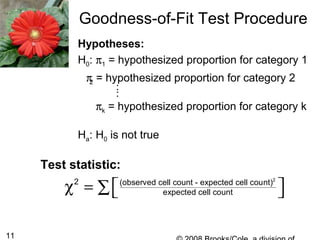
H0: π1 = hypothesized proportion for category 1
π2 = hypothesized proportion for category 2
:
:
πk = hypothesized proportion for category k
Ha: H0 is not true
Test statistic:
2
2 (observed cell count - expected cell count)
expected cell countχ =   ∑
12
Goodness-of-Fit Test Procedure
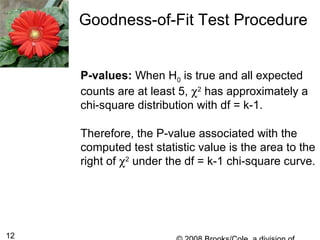
P-values: When H0 is true and all expected
counts are at least 5, χ2
has approximately a
chi-square distribution with df = k-1.
Therefore, the P-value associated with the
computed test statistic value is the area to the
right of χ2
under the df = k-1 chi-square curve.
13
Goodness-of-Fit Test Procedure
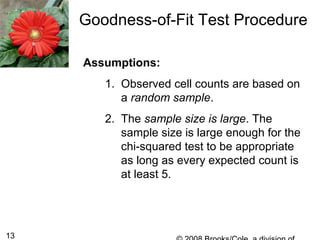
Assumptions:
1. Observed cell counts are based on
a random sample.
2. The sample size is large. The
sample size is large enough for the
chi-squared test to be appropriate
as long as every expected count is
at least 5.
14
Example
Consider the newsperson’s desire to
determine if the faculty of a large university
system were equally distributed. Let us test
this hypothesis at a significance level of 0.05.
Let π1, π2, π3, π4, and π5 denote the proportions of all
faculty in this university system that are full
professors, associate professors, assistant
professors, instructors and adjunct/part time
respectively.
H0: π1 = 0.2, π2 = 0.2, π3 = 0.2, π4= 0.2, π5 = 0.2
Ha: H0 is not true
15
Example
Significance level: α = 0.05
Assumptions: As we saw in an earlier slide, the
expected counts were all 30.8 which is greater than
5. Although we do not know for sure how the
sample was obtained for the purposes of this
example, we shall assume selection procedure
generated a random sample.
Test statistic:
2
2 (observed cell count - expected cell count)
expected cell countχ =   ∑
16
Example
Full
Professor
Associate
Professor
Assistant
Professor
Instructor
Adjunct/
Part time Total
Frequency 22 31 25 35 41 154
Hypothesized
Proportion
0.2 0.2 0.2 0.2 0.2 1
Expected
Count
30.8 30.8 30.8 30.8 30.8 154
Category
Calculation:
recall
( ) ( ) ( ) ( ) ( )
2 2 2 2 2
2 22 30.8 31 30.8 25 30.8 35 30.8 41 30.8
30.8 30.8 30.8 30.8 30.8
2.514 0.001 1.092 0.573 3.378
7.56
− − − − −
χ = + + + +
= + + + +
=
17
Example
P-value:
The P-value is based on a chi-squared
distribution with df = 5 - 1 = 4. The computed
value of χ2
, 7.56 is smaller than 7.77, the
lowest value of χ2
in the table for df = 4, so
that the P-value is greater than 0.100.
Conclusion:
Since the P-value > 0.05 = α, H0 cannot be
rejected. There is insufficient evidence to refute
the claim that the proportion of faculty in each of
the different categories is the same.
18
Tests for Homogeneity and
Independence in a Two-Way Table
Data resulting from observations made on
two different categorical variables can be
summarized using a tabular format. For
example, consider the student data set
giving information on 79 student dataset that
was obtained from a sample of 79 students
taking elementary statistics. The table is on
the next slide.
19
Tests for Homogeneity and
Independence in a Two-Way Table
Contacts Glasses None
Female 5 9 11
Male 5 22 27
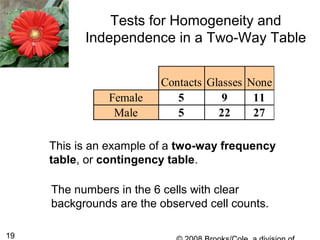
This is an example of a two-way frequency
table, or contingency table.
The numbers in the 6 cells with clear
backgrounds are the observed cell counts.
20
Tests for Homogeneity and
Independence in a Two-Way Table
Contacts Glasses None
Row Marginal
Total
Female 5 9 11 25
Male 5 22 27 54
Column Marginal
Total
10 31 38 79
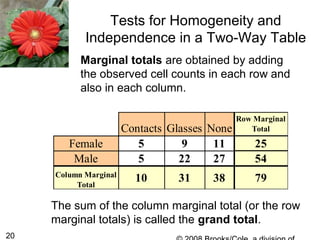
Marginal totals are obtained by adding
the observed cell counts in each row and
also in each column.
The sum of the column marginal total (or the row
marginal totals) is called the grand total.
21
Tests for Homogeneity in a Two-Way Table
Typically, with a two-way table used to test
homogeneity, the rows indicate different
populations and the columns indicate
different categories or vice versa.
For a test of homogeneity, the central
question is whether the category proportions
are the same for all of the populations
22
Tests for Homogeneity in a Two-Way Table
When the row indicates the population, the
expected count for a cell is simply the
overall proportion (over all populations)
that have the category times the number in
the population.
To illustrate: Contacts Glasses None
Row Marginal
Total
Female 5 9 11 25
Male 5 22 27 54
Column Marginal
Total
10 31 38 79
54 = total number of male students
= overall proportion of students using contacts
10
79
= expected number of males that use
contacts as primary vision correction
10
54 6.83
79
• =
23
Tests for Homogeneity in a Two-Way Table
The expected values for each cell
represent what would be expected if there
is no difference between the groups under
study can be found easily by using the
following formula.
(Row total)(Column total)
Expected cell count =
Grand total
24
Contacts Glasses None
Row
Marginal
Total
5 9 11
5 22 27
Column
Marginal
Total
10 31 38 79
Female
Male
25
54
×25 10
79
×25 31
79
×25 38
79
×54 10
79
×54 31
79
×54 38
79
Tests for Homogeneity in a Two-Way Table
25
Contacts Glasses None
Row
Marginal
Total
5 9 11
(3.16) (9.81) (12.03)
5 22 27
(6.84) (21.19) (25.97)
Column
Marginal
Total
10 31 38 79
Female
25
Male
54
Tests for Homogeneity in a Two-Way Table
Expected counts are in parentheses.
26
Comparing Two or More
Populations Using the χ2
Statistic
Hypotheses:
H0: The true category proportions are the
same for all of the populations
(homogeneity of populations).
Ha: The true category proportions are not
all the same for all of the populations.
27
Comparing Two or More
Populations Using the χ2
Statistic
The expected cell counts are estimated from
the sample data (assuming that H0 is true)
using the formula
(Row total)(Column total)
Expected cell count =
Grand total
Test statistic:
2
2 (observed cell count - expected cell count)
expected cell countχ =   ∑
28
Comparing Two or More
Populations Using the χ2
Statistic
P-value:When H0 is true, χ2
has
approximately a chi-square
distribution with
The P-value associated with the computed
test statistic value is the area to the right of
χ2
under the chi-square curve with the
appropriate df.
df = (number of rows - 1)(number of columns - 1)
29
Comparing Two or More
Populations Using the χ2
Statistic
Assumptions:
1. The data consists of independently
chosen random samples.
2. The sample size is large: all
expected counts are at least 5. If
some expected counts are less than
5, rows or columns of the table may
be combined to achieve a table with
satisfactory expected counts.
30
Example
The following data come from a clinical trial of a
drug regime used in treating a type of cancer,
lymphocytic lymphomas.* Patients (273) were
randomly divided into two groups, with one
group of patients receiving cytoxan plus
prednisone (CP) and the other receiving BCNU
plus prednisone (BP). The responses to treatment
were graded on a qualitative scale. The two-way
table summary of the results is on the following
slide.
* Ezdinli, E., S., Berard, C. W., et al. (1976) Comparison of intensive versus moderate
chemotherapy of lympocytic lymphomas: a progress report. Cancer, 38, 1060-1068.
31
Example
Set up and perform an appropriate hypothesis
test at the 0.05 level of significance.
Complete
Response
Partial
Response
No
Change Progression
Row
Marginal
Total
26 51 21 40
31 59 11 34
Column
Marginal
Total
57 110 32 74 273
BP
CP
138
135
32
Hypotheses:
H0: The true response to treatment
proportions are the same for both
treatments (homogeneity of populations).
Ha: The true response to treatment
proportions are not all the same for both
treatments.
Example
Significance level: α = 0.05
Test statistic:
2
2 (observed cell count - expected cell count)
expected cell countχ =   ∑
33
Example
Assumptions:
All expected cell counts are at least 5, and
samples were chosen independently so the χ2
test is appropriate.
34
Example
Calculations:
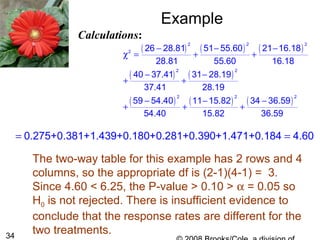
The two-way table for this example has 2 rows and 4
columns, so the appropriate df is (2-1)(4-1) = 3.
Since 4.60 < 6.25, the P-value > 0.10 > α = 0.05 so
H0 is not rejected. There is insufficient evidence to
conclude that the response rates are different for the
two treatments.
( ) ( ) ( )
( ) ( )
( ) ( ) ( )
− − −
χ = + +
− −
+ +
− − −
+ + +
2 2 2
2
2 2
2 2 2
26 28.81 51 55.60 21 16.18
28.81 55.60 16.18
40 37.41 31 28.19
37.41 28.19
59 54.40 11 15.82 34 36.59
54.40 15.82 36.59
= =0.275+0.381+1.439+0.180+0.281+0.390+1.471+0.184 4.60
35
Comparing Two or More Populations Using the
χ2
Statistic
P-value: When H0 is true, χ2
has
approximately a chi-square
distribution with
df = (number of rows - 1)(number of columns - 1)
The P-value associated with the computed test
statistic value is the area to the right of χ2
under
the chi-square curve with the appropriate df.
(Row total)(Column total)
Expected cell count =
Grand total
36
Example
A student decided to study the shoppers in
Wegman’s, a local supermarket to see if males
and females exhibited the same behavior patterns
with regard to the device use to carry items.
He observed 57 shoppers (presumably randomly)
and obtained the results that are summarized in
the table on the next slide.
37
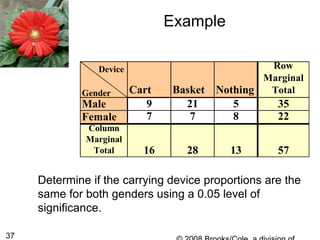
Example
Determine if the carrying device proportions are the
same for both genders using a 0.05 level of
significance.
Device
Gender Cart Basket Nothing
Row
Marginal
Total
Male 9 21 5 35
Female 7 7 8 22
Column
Marginal
Total 16 28 13 57
38
Hypotheses:
H0: The true proportions of the device used are
the same for both genders.
Ha: The true proportions of the device used are
not the same for both genders.
Example
Significance level: α = 0.05
Test statistic:
2
2 (observed cell count - expected cell count)
expected cell countχ =   ∑
39
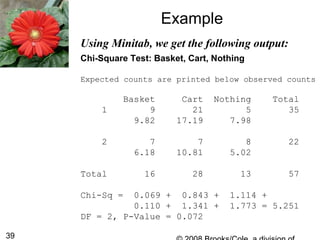
Using Minitab, we get the following output:
Example
Chi-Square Test: Basket, Cart, Nothing
Expected counts are printed below observed counts
Basket Cart Nothing Total
1 9 21 5 35
9.82 17.19 7.98
2 7 7 8 22
6.18 10.81 5.02
Total 16 28 13 57
Chi-Sq = 0.069 + 0.843 + 1.114 +
0.110 + 1.341 + 1.773 = 5.251
DF = 2, P-Value = 0.072
40
We draw the following conclusion.
Example
With a P-value of 0.072, there is insufficient
evidence at the 0.05 significance level to
support a claim that males and females are
not the same in terms of proportionate use of
carrying devices at Wegman’s supermarket.
41
Hypotheses:
H0: The two variables are independent.
Ha: The two variables are not independent.
χ2
Test for Independence
The χ2
test statistic and procedures can also
be used to investigate the association
between tow categorical variable in a single
population.
42
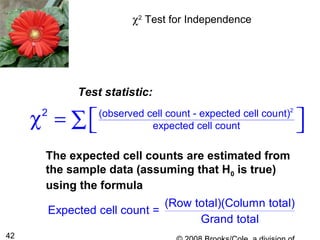
The expected cell counts are estimated from
the sample data (assuming that H0 is true)
using the formula
χ2
Test for Independence
Test statistic:
2
2 (observed cell count - expected cell count)
expected cell countχ =   ∑
(Row total)(Column total)
Expected cell count =
Grand total
43
χ2
Test for Independence
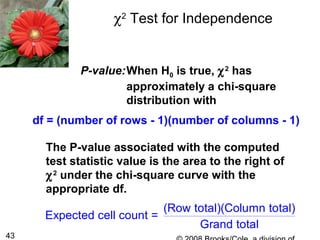
The P-value associated with the computed
test statistic value is the area to the right of
χ2
under the chi-square curve with the
appropriate df.
(Row total)(Column total)
Expected cell count =
Grand total
P-value:When H0 is true, χ2
has
approximately a chi-square
distribution with
df = (number of rows - 1)(number of columns - 1)
44
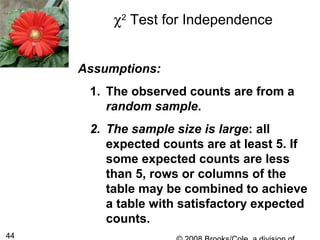
Assumptions:
1. The observed counts are from a
random sample.
2. The sample size is large: all
expected counts are at least 5. If
some expected counts are less
than 5, rows or columns of the
table may be combined to achieve
a table with satisfactory expected
counts.
χ2
Test for Independence
45
Example
Consider the two categorical variables,
gender and principle form of vision
correction for the sample of students used
earlier in this presentation.
We shall now test to see if the gender and the
principle form of vision correction are independent.
46
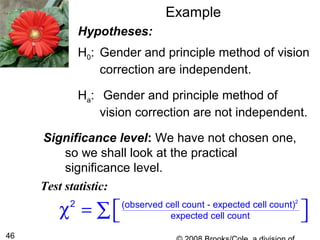
Example
Hypotheses:
H0: Gender and principle method of vision
correction are independent.
Ha: Gender and principle method of
vision correction are not independent.
Significance level: We have not chosen one,
so we shall look at the practical
significance level.
Test statistic:
2
2 (observed cell count - expected cell count)
expected cell countχ =   ∑
47
Example
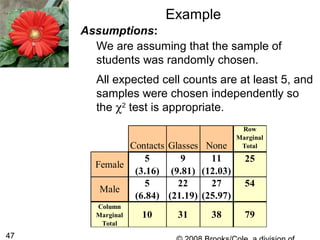
Assumptions:
We are assuming that the sample of
students was randomly chosen.
All expected cell counts are at least 5, and
samples were chosen independently so
the χ2
test is appropriate.
Contacts Glasses None
Row
Marginal
Total
5 9 11
(3.16) (9.81) (12.03)
5 22 27
(6.84) (21.19) (25.97)
Column
Marginal
Total
10 31 38 79
Female
25
Male
54
48
Example
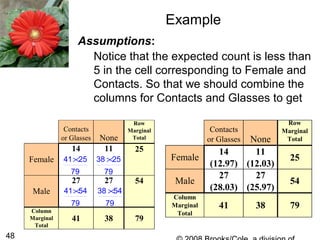
Assumptions:
Notice that the expected count is less than
5 in the cell corresponding to Female and
Contacts. So that we should combine the
columns for Contacts and Glasses to get
Contacts
or Glasses None
Row
Marginal
Total
14 11
(12.97) (12.03)
27 27
(28.03) (25.97)
Column
Marginal
Total
41 38 79
Female 25
Male 54
Contacts
or Glasses None
Row
Marginal
Total
14 11
27 27
Column
Marginal
Total
41 38 79
Female
25
Male
54
×41 25
79
×38 25
79
×41 54
79
×38 54
79
49
Example
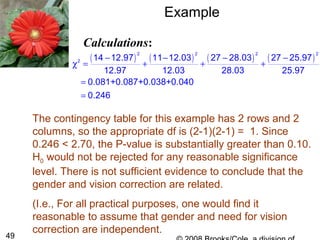
The contingency table for this example has 2 rows and 2
columns, so the appropriate df is (2-1)(2-1) = 1. Since
0.246 < 2.70, the P-value is substantially greater than 0.10.
H0 would not be rejected for any reasonable significance
level. There is not sufficient evidence to conclude that the
gender and vision correction are related.
(I.e., For all practical purposes, one would find it
reasonable to assume that gender and need for vision
correction are independent.
Calculations:
( ) ( ) ( ) ( )
2 2 2 2
2 14 12.97 11 12.03 27 28.03 27 25.97
12.97 12.03 28.03 25.97
0.081+0.087+0.038+0.040
0.246
− − − −
χ = + + +
=
=
50
Example
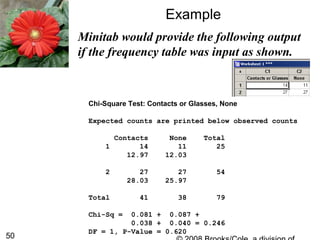
Minitab would provide the following output
if the frequency table was input as shown.
Chi-Square Test: Contacts or Glasses, None
Expected counts are printed below observed counts
Contacts None Total
1 14 11 25
12.97 12.03
2 27 27 54
28.03 25.97
Total 41 38 79
Chi-Sq = 0.081 + 0.087 +
0.038 + 0.040 = 0.246
DF = 1, P-Value = 0.620

Chapter12

  • 1.
    1 Chapter 12 The Analysisof Categorical Data and Goodness-of-Fit Tests
  • 2.
    2 Univariate Categorical Data Univariatecategorical data is best summarized in a one-way frequency table. For example, consider the following observations of sample of faculty status for faculty in a large university system. Full Professor Associate Professor Assistant Professor Instructor Adjunct/ Part time Frequency 22 31 25 35 41 Category
  • 3.
    3 Univariate Categorical Data Alocal newsperson might be interested in testing hypotheses about the proportion of the population that fall in each of the categories. For example, the newsperson might want to test to see if the five categories occur with equal frequency throughout the whole university system. To deal with this type of question we need to establish some notation.
  • 4.
    4 Notation k = numberof categories of a categorical variable π1 = true proportion for category 1 π2 = true proportion for category 2 : : πk = true proportion for category k (note: π1 + π2 + … + πk = 1)
  • 5.
    5 Hypotheses H0: π1 =hypothesized proportion for category 1 π2 = hypothesized proportion for category 2 : : πk = hypothesized proportion for category k Ha: H0 is not true, so at least one of the true category proportions differs from the corresponding hypothesized value.
  • 6.
    6 Expected Counts For eachcategory, the expected count for that category is the product of the total number of observations with the hypothesized proportion for that category.
  • 7.
    7 Expected Counts -Example Consider the sample of faculty from a large university system and recall that the newsperson wanted to test to see if each of the groups occurred with equal frequency. Full Professor Associate Professor Assistant Professor Instructor Adjunct/ Part time Total Frequency 22 31 25 35 41 154 Hypothesized Proportion 0.2 0.2 0.2 0.2 0.2 1 Expected Count 30.8 30.8 30.8 30.8 30.8 154 Category
  • 8.
    8 Goodness-of-fit statistic, χ2 Thevalue of the χ2 statistic is the sum of these terms. The goodness-of-fit statistic, χ2 , results from first computing the quantity for each cell. 2 (observed cell count - expected cell count) expected cell count 2 2 (observed cell count - expected cell count) expected cell countχ =   ∑
  • 9.
    9 Chi-square distributions Chi-square Distributions 05 10 15 20 25x df = 1 df = 2 df = 3 df = 4 df = 5 df = 8 df = 10 df = 15
  • 10.
    10 Upper-tail Areas forChi-square Distributions Right-tail area df = 1 df = 2 df = 3 df = 4 df = 5 > .100 < 2.70 < 4.60 < 6.25 < 7.77 < 9.23 0.100 2.70 4.60 6.25 7.77 9.23 0.095 2.78 4.70 6.36 7.90 9.37 0.090 2.87 4.81 6.49 8.04 9.52 0.085 2.96 4.93 6.62 8.18 9.67 0.080 3.06 5.05 6.75 8.33 9.83 0.075 3.17 5.18 6.90 8.49 10.00 0.070 3.28 5.31 7.06 8.66 10.19 0.065 3.40 5.46 7.22 8.84 10.38 0.060 3.53 5.62 7.40 9.04 10.59 0.055 3.68 5.80 7.60 9.25 10.82 0.050 3.84 5.99 7.81 9.48 11.07 0.045 4.01 6.20 8.04 9.74 11.34 0.040 4.21 6.43 8.31 10.02 11.64 0.035 4.44 6.70 8.60 10.34 11.98 0.030 4.70 7.01 8.94 10.71 12.37 0.025 5.02 7.37 9.34 11.14 12.83 0.020 5.41 7.82 9.83 11.66 13.38 0.015 5.91 8.39 10.46 12.33 14.09 0.010 6.63 9.21 11.34 13.27 15.08 0.005 7.87 10.59 12.83 14.86 16.74 0.001 10.82 13.81 16.26 18.46 20.51 < .001 > 10.82 > 13.81 > 16.26 > 18.46 > 20.51 Right-tail area df = 6 df = 7 df = 8 df = 9 df = 10 > .100 < 10.64 < 12.01 < 13.36 < 14.68 < 15.98 0.100 10.64 12.01 13.36 14.68 15.98 0.095 10.79 12.17 13.52 14.85 16.16 0.090 10.94 12.33 13.69 15.03 16.35 0.085 11.11 12.50 13.87 15.22 16.54 0.080 11.28 12.69 14.06 15.42 16.75
  • 11.
    11 Goodness-of-Fit Test Procedure Hypotheses: H0:π1 = hypothesized proportion for category 1 π2 = hypothesized proportion for category 2 : : πk = hypothesized proportion for category k Ha: H0 is not true Test statistic: 2 2 (observed cell count - expected cell count) expected cell countχ =   ∑
  • 12.
    12 Goodness-of-Fit Test Procedure P-values:When H0 is true and all expected counts are at least 5, χ2 has approximately a chi-square distribution with df = k-1. Therefore, the P-value associated with the computed test statistic value is the area to the right of χ2 under the df = k-1 chi-square curve.
  • 13.
    13 Goodness-of-Fit Test Procedure Assumptions: 1.Observed cell counts are based on a random sample. 2. The sample size is large. The sample size is large enough for the chi-squared test to be appropriate as long as every expected count is at least 5.
  • 14.
    14 Example Consider the newsperson’sdesire to determine if the faculty of a large university system were equally distributed. Let us test this hypothesis at a significance level of 0.05. Let π1, π2, π3, π4, and π5 denote the proportions of all faculty in this university system that are full professors, associate professors, assistant professors, instructors and adjunct/part time respectively. H0: π1 = 0.2, π2 = 0.2, π3 = 0.2, π4= 0.2, π5 = 0.2 Ha: H0 is not true
  • 15.
    15 Example Significance level: α= 0.05 Assumptions: As we saw in an earlier slide, the expected counts were all 30.8 which is greater than 5. Although we do not know for sure how the sample was obtained for the purposes of this example, we shall assume selection procedure generated a random sample. Test statistic: 2 2 (observed cell count - expected cell count) expected cell countχ =   ∑
  • 16.
    16 Example Full Professor Associate Professor Assistant Professor Instructor Adjunct/ Part time Total Frequency22 31 25 35 41 154 Hypothesized Proportion 0.2 0.2 0.2 0.2 0.2 1 Expected Count 30.8 30.8 30.8 30.8 30.8 154 Category Calculation: recall ( ) ( ) ( ) ( ) ( ) 2 2 2 2 2 2 22 30.8 31 30.8 25 30.8 35 30.8 41 30.8 30.8 30.8 30.8 30.8 30.8 2.514 0.001 1.092 0.573 3.378 7.56 − − − − − χ = + + + + = + + + + =
  • 17.
    17 Example P-value: The P-value isbased on a chi-squared distribution with df = 5 - 1 = 4. The computed value of χ2 , 7.56 is smaller than 7.77, the lowest value of χ2 in the table for df = 4, so that the P-value is greater than 0.100. Conclusion: Since the P-value > 0.05 = α, H0 cannot be rejected. There is insufficient evidence to refute the claim that the proportion of faculty in each of the different categories is the same.
  • 18.
    18 Tests for Homogeneityand Independence in a Two-Way Table Data resulting from observations made on two different categorical variables can be summarized using a tabular format. For example, consider the student data set giving information on 79 student dataset that was obtained from a sample of 79 students taking elementary statistics. The table is on the next slide.
  • 19.
    19 Tests for Homogeneityand Independence in a Two-Way Table Contacts Glasses None Female 5 9 11 Male 5 22 27 This is an example of a two-way frequency table, or contingency table. The numbers in the 6 cells with clear backgrounds are the observed cell counts.
  • 20.
    20 Tests for Homogeneityand Independence in a Two-Way Table Contacts Glasses None Row Marginal Total Female 5 9 11 25 Male 5 22 27 54 Column Marginal Total 10 31 38 79 Marginal totals are obtained by adding the observed cell counts in each row and also in each column. The sum of the column marginal total (or the row marginal totals) is called the grand total.
  • 21.
    21 Tests for Homogeneityin a Two-Way Table Typically, with a two-way table used to test homogeneity, the rows indicate different populations and the columns indicate different categories or vice versa. For a test of homogeneity, the central question is whether the category proportions are the same for all of the populations
  • 22.
    22 Tests for Homogeneityin a Two-Way Table When the row indicates the population, the expected count for a cell is simply the overall proportion (over all populations) that have the category times the number in the population. To illustrate: Contacts Glasses None Row Marginal Total Female 5 9 11 25 Male 5 22 27 54 Column Marginal Total 10 31 38 79 54 = total number of male students = overall proportion of students using contacts 10 79 = expected number of males that use contacts as primary vision correction 10 54 6.83 79 • =
  • 23.
    23 Tests for Homogeneityin a Two-Way Table The expected values for each cell represent what would be expected if there is no difference between the groups under study can be found easily by using the following formula. (Row total)(Column total) Expected cell count = Grand total
  • 24.
    24 Contacts Glasses None Row Marginal Total 59 11 5 22 27 Column Marginal Total 10 31 38 79 Female Male 25 54 ×25 10 79 ×25 31 79 ×25 38 79 ×54 10 79 ×54 31 79 ×54 38 79 Tests for Homogeneity in a Two-Way Table
  • 25.
    25 Contacts Glasses None Row Marginal Total 59 11 (3.16) (9.81) (12.03) 5 22 27 (6.84) (21.19) (25.97) Column Marginal Total 10 31 38 79 Female 25 Male 54 Tests for Homogeneity in a Two-Way Table Expected counts are in parentheses.
  • 26.
    26 Comparing Two orMore Populations Using the χ2 Statistic Hypotheses: H0: The true category proportions are the same for all of the populations (homogeneity of populations). Ha: The true category proportions are not all the same for all of the populations.
  • 27.
    27 Comparing Two orMore Populations Using the χ2 Statistic The expected cell counts are estimated from the sample data (assuming that H0 is true) using the formula (Row total)(Column total) Expected cell count = Grand total Test statistic: 2 2 (observed cell count - expected cell count) expected cell countχ =   ∑
  • 28.
    28 Comparing Two orMore Populations Using the χ2 Statistic P-value:When H0 is true, χ2 has approximately a chi-square distribution with The P-value associated with the computed test statistic value is the area to the right of χ2 under the chi-square curve with the appropriate df. df = (number of rows - 1)(number of columns - 1)
  • 29.
    29 Comparing Two orMore Populations Using the χ2 Statistic Assumptions: 1. The data consists of independently chosen random samples. 2. The sample size is large: all expected counts are at least 5. If some expected counts are less than 5, rows or columns of the table may be combined to achieve a table with satisfactory expected counts.
  • 30.
    30 Example The following datacome from a clinical trial of a drug regime used in treating a type of cancer, lymphocytic lymphomas.* Patients (273) were randomly divided into two groups, with one group of patients receiving cytoxan plus prednisone (CP) and the other receiving BCNU plus prednisone (BP). The responses to treatment were graded on a qualitative scale. The two-way table summary of the results is on the following slide. * Ezdinli, E., S., Berard, C. W., et al. (1976) Comparison of intensive versus moderate chemotherapy of lympocytic lymphomas: a progress report. Cancer, 38, 1060-1068.
  • 31.
    31 Example Set up andperform an appropriate hypothesis test at the 0.05 level of significance. Complete Response Partial Response No Change Progression Row Marginal Total 26 51 21 40 31 59 11 34 Column Marginal Total 57 110 32 74 273 BP CP 138 135
  • 32.
    32 Hypotheses: H0: The trueresponse to treatment proportions are the same for both treatments (homogeneity of populations). Ha: The true response to treatment proportions are not all the same for both treatments. Example Significance level: α = 0.05 Test statistic: 2 2 (observed cell count - expected cell count) expected cell countχ =   ∑
  • 33.
    33 Example Assumptions: All expected cellcounts are at least 5, and samples were chosen independently so the χ2 test is appropriate.
  • 34.
    34 Example Calculations: The two-way tablefor this example has 2 rows and 4 columns, so the appropriate df is (2-1)(4-1) = 3. Since 4.60 < 6.25, the P-value > 0.10 > α = 0.05 so H0 is not rejected. There is insufficient evidence to conclude that the response rates are different for the two treatments. ( ) ( ) ( ) ( ) ( ) ( ) ( ) ( ) − − − χ = + + − − + + − − − + + + 2 2 2 2 2 2 2 2 2 26 28.81 51 55.60 21 16.18 28.81 55.60 16.18 40 37.41 31 28.19 37.41 28.19 59 54.40 11 15.82 34 36.59 54.40 15.82 36.59 = =0.275+0.381+1.439+0.180+0.281+0.390+1.471+0.184 4.60
  • 35.
    35 Comparing Two orMore Populations Using the χ2 Statistic P-value: When H0 is true, χ2 has approximately a chi-square distribution with df = (number of rows - 1)(number of columns - 1) The P-value associated with the computed test statistic value is the area to the right of χ2 under the chi-square curve with the appropriate df. (Row total)(Column total) Expected cell count = Grand total
  • 36.
    36 Example A student decidedto study the shoppers in Wegman’s, a local supermarket to see if males and females exhibited the same behavior patterns with regard to the device use to carry items. He observed 57 shoppers (presumably randomly) and obtained the results that are summarized in the table on the next slide.
  • 37.
    37 Example Determine if thecarrying device proportions are the same for both genders using a 0.05 level of significance. Device Gender Cart Basket Nothing Row Marginal Total Male 9 21 5 35 Female 7 7 8 22 Column Marginal Total 16 28 13 57
  • 38.
    38 Hypotheses: H0: The trueproportions of the device used are the same for both genders. Ha: The true proportions of the device used are not the same for both genders. Example Significance level: α = 0.05 Test statistic: 2 2 (observed cell count - expected cell count) expected cell countχ =   ∑
  • 39.
    39 Using Minitab, weget the following output: Example Chi-Square Test: Basket, Cart, Nothing Expected counts are printed below observed counts Basket Cart Nothing Total 1 9 21 5 35 9.82 17.19 7.98 2 7 7 8 22 6.18 10.81 5.02 Total 16 28 13 57 Chi-Sq = 0.069 + 0.843 + 1.114 + 0.110 + 1.341 + 1.773 = 5.251 DF = 2, P-Value = 0.072
  • 40.
    40 We draw thefollowing conclusion. Example With a P-value of 0.072, there is insufficient evidence at the 0.05 significance level to support a claim that males and females are not the same in terms of proportionate use of carrying devices at Wegman’s supermarket.
  • 41.
    41 Hypotheses: H0: The twovariables are independent. Ha: The two variables are not independent. χ2 Test for Independence The χ2 test statistic and procedures can also be used to investigate the association between tow categorical variable in a single population.
  • 42.
    42 The expected cellcounts are estimated from the sample data (assuming that H0 is true) using the formula χ2 Test for Independence Test statistic: 2 2 (observed cell count - expected cell count) expected cell countχ =   ∑ (Row total)(Column total) Expected cell count = Grand total
  • 43.
    43 χ2 Test for Independence TheP-value associated with the computed test statistic value is the area to the right of χ2 under the chi-square curve with the appropriate df. (Row total)(Column total) Expected cell count = Grand total P-value:When H0 is true, χ2 has approximately a chi-square distribution with df = (number of rows - 1)(number of columns - 1)
  • 44.
    44 Assumptions: 1. The observedcounts are from a random sample. 2. The sample size is large: all expected counts are at least 5. If some expected counts are less than 5, rows or columns of the table may be combined to achieve a table with satisfactory expected counts. χ2 Test for Independence
  • 45.
    45 Example Consider the twocategorical variables, gender and principle form of vision correction for the sample of students used earlier in this presentation. We shall now test to see if the gender and the principle form of vision correction are independent.
  • 46.
    46 Example Hypotheses: H0: Gender andprinciple method of vision correction are independent. Ha: Gender and principle method of vision correction are not independent. Significance level: We have not chosen one, so we shall look at the practical significance level. Test statistic: 2 2 (observed cell count - expected cell count) expected cell countχ =   ∑
  • 47.
    47 Example Assumptions: We are assumingthat the sample of students was randomly chosen. All expected cell counts are at least 5, and samples were chosen independently so the χ2 test is appropriate. Contacts Glasses None Row Marginal Total 5 9 11 (3.16) (9.81) (12.03) 5 22 27 (6.84) (21.19) (25.97) Column Marginal Total 10 31 38 79 Female 25 Male 54
  • 48.
    48 Example Assumptions: Notice that theexpected count is less than 5 in the cell corresponding to Female and Contacts. So that we should combine the columns for Contacts and Glasses to get Contacts or Glasses None Row Marginal Total 14 11 (12.97) (12.03) 27 27 (28.03) (25.97) Column Marginal Total 41 38 79 Female 25 Male 54 Contacts or Glasses None Row Marginal Total 14 11 27 27 Column Marginal Total 41 38 79 Female 25 Male 54 ×41 25 79 ×38 25 79 ×41 54 79 ×38 54 79
  • 49.
    49 Example The contingency tablefor this example has 2 rows and 2 columns, so the appropriate df is (2-1)(2-1) = 1. Since 0.246 < 2.70, the P-value is substantially greater than 0.10. H0 would not be rejected for any reasonable significance level. There is not sufficient evidence to conclude that the gender and vision correction are related. (I.e., For all practical purposes, one would find it reasonable to assume that gender and need for vision correction are independent. Calculations: ( ) ( ) ( ) ( ) 2 2 2 2 2 14 12.97 11 12.03 27 28.03 27 25.97 12.97 12.03 28.03 25.97 0.081+0.087+0.038+0.040 0.246 − − − − χ = + + + = =
  • 50.
    50 Example Minitab would providethe following output if the frequency table was input as shown. Chi-Square Test: Contacts or Glasses, None Expected counts are printed below observed counts Contacts None Total 1 14 11 25 12.97 12.03 2 27 27 54 28.03 25.97 Total 41 38 79 Chi-Sq = 0.081 + 0.087 + 0.038 + 0.040 = 0.246 DF = 1, P-Value = 0.620

Editor's Notes

  • #2 &amp;lt;number&amp;gt;
  • #3 &amp;lt;number&amp;gt;
  • #4 &amp;lt;number&amp;gt;
  • #5 &amp;lt;number&amp;gt;
  • #6 &amp;lt;number&amp;gt;
  • #7 &amp;lt;number&amp;gt;
  • #8 &amp;lt;number&amp;gt;
  • #9 &amp;lt;number&amp;gt;
  • #10 &amp;lt;number&amp;gt;
  • #11 &amp;lt;number&amp;gt;
  • #12 &amp;lt;number&amp;gt;
  • #13 &amp;lt;number&amp;gt;
  • #14 &amp;lt;number&amp;gt;
  • #15 &amp;lt;number&amp;gt;
  • #16 &amp;lt;number&amp;gt;
  • #17 &amp;lt;number&amp;gt;
  • #18 &amp;lt;number&amp;gt;
  • #19 &amp;lt;number&amp;gt;
  • #20 &amp;lt;number&amp;gt;
  • #21 &amp;lt;number&amp;gt;
  • #22 &amp;lt;number&amp;gt;
  • #23 &amp;lt;number&amp;gt;
  • #24 &amp;lt;number&amp;gt;
  • #25 &amp;lt;number&amp;gt;
  • #26 &amp;lt;number&amp;gt;
  • #27 &amp;lt;number&amp;gt;
  • #28 &amp;lt;number&amp;gt;
  • #29 &amp;lt;number&amp;gt;
  • #30 &amp;lt;number&amp;gt;
  • #31 &amp;lt;number&amp;gt;
  • #32 &amp;lt;number&amp;gt;
  • #33 &amp;lt;number&amp;gt;
  • #34 &amp;lt;number&amp;gt;
  • #35 &amp;lt;number&amp;gt;
  • #36 &amp;lt;number&amp;gt;
  • #37 &amp;lt;number&amp;gt;
  • #39 &amp;lt;number&amp;gt;
  • #40 &amp;lt;number&amp;gt;
  • #41 &amp;lt;number&amp;gt;
  • #42 &amp;lt;number&amp;gt;
  • #43 &amp;lt;number&amp;gt;
  • #44 &amp;lt;number&amp;gt;
  • #45 &amp;lt;number&amp;gt;
  • #46 &amp;lt;number&amp;gt;
  • #47 &amp;lt;number&amp;gt;
  • #48 &amp;lt;number&amp;gt;
  • #49 &amp;lt;number&amp;gt;
  • #50 &amp;lt;number&amp;gt;
  • #51 &amp;lt;number&amp;gt;