ANIMAL GENETICS &BREEDING
UNIT – I
Biostatistics & Computer Application
Lecture – 7
Chi-square Test of Significance
Dr K G Mandal
Department of Animal Genetics & Breeding
Bihar Veterinary College, Patna
Bihar Animal Sciences University, Patna
2.
Chi-square (χ2
) testof significance
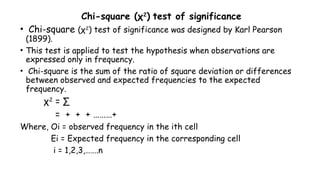
• Chi-square (χ2
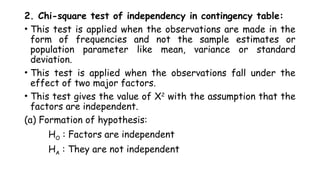
) test of significance was designed by Karl Pearson
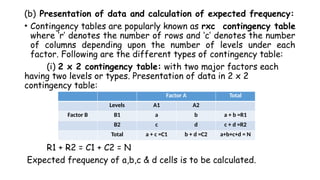
(1899).
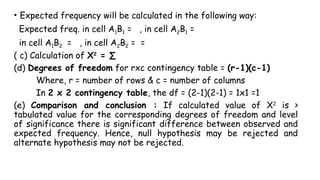
• This test is applied to test the hypothesis when observations are
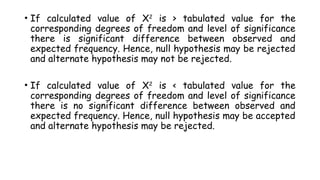
expressed only in frequency.
• Chi-square is the sum of the ratio of square deviation or differences
between observed and expected frequencies to the expected
frequency.
χ2
= ∑
= + + + ………+
Where, Oi = observed frequency in the ith cell
Ei = Expected frequency in the corresponding cell
i = 1,2,3,…….n
3.
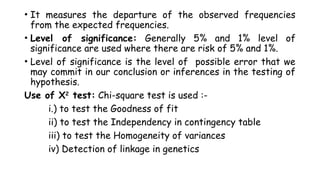
• It measuresthe departure of the observed frequencies
from the expected frequencies.
• Level of significance: Generally 5% and 1% level of
significance are used where there are risk of 5% and 1%.
• Level of significance is the level of possible error that we
may commit in our conclusion or inferences in the testing of
hypothesis.
Use of X2
test: Chi-square test is used :-
i.) to test the Goodness of fit
ii) to test the Independency in contingency table
iii) to test the Homogeneity of variances
iv) Detection of linkage in genetics
4.
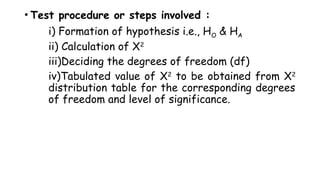
• Test procedureor steps involved :
i) Formation of hypothesis i.e., HO & HA
ii) Calculation of X2
iii)Deciding the degrees of freedom (df)
iv)Tabulated value of X2
to be obtained from X2
distribution table for the corresponding degrees
of freedom and level of significance.
5.
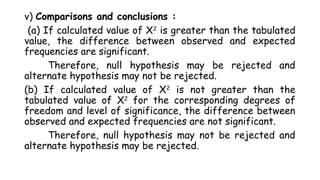
v) Comparisons andconclusions :
(a) If calculated value of X2
is greater than the tabulated
value, the difference between observed and expected
frequencies are significant.
Therefore, null hypothesis may be rejected and
alternate hypothesis may not be rejected.
(b) If calculated value of X2
is not greater than the
tabulated value of X2
for the corresponding degrees of
freedom and level of significance, the difference between
observed and expected frequencies are not significant.
Therefore, null hypothesis may not be rejected and
alternate hypothesis may be rejected.
6.
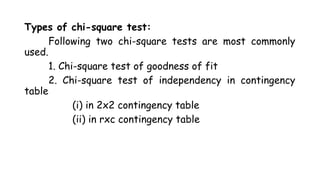
Types of chi-squaretest:
Following two chi-square tests are most commonly
used.
1. Chi-square test of goodness of fit
2. Chi-square test of independency in contingency
table
(i) in 2x2 contingency table
(ii) in rxc contingency table
7.
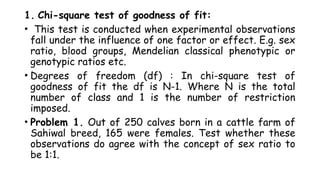
1. Chi-square testof goodness of fit:
• This test is conducted when experimental observations
fall under the influence of one factor or effect. E.g. sex
ratio, blood groups, Mendelian classical phenotypic or
genotypic ratios etc.
• Degrees of freedom (df) : In chi-square test of
goodness of fit the df is N-1. Where N is the total
number of class and 1 is the number of restriction
imposed.
• Problem 1. Out of 250 calves born in a cattle farm of
Sahiwal breed, 165 were females. Test whether these
observations do agree with the concept of sex ratio to
be 1:1.
8.
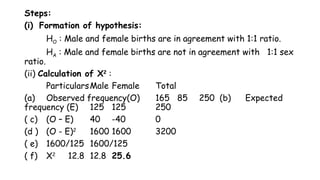
Steps:
(i) Formation ofhypothesis:
HO : Male and female births are in agreement with 1:1 ratio.
HA : Male and female births are not in agreement with 1:1 sex
ratio.
(ii) Calculation of X2
:
ParticularsMale Female Total
(a) Observed frequency(O) 165 85 250 (b) Expected
frequency (E) 125 125 250
( c) (O – E) 40 -40 0
(d ) (O - E)2
1600 1600 3200
( e) 1600/125 1600/125
( f) X2
12.8 12.8 25.6
9.
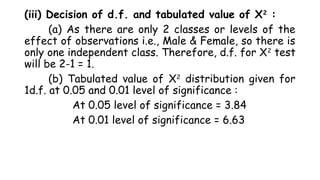
(iii) Decision ofd.f. and tabulated value of X2
:
(a) As there are only 2 classes or levels of the
effect of observations i.e., Male & Female, so there is
only one independent class. Therefore, d.f. for X2
test
will be 2-1 = 1.
(b) Tabulated value of X2
distribution given for
1d.f. at 0.05 and 0.01 level of significance :
At 0.05 level of significance = 3.84
At 0.01 level of significance = 6.63
10.
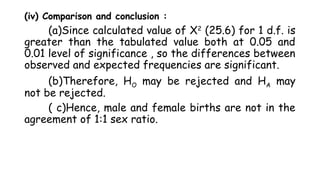
(iv) Comparison andconclusion :
(a)Since calculated value of X2
(25.6) for 1 d.f. is
greater than the tabulated value both at 0.05 and
0.01 level of significance , so the differences between
observed and expected frequencies are significant.
(b)Therefore, HO may be rejected and HA may
not be rejected.
( c)Hence, male and female births are not in the
agreement of 1:1 sex ratio.
11.
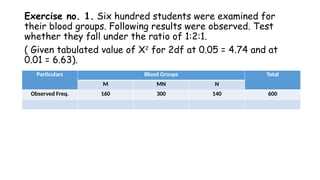
Exercise no. 1.Six hundred students were examined for
their blood groups. Following results were observed. Test
whether they fall under the ratio of 1:2:1.
( Given tabulated value of X2
for 2df at 0.05 = 4.74 and at
0.01 = 6.63).
Particulars Blood Groups Total
M MN N
Observed Freq. 160 300 140 600
12.
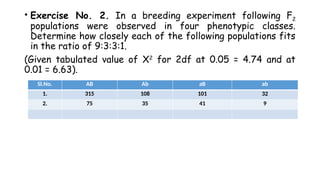
• Exercise No.2. In a breeding experiment following F2
populations were observed in four phenotypic classes.
Determine how closely each of the following populations fits
in the ratio of 9:3:3:1.
(Given tabulated value of X2
for 2df at 0.05 = 4.74 and at
0.01 = 6.63).
Sl.No. AB Ab aB ab
1. 315 108 101 32
2. 75 35 41 9
13.
2. Chi-square testof independency in contingency table:
• This test is applied when the observations are made in the
form of frequencies and not the sample estimates or
population parameter like mean, variance or standard
deviation.
• This test is applied when the observations fall under the
effect of two major factors.
• This test gives the value of X2
with the assumption that the
factors are independent.
(a) Formation of hypothesis:
HO : Factors are independent
HA : They are not independent
14.
(b) Presentation ofdata and calculation of expected frequency:
• Contingency tables are popularly known as rxc contingency table
where ‘r’ denotes the number of rows and ‘c’ denotes the number
of columns depending upon the number of levels under each
factor. Following are the different types of contingency table:
(i) 2 x 2 contingency table: with two major factors each
having two levels or types. Presentation of data in 2 x 2
contingency table:
R1 + R2 = C1 + C2 = N
Expected frequency of a,b,c & d cells is to be calculated.
Factor A Total
Levels A1 A2
Factor B B1 a b a + b =R1
B2 c d c + d =R2
Total a + c =C1 b + d =C2 a+b+c+d = N
15.
• Expected frequencywill be calculated in the following way:
Expected freq. in cell A1B1 = , in cell A2B1 =
in cell A1B2 = , in cell A2B2 = =
( c) Calculation of X2
= ∑
(d) Degrees of freedom for rxc contingency table = (r-1)(c-1)
Where, r = number of rows & c = number of columns
In 2 x 2 contingency table, the df = (2-1)(2-1) = 1x1 =1
(e) Comparison and conclusion : If calculated value of X2
is >
tabulated value for the corresponding degrees of freedom and level
of significance there is significant difference between observed and
expected frequency. Hence, null hypothesis may be rejected and
alternate hypothesis may not be rejected.
16.
• If calculatedvalue of X2
is > tabulated value for the
corresponding degrees of freedom and level of significance
there is significant difference between observed and
expected frequency. Hence, null hypothesis may be rejected
and alternate hypothesis may not be rejected.
• If calculated value of X2
is < tabulated value for the
corresponding degrees of freedom and level of significance
there is no significant difference between observed and
expected frequency. Hence, null hypothesis may be accepted
and alternate hypothesis may be rejected.
17.
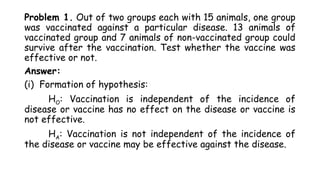
Problem 1. Outof two groups each with 15 animals, one group
was vaccinated against a particular disease. 13 animals of
vaccinated group and 7 animals of non-vaccinated group could
survive after the vaccination. Test whether the vaccine was
effective or not.
Answer:
(i) Formation of hypothesis:
HO: Vaccination is independent of the incidence of
disease or vaccine has no effect on the disease or vaccine is
not effective.
HA: Vaccination is not independent of the incidence of
the disease or vaccine may be effective against the disease.
18.
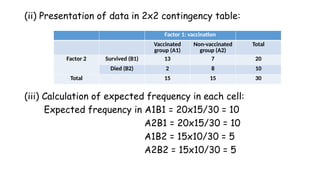
(ii) Presentation ofdata in 2x2 contingency table:
(iii) Calculation of expected frequency in each cell:
Expected frequency in A1B1 = 20x15/30 = 10
A2B1 = 20x15/30 = 10
A1B2 = 15x10/30 = 5
A2B2 = 15x10/30 = 5
Factor 1: vaccination
Vaccinated
group (A1)
Non-vaccinated
group (A2)
Total
Factor 2 Survived (B1) 13 7 20
Died (B2) 2 8 10
Total 15 15 30
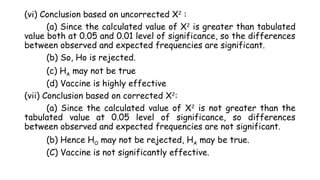
(vi) Conclusion basedon uncorrected X2
:
(a) Since the calculated value of X2
is greater than tabulated
value both at 0.05 and 0.01 level of significance, so the differences
between observed and expected frequencies are significant.
(b) So, Ho is rejected.
(c) HA may not be true
(d) Vaccine is highly effective
(vii) Conclusion based on corrected X2
:
(a) Since the calculated value of X2
is not greater than the
tabulated value at 0.05 level of significance, so differences
between observed and expected frequencies are not significant.
(b) Hence HO may not be rejected, HA may be true.
(C) Vaccine is not significantly effective.
21.
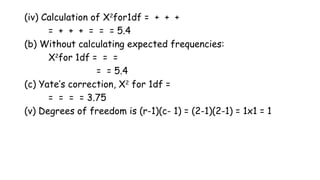
(ii) In 2x2contingency table, chi-square may also be
calculated without estimating the expected frequencies as
follows:
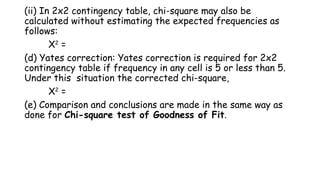
X2
=
(d) Yates correction: Yates correction is required for 2x2
contingency table if frequency in any cell is 5 or less than 5.
Under this situation the corrected chi-square,
X2
=
(e) Comparison and conclusions are made in the same way as
done for Chi-square test of Goodness of Fit.
22.
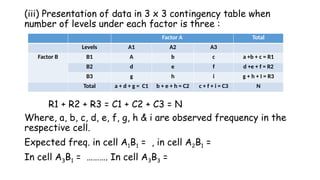
(iii) Presentation ofdata in 3 x 3 contingency table when
number of levels under each factor is three :
R1 + R2 + R3 = C1 + C2 + C3 = N
Where, a, b, c, d, e, f, g, h & i are observed frequency in the
respective cell.
Expected freq. in cell A1B1 = , in cell A2B1 =
In cell A3B1 = ………. In cell A3B3 =
Factor A Total
Levels A1 A2 A3
Factor B B1 A b c a +b + c = R1
B2 d e f d +e + f = R2
B3 g h i g + h + I = R3
Total a + d + g = C1 b + e + h = C2 c + f + i = C3 N
23.
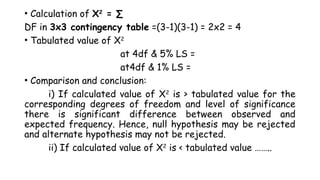
• Calculation ofX2
= ∑
DF in 3x3 contingency table =(3-1)(3-1) = 2x2 = 4
• Tabulated value of X2
at 4df & 5% LS =
at4df & 1% LS =
• Comparison and conclusion:
i) If calculated value of X2
is > tabulated value for the
corresponding degrees of freedom and level of significance
there is significant difference between observed and
expected frequency. Hence, null hypothesis may be rejected
and alternate hypothesis may not be rejected.
ii) If calculated value of X2
is < tabulated value ……..
24.
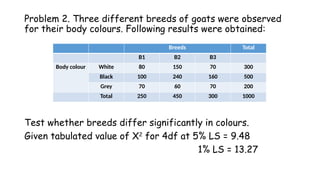
Problem 2. Threedifferent breeds of goats were observed
for their body colours. Following results were obtained:
Test whether breeds differ significantly in colours.
Given tabulated value of X2
for 4df at 5% LS = 9.48
1% LS = 13.27
Breeds Total
B1 B2 B3
Body colour White 80 150 70 300
Black 100 240 160 500
Grey 70 60 70 200
Total 250 450 300 1000