1
Chapter 14
Multiple Regression Models
2
A general additive multiple regression
model, which relates a dependent variable
y to k predictor variables x1, x2,…, xk is given
by the model equation
y = α + β1x1 + β2x2 + … + βkxk + e
Multiple Regression Models
3
The random deviation e is assumed to be
normally distributed with mean value 0 and
variance σ2
for any particular values of x1, x2,
…, xk.
This implies that for fixed x1, x2,…, xk values, y
has a normal distribution with variance σ2
and
Multiple Regression Models
(mean y value for
fixed x1, x2,…, xk values) = α + β1x1 + β2x2 + … + βkxk
4
The βi’s are called population regression
coefficients; each βi can be interpreted as
the true average change in y when the
predictor xi increases by 1 unit and the
values of all the other predictors remain
fixed.
Multiple Regression Models
The deterministic portion
α+ β1x1 + β2x2 + … + βkxk
is called the population regression function.
5
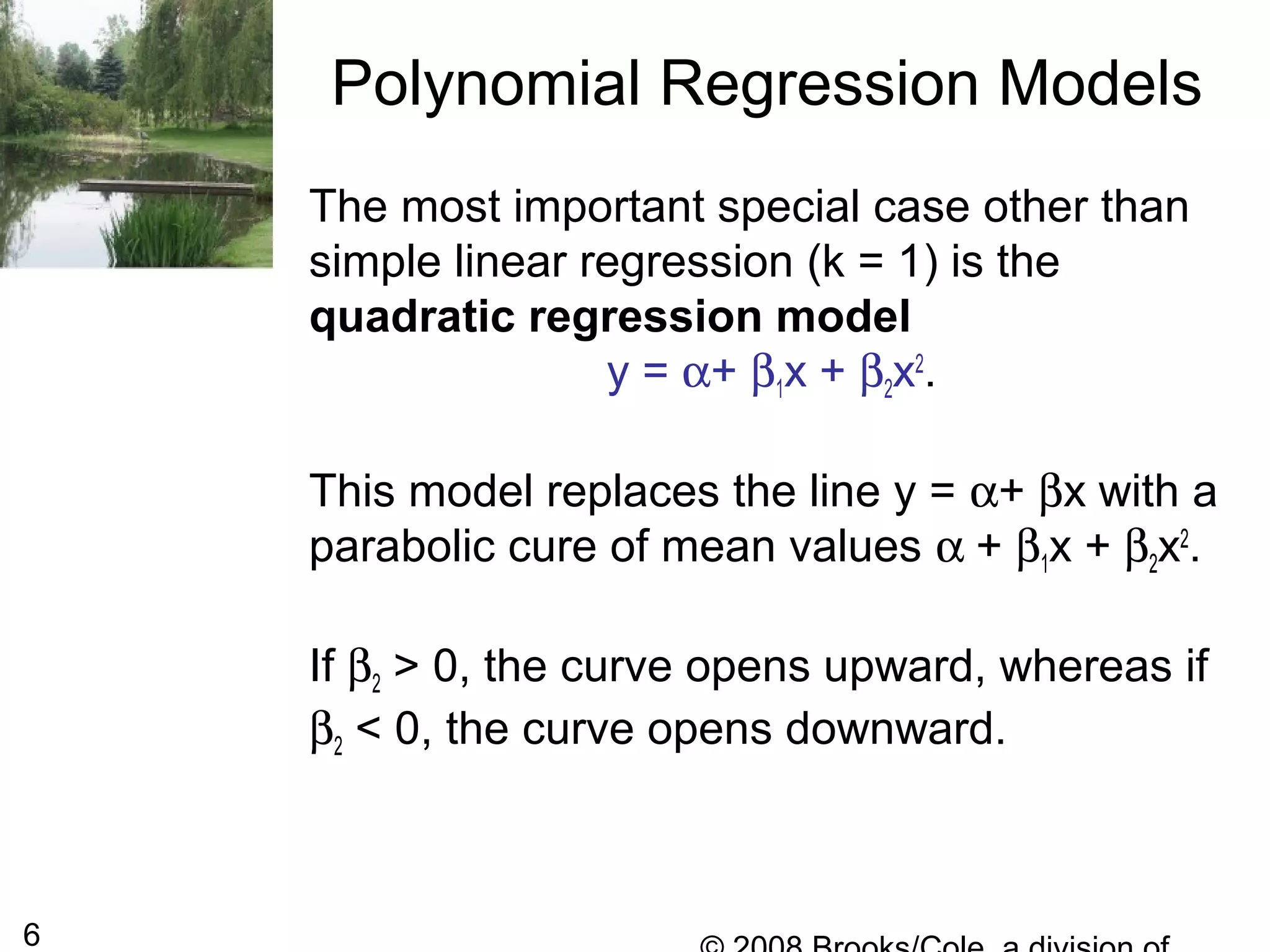
The kth
degree polynomial regression
model
y = α + β1x + β2x2
+ … + βkxk
+ e
is a special case of the general multiple
regression model with x1 = x, x2 = x2
, … , xk
= xk
.
The population regression function
(mean value of y for fixed values of the
predictors) is
α + β1x + β2x2
+ … + βkxk
.
Polynomial Regression Models
6
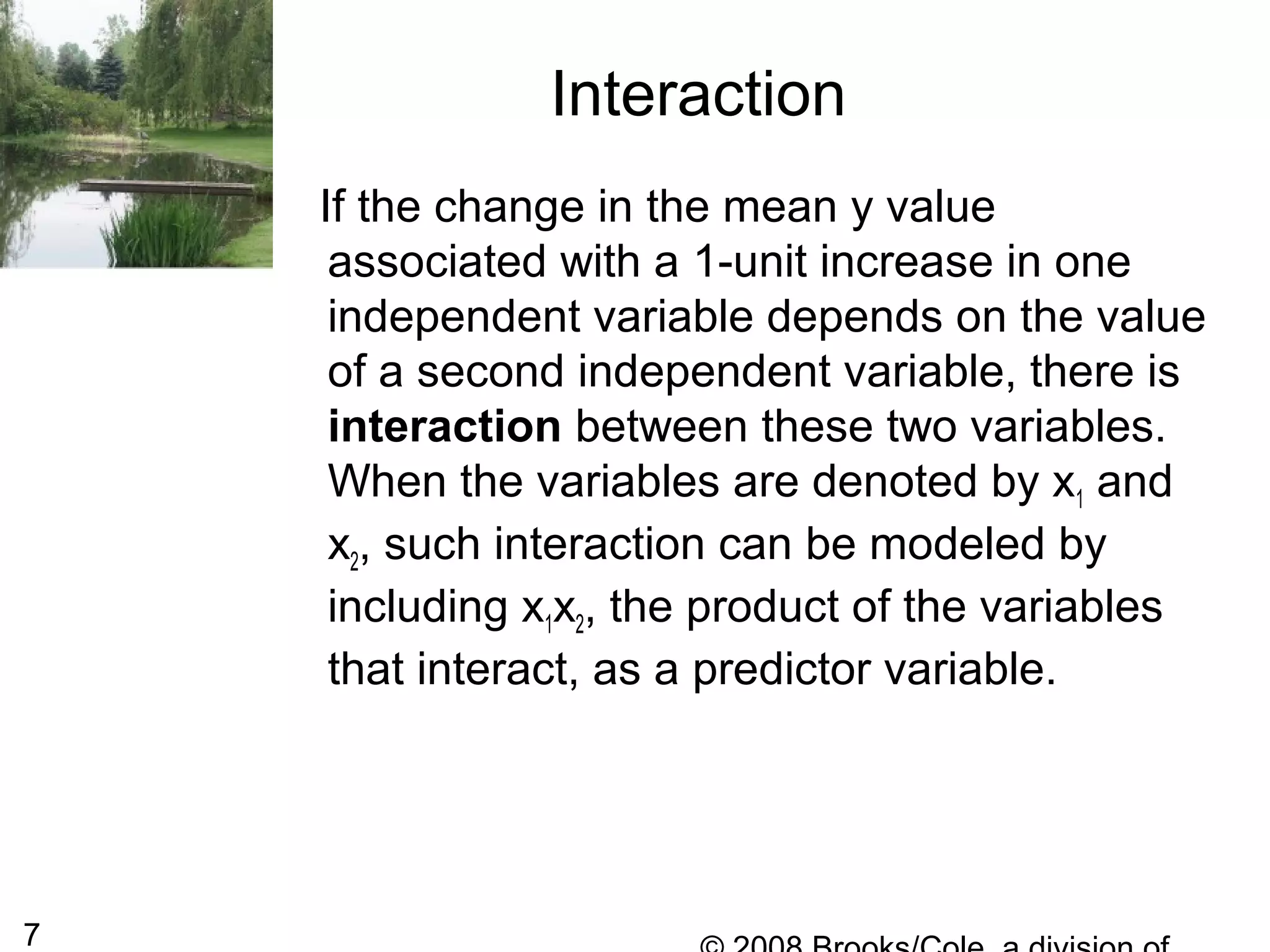
The most important special case other than
simple linear regression (k = 1) is the
quadratic regression model
y = α+ β1x + β2x2
.
This model replaces the line y = α+ βx with a
parabolic cure of mean values α + β1x + β2x2
.
If β2 > 0, the curve opens upward, whereas if
β2 < 0, the curve opens downward.
Polynomial Regression Models
7
If the change in the mean y value
associated with a 1-unit increase in one
independent variable depends on the value
of a second independent variable, there is
interaction between these two variables.
When the variables are denoted by x1 and
x2, such interaction can be modeled by
including x1x2, the product of the variables
that interact, as a predictor variable.
Interaction
8
Up to now, we have only considered the
inclusion of quantitative (numerical) predictor
variables in a multiple regression model.
Two other types are very common:
Dichotomous variable: One with just two
possible categories coded 0 and 1
Examples
 Gender {male, female}
 Marriage status {married, not-
married}
Qualitative Predictor Variables.
9
Ordinal variables: Categorical variables
that have a natural ordering
 Activity level {light, moderate,
heavy} coded respectively as 1, 2
and 3
 Education level {none, elementary,
secondary, college, graduate}
coded respectively 1, 2, 3, 4, 5 (or
for that matter any 5 consecutive
integers}
Qualitative Predictor Variables.
10
According to the principle of least squares,
the fit of a particular estimated regression
function a + b1x1 + b2x2 + … + bkxk to the
observed data is measured by the sum of
squared deviations between the observed y
values and the y values predicted by the
estimated function:
Σ[y –(a + b1x1 + b2x2 + … + bkxk )]2
Least Square Estimates
The least squares estimates of α, β1, β2,…, βk are
those values of a, b1, b2, … , bk that make this sum of
squared deviations as small as possible.
11
Predicted Values & Residuals
Doing this successively for the remaining
observations yields the predicted values
(sometimes referred to as the fitted values or fits).
L2 3 ky ,y , ,yˆ ˆ ˆ
The first predicted value is obtained by
taking the values of the predictor variables
x1, x2,…, xk for the first sample observation
and substituting these values into the
estimated regression function.
1ˆy
12
Predicted Values & Residuals
The residuals are then the differences
between the observed and predicted y
values.
− − −L1 1 2 2 k ky y ,y y , ,y yˆ ˆ ˆ
13
Sums of Squares
The number of degrees of freedom associated with
SSResid is n - (k + 1), because k + 1 df are lost in
estimating the k + 1 coefficients α, β1, β2,…,βk.
The residual (or error) sum of sqyares,
SSResid, and total sum of squares,
SSTo, are given by
where is the mean of the y observations
in the sample.
( ) ( )
2 2
ˆSSResid= y-y SSTo= y-y∑ ∑
y
14
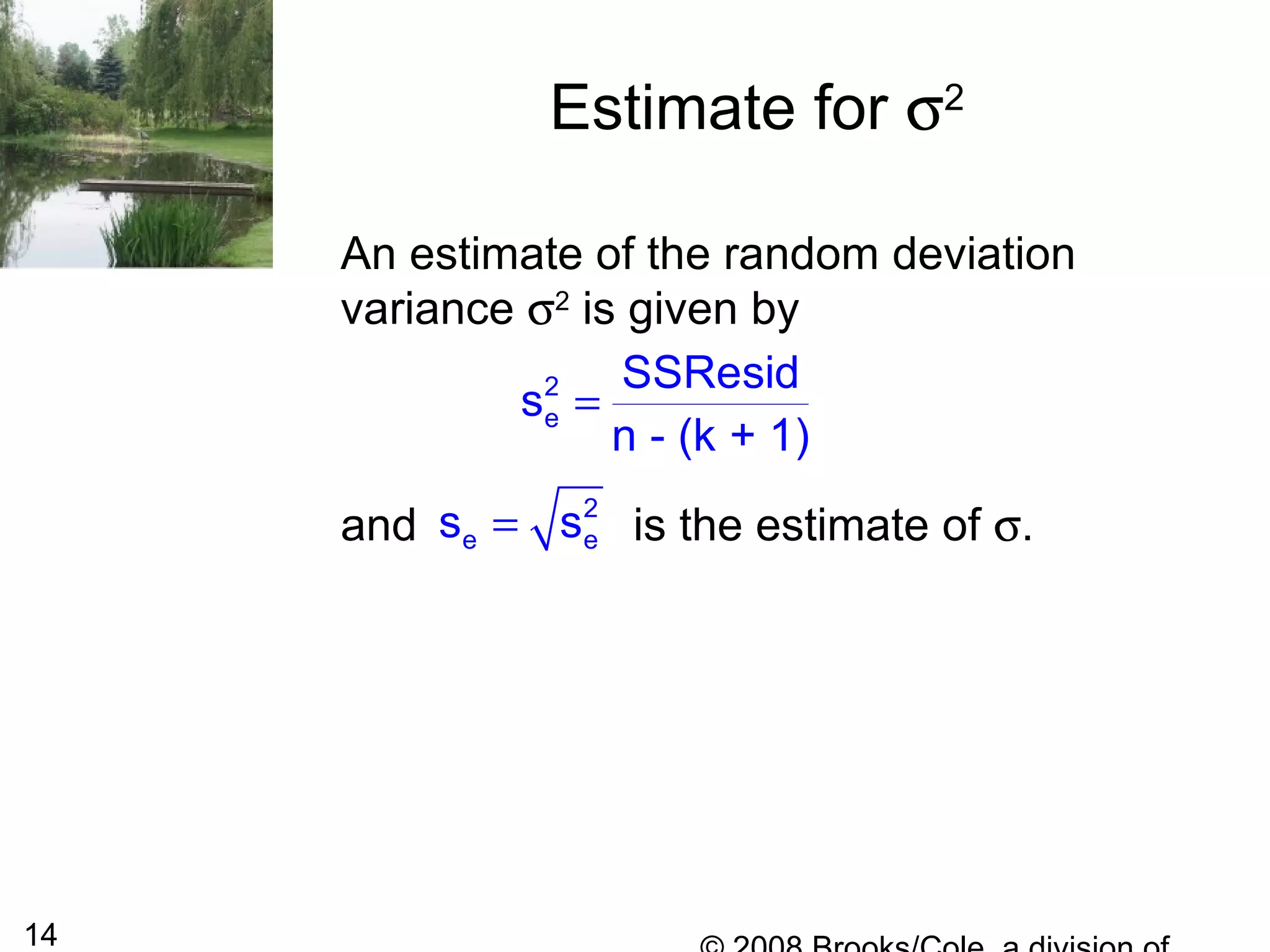
Estimate for σ2
An estimate of the random deviation
variance σ2
is given by
and is the estimate of σ.
2
e
SSResid
s
n - (k + 1)
=
2
e es s=
15
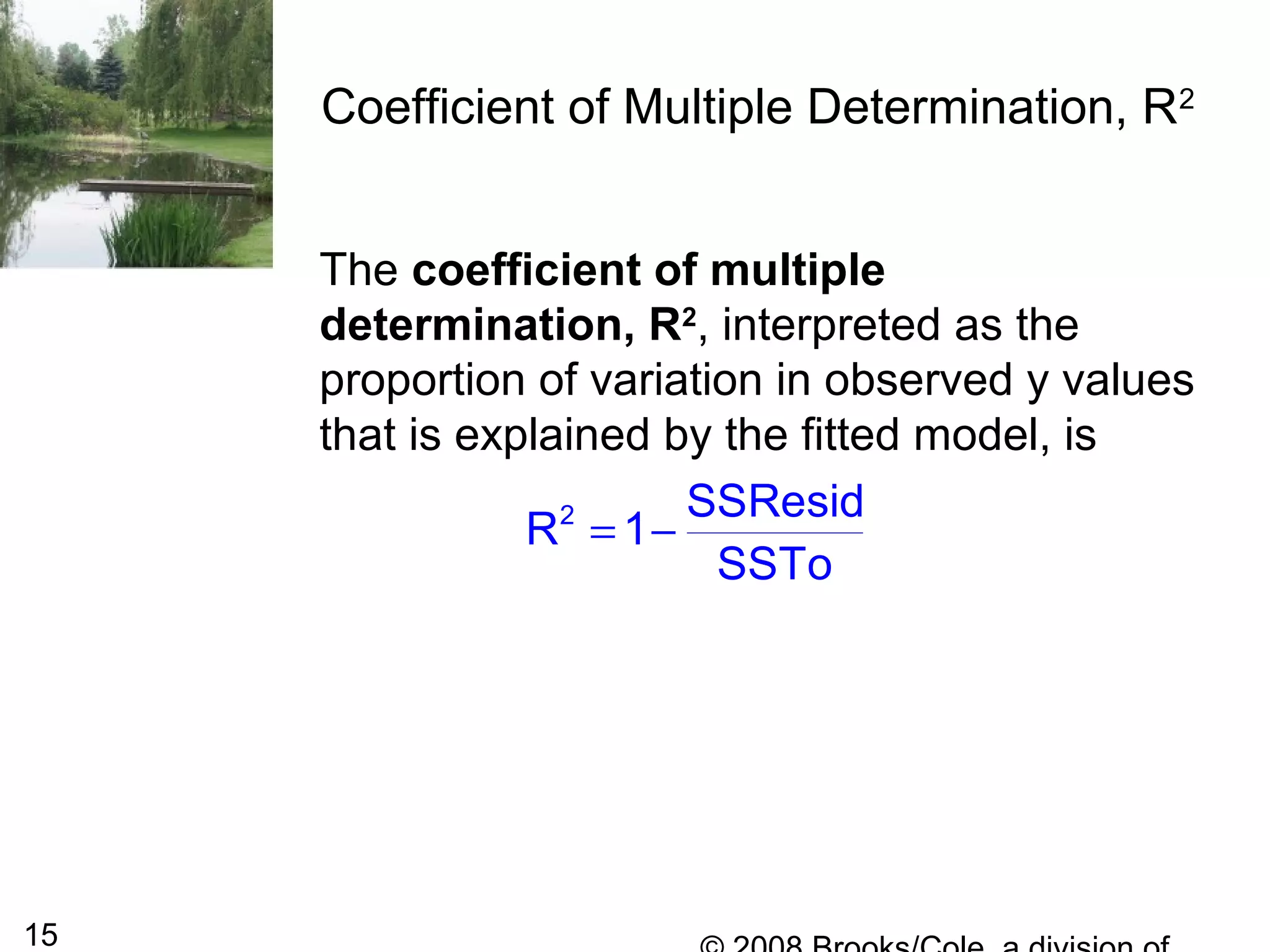
Coefficient of Multiple Determination, R2
The coefficient of multiple
determination, R2
, interpreted as the
proportion of variation in observed y values
that is explained by the fitted model, is
2 SSResid
R 1
SSTo
= −
16
Adjusted R2
Generally, a model with large R2
and small
se are desirable. If a large number of
variables (relative to the number of data
points) is used those conditions may be
satisfied but the model will be unrealistic
and difficult to interpret.
17
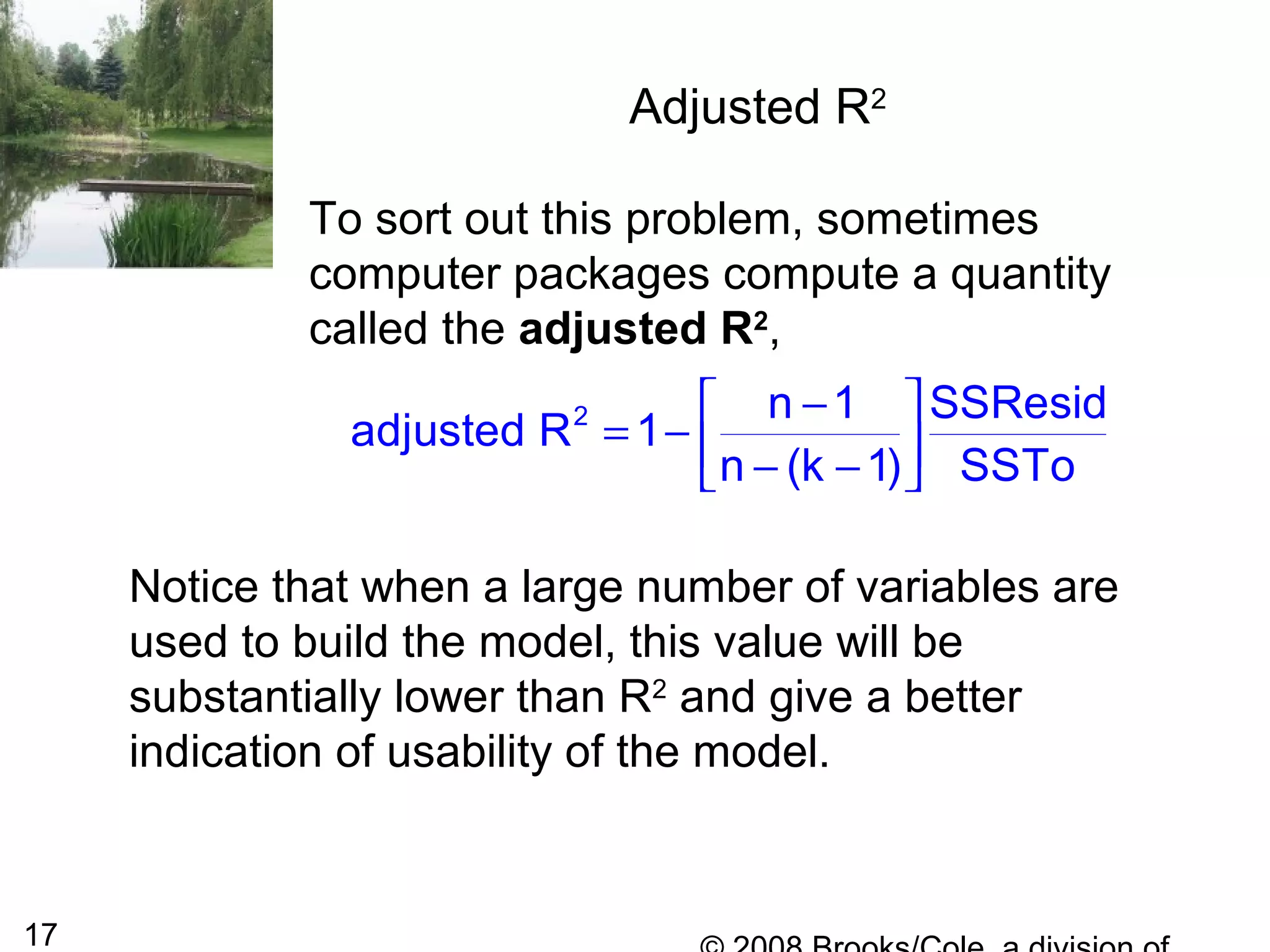
Adjusted R2
To sort out this problem, sometimes
computer packages compute a quantity
called the adjusted R2
,
2 n 1 SSResid
adjusted R 1
n (k 1) SSTo
− 
= −  − − 
Notice that when a large number of variables are
used to build the model, this value will be
substantially lower than R2
and give a better
indication of usability of the model.
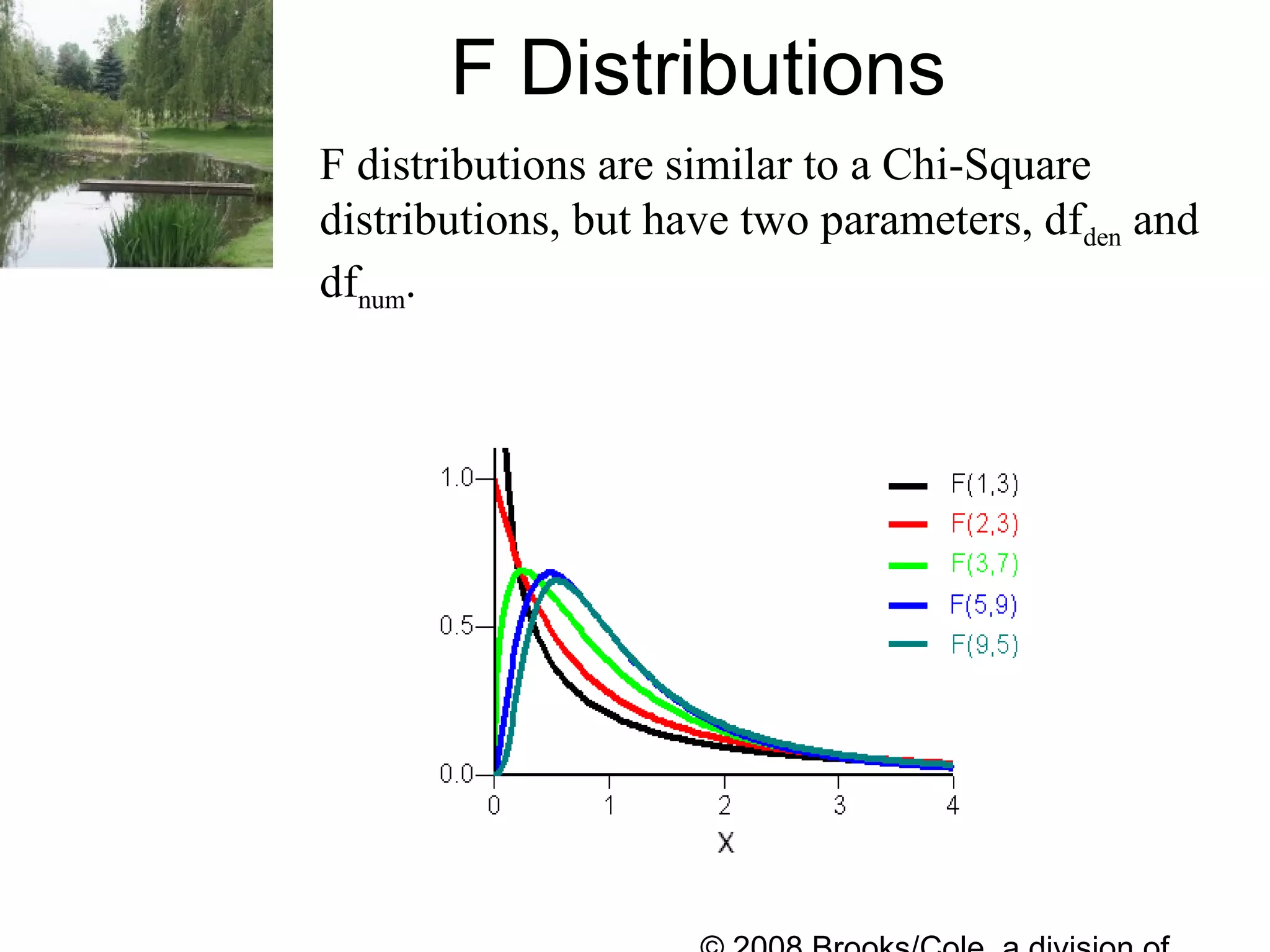
F Distributions
F distributions are similar to a Chi-Square
distributions, but have two parameters, dfden and
dfnum.
19
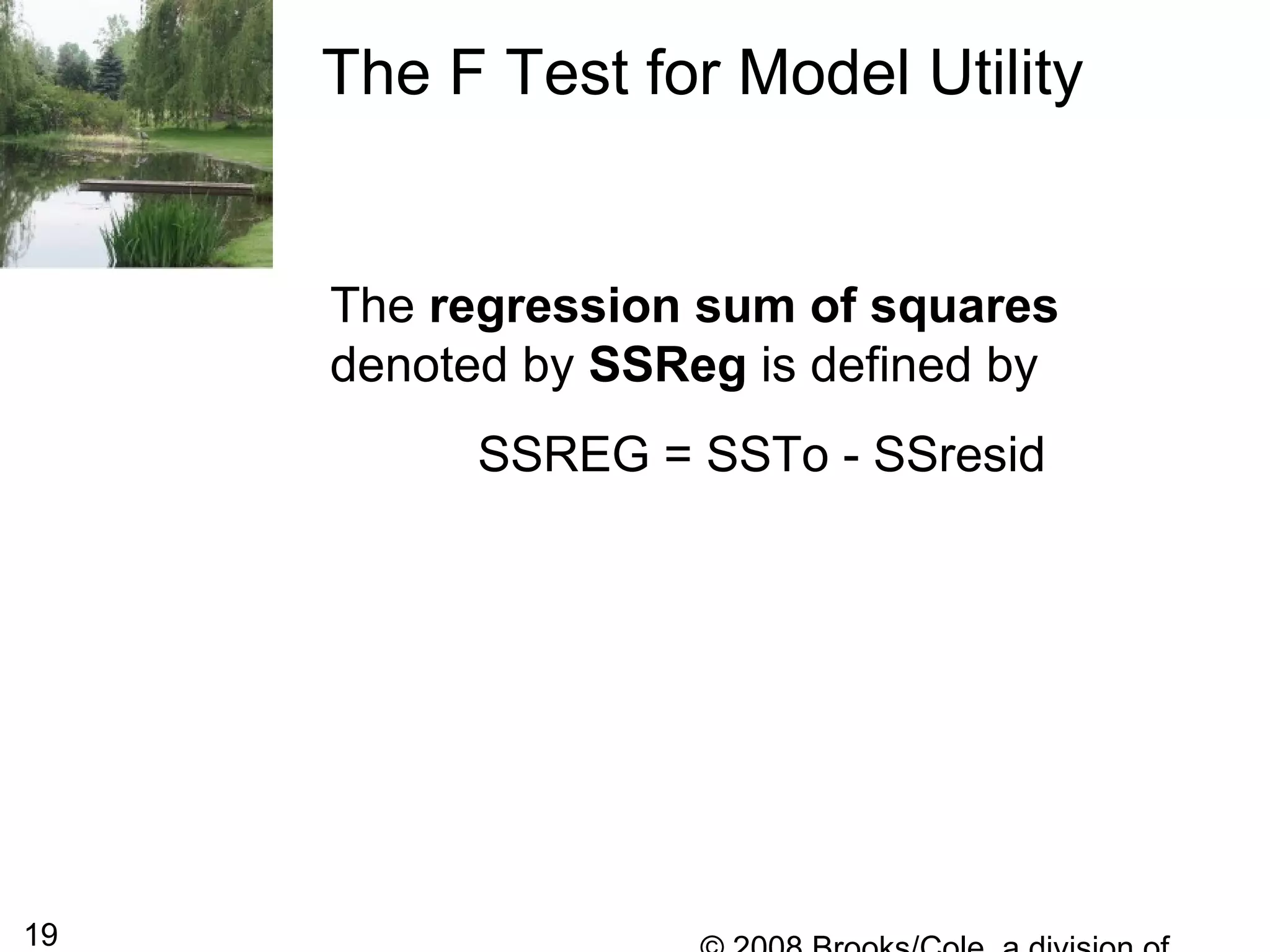
The F Test for Model Utility
The regression sum of squares
denoted by SSReg is defined by
SSREG = SSTo - SSresid
20
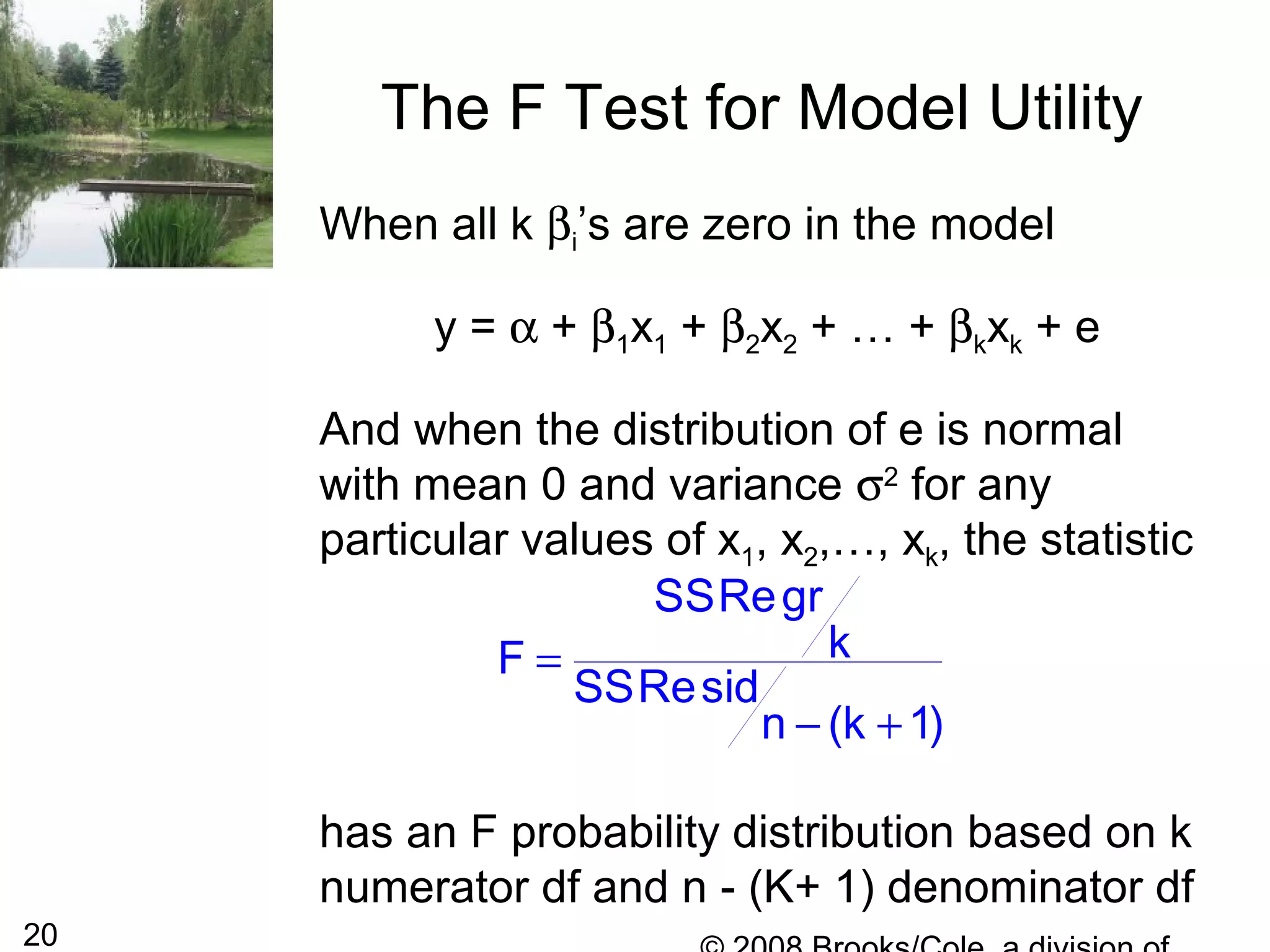
The F Test for Model Utility
When all k βi’s are zero in the model
y = α + β1x1 + β2x2 + … + βkxk + e
And when the distribution of e is normal
with mean 0 and variance σ2
for any
particular values of x1, x2,…, xk, the statistic
has an F probability distribution based on k
numerator df and n - (K+ 1) denominator df
SSRegr
kF
SSResid
n (k 1)
=
− +
21
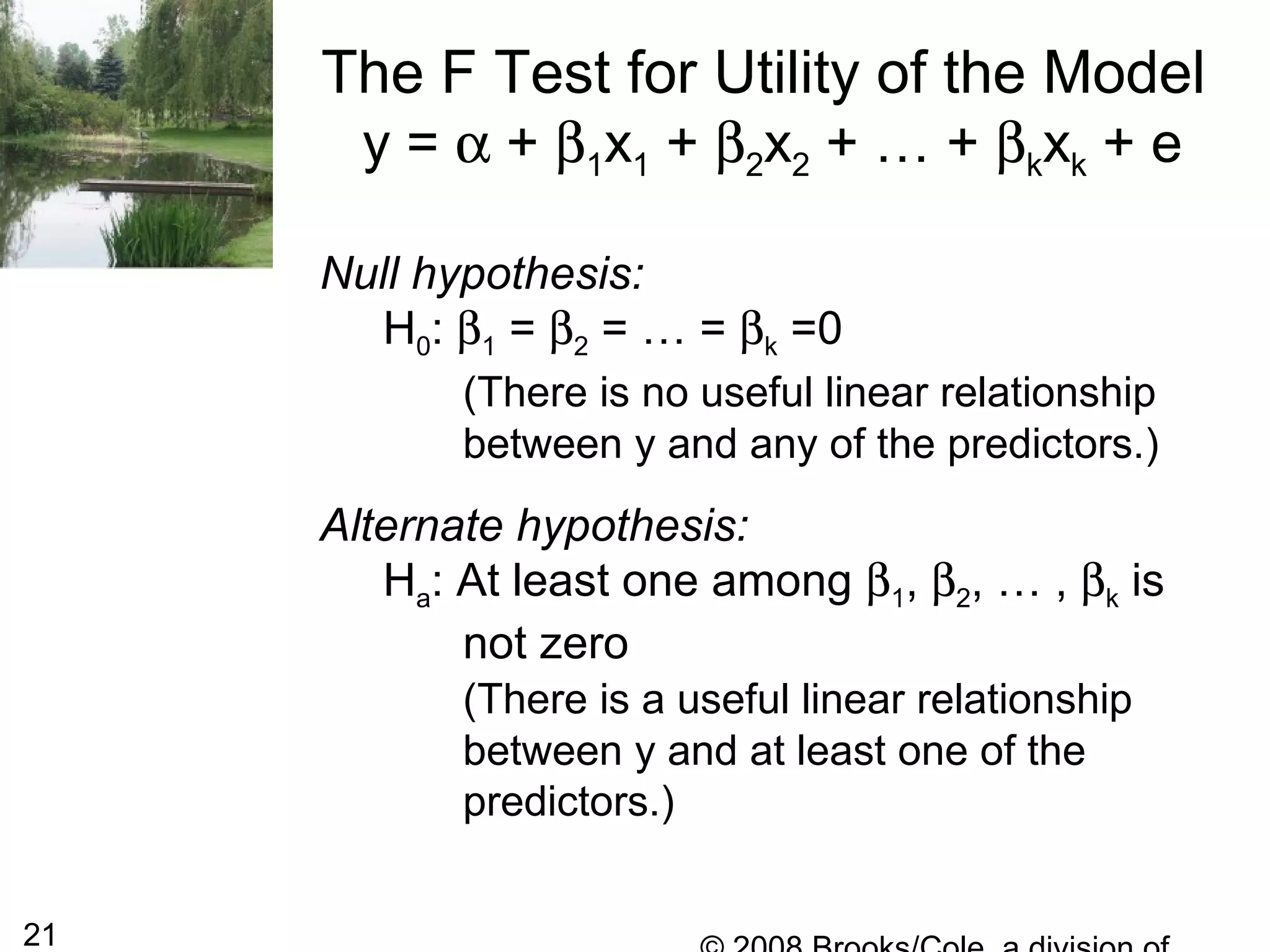
The F Test for Utility of the Model
y = α + β1x1 + β2x2 + … + βkxk + e
Null hypothesis:
H0: β1 = β2 = … = βk =0
(There is no useful linear relationship
between y and any of the predictors.)
Alternate hypothesis:
Ha: At least one among β1, β2, … , βk is
not zero
(There is a useful linear relationship
between y and at least one of the
predictors.)
22
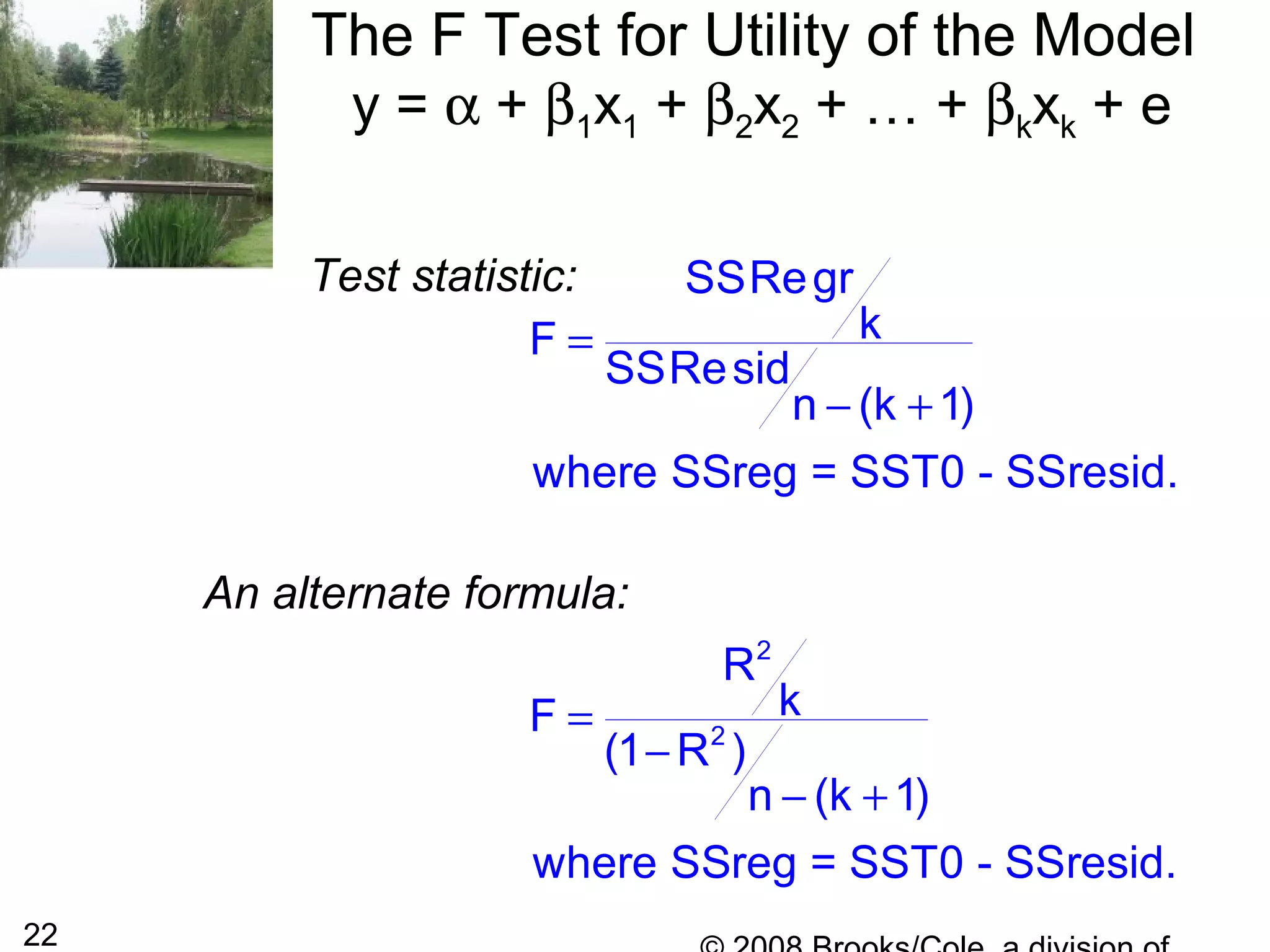
The F Test for Utility of the Model
y = α + β1x1 + β2x2 + … + βkxk + e
Test statistic: SSRegr
kF
SSResid
n (k 1)
where SSreg = SST0 - SSresid.
=
− +
An alternate formula:
2
2
R
kF
(1 R )
n (k 1)
where SSreg = SST0 - SSresid.
=
−
− +
23
The F Test Utility of the Model
y = α + β1x1 + β2x2 + … + βkxk + e
The test is upper-tailed, and the information
in the Table of Values that capture specified
upper-tail F curve areas is used to obtain a
bound or bounds on the P-value using
numerator df = k and denominator
df = n - (k + 1).
Assumptions: For any particular combination of
predictor variable values, the distribution of e, the
random deviation, is normal with mean 0 and
constant variance.
24
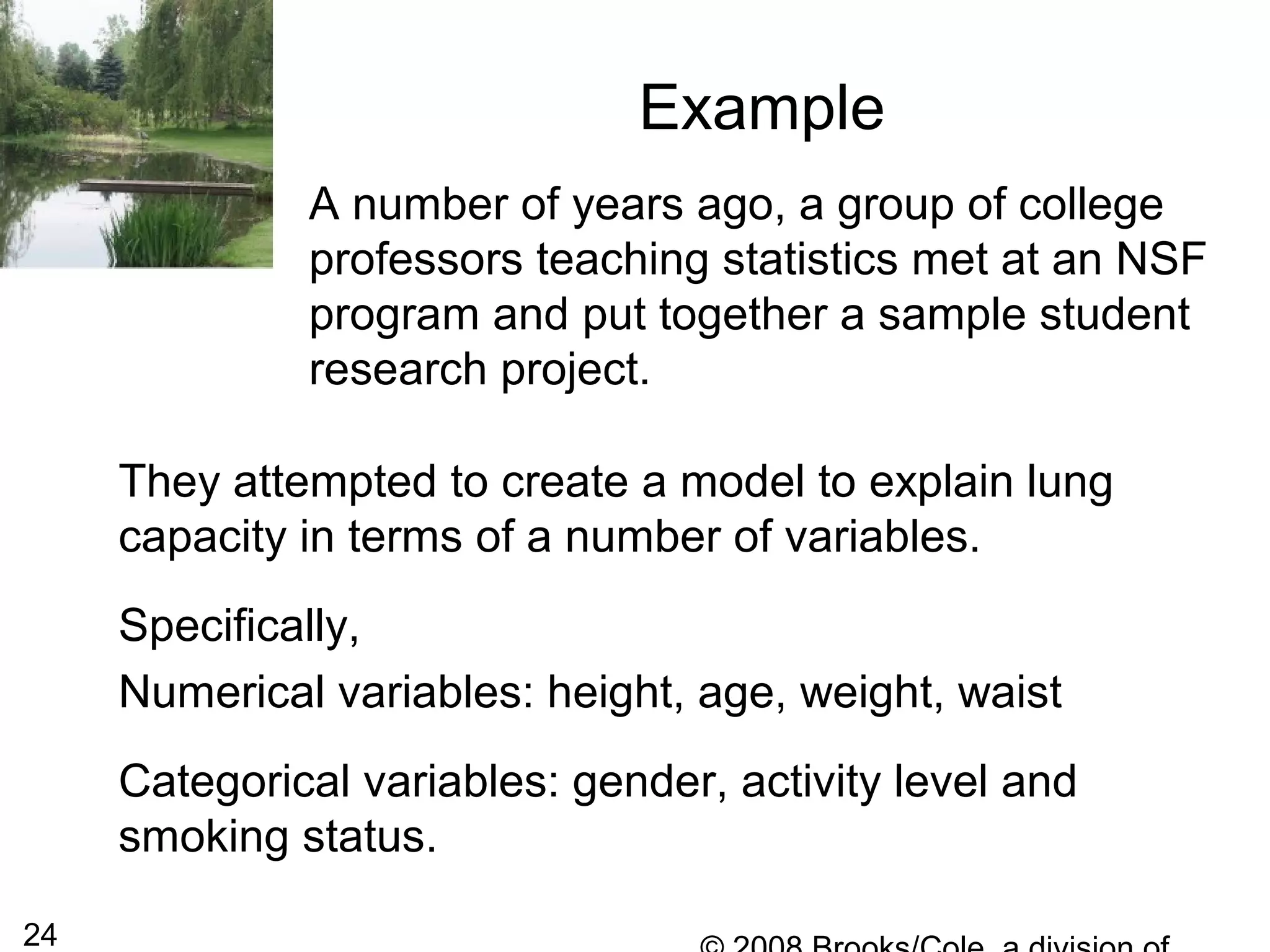
Example
A number of years ago, a group of college
professors teaching statistics met at an NSF
program and put together a sample student
research project.
They attempted to create a model to explain lung
capacity in terms of a number of variables.
Specifically,
Numerical variables: height, age, weight, waist
Categorical variables: gender, activity level and
smoking status.
25
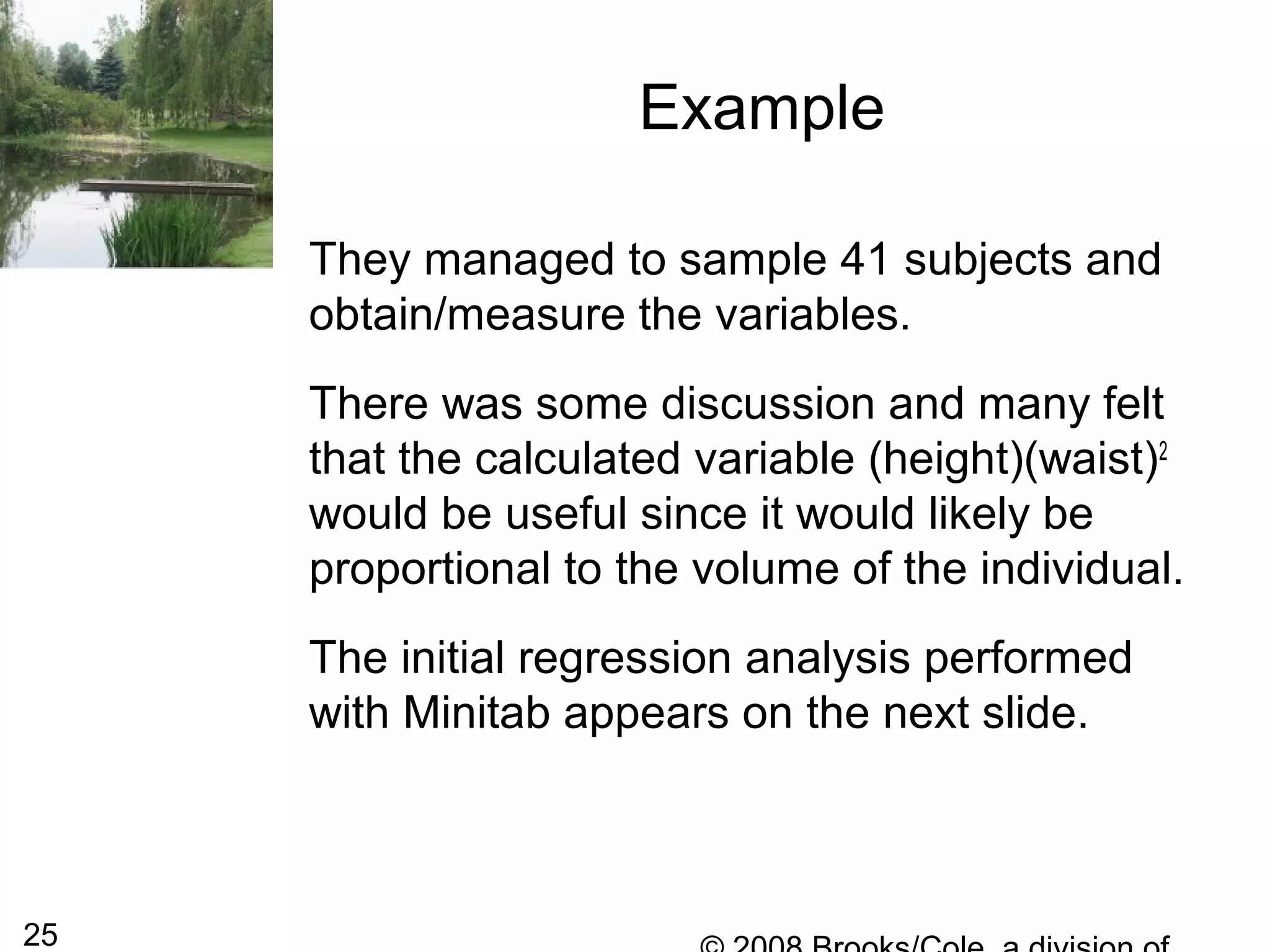
Example
They managed to sample 41 subjects and
obtain/measure the variables.
There was some discussion and many felt
that the calculated variable (height)(waist)2
would be useful since it would likely be
proportional to the volume of the individual.
The initial regression analysis performed
with Minitab appears on the next slide.
26
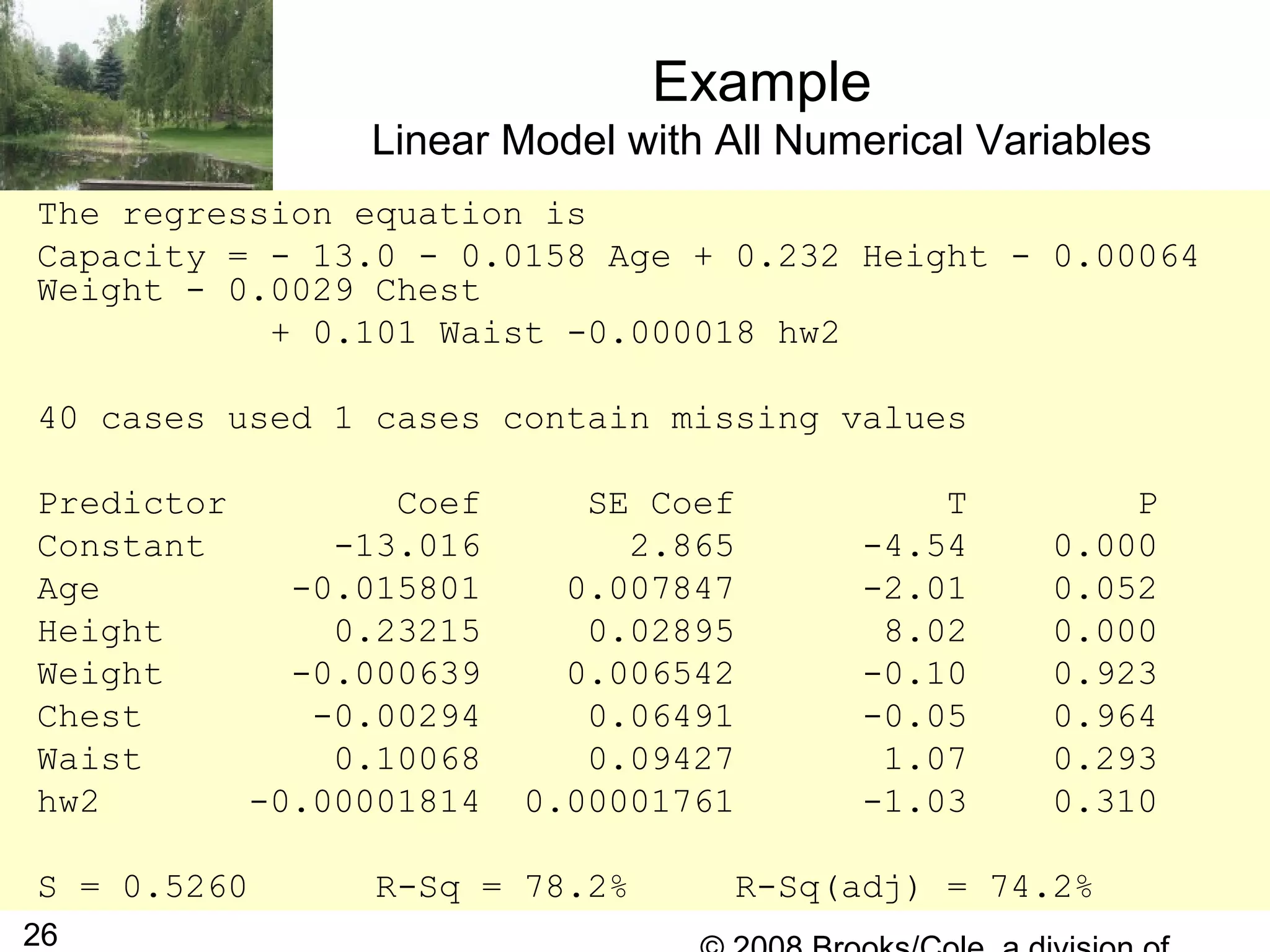
Example
Linear Model with All Numerical Variables
The regression equation is
Capacity = - 13.0 - 0.0158 Age + 0.232 Height - 0.00064
Weight - 0.0029 Chest
+ 0.101 Waist -0.000018 hw2
40 cases used 1 cases contain missing values
Predictor Coef SE Coef T P
Constant -13.016 2.865 -4.54 0.000
Age -0.015801 0.007847 -2.01 0.052
Height 0.23215 0.02895 8.02 0.000
Weight -0.000639 0.006542 -0.10 0.923
Chest -0.00294 0.06491 -0.05 0.964
Waist 0.10068 0.09427 1.07 0.293
hw2 -0.00001814 0.00001761 -1.03 0.310
S = 0.5260 R-Sq = 78.2% R-Sq(adj) = 74.2%
27
Example
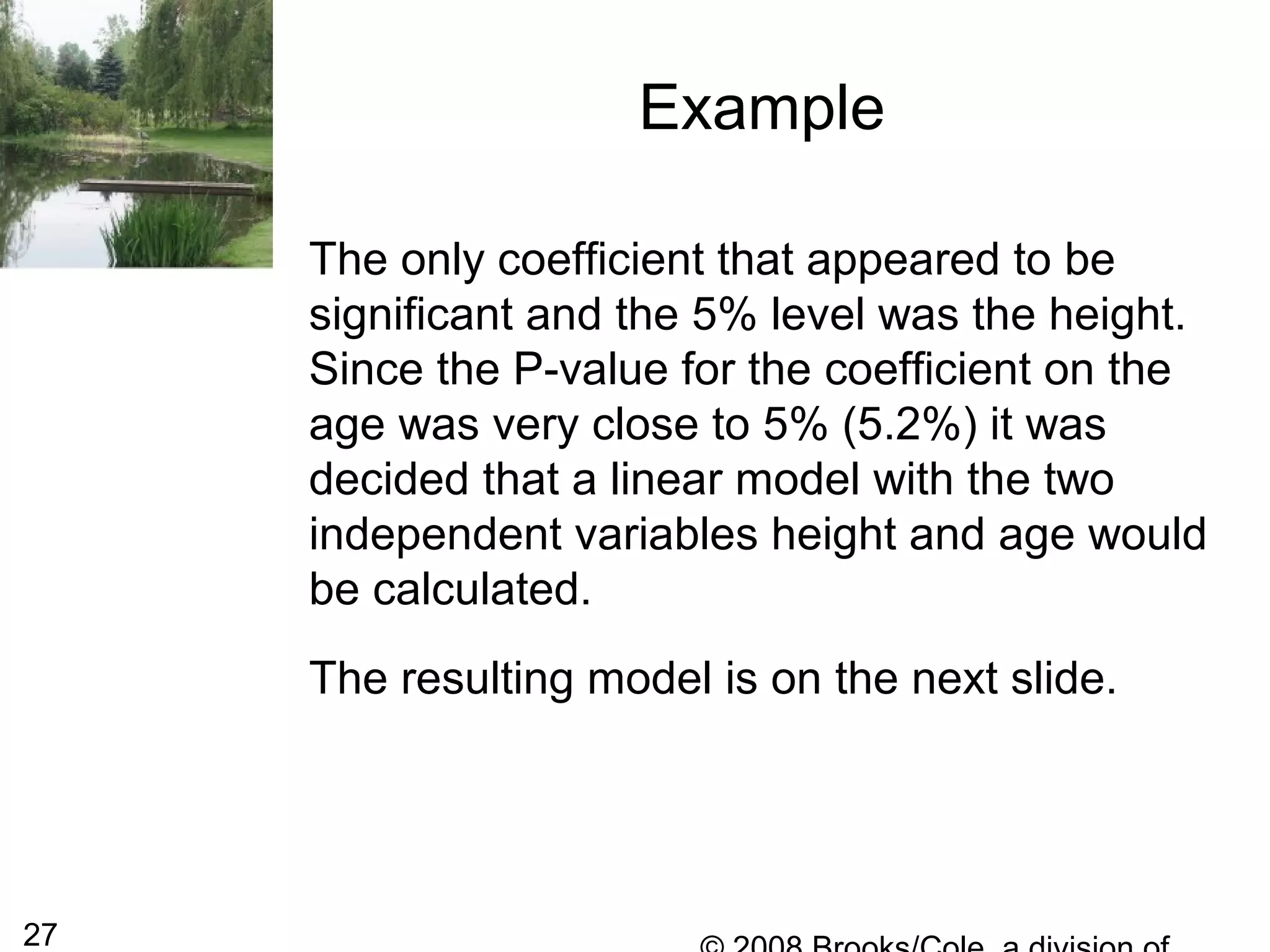
The only coefficient that appeared to be
significant and the 5% level was the height.
Since the P-value for the coefficient on the
age was very close to 5% (5.2%) it was
decided that a linear model with the two
independent variables height and age would
be calculated.
The resulting model is on the next slide.
28
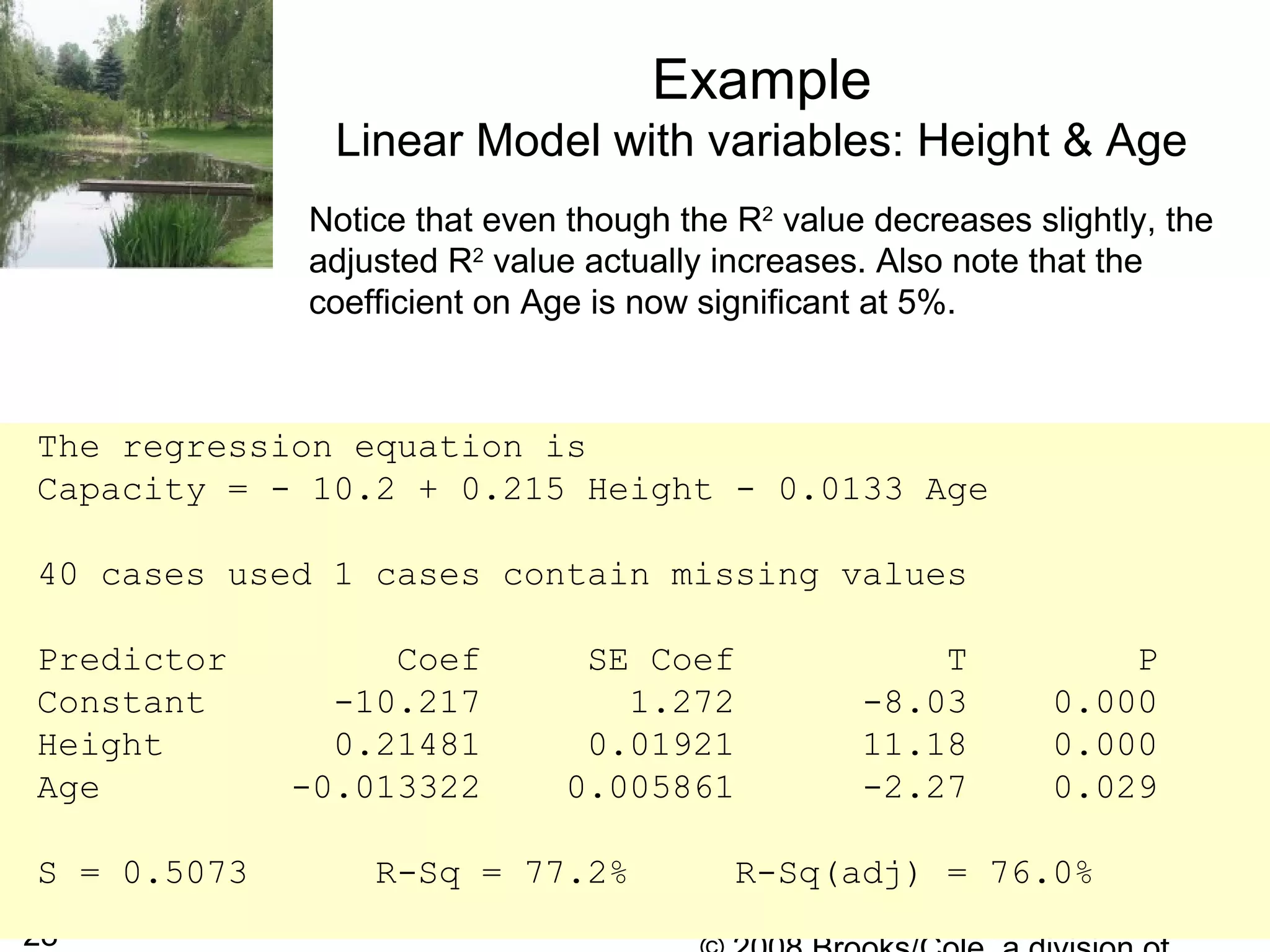
Example
Linear Model with variables: Height & Age
The regression equation is
Capacity = - 10.2 + 0.215 Height - 0.0133 Age
40 cases used 1 cases contain missing values
Predictor Coef SE Coef T P
Constant -10.217 1.272 -8.03 0.000
Height 0.21481 0.01921 11.18 0.000
Age -0.013322 0.005861 -2.27 0.029
S = 0.5073 R-Sq = 77.2% R-Sq(adj) = 76.0%
Notice that even though the R2
value decreases slightly, the
adjusted R2
value actually increases. Also note that the
coefficient on Age is now significant at 5%.
29
Example
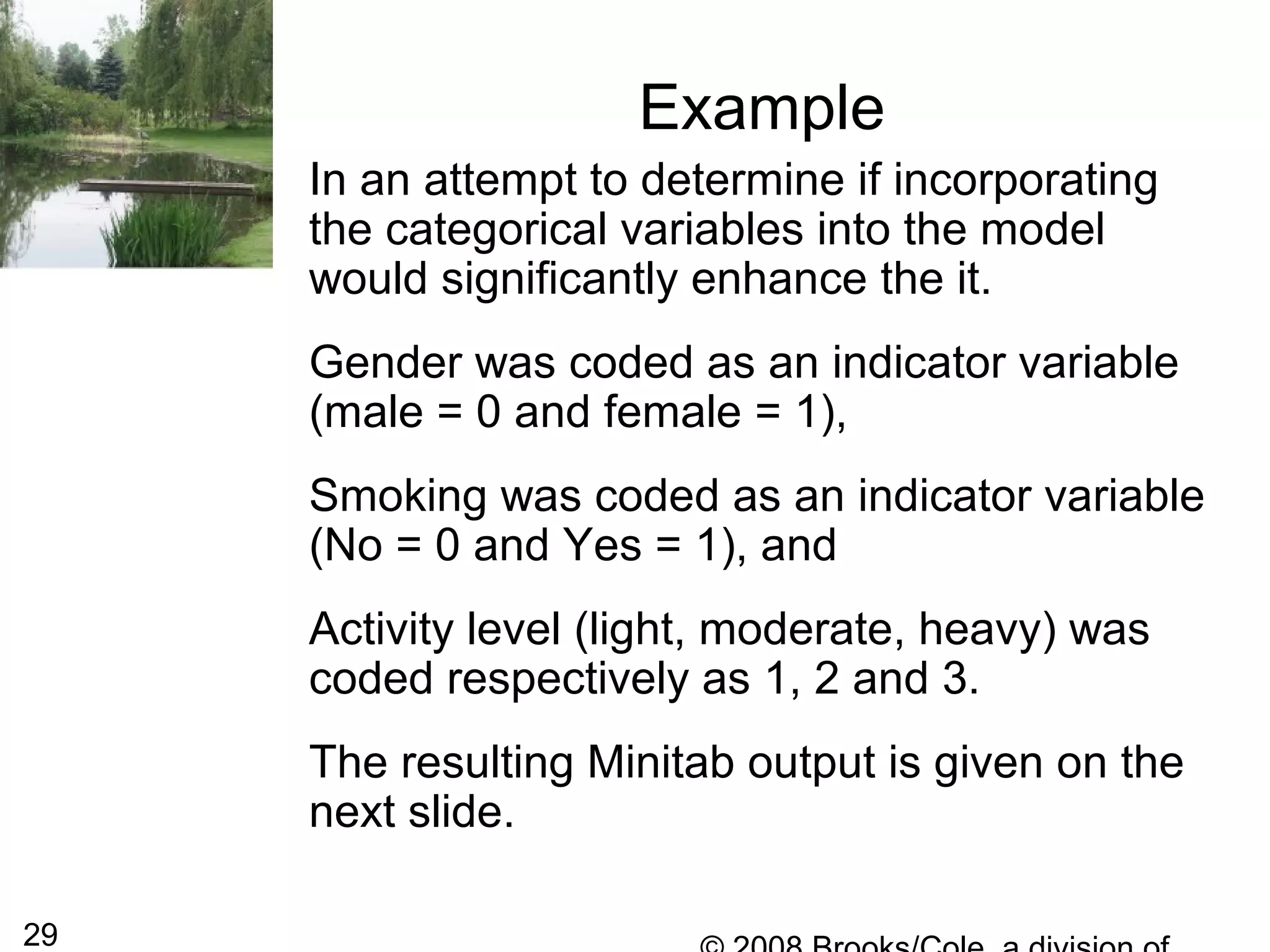
In an attempt to determine if incorporating
the categorical variables into the model
would significantly enhance the it.
Gender was coded as an indicator variable
(male = 0 and female = 1),
Smoking was coded as an indicator variable
(No = 0 and Yes = 1), and
Activity level (light, moderate, heavy) was
coded respectively as 1, 2 and 3.
The resulting Minitab output is given on the
next slide.
30
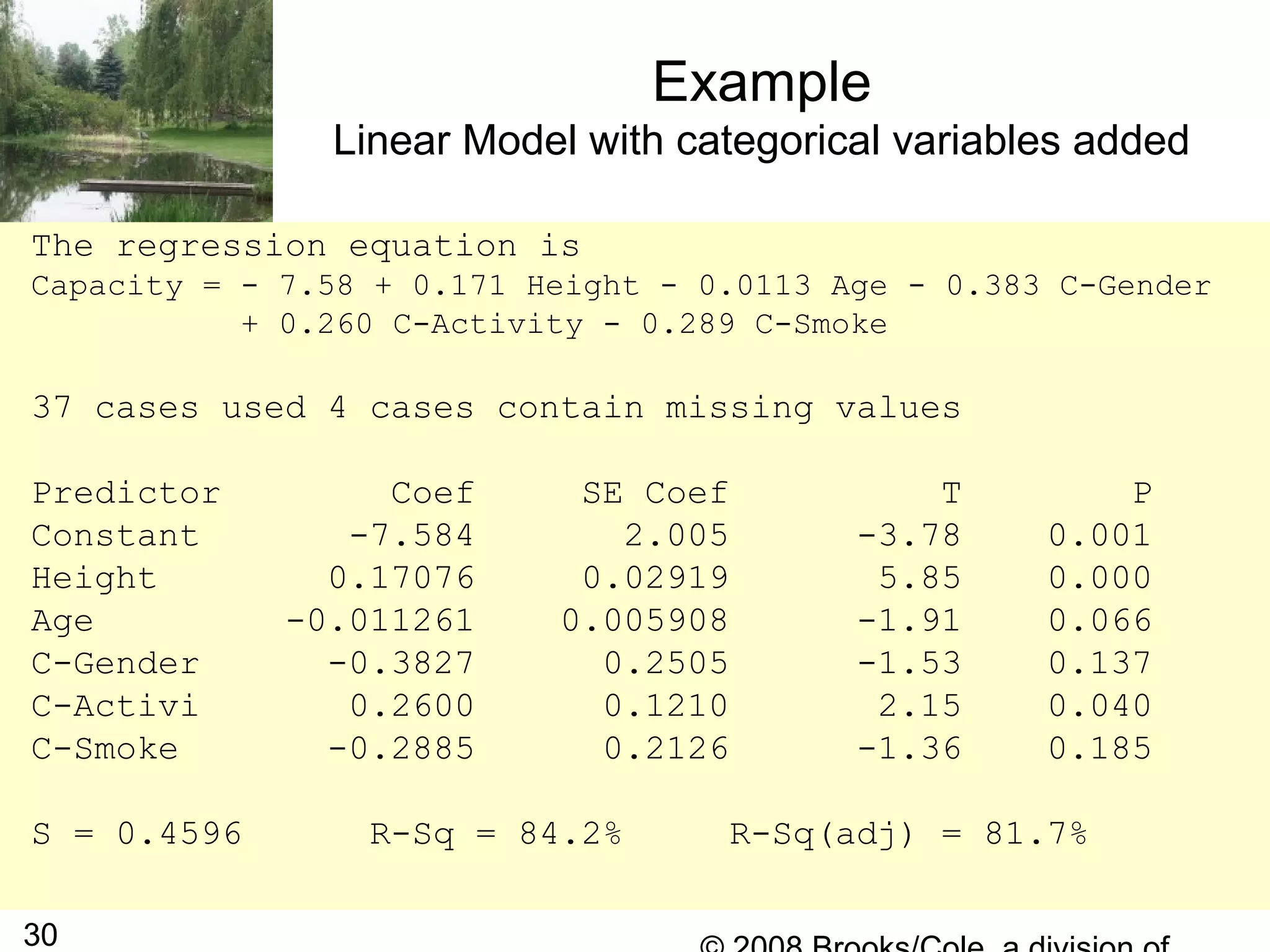
Example
Linear Model with categorical variables added
The regression equation is
Capacity = - 7.58 + 0.171 Height - 0.0113 Age - 0.383 C-Gender
+ 0.260 C-Activity - 0.289 C-Smoke
37 cases used 4 cases contain missing values
Predictor Coef SE Coef T P
Constant -7.584 2.005 -3.78 0.001
Height 0.17076 0.02919 5.85 0.000
Age -0.011261 0.005908 -1.91 0.066
C-Gender -0.3827 0.2505 -1.53 0.137
C-Activi 0.2600 0.1210 2.15 0.040
C-Smoke -0.2885 0.2126 -1.36 0.185
S = 0.4596 R-Sq = 84.2% R-Sq(adj) = 81.7%
31
Example
It was noted that coefficient for the coded
indicator variables gender and smoking
were not significant, but after considerable
discussion, the group felt that a number of
the variables were related.
This, the group felt, was confounding the study. In an
attempt to determine a reasonable optimal subgroup of
the variables to keep in the study, it was noted that a
number of the variables were highly related. Since the
study was small, a stepwise regression was run and the
variables, Height, Age, Coded Activity, Coded Gender
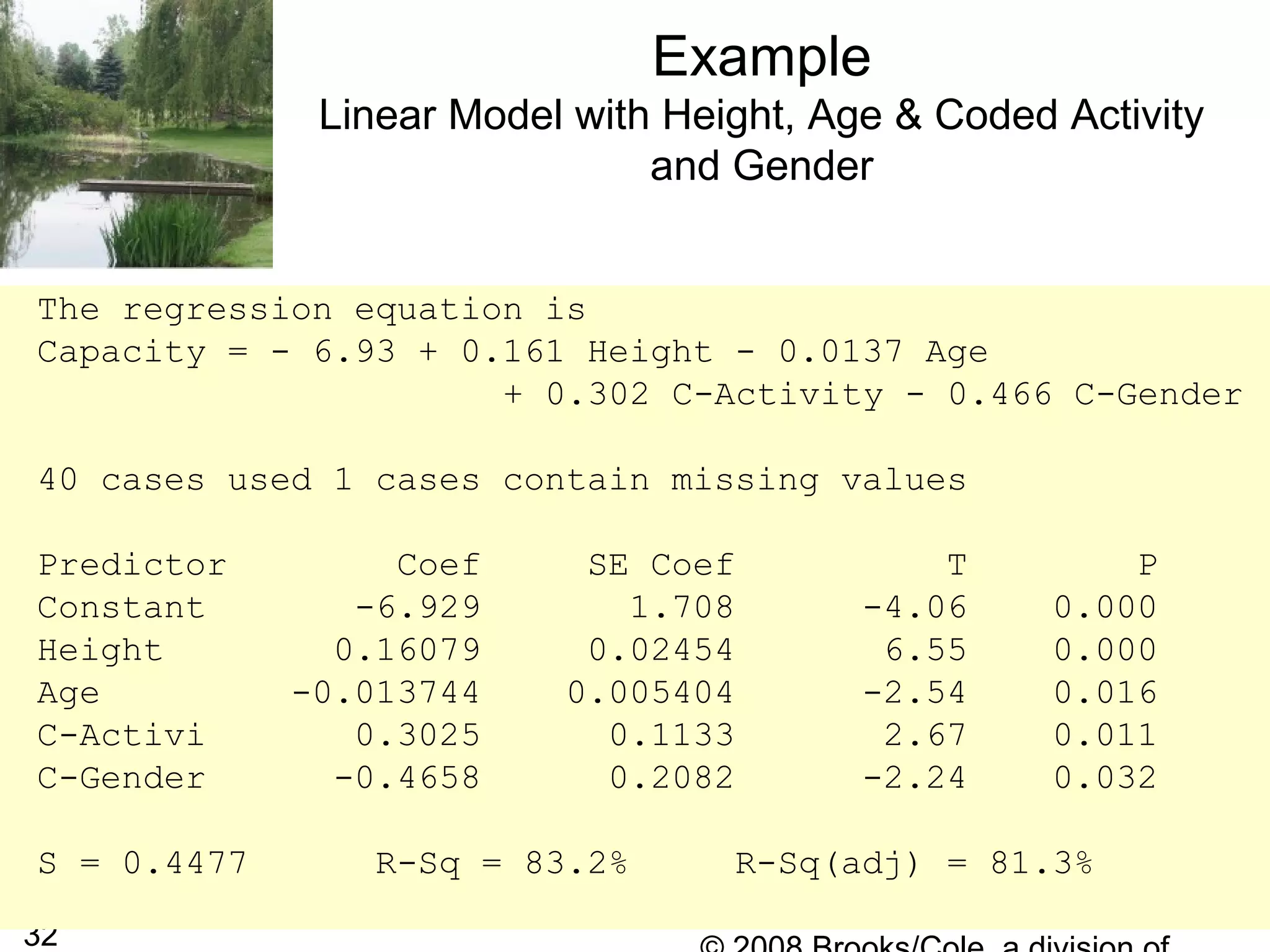
were kept and the following model was obtained.
32
Example
Linear Model with Height, Age & Coded Activity
and Gender
The regression equation is
Capacity = - 6.93 + 0.161 Height - 0.0137 Age
+ 0.302 C-Activity - 0.466 C-Gender
40 cases used 1 cases contain missing values
Predictor Coef SE Coef T P
Constant -6.929 1.708 -4.06 0.000
Height 0.16079 0.02454 6.55 0.000
Age -0.013744 0.005404 -2.54 0.016
C-Activi 0.3025 0.1133 2.67 0.011
C-Gender -0.4658 0.2082 -2.24 0.032
S = 0.4477 R-Sq = 83.2% R-Sq(adj) = 81.3%
33
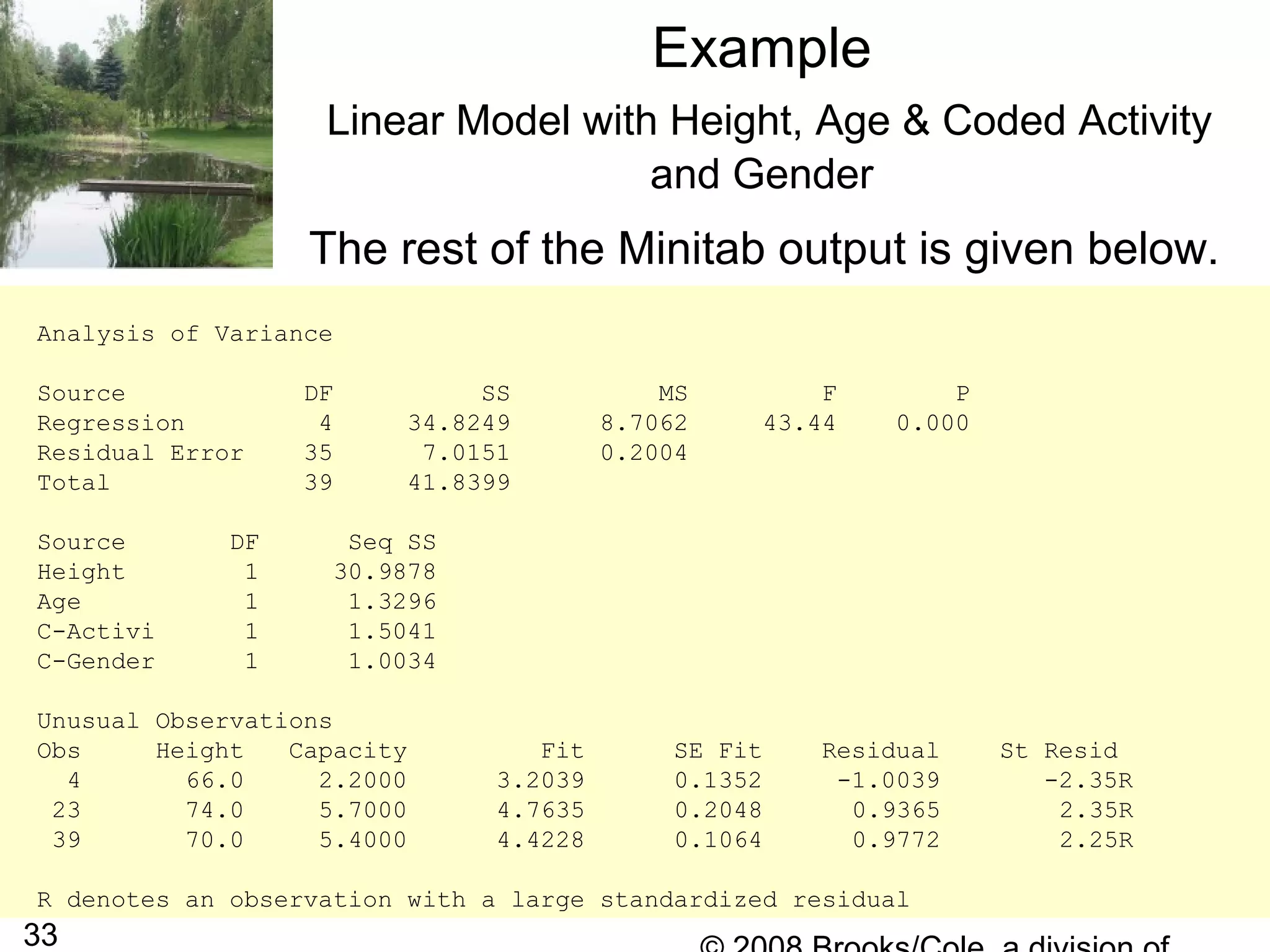
Example
Linear Model with Height, Age & Coded Activity
and Gender
Analysis of Variance
Source DF SS MS F P
Regression 4 34.8249 8.7062 43.44 0.000
Residual Error 35 7.0151 0.2004
Total 39 41.8399
Source DF Seq SS
Height 1 30.9878
Age 1 1.3296
C-Activi 1 1.5041
C-Gender 1 1.0034
Unusual Observations
Obs Height Capacity Fit SE Fit Residual St Resid
4 66.0 2.2000 3.2039 0.1352 -1.0039 -2.35R
23 74.0 5.7000 4.7635 0.2048 0.9365 2.35R
39 70.0 5.4000 4.4228 0.1064 0.9772 2.25R
R denotes an observation with a large standardized residual
The rest of the Minitab output is given below.
34
Example
Linear Model with Height, Age & Coded Activity
and Gender
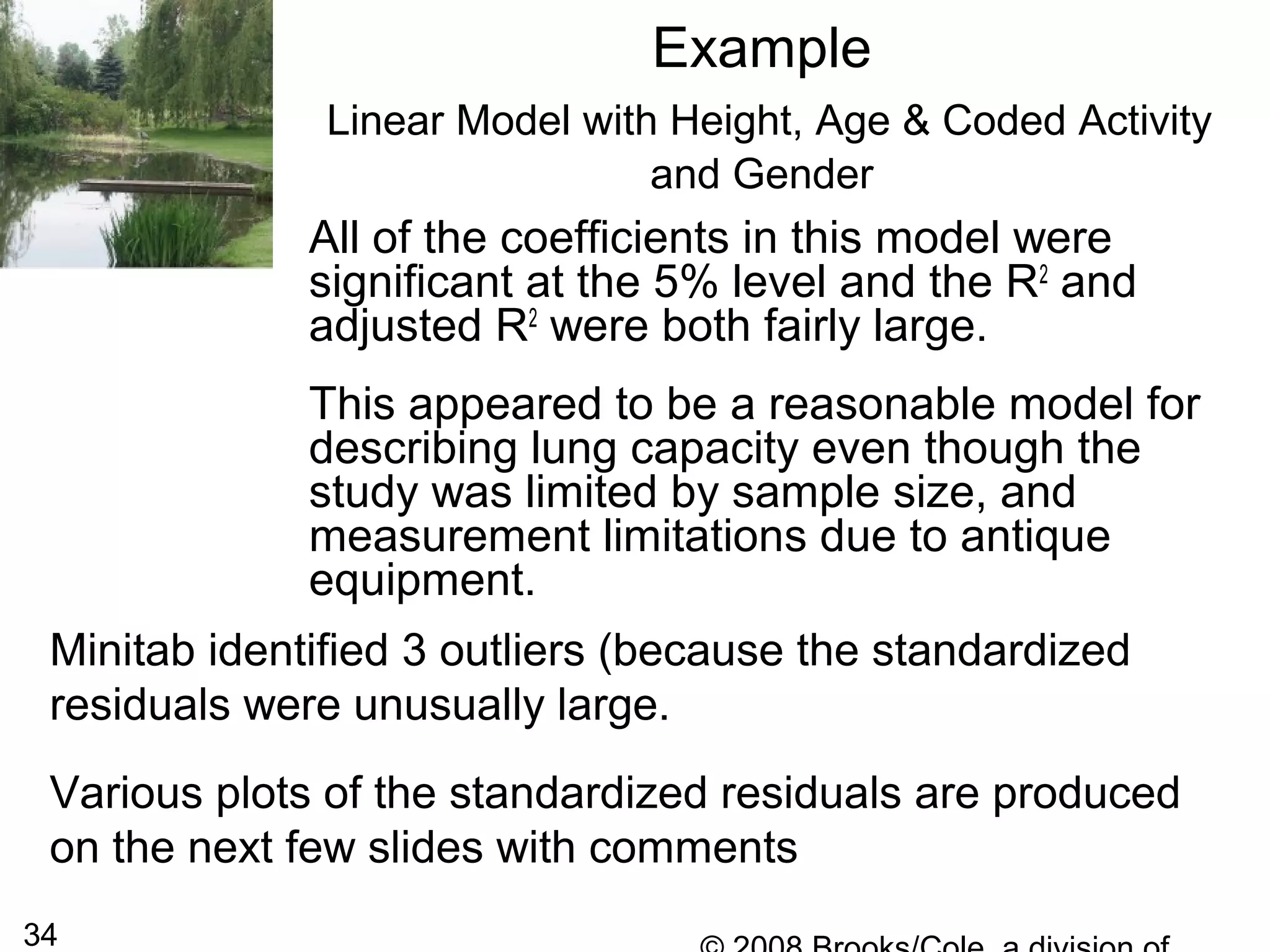
All of the coefficients in this model were
significant at the 5% level and the R2
and
adjusted R2
were both fairly large.
This appeared to be a reasonable model for
describing lung capacity even though the
study was limited by sample size, and
measurement limitations due to antique
equipment.
Minitab identified 3 outliers (because the standardized
residuals were unusually large.
Various plots of the standardized residuals are produced
on the next few slides with comments
35
Example
Linear Model with Height, Age & Coded Activity
and Gender
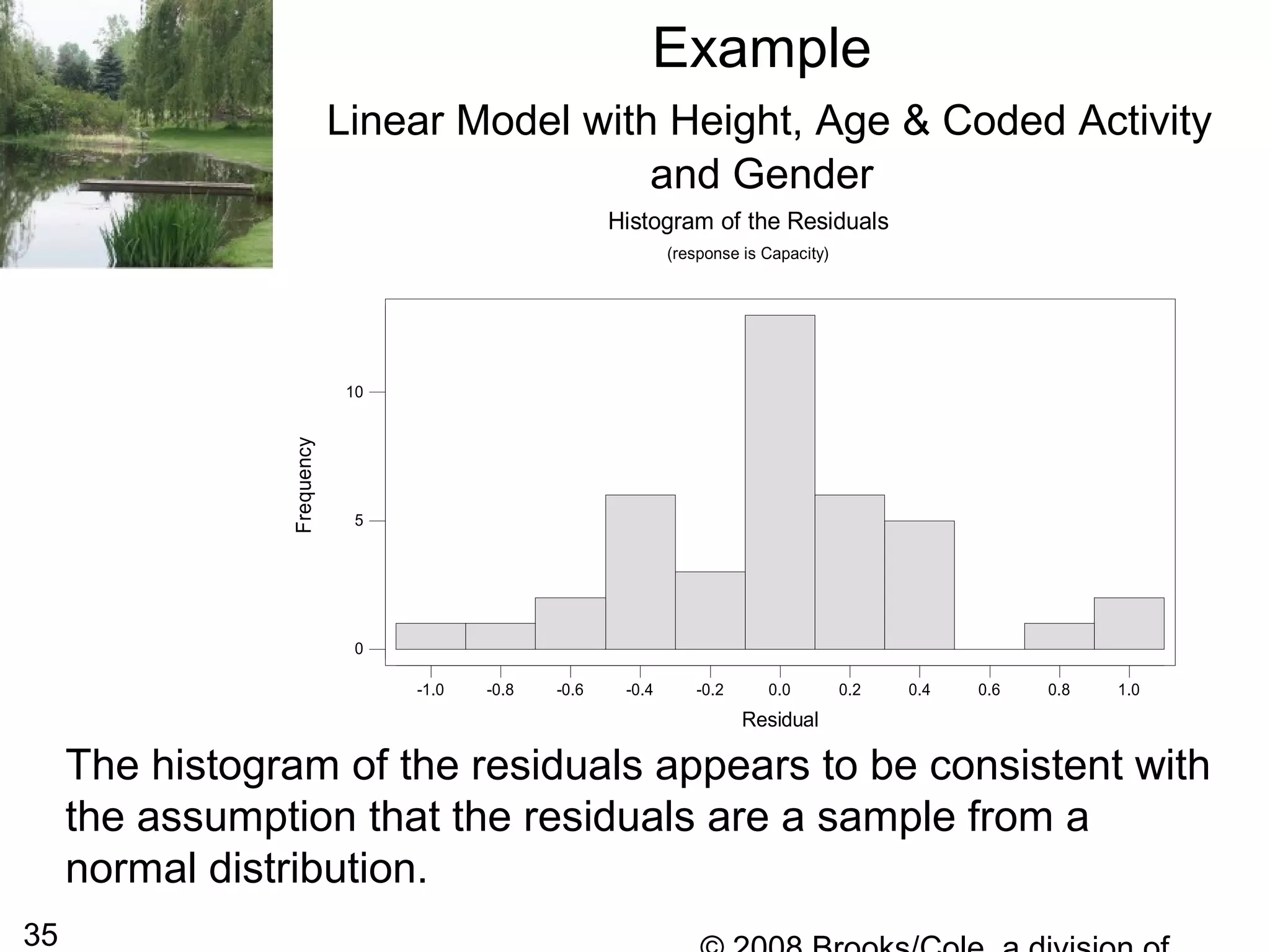
The histogram of the residuals appears to be consistent with
the assumption that the residuals are a sample from a
normal distribution.
1.00.80.60.40.20.0-0.2-0.4-0.6-0.8-1.0
10
5
0
Residual
Frequency
Histogram of the Residuals
(response is Capacity)
36
Example
Linear Model with Height, Age & Coded Activity
and Gender
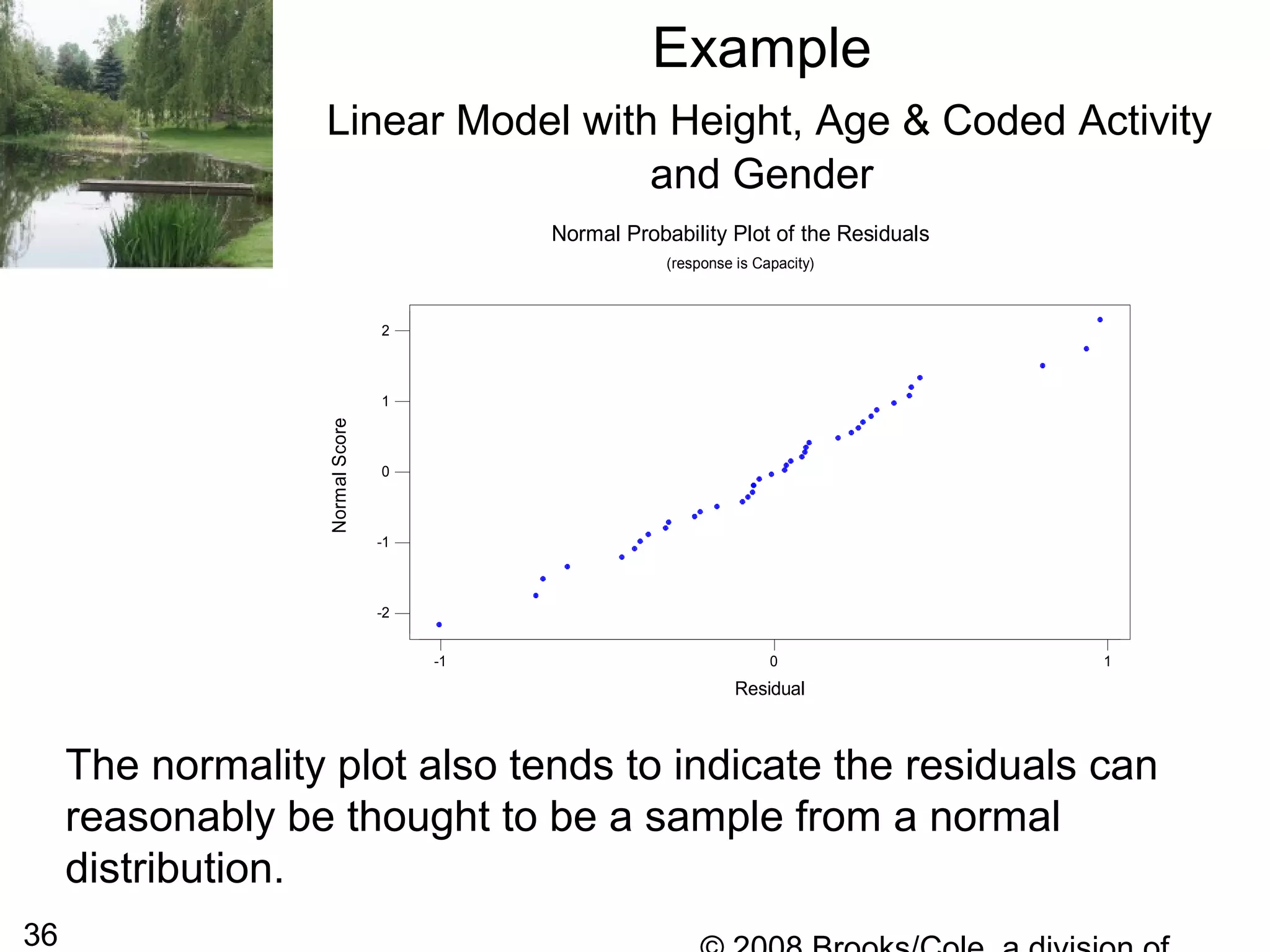
The normality plot also tends to indicate the residuals can
reasonably be thought to be a sample from a normal
distribution.
10-1
2
1
0
-1
-2
NormalScore
Residual
Normal Probability Plot of the Residuals
(response is Capacity)
37
Example
Linear Model with Height, Age & Coded Activity
and Gender
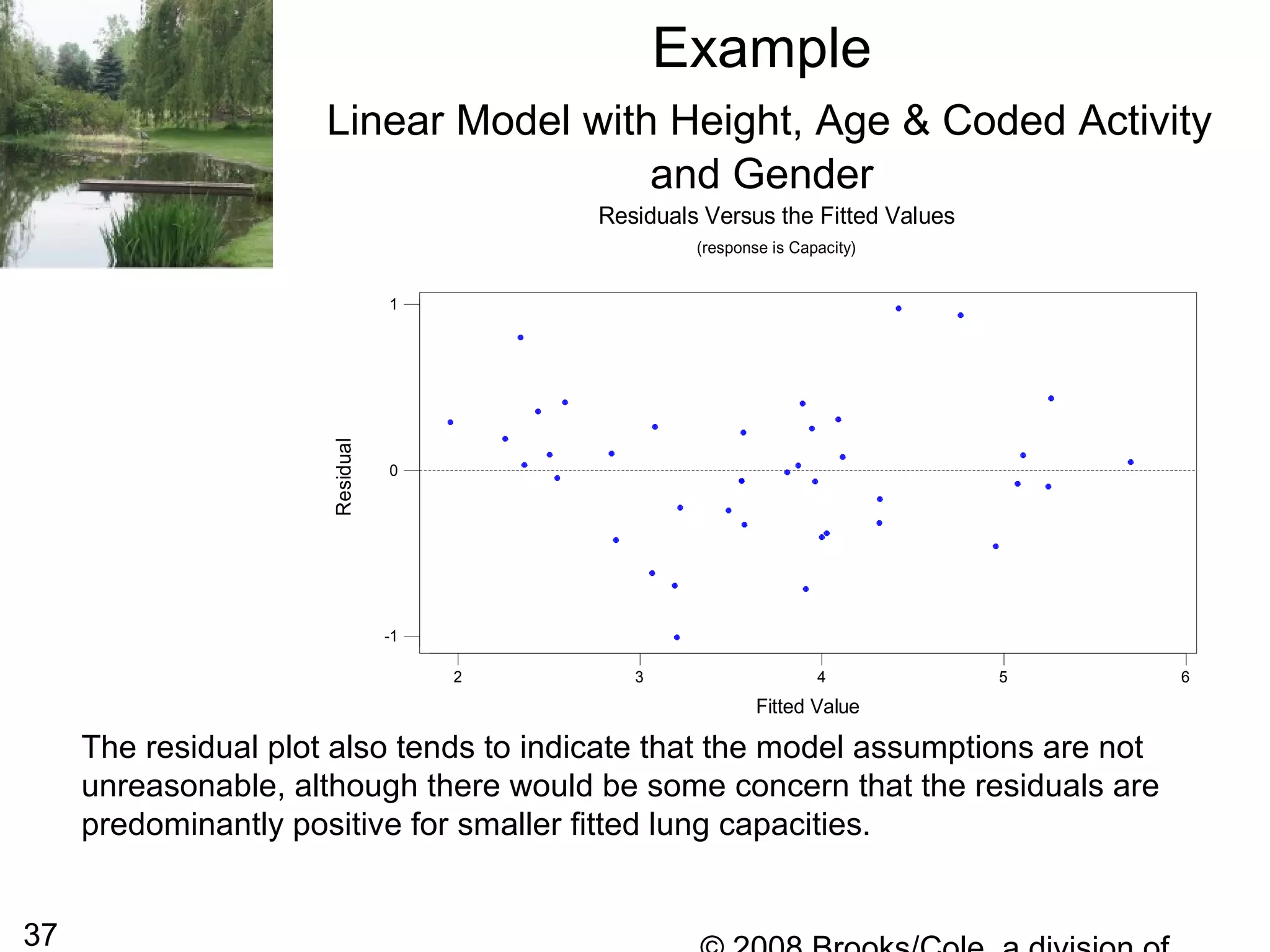
The residual plot also tends to indicate that the model assumptions are not
unreasonable, although there would be some concern that the residuals are
predominantly positive for smaller fitted lung capacities.
65432
1
0
-1
Fitted Value
Residual
Residuals Versus the Fitted Values
(response is Capacity)

Chapter14

  • 1.
  • 2.
    2 A general additivemultiple regression model, which relates a dependent variable y to k predictor variables x1, x2,…, xk is given by the model equation y = α + β1x1 + β2x2 + … + βkxk + e Multiple Regression Models
  • 3.
    3 The random deviatione is assumed to be normally distributed with mean value 0 and variance σ2 for any particular values of x1, x2, …, xk. This implies that for fixed x1, x2,…, xk values, y has a normal distribution with variance σ2 and Multiple Regression Models (mean y value for fixed x1, x2,…, xk values) = α + β1x1 + β2x2 + … + βkxk
  • 4.
    4 The βi’s arecalled population regression coefficients; each βi can be interpreted as the true average change in y when the predictor xi increases by 1 unit and the values of all the other predictors remain fixed. Multiple Regression Models The deterministic portion α+ β1x1 + β2x2 + … + βkxk is called the population regression function.
  • 5.
    5 The kth degree polynomialregression model y = α + β1x + β2x2 + … + βkxk + e is a special case of the general multiple regression model with x1 = x, x2 = x2 , … , xk = xk . The population regression function (mean value of y for fixed values of the predictors) is α + β1x + β2x2 + … + βkxk . Polynomial Regression Models
  • 6.
    6 The most importantspecial case other than simple linear regression (k = 1) is the quadratic regression model y = α+ β1x + β2x2 . This model replaces the line y = α+ βx with a parabolic cure of mean values α + β1x + β2x2 . If β2 > 0, the curve opens upward, whereas if β2 < 0, the curve opens downward. Polynomial Regression Models
  • 7.
    7 If the changein the mean y value associated with a 1-unit increase in one independent variable depends on the value of a second independent variable, there is interaction between these two variables. When the variables are denoted by x1 and x2, such interaction can be modeled by including x1x2, the product of the variables that interact, as a predictor variable. Interaction
  • 8.
    8 Up to now,we have only considered the inclusion of quantitative (numerical) predictor variables in a multiple regression model. Two other types are very common: Dichotomous variable: One with just two possible categories coded 0 and 1 Examples  Gender {male, female}  Marriage status {married, not- married} Qualitative Predictor Variables.
  • 9.
    9 Ordinal variables: Categoricalvariables that have a natural ordering  Activity level {light, moderate, heavy} coded respectively as 1, 2 and 3  Education level {none, elementary, secondary, college, graduate} coded respectively 1, 2, 3, 4, 5 (or for that matter any 5 consecutive integers} Qualitative Predictor Variables.
  • 10.
    10 According to theprinciple of least squares, the fit of a particular estimated regression function a + b1x1 + b2x2 + … + bkxk to the observed data is measured by the sum of squared deviations between the observed y values and the y values predicted by the estimated function: Σ[y –(a + b1x1 + b2x2 + … + bkxk )]2 Least Square Estimates The least squares estimates of α, β1, β2,…, βk are those values of a, b1, b2, … , bk that make this sum of squared deviations as small as possible.
  • 11.
    11 Predicted Values &Residuals Doing this successively for the remaining observations yields the predicted values (sometimes referred to as the fitted values or fits). L2 3 ky ,y , ,yˆ ˆ ˆ The first predicted value is obtained by taking the values of the predictor variables x1, x2,…, xk for the first sample observation and substituting these values into the estimated regression function. 1ˆy
  • 12.
    12 Predicted Values &Residuals The residuals are then the differences between the observed and predicted y values. − − −L1 1 2 2 k ky y ,y y , ,y yˆ ˆ ˆ
  • 13.
    13 Sums of Squares Thenumber of degrees of freedom associated with SSResid is n - (k + 1), because k + 1 df are lost in estimating the k + 1 coefficients α, β1, β2,…,βk. The residual (or error) sum of sqyares, SSResid, and total sum of squares, SSTo, are given by where is the mean of the y observations in the sample. ( ) ( ) 2 2 ˆSSResid= y-y SSTo= y-y∑ ∑ y
  • 14.
    14 Estimate for σ2 Anestimate of the random deviation variance σ2 is given by and is the estimate of σ. 2 e SSResid s n - (k + 1) = 2 e es s=
  • 15.
    15 Coefficient of MultipleDetermination, R2 The coefficient of multiple determination, R2 , interpreted as the proportion of variation in observed y values that is explained by the fitted model, is 2 SSResid R 1 SSTo = −
  • 16.
    16 Adjusted R2 Generally, amodel with large R2 and small se are desirable. If a large number of variables (relative to the number of data points) is used those conditions may be satisfied but the model will be unrealistic and difficult to interpret.
  • 17.
    17 Adjusted R2 To sortout this problem, sometimes computer packages compute a quantity called the adjusted R2 , 2 n 1 SSResid adjusted R 1 n (k 1) SSTo −  = −  − −  Notice that when a large number of variables are used to build the model, this value will be substantially lower than R2 and give a better indication of usability of the model.
  • 18.
    F Distributions F distributionsare similar to a Chi-Square distributions, but have two parameters, dfden and dfnum.
  • 19.
    19 The F Testfor Model Utility The regression sum of squares denoted by SSReg is defined by SSREG = SSTo - SSresid
  • 20.
    20 The F Testfor Model Utility When all k βi’s are zero in the model y = α + β1x1 + β2x2 + … + βkxk + e And when the distribution of e is normal with mean 0 and variance σ2 for any particular values of x1, x2,…, xk, the statistic has an F probability distribution based on k numerator df and n - (K+ 1) denominator df SSRegr kF SSResid n (k 1) = − +
  • 21.
    21 The F Testfor Utility of the Model y = α + β1x1 + β2x2 + … + βkxk + e Null hypothesis: H0: β1 = β2 = … = βk =0 (There is no useful linear relationship between y and any of the predictors.) Alternate hypothesis: Ha: At least one among β1, β2, … , βk is not zero (There is a useful linear relationship between y and at least one of the predictors.)
  • 22.
    22 The F Testfor Utility of the Model y = α + β1x1 + β2x2 + … + βkxk + e Test statistic: SSRegr kF SSResid n (k 1) where SSreg = SST0 - SSresid. = − + An alternate formula: 2 2 R kF (1 R ) n (k 1) where SSreg = SST0 - SSresid. = − − +
  • 23.
    23 The F TestUtility of the Model y = α + β1x1 + β2x2 + … + βkxk + e The test is upper-tailed, and the information in the Table of Values that capture specified upper-tail F curve areas is used to obtain a bound or bounds on the P-value using numerator df = k and denominator df = n - (k + 1). Assumptions: For any particular combination of predictor variable values, the distribution of e, the random deviation, is normal with mean 0 and constant variance.
  • 24.
    24 Example A number ofyears ago, a group of college professors teaching statistics met at an NSF program and put together a sample student research project. They attempted to create a model to explain lung capacity in terms of a number of variables. Specifically, Numerical variables: height, age, weight, waist Categorical variables: gender, activity level and smoking status.
  • 25.
    25 Example They managed tosample 41 subjects and obtain/measure the variables. There was some discussion and many felt that the calculated variable (height)(waist)2 would be useful since it would likely be proportional to the volume of the individual. The initial regression analysis performed with Minitab appears on the next slide.
  • 26.
    26 Example Linear Model withAll Numerical Variables The regression equation is Capacity = - 13.0 - 0.0158 Age + 0.232 Height - 0.00064 Weight - 0.0029 Chest + 0.101 Waist -0.000018 hw2 40 cases used 1 cases contain missing values Predictor Coef SE Coef T P Constant -13.016 2.865 -4.54 0.000 Age -0.015801 0.007847 -2.01 0.052 Height 0.23215 0.02895 8.02 0.000 Weight -0.000639 0.006542 -0.10 0.923 Chest -0.00294 0.06491 -0.05 0.964 Waist 0.10068 0.09427 1.07 0.293 hw2 -0.00001814 0.00001761 -1.03 0.310 S = 0.5260 R-Sq = 78.2% R-Sq(adj) = 74.2%
  • 27.
    27 Example The only coefficientthat appeared to be significant and the 5% level was the height. Since the P-value for the coefficient on the age was very close to 5% (5.2%) it was decided that a linear model with the two independent variables height and age would be calculated. The resulting model is on the next slide.
  • 28.
    28 Example Linear Model withvariables: Height & Age The regression equation is Capacity = - 10.2 + 0.215 Height - 0.0133 Age 40 cases used 1 cases contain missing values Predictor Coef SE Coef T P Constant -10.217 1.272 -8.03 0.000 Height 0.21481 0.01921 11.18 0.000 Age -0.013322 0.005861 -2.27 0.029 S = 0.5073 R-Sq = 77.2% R-Sq(adj) = 76.0% Notice that even though the R2 value decreases slightly, the adjusted R2 value actually increases. Also note that the coefficient on Age is now significant at 5%.
  • 29.
    29 Example In an attemptto determine if incorporating the categorical variables into the model would significantly enhance the it. Gender was coded as an indicator variable (male = 0 and female = 1), Smoking was coded as an indicator variable (No = 0 and Yes = 1), and Activity level (light, moderate, heavy) was coded respectively as 1, 2 and 3. The resulting Minitab output is given on the next slide.
  • 30.
    30 Example Linear Model withcategorical variables added The regression equation is Capacity = - 7.58 + 0.171 Height - 0.0113 Age - 0.383 C-Gender + 0.260 C-Activity - 0.289 C-Smoke 37 cases used 4 cases contain missing values Predictor Coef SE Coef T P Constant -7.584 2.005 -3.78 0.001 Height 0.17076 0.02919 5.85 0.000 Age -0.011261 0.005908 -1.91 0.066 C-Gender -0.3827 0.2505 -1.53 0.137 C-Activi 0.2600 0.1210 2.15 0.040 C-Smoke -0.2885 0.2126 -1.36 0.185 S = 0.4596 R-Sq = 84.2% R-Sq(adj) = 81.7%
  • 31.
    31 Example It was notedthat coefficient for the coded indicator variables gender and smoking were not significant, but after considerable discussion, the group felt that a number of the variables were related. This, the group felt, was confounding the study. In an attempt to determine a reasonable optimal subgroup of the variables to keep in the study, it was noted that a number of the variables were highly related. Since the study was small, a stepwise regression was run and the variables, Height, Age, Coded Activity, Coded Gender were kept and the following model was obtained.
  • 32.
    32 Example Linear Model withHeight, Age & Coded Activity and Gender The regression equation is Capacity = - 6.93 + 0.161 Height - 0.0137 Age + 0.302 C-Activity - 0.466 C-Gender 40 cases used 1 cases contain missing values Predictor Coef SE Coef T P Constant -6.929 1.708 -4.06 0.000 Height 0.16079 0.02454 6.55 0.000 Age -0.013744 0.005404 -2.54 0.016 C-Activi 0.3025 0.1133 2.67 0.011 C-Gender -0.4658 0.2082 -2.24 0.032 S = 0.4477 R-Sq = 83.2% R-Sq(adj) = 81.3%
  • 33.
    33 Example Linear Model withHeight, Age & Coded Activity and Gender Analysis of Variance Source DF SS MS F P Regression 4 34.8249 8.7062 43.44 0.000 Residual Error 35 7.0151 0.2004 Total 39 41.8399 Source DF Seq SS Height 1 30.9878 Age 1 1.3296 C-Activi 1 1.5041 C-Gender 1 1.0034 Unusual Observations Obs Height Capacity Fit SE Fit Residual St Resid 4 66.0 2.2000 3.2039 0.1352 -1.0039 -2.35R 23 74.0 5.7000 4.7635 0.2048 0.9365 2.35R 39 70.0 5.4000 4.4228 0.1064 0.9772 2.25R R denotes an observation with a large standardized residual The rest of the Minitab output is given below.
  • 34.
    34 Example Linear Model withHeight, Age & Coded Activity and Gender All of the coefficients in this model were significant at the 5% level and the R2 and adjusted R2 were both fairly large. This appeared to be a reasonable model for describing lung capacity even though the study was limited by sample size, and measurement limitations due to antique equipment. Minitab identified 3 outliers (because the standardized residuals were unusually large. Various plots of the standardized residuals are produced on the next few slides with comments
  • 35.
    35 Example Linear Model withHeight, Age & Coded Activity and Gender The histogram of the residuals appears to be consistent with the assumption that the residuals are a sample from a normal distribution. 1.00.80.60.40.20.0-0.2-0.4-0.6-0.8-1.0 10 5 0 Residual Frequency Histogram of the Residuals (response is Capacity)
  • 36.
    36 Example Linear Model withHeight, Age & Coded Activity and Gender The normality plot also tends to indicate the residuals can reasonably be thought to be a sample from a normal distribution. 10-1 2 1 0 -1 -2 NormalScore Residual Normal Probability Plot of the Residuals (response is Capacity)
  • 37.
    37 Example Linear Model withHeight, Age & Coded Activity and Gender The residual plot also tends to indicate that the model assumptions are not unreasonable, although there would be some concern that the residuals are predominantly positive for smaller fitted lung capacities. 65432 1 0 -1 Fitted Value Residual Residuals Versus the Fitted Values (response is Capacity)

Editor's Notes

  • #2 &amp;lt;number&amp;gt;
  • #19 &amp;lt;number&amp;gt;