© 2008 Brooks/Cole, a division of Thomson Learning, Inc.
Chapter 2
Collecting Data Sensibly
© 2008 Brooks/Cole, a division of Thomson Learning, Inc.
Important Terms
Variable – A variable is any characteristic
whose value may change from one
individual to another
Examples:
Brand of television
Height of a building
Number of students in a class
© 2008 Brooks/Cole, a division of Thomson Learning, Inc.
Important Terms
Data – Data results from making
observations either on a single variable or
simultaneously on two or more variables.
A univariate data set consists of
observations on a single variable made
on individuals in a sample or population.
© 2008 Brooks/Cole, a division of Thomson Learning, Inc.
Important Terms
A bivariate data set consists of
observations on two variables made on
individuals in a sample or population.
A multivariate data set consists of
observations on two or more variables
made on individuals in a sample or
population.
© 2008 Brooks/Cole, a division of Thomson Learning, Inc.
Data Sets
A univariate data set is categorical (or
qualitative) if the individual observations
are categorical responses.
A univariate data set is numerical (or
quantitative) if the individual
observations are numerical responses
where numerical operations generally
have meaning.
© 2008 Brooks/Cole, a division of Thomson Learning, Inc.
Selection Bias is the tendency for samples to
differ from the corresponding population as a
result of systematic exclusion of some part of the
population.
Example: Taking a sample of opinion in a
community by selecting participants from
phone numbers in the local phone book
would systematically exclude people who
choose to have unlisted numbers, people
who do not have phones, and people who
have moved into the community since the
telephone directory was published.
Types of Bias
© 2008 Brooks/Cole, a division of Thomson Learning, Inc.
Measurement or Response Bias is the
tendency for samples to differ from the
corresponding population because the
method of observation tends to produce
values that differ from the true value.
Example: Taking a sample of weights
of a type of apple when the scale
consistently gives a weigh that is 0.2
ounces high.
Types of Bias
© 2008 Brooks/Cole, a division of Thomson Learning, Inc.
Nonresponse Bias is the tendency for samples
to differ from the corresponding population
because data is not obtained from all individuals
selected for inclusion in the sample..
Example: In a study that ask questions of a
personal nature, many individuals that are
selected might refuse to answer the survey
questions. This occurs quite often when the
questions are of a highly personal nature or
when the individual feels that certain
response might prove personally damaging.
Types of Bias
© 2008 Brooks/Cole, a division of Thomson Learning, Inc.
Bias is introduced by the way in which a
sample is selected so that increasing the
size of the sample does nothing to reduce
the bias
Important Note on Bias
© 2008 Brooks/Cole, a division of Thomson Learning, Inc.
Sampling Methods
A Simple Random Sample of size n is a sample
that is selected in a way that ensures that every
different possible sample of the desired size has
the same chance of being selected.
A common method of selecting a random sample
is to first create a list, called a sampling frame of
the individuals in the population. Each item on the
list can then be identified by a number, and a table
random digits or a random number generator can
be used to select the sample.
© 2008 Brooks/Cole, a division of Thomson Learning, Inc.
Sampling Methods
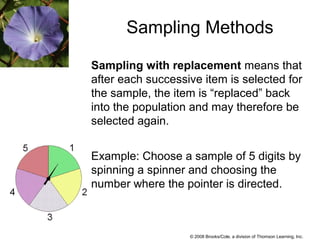
Sampling with replacement means that
after each successive item is selected for
the sample, the item is “replaced” back
into the population and may therefore be
selected again.
Example: Choose a sample of 5 digits by
spinning a spinner and choosing the
number where the pointer is directed.
© 2008 Brooks/Cole, a division of Thomson Learning, Inc.
Sampling Methods
Sampling without replacement means
that after an item is selected for the sample
it is removed from the population and
therefore cannot be selected again.
Example: A hand of “five card stud” poker is
dealt from an ordinary deck of playing
cards. Typically, once a card is dealt it is
not possible for that card to appear again
until the deck is reshuffled and dealt again.
© 2008 Brooks/Cole, a division of Thomson Learning, Inc.
Sampling Methods
A entire population is divided into
subpopulations called strata.
Stratified sampling entails selecting a
separate simple random sample from
each of the strata.
Example: Teachers in a large urban
school district are given tenure by
subject. The sample is taken by
choosing random samples from each of
the tenure areas.
© 2008 Brooks/Cole, a division of Thomson Learning, Inc.
Sampling Methods
A entire population is divided into non-
overlapping subgroups called clusters.
Cluster sampling entails selecting clusters
at random and all individuals in the selected
clusters are included in the sample.
Example: In a large university, a professor
wanting to find out about student attitudes
randomly selects a number of classes to
survey and he includes all the students in
those classes.
Note: The ideal situation occurs when it is reasonable to
assume that each cluster reflects the generally population. If
that is not the case or when clusters are small, a large number
of clusters must be selected to get a sample that reflects the
population.
© 2008 Brooks/Cole, a division of Thomson Learning, Inc.
Sampling Methods
Systematic sampling is a procedure that can
be employed when it is possible to view the
population of interest as consisting of a list or
some other sequential arrangement. A value k
is specified (a number such as 25, 100,
2500…). The one of the first k individuals is
selected at random, and then ever kth
individual
in the sequence is selected to be included in
the sample.
Example: In a large university, a professor
wanting to select a sample of students to
determine the student’s age, might take the
student directory (an alphabetical list) and
randomly choose one of the first 100 students)
and then take every 100th
student from that
point on.
© 2008 Brooks/Cole, a division of Thomson Learning, Inc.
Sampling Methods
Convenience sampling is using and
easily available or convenient group to
form a sample.
Example: A “voluntary response sample”
is often taken by television news
programs. Viewers are encouraged to
go to a website and “vote” yes or no on
some issue. The commentator then
would announce the results of the
survey.
It is highly unlikely that the responses
would be accurately representative of
the opinion of the public at large.
© 2008 Brooks/Cole, a division of Thomson Learning, Inc.
A confounding variable is one that is
related both the group membership and
to the response variable of interest in
the research study. It is generally an
explanatory variable of importance that
is not included in the study. A carefully
designed experiment can do a lot to
control confounding variables.
Collection of Data
© 2008 Brooks/Cole, a division of Thomson Learning, Inc.
A study is an Observational Study if the
values of the variable(s) of a sample from
one or more populations is observed.
Observational studies are usually used to
draw conclusions about the population or
about differences between two or more
populations.
Collection of Data
© 2008 Brooks/Cole, a division of Thomson Learning, Inc.
Observational Study
An observational study observes
individuals and measures variables of
interest but does not attempt to
influence the responses.
- Difficult to measure or gauge the
effect of an action or procedure
- Lurking variables are uncontrolled
so the study may be confounded
+ Can use available data
© 2008 Brooks/Cole, a division of Thomson Learning, Inc.
A study is an Experiment if the values
of one or more response variables are
recorded when the investigator
controls (or manipulates) one or more
factors.
Experiments are usually used when
attempting to determine the effect of
the manipulation of the factors being
controlled.
Collection of Data
© 2008 Brooks/Cole, a division of Thomson Learning, Inc.
More on Experiments
An experiment is a planned intervention
undertaken to observe the effects of one
or more explanatory variables, often
called factors, on a response variable.
Any particular combination of values for
the explanatory variables is called an
experimental condition or treatment.
The design of the experiment is the
overall plan for conducting the
experiment. A good design minimizes
ambiguity in the interpretation of the
results.
© 2008 Brooks/Cole, a division of Thomson Learning, Inc.
Experimental Studies
An experiment deliberately imposes
some treatment on individuals in order to
observe their responses.
+ Allows the measurement of effect of
a treatment
+ Can help to control lurking variables
+ Can give good evidence of
causation
- May not measure realistic effects.
Not necessarily workable in real life.
© 2008 Brooks/Cole, a division of Thomson Learning, Inc.
Factors
Any particular combination of values for
the explanatory variables is called an
experimental condition or treatment.
An extraneous factor is one that is not
of interest in the current study but is
thought to affect the response variable.
Two factors are confounded if their
effects on the response variable cannot
be distinguished from one another.
© 2008 Brooks/Cole, a division of Thomson Learning, Inc.
More on Treatments
A placebo is a treatment that resembles
the other treatments in an experiment, but
which has no active ingredients.
In an experiment to test the
effectiveness of a new vaccine (by
injection), a placebo treatment would
consist of injection a neutral substance
such as saline solution.
A control group is a group that receives
no treatment or a placebo treatment.
© 2008 Brooks/Cole, a division of Thomson Learning, Inc.
Principles of Experimental
Design
The fundamental principles of statistical
design of experiments are:
1) Randomization
Random assignment (of subjects to
treatments or of treatments to trials) to
ensure that the experiment does not
systematically favor one experimental
condition over another.
2) Blocking
Using extraneous factors to create
groups (blocks) that are similar. All
experimental conditions are then tried
in each block.
© 2008 Brooks/Cole, a division of Thomson Learning, Inc.
Principles of
Experimental Design
The fundamental principles of statistical
design of experiments are:
3) Direct Control
Holding extraneous factors constant
so that their effects are not
confounded with those of the
experimental conditions.
4) Replication
Ensuring that there is an adequate
number of observations in each
experimental condition.
© 2008 Brooks/Cole, a division of Thomson Learning, Inc.
Planning and Conducting a Study
Understand the Nature of the
Problem
Decide What to Measure and How to
Measure It
Collect the Data
Summarize the Data & Perform a
Preliminary Analysis
Do the Formal Data Analysis
Interpret the Results
Steps of the Data Analysis Process

Chapter2

  • 1.
    © 2008 Brooks/Cole,a division of Thomson Learning, Inc. Chapter 2 Collecting Data Sensibly
  • 2.
    © 2008 Brooks/Cole,a division of Thomson Learning, Inc. Important Terms Variable – A variable is any characteristic whose value may change from one individual to another Examples: Brand of television Height of a building Number of students in a class
  • 3.
    © 2008 Brooks/Cole,a division of Thomson Learning, Inc. Important Terms Data – Data results from making observations either on a single variable or simultaneously on two or more variables. A univariate data set consists of observations on a single variable made on individuals in a sample or population.
  • 4.
    © 2008 Brooks/Cole,a division of Thomson Learning, Inc. Important Terms A bivariate data set consists of observations on two variables made on individuals in a sample or population. A multivariate data set consists of observations on two or more variables made on individuals in a sample or population.
  • 5.
    © 2008 Brooks/Cole,a division of Thomson Learning, Inc. Data Sets A univariate data set is categorical (or qualitative) if the individual observations are categorical responses. A univariate data set is numerical (or quantitative) if the individual observations are numerical responses where numerical operations generally have meaning.
  • 6.
    © 2008 Brooks/Cole,a division of Thomson Learning, Inc. Selection Bias is the tendency for samples to differ from the corresponding population as a result of systematic exclusion of some part of the population. Example: Taking a sample of opinion in a community by selecting participants from phone numbers in the local phone book would systematically exclude people who choose to have unlisted numbers, people who do not have phones, and people who have moved into the community since the telephone directory was published. Types of Bias
  • 7.
    © 2008 Brooks/Cole,a division of Thomson Learning, Inc. Measurement or Response Bias is the tendency for samples to differ from the corresponding population because the method of observation tends to produce values that differ from the true value. Example: Taking a sample of weights of a type of apple when the scale consistently gives a weigh that is 0.2 ounces high. Types of Bias
  • 8.
    © 2008 Brooks/Cole,a division of Thomson Learning, Inc. Nonresponse Bias is the tendency for samples to differ from the corresponding population because data is not obtained from all individuals selected for inclusion in the sample.. Example: In a study that ask questions of a personal nature, many individuals that are selected might refuse to answer the survey questions. This occurs quite often when the questions are of a highly personal nature or when the individual feels that certain response might prove personally damaging. Types of Bias
  • 9.
    © 2008 Brooks/Cole,a division of Thomson Learning, Inc. Bias is introduced by the way in which a sample is selected so that increasing the size of the sample does nothing to reduce the bias Important Note on Bias
  • 10.
    © 2008 Brooks/Cole,a division of Thomson Learning, Inc. Sampling Methods A Simple Random Sample of size n is a sample that is selected in a way that ensures that every different possible sample of the desired size has the same chance of being selected. A common method of selecting a random sample is to first create a list, called a sampling frame of the individuals in the population. Each item on the list can then be identified by a number, and a table random digits or a random number generator can be used to select the sample.
  • 11.
    © 2008 Brooks/Cole,a division of Thomson Learning, Inc. Sampling Methods Sampling with replacement means that after each successive item is selected for the sample, the item is “replaced” back into the population and may therefore be selected again. Example: Choose a sample of 5 digits by spinning a spinner and choosing the number where the pointer is directed.
  • 12.
    © 2008 Brooks/Cole,a division of Thomson Learning, Inc. Sampling Methods Sampling without replacement means that after an item is selected for the sample it is removed from the population and therefore cannot be selected again. Example: A hand of “five card stud” poker is dealt from an ordinary deck of playing cards. Typically, once a card is dealt it is not possible for that card to appear again until the deck is reshuffled and dealt again.
  • 13.
    © 2008 Brooks/Cole,a division of Thomson Learning, Inc. Sampling Methods A entire population is divided into subpopulations called strata. Stratified sampling entails selecting a separate simple random sample from each of the strata. Example: Teachers in a large urban school district are given tenure by subject. The sample is taken by choosing random samples from each of the tenure areas.
  • 14.
    © 2008 Brooks/Cole,a division of Thomson Learning, Inc. Sampling Methods A entire population is divided into non- overlapping subgroups called clusters. Cluster sampling entails selecting clusters at random and all individuals in the selected clusters are included in the sample. Example: In a large university, a professor wanting to find out about student attitudes randomly selects a number of classes to survey and he includes all the students in those classes. Note: The ideal situation occurs when it is reasonable to assume that each cluster reflects the generally population. If that is not the case or when clusters are small, a large number of clusters must be selected to get a sample that reflects the population.
  • 15.
    © 2008 Brooks/Cole,a division of Thomson Learning, Inc. Sampling Methods Systematic sampling is a procedure that can be employed when it is possible to view the population of interest as consisting of a list or some other sequential arrangement. A value k is specified (a number such as 25, 100, 2500…). The one of the first k individuals is selected at random, and then ever kth individual in the sequence is selected to be included in the sample. Example: In a large university, a professor wanting to select a sample of students to determine the student’s age, might take the student directory (an alphabetical list) and randomly choose one of the first 100 students) and then take every 100th student from that point on.
  • 16.
    © 2008 Brooks/Cole,a division of Thomson Learning, Inc. Sampling Methods Convenience sampling is using and easily available or convenient group to form a sample. Example: A “voluntary response sample” is often taken by television news programs. Viewers are encouraged to go to a website and “vote” yes or no on some issue. The commentator then would announce the results of the survey. It is highly unlikely that the responses would be accurately representative of the opinion of the public at large.
  • 17.
    © 2008 Brooks/Cole,a division of Thomson Learning, Inc. A confounding variable is one that is related both the group membership and to the response variable of interest in the research study. It is generally an explanatory variable of importance that is not included in the study. A carefully designed experiment can do a lot to control confounding variables. Collection of Data
  • 18.
    © 2008 Brooks/Cole,a division of Thomson Learning, Inc. A study is an Observational Study if the values of the variable(s) of a sample from one or more populations is observed. Observational studies are usually used to draw conclusions about the population or about differences between two or more populations. Collection of Data
  • 19.
    © 2008 Brooks/Cole,a division of Thomson Learning, Inc. Observational Study An observational study observes individuals and measures variables of interest but does not attempt to influence the responses. - Difficult to measure or gauge the effect of an action or procedure - Lurking variables are uncontrolled so the study may be confounded + Can use available data
  • 20.
    © 2008 Brooks/Cole,a division of Thomson Learning, Inc. A study is an Experiment if the values of one or more response variables are recorded when the investigator controls (or manipulates) one or more factors. Experiments are usually used when attempting to determine the effect of the manipulation of the factors being controlled. Collection of Data
  • 21.
    © 2008 Brooks/Cole,a division of Thomson Learning, Inc. More on Experiments An experiment is a planned intervention undertaken to observe the effects of one or more explanatory variables, often called factors, on a response variable. Any particular combination of values for the explanatory variables is called an experimental condition or treatment. The design of the experiment is the overall plan for conducting the experiment. A good design minimizes ambiguity in the interpretation of the results.
  • 22.
    © 2008 Brooks/Cole,a division of Thomson Learning, Inc. Experimental Studies An experiment deliberately imposes some treatment on individuals in order to observe their responses. + Allows the measurement of effect of a treatment + Can help to control lurking variables + Can give good evidence of causation - May not measure realistic effects. Not necessarily workable in real life.
  • 23.
    © 2008 Brooks/Cole,a division of Thomson Learning, Inc. Factors Any particular combination of values for the explanatory variables is called an experimental condition or treatment. An extraneous factor is one that is not of interest in the current study but is thought to affect the response variable. Two factors are confounded if their effects on the response variable cannot be distinguished from one another.
  • 24.
    © 2008 Brooks/Cole,a division of Thomson Learning, Inc. More on Treatments A placebo is a treatment that resembles the other treatments in an experiment, but which has no active ingredients. In an experiment to test the effectiveness of a new vaccine (by injection), a placebo treatment would consist of injection a neutral substance such as saline solution. A control group is a group that receives no treatment or a placebo treatment.
  • 25.
    © 2008 Brooks/Cole,a division of Thomson Learning, Inc. Principles of Experimental Design The fundamental principles of statistical design of experiments are: 1) Randomization Random assignment (of subjects to treatments or of treatments to trials) to ensure that the experiment does not systematically favor one experimental condition over another. 2) Blocking Using extraneous factors to create groups (blocks) that are similar. All experimental conditions are then tried in each block.
  • 26.
    © 2008 Brooks/Cole,a division of Thomson Learning, Inc. Principles of Experimental Design The fundamental principles of statistical design of experiments are: 3) Direct Control Holding extraneous factors constant so that their effects are not confounded with those of the experimental conditions. 4) Replication Ensuring that there is an adequate number of observations in each experimental condition.
  • 27.
    © 2008 Brooks/Cole,a division of Thomson Learning, Inc. Planning and Conducting a Study Understand the Nature of the Problem Decide What to Measure and How to Measure It Collect the Data Summarize the Data & Perform a Preliminary Analysis Do the Formal Data Analysis Interpret the Results Steps of the Data Analysis Process

Editor's Notes

  • #6 <number>
  • #7 <number>
  • #8 <number>
  • #9 <number>
  • #10 <number>
  • #18 <number>
  • #19 <number>
  • #21 <number>
  • #28 <number>