Chapter 12Significance Tests in Practice
12.1 Tests about Population Mean
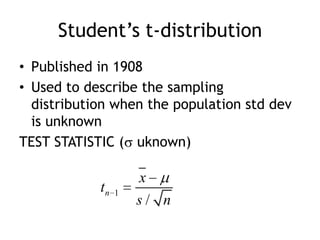
Student’s t-distributionPublished in 1908Used to describe the sampling distribution when the population std dev is unknownTEST STATISTIC ( uknown)
Student’s t- distributionSince this is just another significance test:	Use PHANTOMSDifferences:We are using a t distribution with n-1 degrees of freedomUse “tcdf(lower, upper, df)”The t-distribution is not resistant to outliers when sample size is small (less than 30)
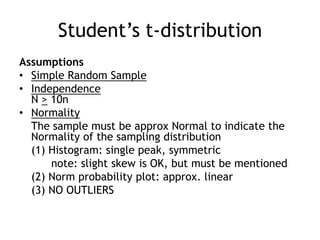
Student’s t-distributionAssumptionsSimple Random SampleIndependenceN > 10nNormalityThe sample must be approx Normal to indicate the Normality of the sampling distribution(1) Histogram: single peak, symmetric 	note: slight skew is OK, but must be mentioned(2) Norm probability plot: approx. linear(3) NO OUTLIERS
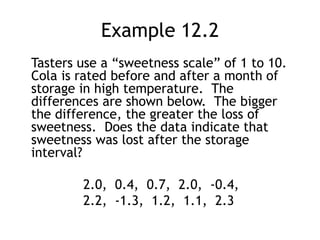
Example 12.2	Tasters use a “sweetness scale” of 1 to 10.  Cola is rated before and after a month of storage in high temperature.  The differences are shown below.  The bigger the difference, the greater the loss of sweetness.  Does the data indicate that sweetness was lost after the storage interval?			2.0,  0.4,  0.7,  2.0,  -0.4, 		2.2,  -1.3,  1.2,  1.1,  2.3
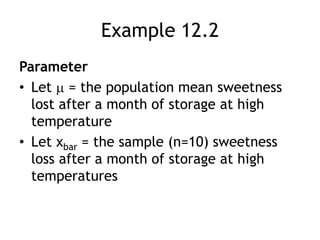
Example 12.2ParameterLet  = the population mean sweetness lost after a month of storage at high temperatureLet xbar = the sample (n=10) sweetness loss after a month of storage at high temperatures
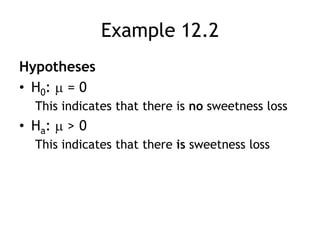
Example 12.2HypothesesH0:  = 0This indicates that there is no sweetness loss Ha:  > 0This indicates that there is sweetness loss
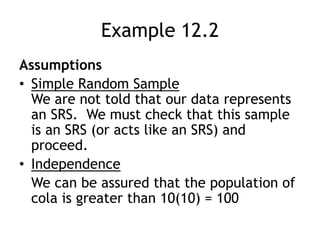
Example 12.2AssumptionsSimple Random SampleWe are not told that our data represents an SRS.  We must check that this sample is an SRS (or acts like an SRS) and proceed.IndependenceWe can be assured that the population of cola is greater than 10(10) = 100
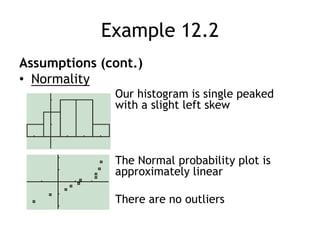
Example 12.2Assumptions (cont.)Normality				Our histogram is single peaked 			with a slight left skew			The Normal probability plot is 				approximately linear				There are no outliers
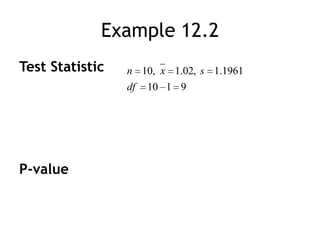
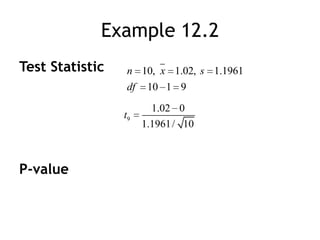
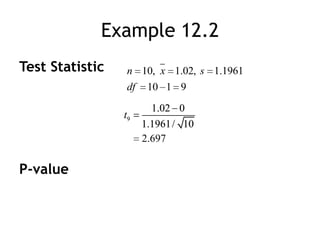
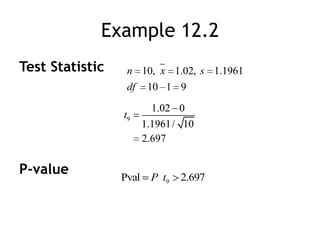
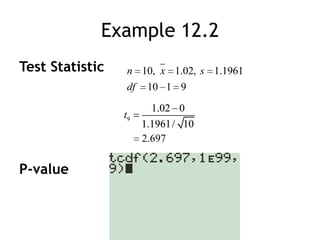
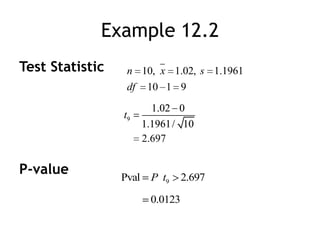
Example 12.2Test StatisticP-value
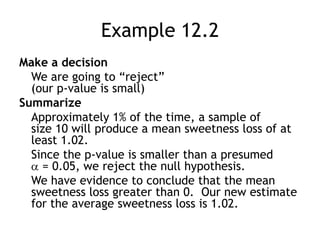
Example 12.2Make a decisionWe are going to “reject” (our p-value is small)SummarizeApproximately 1% of the time, a sample of size 10 will produce a mean sweetness loss of at least 1.02.Since the p-value is smaller than a presumed  = 0.05, we reject the null hypothesis.We have evidence to conclude that the mean sweetness loss greater than 0.  Our new estimate for the average sweetness loss is 1.02.
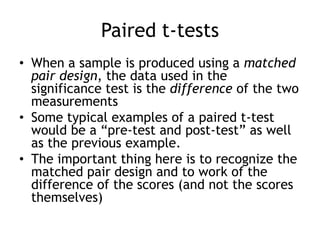
Paired t-testsWhen a sample is produced using a matched pair design, the data used in the significance test is the difference of the two measurementsSome typical examples of a paired t-test would be a “pre-test and post-test” as well as the previous example.The important thing here is to recognize the matched pair design and to work of the difference of the scores (and not the scores themselves)
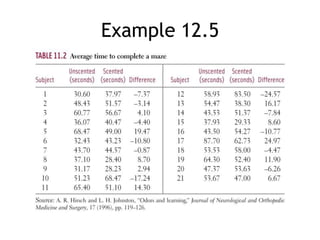
Example 12.5
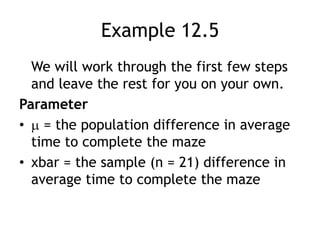
Example 12.5	We will work through the first few steps and leave the rest for you on your own.Parameter = the population difference in average time to complete the maze xbar = the sample (n = 21) difference in average time to complete the maze
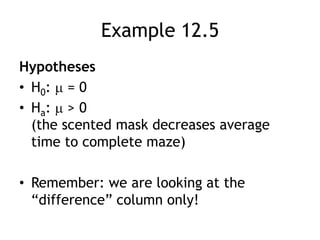
Example 12.5HypothesesH0:  = 0Ha:  > 0(the scented mask decreases average time to complete maze)Remember: we are looking at the “difference” column only!
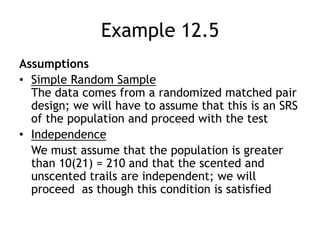
Example 12.5AssumptionsSimple Random SampleThe data comes from a randomized matched pair design; we will have to assume that this is an SRS of the population and proceed with the testIndependenceWe must assume that the population is greater than 10(21) = 210 and that the scented and unscented trails are independent; we will proceed  as though this condition is satisfied
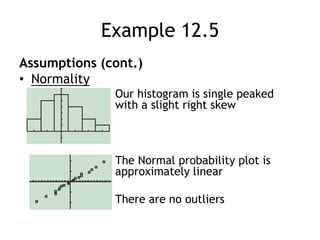
Example 12.5Assumptions (cont.)Normality				Our histogram is single peaked 			with a slight right skew			The Normal probability plot is 				approximately linear				There are no outliers
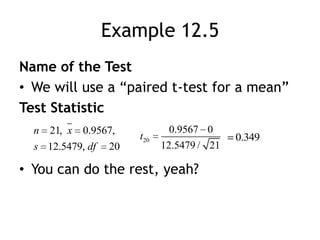
Example 12.5Name of the TestWe will use a “paired t-test for a mean”Test StatisticYou can do the rest, yeah?
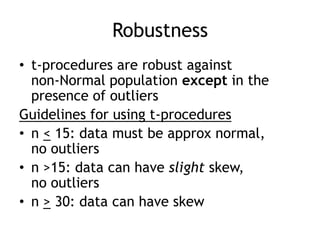
Robustnesst-procedures are robust against non-Normal population except in the presence of outliersGuidelines for using t-proceduresn < 15: data must be approx normal,no outliersn >15: data can have slight skew, no outliersn > 30: data can have skew
Assignment 12.1Page 745 #1, 3, 6, 9, 10, 12, 16, 20
12.2 Tests about a Population Proportion
z-tests for proportionAgain, we have introduced most of the material- this is just another significance test.Unlike tests for means, tests for proportions will always be a z-testWe will review some of the key information:
Assumptions for proportionsSimple Random SampleIndependenceN > 10nNormality (of sampling distribution)np> 10 and nq>10remember that this is just the number of responses
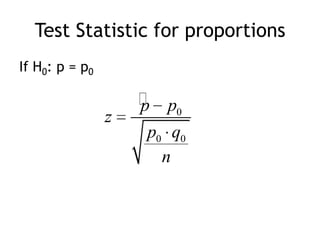
Test Statistic for proportionsIf H0: p = p0
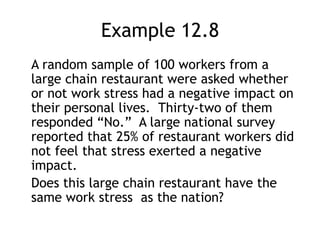
Example 12.8	A random sample of 100 workers from a large chain restaurant were asked whether or not work stress had a negative impact on their personal lives.  Thirty-two of them responded “No.”  A large national survey reported that 25% of restaurant workers did not feel that stress exerted a negative impact.	Does this large chain restaurant have the same work stress  as the nation?
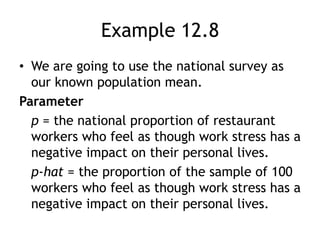
Example 12.8We are going to use the national survey as our known population mean.Parameterp = the national proportion of restaurant workers who feel as though work stress has a negative impact on their personal lives.p-hat = the proportion of the sample of 100 workers who feel as though work stress has a negative impact on their personal lives.
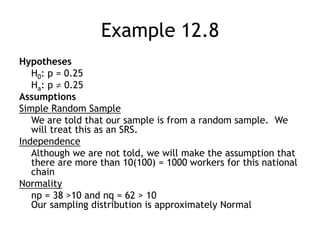
Example 12.8Hypotheses	H0: p = 0.25	Ha: p  0.25AssumptionsSimple Random Sample	We are told that our sample is from a random sample.  We will treat this as an SRS.Independence	Although we are not told, we will make the assumption that there are more than 10(100) = 1000 workers for this national chainNormalitynp = 38 >10 and nq = 62 > 10Our sampling distribution is approximately Normal
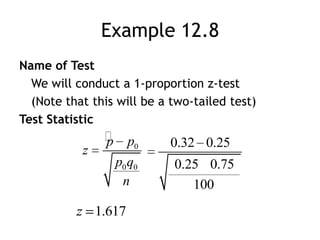
Example 12.8Name of Test	We will conduct a 1-proportion z-test	(Note that this will be a two-tailed test)Test Statistic
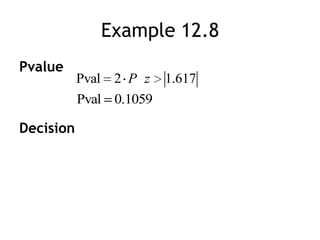
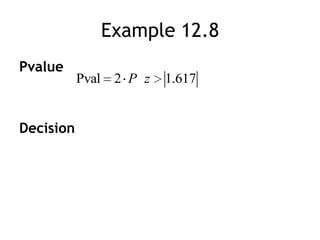
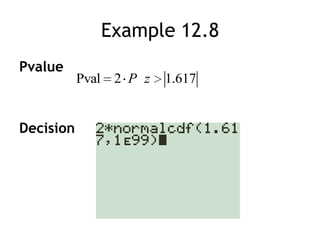
Example 12.8PvalueDecision
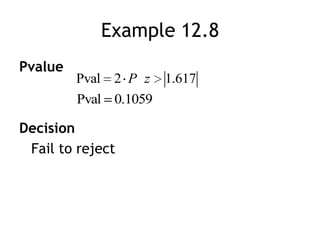
Example 12.8PvalueDecisionFail to reject
Example 12.8Summarize	Approximately 11% of the time, a sample of size 100 will produce a proportion at least as extreme 0.38.	Since this is not less than a presumed  = 0.05, we will fail to reject the H0.	We do not have enough evidence to conclude that the proportion of workers of this national chain who feel that work stress affects their personal lives is not 0.25.
PowerThe preceding example should make you feel a bit uncomfortable: that p-value was not large. 	We don’t really expect the average to be exactly equal to the national average!	Most likely, the restaurant’s proportion was not that different from the national average: maybe just a few percentage points greater.	Our test didn’t have enough power to detect the difference between the two proportions!
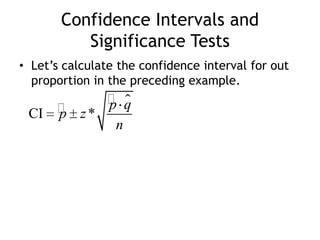
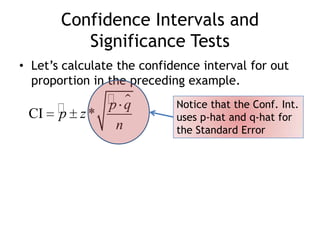
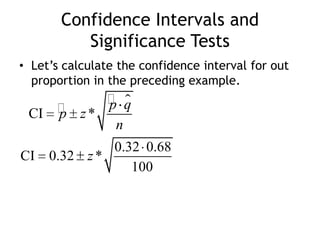
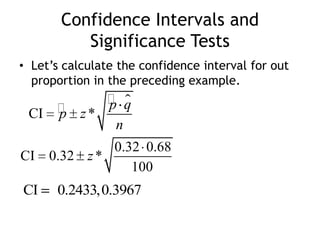
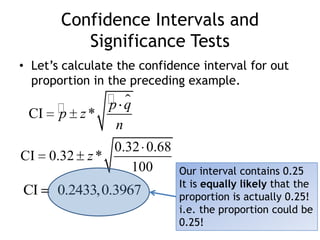
Confidence Intervals and Significance TestsLet’s calculate the confidence interval for out proportion in the preceding example.
Confidence Intervals and Significance TestsLet’s calculate the confidence interval for out proportion in the preceding example.Notice that the Conf. Int.uses p-hat and q-hat for the Standard Error
Confidence Intervals and Significance TestsLet’s calculate the confidence interval for out proportion in the preceding example.
Confidence Intervals and Significance TestsLet’s calculate the confidence interval for out proportion in the preceding example.Our interval contains 0.25It is equally likely that theproportion is actually 0.25!i.e. the proportion could be0.25!
Calculator Usage	As you may have already noticed, the TI calculators automate many of these calculations.	Of course, this does not excuse you from writing out the PHANTOMS or PANIC procedures, or even showing your calculations!
Calculator Usage
Calculator UsageTI83/84: Since these functions are menu driven we will just list the tests and their usage [STAT] -> “TESTS”Z-Test = one or two tailed z test for meanT-Test = one or two tail t-test for means1-PropZTest = one or two tail test for proportionsZInterval = confidence interval for mean (-known)Tinterval = confidence interval for mean (-unknown)1-PropZInt = confidence interval for proportions
Stats chapter 12

Stats chapter 12

  • 1.
  • 2.
    12.1 Tests aboutPopulation Mean
  • 3.
    Student’s t-distributionPublished in1908Used to describe the sampling distribution when the population std dev is unknownTEST STATISTIC ( uknown)
  • 4.
    Student’s t- distributionSincethis is just another significance test: Use PHANTOMSDifferences:We are using a t distribution with n-1 degrees of freedomUse “tcdf(lower, upper, df)”The t-distribution is not resistant to outliers when sample size is small (less than 30)
  • 5.
    Student’s t-distributionAssumptionsSimple RandomSampleIndependenceN > 10nNormalityThe sample must be approx Normal to indicate the Normality of the sampling distribution(1) Histogram: single peak, symmetric note: slight skew is OK, but must be mentioned(2) Norm probability plot: approx. linear(3) NO OUTLIERS
  • 6.
    Example 12.2 Tasters usea “sweetness scale” of 1 to 10. Cola is rated before and after a month of storage in high temperature. The differences are shown below. The bigger the difference, the greater the loss of sweetness. Does the data indicate that sweetness was lost after the storage interval? 2.0, 0.4, 0.7, 2.0, -0.4, 2.2, -1.3, 1.2, 1.1, 2.3
  • 7.
    Example 12.2ParameterLet = the population mean sweetness lost after a month of storage at high temperatureLet xbar = the sample (n=10) sweetness loss after a month of storage at high temperatures
  • 8.
    Example 12.2HypothesesH0: = 0This indicates that there is no sweetness loss Ha:  > 0This indicates that there is sweetness loss
  • 9.
    Example 12.2AssumptionsSimple RandomSampleWe are not told that our data represents an SRS. We must check that this sample is an SRS (or acts like an SRS) and proceed.IndependenceWe can be assured that the population of cola is greater than 10(10) = 100
  • 10.
    Example 12.2Assumptions (cont.)Normality Ourhistogram is single peaked with a slight left skew The Normal probability plot is approximately linear There are no outliers
  • 11.
  • 12.
  • 13.
  • 14.
  • 15.
  • 16.
  • 17.
  • 18.
    Example 12.2Make adecisionWe are going to “reject” (our p-value is small)SummarizeApproximately 1% of the time, a sample of size 10 will produce a mean sweetness loss of at least 1.02.Since the p-value is smaller than a presumed  = 0.05, we reject the null hypothesis.We have evidence to conclude that the mean sweetness loss greater than 0. Our new estimate for the average sweetness loss is 1.02.
  • 19.
    Paired t-testsWhen asample is produced using a matched pair design, the data used in the significance test is the difference of the two measurementsSome typical examples of a paired t-test would be a “pre-test and post-test” as well as the previous example.The important thing here is to recognize the matched pair design and to work of the difference of the scores (and not the scores themselves)
  • 20.
  • 21.
    Example 12.5 We willwork through the first few steps and leave the rest for you on your own.Parameter = the population difference in average time to complete the maze xbar = the sample (n = 21) difference in average time to complete the maze
  • 22.
    Example 12.5HypothesesH0: = 0Ha:  > 0(the scented mask decreases average time to complete maze)Remember: we are looking at the “difference” column only!
  • 23.
    Example 12.5AssumptionsSimple RandomSampleThe data comes from a randomized matched pair design; we will have to assume that this is an SRS of the population and proceed with the testIndependenceWe must assume that the population is greater than 10(21) = 210 and that the scented and unscented trails are independent; we will proceed as though this condition is satisfied
  • 24.
    Example 12.5Assumptions (cont.)Normality Ourhistogram is single peaked with a slight right skew The Normal probability plot is approximately linear There are no outliers
  • 25.
    Example 12.5Name ofthe TestWe will use a “paired t-test for a mean”Test StatisticYou can do the rest, yeah?
  • 26.
    Robustnesst-procedures are robustagainst non-Normal population except in the presence of outliersGuidelines for using t-proceduresn < 15: data must be approx normal,no outliersn >15: data can have slight skew, no outliersn > 30: data can have skew
  • 27.
    Assignment 12.1Page 745#1, 3, 6, 9, 10, 12, 16, 20
  • 28.
    12.2 Tests abouta Population Proportion
  • 29.
    z-tests for proportionAgain,we have introduced most of the material- this is just another significance test.Unlike tests for means, tests for proportions will always be a z-testWe will review some of the key information:
  • 30.
    Assumptions for proportionsSimpleRandom SampleIndependenceN > 10nNormality (of sampling distribution)np> 10 and nq>10remember that this is just the number of responses
  • 31.
    Test Statistic forproportionsIf H0: p = p0
  • 32.
    Example 12.8 A randomsample of 100 workers from a large chain restaurant were asked whether or not work stress had a negative impact on their personal lives. Thirty-two of them responded “No.” A large national survey reported that 25% of restaurant workers did not feel that stress exerted a negative impact. Does this large chain restaurant have the same work stress as the nation?
  • 33.
    Example 12.8We aregoing to use the national survey as our known population mean.Parameterp = the national proportion of restaurant workers who feel as though work stress has a negative impact on their personal lives.p-hat = the proportion of the sample of 100 workers who feel as though work stress has a negative impact on their personal lives.
  • 34.
    Example 12.8Hypotheses H0: p= 0.25 Ha: p  0.25AssumptionsSimple Random Sample We are told that our sample is from a random sample. We will treat this as an SRS.Independence Although we are not told, we will make the assumption that there are more than 10(100) = 1000 workers for this national chainNormalitynp = 38 >10 and nq = 62 > 10Our sampling distribution is approximately Normal
  • 35.
    Example 12.8Name ofTest We will conduct a 1-proportion z-test (Note that this will be a two-tailed test)Test Statistic
  • 36.
  • 37.
  • 38.
  • 39.
  • 40.
  • 41.
    Example 12.8Summarize Approximately 11%of the time, a sample of size 100 will produce a proportion at least as extreme 0.38. Since this is not less than a presumed  = 0.05, we will fail to reject the H0. We do not have enough evidence to conclude that the proportion of workers of this national chain who feel that work stress affects their personal lives is not 0.25.
  • 42.
    PowerThe preceding exampleshould make you feel a bit uncomfortable: that p-value was not large. We don’t really expect the average to be exactly equal to the national average! Most likely, the restaurant’s proportion was not that different from the national average: maybe just a few percentage points greater. Our test didn’t have enough power to detect the difference between the two proportions!
  • 43.
    Confidence Intervals andSignificance TestsLet’s calculate the confidence interval for out proportion in the preceding example.
  • 44.
    Confidence Intervals andSignificance TestsLet’s calculate the confidence interval for out proportion in the preceding example.
  • 45.
    Confidence Intervals andSignificance TestsLet’s calculate the confidence interval for out proportion in the preceding example.Notice that the Conf. Int.uses p-hat and q-hat for the Standard Error
  • 46.
    Confidence Intervals andSignificance TestsLet’s calculate the confidence interval for out proportion in the preceding example.
  • 47.
    Confidence Intervals andSignificance TestsLet’s calculate the confidence interval for out proportion in the preceding example.
  • 48.
    Confidence Intervals andSignificance TestsLet’s calculate the confidence interval for out proportion in the preceding example.Our interval contains 0.25It is equally likely that theproportion is actually 0.25!i.e. the proportion could be0.25!
  • 49.
    Calculator Usage As youmay have already noticed, the TI calculators automate many of these calculations. Of course, this does not excuse you from writing out the PHANTOMS or PANIC procedures, or even showing your calculations!
  • 50.
  • 51.
    Calculator UsageTI83/84: Sincethese functions are menu driven we will just list the tests and their usage [STAT] -> “TESTS”Z-Test = one or two tailed z test for meanT-Test = one or two tail t-test for means1-PropZTest = one or two tail test for proportionsZInterval = confidence interval for mean (-known)Tinterval = confidence interval for mean (-unknown)1-PropZInt = confidence interval for proportions