Name _______________________________________ Date ______________________

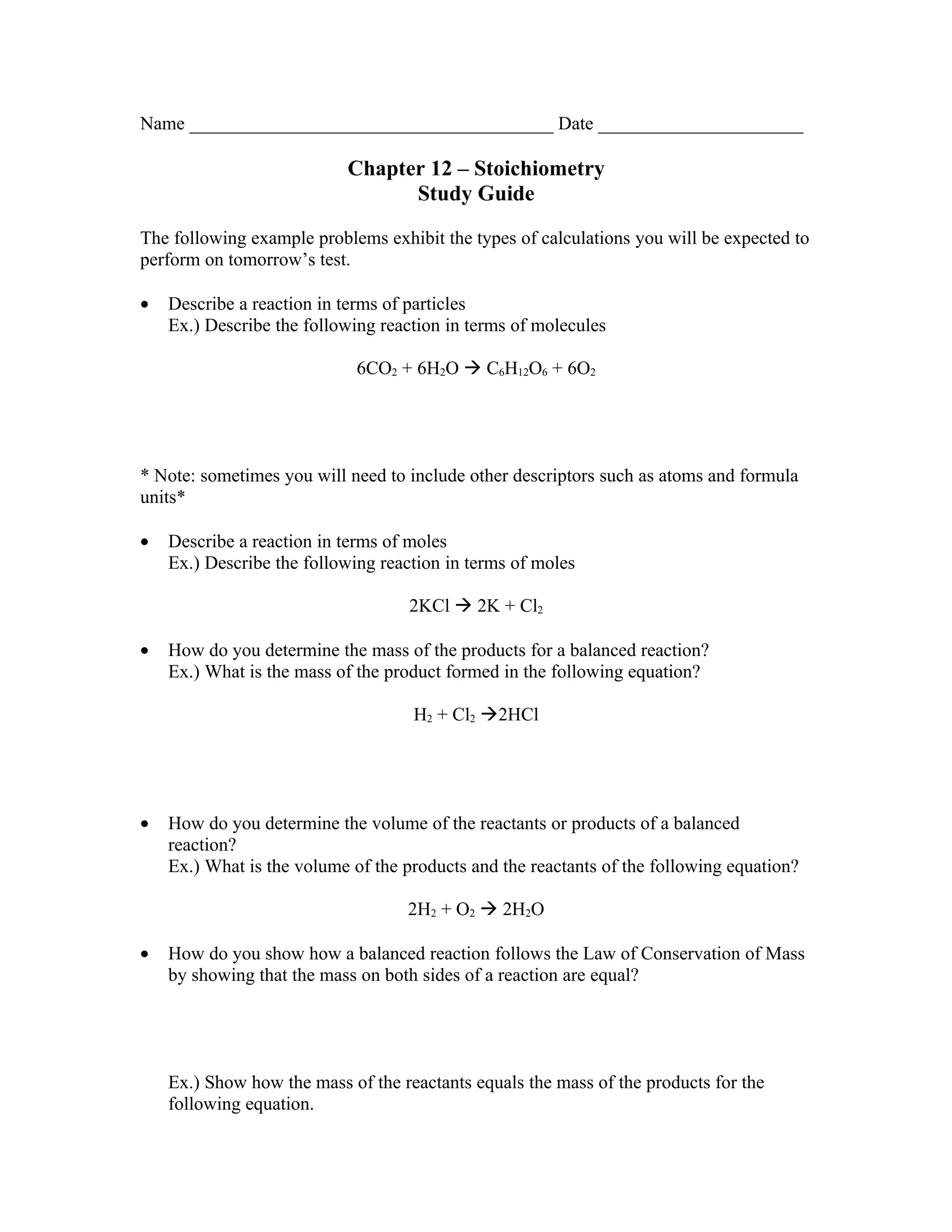
                           Chapter 12 – Stoichiometry
                                 Study Guide

The following example problems exhibit the types of calculations you will be expected to
perform on tomorrow’s test.

•   Describe a reaction in terms of particles
    Ex.) Describe the following reaction in terms of molecules

                             6CO2 + 6H2O  C6H12O6 + 6O2


* Note: sometimes you will need to include other descriptors such as atoms and formula
units*

•   Describe a reaction in terms of moles
    Ex.) Describe the following reaction in terms of moles

                                    2KCl  2K + Cl2

•   How do you determine the mass of the products for a balanced reaction?
    Ex.) What is the mass of the product formed in the following equation?

                                    H2 + Cl2 2HCl


•   How do you determine the volume of the reactants or products of a balanced
    reaction?
    Ex.) What is the volume of the products and the reactants of the following equation?

                                   2H2 + O2  2H2O

•   How do you show how a balanced reaction follows the Law of Conservation of Mass
    by showing that the mass on both sides of a reaction are equal?


    Ex.) Show how the mass of the reactants equals the mass of the products for the
    following equation.
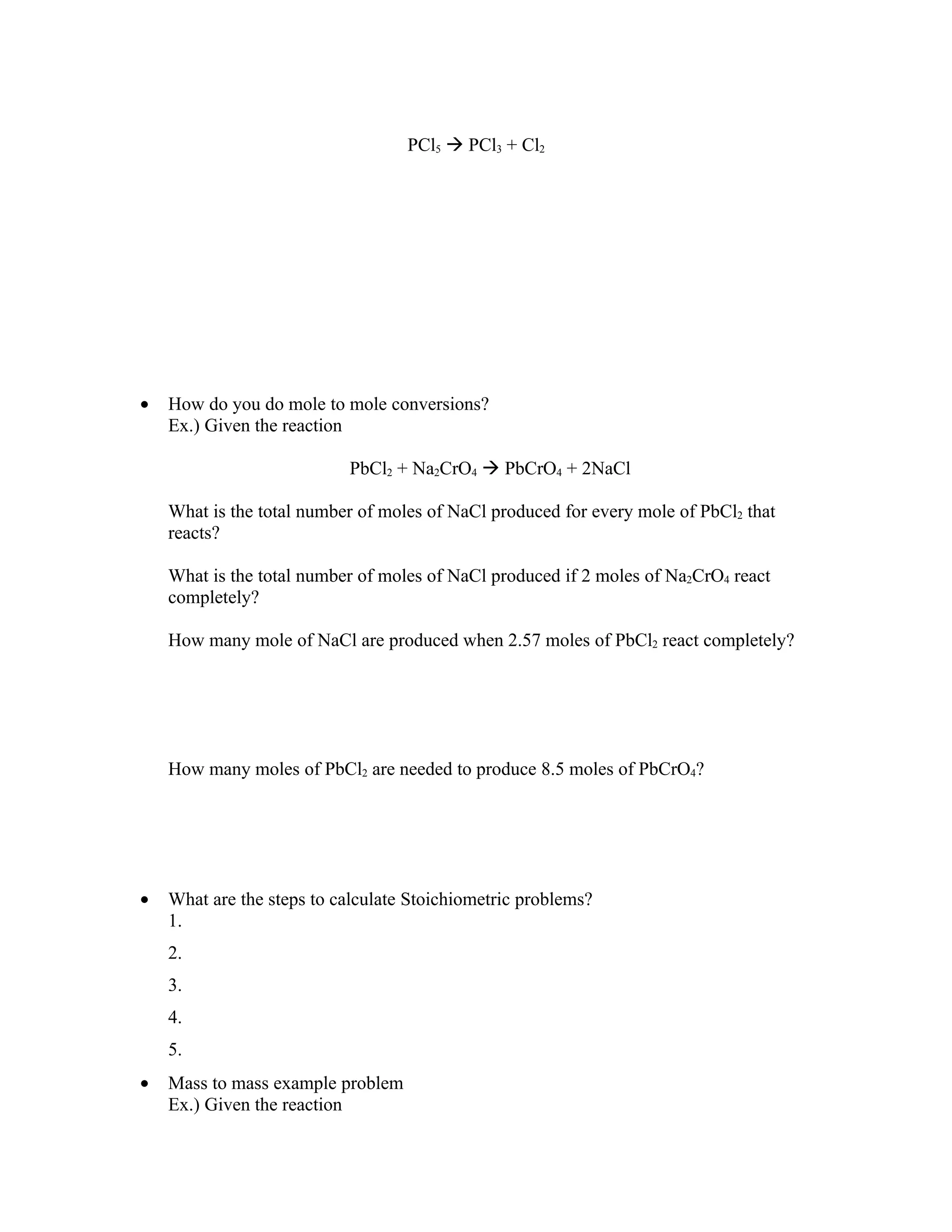
PCl5  PCl3 + Cl2


•   How do you do mole to mole conversions?
    Ex.) Given the reaction

                           PbCl2 + Na2CrO4  PbCrO4 + 2NaCl

    What is the total number of moles of NaCl produced for every mole of PbCl2 that
    reacts?

    What is the total number of moles of NaCl produced if 2 moles of Na2CrO4 react
    completely?

    How many mole of NaCl are produced when 2.57 moles of PbCl2 react completely?


    How many moles of PbCl2 are needed to produce 8.5 moles of PbCrO4?


•   What are the steps to calculate Stoichiometric problems?
    1.
    2.
    3.
    4.
    5.
•   Mass to mass example problem
    Ex.) Given the reaction
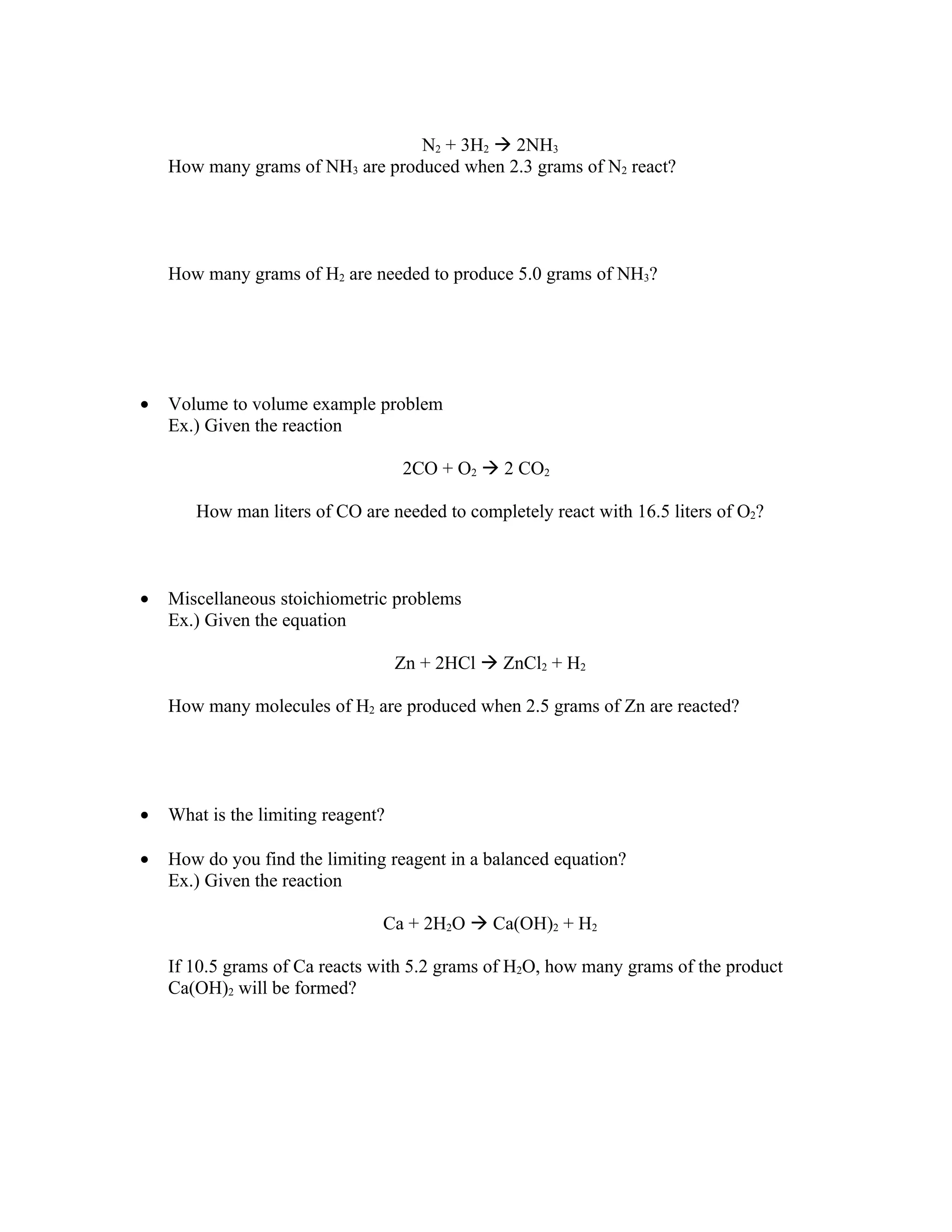
N2 + 3H2  2NH3
    How many grams of NH3 are produced when 2.3 grams of N2 react?


    How many grams of H2 are needed to produce 5.0 grams of NH3?


•   Volume to volume example problem
    Ex.) Given the reaction

                                    2CO + O2  2 CO2

       How man liters of CO are needed to completely react with 16.5 liters of O2?


•   Miscellaneous stoichiometric problems
    Ex.) Given the equation

                                    Zn + 2HCl  ZnCl2 + H2

    How many molecules of H2 are produced when 2.5 grams of Zn are reacted?


•   What is the limiting reagent?

•   How do you find the limiting reagent in a balanced equation?
    Ex.) Given the reaction

                                Ca + 2H2O  Ca(OH)2 + H2

    If 10.5 grams of Ca reacts with 5.2 grams of H2O, how many grams of the product
    Ca(OH)2 will be formed?
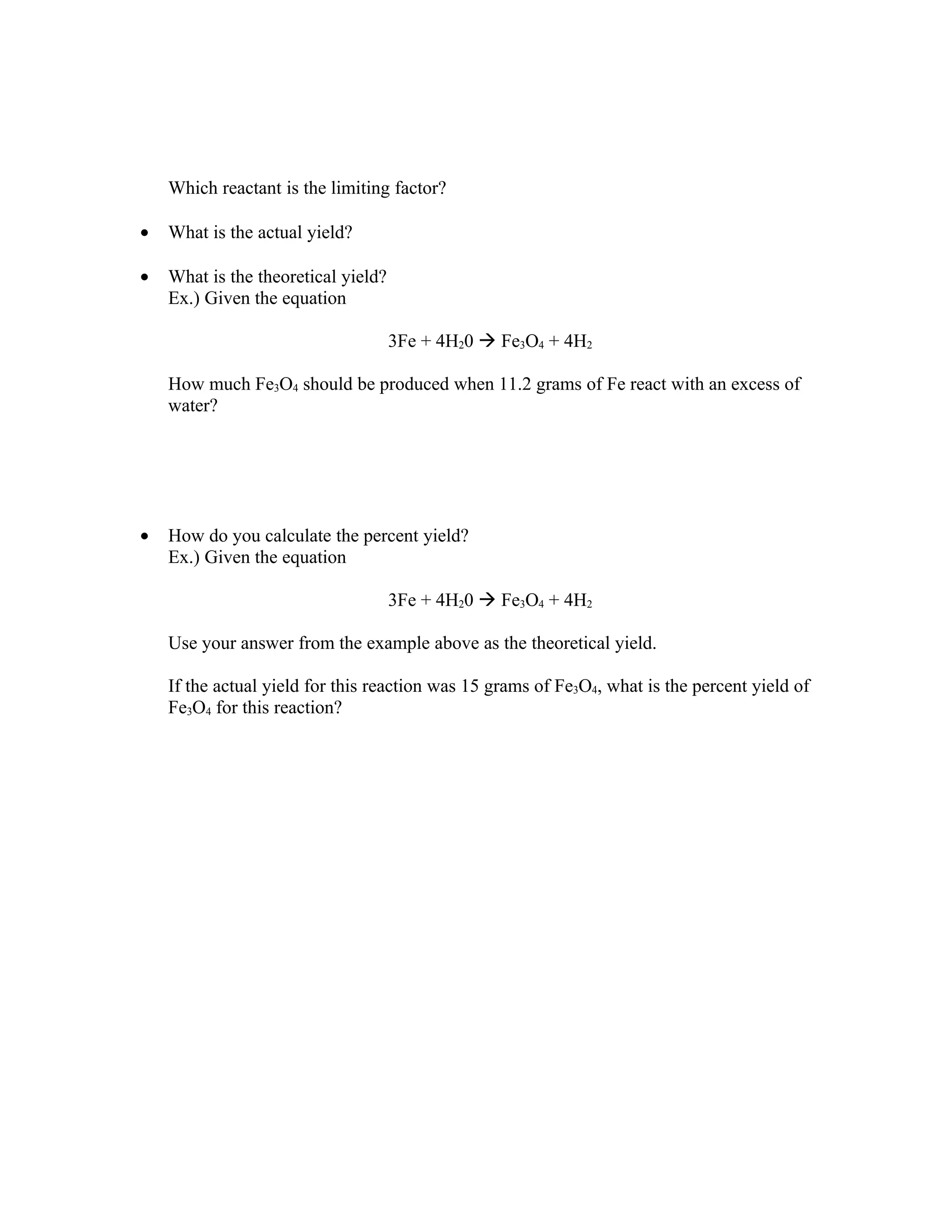
Which reactant is the limiting factor?

•   What is the actual yield?

•   What is the theoretical yield?
    Ex.) Given the equation

                                     3Fe + 4H20  Fe3O4 + 4H2

    How much Fe3O4 should be produced when 11.2 grams of Fe react with an excess of
    water?


•   How do you calculate the percent yield?
    Ex.) Given the equation

                                     3Fe + 4H20  Fe3O4 + 4H2

    Use your answer from the example above as the theoretical yield.

    If the actual yield for this reaction was 15 grams of Fe3O4, what is the percent yield of
    Fe3O4 for this reaction?

Chemistry - Chp 12 - Stoichiometry - Study Guide

  • 1.
    Name _______________________________________ Date______________________ Chapter 12 – Stoichiometry Study Guide The following example problems exhibit the types of calculations you will be expected to perform on tomorrow’s test. • Describe a reaction in terms of particles Ex.) Describe the following reaction in terms of molecules 6CO2 + 6H2O  C6H12O6 + 6O2 * Note: sometimes you will need to include other descriptors such as atoms and formula units* • Describe a reaction in terms of moles Ex.) Describe the following reaction in terms of moles 2KCl  2K + Cl2 • How do you determine the mass of the products for a balanced reaction? Ex.) What is the mass of the product formed in the following equation? H2 + Cl2 2HCl • How do you determine the volume of the reactants or products of a balanced reaction? Ex.) What is the volume of the products and the reactants of the following equation? 2H2 + O2  2H2O • How do you show how a balanced reaction follows the Law of Conservation of Mass by showing that the mass on both sides of a reaction are equal? Ex.) Show how the mass of the reactants equals the mass of the products for the following equation.
  • 2.
    PCl5  PCl3+ Cl2 • How do you do mole to mole conversions? Ex.) Given the reaction PbCl2 + Na2CrO4  PbCrO4 + 2NaCl What is the total number of moles of NaCl produced for every mole of PbCl2 that reacts? What is the total number of moles of NaCl produced if 2 moles of Na2CrO4 react completely? How many mole of NaCl are produced when 2.57 moles of PbCl2 react completely? How many moles of PbCl2 are needed to produce 8.5 moles of PbCrO4? • What are the steps to calculate Stoichiometric problems? 1. 2. 3. 4. 5. • Mass to mass example problem Ex.) Given the reaction
  • 3.
    N2 + 3H2 2NH3 How many grams of NH3 are produced when 2.3 grams of N2 react? How many grams of H2 are needed to produce 5.0 grams of NH3? • Volume to volume example problem Ex.) Given the reaction 2CO + O2  2 CO2 How man liters of CO are needed to completely react with 16.5 liters of O2? • Miscellaneous stoichiometric problems Ex.) Given the equation Zn + 2HCl  ZnCl2 + H2 How many molecules of H2 are produced when 2.5 grams of Zn are reacted? • What is the limiting reagent? • How do you find the limiting reagent in a balanced equation? Ex.) Given the reaction Ca + 2H2O  Ca(OH)2 + H2 If 10.5 grams of Ca reacts with 5.2 grams of H2O, how many grams of the product Ca(OH)2 will be formed?
  • 4.
    Which reactant isthe limiting factor? • What is the actual yield? • What is the theoretical yield? Ex.) Given the equation 3Fe + 4H20  Fe3O4 + 4H2 How much Fe3O4 should be produced when 11.2 grams of Fe react with an excess of water? • How do you calculate the percent yield? Ex.) Given the equation 3Fe + 4H20  Fe3O4 + 4H2 Use your answer from the example above as the theoretical yield. If the actual yield for this reaction was 15 grams of Fe3O4, what is the percent yield of Fe3O4 for this reaction?