Motion in One Dimension
Uniform Rectilinear Motion   This motion is produced when the forces acting on a body add to zero. When a body is in uniform rectilinear motion, its velocity  v  is constant. Therefore a  =  = 0 that is, there is no acceleration. When  v  is constant we have x  =  x 0 +  v  t
Example: A car starts 2 x 10² m west of the town square and move with a constant velocity of 15 m/s toward the east. Choose a coordinate system in which x-axis points east and the origin is at the town square. (a) Write the equation that represents the motion of the car (b) Where will the car be 10 min later ? Known  :  x0 = - 2 x 10² m  v = 15 m/s  t = 10 min = 6x10² s Solution :  x = x0 + v t x = -2 x 10²  + 15(600) = 88 x 102 m
Uniformly Accelerated Rectilinear Motion   This motion is produced when the net force acting on a body is constant. When a body is in  uniformly accelerated motion, its acceleration  a  is constant v  =  v 0 +  a  t x  =  x 0 +  v  t +  a  t2 v 2 =  v 02 + 2  a   x
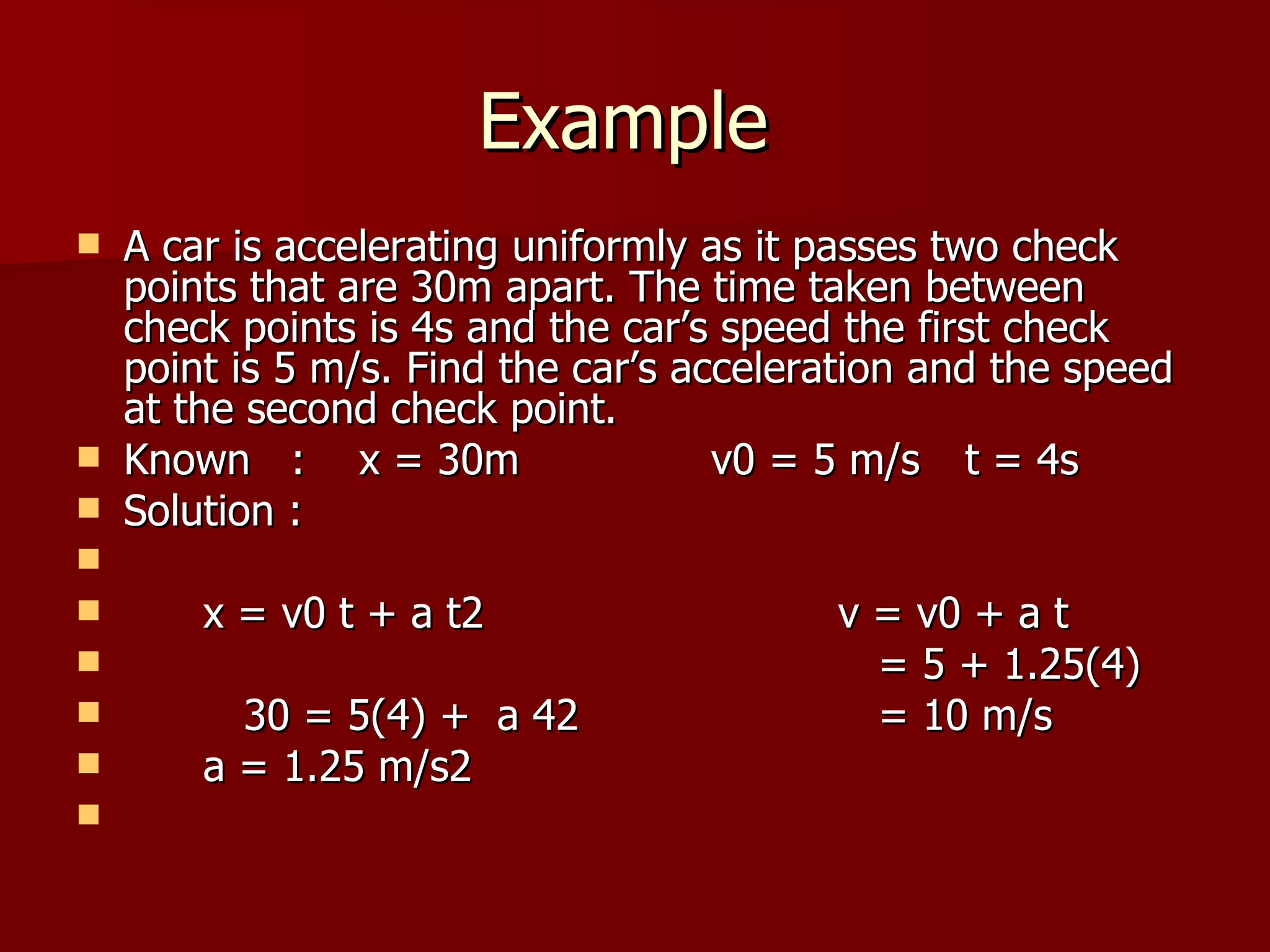
Example  A car is accelerating uniformly as it passes two check points that are 30m apart. The time taken between check points is 4s and the car’s speed the first check point is 5 m/s. Find the car’s acceleration and the speed at the second check point. Known  :  x = 30m v0 = 5 m/s t = 4s Solution : x = v0 t + a t2  v = v0 + a t    = 5 + 1.25(4)  30 = 5(4) +  a 42   = 10 m/s  a = 1.25 m/s2
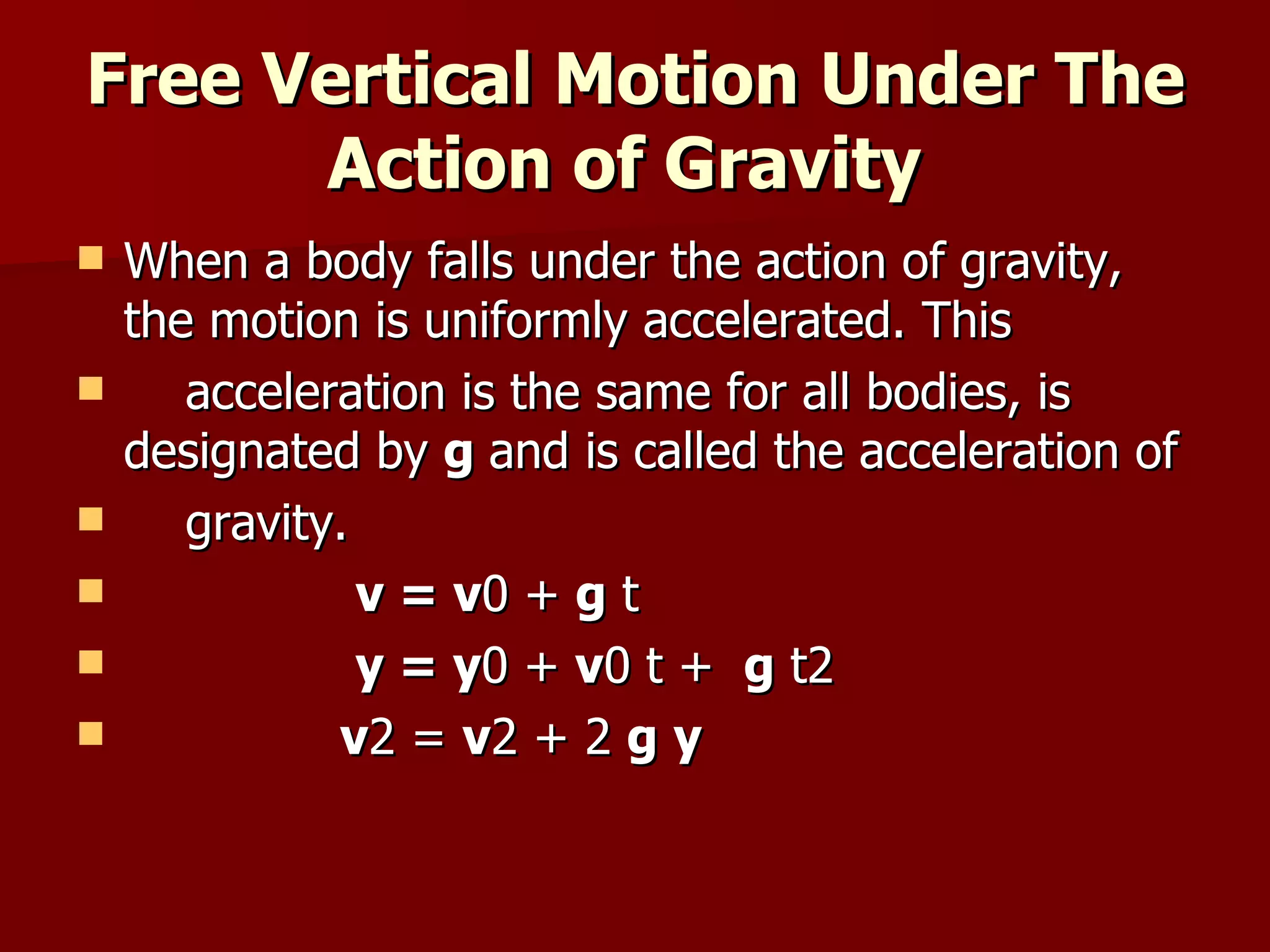
Free Vertical Motion Under The Action of Gravity   When a body falls under the action of gravity, the motion is uniformly accelerated. This  acceleration is the same for all bodies, is designated by  g  and is called the acceleration of  gravity. v = v 0 +  g  t y = y 0 +  v 0 t +  g  t2  v 2 =  v 2 + 2  g   y
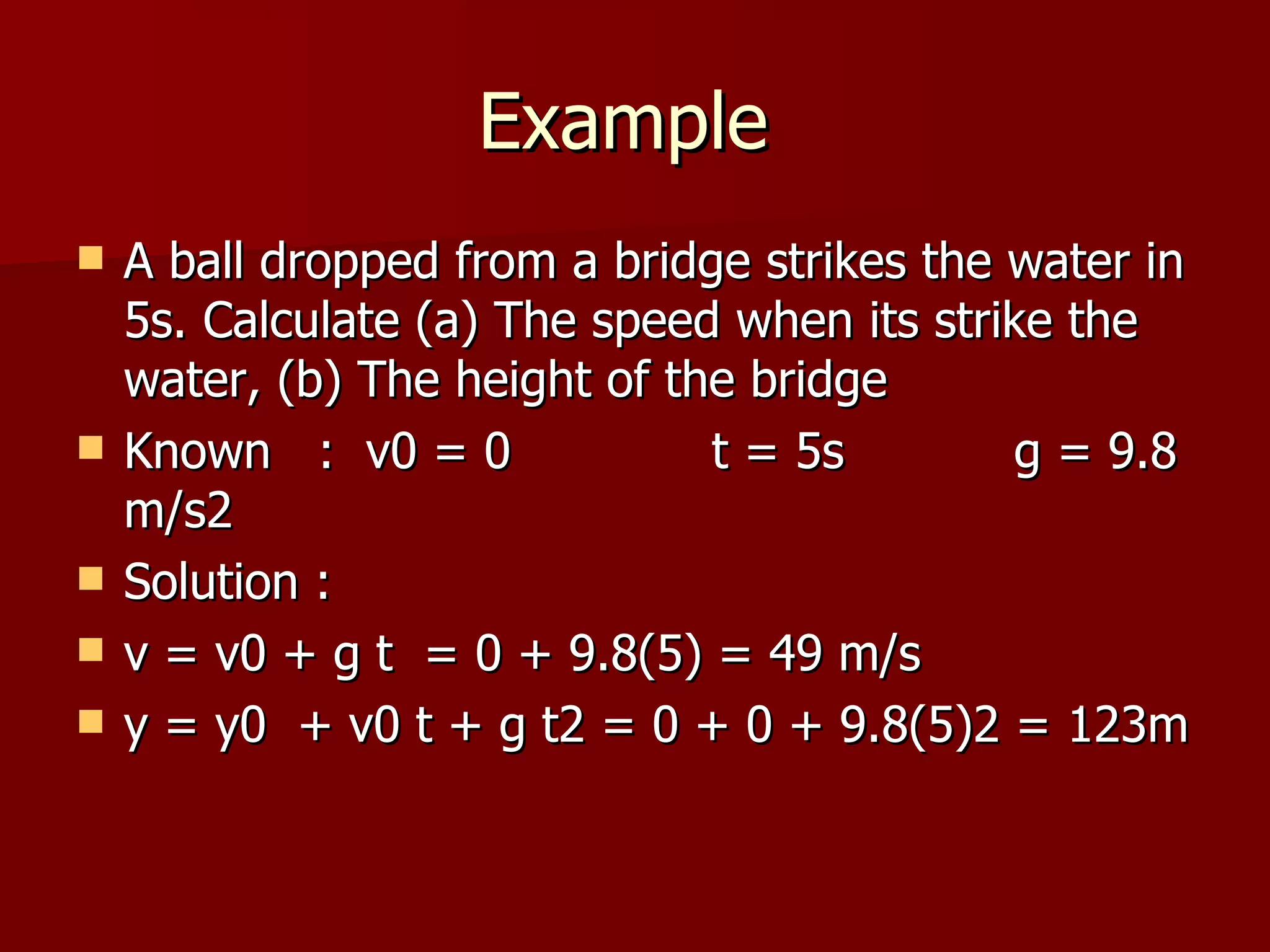
Example  A ball dropped from a bridge strikes the water in 5s. Calculate (a) The speed when its strike the water, (b) The height of the bridge Known  :  v0 = 0  t = 5s  g = 9.8 m/s2   Solution : v = v0 + g t  = 0 + 9.8(5) = 49 m/s y = y0  + v0 t + g t2 = 0 + 0 + 9.8(5)2 = 123m

Motion in One Dimension

  • 1.
    Motion in OneDimension
  • 2.
    Uniform Rectilinear Motion This motion is produced when the forces acting on a body add to zero. When a body is in uniform rectilinear motion, its velocity v is constant. Therefore a = = 0 that is, there is no acceleration. When v is constant we have x = x 0 + v t
  • 3.
    Example: A carstarts 2 x 10² m west of the town square and move with a constant velocity of 15 m/s toward the east. Choose a coordinate system in which x-axis points east and the origin is at the town square. (a) Write the equation that represents the motion of the car (b) Where will the car be 10 min later ? Known : x0 = - 2 x 10² m v = 15 m/s t = 10 min = 6x10² s Solution : x = x0 + v t x = -2 x 10² + 15(600) = 88 x 102 m
  • 4.
    Uniformly Accelerated RectilinearMotion This motion is produced when the net force acting on a body is constant. When a body is in uniformly accelerated motion, its acceleration a is constant v = v 0 + a t x = x 0 + v t + a t2 v 2 = v 02 + 2 a x
  • 5.
    Example Acar is accelerating uniformly as it passes two check points that are 30m apart. The time taken between check points is 4s and the car’s speed the first check point is 5 m/s. Find the car’s acceleration and the speed at the second check point. Known : x = 30m v0 = 5 m/s t = 4s Solution : x = v0 t + a t2 v = v0 + a t = 5 + 1.25(4) 30 = 5(4) + a 42 = 10 m/s a = 1.25 m/s2
  • 6.
    Free Vertical MotionUnder The Action of Gravity When a body falls under the action of gravity, the motion is uniformly accelerated. This acceleration is the same for all bodies, is designated by g and is called the acceleration of gravity. v = v 0 + g t y = y 0 + v 0 t + g t2 v 2 = v 2 + 2 g y
  • 7.
    Example Aball dropped from a bridge strikes the water in 5s. Calculate (a) The speed when its strike the water, (b) The height of the bridge Known : v0 = 0 t = 5s g = 9.8 m/s2 Solution : v = v0 + g t = 0 + 9.8(5) = 49 m/s y = y0 + v0 t + g t2 = 0 + 0 + 9.8(5)2 = 123m