Consciousness and  Its Variations
Consciousness Described as a stream or river by William James Introspection tried to capture the structure of consciousness Modern study includes roles of psychological, physiological, social, and cultural influences
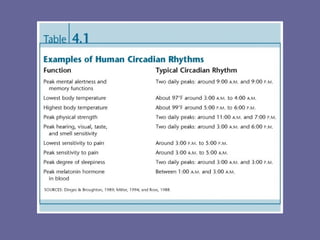
Circadian Rhythm Any rhythmic change that continues at close to a 24-hour cycle in the absence of 24-hour cues body temperature cortisol secretion sleep and wakefulness In the absence of time cues, the cycle period will become somewhat longer than 24 hours
 
The Body’s Clock Suprachiasmatic nucleus (SCN)—cluster of neurons in the hypothalamus that governs the timing of circadian rhythms Melatonin—hormone of the pineal gland that produces sleepiness Bright light decreases production of melatonin; decreased light increases melatonin
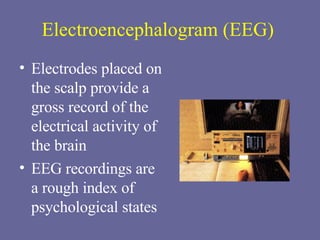
Electroencephalogram (EEG) Electrodes placed on the scalp provide a gross record of the electrical activity of the brain EEG recordings are a rough index of psychological states
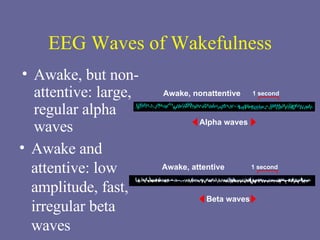
EEG Waves of Wakefulness Awake, but non-attentive: large, regular alpha waves Awake and attentive: low amplitude, fast, irregular beta waves 1 second Alpha waves Awake, nonattentive 1 second Beta waves Awake, attentive
Stages of Sleep Awake but sleepy--relaxed. alpha waves seen in EEG Stage 1 NREM-- brief transition stage when first falling asleep--theta waves Hypnogogic hallucinations--vivid sensory phenomena during onset of sleep
Stages of Sleep Stage 2 NREM--characterized by sleep spindles--brief spurts of activity Stages 3 and 4 NREM (slow-wave sleep): successively deeper stages of sleep Characterized by an increasing percentage  of slow, irregular, high-amplitude delta waves  Stage 4 NREM is very deep sleep
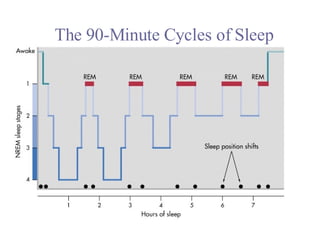
Stages of Sleep Upon reaching stage 4 and after about 80 to 100 minutes of total sleep time, sleep lightens, returns through stages 3 and 2 REM sleep emerges, characterized by EEG patterns that resemble beta waves of alert wakefulness muscles most relaxed rapid eye movements occur dreams occur Four or five sleep cycles occur in a typical night’s  sleep; less time is spent in slow-wave, more is spent  in REM
The 90-Minute Cycles of Sleep
Sleep Changes Throughout Life Changes in quality and quantity are apparent Amount of time in deep (slow wave) and REM sleep decreases with age
Functions of Sleep Restoration theory—body wears out during the day and sleep is necessary to put it back in shape Adaptive theory—sleep emerged in evolution to preserve energy and protect during the time of day when there is considerable danger
Sleep Deprivation Microsleep--episodes lasting only a few seconds REM rebound--deprivation of REM sleep causes increase in time spent in REM sleep to “catch up” NREM rebound--catching up on Stages 3 and 4 sleep
Individual Differences  in Sleep Drive Some individuals need more and some  less than the typical 8 hours per night Nonsomniacs—sleep far less than most,  but do not feel tired during the day Insomniacs—have a normal desire for  sleep, but are unable to and feel tired  during the day
Sleep Disorders Insomnia—inability to fall asleep or stay asleep Night terrors—sudden arousal from sleep and intense fear accompanied by physiological reactions (e.g., rapid heart rate, perspiration) that occur during slow-wave sleep Narcolepsy—overpowering urge to fall asleep that may occur while talking or standing up
Sleep Disorders Restless Legs Syndrome--RLS unpleasant sensations in lower legs and urge to move legs disrupts sleep. Sleep apnea—failure to breathe when asleep REM sleep behavior disorder—sleeper acts out his or her dreams
Dreams and REM Sleep True dream—vivid, detailed dreams consisting of sensory and motor sensations experienced during REM  Sleep thinking—lacks vivid sensory and motor sensations, is more similar to daytime thinking, and occurs during slow-wave sleep
Brain and REM Sleep Active areas during REM--amygdala and hippocampus Inactive areas during REM--frontal lobes and primary visual cortex REM sleep plays a role in memory consolidation
Significance of Dreams Psychoanalytic Interpretation Activation Synthesis Model
Psychoanalytic Interpretation Manifest content—elements of the dream that are consciously experienced and remembered Latent content—the unconscious wishes that are concealed in the manifest content Dreams as “wish fulfillments”
Activation Synthesis Model Brain activity during sleep produces dream images (activation) which are combined by the brain into a dream story (synthesis). Meaning is to be found by analyzing the way the dreamer makes sense of the progression of chaotic dream images.
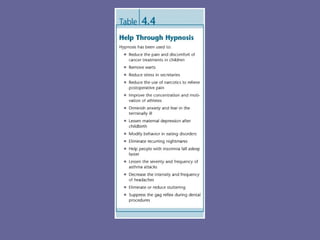
Hypnosis State of awareness Highly focused attention Increased responsiveness to suggestion Vivid imagery Willingness to accept distortions of logic Alteration of sensation and perception
 
Hypnosis and Memory Posthypnotic suggestion--during hypnosis a suggestion is made for the person to carry out some behavior after hypnosis is over Posthypnotic amnesia--inability to remember specific information because of a posthypnotic suggestion Hypermnesia--enhancement of memory because of posthypnotic suggestion
Meditation Sustained concentration that focuses attention and heightens awareness Lowered physiological arousal decreased heart rate decreased BP Predominance of alpha brain waves
Meditation Techniques Concentration techniques--control attention by focusing awareness on a visual image, word, or phrase Opening-up techniques--control attention by focusing on the “here and now”
Psychoactive Drugs Depressants—inhibit brain activity Opiates—produce pain relief and euphoria Stimulants—increase brain activity Psychedelics—distort sensory perceptions
Common Properties Physical dependence Tolerance Withdrawal symptoms Drug rebound effect
Drug Abuse Recurrent drug use that results in disruption of academic, social, or occupational functioning or in  legal or psychological problems
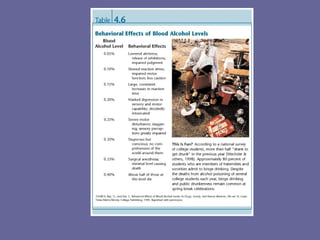
Depressants Alcohol—CNS depressant  Barbiturates—induce sleep but can cause dependence and as a result serious withdrawal symptoms Tranquilizers—relieve anxiety but can be addictive Effects are additive
 
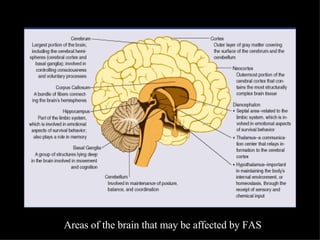
Areas of the brain that may be affected by FAS
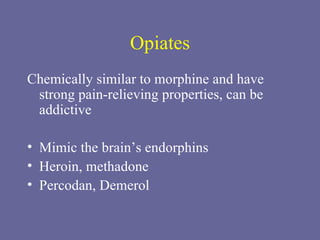
Opiates Chemically similar to morphine and have strong pain-relieving properties, can be addictive Mimic the brain’s endorphins Heroin, methadone Percodan, Demerol
Stimulants Caffeine Nicotine Amphetamines Cocaine Stimulant induced psychosis
Psychedelics Create perceptual distortions Mescaline LSD Marijuana Flashback reactions and psychotic episodes
“ Club” Drugs Ecstasy (MDMA)—feelings of euphoria, increased well-being Side effects—dehydration, hyperthermia, tremor, rapid heartbeat Dissociative anesthetics—include PCP and Ketamine.  Deaden pain, produce stupor or coma, and may induce hallucinations.
Chapter 4 Ppp

  • 1.
    Consciousness and Its Variations
  • 2.
    Consciousness Described asa stream or river by William James Introspection tried to capture the structure of consciousness Modern study includes roles of psychological, physiological, social, and cultural influences
  • 3.
    Circadian Rhythm Anyrhythmic change that continues at close to a 24-hour cycle in the absence of 24-hour cues body temperature cortisol secretion sleep and wakefulness In the absence of time cues, the cycle period will become somewhat longer than 24 hours
  • 4.
  • 5.
    The Body’s ClockSuprachiasmatic nucleus (SCN)—cluster of neurons in the hypothalamus that governs the timing of circadian rhythms Melatonin—hormone of the pineal gland that produces sleepiness Bright light decreases production of melatonin; decreased light increases melatonin
  • 6.
    Electroencephalogram (EEG) Electrodesplaced on the scalp provide a gross record of the electrical activity of the brain EEG recordings are a rough index of psychological states
  • 7.
    EEG Waves ofWakefulness Awake, but non-attentive: large, regular alpha waves Awake and attentive: low amplitude, fast, irregular beta waves 1 second Alpha waves Awake, nonattentive 1 second Beta waves Awake, attentive
  • 8.
    Stages of SleepAwake but sleepy--relaxed. alpha waves seen in EEG Stage 1 NREM-- brief transition stage when first falling asleep--theta waves Hypnogogic hallucinations--vivid sensory phenomena during onset of sleep
  • 9.
    Stages of SleepStage 2 NREM--characterized by sleep spindles--brief spurts of activity Stages 3 and 4 NREM (slow-wave sleep): successively deeper stages of sleep Characterized by an increasing percentage of slow, irregular, high-amplitude delta waves Stage 4 NREM is very deep sleep
  • 10.
    Stages of SleepUpon reaching stage 4 and after about 80 to 100 minutes of total sleep time, sleep lightens, returns through stages 3 and 2 REM sleep emerges, characterized by EEG patterns that resemble beta waves of alert wakefulness muscles most relaxed rapid eye movements occur dreams occur Four or five sleep cycles occur in a typical night’s sleep; less time is spent in slow-wave, more is spent in REM
  • 11.
  • 12.
    Sleep Changes ThroughoutLife Changes in quality and quantity are apparent Amount of time in deep (slow wave) and REM sleep decreases with age
  • 13.
    Functions of SleepRestoration theory—body wears out during the day and sleep is necessary to put it back in shape Adaptive theory—sleep emerged in evolution to preserve energy and protect during the time of day when there is considerable danger
  • 14.
    Sleep Deprivation Microsleep--episodeslasting only a few seconds REM rebound--deprivation of REM sleep causes increase in time spent in REM sleep to “catch up” NREM rebound--catching up on Stages 3 and 4 sleep
  • 15.
    Individual Differences in Sleep Drive Some individuals need more and some less than the typical 8 hours per night Nonsomniacs—sleep far less than most, but do not feel tired during the day Insomniacs—have a normal desire for sleep, but are unable to and feel tired during the day
  • 16.
    Sleep Disorders Insomnia—inabilityto fall asleep or stay asleep Night terrors—sudden arousal from sleep and intense fear accompanied by physiological reactions (e.g., rapid heart rate, perspiration) that occur during slow-wave sleep Narcolepsy—overpowering urge to fall asleep that may occur while talking or standing up
  • 17.
    Sleep Disorders RestlessLegs Syndrome--RLS unpleasant sensations in lower legs and urge to move legs disrupts sleep. Sleep apnea—failure to breathe when asleep REM sleep behavior disorder—sleeper acts out his or her dreams
  • 18.
    Dreams and REMSleep True dream—vivid, detailed dreams consisting of sensory and motor sensations experienced during REM Sleep thinking—lacks vivid sensory and motor sensations, is more similar to daytime thinking, and occurs during slow-wave sleep
  • 19.
    Brain and REMSleep Active areas during REM--amygdala and hippocampus Inactive areas during REM--frontal lobes and primary visual cortex REM sleep plays a role in memory consolidation
  • 20.
    Significance of DreamsPsychoanalytic Interpretation Activation Synthesis Model
  • 21.
    Psychoanalytic Interpretation Manifestcontent—elements of the dream that are consciously experienced and remembered Latent content—the unconscious wishes that are concealed in the manifest content Dreams as “wish fulfillments”
  • 22.
    Activation Synthesis ModelBrain activity during sleep produces dream images (activation) which are combined by the brain into a dream story (synthesis). Meaning is to be found by analyzing the way the dreamer makes sense of the progression of chaotic dream images.
  • 23.
    Hypnosis State ofawareness Highly focused attention Increased responsiveness to suggestion Vivid imagery Willingness to accept distortions of logic Alteration of sensation and perception
  • 24.
  • 25.
    Hypnosis and MemoryPosthypnotic suggestion--during hypnosis a suggestion is made for the person to carry out some behavior after hypnosis is over Posthypnotic amnesia--inability to remember specific information because of a posthypnotic suggestion Hypermnesia--enhancement of memory because of posthypnotic suggestion
  • 26.
    Meditation Sustained concentrationthat focuses attention and heightens awareness Lowered physiological arousal decreased heart rate decreased BP Predominance of alpha brain waves
  • 27.
    Meditation Techniques Concentrationtechniques--control attention by focusing awareness on a visual image, word, or phrase Opening-up techniques--control attention by focusing on the “here and now”
  • 28.
    Psychoactive Drugs Depressants—inhibitbrain activity Opiates—produce pain relief and euphoria Stimulants—increase brain activity Psychedelics—distort sensory perceptions
  • 29.
    Common Properties Physicaldependence Tolerance Withdrawal symptoms Drug rebound effect
  • 30.
    Drug Abuse Recurrentdrug use that results in disruption of academic, social, or occupational functioning or in legal or psychological problems
  • 31.
    Depressants Alcohol—CNS depressant Barbiturates—induce sleep but can cause dependence and as a result serious withdrawal symptoms Tranquilizers—relieve anxiety but can be addictive Effects are additive
  • 32.
  • 33.
    Areas of thebrain that may be affected by FAS
  • 34.
    Opiates Chemically similarto morphine and have strong pain-relieving properties, can be addictive Mimic the brain’s endorphins Heroin, methadone Percodan, Demerol
  • 35.
    Stimulants Caffeine NicotineAmphetamines Cocaine Stimulant induced psychosis
  • 36.
    Psychedelics Create perceptualdistortions Mescaline LSD Marijuana Flashback reactions and psychotic episodes
  • 37.
    “ Club” DrugsEcstasy (MDMA)—feelings of euphoria, increased well-being Side effects—dehydration, hyperthermia, tremor, rapid heartbeat Dissociative anesthetics—include PCP and Ketamine. Deaden pain, produce stupor or coma, and may induce hallucinations.