Introduction to Psychology: Kellogg Community College, Talbot
Chapter 8
Chapter 8
Cognition, Intelligence, and
Creativity
Introduction to Psychology: Kellogg Community College, Talbot
Chapter 8
The Nature of Thought
• Thinking: internal ________ of external __________.
• Cognition: Mentally processing information (images,
concepts, etc.); thinking
• Images: picture-like mental representations
• Concept: Generalized idea representing a class of
related objects or events
• Language: Words or symbols, and rules for combining
them, that are used for thinking and communication
Introduction to Psychology: Kellogg Community College, Talbot
Chapter 8
Types of Mental Images
• Stored Image: Mental image kept in long-term memory
(LTM) and retrieved when appropriate
• Created Image: Image that has been assembled or
invented rather than remembered
• 3-D, rotated in space, size may change.
• Kinesthetic Image: Created from produced,
remembered, or imagined muscular sensations
Introduction to Psychology: Kellogg Community College, Talbot
Chapter 8Figure 8.1
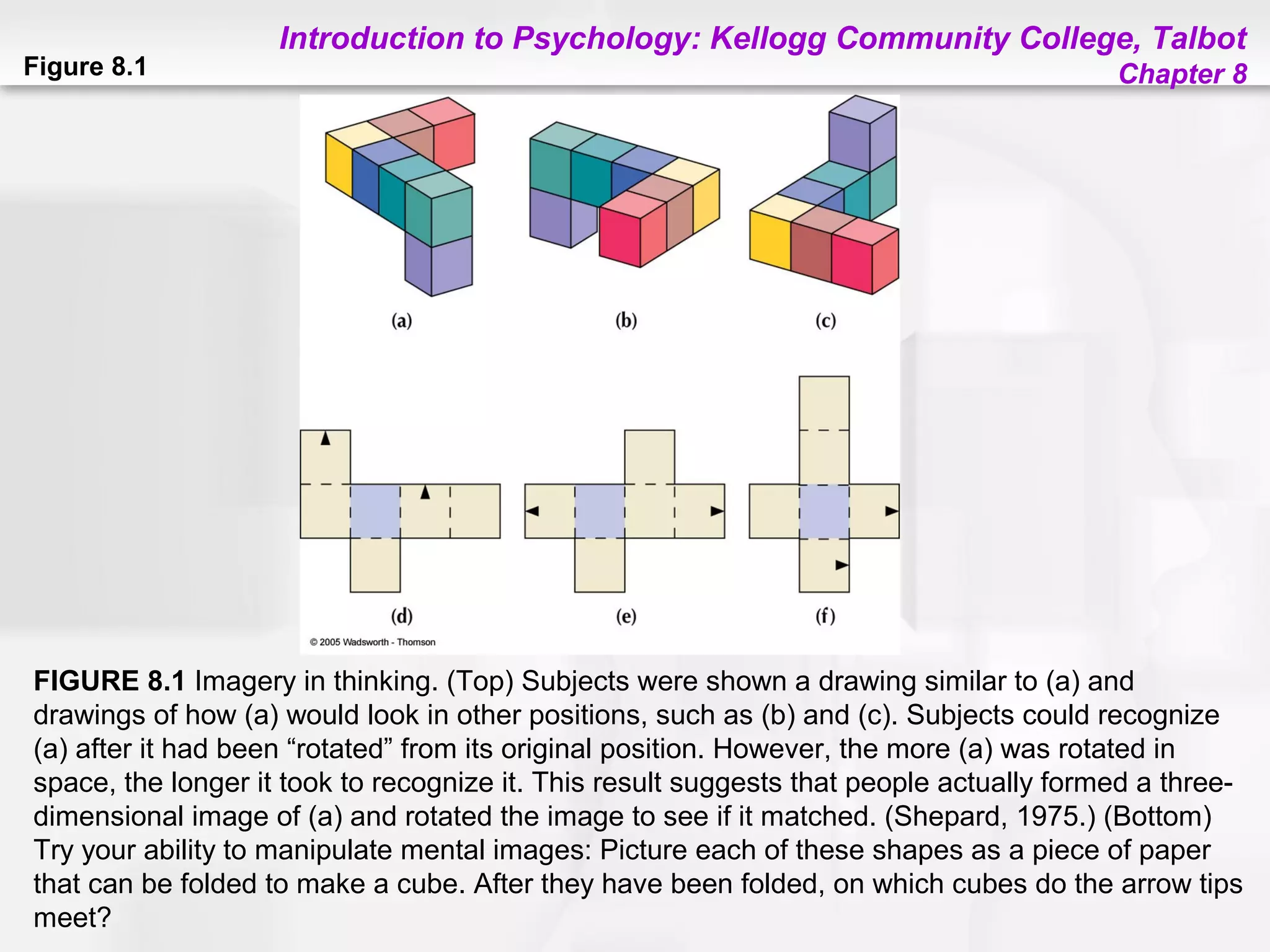
FIGURE 8.1 Imagery in thinking. (Top) Subjects were shown a drawing similar to (a) and
drawings of how (a) would look in other positions, such as (b) and (c). Subjects could recognize
(a) after it had been “rotated” from its original position. However, the more (a) was rotated in
space, the longer it took to recognize it. This result suggests that people actually formed a three-
dimensional image of (a) and rotated the image to see if it matched. (Shepard, 1975.) (Bottom)
Try your ability to manipulate mental images: Picture each of these shapes as a piece of paper
that can be folded to make a cube. After they have been folded, on which cubes do the arrow tips
meet?
Introduction to Psychology: Kellogg Community College, Talbot
Chapter 8
Concept Formation
• Process of classifying world into meaningful categories
– Positive Instance: Object or event that belongs to the
concept class
– Negative Instance: Object or event that does not
belong to the concept class
• Conceptual Rule: Guidelines for deciding whether
objects or events belong to concept class
• Prototypes/ Ideal Models
Introduction to Psychology: Kellogg Community College, Talbot
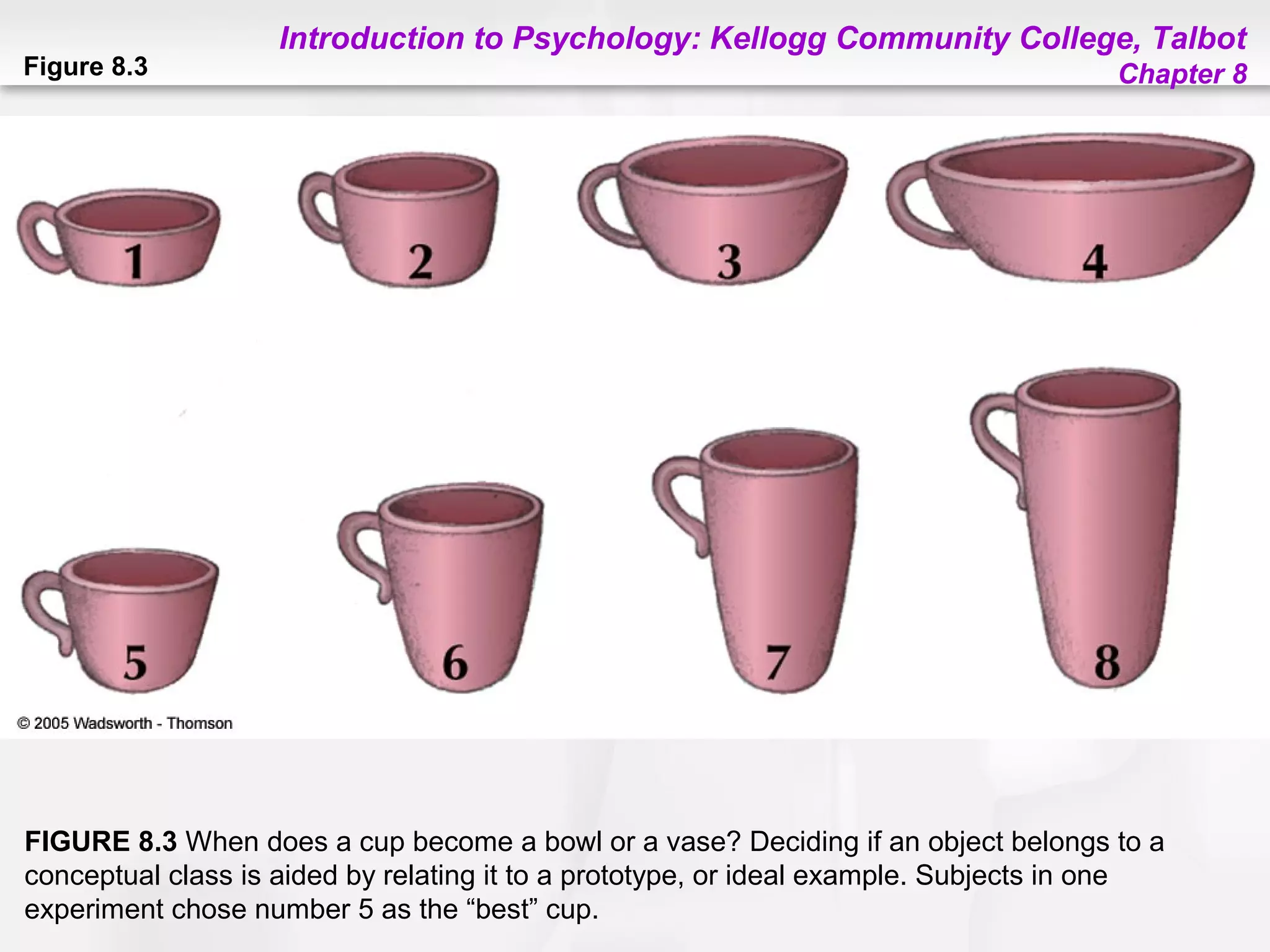
Chapter 8Figure 8.3
FIGURE 8.3 When does a cup become a bowl or a vase? Deciding if an object belongs to a
conceptual class is aided by relating it to a prototype, or ideal example. Subjects in one
experiment chose number 5 as the “best” cup.
Introduction to Psychology: Kellogg Community College, Talbot
Chapter 8
Concept Formation (cont'd)
• Conjunctive Concept: Class of objects that are defined
by the presence of two or more common features (e.g.,
object is pink and soft)
• Relational Concept: Based on how an object relates to
something else or how its features relate to one another
• Disjunctive Concept: Objects that have at least one of
several possible features; either-or concept (strike in
baseball)
Introduction to Psychology: Kellogg Community College, Talbot
Chapter 8
More Concept Issues and Terms
• Denotative Meaning: Exact definition of a word or
concept
• Connotative Meaning: Emotional or personal meaning of
a concept
Introduction to Psychology: Kellogg Community College, Talbot
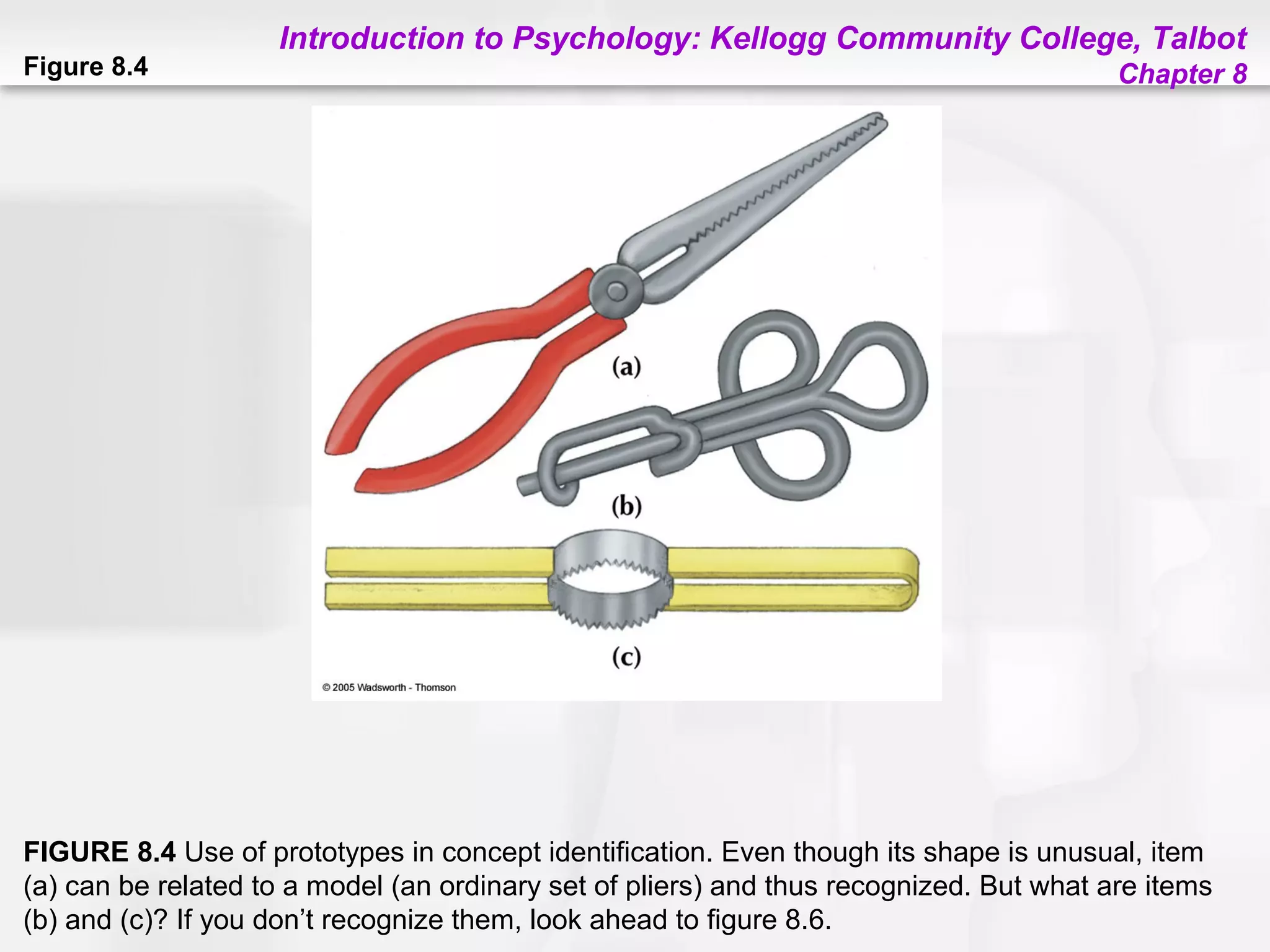
Chapter 8Figure 8.4
FIGURE 8.4 Use of prototypes in concept identification. Even though its shape is unusual, item
(a) can be related to a model (an ordinary set of pliers) and thus recognized. But what are items
(b) and (c)? If you don’t recognize them, look ahead to figure 8.6.
Introduction to Psychology: Kellogg Community College, Talbot
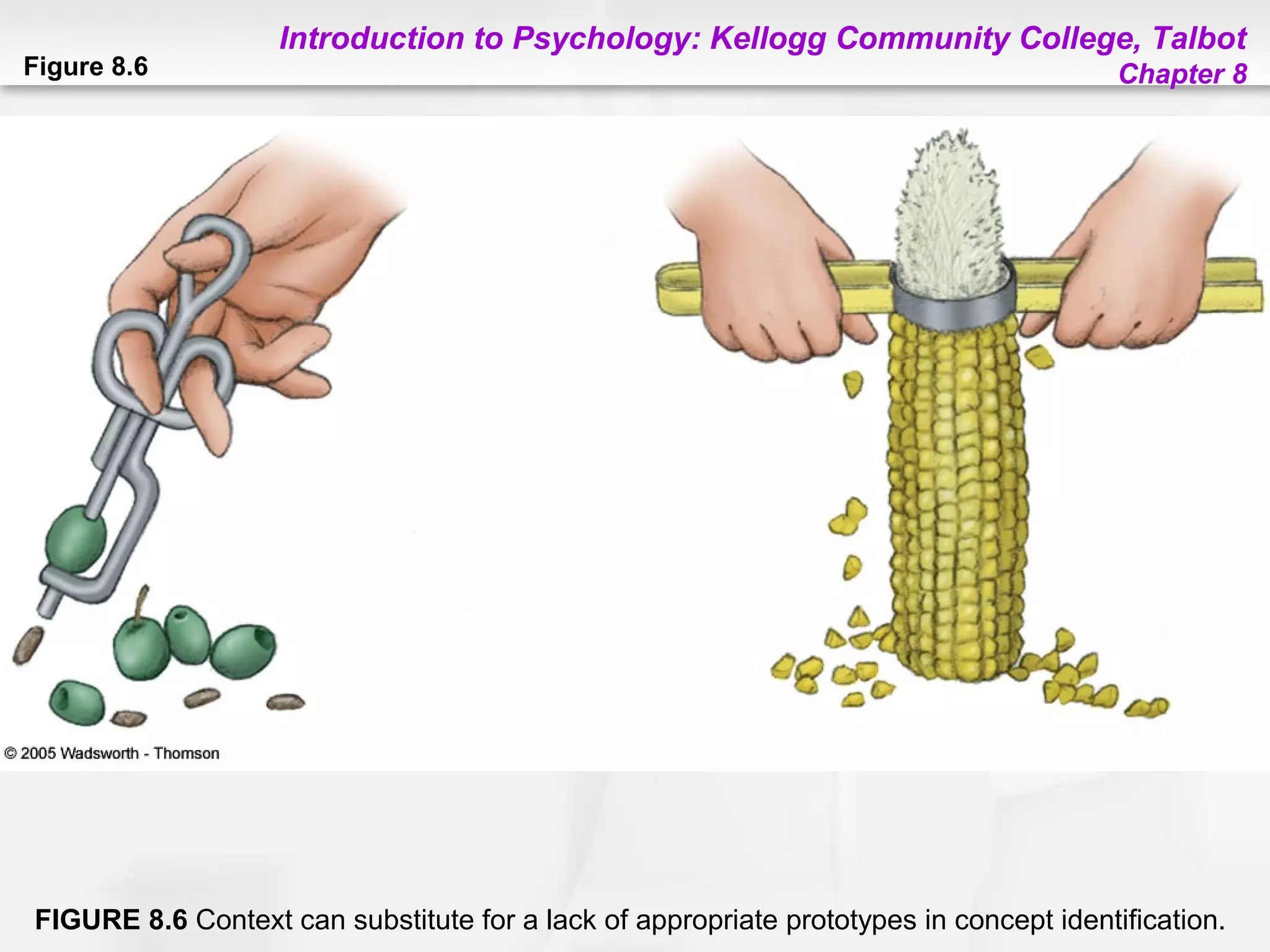
Chapter 8Figure 8.6
FIGURE 8.6 Context can substitute for a lack of appropriate prototypes in concept identification.
Introduction to Psychology: Kellogg Community College, Talbot
Chapter 8
Language
• What is the role of language in thinking?
– A: Allows events to be _______________ into ___________ for
_________________ manipulation.
• Encoding: Translating information into symbols that are
easy to manipulate and understand
• Semantics: Study of meanings in language
• Phoneme: Basic speech sounds
• Morpheme: Speech sounds collected into meaningful
units, like syllables or words
Introduction to Psychology: Kellogg Community College, Talbot
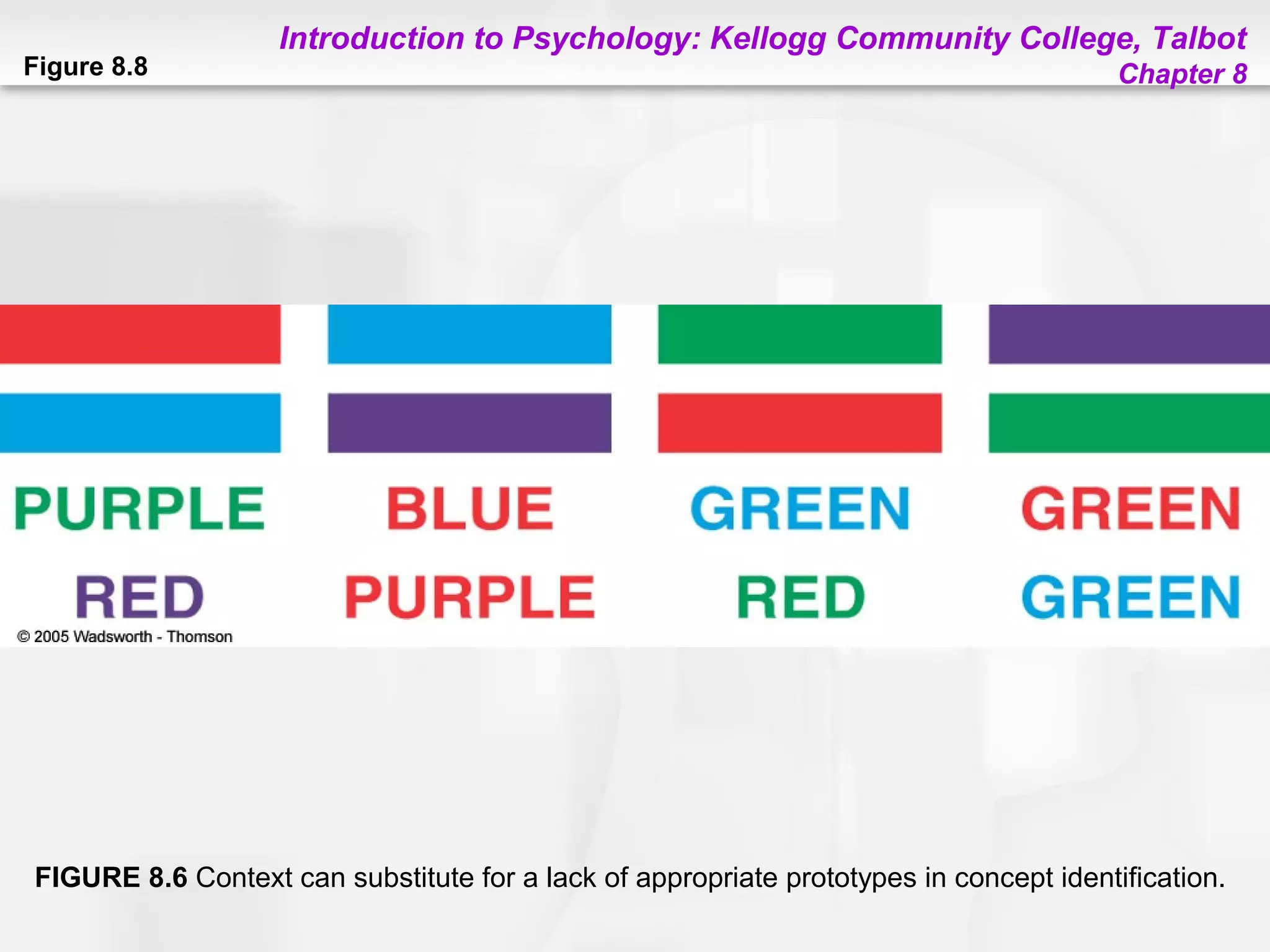
Chapter 8Figure 8.8
FIGURE 8.6 Context can substitute for a lack of appropriate prototypes in concept identification.
Introduction to Psychology: Kellogg Community College, Talbot
Chapter 8
Language (cont'd)
• Grammar: Set of rules for making sounds into words or
words into sentences
• Syntax: Rules for word order in sentences
• Productivity: Ability of language to generate new
thoughts or ideas
• American Sign Language (ASL): Language used by deaf
and hearing-impaired people
Introduction to Psychology: Kellogg Community College, Talbot
Chapter 8
Problem Solving
• Mechanical Solution: Achieved by trial and error or by
rote
• Understanding:
• Algorithm: Learned set of rules that always leads to the
correct solution
• General Solution: States the requirements for success
but not in enough detail for further action
• Random Search Strategy: All possibilities are tried, more
or less randomly
• Functional Solution:
• Heuristic: Strategy for identifying and evaluating problem
solutions
Introduction to Psychology: Kellogg Community College, Talbot
Chapter 8
Insight
• When an answer appears suddenly in problem solving
(a-ha learning)
• Involves three abilities
– Selective Encoding: Selecting information that is
relevant to a problem while ignoring distractions
– Selective Combination: Connecting seemingly
unrelated bits of useful information
– Selective Comparison: Comparing new problems with
old information or with problems already solved
Introduction to Psychology: Kellogg Community College, Talbot
Chapter 8
Problem solving can also be blocked:
Fixations
• Fixations: Tendency to repeat wrong solutions and to
“fixate” on them, or to become blind to alternatives
• Functional Fixedness: Inability to see new uses
(functions) for familiar objects or for things that were
used in a particular way
Introduction to Psychology: Kellogg Community College, Talbot
Chapter 8
Barriers to Problem Solving
• Emotional Barriers: Inhibition and fear of making a fool of
oneself or of making a mistake
• Cultural Barriers: Belief that fantasy is a waste and
feelings and humor have no place in problem solving
• Learned Barriers: Taboos; staying with conventional
uses
• Perceptual Barriers: Habits leading to a failure to identify
important elements of a problem
Introduction to Psychology: Kellogg Community College, Talbot
Chapter 8
Artificial Intelligence (AI)
• Computers (and their programs) that perform human-like
problem solving or intelligent responding (Deep Blue, the
chess-playing supercomputer)
• Computer Simulations: Programs that attempt to
duplicate human behavior, especially thinking, problem
solving, or decision making
• Expert Systems: Computer programs that respond as an
expert human would
– Responding like a chess Grand Master
• Organized Knowledge: Systematic information
• Acquired Strategies: Learned tactics
Introduction to Psychology: Kellogg Community College, Talbot
Chapter 8
Defining Intelligence
• Global capacity to act purposefully, think rationally, and
deal effectively with the environment
• Operational Definition: Specifies what procedures we will
use to measure a concept
Introduction to Psychology: Kellogg Community College, Talbot
Chapter 8
Some Intelligence Quotient (IQ) Terms
• Norm: Average score for a designated group of people
• Chronological Age: Person’s age in years
• Mental Age: Average intellectual performance
Introduction to Psychology: Kellogg Community College, Talbot
Chapter 8
More Intelligence Quotient (IQ) Terms
• Intelligence Quotient (IQ): Intelligence index; original
definition; mental age divided by chronological age, then
multiplied by 100
• Deviation IQ: Scores based on a person’s standing in his
or her age group; how far above or below average a
person’s score is, relative to other scores
• Average IQ in the U.S.: 100
Introduction to Psychology: Kellogg Community College, Talbot
Chapter 8
Wechsler Tests
• Wechsler Adult Intelligence Test, 3rd Edition (WAIS-III):
Adult intelligence test that rates verbal and performance
intelligence and abilities
– Wechsler Intelligence Scale for Children, 4th Edition
(WISC-IV): Downscaled version of the WAIS-III; for
children from 6 years to 16 years, 11 months, 30 days
• Performance Intelligence: Nonverbal intelligence
• Verbal Intelligence: Language or symbol-oriented
intelligence
• Normal (Bell-shaped) Curve: Most scores fall close to
the average, and very few are found at the extremes
Introduction to Psychology: Kellogg Community College, Talbot
Chapter 8
IQ Research Results, and a Few More
Terms to Know
• A strong correlation (about .50) exists between IQ and
school grades, but not a measure of ___________.
• IQ is NOT a good predictor of success in art, music,
writing, dramatics, science and leadership.
• Men and women do NOT appear to differ in overall
intelligence.
• Giftedness/ Genius: Having a high IQ (usually above
130) or special talents or abilities (playing Mozart at age
5).
• Giftedness/ Mental Retardation: Having a low IQ
Introduction to Psychology: Kellogg Community College, Talbot
Chapter 8
Mental Retardation: Some Definitions
• Presence of a developmental disability or an IQ score
below 70; a significant impairment of adaptive behavior
also figures into the definition
– Adaptive Behavior: Basic skills such as dressing,
eating, working, hygiene; necessary for self-care
• Familial Retardation: Mild retardation that occurs in
homes that have inadequate nutrition, intellectual
stimulation, medical care, and emotional support
Introduction to Psychology: Kellogg Community College, Talbot
Chapter 8
Organic Causes of Mental Retardation
• Related to physical disorders
• Birth Injuries: Lack of oxygen to the brain, for example
• Fetal Damage: Congenital problem; prenatal damage
from disease, infection, or drug abuse by the mother
• Metabolic Disorders: Disorder in metabolism; affects
energy use and production in the body
• Genetic Abnormalities: Abnormality in the genes, such
as missing genes, extra genes, or defective genes
Introduction to Psychology: Kellogg Community College, Talbot
Chapter 8
Gardner’s Theory of Eight Multiple Intelligences
• Language: Used for thinking by lawyers, writers,
comedians
• Logic and Math: Used by scientists, accountants,
programmers
• Visual and Spatial Thinking: Used by engineers,
inventors, aviators
• Music: Used by composers, musicians, music critics
Introduction to Psychology: Kellogg Community College, Talbot
Chapter 8
Gardner’s Theory of Eight Multiple
Intelligences (cont'd)
• Bodily-Kinesthetic Skills: Used by dancers, athletes,
surgeons
• Intrapersonal Skills (Self-Knowledge): Used by poets,
actors, ministers
• Interpersonal Skills (Social Abilities): Used by
psychologists, teachers, politicians
• Naturalistic Skills (Ability to Understand Natural
Environment): Used by biologists, organic farmers
Introduction to Psychology: Kellogg Community College, Talbot
Chapter 8
Creative Thinking
• Inductive Thought: Going from specific facts or
observations to general principles
• Deductive Thought: Going from general principles to
specific situations
Introduction to Psychology: Kellogg Community College, Talbot
Chapter 8
How to “Rate” Creative Thoughts
• Fluency: Total number of suggestions you can make
• Flexibility: Number of times you shift from one class of
possible uses to another
• Originality: How novel or unusual or unique your
suggestions are
• Convergent Thinking: Many thoughts or variations
converging on a single answer; conventional thinking
• Divergent Thinking: Many possibilities developing from
one starting point
Introduction to Psychology: Kellogg Community College, Talbot
Chapter 8
Stages of Creative Thought
• Orientation: Defining the problem
• Preparation: Gaining as much information as possible
• Incubation: The problem, while not appearing to be
actively worked on, is still “cooking” in the background
• Illumination: The “a-ha” experience; rapid insight into the
solution
• Verification: Testing and critically evaluating the solution
Introduction to Psychology: Kellogg Community College, Talbot
Chapter 8
Logic and Intuition
• Intuition: Quick, impulsive thought that does not make
use of formal reasoning
• Representativeness Heuristic: Giving a choice greater
weight if it seems to be representative of what is already
known
• Base Rate: Underlying probability of an event
• Framing: The way a problem is stated or the way it is
structured
Introduction to Psychology: Kellogg Community College, Talbot
Chapter 8
How to Enhance Creativity
• Break mental sets and challenge assumptions.
– Mental Set: Tendency to perceive or respond in a
certain way that blinds us to possible solutions.
• Define problems broadly.
• Restate the problem in different ways.
• Allow time for incubation.
Introduction to Psychology: Kellogg Community College, Talbot
Chapter 8
How to Enhance Creativity (cont'd)
• Seek varied input.
• Look for analogies.
• Take sensible risks.
• Delay evaluation
• Brainstorm

Introduction to psychology ch 8

  • 1.
    Introduction to Psychology:Kellogg Community College, Talbot Chapter 8 Chapter 8 Cognition, Intelligence, and Creativity
  • 2.
    Introduction to Psychology:Kellogg Community College, Talbot Chapter 8 The Nature of Thought • Thinking: internal ________ of external __________. • Cognition: Mentally processing information (images, concepts, etc.); thinking • Images: picture-like mental representations • Concept: Generalized idea representing a class of related objects or events • Language: Words or symbols, and rules for combining them, that are used for thinking and communication
  • 3.
    Introduction to Psychology:Kellogg Community College, Talbot Chapter 8 Types of Mental Images • Stored Image: Mental image kept in long-term memory (LTM) and retrieved when appropriate • Created Image: Image that has been assembled or invented rather than remembered • 3-D, rotated in space, size may change. • Kinesthetic Image: Created from produced, remembered, or imagined muscular sensations
  • 4.
    Introduction to Psychology:Kellogg Community College, Talbot Chapter 8Figure 8.1 FIGURE 8.1 Imagery in thinking. (Top) Subjects were shown a drawing similar to (a) and drawings of how (a) would look in other positions, such as (b) and (c). Subjects could recognize (a) after it had been “rotated” from its original position. However, the more (a) was rotated in space, the longer it took to recognize it. This result suggests that people actually formed a three- dimensional image of (a) and rotated the image to see if it matched. (Shepard, 1975.) (Bottom) Try your ability to manipulate mental images: Picture each of these shapes as a piece of paper that can be folded to make a cube. After they have been folded, on which cubes do the arrow tips meet?
  • 5.
    Introduction to Psychology:Kellogg Community College, Talbot Chapter 8 Concept Formation • Process of classifying world into meaningful categories – Positive Instance: Object or event that belongs to the concept class – Negative Instance: Object or event that does not belong to the concept class • Conceptual Rule: Guidelines for deciding whether objects or events belong to concept class • Prototypes/ Ideal Models
  • 6.
    Introduction to Psychology:Kellogg Community College, Talbot Chapter 8Figure 8.3 FIGURE 8.3 When does a cup become a bowl or a vase? Deciding if an object belongs to a conceptual class is aided by relating it to a prototype, or ideal example. Subjects in one experiment chose number 5 as the “best” cup.
  • 7.
    Introduction to Psychology:Kellogg Community College, Talbot Chapter 8 Concept Formation (cont'd) • Conjunctive Concept: Class of objects that are defined by the presence of two or more common features (e.g., object is pink and soft) • Relational Concept: Based on how an object relates to something else or how its features relate to one another • Disjunctive Concept: Objects that have at least one of several possible features; either-or concept (strike in baseball)
  • 8.
    Introduction to Psychology:Kellogg Community College, Talbot Chapter 8 More Concept Issues and Terms • Denotative Meaning: Exact definition of a word or concept • Connotative Meaning: Emotional or personal meaning of a concept
  • 9.
    Introduction to Psychology:Kellogg Community College, Talbot Chapter 8Figure 8.4 FIGURE 8.4 Use of prototypes in concept identification. Even though its shape is unusual, item (a) can be related to a model (an ordinary set of pliers) and thus recognized. But what are items (b) and (c)? If you don’t recognize them, look ahead to figure 8.6.
  • 10.
    Introduction to Psychology:Kellogg Community College, Talbot Chapter 8Figure 8.6 FIGURE 8.6 Context can substitute for a lack of appropriate prototypes in concept identification.
  • 11.
    Introduction to Psychology:Kellogg Community College, Talbot Chapter 8 Language • What is the role of language in thinking? – A: Allows events to be _______________ into ___________ for _________________ manipulation. • Encoding: Translating information into symbols that are easy to manipulate and understand • Semantics: Study of meanings in language • Phoneme: Basic speech sounds • Morpheme: Speech sounds collected into meaningful units, like syllables or words
  • 12.
    Introduction to Psychology:Kellogg Community College, Talbot Chapter 8Figure 8.8 FIGURE 8.6 Context can substitute for a lack of appropriate prototypes in concept identification.
  • 13.
    Introduction to Psychology:Kellogg Community College, Talbot Chapter 8 Language (cont'd) • Grammar: Set of rules for making sounds into words or words into sentences • Syntax: Rules for word order in sentences • Productivity: Ability of language to generate new thoughts or ideas • American Sign Language (ASL): Language used by deaf and hearing-impaired people
  • 14.
    Introduction to Psychology:Kellogg Community College, Talbot Chapter 8 Problem Solving • Mechanical Solution: Achieved by trial and error or by rote • Understanding: • Algorithm: Learned set of rules that always leads to the correct solution • General Solution: States the requirements for success but not in enough detail for further action • Random Search Strategy: All possibilities are tried, more or less randomly • Functional Solution: • Heuristic: Strategy for identifying and evaluating problem solutions
  • 15.
    Introduction to Psychology:Kellogg Community College, Talbot Chapter 8 Insight • When an answer appears suddenly in problem solving (a-ha learning) • Involves three abilities – Selective Encoding: Selecting information that is relevant to a problem while ignoring distractions – Selective Combination: Connecting seemingly unrelated bits of useful information – Selective Comparison: Comparing new problems with old information or with problems already solved
  • 16.
    Introduction to Psychology:Kellogg Community College, Talbot Chapter 8 Problem solving can also be blocked: Fixations • Fixations: Tendency to repeat wrong solutions and to “fixate” on them, or to become blind to alternatives • Functional Fixedness: Inability to see new uses (functions) for familiar objects or for things that were used in a particular way
  • 17.
    Introduction to Psychology:Kellogg Community College, Talbot Chapter 8 Barriers to Problem Solving • Emotional Barriers: Inhibition and fear of making a fool of oneself or of making a mistake • Cultural Barriers: Belief that fantasy is a waste and feelings and humor have no place in problem solving • Learned Barriers: Taboos; staying with conventional uses • Perceptual Barriers: Habits leading to a failure to identify important elements of a problem
  • 18.
    Introduction to Psychology:Kellogg Community College, Talbot Chapter 8 Artificial Intelligence (AI) • Computers (and their programs) that perform human-like problem solving or intelligent responding (Deep Blue, the chess-playing supercomputer) • Computer Simulations: Programs that attempt to duplicate human behavior, especially thinking, problem solving, or decision making • Expert Systems: Computer programs that respond as an expert human would – Responding like a chess Grand Master • Organized Knowledge: Systematic information • Acquired Strategies: Learned tactics
  • 19.
    Introduction to Psychology:Kellogg Community College, Talbot Chapter 8 Defining Intelligence • Global capacity to act purposefully, think rationally, and deal effectively with the environment • Operational Definition: Specifies what procedures we will use to measure a concept
  • 20.
    Introduction to Psychology:Kellogg Community College, Talbot Chapter 8 Some Intelligence Quotient (IQ) Terms • Norm: Average score for a designated group of people • Chronological Age: Person’s age in years • Mental Age: Average intellectual performance
  • 21.
    Introduction to Psychology:Kellogg Community College, Talbot Chapter 8 More Intelligence Quotient (IQ) Terms • Intelligence Quotient (IQ): Intelligence index; original definition; mental age divided by chronological age, then multiplied by 100 • Deviation IQ: Scores based on a person’s standing in his or her age group; how far above or below average a person’s score is, relative to other scores • Average IQ in the U.S.: 100
  • 22.
    Introduction to Psychology:Kellogg Community College, Talbot Chapter 8 Wechsler Tests • Wechsler Adult Intelligence Test, 3rd Edition (WAIS-III): Adult intelligence test that rates verbal and performance intelligence and abilities – Wechsler Intelligence Scale for Children, 4th Edition (WISC-IV): Downscaled version of the WAIS-III; for children from 6 years to 16 years, 11 months, 30 days • Performance Intelligence: Nonverbal intelligence • Verbal Intelligence: Language or symbol-oriented intelligence • Normal (Bell-shaped) Curve: Most scores fall close to the average, and very few are found at the extremes
  • 23.
    Introduction to Psychology:Kellogg Community College, Talbot Chapter 8 IQ Research Results, and a Few More Terms to Know • A strong correlation (about .50) exists between IQ and school grades, but not a measure of ___________. • IQ is NOT a good predictor of success in art, music, writing, dramatics, science and leadership. • Men and women do NOT appear to differ in overall intelligence. • Giftedness/ Genius: Having a high IQ (usually above 130) or special talents or abilities (playing Mozart at age 5). • Giftedness/ Mental Retardation: Having a low IQ
  • 24.
    Introduction to Psychology:Kellogg Community College, Talbot Chapter 8 Mental Retardation: Some Definitions • Presence of a developmental disability or an IQ score below 70; a significant impairment of adaptive behavior also figures into the definition – Adaptive Behavior: Basic skills such as dressing, eating, working, hygiene; necessary for self-care • Familial Retardation: Mild retardation that occurs in homes that have inadequate nutrition, intellectual stimulation, medical care, and emotional support
  • 25.
    Introduction to Psychology:Kellogg Community College, Talbot Chapter 8 Organic Causes of Mental Retardation • Related to physical disorders • Birth Injuries: Lack of oxygen to the brain, for example • Fetal Damage: Congenital problem; prenatal damage from disease, infection, or drug abuse by the mother • Metabolic Disorders: Disorder in metabolism; affects energy use and production in the body • Genetic Abnormalities: Abnormality in the genes, such as missing genes, extra genes, or defective genes
  • 26.
    Introduction to Psychology:Kellogg Community College, Talbot Chapter 8 Gardner’s Theory of Eight Multiple Intelligences • Language: Used for thinking by lawyers, writers, comedians • Logic and Math: Used by scientists, accountants, programmers • Visual and Spatial Thinking: Used by engineers, inventors, aviators • Music: Used by composers, musicians, music critics
  • 27.
    Introduction to Psychology:Kellogg Community College, Talbot Chapter 8 Gardner’s Theory of Eight Multiple Intelligences (cont'd) • Bodily-Kinesthetic Skills: Used by dancers, athletes, surgeons • Intrapersonal Skills (Self-Knowledge): Used by poets, actors, ministers • Interpersonal Skills (Social Abilities): Used by psychologists, teachers, politicians • Naturalistic Skills (Ability to Understand Natural Environment): Used by biologists, organic farmers
  • 28.
    Introduction to Psychology:Kellogg Community College, Talbot Chapter 8 Creative Thinking • Inductive Thought: Going from specific facts or observations to general principles • Deductive Thought: Going from general principles to specific situations
  • 29.
    Introduction to Psychology:Kellogg Community College, Talbot Chapter 8 How to “Rate” Creative Thoughts • Fluency: Total number of suggestions you can make • Flexibility: Number of times you shift from one class of possible uses to another • Originality: How novel or unusual or unique your suggestions are • Convergent Thinking: Many thoughts or variations converging on a single answer; conventional thinking • Divergent Thinking: Many possibilities developing from one starting point
  • 30.
    Introduction to Psychology:Kellogg Community College, Talbot Chapter 8 Stages of Creative Thought • Orientation: Defining the problem • Preparation: Gaining as much information as possible • Incubation: The problem, while not appearing to be actively worked on, is still “cooking” in the background • Illumination: The “a-ha” experience; rapid insight into the solution • Verification: Testing and critically evaluating the solution
  • 31.
    Introduction to Psychology:Kellogg Community College, Talbot Chapter 8 Logic and Intuition • Intuition: Quick, impulsive thought that does not make use of formal reasoning • Representativeness Heuristic: Giving a choice greater weight if it seems to be representative of what is already known • Base Rate: Underlying probability of an event • Framing: The way a problem is stated or the way it is structured
  • 32.
    Introduction to Psychology:Kellogg Community College, Talbot Chapter 8 How to Enhance Creativity • Break mental sets and challenge assumptions. – Mental Set: Tendency to perceive or respond in a certain way that blinds us to possible solutions. • Define problems broadly. • Restate the problem in different ways. • Allow time for incubation.
  • 33.
    Introduction to Psychology:Kellogg Community College, Talbot Chapter 8 How to Enhance Creativity (cont'd) • Seek varied input. • Look for analogies. • Take sensible risks. • Delay evaluation • Brainstorm