Chapter 1  Introduction and Research Methods
What is Psychology? The science of behavior and mental processes Behavior—observable actions of a person or animal Mind—thoughts, feelings, sensations, perceptions, memories, dreams, motives and other subjective experiences Science—an objective way to answer questions based on observable facts/data and well-described methods
Philosophical Developments A  Question:  How are mind and body related?   René Descartes (1596–1650)—Interactive dualism The mind and body interact to produce conscious experience BIG
Philosophical Developments Another  Question:  Nature vs. Nurture Are abilities determined by our genes or our experiences? What are the interactions between genetics and environment? What effect does it have on behavior? BIG
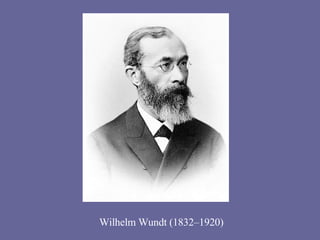
Foundations of  Modern Psychology Separated from philosophy in 19th century influences from physiology remain Wilhelm Wundt (1832–1920) Leipzig, Germany wrote the first psychology textbook applied laboratory techniques to study of the mind structuralism—identify “atoms” of the mind focused on basic sensory and perceptual processes  measured reaction times
Wilhelm Wundt (1832–1920)
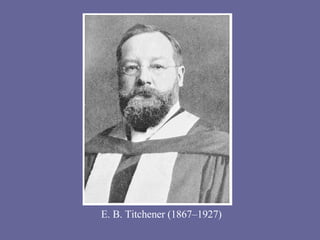
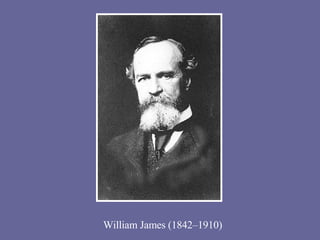
Other Pioneers Edward Titchener (1867–1927) Wundt’s student, professor at Cornell University William James (1842–1910) started psychology at Harvard in 1870s opposed Wundt and Titchener’s approach functionalism – influenced by Darwin  Mary Whiton Calkins (1863-1930) Student of James First woman president of APA G. Stanley Hall Received first PhD in psychology in US First president of APA
E. B. Titchener (1867–1927)
William James (1842–1910)
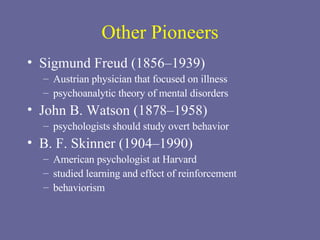
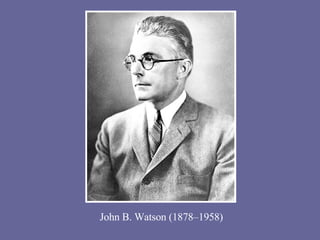
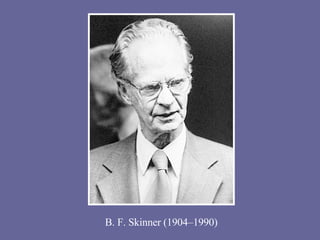
Other Pioneers Sigmund Freud (1856–1939) Austrian physician that focused on illness psychoanalytic theory of mental disorders  John B. Watson (1878–1958) psychologists should study overt behavior B. F. Skinner (1904–1990) American psychologist at Harvard studied learning and effect of reinforcement behaviorism
John B. Watson (1878–1958)
B. F. Skinner (1904–1990)
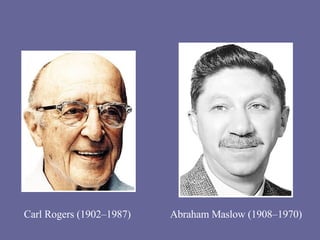
Humanistic Psychology Carl Rogers focus on self-determination and free will more positive view of basic forces than Freud’s Abraham Maslow  behavior reflects innate “actualization”  theory of motivation emphasizing psychological growth
Carl Rogers (1902–1987) Abraham Maslow (1908–1970)
Perspectives  Perspective is a way of viewing phenomena Psychology has multiple perspectives Biological Psychodynamic Behavioral Humanistic Cognitive Cross Cultural Evolutionary
Biological Perspective Study the physiological mechanisms in the brain and nervous system that organize and control behavior Focus may be at various levels individual neurons areas of the brain specific functions like eating, emotion, or learning Interest in behavior distinguishes biological psychology from many other biological sciences
Psychodynamic Perspective View of behavior based on experience treating patients Psychoanalytic approach  (Sigmund Freud) both a method of treatment and a theory of the mind behavior reflects combinations of conscious and unconscious influences drives and urges within the unconscious component of mind influence thought and behavior early childhood experiences shape unconscious motivations
Behavioral  Perspective View of behavior based on experience or learning Classical conditioning Operant conditioning
Humanistic Perspective Focus on motivation of people  to grow psychologically Influence of interpersonal relationships on self concept Importance of choice and self-direction to reach potential
Cognitive Perspective How is knowledge acquired, organized, remembered, and used to guide behavior? Influences include Piaget – studied intellectual development Chomsky – studied language Cybernetics – science of information processing
Cross-Cultural Perspective The study of psychological differences among people living in different cultural groups How are people’s thoughts, feelings, and behavior influenced by their culture? What are the common elements across culture? Are these innate?
Evolutionary Perspective Influenced by Darwin and the emphasis on innate, adaptive behavior patterns  Application of principles of evolution to explain behavior and psychological processes
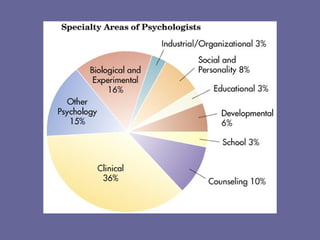
The Profession of Psychology American Psychological Association had 52 divisions in 1998 Some represent areas of training and specialization (e.g., developmental, clinical) Some are applied (i.e., teaching in psychology, psychology and the law)
 
Review
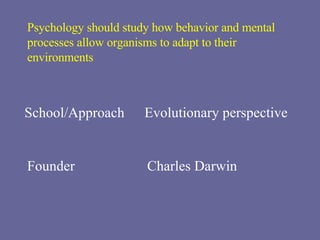
Psychology should study how behavior and mental processes allow organisms to adapt to their environments School/Approach Evolutionary perspective Founder Charles Darwin
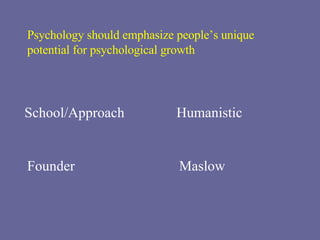
Psychology should emphasize people’s unique potential for psychological growth School/Approach Humanistic Founder Maslow
Psychology should only study observable behavior School/Approach Behaviorism Founder Watson/Skinner
Goals of Psychology Describe Explain Predict Control behavior and mental processes
Scientific Skepticism Science helps build explanations that are consistent and predictive rather than conflicting and postdictive  (hindsight) Science is based on knowledge of facts developing theories  testing hypotheses public and repeatable procedures
Scientific Method Formulate testable questions Develop hypotheses Design study to collect data Experimental  Descriptive Analyze data to arrive at conclusions Use of statistical procedures Use of meta-analysis Report results Publication Replication
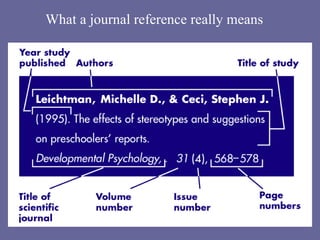
What a journal reference really means
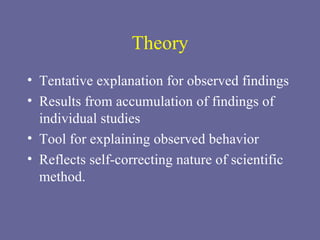
Theory Tentative explanation for observed findings Results from accumulation of findings of individual studies  Tool for explaining observed behavior Reflects self-correcting nature of scientific method.
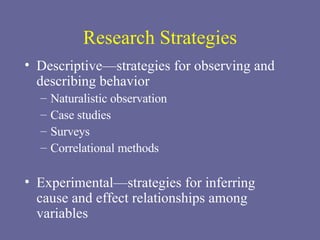
Research Strategies Descriptive—strategies for observing and describing behavior Naturalistic observation Case studies Surveys Correlational methods Experimental—strategies for inferring cause and effect relationships among variables
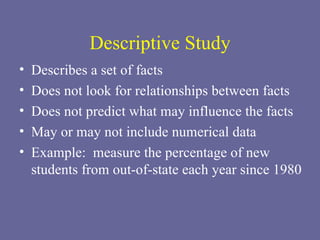
Descriptive Study Describes a set of facts Does not look for relationships between facts Does not predict what may influence the facts May or may not include numerical data Example:  measure the percentage of new students from out-of-state each year since 1980
Naturalistic Observation Researchers directly observe and record behavior rather than relying on subject descriptions. In   naturalistic observation  researcher records behavior as it occurs naturally.
Case Study Method Highly detailed description of a single individual Generally used to investigate rare, unusual, or extreme conditions
Survey Methods Designed to investigate opinions, behaviors, or characteristics of a particular group. Usually in self-report form.
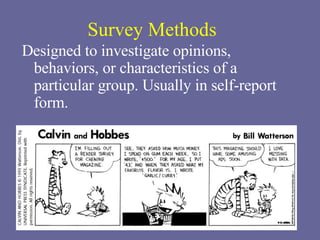
Samples and Sampling Population—large (potentially infinite) group represented by the sample.  Findings are generalized to this group. Sample—selected segment of the population Representative sample—closely parallels the population on relevant characteristics Random selection—every member of larger group has equal change of being selected for the study sample
Correlational Study Collects a set of facts organized into two or more categories measure time spent playing video games measure other personality characteristics Examines the relationship between categories Correlation reveals relationships among facts
Coefficient of Correlation Numerical indication of magnitude and direction of the relationship between two variables Positive correlation—two variables vary systematically in the SAME direction Negative correlation—two variables vary systematically in OPPOSITE directions
Correlational Study Correlation cannot prove causation Does playing video games cause a decline in academic achievement? Does playing video games cause more aggressive behavior? May be an unmeasured common factor   e.g., maybe more aggressive people are attracted to video games.
Experiments Direct way to test a hypothesis about a cause-effect relationship between factors Factors are called  variables  One variable is controlled by the experimenter e.g., type of video game--violent vs. non-violent The other is observed and measured e.g., aggressive behavior
Definitions Hypothesis—tentative statement about the relationship between variables Variables—factors that can vary in ways that can be observed, measured, and verified Operational definition—precise description of how the variables will be measured
Experimental Variables Independent variable  (IV) the controlled factor in an experiment  hypothesized to cause an effect on another variable Dependent variable (DV) the measured facts  hypothesized to be affected
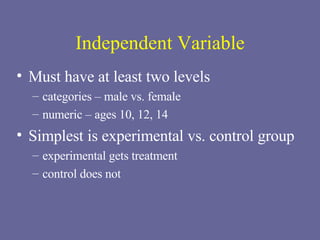
Independent Variable Must have at least two levels categories – male vs. female numeric – ages 10, 12, 14 Simplest is experimental vs. control group experimental gets treatment control does not
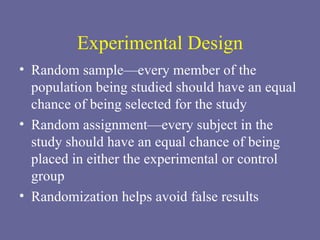
Experimental Design Random sample—every member of the population being studied should have an equal chance of being selected for the study Random assignment—every subject in the study should have an equal chance of being placed in either the experimental or control group  Randomization helps avoid false results
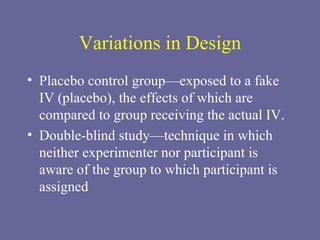
Variations in Design Placebo control group—exposed to a fake IV (placebo), the effects of which are compared to group receiving the actual IV. Double-blind study—technique in which neither experimenter nor participant is aware of the group to which participant is assigned
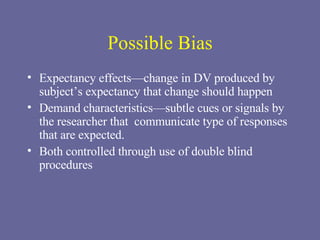
Possible Bias Expectancy effects—change in DV produced by subject’s expectancy that change should happen Demand characteristics—subtle cues or signals by the researcher that  communicate type of responses that are expected. Both controlled through use of double blind procedures
Natural Experiments Often used to measure impact of naturally occurring events Used when actual experiments are impossible or unethical to create Example:  Effects of chronic noise on stress in children
Limitations Often criticized for having little to do with actual behavior because of strict laboratory conditions Ethical considerations in creating some more “real life” situations
Ethical Guidelines Informed consent and voluntary participation Students as participants Use of deception Confidentiality of records Information about the study and debriefing
Evaluating Media Reports Be skeptical of sensationalist claims Goal of “shock” media is ratings Look for original sources Separate opinion from data Consider methodology and operational definitions Correlation is not causality Skepticism is the rule is science.

Chapter 1 Ppp

  • 1.
    Chapter 1 Introduction and Research Methods
  • 2.
    What is Psychology?The science of behavior and mental processes Behavior—observable actions of a person or animal Mind—thoughts, feelings, sensations, perceptions, memories, dreams, motives and other subjective experiences Science—an objective way to answer questions based on observable facts/data and well-described methods
  • 3.
    Philosophical Developments A Question: How are mind and body related? René Descartes (1596–1650)—Interactive dualism The mind and body interact to produce conscious experience BIG
  • 4.
    Philosophical Developments Another Question: Nature vs. Nurture Are abilities determined by our genes or our experiences? What are the interactions between genetics and environment? What effect does it have on behavior? BIG
  • 5.
    Foundations of Modern Psychology Separated from philosophy in 19th century influences from physiology remain Wilhelm Wundt (1832–1920) Leipzig, Germany wrote the first psychology textbook applied laboratory techniques to study of the mind structuralism—identify “atoms” of the mind focused on basic sensory and perceptual processes measured reaction times
  • 6.
  • 7.
    Other Pioneers EdwardTitchener (1867–1927) Wundt’s student, professor at Cornell University William James (1842–1910) started psychology at Harvard in 1870s opposed Wundt and Titchener’s approach functionalism – influenced by Darwin Mary Whiton Calkins (1863-1930) Student of James First woman president of APA G. Stanley Hall Received first PhD in psychology in US First president of APA
  • 8.
    E. B. Titchener(1867–1927)
  • 9.
  • 10.
    Other Pioneers SigmundFreud (1856–1939) Austrian physician that focused on illness psychoanalytic theory of mental disorders John B. Watson (1878–1958) psychologists should study overt behavior B. F. Skinner (1904–1990) American psychologist at Harvard studied learning and effect of reinforcement behaviorism
  • 11.
    John B. Watson(1878–1958)
  • 12.
    B. F. Skinner(1904–1990)
  • 13.
    Humanistic Psychology CarlRogers focus on self-determination and free will more positive view of basic forces than Freud’s Abraham Maslow behavior reflects innate “actualization” theory of motivation emphasizing psychological growth
  • 14.
    Carl Rogers (1902–1987)Abraham Maslow (1908–1970)
  • 15.
    Perspectives Perspectiveis a way of viewing phenomena Psychology has multiple perspectives Biological Psychodynamic Behavioral Humanistic Cognitive Cross Cultural Evolutionary
  • 16.
    Biological Perspective Studythe physiological mechanisms in the brain and nervous system that organize and control behavior Focus may be at various levels individual neurons areas of the brain specific functions like eating, emotion, or learning Interest in behavior distinguishes biological psychology from many other biological sciences
  • 17.
    Psychodynamic Perspective Viewof behavior based on experience treating patients Psychoanalytic approach (Sigmund Freud) both a method of treatment and a theory of the mind behavior reflects combinations of conscious and unconscious influences drives and urges within the unconscious component of mind influence thought and behavior early childhood experiences shape unconscious motivations
  • 18.
    Behavioral PerspectiveView of behavior based on experience or learning Classical conditioning Operant conditioning
  • 19.
    Humanistic Perspective Focuson motivation of people to grow psychologically Influence of interpersonal relationships on self concept Importance of choice and self-direction to reach potential
  • 20.
    Cognitive Perspective Howis knowledge acquired, organized, remembered, and used to guide behavior? Influences include Piaget – studied intellectual development Chomsky – studied language Cybernetics – science of information processing
  • 21.
    Cross-Cultural Perspective Thestudy of psychological differences among people living in different cultural groups How are people’s thoughts, feelings, and behavior influenced by their culture? What are the common elements across culture? Are these innate?
  • 22.
    Evolutionary Perspective Influencedby Darwin and the emphasis on innate, adaptive behavior patterns Application of principles of evolution to explain behavior and psychological processes
  • 23.
    The Profession ofPsychology American Psychological Association had 52 divisions in 1998 Some represent areas of training and specialization (e.g., developmental, clinical) Some are applied (i.e., teaching in psychology, psychology and the law)
  • 24.
  • 25.
  • 26.
    Psychology should studyhow behavior and mental processes allow organisms to adapt to their environments School/Approach Evolutionary perspective Founder Charles Darwin
  • 27.
    Psychology should emphasizepeople’s unique potential for psychological growth School/Approach Humanistic Founder Maslow
  • 28.
    Psychology should onlystudy observable behavior School/Approach Behaviorism Founder Watson/Skinner
  • 29.
    Goals of PsychologyDescribe Explain Predict Control behavior and mental processes
  • 30.
    Scientific Skepticism Sciencehelps build explanations that are consistent and predictive rather than conflicting and postdictive (hindsight) Science is based on knowledge of facts developing theories testing hypotheses public and repeatable procedures
  • 31.
    Scientific Method Formulatetestable questions Develop hypotheses Design study to collect data Experimental Descriptive Analyze data to arrive at conclusions Use of statistical procedures Use of meta-analysis Report results Publication Replication
  • 32.
    What a journalreference really means
  • 33.
    Theory Tentative explanationfor observed findings Results from accumulation of findings of individual studies Tool for explaining observed behavior Reflects self-correcting nature of scientific method.
  • 34.
    Research Strategies Descriptive—strategiesfor observing and describing behavior Naturalistic observation Case studies Surveys Correlational methods Experimental—strategies for inferring cause and effect relationships among variables
  • 35.
    Descriptive Study Describesa set of facts Does not look for relationships between facts Does not predict what may influence the facts May or may not include numerical data Example: measure the percentage of new students from out-of-state each year since 1980
  • 36.
    Naturalistic Observation Researchersdirectly observe and record behavior rather than relying on subject descriptions. In naturalistic observation researcher records behavior as it occurs naturally.
  • 37.
    Case Study MethodHighly detailed description of a single individual Generally used to investigate rare, unusual, or extreme conditions
  • 38.
    Survey Methods Designedto investigate opinions, behaviors, or characteristics of a particular group. Usually in self-report form.
  • 39.
    Samples and SamplingPopulation—large (potentially infinite) group represented by the sample. Findings are generalized to this group. Sample—selected segment of the population Representative sample—closely parallels the population on relevant characteristics Random selection—every member of larger group has equal change of being selected for the study sample
  • 40.
    Correlational Study Collectsa set of facts organized into two or more categories measure time spent playing video games measure other personality characteristics Examines the relationship between categories Correlation reveals relationships among facts
  • 41.
    Coefficient of CorrelationNumerical indication of magnitude and direction of the relationship between two variables Positive correlation—two variables vary systematically in the SAME direction Negative correlation—two variables vary systematically in OPPOSITE directions
  • 42.
    Correlational Study Correlationcannot prove causation Does playing video games cause a decline in academic achievement? Does playing video games cause more aggressive behavior? May be an unmeasured common factor e.g., maybe more aggressive people are attracted to video games.
  • 43.
    Experiments Direct wayto test a hypothesis about a cause-effect relationship between factors Factors are called variables One variable is controlled by the experimenter e.g., type of video game--violent vs. non-violent The other is observed and measured e.g., aggressive behavior
  • 44.
    Definitions Hypothesis—tentative statementabout the relationship between variables Variables—factors that can vary in ways that can be observed, measured, and verified Operational definition—precise description of how the variables will be measured
  • 45.
    Experimental Variables Independentvariable (IV) the controlled factor in an experiment hypothesized to cause an effect on another variable Dependent variable (DV) the measured facts hypothesized to be affected
  • 46.
    Independent Variable Musthave at least two levels categories – male vs. female numeric – ages 10, 12, 14 Simplest is experimental vs. control group experimental gets treatment control does not
  • 47.
    Experimental Design Randomsample—every member of the population being studied should have an equal chance of being selected for the study Random assignment—every subject in the study should have an equal chance of being placed in either the experimental or control group Randomization helps avoid false results
  • 48.
    Variations in DesignPlacebo control group—exposed to a fake IV (placebo), the effects of which are compared to group receiving the actual IV. Double-blind study—technique in which neither experimenter nor participant is aware of the group to which participant is assigned
  • 49.
    Possible Bias Expectancyeffects—change in DV produced by subject’s expectancy that change should happen Demand characteristics—subtle cues or signals by the researcher that communicate type of responses that are expected. Both controlled through use of double blind procedures
  • 50.
    Natural Experiments Oftenused to measure impact of naturally occurring events Used when actual experiments are impossible or unethical to create Example: Effects of chronic noise on stress in children
  • 51.
    Limitations Often criticizedfor having little to do with actual behavior because of strict laboratory conditions Ethical considerations in creating some more “real life” situations
  • 52.
    Ethical Guidelines Informedconsent and voluntary participation Students as participants Use of deception Confidentiality of records Information about the study and debriefing
  • 53.
    Evaluating Media ReportsBe skeptical of sensationalist claims Goal of “shock” media is ratings Look for original sources Separate opinion from data Consider methodology and operational definitions Correlation is not causality Skepticism is the rule is science.