Stress, Health, and Coping
Stress A negative emotional state in response  to events that we perceive as taxing our resources or our ability to cope Stressors—events that are perceived as harmful, threatening, or challenging
Biopsychosocial Model of Health Biopsychosocial model—the belief that physical health and illness are determined by the complex interaction of biological, psychological, and social factors Health psychology—the study of how psychological factors influence health, illness, and health-related behaviors
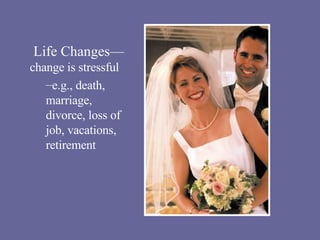
Life Changes— change is stressful e.g., death, marriage, divorce, loss of job, vacations, retirement
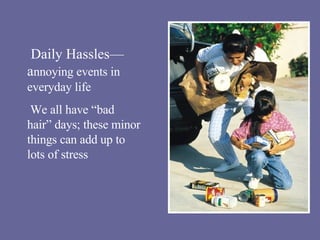
Daily Hassles—a nnoying events in everyday life We all have “bad hair” days; these minor things can add up to lots of stress
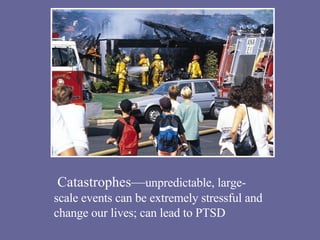
Catastrophes— unpredictable, large-scale events can be extremely stressful and change our lives; can lead to PTSD
Conflict Pull between two opposing desires or goals Approach-approach conflict choice between 2 appealing outcomes easy to resolve, low stress Avoidance-avoidance conflict choice between 2 unappealing outcomes more stressful than approach-approach Approach-avoidance conflict one goal with appealing & unappealing aspects most stressful type of conflict often see vacillation
Social and Cultural  Sources of Stress Social conditions that promote stress poverty, racism, crime low SES tend to have highest levels of stress Culture clashes lead to stress company owned by different culture refugees, immigrants suffer acculturative stress
Health Effects of Stress Indirect effects—promote behaviors that jeopardize physical well being.  Use of drugs, lack of sleep, poor concentration Direct effects—promote changes in body functions, leading to illness such as headaches and other physical symptoms
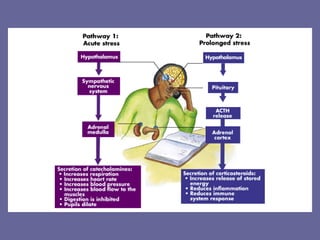
Endocrine Responses to Stress •  Fight or flight preparation of body •  Stress hormones—produced by adrenal glands Adrenal medulla—catecholamines Epinephrine and norepinephrine Increases respiration, BP, heart rate Adrenal cortex—corticosteroids Release stored energy Reduce inflammation and immune system responses
 
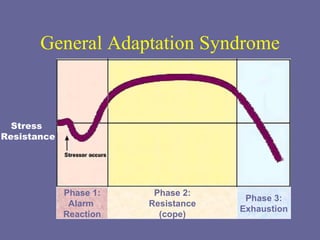
General Adaptation Syndrome Hans Selye Three stage process Alarm—intense arousal, mobilization of physical resources (catecholamines) Resistive—body actively resists stressors (corticosteroids) Exhaustion—more intense arousal but this leads to physical exhaustion and physical disorders
General Adaptation Syndrome Phase 1: Alarm  Reaction Phase 2: Resistance (cope) Phase 3: Exhaustion Stress  Resistance
Stress and the Immune System Psychoneuroimmunology—studies interaction between nervous system, endocrine system, and immune system Stress leads to suppressed immune function Chronic stress tends to have more influence Stress-weakened immune system increases likelihood of illness
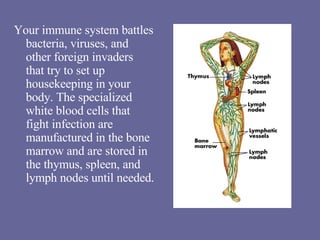
Your immune system battles bacteria, viruses, and other foreign invaders that try to set up housekeeping in your body. The specialized white blood cells that fight infection are manufactured in the bone marrow and are stored in the thymus, spleen, and lymph nodes until needed.
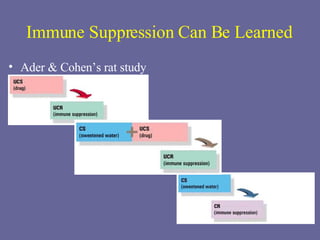
Immune Suppression Can Be Learned Ader & Cohen’s rat study
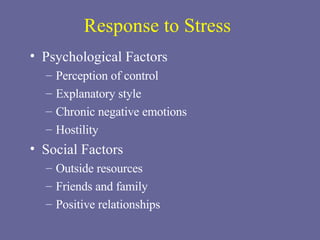
Response to Stress Psychological Factors Perception of control Explanatory style Chronic negative emotions Hostility Social Factors Outside resources Friends and family Positive relationships
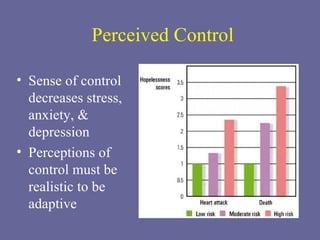
Perceived Control Sense of control decreases stress, anxiety, & depression Perceptions of control must be realistic to be adaptive
Explanatory Style Optimism  use external, unstable, & specific explanations for negative events predicts better health outcomes Pessimism use internal, stable, & global explanations for negative events predicts worse health outcomes
Stress, Personality,  and Heart Disease Coronary heart disease is North America’s leading cause of death  Habitually grouchy people tend to have poorer health outcomes Chronic negative emotions have negative effect on immune system
Type A vs. Type B Personality Type A time urgency intense ambition and competitiveness  general hostility associated with heart disease Type B more easygoing not associated with heart disease
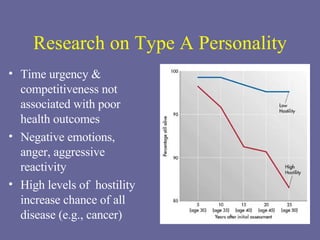
Research on Type A Personality Time urgency & competitiveness not associated with poor health outcomes Negative emotions, anger, aggressive reactivity  High levels of  hostility increase chance of all disease (e.g., cancer)
Social Factors Promoting Health Social support—resources provided by others in times of need Emotional—expressions of concern, empathy, positive regard Tangible—direct assistance such as lending money, providing meals Informational—such as making good suggestions, advice, good referrals
Social Support Improves ability to cope with stress & benefits health person modifies appraisal of stressor’s significance to be less threatening helps to decrease intensity of physical reactions to stress make person less likely to experience negative emotions Pets as social support especially for elderly and people who live alone Gender and social support
Coping Behavioral and cognitive responses used to deal with stressors; involve efforts to change circumstances, or our interpretation of them to make them more favorable and less threatening.
Coping Problem-focused coping managing or changing the stressor use if problem seems alterable confrontive coping planful problem solving Emotion-focused coping try to feel better about situation use if problem out of our control
Emotion-focused  Coping Strategies Escape-avoidance—try  to escape stressor Distancing—minimize  impact of stressor Denial—refuse  to acknowledge problem exists
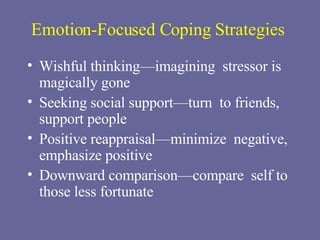
Emotion-Focused Coping Strategies Wishful thinking—imagining  stressor is magically gone Seeking social support—turn  to friends, support people Positive reappraisal—minimize  negative, emphasize positive Downward comparison—compare  self to those less fortunate
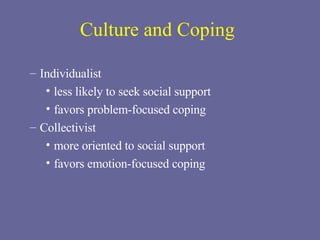
Culture and Coping Individualist less likely to seek social support favors problem-focused coping Collectivist more oriented to social support favors emotion-focused coping

Chapter 12 Ppp

  • 1.
  • 2.
    Stress A negativeemotional state in response to events that we perceive as taxing our resources or our ability to cope Stressors—events that are perceived as harmful, threatening, or challenging
  • 3.
    Biopsychosocial Model ofHealth Biopsychosocial model—the belief that physical health and illness are determined by the complex interaction of biological, psychological, and social factors Health psychology—the study of how psychological factors influence health, illness, and health-related behaviors
  • 4.
    Life Changes— changeis stressful e.g., death, marriage, divorce, loss of job, vacations, retirement
  • 5.
    Daily Hassles—a nnoyingevents in everyday life We all have “bad hair” days; these minor things can add up to lots of stress
  • 6.
    Catastrophes— unpredictable, large-scaleevents can be extremely stressful and change our lives; can lead to PTSD
  • 7.
    Conflict Pull betweentwo opposing desires or goals Approach-approach conflict choice between 2 appealing outcomes easy to resolve, low stress Avoidance-avoidance conflict choice between 2 unappealing outcomes more stressful than approach-approach Approach-avoidance conflict one goal with appealing & unappealing aspects most stressful type of conflict often see vacillation
  • 8.
    Social and Cultural Sources of Stress Social conditions that promote stress poverty, racism, crime low SES tend to have highest levels of stress Culture clashes lead to stress company owned by different culture refugees, immigrants suffer acculturative stress
  • 9.
    Health Effects ofStress Indirect effects—promote behaviors that jeopardize physical well being. Use of drugs, lack of sleep, poor concentration Direct effects—promote changes in body functions, leading to illness such as headaches and other physical symptoms
  • 10.
    Endocrine Responses toStress • Fight or flight preparation of body • Stress hormones—produced by adrenal glands Adrenal medulla—catecholamines Epinephrine and norepinephrine Increases respiration, BP, heart rate Adrenal cortex—corticosteroids Release stored energy Reduce inflammation and immune system responses
  • 11.
  • 12.
    General Adaptation SyndromeHans Selye Three stage process Alarm—intense arousal, mobilization of physical resources (catecholamines) Resistive—body actively resists stressors (corticosteroids) Exhaustion—more intense arousal but this leads to physical exhaustion and physical disorders
  • 13.
    General Adaptation SyndromePhase 1: Alarm Reaction Phase 2: Resistance (cope) Phase 3: Exhaustion Stress Resistance
  • 14.
    Stress and theImmune System Psychoneuroimmunology—studies interaction between nervous system, endocrine system, and immune system Stress leads to suppressed immune function Chronic stress tends to have more influence Stress-weakened immune system increases likelihood of illness
  • 15.
    Your immune systembattles bacteria, viruses, and other foreign invaders that try to set up housekeeping in your body. The specialized white blood cells that fight infection are manufactured in the bone marrow and are stored in the thymus, spleen, and lymph nodes until needed.
  • 16.
    Immune Suppression CanBe Learned Ader & Cohen’s rat study
  • 17.
    Response to StressPsychological Factors Perception of control Explanatory style Chronic negative emotions Hostility Social Factors Outside resources Friends and family Positive relationships
  • 18.
    Perceived Control Senseof control decreases stress, anxiety, & depression Perceptions of control must be realistic to be adaptive
  • 19.
    Explanatory Style Optimism use external, unstable, & specific explanations for negative events predicts better health outcomes Pessimism use internal, stable, & global explanations for negative events predicts worse health outcomes
  • 20.
    Stress, Personality, and Heart Disease Coronary heart disease is North America’s leading cause of death Habitually grouchy people tend to have poorer health outcomes Chronic negative emotions have negative effect on immune system
  • 21.
    Type A vs.Type B Personality Type A time urgency intense ambition and competitiveness general hostility associated with heart disease Type B more easygoing not associated with heart disease
  • 22.
    Research on TypeA Personality Time urgency & competitiveness not associated with poor health outcomes Negative emotions, anger, aggressive reactivity High levels of hostility increase chance of all disease (e.g., cancer)
  • 23.
    Social Factors PromotingHealth Social support—resources provided by others in times of need Emotional—expressions of concern, empathy, positive regard Tangible—direct assistance such as lending money, providing meals Informational—such as making good suggestions, advice, good referrals
  • 24.
    Social Support Improvesability to cope with stress & benefits health person modifies appraisal of stressor’s significance to be less threatening helps to decrease intensity of physical reactions to stress make person less likely to experience negative emotions Pets as social support especially for elderly and people who live alone Gender and social support
  • 25.
    Coping Behavioral andcognitive responses used to deal with stressors; involve efforts to change circumstances, or our interpretation of them to make them more favorable and less threatening.
  • 26.
    Coping Problem-focused copingmanaging or changing the stressor use if problem seems alterable confrontive coping planful problem solving Emotion-focused coping try to feel better about situation use if problem out of our control
  • 27.
    Emotion-focused CopingStrategies Escape-avoidance—try to escape stressor Distancing—minimize impact of stressor Denial—refuse to acknowledge problem exists
  • 28.
    Emotion-Focused Coping StrategiesWishful thinking—imagining stressor is magically gone Seeking social support—turn to friends, support people Positive reappraisal—minimize negative, emphasize positive Downward comparison—compare self to those less fortunate
  • 29.
    Culture and CopingIndividualist less likely to seek social support favors problem-focused coping Collectivist more oriented to social support favors emotion-focused coping