Classification of
elements and periodicity
in properties
Chapter
3
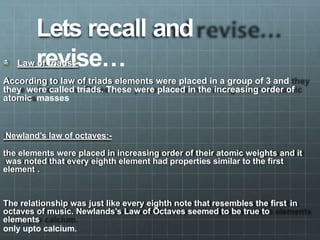
Lets recall and
revise…
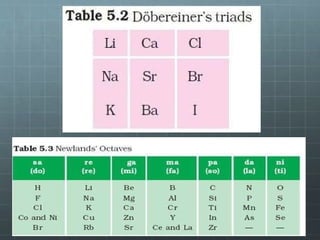
Law of triads:-
According to law of triads elements were placed in a group of 3 and
they were called triads. These were placed in the increasing order of
atomic masses
Newland’s law of octaves:-
the elements were placed in increasing order of their atomic weights and it
was noted that every eighth element had properties similar to the first
element .
The relationship was just like every eighth note that resembles the first in
octaves of music. Newlands’s Law of Octaves seemed to be true to
elements
only upto calcium.
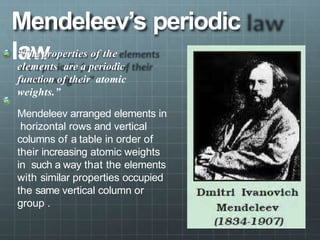
Mendeleev’s periodic
law
“The properties of the
elements are a periodic
function of their atomic
weights.”
Mendeleev arranged elements in
horizontal rows and vertical
columns of a table in order of
their increasing atomic weights
in such a way that the elements
with similar properties occupied
the same vertical column or
group .
Mendeleev left gaps under
silicon and aluminium and those
were known as eka aluminium
and eka silicon.
Later it wasdiscovered that eka
aluminium had properties similar
to gallium and eka silicon had
properties similar to germanium.
According to modern periodic law,
“The physical and chemical
properties of the elements are periodic
functions of their atomic numbers”.
Modern form of periodic table was
discovered by henry Mosley and hence
it was also called henry Mosley's
periodic table.
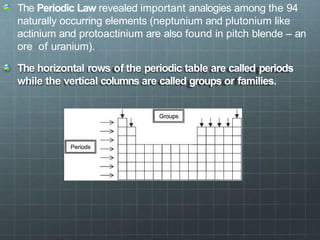
The Periodic Law revealed important analogies among the 94
naturally occurring elements (neptunium and plutonium like
actinium and protoactinium are also found in pitch blende – an
ore of uranium).
The horizontal rows of the periodic table are called periods
while the vertical columns are called groups or families.
DIVISION OF PERIODIC
TABLE
The periodic table is divided into 4 blocks mainly the s-block p-block
d- block and f-block.
S-block:-
The elements of Group 1 (alkali metals) and Group 2 (alkaline earth
metals) which have ns1 and ns2 outermost electronic configuration
belong to the s- Block Elements.
They are all reactive metals with low ionization enthalpies. They lose the
outermost electron(s) readily to form 1+ ion in the case of alkali metals or
2+ ion in the case of alkaline earth metals.
The metallic character and the reactivity increase as we go down the
group. Because of high reactivity they are never found pure in nature.
The compounds of the s-block elements, with the exception of those of
lithium and beryllium are predominantly ionic.
P-block:
The p-Block Elements comprise those belonging to Group 13 to 18 and
these together with the s-Block Elements are called the Representative
Elements or Main Group Elements.
The outermost electronic configuration varies from ns2np1 to ns2np6 in
each period. At the end of each period is a noble gas element with a
closed valence shell ns2np6 configuration.
All the orbitals in the valence shell of the noble gases are completely
filled by electrons and it is very difficult to alter this stable
arrangement by the addition or removal of electrons.
The noble gases thus exhibit very low chemical reactivity. Preceding the
noble gas family are two chemically important groups of non-metals.
They are the halogens (Group 17) and the chalcogens (Group 16).
These two groups of elements have highly negative electron gain
enthalpies and readily add one or two electrons respectively to attain the
stable noble gas configuration.
The non-metallic character increases as we move from left to right
across a period and metallic character increases as we go down the
D-block:
Elements in which the d-orbitals are completely filled are called
the d-block elements.
General electronic configuration is (n-1)d1-10ns1-2 .
Properties:-
-Shows catalytic properties
-forms coloured ions
-shows paramagnetic properties
-forms complexes
They are often referred to as transition metals as they are placed
between metals and non metals and also due to their
charecteristic feature.
F-block:
Elements in which the f-orbital is completely filled are called the
f- block elements.
General electronic configuration is ns2(n-1)d0-1(n-2)f1-10.
Inner transition metals are known as f-block
elements.
They have incomplete d-orbital electronic confg in their normal
state and in their oxidation state.
They are generally radioactive.
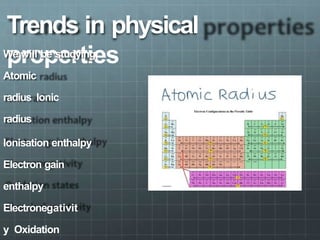
Trends in physical
properties
We will be studying,
Atomic
radius Ionic
radius
Ionisation enthalpy
Electron gain
enthalpy
Electronegativit
y Oxidation
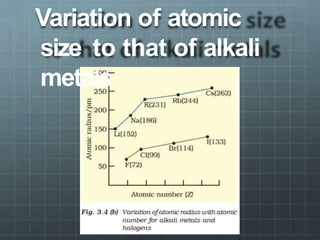
Atomic
radius
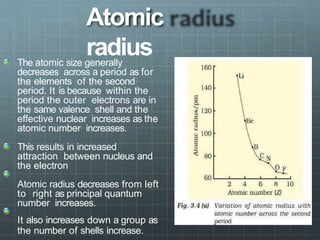
The atomic size generally
decreases across a period as for
the elements of the second
period. It is because within the
period the outer electrons are in
the same valence shell and the
effective nuclear increases as the
atomic number increases.
This results in increased
attraction between nucleus and
the electron
Atomic radius decreases from left
to right as principal quantum
number increases.
It also increases down a group as
the number of shells increase.
Variation of atomic
size to that of alkali
metals
Ionic
radius
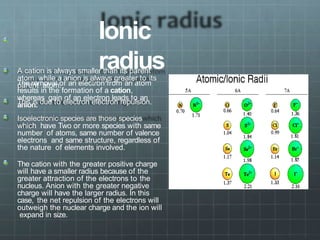
The removal of an electron from an atom
results in the formation of a cation,
whereas gain of an electron leads to an
anion.
A cation is always smaller than its parent
atom while a anion is always greater to its
parent atom.
This is due to electron electron repulsion.
Isoelectronic species are those species
which have Two or more species with same
number of atoms, same number of valence
electrons and same structure, regardless of
the nature of elements involved.
The cation with the greater positive charge
will have a smaller radius because of the
greater attraction of the electrons to the
nucleus. Anion with the greater negative
charge will have the larger radius. In this
case, the net repulsion of the electrons will
outweigh the nuclear charge and the ion will
expand in size.
Ionisation
enthalpy
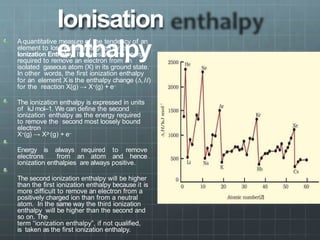
A quantitative measure of the tendency of an
element to lose electron is given by its
Ionization Enthalpy. It represents the energy
required to remove an electron from an
isolated gaseous atom (X) in its ground state.
In other words, the first ionization enthalpy
for an element X is the enthalpy change (∆i H)
for the reaction X(g) → X+(g) + e–
The ionization enthalpy is expressed in units
of kJ mol–1. We can define the second
ionization enthalpy as the energy required
to remove the second most loosely bound
electron
X+(g) → X2
+(g) + e–
Energy is always required to remove
electrons from an atom and hence
ionization enthalpies are always positive.
The second ionization enthalpy will be higher
than the first ionization enthalpy because it is
more difficult to remove an electron from a
positively charged ion than from a neutral
atom. In the same way the third ionization
enthalpy will be higher than the second and
so on. The
term “ionization enthalpy”, if not qualified,
is taken as the first ionization enthalpy.
Energy is always required to
remove electrons from an atom
and hence ionization enthalpies
are always positive.
The second ionization enthalpy will
be higher than the first ionization
enthalpy because it is more difficult
to remove an electron from a
positively charged ion than from a
neutral atom.
In the same way the third
ionization enthalpy will be higher
than the second and so on. The
term
“ionization enthalpy”, if not
qualified, is taken as the first
ionization enthalpy.
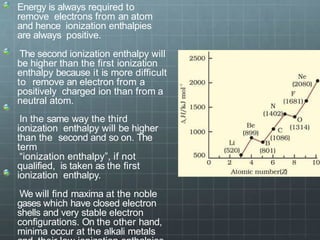
We will find maxima at the noble
gases which have closed electron
shells and very stable electron
configurations. On the other hand,
minima occur at the alkali metals
Shielding
effect
In multi electron atoms , the electrons are present
in the outer most shell and they do not
experience a full positive charge hence they are
shielded or screened away from the nucleus.
For Eg:- in the same subshell the p-electrons will get
shielded away by the s-electron as p-electron is
away from the influence of nucleus and hence it s
does not experience a complete positive charge !
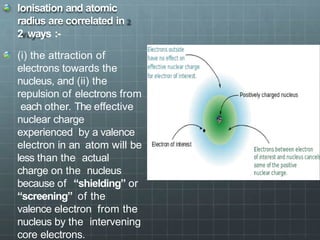
Ionisation and atomic
radius are correlated in
2 ways :-
(i) the attraction of
electrons towards the
nucleus, and (ii) the
repulsion of electrons from
each other. The effective
nuclear charge
experienced by a valence
electron in an atom will be
less than the actual
charge on the nucleus
because of “shielding” or
“screening” of the
valence electron from the
nucleus by the intervening
core electrons.
Anomalie
s
2s electron of lithium is shielded away.
The 2s electron in lithium is shielded from the nucleus by the
inner core of 1s electrons. As a result, the valence electron
experiences a net positive charge which is less than the actual
charge of +3. In general, shielding is effective when the orbitals
in the inner shells are completely filled. This situation occurs in
the case of alkali metals which have single outermost ns-electron
preceded by a noble gas electronic configuration.
When we move from lithium to fluorine across the second
period, successive electrons are added to orbitals in the same
principal quantum level and the shielding of the nuclear charge
by the inner core of electrons does not increase very much to
compensate for the increased attraction of the electron to the
nucleus.
Thus, across a period, increasing nuclear charge outweighs the
shielding. Consequently, the outermost electrons are held
more and more tightly and the ionization enthalpy increases
across a period.
As we go down a group, the outermost electron being
increasingly farther from the nucleus, there is an increased
shielding of the nuclear charge by the electrons in the inner
levels.
In this case, increase in shielding outweighs the increasing
nuclear charge and the removal of the outermost electron
It is easier to remove 2p electron of boron than 2s electron
of beryllium.
The first ionisation enthalpy of boron is slightly less than
beryllium though the former has a greater nuclear charge. When
we consider the same principal quantum level, an s-electron is
attracted to the nucleus more than a p-electron.
In beryllium, the electron removed during the ionization is an s-
electron whereas the electron removed during ionization of boron
is a p-electron.
The penetration of a 2s-electron to the nucleus is more than that
of a 2p-electron; hence the 2p electron of boron is more shielded
from the nucleus by the inner core of electrons than the 2s
electrons of beryllium.
Therefore, it is easier to remove the 2p-electron from boron
compared to the removal of a 2s- electron from beryllium.
Thus, boron has a smaller first ionization enthalpy than
beryllium
First ionisation enthalpy of oxygen isless than nitrogen.
The smaller first ionization enthalpy of oxygen compared to
nitrogen. This arises because in the nitrogen atom, three 2p-
electrons reside in different atomic orbitals (Hund’s rule)
whereas in the oxygen atom, two of the four 2p- electrons must
occupy the same 2p-orbital resulting in an increased electron-
electron repulsion. Consequently, it is easier to remove the
fourth 2p- electron from oxygen than it is, to remove one of the
three 2 p- electrons from nitrogen.
Give
reasons
Why are lanthanides and actinides placed separately at the bottom of the periodic table ?
(a) For convenience and systematic study of elements having similar properties.
(b) To maintain the structure of periodic table of classification by keeping elements with
similar properties in a similar way.
Elements like Zn , Pd, Cd are not considered transition elements ?
(a) As they have incompletely filled d-orbitals
Chemistry of Actinoids is complicated why ?
As they show large no of oxidation states
Electron gain
enthalpy
when an electron is added to a neutral gaseous atom (X) to convert it into a
negative ion, the enthalpy change accompanying the process is defined as
the Electron Gain Enthalpy (∆egH).
Electron gain enthalpy provides a measure of the ease with which an atom
adds an
electron to form anion
X(g)+e– → X–(g)
Depending on the element, the process of adding an electron to the atom can
be either endothermic or exothermic
Added to the atom and the electron gain enthalpy is negative. For example,
group 17elements (the halogens) have very high negative electron gain
enthalpies because they can attain stable noble gas electronic configurations by
picking up an electron
On the other hand, noble gases have large positive electron gain enthalpies
because the electron has to enter the next higher principal quantum level
leading to a very unstable electronic configuration. It may be noted that
electron gain enthalpies have large negative values toward the upper right of
the periodic table preceding the noble gases.
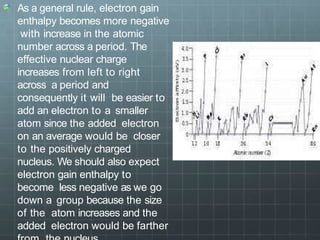
As a general rule, electron gain
enthalpy becomes more negative
with increase in the atomic
number across a period. The
effective nuclear charge
increases from left to right
across a period and
consequently it will be easier to
add an electron to a smaller
atom since the added electron
on an average would be closer
to the positively charged
nucleus. We should also expect
electron gain enthalpy to
become less negative as we go
down a group because the size
of the atom increases and the
added electron would be farther
electronegativit
y
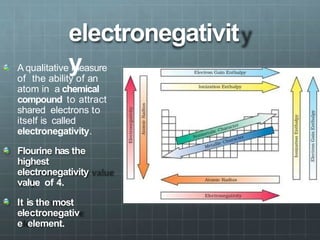
A qualitative measure
of the ability of an
atom in a chemical
compound to attract
shared electrons to
itself is called
electronegativity.
Flourine has the
highest
electronegativity
value of 4.
It is the most
electronegativ
e element.
Non-metallic elements have strong tendency to gain electrons.
Therefore, electronegativity is directly related to that non-
metallic properties of elements.
It can be further extended to say that the electronegativity is
inversely related to the metallic properties of elements. Thus,
the increase in electronegativities across a period is
accompanied by an increase in non-metallic properties (or
decrease in metallic properties) of elements.
Similarly, the decrease in electronegativity down a group is
accompanied by a decrease in non-metallic properties (or
increase in metallic properties) of elements.
Oxidation
state
The valence equals to the number of electrons present in
the outermost shell.
The term oxidation state interchangeably means valence.
Fluorine has the oxidation state of -1but in compounds like OF2
it exhibits +2 oxidation state.
Oxidation state determines the oxidation number of the
element.
Chemical
reactivity
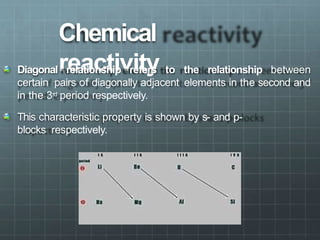
Diagonal relationship refers to the relationship between
certain pairs of diagonally adjacent elements in the second and
in the 3rd period respectively.
This characteristic property is shown by s- and p-
blocks respectively.
he anomalous behaviour is attributed to their small size, large
charge/ radius ratio and high electronegativity of the elements.
In addition, the first member of group has only four valence
orbitals (2s and 2p) available for bonding, whereas the second
member of the groups have nine valence orbitals (3s, 3p, 3d).
As a consequence of this, the maximum covalency of the first
member of each group is 4 (e.g., boron can only form [BF4 ]− ,
whereas the other members of the groups can expand their
valence shell to accommodate more than four pairs of
electrons e.g., aluminium forms [AlF6 ]3- .
Furthermore, the first member of p-block elements displays
greater ability to form pπ – pπ multiple bonds to itself (e.g.
C=C,C≡C, N=N, N ≡ Ν) and to other second period elements
(e.g., C
= O, C = N, C ≡ N, N = O) compared to subsequent members
Metallic character decreases from right to left whereas
non metallic character increases from left to right.
This is due to addition of electrons in various orbitals.
Elements which combine on the two extremes of the
periodic table form oxides like peroxides andsuper oxides.
Some are acidic basic and neutral or bette rknown as
amphoteric oxides
Metals from basic oxides , non metal form acidic oxides.
Among transition metals (3d series), the change in atomic radii is
much smaller as compared to those of representative elements
across the period. The change in atomic radii is still smaller
among inner-transition metals (4f series). The ionization
enthalpies are intermediate between those of s- and p-blocks.
As a consequence, they are less electropositive than group 1
and 2 metals.
The
end.

classification of elements chemistry ppt 11.pptx

  • 1.
    Classification of elements andperiodicity in properties Chapter 3
  • 2.
    Lets recall and revise… Lawof triads:- According to law of triads elements were placed in a group of 3 and they were called triads. These were placed in the increasing order of atomic masses Newland’s law of octaves:- the elements were placed in increasing order of their atomic weights and it was noted that every eighth element had properties similar to the first element . The relationship was just like every eighth note that resembles the first in octaves of music. Newlands’s Law of Octaves seemed to be true to elements only upto calcium.
  • 4.
    Mendeleev’s periodic law “The propertiesof the elements are a periodic function of their atomic weights.” Mendeleev arranged elements in horizontal rows and vertical columns of a table in order of their increasing atomic weights in such a way that the elements with similar properties occupied the same vertical column or group .
  • 5.
    Mendeleev left gapsunder silicon and aluminium and those were known as eka aluminium and eka silicon. Later it wasdiscovered that eka aluminium had properties similar to gallium and eka silicon had properties similar to germanium. According to modern periodic law, “The physical and chemical properties of the elements are periodic functions of their atomic numbers”. Modern form of periodic table was discovered by henry Mosley and hence it was also called henry Mosley's periodic table.
  • 6.
    The Periodic Lawrevealed important analogies among the 94 naturally occurring elements (neptunium and plutonium like actinium and protoactinium are also found in pitch blende – an ore of uranium). The horizontal rows of the periodic table are called periods while the vertical columns are called groups or families.
  • 7.
    DIVISION OF PERIODIC TABLE Theperiodic table is divided into 4 blocks mainly the s-block p-block d- block and f-block. S-block:- The elements of Group 1 (alkali metals) and Group 2 (alkaline earth metals) which have ns1 and ns2 outermost electronic configuration belong to the s- Block Elements. They are all reactive metals with low ionization enthalpies. They lose the outermost electron(s) readily to form 1+ ion in the case of alkali metals or 2+ ion in the case of alkaline earth metals. The metallic character and the reactivity increase as we go down the group. Because of high reactivity they are never found pure in nature. The compounds of the s-block elements, with the exception of those of lithium and beryllium are predominantly ionic.
  • 8.
    P-block: The p-Block Elementscomprise those belonging to Group 13 to 18 and these together with the s-Block Elements are called the Representative Elements or Main Group Elements. The outermost electronic configuration varies from ns2np1 to ns2np6 in each period. At the end of each period is a noble gas element with a closed valence shell ns2np6 configuration. All the orbitals in the valence shell of the noble gases are completely filled by electrons and it is very difficult to alter this stable arrangement by the addition or removal of electrons. The noble gases thus exhibit very low chemical reactivity. Preceding the noble gas family are two chemically important groups of non-metals. They are the halogens (Group 17) and the chalcogens (Group 16). These two groups of elements have highly negative electron gain enthalpies and readily add one or two electrons respectively to attain the stable noble gas configuration. The non-metallic character increases as we move from left to right across a period and metallic character increases as we go down the
  • 9.
    D-block: Elements in whichthe d-orbitals are completely filled are called the d-block elements. General electronic configuration is (n-1)d1-10ns1-2 . Properties:- -Shows catalytic properties -forms coloured ions -shows paramagnetic properties -forms complexes They are often referred to as transition metals as they are placed between metals and non metals and also due to their charecteristic feature.
  • 10.
    F-block: Elements in whichthe f-orbital is completely filled are called the f- block elements. General electronic configuration is ns2(n-1)d0-1(n-2)f1-10. Inner transition metals are known as f-block elements. They have incomplete d-orbital electronic confg in their normal state and in their oxidation state. They are generally radioactive.
  • 11.
    Trends in physical properties Wewill be studying, Atomic radius Ionic radius Ionisation enthalpy Electron gain enthalpy Electronegativit y Oxidation
  • 12.
    Atomic radius The atomic sizegenerally decreases across a period as for the elements of the second period. It is because within the period the outer electrons are in the same valence shell and the effective nuclear increases as the atomic number increases. This results in increased attraction between nucleus and the electron Atomic radius decreases from left to right as principal quantum number increases. It also increases down a group as the number of shells increase.
  • 13.
    Variation of atomic sizeto that of alkali metals
  • 14.
    Ionic radius The removal ofan electron from an atom results in the formation of a cation, whereas gain of an electron leads to an anion. A cation is always smaller than its parent atom while a anion is always greater to its parent atom. This is due to electron electron repulsion. Isoelectronic species are those species which have Two or more species with same number of atoms, same number of valence electrons and same structure, regardless of the nature of elements involved. The cation with the greater positive charge will have a smaller radius because of the greater attraction of the electrons to the nucleus. Anion with the greater negative charge will have the larger radius. In this case, the net repulsion of the electrons will outweigh the nuclear charge and the ion will expand in size.
  • 15.
    Ionisation enthalpy A quantitative measureof the tendency of an element to lose electron is given by its Ionization Enthalpy. It represents the energy required to remove an electron from an isolated gaseous atom (X) in its ground state. In other words, the first ionization enthalpy for an element X is the enthalpy change (∆i H) for the reaction X(g) → X+(g) + e– The ionization enthalpy is expressed in units of kJ mol–1. We can define the second ionization enthalpy as the energy required to remove the second most loosely bound electron X+(g) → X2 +(g) + e– Energy is always required to remove electrons from an atom and hence ionization enthalpies are always positive. The second ionization enthalpy will be higher than the first ionization enthalpy because it is more difficult to remove an electron from a positively charged ion than from a neutral atom. In the same way the third ionization enthalpy will be higher than the second and so on. The term “ionization enthalpy”, if not qualified, is taken as the first ionization enthalpy.
  • 16.
    Energy is alwaysrequired to remove electrons from an atom and hence ionization enthalpies are always positive. The second ionization enthalpy will be higher than the first ionization enthalpy because it is more difficult to remove an electron from a positively charged ion than from a neutral atom. In the same way the third ionization enthalpy will be higher than the second and so on. The term “ionization enthalpy”, if not qualified, is taken as the first ionization enthalpy. We will find maxima at the noble gases which have closed electron shells and very stable electron configurations. On the other hand, minima occur at the alkali metals
  • 17.
    Shielding effect In multi electronatoms , the electrons are present in the outer most shell and they do not experience a full positive charge hence they are shielded or screened away from the nucleus. For Eg:- in the same subshell the p-electrons will get shielded away by the s-electron as p-electron is away from the influence of nucleus and hence it s does not experience a complete positive charge !
  • 18.
    Ionisation and atomic radiusare correlated in 2 ways :- (i) the attraction of electrons towards the nucleus, and (ii) the repulsion of electrons from each other. The effective nuclear charge experienced by a valence electron in an atom will be less than the actual charge on the nucleus because of “shielding” or “screening” of the valence electron from the nucleus by the intervening core electrons.
  • 19.
    Anomalie s 2s electron oflithium is shielded away. The 2s electron in lithium is shielded from the nucleus by the inner core of 1s electrons. As a result, the valence electron experiences a net positive charge which is less than the actual charge of +3. In general, shielding is effective when the orbitals in the inner shells are completely filled. This situation occurs in the case of alkali metals which have single outermost ns-electron preceded by a noble gas electronic configuration.
  • 20.
    When we movefrom lithium to fluorine across the second period, successive electrons are added to orbitals in the same principal quantum level and the shielding of the nuclear charge by the inner core of electrons does not increase very much to compensate for the increased attraction of the electron to the nucleus. Thus, across a period, increasing nuclear charge outweighs the shielding. Consequently, the outermost electrons are held more and more tightly and the ionization enthalpy increases across a period. As we go down a group, the outermost electron being increasingly farther from the nucleus, there is an increased shielding of the nuclear charge by the electrons in the inner levels. In this case, increase in shielding outweighs the increasing nuclear charge and the removal of the outermost electron
  • 21.
    It is easierto remove 2p electron of boron than 2s electron of beryllium. The first ionisation enthalpy of boron is slightly less than beryllium though the former has a greater nuclear charge. When we consider the same principal quantum level, an s-electron is attracted to the nucleus more than a p-electron. In beryllium, the electron removed during the ionization is an s- electron whereas the electron removed during ionization of boron is a p-electron. The penetration of a 2s-electron to the nucleus is more than that of a 2p-electron; hence the 2p electron of boron is more shielded from the nucleus by the inner core of electrons than the 2s electrons of beryllium. Therefore, it is easier to remove the 2p-electron from boron compared to the removal of a 2s- electron from beryllium. Thus, boron has a smaller first ionization enthalpy than beryllium
  • 22.
    First ionisation enthalpyof oxygen isless than nitrogen. The smaller first ionization enthalpy of oxygen compared to nitrogen. This arises because in the nitrogen atom, three 2p- electrons reside in different atomic orbitals (Hund’s rule) whereas in the oxygen atom, two of the four 2p- electrons must occupy the same 2p-orbital resulting in an increased electron- electron repulsion. Consequently, it is easier to remove the fourth 2p- electron from oxygen than it is, to remove one of the three 2 p- electrons from nitrogen.
  • 23.
    Give reasons Why are lanthanidesand actinides placed separately at the bottom of the periodic table ? (a) For convenience and systematic study of elements having similar properties. (b) To maintain the structure of periodic table of classification by keeping elements with similar properties in a similar way. Elements like Zn , Pd, Cd are not considered transition elements ? (a) As they have incompletely filled d-orbitals Chemistry of Actinoids is complicated why ? As they show large no of oxidation states
  • 24.
    Electron gain enthalpy when anelectron is added to a neutral gaseous atom (X) to convert it into a negative ion, the enthalpy change accompanying the process is defined as the Electron Gain Enthalpy (∆egH). Electron gain enthalpy provides a measure of the ease with which an atom adds an electron to form anion X(g)+e– → X–(g) Depending on the element, the process of adding an electron to the atom can be either endothermic or exothermic Added to the atom and the electron gain enthalpy is negative. For example, group 17elements (the halogens) have very high negative electron gain enthalpies because they can attain stable noble gas electronic configurations by picking up an electron On the other hand, noble gases have large positive electron gain enthalpies because the electron has to enter the next higher principal quantum level leading to a very unstable electronic configuration. It may be noted that electron gain enthalpies have large negative values toward the upper right of the periodic table preceding the noble gases.
  • 25.
    As a generalrule, electron gain enthalpy becomes more negative with increase in the atomic number across a period. The effective nuclear charge increases from left to right across a period and consequently it will be easier to add an electron to a smaller atom since the added electron on an average would be closer to the positively charged nucleus. We should also expect electron gain enthalpy to become less negative as we go down a group because the size of the atom increases and the added electron would be farther
  • 26.
    electronegativit y A qualitative measure ofthe ability of an atom in a chemical compound to attract shared electrons to itself is called electronegativity. Flourine has the highest electronegativity value of 4. It is the most electronegativ e element.
  • 27.
    Non-metallic elements havestrong tendency to gain electrons. Therefore, electronegativity is directly related to that non- metallic properties of elements. It can be further extended to say that the electronegativity is inversely related to the metallic properties of elements. Thus, the increase in electronegativities across a period is accompanied by an increase in non-metallic properties (or decrease in metallic properties) of elements. Similarly, the decrease in electronegativity down a group is accompanied by a decrease in non-metallic properties (or increase in metallic properties) of elements.
  • 28.
    Oxidation state The valence equalsto the number of electrons present in the outermost shell. The term oxidation state interchangeably means valence. Fluorine has the oxidation state of -1but in compounds like OF2 it exhibits +2 oxidation state. Oxidation state determines the oxidation number of the element.
  • 29.
    Chemical reactivity Diagonal relationship refersto the relationship between certain pairs of diagonally adjacent elements in the second and in the 3rd period respectively. This characteristic property is shown by s- and p- blocks respectively.
  • 30.
    he anomalous behaviouris attributed to their small size, large charge/ radius ratio and high electronegativity of the elements. In addition, the first member of group has only four valence orbitals (2s and 2p) available for bonding, whereas the second member of the groups have nine valence orbitals (3s, 3p, 3d). As a consequence of this, the maximum covalency of the first member of each group is 4 (e.g., boron can only form [BF4 ]− , whereas the other members of the groups can expand their valence shell to accommodate more than four pairs of electrons e.g., aluminium forms [AlF6 ]3- . Furthermore, the first member of p-block elements displays greater ability to form pπ – pπ multiple bonds to itself (e.g. C=C,C≡C, N=N, N ≡ Ν) and to other second period elements (e.g., C = O, C = N, C ≡ N, N = O) compared to subsequent members
  • 31.
    Metallic character decreasesfrom right to left whereas non metallic character increases from left to right. This is due to addition of electrons in various orbitals. Elements which combine on the two extremes of the periodic table form oxides like peroxides andsuper oxides. Some are acidic basic and neutral or bette rknown as amphoteric oxides Metals from basic oxides , non metal form acidic oxides. Among transition metals (3d series), the change in atomic radii is much smaller as compared to those of representative elements across the period. The change in atomic radii is still smaller among inner-transition metals (4f series). The ionization enthalpies are intermediate between those of s- and p-blocks. As a consequence, they are less electropositive than group 1 and 2 metals.
  • 32.