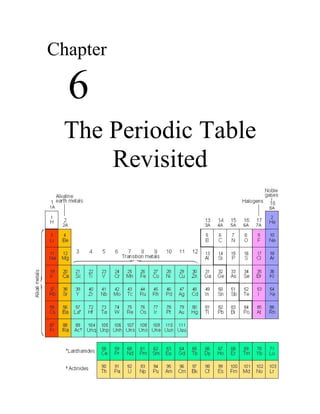
Chapter

  6
 The Periodic Table
     Revisited
Section 6.1 and 6.2
                  Organizing and Classifying the Elements

Objectives:
   • Explain how elements are organized in a periodic table.
   • Identify three broad classes of elements.
   • Describe the information in a periodic table.
   • Classify elements based on electron configuration.
   • Distinguish representative elements and transition metals.

Organizing the Elements

   •   A few elements, such as gold and copper, have been known for thousands of years
       - since ancient times
   •   Yet, only about 13 had been identified by the year 1700.
   •   As more were discovered, chemists realized they needed a way to organize the
       elements.


                                                                                    2
The Periodic Law says:

•   When elements are arranged in order of increasing atomic number, there is a periodic
    repetition of their physical and chemical properties.
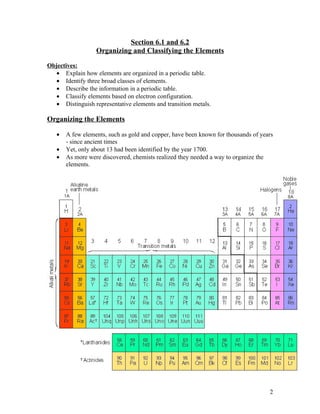
•   Horizontal rows = periods
        o There are 7 periods
•   Vertical column = group (or family)
        o Similar physical & chemical prop.

Squares in the Periodic Table

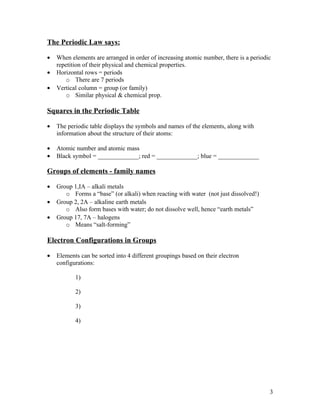
•   The periodic table displays the symbols and names of the elements, along with
    information about the structure of their atoms:

•   Atomic number and atomic mass
•   Black symbol = _____________; red = _____________; blue = _____________

Groups of elements - family names

•   Group 1,IA – alkali metals
       o Forms a “base” (or alkali) when reacting with water (not just dissolved!)
•   Group 2, 2A – alkaline earth metals
       o Also form bases with water; do not dissolve well, hence “earth metals”
•   Group 17, 7A – halogens
       o Means “salt-forming”

Electron Configurations in Groups

•   Elements can be sorted into 4 different groupings based on their electron
    configurations:

           1)

           2)

           3)

           4)


                                                                                       3
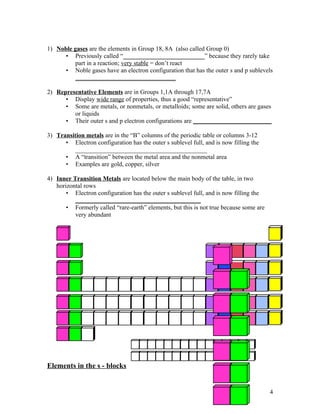
1) Noble gases are the elements in Group 18, 8A (also called Group 0)
     • Previously called “__________________________” because they rarely take
         part in a reaction; very stable = don’t react
     • Noble gases have an electron configuration that has the outer s and p sublevels
         ________________________________

2) Representative Elements are in Groups 1,1A through 17,7A
      • Display wide range of properties, thus a good “representative”
      • Some are metals, or nonmetals, or metalloids; some are solid, others are gases
         or liquids
      • Their outer s and p electron configurations are _________________________

3) Transition metals are in the “B” columns of the periodic table or columns 3-12
      • Electron configuration has the outer s sublevel full, and is now filling the
         __________________________________________
      • A “transition” between the metal area and the nonmetal area
      • Examples are gold, copper, silver

4) Inner Transition Metals are located below the main body of the table, in two
   horizontal rows
       • Electron configuration has the outer s sublevel full, and is now filling the
          ________________________________________
       • Formerly called “rare-earth” elements, but this is not true because some are
          very abundant


Elements in the s - blocks


                                                                                        4
•   Alkali metals all end in _________
•   Alkaline earth metals all end in _________
       o really should include He, but it fits
           better in a different spot, since He has
           the properties of the noble gases, and has
           a full outer level of electrons.


Transition Metals - d block


                                                        5
The P-block


F - block

•   Called the “inner transition elements”


    f1 f2 f3 f4 f5 f6 f7 f8 f9 f10 f11 f12 f13 f14


                                                     6
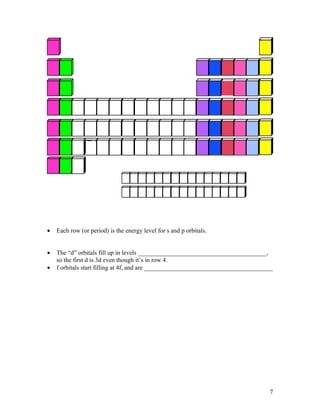
•   Each row (or period) is the energy level for s and p orbitals.


•   The “d” orbitals fill up in levels _________________________________________,
    so the first d is 3d even though it’s in row 4.
•   f orbitals start filling at 4f, and are _________________________________________


                                                                                   7
Section 6.3
                                  Periodic Trends
OBJECTIVES:
• Describe trends among the elements for atomic size.
• Explain how ions form.
• Describe periodic trends for first ionization energy, ionic size, and electronegativity.

Trends in Atomic Size

•   First problem: Where do you start measuring from?
•   The electron cloud doesn’t have a definite edge.
•   They get around this by measuring more than 1 atom at a time.

Atomic Size


                  Radius


•   Measure the Atomic Radius - this is half the distance between the two nuclei of a
    diatomic molecule.


                                                                                             8
ALL Periodic Table Trends

•   Influenced by three factors:
        1. _______________________________

           •
       2. _______________________________________________________

           •

       3. Shielding effect

What do they influence?

•   Energy levels and Shielding have an effect on the GROUP
•   Nuclear charge has an effect on a PERIOD

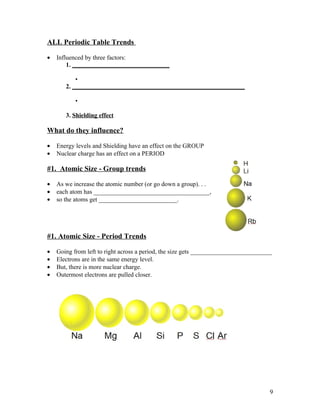
#1. Atomic Size - Group trends

•   As we increase the atomic number (or go down a group). . .
•   each atom has _____________________________________,
•   so the atoms get _________________________.


#1. Atomic Size - Period Trends

•   Going from left to right across a period, the size gets __________________________
•   Electrons are in the same energy level.
•   But, there is more nuclear charge.
•   Outermost electrons are pulled closer.


                                                                                     9
Ions

•   Some compounds are composed of particles called “ions”
•   An ion is an atom (or group of atoms) that has a ______________________________
•   Atoms are neutral because _______________________________________________
•   Positive and negative ions are formed when electrons are transferred (lost or gained)
    between atoms

•   Metals tend to ________________ electrons, from their outer energy level
       • Sodium loses one: there are now more protons (11) than electrons (10), and
           thus a positively charged particle is formed = ______________________
       • The charge is written as a number followed by a plus sign: ___________
       • Now named a _____________________________

•   Nonmetals tend to _________________ one or more electrons
       • Chlorine will gain one electron
       • Protons (17) no longer equals the electrons (18), so a charge of -1
       • Cl1- is re-named a ________________________________
       • Negative ions are called ______________________

#2. Trends in Ionization Energy

• Ionization energy is the _________________________________________________
_______________________________________________________________________
_
• Removing one electron makes a _______ ion.
• The energy required to remove only the first electron is called the ________________
   ____________________________________
• The second ionization energy is the energy required to remove the second electron.
• Always greater than first IE.
• The third IE is the energy required to remove a third electron.
• Greater than 1st or 2nd IE.

What factors determine IE?

•   The greater the nuclear charge, ____________________________________
•   Greater distance from nucleus _____________________________________
•   Filled and half-filled orbitals have lower energy, so achieving them is easier, lower
    IE.
•   Shielding effect


                                                                                            10
Shielding

•   The electron on the outermost energy level has to look through all the other energy
    levels to see the nucleus.
•   Second electron has same shielding, if it is in the same period


Ionization Energy - Group trends

•   As you go down a group, the first IE decreases because...
•   ____________________________________________________________________
    _
•   There is more shielding.

Ionization Energy - Period trends

•   All the atoms in the same period have the same energy level.
•   Same shielding.
•   But, increasing nuclear charge
•   So IE generally ___________________________ from left to right.
•   Exceptions at full and 1/2 full orbitals.

Driving Forces

•   Full Energy Levels require lots of energy to remove their electrons.
    • Noble Gases have full orbitals.
•   Atoms behave in ways to try and achieve a noble gas configuration.


                                                                                          11
2nd Ionization Energy

•   For elements that reach a filled or half-filled orbital by removing 2 electrons, 2nd IE
    is lower than expected.
•   True for s2
•   Alkaline earth metals form 2+ ions.

3rd IE

•   Using the same logic s2p1 atoms have a low 3rd IE.
•   Atoms in the aluminum family form 3+ ions.
•   2nd IE and 3rd IE are always higher than 1st IE!!!

Trends in Ionic Size: Cations

•   Cations form by ___________________ electrons.
•   Cations are _________________________ than the atom they came from – not only
    do they lose electrons, they lose an entire energy level.
•   Metals form cations.
•   Cations of representative elements have the noble gas configuration before them.

Ionic size: Anions

•   Anions form by ________________________ electrons.
•   Anions are ______________________ than the atom they came from – have the same
    energy level, but a greater area the nuclear charge needs to cover
•   Nonmetals form anions.
•   Anions of representative elements have the noble gas configuration after them.

Configuration of Ions

•   Ions always have noble gas configurations ( = a full outer level)
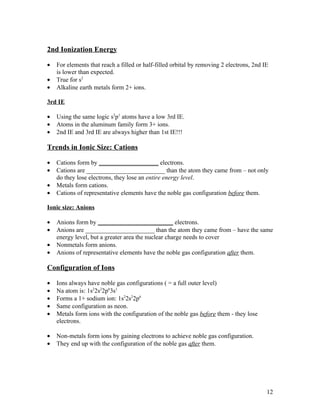
•   Na atom is: 1s22s22p63s1
•   Forms a 1+ sodium ion: 1s22s22p6
•   Same configuration as neon.
•   Metals form ions with the configuration of the noble gas before them - they lose
    electrons.

•   Non-metals form ions by gaining electrons to achieve noble gas configuration.
•   They end up with the configuration of the noble gas after them.


                                                                                          12
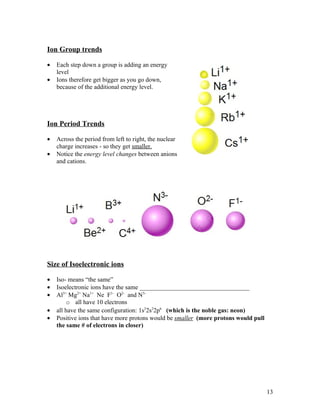
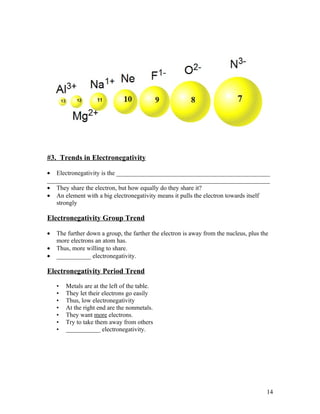
Ion Group trends

•   Each step down a group is adding an energy
    level
•   Ions therefore get bigger as you go down,
    because of the additional energy level.


Ion Period Trends

•   Across the period from left to right, the nuclear
    charge increases - so they get smaller.
•   Notice the energy level changes between anions
    and cations.


Size of Isoelectronic ions

•   Iso- means “the same”
•   Isoelectronic ions have the same ___________________________________
•   Al3+ Mg2+ Na1+ Ne F1- O2- and N3-
         o all have 10 electrons
•   all have the same configuration: 1s22s22p6 (which is the noble gas: neon)
•   Positive ions that have more protons would be smaller (more protons would pull
    the same # of electrons in closer)


                                                                                     13
#3. Trends in Electronegativity

• Electronegativity is the _________________________________________________
_______________________________________________________________________
• They share the electron, but how equally do they share it?
• An element with a big electronegativity means it pulls the electron towards itself
   strongly

Electronegativity Group Trend

•   The further down a group, the farther the electron is away from the nucleus, plus the
    more electrons an atom has.
•   Thus, more willing to share.
•   ___________ electronegativity.

Electronegativity Period Trend

    •   Metals are at the left of the table.
    •   They let their electrons go easily
    •   Thus, low electronegativity
    •   At the right end are the nonmetals.
    •   They want more electrons.
    •   Try to take them away from others
    •   ___________ electronegativity.


                                                                                        14
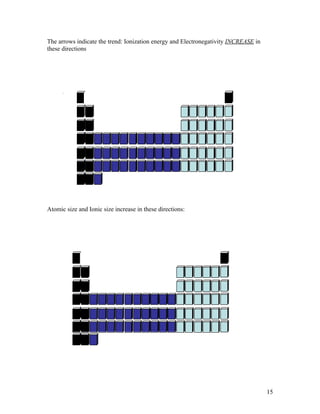
The arrows indicate the trend: Ionization energy and Electronegativity INCREASE in
these directions


Atomic size and Ionic size increase in these directions:


                                                                                     15
16

Chemistry - Chp 6 - The Periodic Table Revisited - Notes

  • 1.
    Chapter 6 The Periodic Table Revisited
  • 2.
    Section 6.1 and6.2 Organizing and Classifying the Elements Objectives: • Explain how elements are organized in a periodic table. • Identify three broad classes of elements. • Describe the information in a periodic table. • Classify elements based on electron configuration. • Distinguish representative elements and transition metals. Organizing the Elements • A few elements, such as gold and copper, have been known for thousands of years - since ancient times • Yet, only about 13 had been identified by the year 1700. • As more were discovered, chemists realized they needed a way to organize the elements. 2
  • 3.
    The Periodic Lawsays: • When elements are arranged in order of increasing atomic number, there is a periodic repetition of their physical and chemical properties. • Horizontal rows = periods o There are 7 periods • Vertical column = group (or family) o Similar physical & chemical prop. Squares in the Periodic Table • The periodic table displays the symbols and names of the elements, along with information about the structure of their atoms: • Atomic number and atomic mass • Black symbol = _____________; red = _____________; blue = _____________ Groups of elements - family names • Group 1,IA – alkali metals o Forms a “base” (or alkali) when reacting with water (not just dissolved!) • Group 2, 2A – alkaline earth metals o Also form bases with water; do not dissolve well, hence “earth metals” • Group 17, 7A – halogens o Means “salt-forming” Electron Configurations in Groups • Elements can be sorted into 4 different groupings based on their electron configurations: 1) 2) 3) 4) 3
  • 4.
    1) Noble gasesare the elements in Group 18, 8A (also called Group 0) • Previously called “__________________________” because they rarely take part in a reaction; very stable = don’t react • Noble gases have an electron configuration that has the outer s and p sublevels ________________________________ 2) Representative Elements are in Groups 1,1A through 17,7A • Display wide range of properties, thus a good “representative” • Some are metals, or nonmetals, or metalloids; some are solid, others are gases or liquids • Their outer s and p electron configurations are _________________________ 3) Transition metals are in the “B” columns of the periodic table or columns 3-12 • Electron configuration has the outer s sublevel full, and is now filling the __________________________________________ • A “transition” between the metal area and the nonmetal area • Examples are gold, copper, silver 4) Inner Transition Metals are located below the main body of the table, in two horizontal rows • Electron configuration has the outer s sublevel full, and is now filling the ________________________________________ • Formerly called “rare-earth” elements, but this is not true because some are very abundant Elements in the s - blocks 4
  • 5.
    Alkali metals all end in _________ • Alkaline earth metals all end in _________ o really should include He, but it fits better in a different spot, since He has the properties of the noble gases, and has a full outer level of electrons. Transition Metals - d block 5
  • 6.
    The P-block F -block • Called the “inner transition elements” f1 f2 f3 f4 f5 f6 f7 f8 f9 f10 f11 f12 f13 f14 6
  • 7.
    Each row (or period) is the energy level for s and p orbitals. • The “d” orbitals fill up in levels _________________________________________, so the first d is 3d even though it’s in row 4. • f orbitals start filling at 4f, and are _________________________________________ 7
  • 8.
    Section 6.3 Periodic Trends OBJECTIVES: • Describe trends among the elements for atomic size. • Explain how ions form. • Describe periodic trends for first ionization energy, ionic size, and electronegativity. Trends in Atomic Size • First problem: Where do you start measuring from? • The electron cloud doesn’t have a definite edge. • They get around this by measuring more than 1 atom at a time. Atomic Size Radius • Measure the Atomic Radius - this is half the distance between the two nuclei of a diatomic molecule. 8
  • 9.
    ALL Periodic TableTrends • Influenced by three factors: 1. _______________________________ • 2. _______________________________________________________ • 3. Shielding effect What do they influence? • Energy levels and Shielding have an effect on the GROUP • Nuclear charge has an effect on a PERIOD #1. Atomic Size - Group trends • As we increase the atomic number (or go down a group). . . • each atom has _____________________________________, • so the atoms get _________________________. #1. Atomic Size - Period Trends • Going from left to right across a period, the size gets __________________________ • Electrons are in the same energy level. • But, there is more nuclear charge. • Outermost electrons are pulled closer. 9
  • 10.
    Ions • Some compounds are composed of particles called “ions” • An ion is an atom (or group of atoms) that has a ______________________________ • Atoms are neutral because _______________________________________________ • Positive and negative ions are formed when electrons are transferred (lost or gained) between atoms • Metals tend to ________________ electrons, from their outer energy level • Sodium loses one: there are now more protons (11) than electrons (10), and thus a positively charged particle is formed = ______________________ • The charge is written as a number followed by a plus sign: ___________ • Now named a _____________________________ • Nonmetals tend to _________________ one or more electrons • Chlorine will gain one electron • Protons (17) no longer equals the electrons (18), so a charge of -1 • Cl1- is re-named a ________________________________ • Negative ions are called ______________________ #2. Trends in Ionization Energy • Ionization energy is the _________________________________________________ _______________________________________________________________________ _ • Removing one electron makes a _______ ion. • The energy required to remove only the first electron is called the ________________ ____________________________________ • The second ionization energy is the energy required to remove the second electron. • Always greater than first IE. • The third IE is the energy required to remove a third electron. • Greater than 1st or 2nd IE. What factors determine IE? • The greater the nuclear charge, ____________________________________ • Greater distance from nucleus _____________________________________ • Filled and half-filled orbitals have lower energy, so achieving them is easier, lower IE. • Shielding effect 10
  • 11.
    Shielding • The electron on the outermost energy level has to look through all the other energy levels to see the nucleus. • Second electron has same shielding, if it is in the same period Ionization Energy - Group trends • As you go down a group, the first IE decreases because... • ____________________________________________________________________ _ • There is more shielding. Ionization Energy - Period trends • All the atoms in the same period have the same energy level. • Same shielding. • But, increasing nuclear charge • So IE generally ___________________________ from left to right. • Exceptions at full and 1/2 full orbitals. Driving Forces • Full Energy Levels require lots of energy to remove their electrons. • Noble Gases have full orbitals. • Atoms behave in ways to try and achieve a noble gas configuration. 11
  • 12.
    2nd Ionization Energy • For elements that reach a filled or half-filled orbital by removing 2 electrons, 2nd IE is lower than expected. • True for s2 • Alkaline earth metals form 2+ ions. 3rd IE • Using the same logic s2p1 atoms have a low 3rd IE. • Atoms in the aluminum family form 3+ ions. • 2nd IE and 3rd IE are always higher than 1st IE!!! Trends in Ionic Size: Cations • Cations form by ___________________ electrons. • Cations are _________________________ than the atom they came from – not only do they lose electrons, they lose an entire energy level. • Metals form cations. • Cations of representative elements have the noble gas configuration before them. Ionic size: Anions • Anions form by ________________________ electrons. • Anions are ______________________ than the atom they came from – have the same energy level, but a greater area the nuclear charge needs to cover • Nonmetals form anions. • Anions of representative elements have the noble gas configuration after them. Configuration of Ions • Ions always have noble gas configurations ( = a full outer level) • Na atom is: 1s22s22p63s1 • Forms a 1+ sodium ion: 1s22s22p6 • Same configuration as neon. • Metals form ions with the configuration of the noble gas before them - they lose electrons. • Non-metals form ions by gaining electrons to achieve noble gas configuration. • They end up with the configuration of the noble gas after them. 12
  • 13.
    Ion Group trends • Each step down a group is adding an energy level • Ions therefore get bigger as you go down, because of the additional energy level. Ion Period Trends • Across the period from left to right, the nuclear charge increases - so they get smaller. • Notice the energy level changes between anions and cations. Size of Isoelectronic ions • Iso- means “the same” • Isoelectronic ions have the same ___________________________________ • Al3+ Mg2+ Na1+ Ne F1- O2- and N3- o all have 10 electrons • all have the same configuration: 1s22s22p6 (which is the noble gas: neon) • Positive ions that have more protons would be smaller (more protons would pull the same # of electrons in closer) 13
  • 14.
    #3. Trends inElectronegativity • Electronegativity is the _________________________________________________ _______________________________________________________________________ • They share the electron, but how equally do they share it? • An element with a big electronegativity means it pulls the electron towards itself strongly Electronegativity Group Trend • The further down a group, the farther the electron is away from the nucleus, plus the more electrons an atom has. • Thus, more willing to share. • ___________ electronegativity. Electronegativity Period Trend • Metals are at the left of the table. • They let their electrons go easily • Thus, low electronegativity • At the right end are the nonmetals. • They want more electrons. • Try to take them away from others • ___________ electronegativity. 14
  • 15.
    The arrows indicatethe trend: Ionization energy and Electronegativity INCREASE in these directions Atomic size and Ionic size increase in these directions: 15
  • 16.