Chapter 5 - Enzymes 5.1  What Are Enzymes? 5.2  Classification of Enzymes 4.3  Characteristics of Enzymes
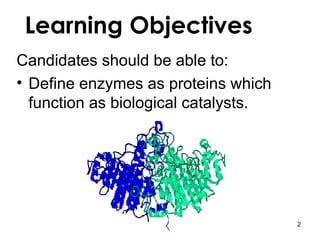
Learning Objectives Candidates should be able to: Define enzymes as proteins which function as biological catalysts.
5.1 What Are Enzymes ? Enzymes are: Biological catalysts, Protein in nature, Catalyze chemical reactions without being changed at the end of the reaction.
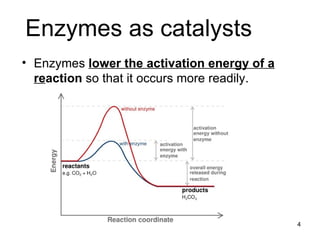
Enzymes as catalysts Enzymes  lower the activation energy of a reaction  so that it occurs more readily .
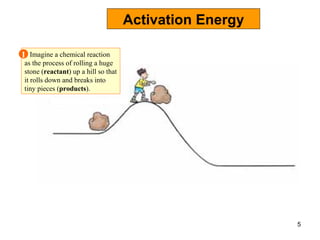
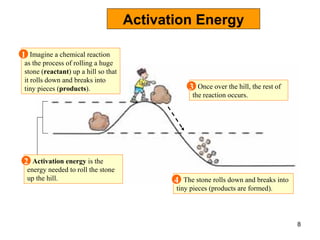
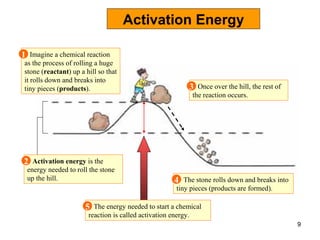
Activation Energy Imagine a chemical reaction as the process of rolling a huge stone ( reactant ) up a hill so that it rolls down and breaks into tiny pieces ( products ). 1
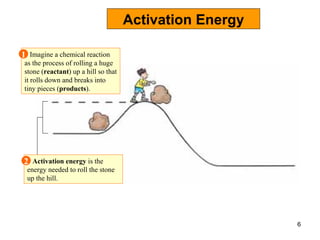
Activation Energy Activation energy  is the energy needed to roll the stone up the hill. Imagine a chemical reaction as the process of rolling a huge stone ( reactant ) up a hill so that it rolls down and breaks into tiny pieces ( products ). 1 2
Activation Energy Once over the hill, the rest of the reaction occurs. Imagine a chemical reaction as the process of rolling a huge stone ( reactant ) up a hill so that it rolls down and breaks into tiny pieces ( products ). 1 Activation energy  is the energy needed to roll the stone up the hill. 2 3
Activation Energy Imagine a chemical reaction as the process of rolling a huge stone ( reactant ) up a hill so that it rolls down and breaks into tiny pieces ( products ). 1 Activation energy  is the energy needed to roll the stone up the hill. 2 Once over the hill, the rest of the reaction occurs. 3 The stone rolls down and breaks into tiny pieces (products are formed). 4
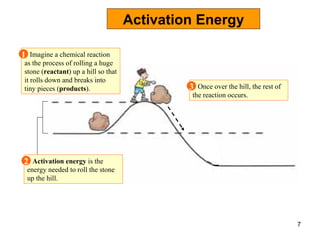
Activation Energy The stone rolls down and breaks into tiny pieces (products are formed). The energy needed to start a chemical reaction is called activation energy. Imagine a chemical reaction as the process of rolling a huge stone ( reactant ) up a hill so that it rolls down and breaks into tiny pieces ( products ). 1 Activation energy  is the energy needed to roll the stone up the hill. 2 Once over the hill, the rest of the reaction occurs. 3 4 5
Digestion:  An Enzyme-Catalysed Process Why do we need to digest our food? Starch, proteins and fats are  very large. They  cannot diffuse across cell membranes  for absorption. Therefore, they must be digested into Simpler, smaller and soluble  substances. Diffusible  across cell membranes.
Other applications of Enzymes Anabolic processes Eg. Synthesis of proteins from amino acids. Catabolic processes Eg. Oxidation of glucose (tissue respiration) Catalase production Catalase catalyses the breakdown of toxic hydrogen peroxide into harmless water and oxygen. Catalase is abundant in liver and blood.
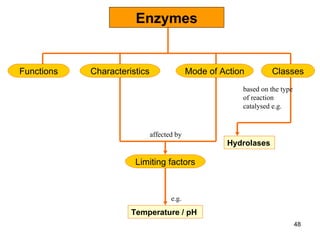
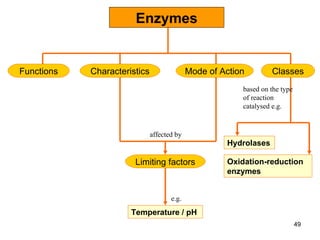
5.2 Classification of Enzymes Enzymes are classified according to the chemical reaction involved in: Enzymes that catalyse hydrolysis reactions are called  hydrolases. Example of hydrolases: Carbohydrases, proteases, lipases .  Enzymes involved in oxidation of food as called  oxidation-reduction enzymes.
Learning Objectives Candidates should be able to: Explain enzyme action in terms of the ‘lock and key’ hypothesis. Investigate and explain the effects of temperature and of pH on the rate of enzyme catalyzed reactions .
5.3 Characteristics of Enzymes Enzymes  alter or speed up the rates of chemical reaction  that occur in a cell. Enzymes are required in  minute amounts . Since enzymes are  not altered  in a chemical reaction, a  small amount  can catalyse a huge reaction.
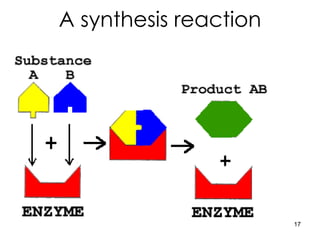
Enzymes are specific Specificity of enzyme is  due to its shape  (or surface configuration). The substrate will fit into an enzyme, forming  an enzyme-substrate complex . The  product will then be released.
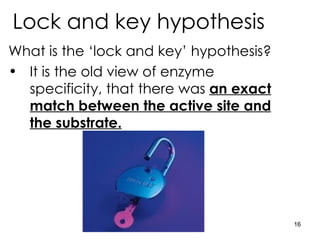
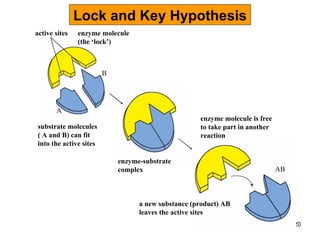
Lock and key hypothesis What is the ‘lock and key’ hypothesis? It is the old view of enzyme specificity, that there was  an exact match between the active site and the substrate.
A synthesis reaction
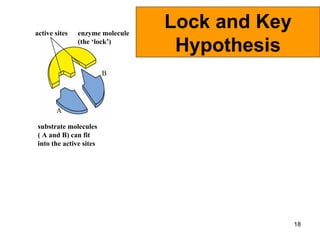
Lock and Key Hypothesis active sites A B enzyme molecule (the ‘lock’) substrate molecules ( A and B) can fit into the active sites
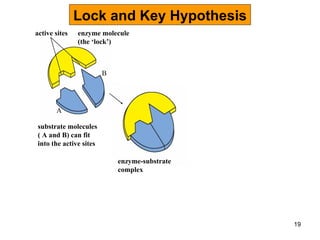
Lock and Key Hypothesis active sites A B enzyme molecule (the ‘lock’) enzyme-substrate complex substrate molecules ( A and B) can fit into the active sites
Lock and Key Hypothesis active sites A B AB enzyme molecule (the ‘lock’) enzyme-substrate complex substrate molecules ( A and B) can fit into the active sites enzyme molecule is free to take part in another reaction a new substance (product) AB leaves the active sites
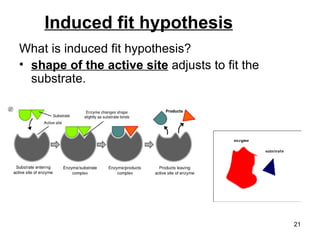
Induced fit hypothesis What is induced fit hypothesis? shape of the active site  adjusts to fit the substrate.
Induced fit hypothesis How did induced fit hypothesis come about? -  recent imaging technology  demonstrated changes in the 3-D conformation of enzymes when interacting with their substrates.
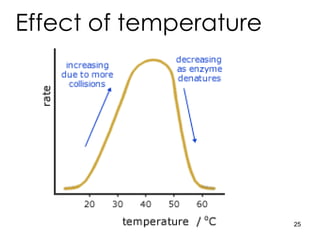
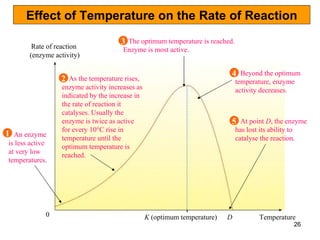
Effect of temperature At low temp: Rate of reaction is  slow. Enzymes are  inactive at low temp . Every  10 o c rise in temp, rate of reaction increases by double   (till it reaches optimum temp).
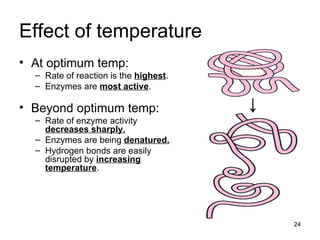
Effect of temperature At optimum temp: Rate of reaction is the  highest . Enzymes are  most active . Beyond optimum temp: Rate of enzyme activity  decreases sharply. Enzymes are being  denatured. Hydrogen bonds are easily disrupted by  increasing temperature .
Effect of temperature
Effect of Temperature on the Rate of Reaction Temperature Rate of reaction  (enzyme activity) 0 K  (optimum temperature) D At point  D , the enzyme has lost its ability to catalyse the reaction.  An enzyme is less active at very low temperatures. 1 As the temperature rises, enzyme activity increases as indicated by the increase in the rate of reaction it catalyses. Usually the enzyme is twice as active for every 10°C rise in temperature until the optimum temperature is reached.  2 The optimum temperature is reached. Enzyme is most active. 3 Beyond the optimum temperature, enzyme activity decreases.  4 5
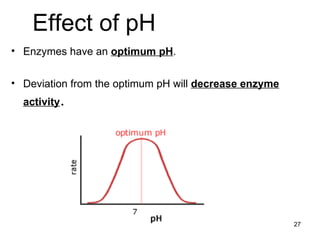
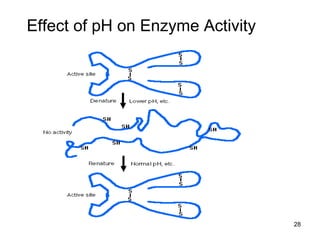
Effect of pH   Enzymes have an  optimum pH . Deviation from the optimum pH will  decrease enzyme activity .
Effect of pH on Enzyme Activity
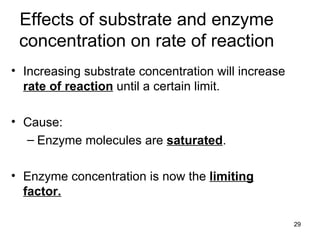
Effects of substrate and enzyme concentration on rate of reaction Increasing substrate concentration will increase  rate of reaction  until a certain limit. Cause: Enzyme molecules are  saturated . Enzyme concentration is now the  limiting factor.
What is a limiting factor? Any factor that directly affects the  rate of a process if its quantity is changed The value of the limiting factor has to be  increased in order to increase the rate of the process .
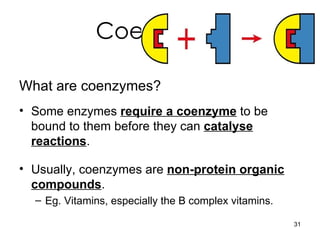
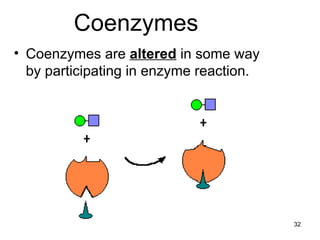
Coenzymes What are coenzymes? Some enzymes  require a coenzyme  to be bound to them before they can  catalyse reactions . Usually, coenzymes are  non-protein organic compounds . Eg. Vitamins, especially the B complex vitamins.
Coenzymes Coenzymes are   altered  in some way by participating in enzyme reaction.
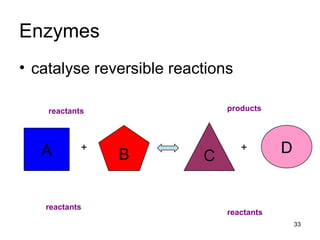
Enzymes  catalyse reversible reactions A D B C + + reactants products reactants reactants
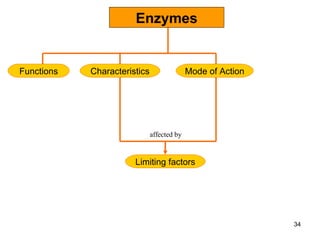
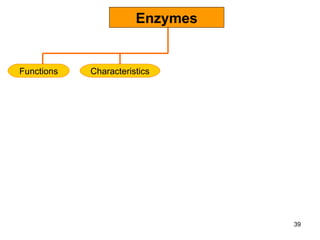
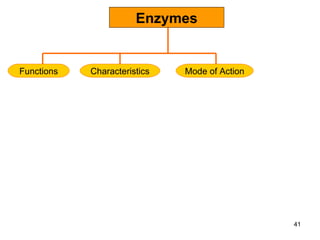
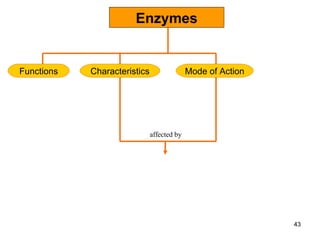
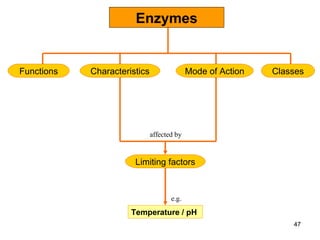
Enzymes Characteristics Functions Mode of Action Limiting factors affected by
Enzymes
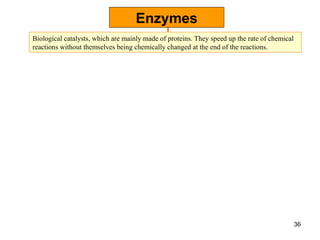
Enzymes Biological catalysts, which are mainly made of proteins. They speed up the rate of chemical reactions without themselves being chemically changed at the end of the reactions.
Enzymes Functions
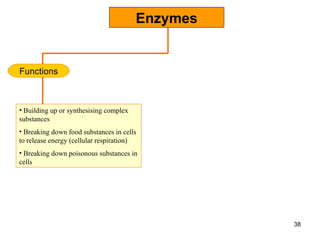
Enzymes Functions Building up or synthesising complex substances  Breaking down food substances in cells to release energy (cellular respiration) Breaking down poisonous substances in cells
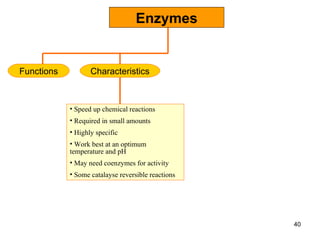
Enzymes Characteristics Functions
Enzymes Characteristics Functions Speed up chemical reactions Required in small amounts Highly specific Work best at an optimum temperature and pH May need coenzymes for activity Some catalayse reversible reactions
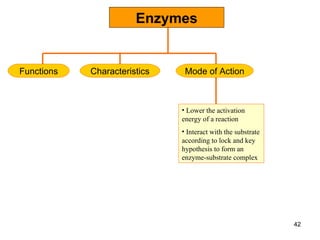
Enzymes Characteristics Functions Mode of Action
Enzymes Characteristics Functions Mode of Action Lower the activation energy of a reaction Interact with the substrate according to lock and key hypothesis to form an enzyme-substrate complex
Enzymes Characteristics Functions Mode of Action affected by
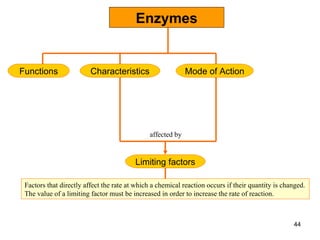
Enzymes Characteristics Functions Mode of Action Limiting factors Factors that directly affect the rate at which a chemical reaction occurs if their quantity is changed. The value of a limiting factor must be increased in order to increase the rate of reaction. affected by
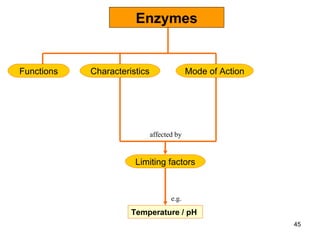
Enzymes Characteristics Functions Mode of Action Limiting factors Temperature / pH e.g. affected by
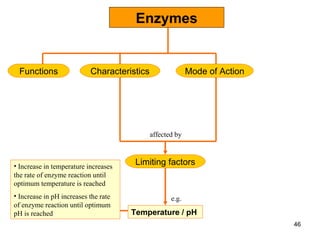
Enzymes Characteristics Functions Mode of Action Limiting factors Temperature / pH e.g. Increase in temperature increases the rate of enzyme reaction until optimum temperature is reached Increase in pH increases the rate of enzyme reaction until optimum pH is reached affected by
Enzymes Characteristics Functions Mode of Action Limiting factors Temperature / pH e.g. Classes affected by
Enzymes Characteristics Functions Mode of Action Limiting factors Temperature / pH e.g. Classes based on the type of reaction catalysed e.g. Hydrolases affected by
Enzymes Characteristics Functions Mode of Action Limiting factors Temperature / pH e.g. Classes based on the type of reaction catalysed e.g. Hydrolases Oxidation-reduction enzymes affected by

Chapter 5 enzymes

  • 1.
    Chapter 5 -Enzymes 5.1 What Are Enzymes? 5.2 Classification of Enzymes 4.3 Characteristics of Enzymes
  • 2.
    Learning Objectives Candidatesshould be able to: Define enzymes as proteins which function as biological catalysts.
  • 3.
    5.1 What AreEnzymes ? Enzymes are: Biological catalysts, Protein in nature, Catalyze chemical reactions without being changed at the end of the reaction.
  • 4.
    Enzymes as catalystsEnzymes lower the activation energy of a reaction so that it occurs more readily .
  • 5.
    Activation Energy Imaginea chemical reaction as the process of rolling a huge stone ( reactant ) up a hill so that it rolls down and breaks into tiny pieces ( products ). 1
  • 6.
    Activation Energy Activationenergy is the energy needed to roll the stone up the hill. Imagine a chemical reaction as the process of rolling a huge stone ( reactant ) up a hill so that it rolls down and breaks into tiny pieces ( products ). 1 2
  • 7.
    Activation Energy Onceover the hill, the rest of the reaction occurs. Imagine a chemical reaction as the process of rolling a huge stone ( reactant ) up a hill so that it rolls down and breaks into tiny pieces ( products ). 1 Activation energy is the energy needed to roll the stone up the hill. 2 3
  • 8.
    Activation Energy Imaginea chemical reaction as the process of rolling a huge stone ( reactant ) up a hill so that it rolls down and breaks into tiny pieces ( products ). 1 Activation energy is the energy needed to roll the stone up the hill. 2 Once over the hill, the rest of the reaction occurs. 3 The stone rolls down and breaks into tiny pieces (products are formed). 4
  • 9.
    Activation Energy Thestone rolls down and breaks into tiny pieces (products are formed). The energy needed to start a chemical reaction is called activation energy. Imagine a chemical reaction as the process of rolling a huge stone ( reactant ) up a hill so that it rolls down and breaks into tiny pieces ( products ). 1 Activation energy is the energy needed to roll the stone up the hill. 2 Once over the hill, the rest of the reaction occurs. 3 4 5
  • 10.
    Digestion: AnEnzyme-Catalysed Process Why do we need to digest our food? Starch, proteins and fats are very large. They cannot diffuse across cell membranes for absorption. Therefore, they must be digested into Simpler, smaller and soluble substances. Diffusible across cell membranes.
  • 11.
    Other applications ofEnzymes Anabolic processes Eg. Synthesis of proteins from amino acids. Catabolic processes Eg. Oxidation of glucose (tissue respiration) Catalase production Catalase catalyses the breakdown of toxic hydrogen peroxide into harmless water and oxygen. Catalase is abundant in liver and blood.
  • 12.
    5.2 Classification ofEnzymes Enzymes are classified according to the chemical reaction involved in: Enzymes that catalyse hydrolysis reactions are called hydrolases. Example of hydrolases: Carbohydrases, proteases, lipases . Enzymes involved in oxidation of food as called oxidation-reduction enzymes.
  • 13.
    Learning Objectives Candidatesshould be able to: Explain enzyme action in terms of the ‘lock and key’ hypothesis. Investigate and explain the effects of temperature and of pH on the rate of enzyme catalyzed reactions .
  • 14.
    5.3 Characteristics ofEnzymes Enzymes alter or speed up the rates of chemical reaction that occur in a cell. Enzymes are required in minute amounts . Since enzymes are not altered in a chemical reaction, a small amount can catalyse a huge reaction.
  • 15.
    Enzymes are specificSpecificity of enzyme is due to its shape (or surface configuration). The substrate will fit into an enzyme, forming an enzyme-substrate complex . The product will then be released.
  • 16.
    Lock and keyhypothesis What is the ‘lock and key’ hypothesis? It is the old view of enzyme specificity, that there was an exact match between the active site and the substrate.
  • 17.
  • 18.
    Lock and KeyHypothesis active sites A B enzyme molecule (the ‘lock’) substrate molecules ( A and B) can fit into the active sites
  • 19.
    Lock and KeyHypothesis active sites A B enzyme molecule (the ‘lock’) enzyme-substrate complex substrate molecules ( A and B) can fit into the active sites
  • 20.
    Lock and KeyHypothesis active sites A B AB enzyme molecule (the ‘lock’) enzyme-substrate complex substrate molecules ( A and B) can fit into the active sites enzyme molecule is free to take part in another reaction a new substance (product) AB leaves the active sites
  • 21.
    Induced fit hypothesisWhat is induced fit hypothesis? shape of the active site adjusts to fit the substrate.
  • 22.
    Induced fit hypothesisHow did induced fit hypothesis come about? - recent imaging technology demonstrated changes in the 3-D conformation of enzymes when interacting with their substrates.
  • 23.
    Effect of temperatureAt low temp: Rate of reaction is slow. Enzymes are inactive at low temp . Every 10 o c rise in temp, rate of reaction increases by double (till it reaches optimum temp).
  • 24.
    Effect of temperatureAt optimum temp: Rate of reaction is the highest . Enzymes are most active . Beyond optimum temp: Rate of enzyme activity decreases sharply. Enzymes are being denatured. Hydrogen bonds are easily disrupted by increasing temperature .
  • 25.
  • 26.
    Effect of Temperatureon the Rate of Reaction Temperature Rate of reaction (enzyme activity) 0 K (optimum temperature) D At point D , the enzyme has lost its ability to catalyse the reaction. An enzyme is less active at very low temperatures. 1 As the temperature rises, enzyme activity increases as indicated by the increase in the rate of reaction it catalyses. Usually the enzyme is twice as active for every 10°C rise in temperature until the optimum temperature is reached. 2 The optimum temperature is reached. Enzyme is most active. 3 Beyond the optimum temperature, enzyme activity decreases. 4 5
  • 27.
    Effect of pH Enzymes have an optimum pH . Deviation from the optimum pH will decrease enzyme activity .
  • 28.
    Effect of pHon Enzyme Activity
  • 29.
    Effects of substrateand enzyme concentration on rate of reaction Increasing substrate concentration will increase rate of reaction until a certain limit. Cause: Enzyme molecules are saturated . Enzyme concentration is now the limiting factor.
  • 30.
    What is alimiting factor? Any factor that directly affects the rate of a process if its quantity is changed The value of the limiting factor has to be increased in order to increase the rate of the process .
  • 31.
    Coenzymes What arecoenzymes? Some enzymes require a coenzyme to be bound to them before they can catalyse reactions . Usually, coenzymes are non-protein organic compounds . Eg. Vitamins, especially the B complex vitamins.
  • 32.
    Coenzymes Coenzymes are altered in some way by participating in enzyme reaction.
  • 33.
    Enzymes catalysereversible reactions A D B C + + reactants products reactants reactants
  • 34.
    Enzymes Characteristics FunctionsMode of Action Limiting factors affected by
  • 35.
  • 36.
    Enzymes Biological catalysts,which are mainly made of proteins. They speed up the rate of chemical reactions without themselves being chemically changed at the end of the reactions.
  • 37.
  • 38.
    Enzymes Functions Buildingup or synthesising complex substances Breaking down food substances in cells to release energy (cellular respiration) Breaking down poisonous substances in cells
  • 39.
  • 40.
    Enzymes Characteristics FunctionsSpeed up chemical reactions Required in small amounts Highly specific Work best at an optimum temperature and pH May need coenzymes for activity Some catalayse reversible reactions
  • 41.
  • 42.
    Enzymes Characteristics FunctionsMode of Action Lower the activation energy of a reaction Interact with the substrate according to lock and key hypothesis to form an enzyme-substrate complex
  • 43.
    Enzymes Characteristics FunctionsMode of Action affected by
  • 44.
    Enzymes Characteristics FunctionsMode of Action Limiting factors Factors that directly affect the rate at which a chemical reaction occurs if their quantity is changed. The value of a limiting factor must be increased in order to increase the rate of reaction. affected by
  • 45.
    Enzymes Characteristics FunctionsMode of Action Limiting factors Temperature / pH e.g. affected by
  • 46.
    Enzymes Characteristics FunctionsMode of Action Limiting factors Temperature / pH e.g. Increase in temperature increases the rate of enzyme reaction until optimum temperature is reached Increase in pH increases the rate of enzyme reaction until optimum pH is reached affected by
  • 47.
    Enzymes Characteristics FunctionsMode of Action Limiting factors Temperature / pH e.g. Classes affected by
  • 48.
    Enzymes Characteristics FunctionsMode of Action Limiting factors Temperature / pH e.g. Classes based on the type of reaction catalysed e.g. Hydrolases affected by
  • 49.
    Enzymes Characteristics FunctionsMode of Action Limiting factors Temperature / pH e.g. Classes based on the type of reaction catalysed e.g. Hydrolases Oxidation-reduction enzymes affected by

Editor's Notes

  • #6 Figure 5.1 page 73
  • #7 Figure 5.1 page 73
  • #8 Figure 5.1 page 73
  • #9 Figure 5.1 page 73
  • #10 Figure 5.1 page 73
  • #19 Figure 5.6 page 77
  • #20 Figure 5.6 page 77
  • #21 Figure 5.6 page 77
  • #27 Figure 5.7 page 80
  • #35 Concept Map page 87
  • #36 Concept Map page 87
  • #37 Concept Map page 87
  • #38 Concept Map page 87
  • #39 Concept Map page 87
  • #40 Concept Map page 87
  • #41 Concept Map page 87
  • #42 Concept Map page 87
  • #43 Concept Map page 87
  • #44 Concept Map page 87
  • #45 Concept Map page 87
  • #46 Concept Map page 87
  • #47 Concept Map page 87
  • #48 Concept Map page 87
  • #49 Concept Map page 87
  • #50 Concept Map page 87