BIOLOGY ENZYMES
PRESENTATION
GROUP 3:
-Andre Nansingh
-Aidan Persad
-Nirad Persad
-Nikhil Prabhakar
-Naasir Rajack
Enzymes
Definition, types of enzymes and
metabolism
What are Enzymes?
● Generally defined as biological catalysts, enzymes are globular proteins that have the
unique capacity of speeding up a biochemical (metabolic) reactions without itself being
altered by the reaction.
● Enzymes can be classified into two types : 1) Intracellular (Endoenzyme)
2) Extracellular(Exoenzyme)
Intracellular and Extracellular Enzymes
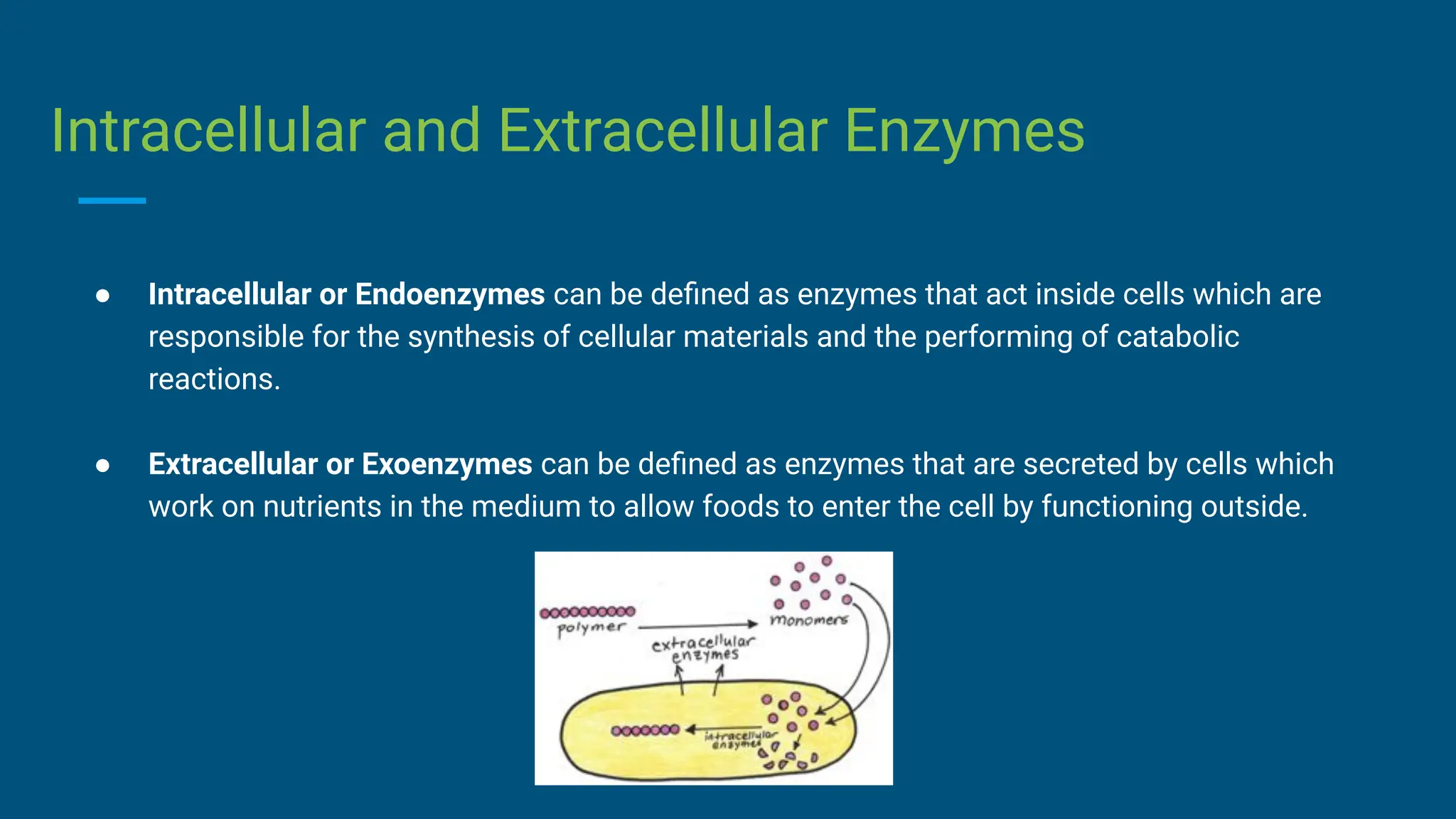
● Intracellular or Endoenzymes can be defined as enzymes that act inside cells which are
responsible for the synthesis of cellular materials and the performing of catabolic
reactions.
● Extracellular or Exoenzymes can be defined as enzymes that are secreted by cells which
work on nutrients in the medium to allow foods to enter the cell by functioning outside.
Key Terms
● Metabolism - The process involving a set of chemical reactions that modifies a molecule
into another to essentially maintain the living state of a cell or an organism. Metabolism
consists of anabolism and catabolism.
● Anabolism - This collectively refers to all the processes of chemical reactions that build
larger molecules out of smaller molecules or atoms.
● Catabolism – This is the part of the metabolism responsible for breaking complex
molecules down into smaller molecules.
The mode of
action of enzymes
Properties of enzymes, active site,
enzyme-substrate complex, activation
energy and enzyme specificity
Properties of Enzymes
1. They are all proteins.
2. Biological catalysts (i.e. they speed up chemical reactions).
3. The catalysed reaction is reversible.
4. They are specific (only certain substrates can be acted upon by enzymes).
5. They are affected by temperature (work best at an optimum temperature).
6. Affected by pH (work best at an optimum pH).
7. They lower activation energy required for a reaction.
8. They remain unchanged after the reaction and can hence be reused.
9. Inhibited by inhibitors such as nicotine.
10. Required in small amounts as they are highly efficient.
Active Site and Enzyme-Substrate Complex
● The active site refers to the specific region of an enzyme where a substrate binds and
catalysis takes place. This region is lined by R Groups of some amino acids after the enzyme
molecule is folded into its tertiary shape.
● The shape made by the R-groups determines which substrate can fit. When the substrate
molecule is inside the active site the molecule is put under strain so that bonds break or form.
This combination of enzyme and substrate forms an enzyme substrate complex.
Activation Energy
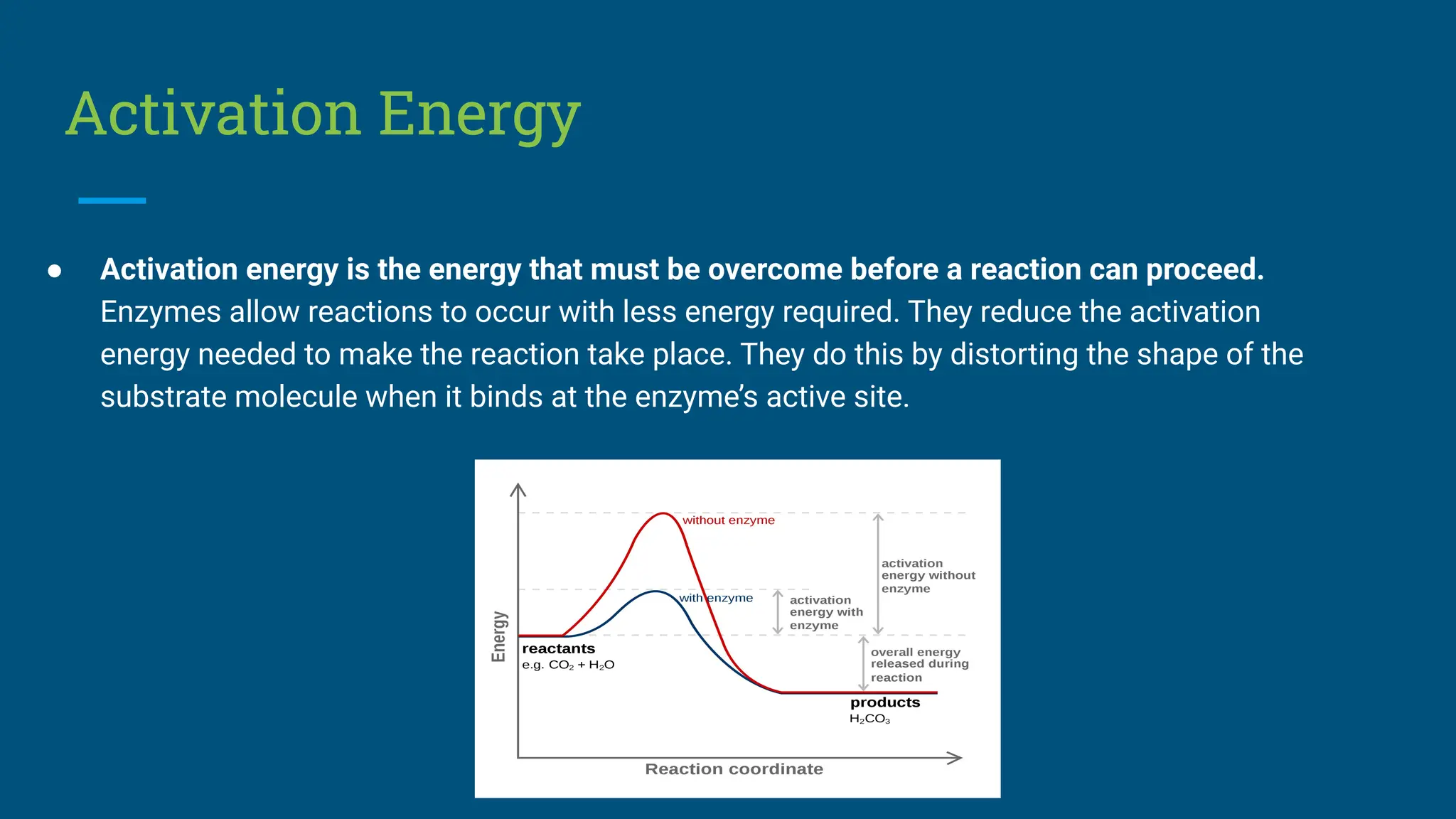
● Activation energy is the energy that must be overcome before a reaction can proceed.
Enzymes allow reactions to occur with less energy required. They reduce the activation
energy needed to make the reaction take place. They do this by distorting the shape of the
substrate molecule when it binds at the enzyme’s active site.
Enzyme Specificity
● The specificity of an enzyme is determined by the shape of its active site, which must be
complementary to the shape of the substrate. This means that they have shapes that match
or fit together.
● There are different degrees of specificity and some enzymes are specific only to one reaction.
Others are less specific and will catalyse a number of reactions of the same type.
Lock and Key Hypothesis
● The lock and key hypothesis states that the shape of the substrate and that of the respective
enzyme’s active site must exactly correspond such that it fits perfectly and only for that pair
of substrate and enzyme, hence the enzyme would be highly specific (similar to how only a
certain key would match a certain lock).
Induced Fit Hypothesis
● This refers to the process ,in an enzyme–substrate reaction, where the active site
undergoes a slight change in shape in the presence of a substrate in order to
accommodate the substrate.
● The enzyme is induced to undergo a slight alteration in shape to achieve an optimum fit for
the substrate. The change in shape of the active site facilitates the enzyme reaction and
after the reaction is completed, the product is released. The enzyme active site returns to
its original shape and is ready to bind another substrate molecule.
What is the difference between Lock and Key
and Induced Fit Hypothesis
● The Lock and Key hypothesis states that there is no change in shape of the
enzyme’s active site needed and that only a certain type of substrate will fit
into the active site.
● However, the induced fit hypothesis claims that the active site will alter its
shape to allow the substrate to fit.
Factors Affecting
Enzymes
Effects of temperature, pH, enzyme
concentration and substrate
concentration on enzyme action
Effects of Temperature on Enzyme Action
● The rate at which an enzyme works is affected by the temperature of the surrounding environment.
● At very low temperatures, enzymes tend to work slowly or may be completely inactive, as the substrate
molecules lack sufficient amounts of kinetic energy (K.E).
● As temperature increases, K.E. increases, hence, the molecules move faster and collide more frequently in
the correct orientation, resulting in more enzyme-substrate complexes and therefore more products formed,
hence a greater rate of reaction (R.O.R).
● The temperature at which the R.O.R is greatest is known as the optimum temperature.
● When the optimum temperature is exceeded, the atoms of the enzyme molecules possess a large amount
of K.E. and vibrate at such a great speed that their bonds break and the shape of the active site is thus
altered. The enzyme can no longer accommodate substrates and make products. It is then referred to as
DENATURED.
Graph Showing Effects of Temperature on An
Enzyme-Catalysed Reaction
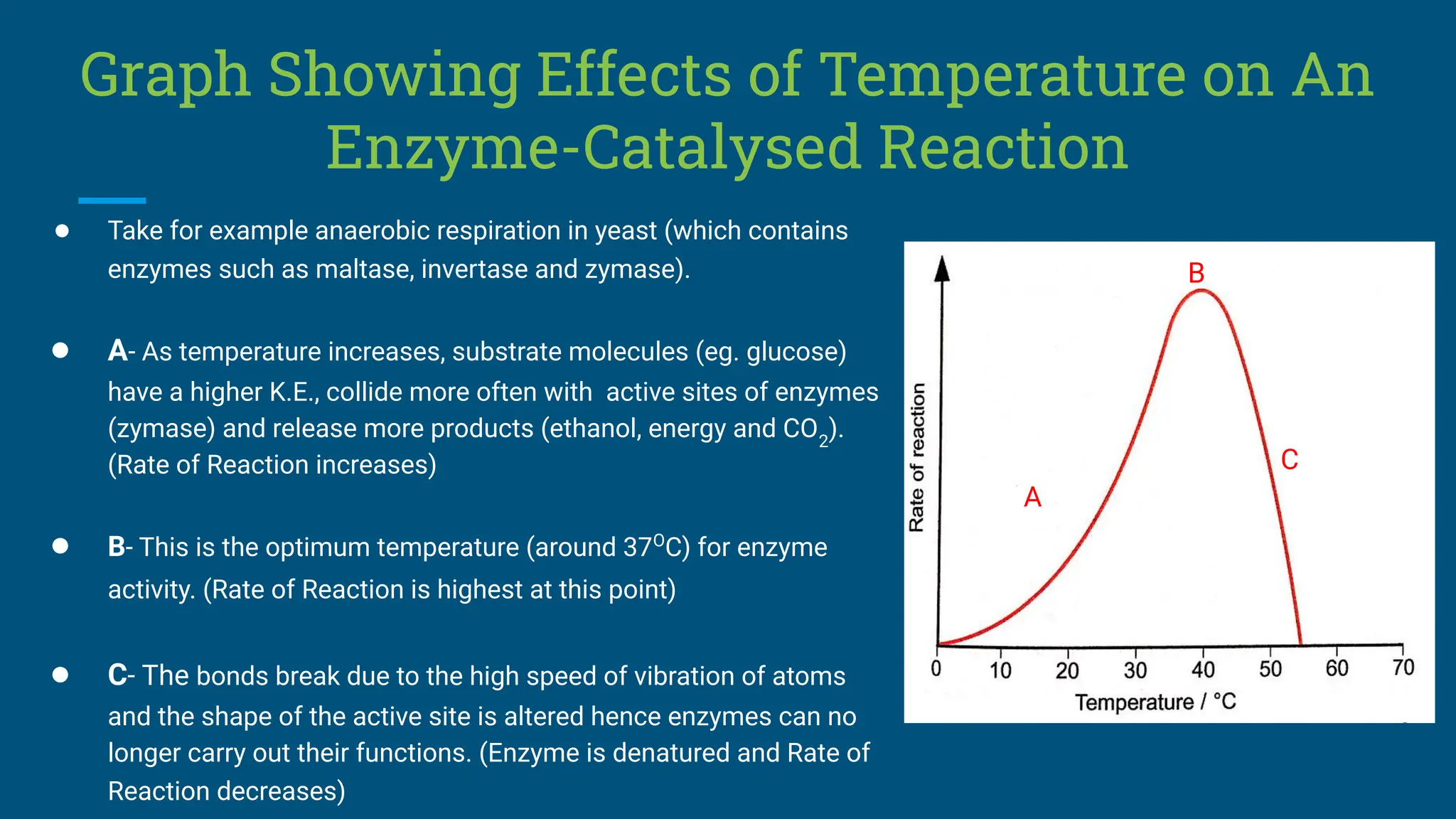
● Take for example anaerobic respiration in yeast (which contains
enzymes such as maltase, invertase and zymase).
● A- As temperature increases, substrate molecules (eg. glucose)
have a higher K.E., collide more often with active sites of enzymes
(zymase) and release more products (ethanol, energy and CO2
).
(Rate of Reaction increases)
● B- This is the optimum temperature (around 37O
C) for enzyme
activity. (Rate of Reaction is highest at this point)
● C- The bonds break due to the high speed of vibration of atoms
and the shape of the active site is altered hence enzymes can no
longer carry out their functions. (Enzyme is denatured and Rate of
Reaction decreases)
A
B
C
Effects of pH on Enzyme Action
● Similarly as with temperature, the rate at which an enzyme works is also affected by the pH of the surrounding
environment. pH is a measure of H+
ions present in solution.
● Most enzymes work best at a neutral pH (around 7.0), however, this varies between certain enzymes. Eg.
Optimum pH of Pepsin= 1.5 - 2.0 and of Salivary Amylase= 6.7 - 7.0 (approximately).
● When the pH is too low ( too acidic), the high concentration of H+
ions prevents -COOH groups from ionising and
when pH is too high ( too basic), the low concentration of H+
ions prevents -NH2 groups from ionising.
● Both of these conditions may cause ionic bonds between R groups in the enzyme molecules to break, resulting in
the change of shape of the enzyme active site, hence denaturing the enzyme, preventing it from being able to
carry out its functions again.
● The change in pH also disrupts hydrogen bonds in the enzyme structure which causes changes in the shape of
the enzyme active site, causing it to become denatured.
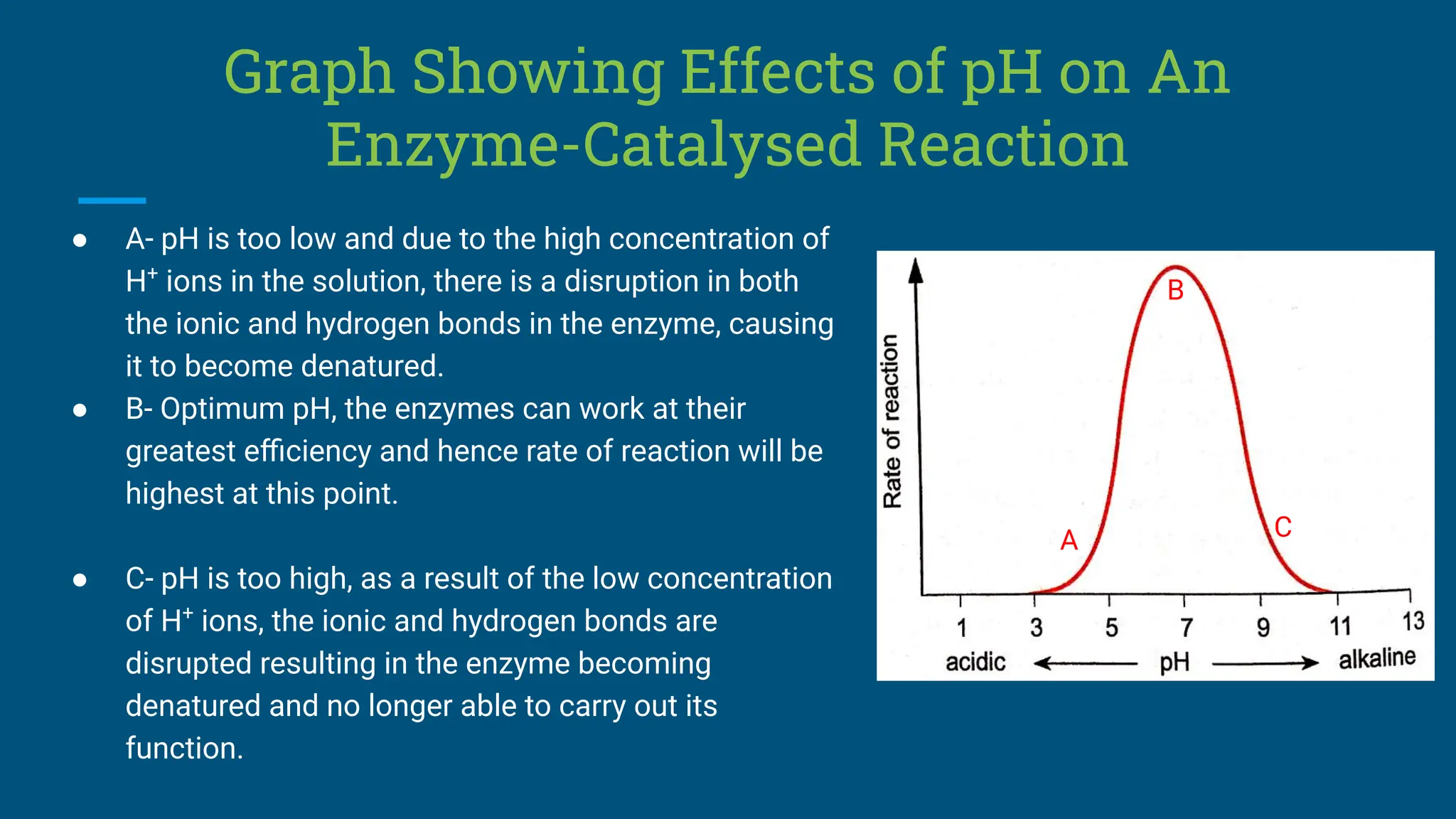
● A- pH is too low and due to the high concentration of
H+
ions in the solution, there is a disruption in both
the ionic and hydrogen bonds in the enzyme, causing
it to become denatured.
● B- Optimum pH, the enzymes can work at their
greatest efficiency and hence rate of reaction will be
highest at this point.
● C- pH is too high, as a result of the low concentration
of H+
ions, the ionic and hydrogen bonds are
disrupted resulting in the enzyme becoming
denatured and no longer able to carry out its
function.
Graph Showing Effects of pH on An
Enzyme-Catalysed Reaction
A
B
C
Effects of Substrate Concentration on
Enzyme Action
● It would be expected that as substrate concentration increases, enzyme action would also
increase. This is indeed true, to a certain extent.
● If we were to increase substrate concentration while maintaining a constant enzyme
concentration, the rate of reaction would steadily increase as more substrate molecules
means that it is more likely for an enzyme to bind top a substrate and produce products.
● However there will come a point where each enzyme will be constantly working and the
substrates are essentially ‘waiting their turn’ to bind to an enzyme becomes available. The
enzyme concentration in this case is a limiting factor.
● At this point the rate of reaction ‘plateaus’ at a maximum rate of reaction.
Graph Showing Effects of Substrate
Concentration on An Enzyme-Catalysed Reaction
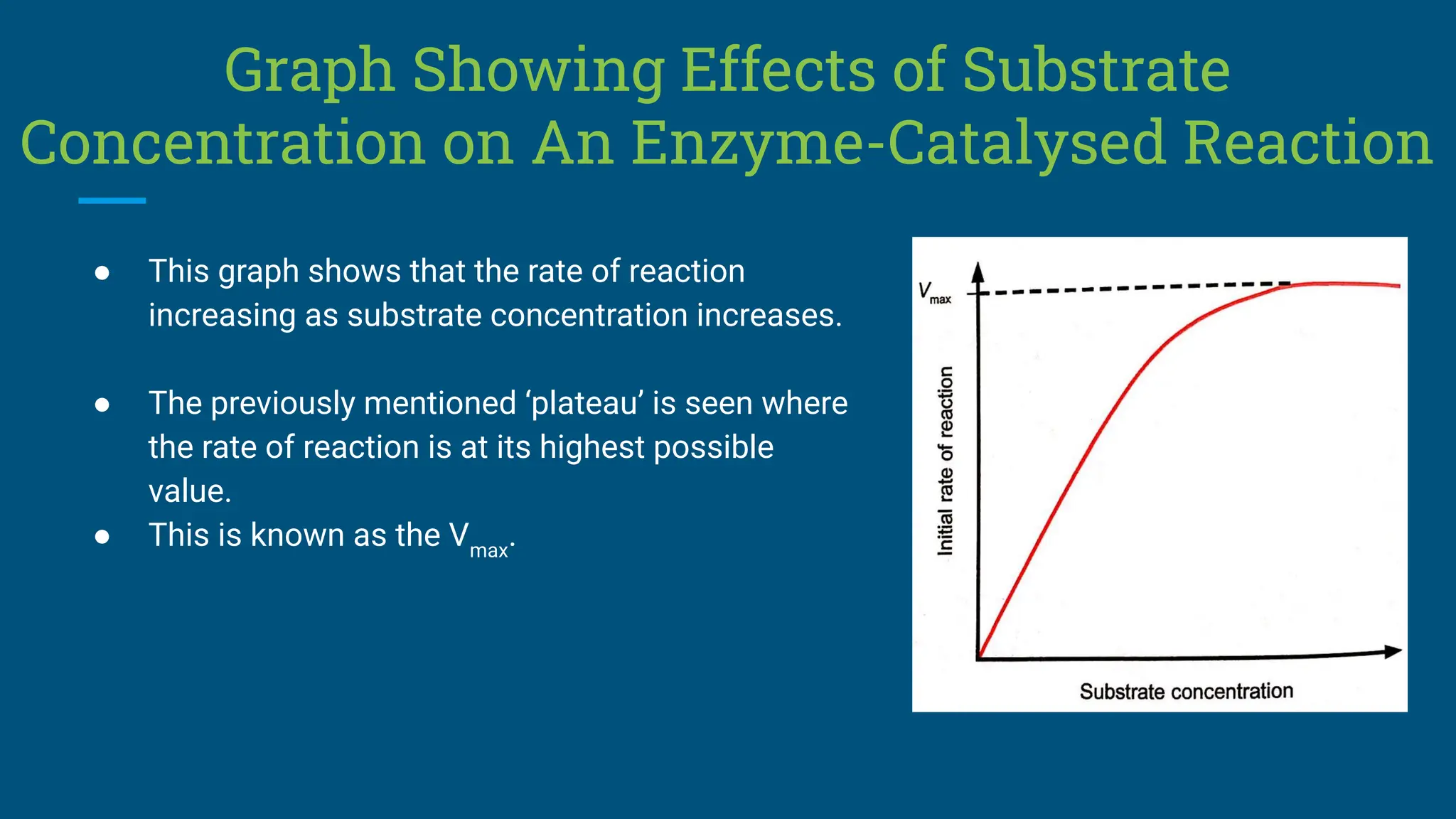
● This graph shows that the rate of reaction
increasing as substrate concentration increases.
● The previously mentioned ‘plateau’ is seen where
the rate of reaction is at its highest possible
value.
● This is known as the Vmax
.
Effects of Enzyme Concentration on Enzyme
Action
● Enzyme concentration also has a major effect on the rate of reaction of enzymes.
● Assuming all other conditions are suitable and constant and there is an excess of
substrates, rate of reaction increases proportionally to increase in enzyme concentration.
● When there is an increase in enzyme concentration, there are more enzymes present and
hence more active sites for substrates to bind to and as a result more products will be
formed (i.e. a greater rate of reaction will be achieved).
● The rate of reaction would only stop increasing and ‘level-off’ if the substrate concentration
was to be limited or due to some other limiting factor.
Graph Showing Effects of Substrate
Concentration on An Enzyme-Catalysed Reaction
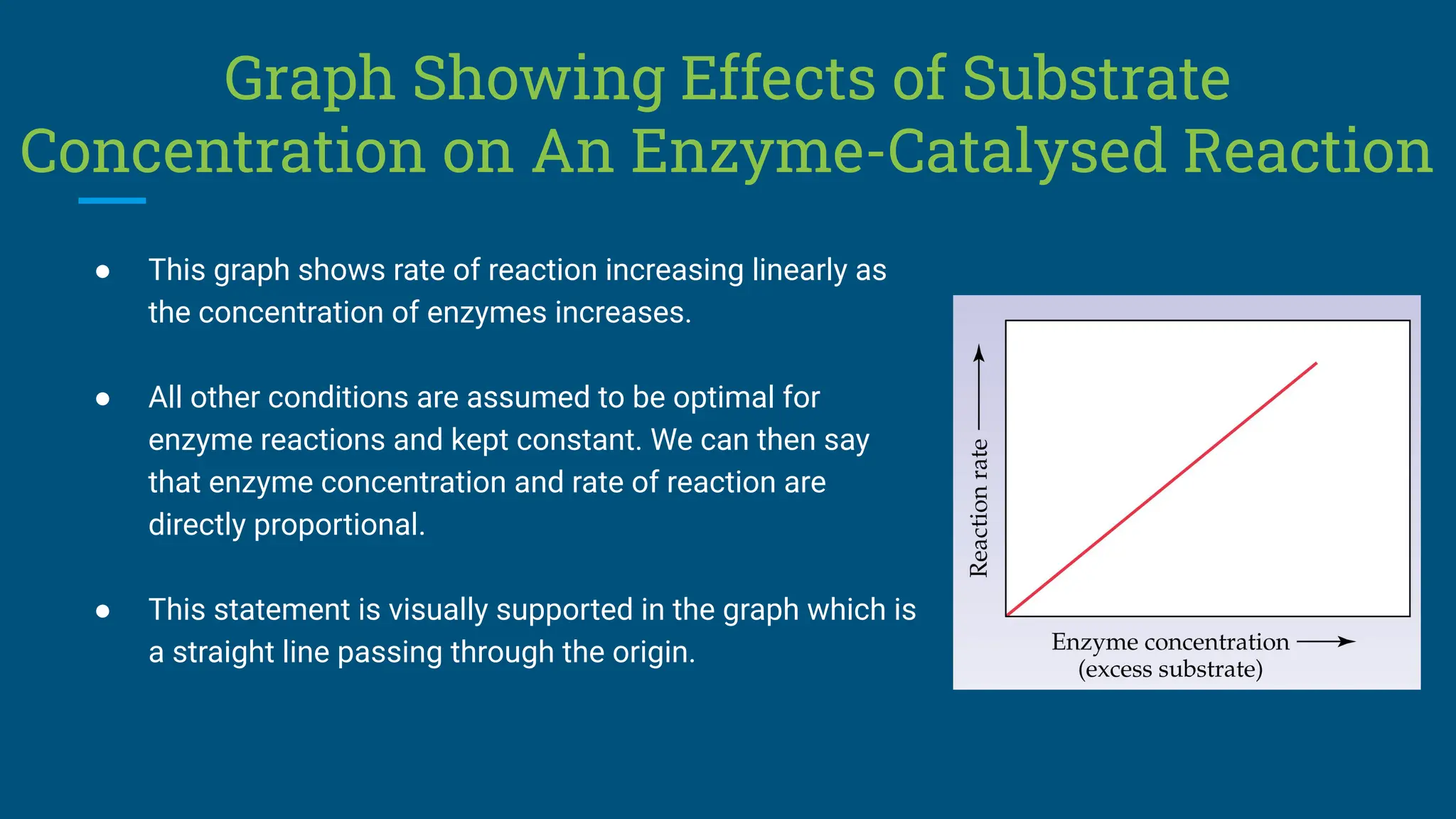
● This graph shows rate of reaction increasing linearly as
the concentration of enzymes increases.
● All other conditions are assumed to be optimal for
enzyme reactions and kept constant. We can then say
that enzyme concentration and rate of reaction are
directly proportional.
● This statement is visually supported in the graph which is
a straight line passing through the origin.
Inhibitors
Competitive and Non-Competitive Inhibitors
and how they affect enzymes
What is an Inhibitor?
● As we know, enzymes are extremely efficient, catalysing a number of reactions in a very
short amount of time, however reactions can be slowed down or even completely stopped
by certain substances.
● These substances are known as inhibitors. These inhibitors prevent the substrate from
binding with the enzyme active site, thereby impeding its ability to form products hence
reducing the rate of reaction.
● There are two major types of inhibition that exist: 1) Competitive Inhibition and
2) Non-competitive Inhibition
Competitive Inhibitors
● Were you ever involved in a situation where you competed with a friend or sibling to
see who can get a snack first?
● That, in a nutshell, is what occurs between the substrate and the inhibitor, where they
compete to see which can bind to the enzyme’s active site ( get the snack) first.
● The inhibitor is capable of binding to the enzyme’s active site due to its similarity of its
structure to the substrate. This inhibitor prevents the substrate from combining with
the active site and as a result less products will be formed (rate of reaction is
decreased).
Non-Competitive Inhibitors
● This type of inhibition is where the inhibitor binds to another part of the enzyme
instead of the active site, this part is known as the Allosteric site. An enzyme-inhibitor
complex is formed.
● This it distorts the structure of the enzyme (it alters the shape of the active site)
which prevents the substrate from being able to bind to the enzyme.
● This results in less products being formed and therefore a reduced rate of reaction.
Non-Competitive Inhibition (Reversible and Irreversible)
● Reversible- this means that when the inhibitor is removed from the enzyme, the enzyme
can function normally as its structure is not permanently damaged.
● Irreversible- as the name suggests, this is when the inhibitor causes permanent damage
to the enzyme structure such that it will no longer be able to carry out its function.
Comparison between the types of Inhibition
Examples
● Competitive Inhibition- The enzyme succinic dehydrogenase acts on the substrate
succinate to produce fumarate, a process important in Krebs Cycle, however a compound,
malonate, has a similar shape to succinate and can fit in the active site of the enzyme
therefore making it a competitive inhibitor. Antabuse is also a competitive inhibitor of
aldehyde dehydrogenase at the peripheral benzodiazepine receptor. This results in the
blockage of processing of alcohol, inducing an unpleasant reaction to consumption of it
and thereby helps patients reduce alcohol intake.
● Non- Competitive Inhibition- Heavy metals such as lead and mercury and poisons
binds permanently to the enzyme disrupting the disulphide bonds which maintain the the
tertiary structure in turn preventing the substrate from binding to the active site.
Organophosphates found in other toxic chemicals such as insecticides or even nerve gases
also non-competitive inhibitors.
References
● Google photos.
● Biology Unit 1 for CAPE Examinations by Myda Ramesar, Mary Jones and
Geoff Jones.
● Biological Sciences 1 and 2 by D.J. Taylor, N.P.O. Green and G.W. Stout.

BIOLOGY ENZYME PRESENTATION INCLUDING GRAPHS

  • 1.
    BIOLOGY ENZYMES PRESENTATION GROUP 3: -AndreNansingh -Aidan Persad -Nirad Persad -Nikhil Prabhakar -Naasir Rajack
  • 2.
    Enzymes Definition, types ofenzymes and metabolism
  • 3.
    What are Enzymes? ●Generally defined as biological catalysts, enzymes are globular proteins that have the unique capacity of speeding up a biochemical (metabolic) reactions without itself being altered by the reaction. ● Enzymes can be classified into two types : 1) Intracellular (Endoenzyme) 2) Extracellular(Exoenzyme)
  • 4.
    Intracellular and ExtracellularEnzymes ● Intracellular or Endoenzymes can be defined as enzymes that act inside cells which are responsible for the synthesis of cellular materials and the performing of catabolic reactions. ● Extracellular or Exoenzymes can be defined as enzymes that are secreted by cells which work on nutrients in the medium to allow foods to enter the cell by functioning outside.
  • 5.
    Key Terms ● Metabolism- The process involving a set of chemical reactions that modifies a molecule into another to essentially maintain the living state of a cell or an organism. Metabolism consists of anabolism and catabolism. ● Anabolism - This collectively refers to all the processes of chemical reactions that build larger molecules out of smaller molecules or atoms. ● Catabolism – This is the part of the metabolism responsible for breaking complex molecules down into smaller molecules.
  • 6.
    The mode of actionof enzymes Properties of enzymes, active site, enzyme-substrate complex, activation energy and enzyme specificity
  • 7.
    Properties of Enzymes 1.They are all proteins. 2. Biological catalysts (i.e. they speed up chemical reactions). 3. The catalysed reaction is reversible. 4. They are specific (only certain substrates can be acted upon by enzymes). 5. They are affected by temperature (work best at an optimum temperature). 6. Affected by pH (work best at an optimum pH). 7. They lower activation energy required for a reaction. 8. They remain unchanged after the reaction and can hence be reused. 9. Inhibited by inhibitors such as nicotine. 10. Required in small amounts as they are highly efficient.
  • 8.
    Active Site andEnzyme-Substrate Complex ● The active site refers to the specific region of an enzyme where a substrate binds and catalysis takes place. This region is lined by R Groups of some amino acids after the enzyme molecule is folded into its tertiary shape. ● The shape made by the R-groups determines which substrate can fit. When the substrate molecule is inside the active site the molecule is put under strain so that bonds break or form. This combination of enzyme and substrate forms an enzyme substrate complex.
  • 9.
    Activation Energy ● Activationenergy is the energy that must be overcome before a reaction can proceed. Enzymes allow reactions to occur with less energy required. They reduce the activation energy needed to make the reaction take place. They do this by distorting the shape of the substrate molecule when it binds at the enzyme’s active site.
  • 10.
    Enzyme Specificity ● Thespecificity of an enzyme is determined by the shape of its active site, which must be complementary to the shape of the substrate. This means that they have shapes that match or fit together. ● There are different degrees of specificity and some enzymes are specific only to one reaction. Others are less specific and will catalyse a number of reactions of the same type.
  • 11.
    Lock and KeyHypothesis ● The lock and key hypothesis states that the shape of the substrate and that of the respective enzyme’s active site must exactly correspond such that it fits perfectly and only for that pair of substrate and enzyme, hence the enzyme would be highly specific (similar to how only a certain key would match a certain lock).
  • 12.
    Induced Fit Hypothesis ●This refers to the process ,in an enzyme–substrate reaction, where the active site undergoes a slight change in shape in the presence of a substrate in order to accommodate the substrate. ● The enzyme is induced to undergo a slight alteration in shape to achieve an optimum fit for the substrate. The change in shape of the active site facilitates the enzyme reaction and after the reaction is completed, the product is released. The enzyme active site returns to its original shape and is ready to bind another substrate molecule.
  • 13.
    What is thedifference between Lock and Key and Induced Fit Hypothesis ● The Lock and Key hypothesis states that there is no change in shape of the enzyme’s active site needed and that only a certain type of substrate will fit into the active site. ● However, the induced fit hypothesis claims that the active site will alter its shape to allow the substrate to fit.
  • 14.
    Factors Affecting Enzymes Effects oftemperature, pH, enzyme concentration and substrate concentration on enzyme action
  • 15.
    Effects of Temperatureon Enzyme Action ● The rate at which an enzyme works is affected by the temperature of the surrounding environment. ● At very low temperatures, enzymes tend to work slowly or may be completely inactive, as the substrate molecules lack sufficient amounts of kinetic energy (K.E). ● As temperature increases, K.E. increases, hence, the molecules move faster and collide more frequently in the correct orientation, resulting in more enzyme-substrate complexes and therefore more products formed, hence a greater rate of reaction (R.O.R). ● The temperature at which the R.O.R is greatest is known as the optimum temperature. ● When the optimum temperature is exceeded, the atoms of the enzyme molecules possess a large amount of K.E. and vibrate at such a great speed that their bonds break and the shape of the active site is thus altered. The enzyme can no longer accommodate substrates and make products. It is then referred to as DENATURED.
  • 16.
    Graph Showing Effectsof Temperature on An Enzyme-Catalysed Reaction ● Take for example anaerobic respiration in yeast (which contains enzymes such as maltase, invertase and zymase). ● A- As temperature increases, substrate molecules (eg. glucose) have a higher K.E., collide more often with active sites of enzymes (zymase) and release more products (ethanol, energy and CO2 ). (Rate of Reaction increases) ● B- This is the optimum temperature (around 37O C) for enzyme activity. (Rate of Reaction is highest at this point) ● C- The bonds break due to the high speed of vibration of atoms and the shape of the active site is altered hence enzymes can no longer carry out their functions. (Enzyme is denatured and Rate of Reaction decreases) A B C
  • 17.
    Effects of pHon Enzyme Action ● Similarly as with temperature, the rate at which an enzyme works is also affected by the pH of the surrounding environment. pH is a measure of H+ ions present in solution. ● Most enzymes work best at a neutral pH (around 7.0), however, this varies between certain enzymes. Eg. Optimum pH of Pepsin= 1.5 - 2.0 and of Salivary Amylase= 6.7 - 7.0 (approximately). ● When the pH is too low ( too acidic), the high concentration of H+ ions prevents -COOH groups from ionising and when pH is too high ( too basic), the low concentration of H+ ions prevents -NH2 groups from ionising. ● Both of these conditions may cause ionic bonds between R groups in the enzyme molecules to break, resulting in the change of shape of the enzyme active site, hence denaturing the enzyme, preventing it from being able to carry out its functions again. ● The change in pH also disrupts hydrogen bonds in the enzyme structure which causes changes in the shape of the enzyme active site, causing it to become denatured.
  • 18.
    ● A- pHis too low and due to the high concentration of H+ ions in the solution, there is a disruption in both the ionic and hydrogen bonds in the enzyme, causing it to become denatured. ● B- Optimum pH, the enzymes can work at their greatest efficiency and hence rate of reaction will be highest at this point. ● C- pH is too high, as a result of the low concentration of H+ ions, the ionic and hydrogen bonds are disrupted resulting in the enzyme becoming denatured and no longer able to carry out its function. Graph Showing Effects of pH on An Enzyme-Catalysed Reaction A B C
  • 19.
    Effects of SubstrateConcentration on Enzyme Action ● It would be expected that as substrate concentration increases, enzyme action would also increase. This is indeed true, to a certain extent. ● If we were to increase substrate concentration while maintaining a constant enzyme concentration, the rate of reaction would steadily increase as more substrate molecules means that it is more likely for an enzyme to bind top a substrate and produce products. ● However there will come a point where each enzyme will be constantly working and the substrates are essentially ‘waiting their turn’ to bind to an enzyme becomes available. The enzyme concentration in this case is a limiting factor. ● At this point the rate of reaction ‘plateaus’ at a maximum rate of reaction.
  • 20.
    Graph Showing Effectsof Substrate Concentration on An Enzyme-Catalysed Reaction ● This graph shows that the rate of reaction increasing as substrate concentration increases. ● The previously mentioned ‘plateau’ is seen where the rate of reaction is at its highest possible value. ● This is known as the Vmax .
  • 21.
    Effects of EnzymeConcentration on Enzyme Action ● Enzyme concentration also has a major effect on the rate of reaction of enzymes. ● Assuming all other conditions are suitable and constant and there is an excess of substrates, rate of reaction increases proportionally to increase in enzyme concentration. ● When there is an increase in enzyme concentration, there are more enzymes present and hence more active sites for substrates to bind to and as a result more products will be formed (i.e. a greater rate of reaction will be achieved). ● The rate of reaction would only stop increasing and ‘level-off’ if the substrate concentration was to be limited or due to some other limiting factor.
  • 22.
    Graph Showing Effectsof Substrate Concentration on An Enzyme-Catalysed Reaction ● This graph shows rate of reaction increasing linearly as the concentration of enzymes increases. ● All other conditions are assumed to be optimal for enzyme reactions and kept constant. We can then say that enzyme concentration and rate of reaction are directly proportional. ● This statement is visually supported in the graph which is a straight line passing through the origin.
  • 23.
    Inhibitors Competitive and Non-CompetitiveInhibitors and how they affect enzymes
  • 24.
    What is anInhibitor? ● As we know, enzymes are extremely efficient, catalysing a number of reactions in a very short amount of time, however reactions can be slowed down or even completely stopped by certain substances. ● These substances are known as inhibitors. These inhibitors prevent the substrate from binding with the enzyme active site, thereby impeding its ability to form products hence reducing the rate of reaction. ● There are two major types of inhibition that exist: 1) Competitive Inhibition and 2) Non-competitive Inhibition
  • 25.
    Competitive Inhibitors ● Wereyou ever involved in a situation where you competed with a friend or sibling to see who can get a snack first? ● That, in a nutshell, is what occurs between the substrate and the inhibitor, where they compete to see which can bind to the enzyme’s active site ( get the snack) first. ● The inhibitor is capable of binding to the enzyme’s active site due to its similarity of its structure to the substrate. This inhibitor prevents the substrate from combining with the active site and as a result less products will be formed (rate of reaction is decreased).
  • 26.
    Non-Competitive Inhibitors ● Thistype of inhibition is where the inhibitor binds to another part of the enzyme instead of the active site, this part is known as the Allosteric site. An enzyme-inhibitor complex is formed. ● This it distorts the structure of the enzyme (it alters the shape of the active site) which prevents the substrate from being able to bind to the enzyme. ● This results in less products being formed and therefore a reduced rate of reaction.
  • 27.
    Non-Competitive Inhibition (Reversibleand Irreversible) ● Reversible- this means that when the inhibitor is removed from the enzyme, the enzyme can function normally as its structure is not permanently damaged. ● Irreversible- as the name suggests, this is when the inhibitor causes permanent damage to the enzyme structure such that it will no longer be able to carry out its function.
  • 28.
    Comparison between thetypes of Inhibition
  • 29.
    Examples ● Competitive Inhibition-The enzyme succinic dehydrogenase acts on the substrate succinate to produce fumarate, a process important in Krebs Cycle, however a compound, malonate, has a similar shape to succinate and can fit in the active site of the enzyme therefore making it a competitive inhibitor. Antabuse is also a competitive inhibitor of aldehyde dehydrogenase at the peripheral benzodiazepine receptor. This results in the blockage of processing of alcohol, inducing an unpleasant reaction to consumption of it and thereby helps patients reduce alcohol intake. ● Non- Competitive Inhibition- Heavy metals such as lead and mercury and poisons binds permanently to the enzyme disrupting the disulphide bonds which maintain the the tertiary structure in turn preventing the substrate from binding to the active site. Organophosphates found in other toxic chemicals such as insecticides or even nerve gases also non-competitive inhibitors.
  • 30.
    References ● Google photos. ●Biology Unit 1 for CAPE Examinations by Myda Ramesar, Mary Jones and Geoff Jones. ● Biological Sciences 1 and 2 by D.J. Taylor, N.P.O. Green and G.W. Stout.