Basic Biological Reactions
Presented by :
Meenakshi Das
M.Sc. 1st Semester
Department of Life Science and Bioinformatics
Assam University, Silchar
Introduction
Living Organisms and Chemical reactions
• Biological processes are the processes vital for
a living organism to live.
• Biological processes are made up of many
chemical reactions that give rise to chemical
transformation.
• Metabolism is the example.
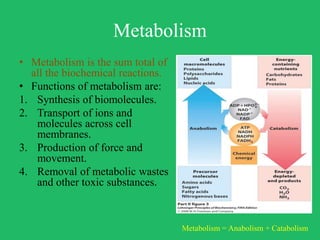
Metabolism
• Metabolism is the sum total of
all the biochemical reactions.
• Functions of metabolism are:
1. Synthesis of biomolecules.
2. Transport of ions and
molecules across cell
membranes.
3. Production of force and
movement.
4. Removal of metabolic wastes
and other toxic substances.
Metabolism = Anabolism + Catabolism
Biochemical Reactions
• Chemical reactions associated with biological
processes are of following main types:
Neutralization Reaction
Condensation Reaction
Oxidation-Reduction Reaction
Group transfer Reaction
Hydrolysis Reaction
Reactions involved in formation or removal of a double bond
with group transfer
Isomerization Reaction
Reactions involved in single bond formation by eliminating
the elements of water
Biological Reactions and Enzymes
ENZYME is a Biological CATALYST
Enzyme speeds up a biological reaction by
lowering activation energy
Enzymes are not used up during a reaction and can
be used over and over again
Enzymes are proteinaceous in nature (except –
Ribozyme)
 Enzymatic reactions are reversible
Enzymes are specific that is they control only one
reaction
Neutralization Reaction
• It is the interaction of an acid and a base to
form a salt and water.
• This reaction is important for maintaining a
constant pH in the body.
• Buffers helps in maintaining pH.
 It releases H+ ions when the fluid is too basic
 It takes up H+ ions when fluid is too acidic
Carbonic acid-hydrogen bicarbonate buffer
system
• This is an important buffer system in the body.
• The pairing of carbonic acid and hydrogen bicarbonate ion
allows a reaction which occurs in both directions.
• It allows hydrogen to be released or taken up depending upon
the conditions in the blood.
Oxidation-Reduction reaction
• This reaction involves the transfer of electrons
 Oxidation = loss of electrons
 Reduction = gain of electrons
• Electrons are very reactive
• If oxidation occurs to one molecule, reduction
must also immediately occurs to the other
molecule
• This reaction is called a REDOX Reaction
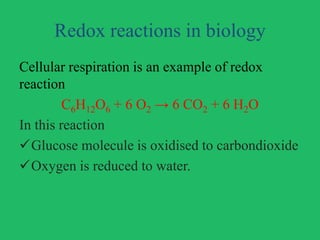
Redox reactions in biology
Cellular respiration is an example of redox
reaction
C6H12O6 + 6 O2 → 6 CO2 + 6 H2O
In this reaction
Glucose molecule is oxidised to carbondioxide
Oxygen is reduced to water.
Condensation Reaction
• This reaction is also called Dehydration synthesis.
• This reaction is involved in the formation of all
the four types of macromolecles.
• In this reaction,
H-atom is removed from a functional group of one
molecule and an OH group is removed from another
molecule
This reaction releases water along with the formation
of product
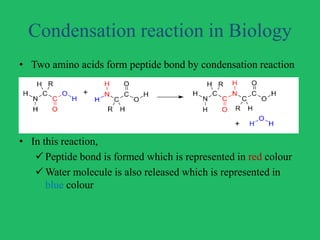
Condensation reaction in Biology
• Two amino acids form peptide bond by condensation reaction
• In this reaction,
 Peptide bond is formed which is represented in red colour
 Water molecule is also released which is represented in
blue colour
Hydrolysis Reaction
• This reaction helps in the breakdown of
macromolecules into their monomers.
Water is added to break the bonds between
monomers.
WATER gets IN, MONOMER gets OUT
Hydrogen from the water is added to one
monomer, and the OH group is added to the
adjacent monomer.
Covalent bond between the macromolecule breaks
down to form two monomers.
Hydrolysis reaction in biology
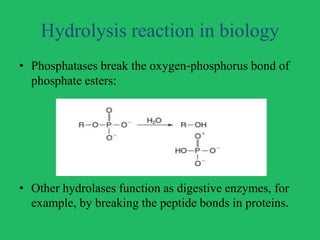
• Phosphatases break the oxygen‐phosphorus bond of
phosphate esters:
• Other hydrolases function as digestive enzymes, for
example, by breaking the peptide bonds in proteins.
Group transfer reactions
• In this reactions functional groups move from one molecule to another.
• The enzymes involved are called transferases
• For example, alanine aminotransferase shuffles the alpha‐amino group
between alanine and aspartate:
• Other transferases move phosphate groups between ATP and other
compounds, sugar residues to form disaccharides, and so on.
Reactions involved in formation or removal
of a double bond with group transfer
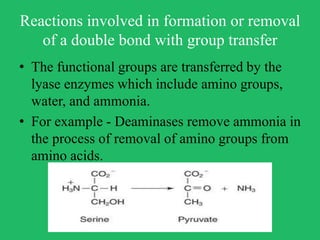
• The functional groups are transferred by the
lyase enzymes which include amino groups,
water, and ammonia.
• For example - Deaminases remove ammonia in
the process of removal of amino groups from
amino acids.
Isomerization Reaction
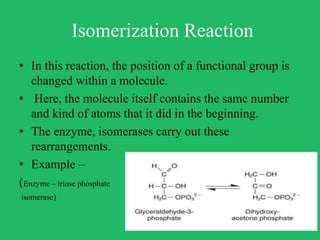
• In this reaction, the position of a functional group is
changed within a molecule.
• Here, the molecule itself contains the same number
and kind of atoms that it did in the beginning.
• The enzyme, isomerases carry out these
rearrangements.
• Example –
(Enzyme – triose phosphate
isomerase)
Reactions involved in single bond formation
by eliminating the elements of water
• In this reactions, water
molecule is removed from
two functional groups to form
a single bond.
• The enzyme, ligases carry out
the reactions.
• For example,
aminoacyl‐transfer RNA
synthetases join amino acids
to their respective transfer
RNAs in preparation for
protein synthesis
Conclusion
• Trillions of chemical reactions happen simultaneously in the
body. They lead the processes that keep a human body
‘alive’.
• They are collectively known as metabolism.
• Metabolism is made up of numerous metabolic pathways.
• A metabolic pathway is a sequence of chemical reactions
that follow a set of ‘instructions’ contained in the body’s
DNA.
• Enzymes are biochemical catalysts that alter the rate of
reactions. However, unlike most chemical catalysts,
enzymes are highly selective and only promote specific
reactions.
Basic biological reactions

Basic biological reactions

  • 1.
    Basic Biological Reactions Presentedby : Meenakshi Das M.Sc. 1st Semester Department of Life Science and Bioinformatics Assam University, Silchar
  • 2.
    Introduction Living Organisms andChemical reactions • Biological processes are the processes vital for a living organism to live. • Biological processes are made up of many chemical reactions that give rise to chemical transformation. • Metabolism is the example.
  • 3.
    Metabolism • Metabolism isthe sum total of all the biochemical reactions. • Functions of metabolism are: 1. Synthesis of biomolecules. 2. Transport of ions and molecules across cell membranes. 3. Production of force and movement. 4. Removal of metabolic wastes and other toxic substances. Metabolism = Anabolism + Catabolism
  • 4.
    Biochemical Reactions • Chemicalreactions associated with biological processes are of following main types: Neutralization Reaction Condensation Reaction Oxidation-Reduction Reaction Group transfer Reaction Hydrolysis Reaction Reactions involved in formation or removal of a double bond with group transfer Isomerization Reaction Reactions involved in single bond formation by eliminating the elements of water
  • 5.
    Biological Reactions andEnzymes ENZYME is a Biological CATALYST Enzyme speeds up a biological reaction by lowering activation energy Enzymes are not used up during a reaction and can be used over and over again Enzymes are proteinaceous in nature (except – Ribozyme)  Enzymatic reactions are reversible Enzymes are specific that is they control only one reaction
  • 6.
    Neutralization Reaction • Itis the interaction of an acid and a base to form a salt and water. • This reaction is important for maintaining a constant pH in the body. • Buffers helps in maintaining pH.  It releases H+ ions when the fluid is too basic  It takes up H+ ions when fluid is too acidic
  • 7.
    Carbonic acid-hydrogen bicarbonatebuffer system • This is an important buffer system in the body. • The pairing of carbonic acid and hydrogen bicarbonate ion allows a reaction which occurs in both directions. • It allows hydrogen to be released or taken up depending upon the conditions in the blood.
  • 8.
    Oxidation-Reduction reaction • Thisreaction involves the transfer of electrons  Oxidation = loss of electrons  Reduction = gain of electrons • Electrons are very reactive • If oxidation occurs to one molecule, reduction must also immediately occurs to the other molecule • This reaction is called a REDOX Reaction
  • 9.
    Redox reactions inbiology Cellular respiration is an example of redox reaction C6H12O6 + 6 O2 → 6 CO2 + 6 H2O In this reaction Glucose molecule is oxidised to carbondioxide Oxygen is reduced to water.
  • 10.
    Condensation Reaction • Thisreaction is also called Dehydration synthesis. • This reaction is involved in the formation of all the four types of macromolecles. • In this reaction, H-atom is removed from a functional group of one molecule and an OH group is removed from another molecule This reaction releases water along with the formation of product
  • 11.
    Condensation reaction inBiology • Two amino acids form peptide bond by condensation reaction • In this reaction,  Peptide bond is formed which is represented in red colour  Water molecule is also released which is represented in blue colour
  • 12.
    Hydrolysis Reaction • Thisreaction helps in the breakdown of macromolecules into their monomers. Water is added to break the bonds between monomers. WATER gets IN, MONOMER gets OUT Hydrogen from the water is added to one monomer, and the OH group is added to the adjacent monomer. Covalent bond between the macromolecule breaks down to form two monomers.
  • 13.
    Hydrolysis reaction inbiology • Phosphatases break the oxygen‐phosphorus bond of phosphate esters: • Other hydrolases function as digestive enzymes, for example, by breaking the peptide bonds in proteins.
  • 14.
    Group transfer reactions •In this reactions functional groups move from one molecule to another. • The enzymes involved are called transferases • For example, alanine aminotransferase shuffles the alpha‐amino group between alanine and aspartate: • Other transferases move phosphate groups between ATP and other compounds, sugar residues to form disaccharides, and so on.
  • 15.
    Reactions involved information or removal of a double bond with group transfer • The functional groups are transferred by the lyase enzymes which include amino groups, water, and ammonia. • For example - Deaminases remove ammonia in the process of removal of amino groups from amino acids.
  • 16.
    Isomerization Reaction • Inthis reaction, the position of a functional group is changed within a molecule. • Here, the molecule itself contains the same number and kind of atoms that it did in the beginning. • The enzyme, isomerases carry out these rearrangements. • Example – (Enzyme – triose phosphate isomerase)
  • 17.
    Reactions involved insingle bond formation by eliminating the elements of water • In this reactions, water molecule is removed from two functional groups to form a single bond. • The enzyme, ligases carry out the reactions. • For example, aminoacyl‐transfer RNA synthetases join amino acids to their respective transfer RNAs in preparation for protein synthesis
  • 18.
    Conclusion • Trillions ofchemical reactions happen simultaneously in the body. They lead the processes that keep a human body ‘alive’. • They are collectively known as metabolism. • Metabolism is made up of numerous metabolic pathways. • A metabolic pathway is a sequence of chemical reactions that follow a set of ‘instructions’ contained in the body’s DNA. • Enzymes are biochemical catalysts that alter the rate of reactions. However, unlike most chemical catalysts, enzymes are highly selective and only promote specific reactions.