RHS Level 2 Certificate
Week 9 –
Photosynthesis,
respiration, transpiration
and nutrient and water
transport
Learning outcomes
1. Photosynthesis and respiration
1.1 State the basic equation for photosynthesis in words.
1.2 Describe how the efficiency of photosynthesis is determined by temperature,
light, carbon dioxide, mineral nutrients and water.
1.3 State the basic equations for aerobic and anaerobic respiration in words.
1.4 Describe how the efficiency of respiration is determined by oxygen, water, and
temperature.
2. Transportation within the plant
2.1 Define the term: ‘transpiration’ and describe how water and minerals move
through the plant.
2.2 Name the tissue that is involved in this process.
2.3 Explain the role of xylem and phloem and describe their location within stems
and roots.
2.4 Describe diffusion and osmosis and their roles within the plant, including
gaseous and liquid diffusion, transpiration, and water uptake
2.5 Describe how stomata control the release of water from the leaf.
2.6 State what is meant by evaporation and how the plant may limit water loss.
2.7 State the effects of relative humidity and temperature on transpiration and water
loss.
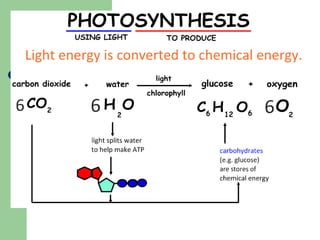
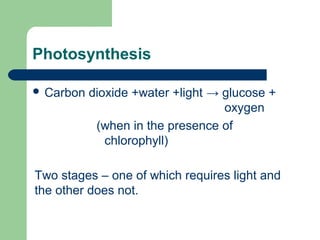
Photosynthesis
 Carbon

dioxide +water +light → glucose +
oxygen
(when in the presence of
chlorophyll)

Two stages – one of which requires light and
the other does not.
The photosynthetic process –light
dependent phase
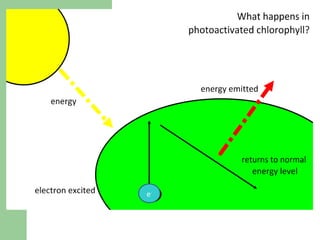
A

molecule of chlorophyll is excited by a
photon of light and an electron ‘escapes’.
This energy is used to split molecules of
water (H2O) into their component hydrogen
and oxygen. The oxygen is released as a
by-product into the atmosphere.
 The energy released by breaking the
chemical bonds in the water is incorporated,
with the hydrogen, into energy carrying
molecules called ATP and NADPH2
e-
Photosynthesis – light independent
phase (Calvin-Benson Cycle)
 The

•

energy produced in the light dependent
cycle is used in the chloroplast to convert
carbon dioxide from the atmosphere into
glucose (simple carbohydrate).
This phase takes place both in the day and at
night until the products of the light dependent
phase are used up– it does not need light to
operate.
Limiting Factors
 If

a process is influenced by more than
one factor, the rate of the process will
be limited by the factor that is in lowest
supply.
 Limiting factors apply to photosynthesis
and respiration
Limiting factors for photosynthesis








Light – only part of the wavelength of light from the
sun is used (PAR – photosynthetically active
radiation).
Carbon dioxide – more than enough of this in the
open air, but under glass may become depleted.
Water –lack of water leads to the stomata closing,
preventing carbon dioxide entering the leaf.
Temperature – the chemical reactions in
photosynthesis are temperature sensitive. Ideal
range 25°C - 36°C.
Nutrients – nutrients from the soil are needed to
make chlorophyll. E.g. magnesium deficient plants
photosynthesise poorly.
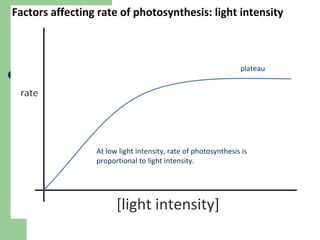
plateau

At low light intensity, rate of photosynthesis is
proportional to light intensity.
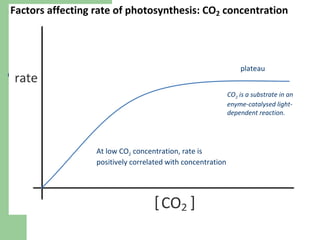
plateau
CO2 is a substrate in an
enyme-catalysed lightdependent reaction.

At low CO2 concentration, rate is
positively correlated with concentration
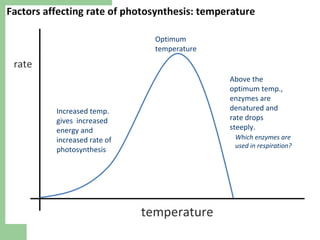
Optimum
temperature

Increased temp.
gives increased
energy and
increased rate of
photosynthesis

Above the
optimum temp.,
enzymes are
denatured and
rate drops
steeply.
Which enzymes are
used in respiration?
Respiration – in the mitochondria
Glucose + oxygen →carbon dioxide + water+
energy
•Looks

familiar? It’s the chemical equation for
photosynthesis in reverse!
•Anaerobic

fermentation

respiration – does not use oxygen. E.g.

Carbohydrate > (enzymes) = ethanol + carbon
dioxide + energy
Limiting factors of respiration
 Temperature

–The ideal range is 36°C
(ideal) down to 0°C.
 Oxygen - aerobic respiration (only)
requires oxygen in sufficient concentration;
reduced oxygen leads to slower respiration.
 Water

loss – closure of stomata due to
water loss prevents oxygen from entering
the plant and slows respiration.
Osmosis and diffusion
Osmosis – the movement of water molecules
from an area of high water potential to an area of
low water potential through a semi- permeable
membrane.
 Diffusion - the movement of molecules of a gas
or liquid from an area of high concentration to an
area of relatively low concentration. Note the
difference – no semi-permeable membrane.
 Concentration gradient – the steeper it is the
quicker the movement.

Transportation of water and nutrients
 Xylem

– transports water from the roots to
the shoots; enters by osmosis, pushed up a
little way by osmotic pressure and then is
drawn up by transpirational pull. This is a
mechanical process.
 Xylem cells are long, wide and open ended;
dead once mature. Linked end to end and
also laterally through pores called pits
Effects of humidity and temperature on
transpiration
 High

humidity =lower transpiration because
the rate of diffusion will fall. This is why
greenhouse growers damp down the floor of
the greenhouse in hot weather.
 The higher the temperature outside the leaf
the more quickly water in the spaces in the
spongy mesophyll will evaporate. The more
water vapour within the leaf the faster the
rate of transpiration through diffusion.
Transportation of water and minerals
 Phloem

– transports carbohydrates and plant
growth regulators around the plant from the
leaves.
 Composed of sieve cells which form hollow
living tubes and companion cells which
provide energy to move the sap.
 This active transport means that the
carbohydrates can be moved to parts of the
plant (such as tap root cortex) that are
already rich in these substances.
Learning outcomes
1. Photosynthesis and respiration
1.1 State the basic equation for photosynthesis in words.
1.2 Describe how the efficiency of photosynthesis is determined by temperature,
light, carbon dioxide, mineral nutrients and water.
1.3 State the basic equations for aerobic and anaerobic respiration in words.
1.4 Describe how the efficiency of respiration is determined by oxygen, water, and
temperature.
2. Transportation within the plant
2.1 Define the term: ‘transpiration’ and describe how water and minerals move
through the plant.
2.2 Name the tissue that is involved in this process.
2.3 Explain the role of xylem and phloem and describe their location within stems
and roots.
2.4 Describe diffusion and osmosis and their roles within the plant, including
gaseous and liquid diffusion, transpiration, and water uptake
2.5 Describe how stomata control the release of water from the leaf.
2.6 State what is meant by evaporation and how the plant may limit water loss.
2.7 State the effects of relative humidity and temperature on transpiration and water
loss.

Year 1 week 8 2013

  • 1.
    RHS Level 2Certificate Week 9 – Photosynthesis, respiration, transpiration and nutrient and water transport
  • 2.
    Learning outcomes 1. Photosynthesisand respiration 1.1 State the basic equation for photosynthesis in words. 1.2 Describe how the efficiency of photosynthesis is determined by temperature, light, carbon dioxide, mineral nutrients and water. 1.3 State the basic equations for aerobic and anaerobic respiration in words. 1.4 Describe how the efficiency of respiration is determined by oxygen, water, and temperature. 2. Transportation within the plant 2.1 Define the term: ‘transpiration’ and describe how water and minerals move through the plant. 2.2 Name the tissue that is involved in this process. 2.3 Explain the role of xylem and phloem and describe their location within stems and roots. 2.4 Describe diffusion and osmosis and their roles within the plant, including gaseous and liquid diffusion, transpiration, and water uptake 2.5 Describe how stomata control the release of water from the leaf. 2.6 State what is meant by evaporation and how the plant may limit water loss. 2.7 State the effects of relative humidity and temperature on transpiration and water loss.
  • 4.
    Photosynthesis  Carbon dioxide +water+light → glucose + oxygen (when in the presence of chlorophyll) Two stages – one of which requires light and the other does not.
  • 5.
    The photosynthetic process–light dependent phase A molecule of chlorophyll is excited by a photon of light and an electron ‘escapes’. This energy is used to split molecules of water (H2O) into their component hydrogen and oxygen. The oxygen is released as a by-product into the atmosphere.  The energy released by breaking the chemical bonds in the water is incorporated, with the hydrogen, into energy carrying molecules called ATP and NADPH2
  • 6.
  • 7.
    Photosynthesis – lightindependent phase (Calvin-Benson Cycle)  The • energy produced in the light dependent cycle is used in the chloroplast to convert carbon dioxide from the atmosphere into glucose (simple carbohydrate). This phase takes place both in the day and at night until the products of the light dependent phase are used up– it does not need light to operate.
  • 8.
    Limiting Factors  If aprocess is influenced by more than one factor, the rate of the process will be limited by the factor that is in lowest supply.  Limiting factors apply to photosynthesis and respiration
  • 9.
    Limiting factors forphotosynthesis      Light – only part of the wavelength of light from the sun is used (PAR – photosynthetically active radiation). Carbon dioxide – more than enough of this in the open air, but under glass may become depleted. Water –lack of water leads to the stomata closing, preventing carbon dioxide entering the leaf. Temperature – the chemical reactions in photosynthesis are temperature sensitive. Ideal range 25°C - 36°C. Nutrients – nutrients from the soil are needed to make chlorophyll. E.g. magnesium deficient plants photosynthesise poorly.
  • 10.
    plateau At low lightintensity, rate of photosynthesis is proportional to light intensity.
  • 11.
    plateau CO2 is asubstrate in an enyme-catalysed lightdependent reaction. At low CO2 concentration, rate is positively correlated with concentration
  • 12.
    Optimum temperature Increased temp. gives increased energyand increased rate of photosynthesis Above the optimum temp., enzymes are denatured and rate drops steeply. Which enzymes are used in respiration?
  • 13.
    Respiration – inthe mitochondria Glucose + oxygen →carbon dioxide + water+ energy •Looks familiar? It’s the chemical equation for photosynthesis in reverse! •Anaerobic fermentation respiration – does not use oxygen. E.g. Carbohydrate > (enzymes) = ethanol + carbon dioxide + energy
  • 14.
    Limiting factors ofrespiration  Temperature –The ideal range is 36°C (ideal) down to 0°C.  Oxygen - aerobic respiration (only) requires oxygen in sufficient concentration; reduced oxygen leads to slower respiration.  Water loss – closure of stomata due to water loss prevents oxygen from entering the plant and slows respiration.
  • 15.
    Osmosis and diffusion Osmosis– the movement of water molecules from an area of high water potential to an area of low water potential through a semi- permeable membrane.  Diffusion - the movement of molecules of a gas or liquid from an area of high concentration to an area of relatively low concentration. Note the difference – no semi-permeable membrane.  Concentration gradient – the steeper it is the quicker the movement. 
  • 16.
    Transportation of waterand nutrients  Xylem – transports water from the roots to the shoots; enters by osmosis, pushed up a little way by osmotic pressure and then is drawn up by transpirational pull. This is a mechanical process.  Xylem cells are long, wide and open ended; dead once mature. Linked end to end and also laterally through pores called pits
  • 17.
    Effects of humidityand temperature on transpiration  High humidity =lower transpiration because the rate of diffusion will fall. This is why greenhouse growers damp down the floor of the greenhouse in hot weather.  The higher the temperature outside the leaf the more quickly water in the spaces in the spongy mesophyll will evaporate. The more water vapour within the leaf the faster the rate of transpiration through diffusion.
  • 18.
    Transportation of waterand minerals  Phloem – transports carbohydrates and plant growth regulators around the plant from the leaves.  Composed of sieve cells which form hollow living tubes and companion cells which provide energy to move the sap.  This active transport means that the carbohydrates can be moved to parts of the plant (such as tap root cortex) that are already rich in these substances.
  • 19.
    Learning outcomes 1. Photosynthesisand respiration 1.1 State the basic equation for photosynthesis in words. 1.2 Describe how the efficiency of photosynthesis is determined by temperature, light, carbon dioxide, mineral nutrients and water. 1.3 State the basic equations for aerobic and anaerobic respiration in words. 1.4 Describe how the efficiency of respiration is determined by oxygen, water, and temperature. 2. Transportation within the plant 2.1 Define the term: ‘transpiration’ and describe how water and minerals move through the plant. 2.2 Name the tissue that is involved in this process. 2.3 Explain the role of xylem and phloem and describe their location within stems and roots. 2.4 Describe diffusion and osmosis and their roles within the plant, including gaseous and liquid diffusion, transpiration, and water uptake 2.5 Describe how stomata control the release of water from the leaf. 2.6 State what is meant by evaporation and how the plant may limit water loss. 2.7 State the effects of relative humidity and temperature on transpiration and water loss.

Editor's Notes

  • #4 Photosynthesis title, definition and equation.
  • #7 Photoactivation of chlorophyll – electrons are excited and return to their original state, releasing oxygen.
  • #11 Light intensity affects rate of photosynthesis.
  • #12 CO2 affects rate of photosynthesis. CO2 is the substrate in carbon fixation (Calvin cycle) – rubisco is the enzyme.
  • #13 Temperature affects the rate of photosynthesis. Remember enzyme theory. Enzymes used in respiration: rubisco is the main one. ATP synthase can also be denatured.