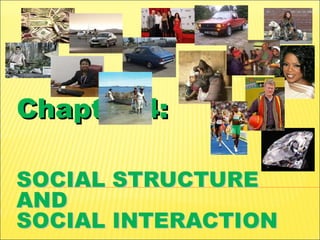
Chapter 4:
Social Interaction  – the ways that people interact with one another Macrosociology  – Analysis of social life that focuses on broad features of society, such as social class and the relationships of groups to one another; usually used by functionalists and conflict theorists  Large-Scale Features of Social Life Microsociology  – Analysis of social life that focuses on social interaction; typically used by symbolic integrationists Focus on Social Interaction
Sociological Significance of Social Structure Social Structure  – the framework that surrounds us, consisting of the relationships of people and groups, which gives direction to and sets limits on behavior Guides Our Behavior Behavior Decided by Location in Social Structure Culture Social Class  – according to Weber, a large group of people who rank close to one another in wealth, prestige, and power; according to Marx, one of two groups: capitalists who own the means of production or workers who sell their labor.
Social Class Divides People by… Income Education Occupational Prestige Social  Status  – the position that someone occupies in society or in a social group
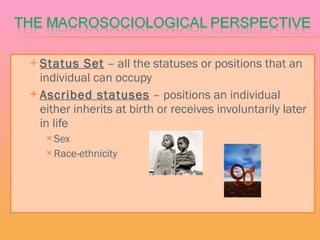
Status Set  – all the statuses or positions that an individual can occupy Ascribed statuses  – positions an individual either inherits at birth or receives involuntarily later in life Sex Race-ethnicity
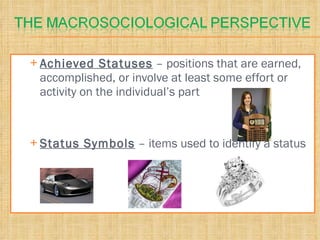
Achieved Statuses  – positions that are earned, accomplished, or involve at least some effort or activity on the individual’s part Status Symbols  – items used to identify a status
Master Status  – a status that cuts across all other statuses that an individual occupies Status inconsistency   - ranking high on some dimensions of social class and low on others, also called  Status Discrepancy Examples: a 14 year old college student…..or a 40 year old married woman who is dating a 19 year old college sophomore
Role  – the behaviors, obligations, and privileges attached to a status The difference between a role and a status.. Occupy Status Play Role Group  – people who have something in common and who believe that what they have in common is significant; also called a Social Group
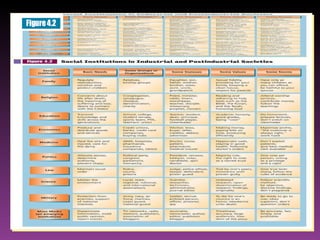
Sociological Significance of Social Institutions Social Institutions – the organized, usual, or standard ways by which society meets its basic needs Ten Social Institutions in Industrialized Societies See page 105
 
 
Mass Media as an Emerging Social Institution Media is starting to shape public opinion
Functionalist Perspective Functional Requisites  – the major tasks that a society  must fulfill if it is to survive Replacing members, Socializing new members, producing and distributing goods and services, Preserving order, providing a sense of purpose Conflict Perspective Powerful Groups Control Institutions Small Groups Garner Lion’s Share of Wealth Social Institutions Affect Gender Relations Main Purpose is to Preserve Social Order
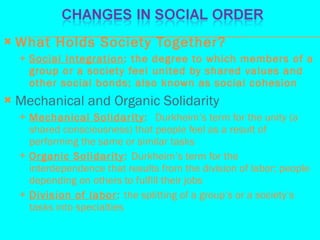
What Holds Society Together? Social Integration : the degree to which members of a group or a society feel united by shared values and other social bonds; also known as social cohesion Mechanical and Organic Solidarity Mechanical Solidarity :  Durkheim’s term for the unity (a shared consciousness) that people feel as a result of performing the same or similar tasks Organic Solidarity :  Durkheim’s term for the interdependence that results from the division of labor; people depending on others to fulfill their jobs Division of labor :  the splitting of a group’s or a society’s tasks into specialties
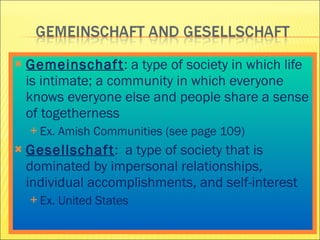
Gemeinschaft : a type of society in which life is intimate; a community in which everyone knows everyone else and people share a sense of togetherness Ex. Amish Communities (see page 109) Gesellschaft :  a type of society that is dominated by impersonal relationships, individual accomplishments, and self-interest Ex. United States
Stereotypes :  assumptions of what people are like, whether true or false Classify Others By Visible Characteristics Ideas About Characteristics Guide Our Behavior
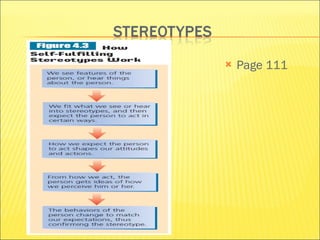
Page 111
Personal Space Intimate Distance, Personal Distance, Social Distance, Public Distance Touching Eye Contact Applied Body Language  TSA using this to fight terrorism (reading facial expressions, looking for nervousness, ect.) Body Language :  The ways in which people use their bodies to give messages to others, much of which is done subconsciously
Dramaturgy :  an approach pioneered by Erving Goffman, in which social life is analyzed in terms of drama or the stage; also called dramaturgical analysis Impression Management : people’s efforts to control the impressions that others receive of them Front stage : where performances are given  Back stage : where people rest from their performances, discuss their presentations, and plan future performances
Role Performance :  The ways in which someone performs a role, showing a particular “style” or “personality” Role Conflict : conflicts that someone else feels between roles because the expectations attached to one role are incompatible with the expectations of another role Role Strain : Conflicts that someone feels within a role
 
Sign Vehicles : the term used by Goffman to refer to how people use social setting, appearance, and manner to communicate information about the self Teamwork : the collaboration of two or more people to manage impressions jointly Face saving behavior : techniques used to salvage a performance that is going sour We become the roles we play.
Ethnomethodology : The study of how people use background assumptions to make sense out of life Background Assumptions : deeply embedded common understandings of how the world operates and how people ought to act  Harold Garfinkle experiments page 118
Thomas Theorem : William I. and Dorothy S. Thomas’ classic formulation of the definition of the situation: “If people define situations as real, they are real in their consequences” Social Construct of Reality : the use of background assumptions and life experiences to define what is real

Chapter 4 Social Structure & Social Interaction

  • 1.
  • 2.
    Social Interaction – the ways that people interact with one another Macrosociology – Analysis of social life that focuses on broad features of society, such as social class and the relationships of groups to one another; usually used by functionalists and conflict theorists Large-Scale Features of Social Life Microsociology – Analysis of social life that focuses on social interaction; typically used by symbolic integrationists Focus on Social Interaction
  • 3.
    Sociological Significance ofSocial Structure Social Structure – the framework that surrounds us, consisting of the relationships of people and groups, which gives direction to and sets limits on behavior Guides Our Behavior Behavior Decided by Location in Social Structure Culture Social Class – according to Weber, a large group of people who rank close to one another in wealth, prestige, and power; according to Marx, one of two groups: capitalists who own the means of production or workers who sell their labor.
  • 4.
    Social Class DividesPeople by… Income Education Occupational Prestige Social Status – the position that someone occupies in society or in a social group
  • 5.
    Status Set – all the statuses or positions that an individual can occupy Ascribed statuses – positions an individual either inherits at birth or receives involuntarily later in life Sex Race-ethnicity
  • 6.
    Achieved Statuses – positions that are earned, accomplished, or involve at least some effort or activity on the individual’s part Status Symbols – items used to identify a status
  • 7.
    Master Status – a status that cuts across all other statuses that an individual occupies Status inconsistency - ranking high on some dimensions of social class and low on others, also called Status Discrepancy Examples: a 14 year old college student…..or a 40 year old married woman who is dating a 19 year old college sophomore
  • 8.
    Role –the behaviors, obligations, and privileges attached to a status The difference between a role and a status.. Occupy Status Play Role Group – people who have something in common and who believe that what they have in common is significant; also called a Social Group
  • 9.
    Sociological Significance ofSocial Institutions Social Institutions – the organized, usual, or standard ways by which society meets its basic needs Ten Social Institutions in Industrialized Societies See page 105
  • 10.
  • 11.
  • 12.
    Mass Media asan Emerging Social Institution Media is starting to shape public opinion
  • 13.
    Functionalist Perspective FunctionalRequisites – the major tasks that a society must fulfill if it is to survive Replacing members, Socializing new members, producing and distributing goods and services, Preserving order, providing a sense of purpose Conflict Perspective Powerful Groups Control Institutions Small Groups Garner Lion’s Share of Wealth Social Institutions Affect Gender Relations Main Purpose is to Preserve Social Order
  • 14.
    What Holds SocietyTogether? Social Integration : the degree to which members of a group or a society feel united by shared values and other social bonds; also known as social cohesion Mechanical and Organic Solidarity Mechanical Solidarity : Durkheim’s term for the unity (a shared consciousness) that people feel as a result of performing the same or similar tasks Organic Solidarity : Durkheim’s term for the interdependence that results from the division of labor; people depending on others to fulfill their jobs Division of labor : the splitting of a group’s or a society’s tasks into specialties
  • 15.
    Gemeinschaft : atype of society in which life is intimate; a community in which everyone knows everyone else and people share a sense of togetherness Ex. Amish Communities (see page 109) Gesellschaft : a type of society that is dominated by impersonal relationships, individual accomplishments, and self-interest Ex. United States
  • 16.
    Stereotypes : assumptions of what people are like, whether true or false Classify Others By Visible Characteristics Ideas About Characteristics Guide Our Behavior
  • 17.
  • 18.
    Personal Space IntimateDistance, Personal Distance, Social Distance, Public Distance Touching Eye Contact Applied Body Language TSA using this to fight terrorism (reading facial expressions, looking for nervousness, ect.) Body Language : The ways in which people use their bodies to give messages to others, much of which is done subconsciously
  • 19.
    Dramaturgy : an approach pioneered by Erving Goffman, in which social life is analyzed in terms of drama or the stage; also called dramaturgical analysis Impression Management : people’s efforts to control the impressions that others receive of them Front stage : where performances are given Back stage : where people rest from their performances, discuss their presentations, and plan future performances
  • 20.
    Role Performance : The ways in which someone performs a role, showing a particular “style” or “personality” Role Conflict : conflicts that someone else feels between roles because the expectations attached to one role are incompatible with the expectations of another role Role Strain : Conflicts that someone feels within a role
  • 21.
  • 22.
    Sign Vehicles :the term used by Goffman to refer to how people use social setting, appearance, and manner to communicate information about the self Teamwork : the collaboration of two or more people to manage impressions jointly Face saving behavior : techniques used to salvage a performance that is going sour We become the roles we play.
  • 23.
    Ethnomethodology : Thestudy of how people use background assumptions to make sense out of life Background Assumptions : deeply embedded common understandings of how the world operates and how people ought to act Harold Garfinkle experiments page 118
  • 24.
    Thomas Theorem :William I. and Dorothy S. Thomas’ classic formulation of the definition of the situation: “If people define situations as real, they are real in their consequences” Social Construct of Reality : the use of background assumptions and life experiences to define what is real