



SELF & COOLEY’S
LOOKING GLASS SELF
SELF
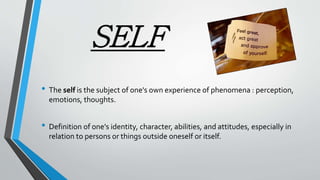
• The self is the subject of one's own experience of phenomena : perception,
emotions, thoughts.
• Definition of one's identity, character, abilities, and attitudes, especially in
relation to persons or things outside oneself or itself.
EXAMPLE OF SELF
• My name is _____ and I'm a future _____ (doctor/chef/teacher/etc.).
• Someday I would like to _____ (change the world/make a difference) by____
(volunteering/etc..).
• Most people would describe me as ____, ____, and ____, but I describe myself
as ____(cheerful/helpful/shy/etc.).
• I was born in _____ (city/state/country) and I was raised in _____
(city/state/country).
• I have a fear of _____ but I think ____ (lizards/wildlife/etc.) is neat, even
though that's an unusual interest.
• My favorite quote of all time is “___" because it give____ (hope/laughter/etc.) .
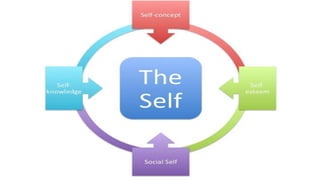
TYPES OF SELF
SELF CONCEPT
• Self-concept (also called self-construction, self-identity, or self-
perspective) is a collection of beliefs about oneself.
• It includes elements such as academic performance, gender roles and
racial identity.
• Generally, self-concept embodies the answer to "Who am I?
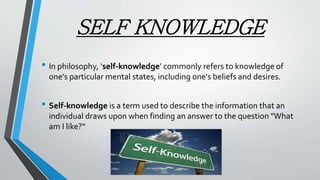
SELF KNOWLEDGE
• In philosophy, ‘self-knowledge’ commonly refers to knowledge of
one's particular mental states, including one's beliefs and desires.
• Self-knowledge is a term used to describe the information that an
individual draws upon when finding an answer to the question "What
am I like?“
SELF ESTEEM
• The Self esteem refers to having esteem in one's self (having self
confidence and feeling good about yourself).
• In easy words:
A confidence and satisfaction in oneself.
SOCIAL SELF
• Social self is a part of self that engages face to face, in relation to
others.
• Social self can include gender , place of residence , age , or any
other categorization that helps to characterize a person identity.
CHARLES COOLEY
• Charles Cooley (August 17, 1864 – May 8, 1929) was an American sociologist and
the son ofThomas M. Cooley.
• He studied and went on to teach economics and sociology at the University of
Michigan.
• He was a founding member and the eighth president of theAmerican
Sociological Association.
• He is perhaps best known for his concept of the looking glass self, which is the
concept that a person's self grows out of society's interpersonal interactions and
the perceptions of others.
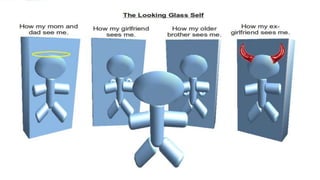
LOOKING GLASS SELF
• The looking-glass self is a social psychological concept, created by Charles
Horton Cooley in 1902.
• The concept of the "looking glass-self" is undoubtedly his most famous, and
is known and accepted by most psychologists and sociologists today.
• The term "looking glass self" was first used by Cooley in his work, Human
Nature and the Social Order in 1902.
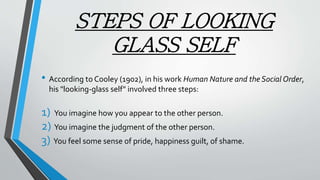
STEPS OF LOOKING
GLASS SELF
• According to Cooley (1902), in his work Human Nature and the Social Order,
his "looking-glass self" involved three steps:
1) You imagine how you appear to the other person.
2) You imagine the judgment of the other person.
3) You feel some sense of pride, happiness guilt, of shame.
Ch cooley
Ch cooley

Ch cooley

  • 1.
  • 2.
    SELF • The selfis the subject of one's own experience of phenomena : perception, emotions, thoughts. • Definition of one's identity, character, abilities, and attitudes, especially in relation to persons or things outside oneself or itself.
  • 3.
    EXAMPLE OF SELF •My name is _____ and I'm a future _____ (doctor/chef/teacher/etc.). • Someday I would like to _____ (change the world/make a difference) by____ (volunteering/etc..). • Most people would describe me as ____, ____, and ____, but I describe myself as ____(cheerful/helpful/shy/etc.). • I was born in _____ (city/state/country) and I was raised in _____ (city/state/country). • I have a fear of _____ but I think ____ (lizards/wildlife/etc.) is neat, even though that's an unusual interest. • My favorite quote of all time is “___" because it give____ (hope/laughter/etc.) .
  • 4.
  • 5.
    SELF CONCEPT • Self-concept(also called self-construction, self-identity, or self- perspective) is a collection of beliefs about oneself. • It includes elements such as academic performance, gender roles and racial identity. • Generally, self-concept embodies the answer to "Who am I?
  • 6.
    SELF KNOWLEDGE • Inphilosophy, ‘self-knowledge’ commonly refers to knowledge of one's particular mental states, including one's beliefs and desires. • Self-knowledge is a term used to describe the information that an individual draws upon when finding an answer to the question "What am I like?“
  • 7.
    SELF ESTEEM • TheSelf esteem refers to having esteem in one's self (having self confidence and feeling good about yourself). • In easy words: A confidence and satisfaction in oneself.
  • 8.
    SOCIAL SELF • Socialself is a part of self that engages face to face, in relation to others. • Social self can include gender , place of residence , age , or any other categorization that helps to characterize a person identity.
  • 9.
    CHARLES COOLEY • CharlesCooley (August 17, 1864 – May 8, 1929) was an American sociologist and the son ofThomas M. Cooley. • He studied and went on to teach economics and sociology at the University of Michigan. • He was a founding member and the eighth president of theAmerican Sociological Association. • He is perhaps best known for his concept of the looking glass self, which is the concept that a person's self grows out of society's interpersonal interactions and the perceptions of others.
  • 10.
    LOOKING GLASS SELF •The looking-glass self is a social psychological concept, created by Charles Horton Cooley in 1902. • The concept of the "looking glass-self" is undoubtedly his most famous, and is known and accepted by most psychologists and sociologists today. • The term "looking glass self" was first used by Cooley in his work, Human Nature and the Social Order in 1902.
  • 11.
    STEPS OF LOOKING GLASSSELF • According to Cooley (1902), in his work Human Nature and the Social Order, his "looking-glass self" involved three steps: 1) You imagine how you appear to the other person. 2) You imagine the judgment of the other person. 3) You feel some sense of pride, happiness guilt, of shame.